 Ask ChatGPT


How AI and CRM changes are worsening sales data, workflow, and deal execution—unless companies clean up tech debt, redesign the CRM/tech stack, and govern AI usage.
Jay Mroni, CEO of Bolt.today; technical background, built a $75M Salesforce practice, believes technology enables but doesn’t solve problems. Steve Keck, Chief Strategy Officer at Bolt.today; met Jay at a tech event, focuses on implementation and RevOps/SDR/BDR bottlenecks.
Salesforce is often built for managers to monitor, not for salespeople to sell faster; AI at “200 miles an hour” exposes “data hygiene” and tech-debt problems; leaders must align to the buyer journey, capture “micro buying signals,” and map stakeholders (including security/CISO).
One client reduced manager call time by 15 minutes across 400 salespeople, returning about $1M/week in sales time. Another client improved quoting/discount approvals by visualizing estimated profit margins during approval flows, tightening discount guardrails.
Written by AI. May contain mistakes.
Explore how Chicago's unique communication style shapes its identity.
“We debate about food, deep dish, tavern style, who's got the best beef.”
Discuss the common frustrations sales teams face with CRM systems.
“If you asked your sales team what they hated most about their jobs, I wonder what they'd say.”
Learn about Bolt's approach to enhancing CRM usability for salespeople.
“Thank you so much for joining us here at Sales Baby Studios.”
Jay Mroni shares insights on how technology should enhance sales processes.
“But many people think technology solves the problem.”
Steve Keck discusses his journey and the impact of tech on sales strategies.
“How can they increase their deal velocity?”
Explore the major obstacles sales teams face in a tech-driven environment.
“Everybody does a much more research on their own before they show up to a salesperson.”
Understanding the importance of clean data for effective sales operations.
“to accommodate what's required to allow that kind of speed.”
Discuss potential future challenges and benefits for sales organizations.
“And this has been going on in the market with AI, especially saying that there will be an AI sales, not a real person.”
Jay explains the key reasons clients prefer Bolt for CRM challenges.
“Many times I've got into the conversations and I've told the customer, you don't need us.”
Learn about the advantages of working with an expert team rather than a few individuals.
“Give you an example, integration expert that is required to come in for a couple of weeks to solve a problem, he will come in and go.”
Hear compelling client stories that illustrate the positive impacts of strategic consulting.
“that you've helped companies be successful by choosing bulk today.”
Discover how technology can streamline sales processes and improve efficiency.
“We didn't, you know, we weren't actually focused on that outcome.”
Explore how clarity in sales processes can lead to better results and efficiency.
“those leadership conversations just went so much better.”
Understand the importance of aligning technology with sales strategies for better outcomes.
“But I know that our CRM is bloated and it's not working the way that we want it to.”
Learn how to navigate the complexities of modern sales environments and buyer journeys.
“So you've been underutilizing these technologies.”
Learn how frontline teams impact executive decision-making through data input.
“Or can I take a different door and put it on there and build a different type of car so it can be more effective?”
Explore the challenges of integrating AI into existing CRM systems and the complexity it creates.
“And you brought up a really good point here that since 2020, people have attached and hammered on and nailed with and duct taped a bunch of AI systems into a database infrastructure that is already failing on its own.”
Understand the shift from SaaS to AI-driven solutions and the implications for businesses.
“which can connect to these infrastructure or enterprise applications, as we call it.”
Discover the impact of AI sprawl on sales processes and the need for a unified AI approach.
“It's really interesting how that gets siloed because we all have our own little models.”
Explore the importance of nurturing valuable client relationships and the impact on sales.
“So if Jeb, if you referred me to a client and we did a million dollars worth of business, you're a million dollar relationship.”
Discuss the difficulties leaders face in creating effective go-to-market strategies, especially in the current landscape.
“How do you see that affecting the leadership level, making decisions about where their budgets allocated for go-to-market motions?”
Learn how executives can prepare their teams for new technologies and improve system adoption.
“You're going to be kicking off the event.”
Understand the importance of demonstrating value when implementing AI in sales processes.
“They go to the people who are actually using it.”
Discover strategies to enhance sales team performance and reduce turnover through effective systems.
“Some customers are taking crawl, walk, run strategy because they are scared of replacing the whole of their revenue system and some of the tools in the revenue stack because adoption is high, right?”
Hear about the key takeaways and learning experiences attendees can expect from the Outbound Conference.
“Like my 30 year project, I have set on the sidelines and all of a sudden I saw in this year, I was like, wow, I can make that happen.”

Get the gist, explore an idea or ask about something said.
 Claude
On Sales Gravy: Jeb Blount, what are the key points of this episode?
Searching your listeningAutomatic transcript. May contain errors.
0:00Chicago talks a lot. Hold on, let me step over here. People are talking too much. We debate about food, deep dish, tavern style, who's got the best beef. We yell across rooms, across blocks, across generations. Yes, nice earrings, Grammy. And now we're doing it on our phones, too. Video calls from the L train, group chats that never shut up. Neighbors texting you the score before your TV catches up. Come on! Get a load of this guy. Catch up on a dog. Yeah, we've got thoughts. Too loud? In Chicago, you're gonna hear it. Because nothing here gets built without conversation. Nothing moves without connection.
0:37So if you think you know AT &T, it might be time to rethink that. Because their network has improved, like, a lot. So Chicago can keep speaking its mind with AT &T Wireless and AT &T Fiber. Chicago won't stop talking. Our improved network backs it up. AT &T, connecting changes everything. AT &T Fiber, limited availability in select areas.
1:01This is the Sales Gravy Podcast. Hi, I'm Jeb Blunt, bestselling author, fanatical prospecting, objections, sales EQ, and inked, and I'm here to help you open more doors, close bigger deals, and rock your commission check. Welcome back to the Sales Gravy Podcast. I'm Jeb Blunt, Jr., your host, and I wanna pose a quick question for you. If you asked your sales team what they hated most about their jobs, I wonder what they'd say. In most cases, I bet that they would probably moan about the activities that they have to do every single day, like prospecting. But eventually, they would complain about their CRM and how hard it is to actually log what they're doing.
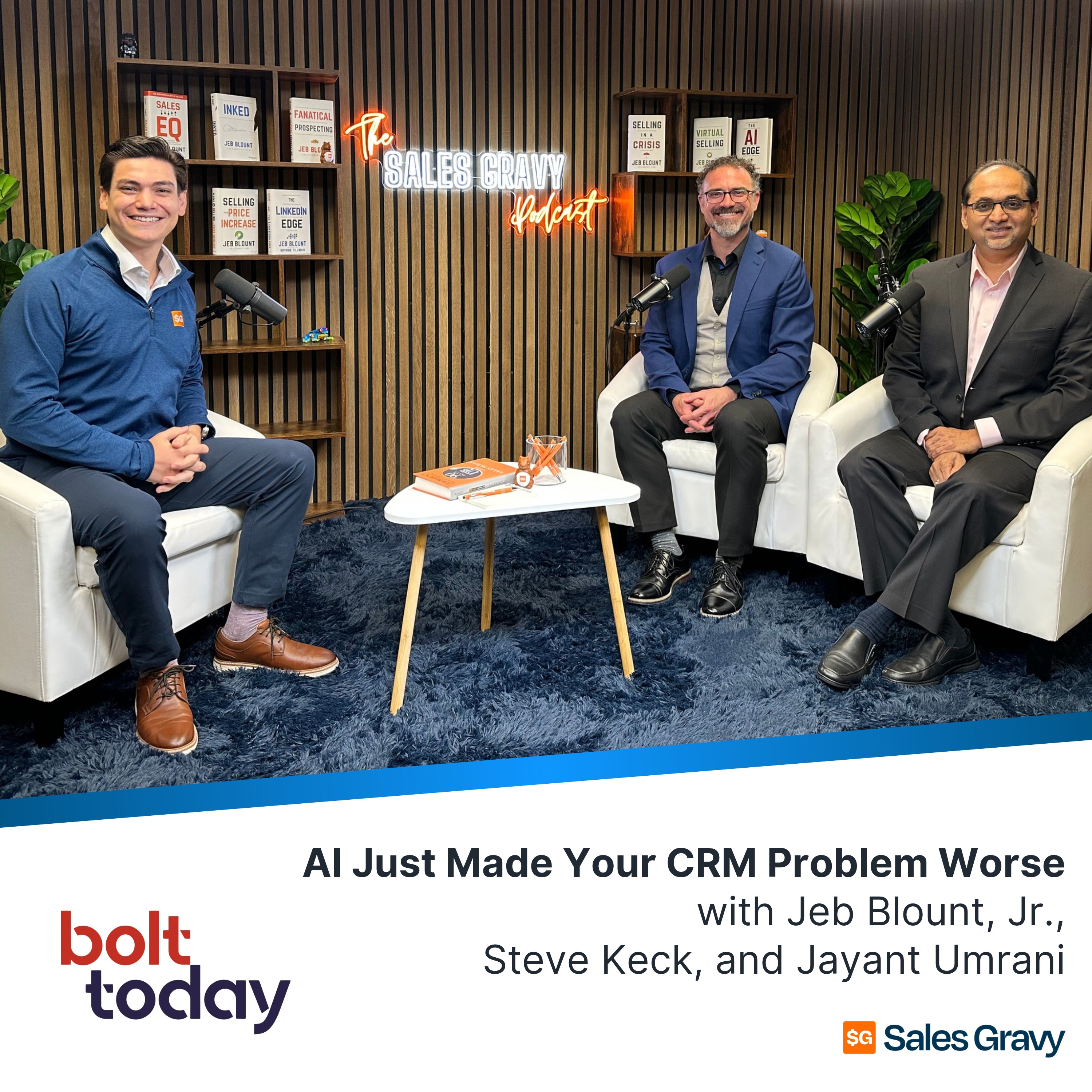
1:38Today's conversation is really exciting because we have our main stage outbound sponsor and a great partner of a sales gravy, Bolt.today. We've got the CEO, Mr. Jay Mroni, and our chief strategy officer at Bolt today, Steve Keck, who are joining us for a conversation of how can we optimize our CRMs so that salespeople can actually get back to doing what they do best, which is sell. Welcome to the podcast. Thank you so much for joining us here at Sales Baby Studios. Thanks for having me, sir. Yeah, great to be here. Jay, I wanted to start the conversation with what possessed you to start Bold today?
2:11What possessed you to start your own business and get your feet off the ground with a business that helps other sales organizations optimize their CRMs? That's a good question. And I think about it all the time that why did I jump into a entrepreneurship, which is the hardest thing to do on the planet Earth. But I come from a very technical background. And when I moved into sales, I realized that it was hard for me to use a CRM system, how hard it would be for the sales guys to use it. And then I went through the journey of building a$75 million Salesforce practice. And that is the time I realized that Salesforce is more designed for the managers to monitor what sales guys are doing.
2:50And it is not really optimized for the sales guy to sell faster. Yeah. And that was the light bulb saying that I can step out with my technical as well as now with my sales knowledge to make Salesforce work for salespeople. I'm going to ask you a quick follow up on that. You got into sales, you saw a problem and you dealt with CRM that sucked and you couldn't track anything. and you realized it was really not for you, it was for somebody else. And you didn't let that bone go. You started an entire business to$75 million to solve that issue. So what did you bring into the business that shakes your philosophy about how you go out into the market, given that you seem like someone who just doesn't let problems go?
3:32Being a technical person doing sales, I always wear the sales hat first. Being technologist at the heart, right? Technology is only an enabler. But many people think technology solves the problem. And that is where they go wrong. And that is the main differentiator that we bring to table when we connect with our customers. How can I really solve a problem rather than implement a technology? I want to highlight that as a core philosophy of the business I've seen and worked with on your side. And from all of the content that you guys put out, that's the core philosophy is you can't solve the problem with more technology.
4:08You guys actually simplify things. And you started this business how many years ago, Jay? This is the 10th year. When we did our 10th year celebration, I was like, oh, really? It has been 10 years? Going back 10 years and looking at what you're trying to get accomplished in 2027, 2028, and going into the next decade, what is your focus on? What is your vision for your organization? I think, see, technology has never caught up until today to truly help the sales guy. And if you know sales guys go around 8 to 10 tools to really even make a 50-minute call to the customer, right? We have all seen that.
4:43But today the technology has caught up to a level where we can bring the insights to the sales guy, you know, at a point of consumption. For example, a pre-meeting briefing in two minutes while they are driving to the customer site or want to get on a call. So the mission really stays the same saying that how do we help sales guys, you know, sell faster? How can they increase their deal velocity? So we always call know the deal, close the deal. I like that the mission stays the same, but the execution becomes even more important, especially as we step into an age where technology is really catching up with the sales profession in a way that makes it a lot easier to do a lot of things right, also makes it a lot easier to do a lot of things wrong.
5:24So we have also with us Mr. Steve Keck, who's Chief Strategy Officer at Bolt today. And you are doing a lot of implementing. and the conversations I've had with you are mind-blowing, a little technical for a simple sales guy. I want to maybe start with a little bit of your background. How did you end up meeting Jay and how did you end up getting into a bowl today? I'd love to hear that story first. It's rather comical. I met him at a technology event and using my sales skills, I sat next to a group of guys who had gray hair and not the young kids at the tech event. That allowed me to start a conversation with people who could buy.
5:55He started telling me about his practice and I was like, oh, that's great. I'm the lazy salesperson. and I don't want to give CRMs any data. That doesn't help me. But he had a really interesting philosophy about it, but he was up to the wire on a eight by 10 mailer. And I was like, you have a what? And he's like, I bought this eight by 10 mailer. It's going out to a bunch of people. I don't know how to put my business on it. And so I literally said, pay me a hundred bucks, meet me on Monday and we can give you your pitch and I'll get you. And 48 pages later, I was like, stop. stop. I got it. Let's do this.
6:27But as we kept going and he started to show me some of the amazing things he was building for salespeople, I was like, we have the same philosophy. Yeah. This is working. This is effectiveness. So we just kept working together throughout the pandemic. It's just grown from there. I remember when we met y 'all the first time, it did seem like you jumped in full heart of passion. And over the years that we've been in communication and I've just been around your circle and watch your content. What I've watched grow is, Steve, your involvement in the ultimate implementation of everything that your business does.
6:59And I asked you this question before we actually got onto the podcast, like, did y 'all start this together or who was first? And you went, oh, no, Jay was first. But honestly, it feels like both of you are in this completely 100 % at the same time, which is beautiful for a business partnership, especially if you guys are running a massive organization with lots of people, you guys have a really clear mission and your focus is on what bottlenecks an organization, what bottlenecks salespeople from getting things done. And you just mentioned that you were watching Jay build these amazing things to deliver to salespeople to sell faster because you experienced this yourself.
7:33What are some of the major bottlenecks that people are dealing with, especially at a leadership level, looking at their entire sales organization? So I would say today what's changed, partly because the sales process has changed, Buyer journey has changed since the pandemic. Everybody does a much more research on their own before they show up to a salesperson. Then on top of that, you added AI, which sends everything off at 200 miles an hour. So if you have what was typically forgotten, the big bottleneck is tech debt. It's forgotten behind all of the other things because it didn't really matter.
8:06Now you're trying to give access at hyperspeed to a bunch of garbage in your basement. And it's like, okay, now we have to figure this out. Because you can't implement effective support strategies, leveraging AI without clean data. And so we saw a lot of customers come around the circle of we need an AI strategy. Then they go, oh, we have to fix our, we have data hygiene problem. Our data sucks. Our systems are everywhere, right? None of it's working. And by the time we can even begin to get the initiative that the CEO is telling them, get an AI strategy for your sales team. Before they can even do that, they had to come around that circle.
8:40So we see that a lot that really when it comes down to workflows, they're not ready yet. A lot of customers run into this problem because from a VP of sales perspective, it seems like it should be easy. But then when you get through RevOps and look at the tech stack and then you look at the data, you're like, well, you know, you put five companies together and none of this data synced. And they're like, well, now you're going to try to do that at 200 miles an hour. You're going to crash. And so that's what we see a lot is I think the biggest bottleneck right now is getting the salespeople what they need and leveraging an AI capacity to build insights, improve workflows really is going to come down to how you design or redesign that tech stack to accommodate what's required to allow that kind of speed.
9:21Working in lots of different organizations. And honestly, my role at Sales Gravy has been to work with BDR and SDR teams. It's kind of my superpower. And I can get in those rooms and get people motivated and galvanized and getting on the phones. And here's the issue. Exactly what you're talking about. Most organizations that I walk into have a data issue. They're bloated. Their CRMs have 150 fields you could fill out on the left side of the screen. Because you have to scroll and scroll and scroll. And there are 500 fields on the page. and then sales guy doesn't know what to enter and guess what he does?
9:52Q, enter, Q, enter, Q, enter. Leave it all garbage data. And I do it too as a salesperson. You remember being a sales seat. If I saw 150 fields and I didn't know what to fill out, I needed to fill out two of them. I just click whatever was in there and just keep moving. If it wasn't helping me, I didn't care. Name, phone, or email. You'll know whether that's a partner, referral source, prospect, big prospect, little prospect, somebody you just met for lunch and turns out it's useless. And what does sales managers say? They go, hey, new salesperson, I don't know, go call them, figure it out. And you go, Hey, what are you?
10:23And they go, I'm a partner. And you go, great. Let's talk about partnership stuff. And then the salesperson gets off the phone and logs, none of the conversation. And two months later, there's a new person in the seat and they go, same thing. I see this happen a lot with the data bloat. There are companies that are starting to figure this out. And you guys have customers that are clearly implementing what your strategy is and moving beyond the problem of just data bloat and tech bloat and this bad systems and nothing syncing together. Maybe looking a little bit further ahead. So that's the main problem that is happening today.
10:52What are the future over the horizon benefits or challenges that companies are going to have to deal with in the age where people have pretty much figured out how to deal with their data and now they've got AI on top of it moving at 200 miles an hour? What are you forecasting in the next new, maybe 10 years or so as the marketplace changes? Once you start to get a sense of the core basic problem, are salespeople connected to the right people? Is go to market approaching the right people to send to the sales team? Are we capturing expansion opportunities on the success side? Do we have any visibility on that?
11:25Are we managing to it? So there's a lot of people processing technology. We always think of technologies at the end, right? How do you support the people in the process? And I don't think that's going to change. I think what's going to happen is it's going to reveal itself faster because you're going to see mistakes faster. As companies are growing, as companies are adopting new opportunities and trying to adapt to new markets, I still think that the core fundamentals, doing the right thing, teaching the right thing, making sure they're doing it, holding them accountable, helping them out, helping them move forward faster is the thing that's going to constantly run up because we went through what?
12:00There was on-prem systems, other SaaS systems, everybody moved to cloud. Now we're moving into an AI age. But at the same time, that's still not going to change the fact that someone has to be effective on the phone or has to be effective in person. I will tell you a very funny thing. And this has been going on in the market with AI, especially saying that there will be an AI sales, not a real person. Yeah, not a real person. And there will be an AI buyer and AI will be selling to AI, right? Looks funny on our side. And I don't think that's reality as well. There is some kind of truth in that, right?
12:31For example, when you're looking at discovery, discovery is a boring process. Suppose I'm buying something. I have to talk to five vendors. I have to do discovery with all five. I might use an AI there to help them discover. Similarly, if I'm a vendor supplying things, discovering problems with all customers is also painful. So I might have an AI who can help discovery. So AI to AI discovery might work to Steve's point. When it comes to actual sales process, I don't think those four fundamentals will ever change. I'm going to ask you a question because I want to understand why people choose Bolt and go with your philosophy in your business when there's probably, and in my estimation, thousands of companies that could potentially help you with this same challenge.
13:19So Jay, from your perspective, why do people choose to go with Bolt today and stay with your business when they have a CRM challenge, like tech bloat or data challenges, and they want to get that fixed and they are actually moving to make a difference in their business? Maybe three main reasons, right? One, we give very honest expertise. to table. Many times I've got into the conversations and I've told the customer, you don't need us. This is the way to fix it. You have this person, he can fix it for you. And a lot of times they like that rather than be creating business for them. Second, most important thing is we bring deep technical expertise to table, but you are not bound to the two people, three people working with you.
14:00There is a whole company behind you. Give you an example, integration expert that is required to come in for a couple of weeks to solve a problem, he will come in and go. You are not restricted to the knowledge of two people, three people working with you on the team. So that's the biggest difference people see with Bolt, saying that I'm not hiring two people from Bolt or not consulting with Bolt, I'm getting the entire expertise. And the third and most important thing is the flexibility that you can work with us. We work most of the time with outcome-based type of engagements, which a lot of services companies run away with, right?
14:31They don't want to commit. They say, oh, give me time and material, well, I will put the efforts where this goes. I don't care, right? We go the opposite way, right? Most of our business is SOW driven, milestone driven. So our billing is going to happen when the milestone reaches. So our skin is in the game. And that is, I think, the three main things I would say. That last point, really interesting. Being a business person and working with lots of companies, the ones that I trust the most are the ones who have skin in the game. And that's how we operate at Sales Gravy as well. Steve, from your side, maybe some examples of ways that you've helped companies be successful by choosing bulk today.
15:06What's a fun story that comes to mind that you'd like to share, especially when you're on sales call? I'd love to hear how you articulate the services and the solution you provide. So one other point to this, one of the reasons you asked why I got in this with Jay is the philosophy of helping salespeople execute comes down to, even in the way we execute, has to come through with results. And so that cohesion inside and out in the way we focus on execution was one of the things just like we're actually making some change that works. So when it comes to a couple of stories, we have one client, Jay had built these wireframes.
15:42So it's kind of a presentation layer. So you can do 80 % of your work on one page instead of all the tabs to get something done. So he built this unique process and we executed that with a client and their sales team. It was good. We did a full discovery, brought in a bunch of stuff. And two months later, their leader calls us and was like, you have no idea what you think. You guys have knocked 15 minutes off of every manager call with every salesperson. And I was like, okay, is that good? Basically, he had 400 salespeople. So when it came down to it, it was like a million dollars a week in sales time returned to their office because they don't have to spend time trying to figure out what's going on in their pipeline.
16:18They were having trouble finding deals, figuring out what their forecast could be, trying to navigate all that. And managers get back so much more time because they could just look, see, work on the same page, get it done, and give back time, effective sales time, and effective results going, hey, go to this field. Don't go to that one. Leave that one for next quarter. Push in this one. Let's figure out how to get other teams involved to get this thing closed. And so that was a huge win. We didn't, you know, we weren't actually focused on that outcome. We just knew it would happen. We didn't charge them enough.
16:47Yeah, we were seriously. Of course, I was like, wow, that means you need to write us a success check for half a million dollars. are calling us back when you need the next thing. Another client we had, one of the big focuses for us is quoting because it's very complex. There's a lot of things involved to get a good quote. Yeah, it makes sense, right? And this client, when they were trying to get a quote, they couldn't actually estimate profit margins because until the client actually starts to order, you don't actually see what the costs are. Yeah. So the CFO and leadership was this really couldn't quite figure out.
17:15So if you sold something at a 20 % discount, you really weren't sure until they started paying you whether you were getting a good profit or not. They couldn't navigate those deals, especially through the approval process. So what we actually created for them was a unique process that when they go through that approval process, they were able to visualize using the approval flow, just how much estimated profit based on activity that they would eventually consume. So if they said they'll order a hundred thousand, I ordered 10, right? Yeah. You've ever seen that? I've never had that happen. Never had that happen.
17:45We're going to get the big volume discount and you're like, So the finance and approval teams could actually see it. It would go directly to them and they could approve it and they could see the profit margin and then tightened up their profit margins on most of their deals to ensure more stable profitability. And that was a huge impact just by cutting, you know, kind of giving the visibility in the approval side that really changed the dynamic on the sales team because they're like, hey, you're going to have to raise this. You can't discount this much. What it helped clarify for the sales team was that, yeah, stay in these guardrails.
18:18And by doing that, the sales team got more effective, they better positioned themselves in the market, and the profit was much more manageable and forecastable. So going into a follow-up call, I want every important note right at my fingertips, not buried somewhere in a scribbled stack of notes. And with Plod Notepin S, I always have them because it's a wearable, portable note taker that lets me stay present and focused on customers during every single meeting. Plod captures the conversation and turns it into organized summaries and action items so I can follow up faster. And if I need a specific detail, Plod's recall has that ready for me.
18:51And that's why Jeb Sr. and I and all of Sales Gravy trusts our Plod Notepen S. Try Plod and stay focused on the conversation while it handles all of your notes. Go to plod.ai forward slash Jeb. That's plod.ai forward slash Jeb and use code JEB to get 10 % off your purchase. I love both of these stories because on the one side from the manager side, I mean, I bet that those leadership conversations just went so much better. The clarity in the message, clarity in the coaching, clarity in the pipeline review, not a bunch of clicking around and like half messages that get broken up because you have to flip through a bunch of tabs.
19:27And then on the second case, you know, if I'm thinking as a salesperson, I'm confident when I'm clear. If I know these are the rails that I have to run within and I can discount at 30 % and still make my number and like being a good spot. But if I discount 40%, I'm gonna be at the bottom of my rung. If I discount 45%, I'm not gonna get this deal approved because I have to sell both external and internal. You guys have made that a lot easier for folks. Jay, just some final thoughts on those two stories and maybe bring in some knowledge from all of the other projects you've done. Final button on why people choose Bolt.
19:56One very different story or experience I'll tell you is with some of our customers, right, even with vendors like Salesforce or Amazon, right, those guys have told them this is not possible. You can't do it. And my people have figured it out. It has happened multiple times. And that customer says, wow, you could do it. Yes, yes, right. We just did it, you know. And this experience that customers have happened is one truth. Why? If you see on our website, every customer's testimonial with their picture, with their LinkedIn is there. They're putting their name out there, right? You can click on that LinkedIn, message them and get the feedback.
20:33You don't even need us in the loop. And that is the honesty is what prospects see when they come to bold and say that, oh, what these people are saying is credibly out there. I can reach out and check myself. I don't even need to call that. Given the background that we've gotten about some of the customer experiences that you've had and what you've done for the marketplace, how you start to solve the problem, let's get a little bit deeper so that if I were a VP of sales and a sales leader, if you're listening to this conversation, You're like, okay, I hear what they're saying and there's a problem, but I don't have time to wrap my head around it.
21:06I'm not technical. I'm just trying to go sell a bunch of stuff. That's my job. But I know that our CRM is bloated and it's not working the way that we want it to. And yes, I got all these AI systems in the last five years, but they're not working. They're just there and we spend on them. You work with these folks all the time. What would your recommendations be for immediate action steps? And then maybe what should you go look for in the first place? So one of the things we tend to find early on, and it's in the discovery phase usually, or the pre-discovery phase, or just talking with them and then they're deciding whether we get to be in the discovery phase, is they have a big tech stack they've adopted and it's grown over time.
21:43And there's a tremendous amount of underutilization. A lot of systems can be doing half of the same things, like somebody bought it and left, and now they've got 10 % of it. I used to use this in banking. If you don't know where your finances are, you're unknown, you have a certain level of stress. But as soon as you find out, you feel less stress. But then once you build a plan, you feel less stress. And then once you execute on that plan, you start to see results and you feel less stress. So when it comes down to starting with this, you really don't have a known on what's possible with your current tech stack.
22:14You're not sure about what's best for the way you implement AI, whose AI you use, how you use it. You know, one of the interesting things is in all our conversations in the last year, we now have CISOs in the room and that has never happened before. You cannot get your tech stack realigned without a CISO looking at it because AI is now involved and you don't know where that data is going and the CISO gets a say. And that was a unique thing for us was like, oh, we have to sell food the CISO. We just add that to the mix, the stakeholders, because they could just walk in and kill the deal, especially if you're not considering security and other things like that.
22:47So I would say the best thing for a sales leader to consider aligning to the RevOps team and getting your systems know. Do we really know how we're utilizing all the technology? What are we actually trying to accomplish with all this data that we're getting from all these places? And part of that translates to how do we get the one page that a salesperson needs to just do their job? But if you figure that part out, usually with us, we can help you do that quickly. then you can go, okay, now I can start to understand where we are. I can sell that upstairs. I can start aligning to what means to be done and what's realistically going to be done, what sort of timeframes.
23:25And then you can build a plan. And that makes sense because as Jay said, we'll tell you, hey, you don't need this because you got it in your system. You already bought it. Why don't you just turn that on? And you're like, oh, we could do that? We bought that? Yeah, you bought that. Yeah. So you've been underutilizing these technologies. You could drop two of these or you know i'll tell you an example yeah i'm in a consulting engagement few weeks back we both right and same thing happened in the discovery we saw that customer success is implementing something which absolutely they don't need and they are already gone to phase one of implementation and when we saw the output of it and they themselves were saying we can't do this we can't do that and on the other side they already had invested almost half a million dollar in a system with all the tech stack they need, which just needs to be tuned for customer success instead of buying a new tool and implementing.
24:13We gave really an opinion saying that shut this project out. Here is where you will save half a million dollars, like now. And you have all the business funding now to really do what you really need to. Going back to like, you have to understand exactly what direction you're heading, what the mission of a sales professional is within your organization, whatever that looks like. What are some of the questions you might be asking, Jay, as CEO to get your VP of sales aligned so that they can go tackle this problem. And then when they get with Steve, the questions are more about what are we going to do, not what is happening?
24:48I think the first question is to understand what is your buyer's journey instead of your selling journey, you know, because that is where people most of the time make a mistake. They do not align their sales process to the buying process. So that's the first question I ask you. How is your customer buying? Do you know that today? AI is still changing. COVID, it changed a lot. Now AI is changing tremendously. Nobody is even coming to your website. They are asking chat GPT about you. And if you are not there, you are not there, right? That is the first question. The second most important question is, do you have a mechanism to find out or identify the microbiome signals your buyer is giving you?
25:24And how do you identify that is from the questions they are asking. They are never going to tell you, right? If they are asking a question about a feature, they want the moon, right? they're in the initial phase but moment they move to a question of pricing they're trying to figure out oh I need all of this what is is it in my budget right so they've moved on in their buying journey right don't sell features at that point because they're talking something else to you you know that is the discovery so first question is do you know your buying journey second question is can you identify the micro buying signals your customer is giving it to you and is it documented can I see it in your sales process right in your sales process show me where you're really putting this buying signal identifying and putting there, right?
26:05And third and most important thing is, have you really figured out all the stakeholders that are required to make this deal happen? Because a new stakeholder coming in is where the deal slips. So what is the buying committee? Have you mapped them? We're going to see someone on that. CISO shows up unannounced into your Teams call and you're like, who's this guy? And he's like, oh, what about this? Ask 10 questions and then... No, but see, important point is he might shut down your deal offline. He will never come in front of you These people go there and he says, no, no, no, this is not happening.
26:35And then the customer goes to see. And you say, oh, no, I don't know why the customer is not picking up my phone. But I love those three areas that you've outlined. So if we look at where people make mistakes, it's in understanding the buying journey, which has changed because AI has changed how people go to market and how they search for things and the micro buying signals that they give us. And then who is in the room that we need to be aware of. So in the sales process, we can align everything to that. Steve, I want to go back to you here from a technical side. How does Bolt start to actualize the conversations that a C-suite is having or a VP-level organization tier is having in the boardroom where they're trying to figure out all these questions?
27:14Say they get them answered and they've got those answers for you. They're like, hey, this is what we want to do. Here's who we're selling to. Here are the micro buying signals. Our CRM doesn't do this. We will help you understand, find the right systems. You know, sometimes that's within the CRM and a capability you haven't unlocked or custom configured. Sometimes it's in different technology. Yeah. Sometimes it's created technology. At this point, it's all sort of open in the air. We are seeing customers balance the idea of the cost of SaaS has gotten so out of line because everybody bought a bunch of stuff in the pandemic.
27:48And now everybody has to be online. Now we live that way, right? And now we're like, okay, do we really need all these things? Yeah. And so what we're finding is a lot of clients are really starting to try to get their arms around the idea of getting systems to work like a chassis, not trying to buy the whole car. I don't need all these things. Or do I need all these things? Or can I take a different door and put it on there and build a different type of car so it can be more effective? One of the things that Jay and I both sort of intrinsically understand is that the frontline adoption equals executive insight.
28:18So if you can get the frontline, you get your BDRs, your SDRs, your go-to-market teams, getting the right data in, hashing the right data all the way through the A in sale. And those frontline teams, if they put in the right data, upstairs can get all the information they need to make better decisions. So for us, if you're going to give us an executive plan, we're going back to the buyer journey. Because if we can get that right, this reveals itself. It will be revealed in how are you going to get that by solving it for this team. We've just seen time and time again that once we help them do that, they start to see what they're looking for.
28:54They start to get to make the decisions they need to, and they can be more adaptable from the top down. Huge impact on an organization. And I know this to be true for a friend because, you know, my friend has a CRM in a business that's a lot of consulting work. They're pretty good at what they do. And that friend is constantly frustrated with the big friction between the front end teams and the executive leadership decisions where the data just isn't there. And getting people to put in the right data is its own challenge. But ultimately, the system isn't set up for success. And therefore, both teams are suffering.
29:26Jay, I know you want to talk about AI. And you brought up a really good point here that since 2020, people have attached and hammered on and nailed with and duct taped a bunch of AI systems into a database infrastructure that is already failing on its own. And there's companies that are dialers and are outbound information machines. And then there's companies that are bringing in more data to the CRM. And then those CRMs are attached to ERP systems and they're attached to, you know, payment systems. They're attached to accounting and they've got all this stuff that just feels like an octopus. And you're just trying to get people to go sell more.
30:00So Jay, from an AI perspective, what are you seeing in the marketplace? What should leaders be paying attention to? I know you're maybe looking at building chassis rather than buying an entire car. What are some of the conversations that you are bringing to the table that are changing the way people are looking at their business? I think what fundamentally had changed with AI, and people say these words, right? Like SaaS is dead. We hear it all the time. But what fundamentally had changed, if you really open the hood and see, what does that really mean? I didn't hear many of my customers saying, I want to get rid of Salesforce.
30:33Nobody said that. Because yes, it is important. Like, I don't want to get rid of SAP. I don't want to get rid of NetSuite, right? I need these systems, right? Because they help me with system of record, with compliance and a lot of stuff, right? And that is where to Steve's point, it is a chassis. I need that as an infrastructure. I need it, right? But above that, things have significantly changed with AI. I don't need to now keep buying software over software over software, which has happened with the SaaS world. And that is where the bloated tech stack comes in. I can now get rid of all of that and really put in a revenue intelligence AI platform on top of it, which can connect to these infrastructure or enterprise applications, as we call it.
31:15They are thick enterprise applications interwoven into your systems. They have good processes, good data models, good security on them. We need them because you know if you make AI lose without security, what can happen? But at the same time, how they should think different to you to answer your question is they should not think in a SaaS way, which we are very programmed to think for the last 50, 20 years. We should think from a solution way. And that is why when they say SaaS is dead, on the other side, the real answer is software is the new services. That's what it is really. To give an example, how we are changing, like we were higher proponent of saying that you need to buy these five things on top of Salesforce to make your thing work.
31:58Now we say it a little differently. We say that you need this chassis, but you need to really implement this AI infrastructure on top of it to get it done. And with AI, what has happened is everybody jumped in. It was like when iPhone came in, right? It was first adopted by the B2C buyer and then enterprises adopted it because everybody wanted an iPhone type experience in the enterprise. That's how exactly happened, right? Similarly, it's happening with AI. AI jumped in a chat GPT where I got access to it and now I'm saying I want it for my business, right? Where the fundamental difference is that if you are going to do B2C type of experience in a B2B world, then you are going to have a lot of agent sprawl as they call it.
32:39And then you are going to get confused as you were confused with SaaS products. Now you're going to get confused with AI agents. Yeah. Where do I go for what? Right? Lastly, I will say concluding to the answer to your question, they need to think of having an AI layer, but it needs to be one governed AI system. And I call it governed because it has to be SISO approved. AI is working with your data. And now information is no more the currency. Data is the currency in the AI world. AI sprawl. I just want to liken this to urban sprawl. If you go to Los Angeles, for example, I was born there in Santa Clarita.
33:12And it takes four hours to get from Santa Clarita, which is about, I don't know, 10 miles from city center of Los Angeles. It takes about 14 hours to get from Los Angeles to Los Angeles because it is huge. It is really difficult to navigate that city. There's so much urban sprawl. And if you think about that in a business perspective, you're going to have AI agents literally everywhere. And what are salespeople going to do? Your computer has a co-pilot. You turn it on and all of a sudden you've accessed all your systems. You get Gong and then they turn on your AI, HubSpot. They turn on your AI and you're like, what are you doing with it?
33:46What is it for? How is it helping me? All of a sudden, you've got all of that. And then you add 13 systems and you're like, everybody wants to offer it. Some turn them on. And then you find out they turned it on. And you're like, did I just lose all of my customer data to your company to be trained? Or did I lose my process? So if you're using Cloud, we worry about like, it may not be giving your data away, but it might be giving your process as a really good idea to your competitor and you don't know. And so when you're thinking through this, like everybody's trying to get in there, but God bless the CISOs that happen to figure out, you know, when everything turns on and your marketing team turns on three AIs because they were just excited.
34:24I think I'll give you an example of what you're saying. One of my customers was saying, I need to put a business case in front of my board. Would you help me with that? And in that day, there were three products. I'll not take the names, but there were three products to be compared, right? One of them was our revenue IQ, the intelligence layer we talk about was there. And when I wanted to compare with other two, I did exactly what Steve said. I went to Claude and I asked, tell me this vendor I want to compare, how do they position themselves? Where are their differentiators and where are not? And the kind of information I got, which I could have never gotten by searching Google the old way.
35:00Guess why? Because that company is heavily using Claude. even though Claude has signed a contract with them that your data will not be used to train my model, which might be true, but the intelligence that company had is all over the place now. The process can be offered to a sales training company as an idea or some unique thing that you have that you didn't realize. I ask what is the source always to AI. AI is notorious. It can find one article, small article written by two people company and might bring it up. So you have to ask a source, right? and tell what is the credible source. In the source, it will give you that document, which might be an internal document of that company, which not a sign they will not use, but now I have access to it.
35:44Holy cow. That's why when you're thinking about AI sprawl, this is why everyone's sort of struggling how to get that on top of just trying to execute better. It's a whole other mess, which is why it's taking everybody sort of like trying to get their arms around this new idea, but it's moving so fast that you can't even learn it fast enough to be able to get ahead of it. And then all of a sudden, your VP of sales is like, I need you to execute better. And you're like, well, yeah, but I got six AIs. Which one do I actually use and how do I do it? Well, that's on top of the 20 systems you make. You know what, boss?
36:14I'll just create my own. I'll tell you the analogy is as every sales guy had or has his own Excel file, which he never tells anybody. Right? Similarly, they have their own AI now, which they don't tell anybody. It's interesting if you look at AI models, I mean, from a B2C perspective, like the way that you interact with AI is a thumbprint of you, sir. It's not a thumbprint of how salespeople do it. It's how Steve does it, how I think and solve problems. It's really interesting how that gets siloed because we all have our own little models. Maybe I want to go back to this tempering of our decision-making about AI at a leadership level.
36:48So Steve, we'll start with you. You have, I think, the two sides of business, which are the revenue folks, like VPs of sales who are saying, hey, go execute better. I've got a number. I'm going to go hit that number. Here's a bunch of solutions. I don't know if they all work, but figure them out. And your goal is to go win more. And then you've got a CISO on the other side or somebody on the operations department who says, hey, all of this information could just potentially get out there in the marketplace. And we have to make prudent decisions about what our AI stack looks like. And there's got to be some middle ground where a VP of sales is like, hey, I need to go execute.
37:20So I'm going to start turning some stuff on. And a CISO has to say, all right, I'll let a couple of things go. Where do you guys see the conversations going for these two sides of the business so that they can eventually execute with AI, but not burn the whole house out of doing so? Two things. The first thing is from the executive level, from the CISO level, every company has a formulation or an intent on a plan for an AI strategy and security posture. They all have that or they're all leaning towards it and they all know they need it. How far along they are is all over the place. There are people who are paying$5 million to bring it all in-house for chips and doing all this stuff.
37:54If we met a client that literally built it themselves, but it made sense because they use terabytes of data. Don't really need to try to use outside systems, right? Makes sense. But it took them 18 months. Well, now everybody has access and now they can start to build the things, the applications, the agentic interfaces that allow you to get more out of that data and figure out new ways to use that. That doesn't change. And you can't just wait as a VP of sales for that. So there's this, you know, this uneven balance or tension that you have that's happening right now with that. Where I think a lot of the advantages and one of the things we bring to the table is we have really leaned into secure AI in a way that honestly we can get CISO approved in 20 minutes, which is I've never seen.
38:41Literally showed it to them. They went, yes. And we got them moving. We started to think through a lot of clients, VPs of sales typically need to solve a big problem. And this is a lot of reasons. One of the reasons people come to us is when they come to us with the biggest problem. I have this big quoting problem. I have this big thing. It's like, fix this giant complex thing. My team can't deal with. We're too busy running. I have too small of a staff. We can't get our heads around it. Yeah. That's where we come in and help them break through those bottlenecks and those hurdles and that inflection point, so to speak.
39:12And in that, we have started building what they need with secure AI. This is this revenue IQ we're talking about. Like we build things that are specifically helping you get through the main problem, forecasting, pipeline, coaching. How do we align your sales training to what's happening on the ground? Is it actually being implemented or was it just something we all did? And then we have a notebook that sits in the back and never gets executed, which never happens ever. They always just jump. Not just one. Yeah. So at least four. So with that, what we really help them do is giving them access to be able to start to figure out and test it in a way that's secure.
39:48Yeah. That makes everyone safe. while they're adopting a larger security posture and getting through that larger strategy. But you have to solve one problem in front of them. And it's usually around, I can't do this one thing, or this is the main pain that's making my deal slow down. Yeah, incredible work you guys are doing. And genuinely, I'm trying to wrap my own head around all of these challenges you guys are solving. Steve, in a passing conversation, you were connecting some dots for a customer or a prospect, but you're building this on your own and you shared it with me and I could not exactly understand it in the call, but I knew that you had told me something revolutionary.
40:25It's been on my heart ever since. And I thought this would be a good place for you to share what you've been working on. I have wanted to do this for almost 30 years. Once I got into LinkedIn back in the day when you had maybe 500 connections, I was building a local network of people who solve problems and refer me to this. And I had to learn who was good, who wasn't. You have to figure out which ones are good champions, which ones are effective champions, which ones are not. You might have really, you know, we're talking about a really good advocate who may not be a really good effective champion because they can't move the needle.
40:57Whereas somebody you barely hear from, every time they call, they send you a closed deal. Yeah. Right. So I have always wanted to figure out how to track that. So I know who I should be connecting to to keep that pipeline working. And in my first career in banking, it took me 10 years to build a network where the most important thing I did as a salesperson was receive an email because I had trained an entire community of people who are out there hunting for their thing, who would then recognize an opportunity for me and knew how to sell me. And then they would refer me and the client was ready to talk.
41:27And I had a 60 % close rate, but it took 10 years to build that. Once we kind of got into this AI world, I started to realize that we could activate this in such a way where I could look at my entire CRM and the relationships, partnerships, all these outside networks that I have and relationships. And then I can start to figure out how I need to connect with them. How do I activate them? Which way should I connect with them? Do I text that guy? Do I call you? Do I send me a LinkedIn message? Which way you respond to? How long has it been since I responded? And then creating like a spider web where it's like the closer you are to the center is a higher value relationship.
42:01So if Jeb, if you referred me to a client and we did a million dollars worth of business, you're a million dollar relationship. I want to make sure I remember that. How much energy am I going to give to find a client for you? Yeah. If I remember that. And so helping me understand, okay, this is the network of this relationship. This person referred me to this person. This person referred me to that event. That event translated into, I went to outbound and outbound translated into an opportunity. that opportunity turned into half a million dollars worth of work. Outbound gets a lot of help. That's how I think about it.
42:29And how will we divert our money, energy, and time to make sure that we are creating the value for the people giving us the value. Huge. And I think tying that together, one of the things that Jay built within Salesforce is your stakeholder buying committee, seeing who to talk to and how well they're communicating with you. Was tracking those things taught me. It was like, oh, well, that's exactly what I need for my follow-ups, my network. But I'll tell you one funny story. Early days of our business, we used to sit in the room, a co-working space, right? And I used to be stressed. I said, what happened?
43:00I said, we don't have any new customers, right? We're not getting any calls. And he said, go home, call your five friends. Text five friends every Monday. He'd go play tennis. Tennis is the most valuable thing he had done in years. He'd go play tennis and he'd stay next to a CTO. And then that guy gets a new job. And then he calls us with a new text back. Jay, given the conversation that we just have, which is mind blowing about where you spend your time as a salesperson, this person's a million dollar relationship. Maybe they only call you once a year, but they give you a million dollars, but you haven't been spending time with them because the salesperson, I'm myopic on what's in front of me.
43:33So, you know, Steve is a really good sales guy, except he doesn't bring me money, but he loves to talk to me. And I love the conversations we have. So I spend a lot of time with Steve, but he's not bringing me a ton of revenue. Whereas John over here brings me a million dollars and we'll talk to him once a year. I'm blind unless your system might be in place in my organization. But this doesn't just inform individual salespeople. This informs an entire business. So as a CEO, you mentioned events like Outbound Conference, which you guys are sponsoring and going to be a part of. How do you see that affecting the leadership level, making decisions about where their budgets allocated for go-to-market motions?
44:09Everybody, maybe starting COVID, are struggling with the go-to-market piece of it, right? And especially on the top of the funnel. How do we bring leads together? Then how do you find to the funnel is a second problem. But the first problem is how do you get people in your funnel? I think that is where most of the people are struggling. And that is, I think, where we found a lot of value without bound. This might be a very funny thing to say on this podcast. But first time when I came to your conference, okay, I was honestly scared of Senior Jeff. That he should not call me on the stage. because he calls you on the stage and he asks you to pitch and then he says your thing 10 times better in front of you it's like what is this guy I paid money to come here and get chastised on stage yeah and today I'm here sitting here right jointly going to be on the stage with him the huge journey right and that journey was only possible because I think first time I came to Outbound and I learned and personally as a CEO I've learned tremendous things right Learning is an everyday thing.
45:16I always say that if you have not learned anything today, you have wasted your day. And so that is the most important part of what Outbound brings. Where we do connect really well is your sales methodology is extremely good in terms of telling the sales. Because what is the one thing sales guy is really scared about? Just one thing, if you want to say. What he doesn't know is blind coroner. Because the moment he knows it, he's a hustler. He will get it done. But what he doesn't know is he's scared of you. what surprise am I going to get from my customer? Right. And you guys unveil that. You guys make him understand that.
45:50Where is the second part of the problem is how do you operationalize it and make it a system? And that's why technology is after people in process. Yeah. So you get the right people, train them in the right way, then you support them with the technology. And then, you know, at some point you can start to move the technology to create and improve that process. But it's still a general process of how do I connect with people? How do I deal with obstacles? How do I get people moving through a process? Technology just needs to support that. I love that we're bringing you guys to Outbound as a main stage sponsor this year.
46:22You're going to be kicking off the event. And again, we're going to be in Las Vegas. The biggest, baddest event in sales is a pure learning conference. And one of the things that people are going to have questions about Bolt today at the conference is, OK, I love this. I think that Steve's idea of a channel matrix and understanding where your money is going to go and also building the chassis and maybe understanding a governing AI system, all of that. I want a thumbs up. My CISO says thumbs up to it. But I have, I don't know, 3 ,000 people in my organization or 100 people or two people in my organization that have to know that this is coming down the pipeline.
46:54Otherwise, they're going to be just as lost in this new system as they were in the last system, even though it's the Apple experience. It's the easy experience. Steve, I'll start with you. And then Jay, I want you to answer this as well. How might you as a leader start to prepare the organization for a project that you and Bolt are going to be working on to improve the execution of the go-to-market motion for a team. We're passionate about frontline adoption. So we also understand that salespeople are just, they're not going to give up their sell sheet if they don't feel like they're sick. So there's a lot of people with AI is like, let's just give them a chat screen.
47:27And then they just talk and they don't even know what to ask. And if they're asking the wrong questions, this becomes useless. And then what do they do? They go back to the Excel sheet. When we think about how we're creating opportunities, creating design systems, redesigning systems, and then leveraging an AI on top of it, We think about how do we put it in such a place, in such a way where you can see it side by side so that when you begin the interface over here in a new way, you can prove it over here. Because deterministic data, when it comes to quotes, when it comes to finance, they don't like you just predicting like chat.
47:56If you could ask the question three times and get three different answers, it is not a pipeline. That is a guess. And that sounds like your new SDR just came up with a pipeline. Right. And that's not true. So we understand that you've got to see it and the salespeople have to live with it. So we actually often talk about like having almost a six month adoption process where they can see it side by side. A select group goes through the process, roll it out to 20 top guys. You know, we're going to adapt to it. They're going to give it a shot. They're going to give you a lot of feedback. You help us refine and fine tune the system to get what they really need.
48:29Because we often require to talk to those folks up front in discovery, which is not always the case. You usually talk to executives. Deloitte will talk to executives. We'll talk to the frontline sales teams. But when they get involved and they start to do it, they start to teach down the path. Yeah. Yeah. It works like this. Go to this person. They'll need to come to us. They go to the people who are actually using it. And they get to see it because you can run parallelly in a lot of these things so that you can effectively learn how to adopt it. And then you just figure out whether you need to turn one off.
48:55Running parallel, having conversations with the frontline, especially as an executive, like maybe Bolt today in the experience I've had with y 'all and the conversations I've had is that teacher, that hand holder, that, hey, executive, we're going to go down to the front line and see what's happening. Come with us and just observe, because this is how it connects to your world and how you make decisions. Jay, from your perspective, what are some pre-operation procedures that an executive team could put in place with you involved that would smooth the rollout, the acclimation of the sales team to a new system?
49:30So I think what we do with our customers. We call it proof of value. It is not a proof of concept. Concept is already proven. AI works, right? But what is the value of that to me? That matters. I know ChatGPT and Claude and everything works, but it has to work for me. So we call it proof of value. To answer your question in the process, what we say is when we show, right, like our revenue IQ, co-presenting it with one of our customers on the stage and customers get excited, say, no, I want this, right they get that iphone moment you know i want that right when steve job first time showed the iphone the process we follow is we say give us your sandbox and your environment in a week we will put it there we don't need more time in a week we will put there and from there to steve's point that is where you start your proof of value with 10 people 20 people 100 people based on the size of your company run this in parallel to your existing system and you will see how better this is, right?
50:28And how adoption starts increasing here, right? Because this is an AI native system. See, the fundamental difference is today's systems are cloud native, right? They are not AI native. Everybody is trying to banded AI on top of it. That's where co-pilots came in. What we built is an AI native system and you'll see that difference when you parallelly run it. And that is the process we ask everybody to follow through. Whether you run proof of value for four weeks, six weeks, eight weeks, or six months, depend upon the complexity of your business. Some customers have gone live within four or five weeks, right?
50:59Some customers are taking crawl, walk, run strategy because they are scared of replacing the whole of their revenue system and some of the tools in the revenue stack because adoption is high, right? People have been using, they're used to it, right? Change management is the biggest problem. We've really got to give them a chance to see that they're actually making more money over here using this because they're getting faster deals. Huge. Yeah. And if they can't see it, Because it's all about accelerating deal velocity. Bottom line metrics is that, right? Everything else, I call it vanilla metrics.
51:29What is the real metrics for a sales guy? Can I close the deal faster? Yeah. That is, I think, where the value lies. This conversation is incredible. We haven't even scratched the surface on a million topics. What I appreciate most about Bolts today and your team and your philosophy is that you speak sales language. You don't speak technology and sell technology as a solution over and over and over again in the conversation, how you guys go to market. It is a people process and then technology solution. And that means that when we bring you to Outbound, the reason we partnered so well is that you speak sales language and then you add your solutions to that whole process.
52:08And I love that very much. But you're going to be at Outbound on the stage, Jay, kicking everything off. You're going to have a little booth there as well so people can have conversations with you. I want to ask you, what do you want people to get most out of their conversations with you at Outbound? I want them to feel empowered that they can really harness what they have and start to infuse what they're learning. Because those two can coexist and be reflected in your technology at a faster rate than ever before. We kind of look at it like getting a proof of value by your SKO 2027. Like if we can actually show you something that you could show your sales team by your SKO next year, do you want to look at this?
52:44that would fundamentally shift the way they think about and the engagement. The problem with tech stack bloating, it's sales engagement. How much energy do I have to spend not doing the things that are going to help me grow? If I've got to put in a bunch of data, right? Or if I'm not getting data out of it, that affects your turnover. That affects your sales performance. How much enthusiasm are they going to put into a complex deal? That might be a little squirrely at the beginning, but pay off at the end. If I've got tech stack that I'm going to be struggling with. And so when you think through a lot of what you can get is you can really start to attack other areas of your sales team.
53:18Turnover, engagement, activity, activation, adoption of new training, adoption of the systems, better data. If you can do all of those things, you really got to start to think about what's possible. If you can see that with us, we'd love to be able to help you with it because I've seen it. the things I've seen in the last year has fundamentally shifted my understanding of what's possible. Like my 30 year project, I have set on the sidelines and all of a sudden I saw in this year, I was like, wow, I can make that happen. Jay, you are going to be kicking everything off for us at Outbound Conference 2026 in Las Vegas.
53:51What do you want people to get out of Outbound from your perspective? And you've been to the conference many times, so I'm very excited to have you back. What do you hope people get out of the conference and then finish up with if they want to learn more or get the conversation started of before they get to Las Vegas, where can they find and connect with you all? I think one most important thing, what I got out of Outbound always, and which I want, maybe with AI, the possibilities are high, is the art of possibly. That is the most important. So most deep learning experience I myself experienced first time I was at Outbound.
54:24I think that, oh my God, I didn't even knew these things. Involuntarily, I was doing something which I felt is right, but it is really not. I'm hurting my own deal. So I want them to get that experience, number one, right? Second, with us, to Steve's point, I want them to see the art of possibility and maybe pick one or two of their pain points, which they would like to get it done by SKO, which will make them the hero, which will move the needle for them, right? That is what I would like them to get. Where can people connect with you or get the conversation started before they get down? There are a lot of ways to find us.
54:57I think they can find us. Our website is pretty simple. It is bolt.today. We can help you today. That was the concept we started with. So that is the best place they can find us. We are on LinkedIn, right? We run our own podcast, as you know. So we are on YouTube where they can find us. They can just simply send the email if they prefer to info at bolt.today. I would say LinkedIn is probably the fastest way for us. We live in the value network. Bolt.today, Jay and Steve, thank you so much for your time. Thanks for joining us on the Sales Review Podcast. And thank you for joining us at Outbound.
55:26We are going to have an amazing time at the Red Rocks Resort. This is going to be the best learning conference where you can put you and maybe even your whole sales team in front of the world's leading experts on breaking through buyer resistance in one single stage for an incredible week in Las Vegas. Go to outboundconference.com. Go get your tickets. Go connect with Bolt today beforehand if this conversation was interesting to you. And we'll catch you next time on the Sales Group Podcast.
56:10We'll see you next time.
56:28Menards. Plus check out our weekly flyer on Menards.com for all the great deals happening now. Save big money at Menards.
Your CRM was already a mess. Now every tool in your stack wants to switch on its own AI agent, and all of them are running on bad data. Jeb Blount Jr. sits down with Jayant Umrani and Steve Keck of Bolt.today to break down what CRM optimization looks like when AI moves this fast, and why the fix starts with the reps who actually use the system.
👉 Download our free 7 Steps to Building Effective Prospecting Sequences Guide
📖 Purchase Jeb Blount's book, 90 Days to Level Up Your Sales Skills
🎥 Watch the full video on YouTube