Ask ChatGPT


 Sales Gravy: Jeb Blount
28 Sep 2026 · 7m · 3 chapters
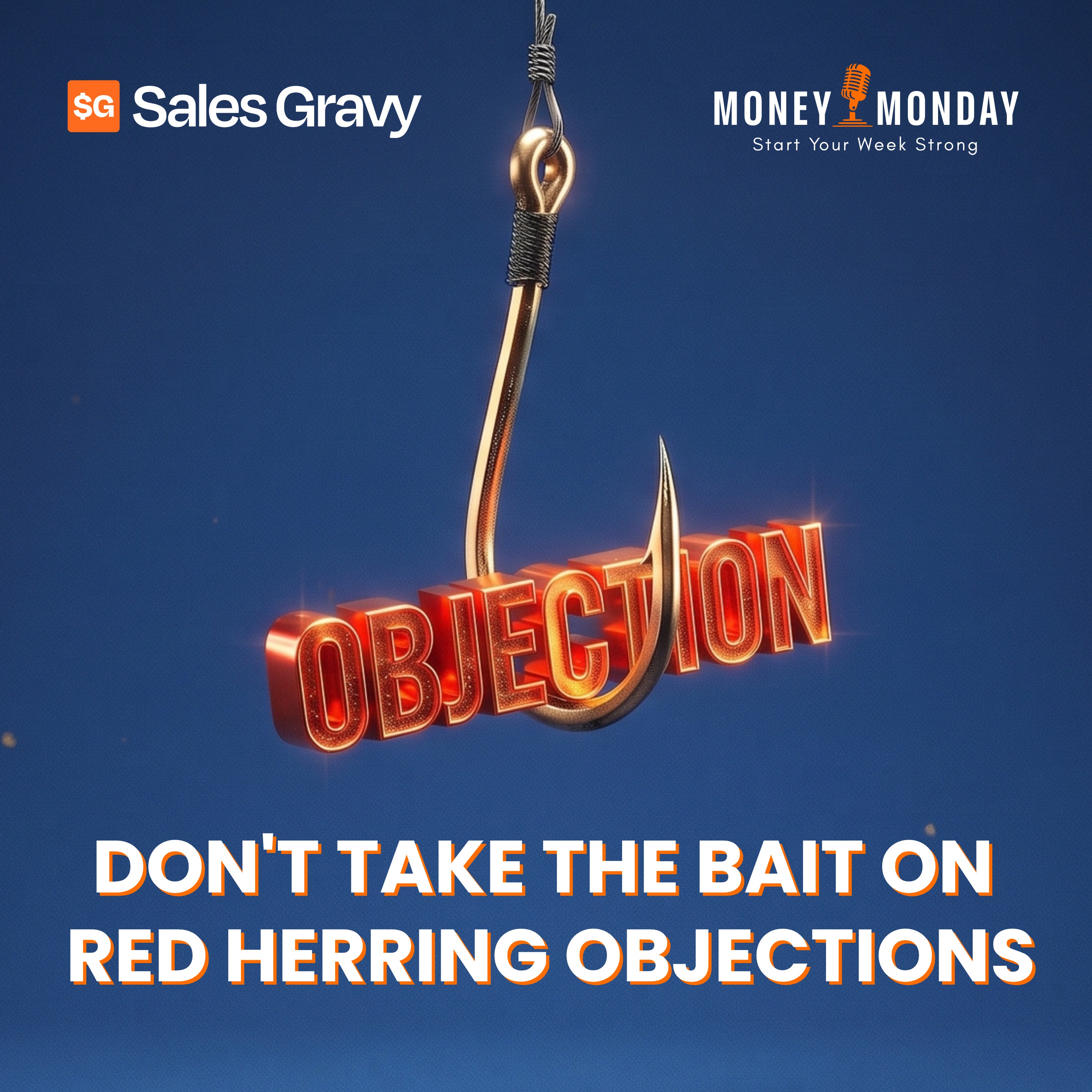
Money Monday episode “Don’t Take the Bait on Red Herring Objections” (Sales Gravy Podcast) explains how red herring objections derail sales calls when handled poorly. Key claim: red herrings divert attention from the meeting objective and can trigger defensiveness, arguments, skipped discovery, premature price talk, and even “ghost objections” being reintroduced later. Notable example: during a demo call, Derek (account executive) responded vaguely to a budget question about big-company pricing, became defensive, and the call unraveled into challenges about stability, references, and missing logos; Sales Gravy declined and ended the meeting.
none mentioned; host is Jeb Blunt, with Sales Gravy team members (e.g., Derek, VP of learning & development) referenced.
Written by AI. May contain mistakes.
Jeb shares a personal anecdote illustrating the impact of red herring objections on sales calls.
“And while you're there, check out Sales Gravy University and take one of our free courses.”
Explore the nature of red herring objections and the emotional barriers they create.
“The term red herring is thought to originate from the practice of dragging a dead fish across a trail to pull hounds off the scent.”
Learn strategies to manage red herring objections without losing control of the conversation.
“When red herrings are managed poorly, they become emotional hijackers that turn sales calls into train wrecks.”

Get the gist, explore an idea or ask about something said.
 Claude
On Sales Gravy: Jeb Blount, what are the key points of this episode?
Searching your listeningAutomatic transcript. May contain errors.
0:01To going into a follow-up call, I want every important note right at my fingertips, not buried somewhere in a scribbled stack of notes. And with Plod Notepin S, I always have them because it's a wearable, portable note taker that lets me stay present and focused on customers during every single meeting. Plod captures the conversation and turns it into organized summaries and action items so I can follow up faster. And if I need a specific detail, Plod's recall has that ready for me. And that's why Jeb Sr. and I and all of Sales Gravy trusts our Plod Notepin S. Try Plod and stay focused on the conversation while it handles all of your notes.
0:34Go to plod.ai forward slash Jeb. That's plod.ai forward slash Jeb and use code JEB to get 10 % off your purchase.
0:48This is Jeb Blunt and it's Money Monday on the Sales Gravy Podcast. Say, make money, money, make money, money, money. Make money, money, make money, money, money. Money makes the world go round. I'm the talk around town. Remy gave me the sound. On this episode, we're going to discuss red herring objections and how they can derail your sales call when handled poorly. Before we get started, though, two things. First, if you're looking for more free sales training advice, tips, tactics, techniques, go to salesgravy.com and click on sales articles. There you'll find videos, podcasts, articles from some of the top sales trainers in the entire world.
1:28And it's all free. Just go to salesgravy.com. That's salesgravy.com. And while you're there, check out Sales Gravy University and take one of our free courses. Next, I want you to go to Barnes & Noble or wherever books are sold and pick up a copy of my book, Objections. The book is storming the sales world. It became an instant bestseller the day that it came out. Go get Objections. It's one book that I promise will make you more money this year. On a recent morning, my executive team at Sales Gravy gathered in our conference room in front of a big wall-mounted flat screen TV. We were there for a video call and an online demo of a new software platform.
2:03After the basic introductions, Derek, who was our account executive, asked if we had any questions before he began the demo. I chimed in with the one question that we had not yet asked. Derek, before we get started, I think it's important for you to know that we're on a very tight budget. We aren't a big company, so we can't afford to pay what you're charging those big company logos that you have up on the screen right now. I was referring to the brag slide where he listed a who's who of his company's clients. I really don't want to waste your time if this is outside of our budget, so why don't you walk us through the costs we can expect?
2:37And then, bam, like a bass hitting allure, he took the bait and he ran. He stuttered through a vague and noncommittal answer that sounded really defensive. and that's when the demo and the sales call unraveled. My vice president of learning and development hit him with, we're going to need you to be more specific than that. It sounds like you aren't giving us the whole story. Then there was more stuttering and sputtering and Derek was talking in circles, sounding more defensive each time he opened his mouth. His defensiveness and argumentativeness served only to create more resistance with my team and they pushed him harder.
3:15It turned into a feeding frenzy. They challenged him about the stability of his company, getting references, why he wasn't showing his logos of companies that were our size, and on and on. He attempted to gain control and get back to the demo, but it was too late. By this time, we had become exasperated with his defensiveness and had lost trust, and we were bumping up against other scheduled meetings. So we politely declined and moved on with our day. See, Derek had blown it all on a red herring. In sales, you must avoid getting drawn in by red herring objections at all costs. A red herring is something your stakeholder says that diverts your attention from the objective of your sales meeting.
3:56The term red herring is thought to originate from the practice of dragging a dead fish across a trail to pull hounds off the scent. And this is exactly what happens to salespeople who abandon the objective of their sales call to chase a red herring. Rather than controlling the agenda and moving towards your targeted next step, you start pitching. You get defensive, you become impatient and talk over your prospect and shut them down, get into an argument, skip steps in the sales process, immediately start talking about price or negotiating, answer hard questions out of context and without clarifying the reason for the question in the first place, attempt to overcome objections before understanding whether they are real objections and before discovery.
4:38and you have the tendency to introduce objections that didn't originally exist. Red herring objections usually emerge in initial sales conversations, at the beginning of discovery meetings, at the start of demos and presentations, and during introductions when presenting to a group of stakeholders. And red herrings often seem innocuous, just simple statements or questions like, look, before we go any further, I need to know that you aren't too expensive. You need to know that we're not going to sign a long-term contract. Just so you know, we're not buying anything from you today. We tried this with your competitor before and it didn't work out.
5:15Why are your online reviews so bad? There are several things about your software that we don't like, so we're going to need you to add some features. We're already in discussions with your competitor. It's important to understand that stakeholders bring into sales conversations the emotional baggage accumulated over a lifetime of dealing with salespeople. They're suspicious of your motivations, don't trust you, and they don't want to be manipulated. Red herring objections are essentially emotional walls that stakeholders erect to protect themselves from being taken advantage of by you. And they're often part of a reflexive buyer script that just comes out of your buyer's mouth every time they deal with a salesperson.
5:56In some cases, though, red herrings are conscious and direct challenges designed to take you off your game and test your mettle. When red herrings are managed poorly, they become emotional hijackers that turn sales calls into train wrecks. When you face a red herring or get a direct challenge from a prospect early in the sales conversation, the key is to remain disciplined to rise above your disruptive emotions and manage your response. Instead of becoming defensive, argumentative, or angry, leverage a non-complementary behavior to flip the script. Respond in a relaxed, calm tone. Acknowledge the issue and take control of the conversation.
6:35But do not take the bait. With red herring objections, impulse control is a must and patience is a virtue. Most red herrings go away and never come back. As you get deeper into the sales process, the prospect engages and trust deepens. And one final note, it's critical that later in the sales conversation, especially in moments of insecurity or when you're asking for buying commitments, that you don't dredge these red herrings back up and remind stakeholders of ghost objections that have long been forgotten. When it comes to your business, you want cards and tools you can trust. Amex Corporate helps put you in control.
7:12Set custom spend parameters to fit your business needs and quickly issue unlimited corporate cashback cards. All backed by best-in-class fraud protection and the powerful backing of American Express. Get started at go.amex slash amexcorporate. Terms apply.
7:47That's why I brought my little scraper.
Red herring objections are a buyer’s emotional self-protection and can derail a sales call fast. But you can break through them with the right approach. Jeb Blount shares a firsthand example from a software demo his own executive team sat through, showing exactly how a rep got baited into a defensive spiral that killed the deal. Jeb explains that most red herrings are built from a lifetime of bad experiences with salespeople and don’t always signal a deal-breaker. He lays out the discipline required to acknowledge these objections calmly, hold the agenda, and keep the sales conversation moving toward its actual objective.
📖 Purchase Jeb Blount's book, Objections: The Ultimate Guide for Mastering the Art and Science of Getting Past No
👉 Download the free Objections Book Club Guide for Sales Teams