Ask ChatGPT

 Sales Gravy: Jeb Blount
21 Aug 2026 · 25m · 11 chapters
Buyer-language alignment for B2B account-based marketing/engagement (ABM/ABE) in “noisy” markets; why teams must build messaging from the buyer’s actual language, not add a few keywords or “frosting” to product messaging.
marketing, sales, and product often say different things, creating noise; ABM/ABE only works when marketing and sales are synchronized on what buyers want to hear; personas and call recordings should capture full conversations and exact wording; listening must be “to listen,” not to respond; strategy should define the conversation/outcomes, while tactics follow.
buyer-focused value propositions start with 1–2 buyer-language sentences (not “I/we/your company”); “baking the cake” from buyer language vs scotch-taping openers; competitor messaging scans (about ~10 competitors) to find gaps and what not to say.
Lisa Dennis, marketing/ABM/ABE specialist and author of a book coming out this fall; Jeb Blount (hosted by Ashley Blunt) is referenced as a sales author/trainer.
Written by AI. May contain mistakes.
Discussion on the importance of aligning sales and marketing messaging to the buyer's language.
“Lisa came to our studio earlier in 2025, and I did not have the pleasure of meeting you then.”
Exploration of how understanding buyer personas can enhance communication.
“Well, I think it starts at the value proposition side.”
Analyzing the costs associated with not speaking the buyer's language effectively.
“And you know, what's interesting is the sales training that we deliver here.”
How the pandemic changed approaches to account-based marketing and communication.
“And so, of course, I was looking at, you know, trying to figure out how can I pull more opportunity.”
Emphasizing the need for messaging that prioritizes the buyer's perspective.
“And we have a little tiny bit of French, but not a lot.”
Discussing the disconnect between strategy and tactics in marketing and sales.
“How does buyer language or the lack of it make or break account based strategies?”
Learn how aligning content with buyer language can enhance communication.
“a language engine that we all understand.”
Understand the distinction between strategy and tactics in sales.
“by default because nobody else is going to talk like that.”
Discover how to merge insights from sales and marketing for better strategies.
“But I feel like we get some respect a little too granular.”
Explore the critical skill of listening and its impact on sales success.
“And you mix those together, which is a really soupy thing.”
Learn about the idea of a language engine in sales and marketing.
“And especially if you have like longer sales cycles, depending on who your client is, the size of the business, that's absolutely necessary to make it successful.”

Get the gist, explore an idea or ask about something said.
 Claude
On Sales Gravy: Jeb Blount, what are the key points of this episode?
Searching your listeningAutomatic transcript. May contain errors.
0:00Your business is our business. Now with Amex Corporate, get 24-7 expertise on demand for your business powered by smarter technology. All backed by the power of American Express. Get started at go.amex slash Amex Corporate. Terms apply. This is the Sales Gravy Podcast. Hi, I'm Jeb Blount, best-selling author, fanatical prospecting, objection, sales EQ, and inked. And I'm here to help you open more doors, close bigger deals, and rock your commission check. Welcome to the Sales Gravy Podcast. I'm your host, Ashley Blunt. And today we're here with Lisa Dennis to talk more about account-based marketing and her new book that'll be coming out this fall.
0:38I'm really happy to be here. Thank you. It's an absolute pleasure to meet you as well. I'm excited that I got to meet you this time. So for those that don't know, Lisa came to our studio earlier in 2025, and I did not have the pleasure of meeting you then. So this is exciting to have you here and have you back on the podcast again. Thank you. Well, we'll jump right in. So my first question for you, your new book that's coming out, it's about speaking the buyer language. And I don't think this gets talked about enough across marketing, across sales. It's just not a topic that comes up. We focus on messaging, but not necessarily the right messaging.
1:16So my first question for you, talking about speaking buyer as a language shift and not a copy or messaging tweak, what do most sales and marketing teams misunderstand about this? And why does it matter so much? I actually think it goes beyond just marketing and sales. I think one of the biggest problems and challenges in B2B content, period, is that everybody's saying something different. Marketing says this. Sales says that. the product team says something entirely different and the buyer, all they hear is noise. As a content producer myself and as a marketer myself and as a seller myself, I do think about messaging and what's the right opener?
1:57What's the right objection that I can handle or that I can do? And that's really about bites of language. We miss the bigger picture, which is it's an entirely different language that they speak. So for us to just pick a word here or there, a phrase here or there. It's hit or miss whether we're going to resonate or not, or we're going to hit them at the right time. So I think it's a bigger. I like that take on it. And, you know, I have a pretty stout background in marketing as well, not specifically account based marketing. It absolutely intrigues me. But I've seen a lot of those campaigns come through because on the marketing side of it, we were so focused on like what you said, what's catchy, what's going to stick, what's going to catch their attention, not necessarily always does it align with the product and what it does.
2:41So do you have recommendations for teams as they're pulling together to work on these strategies? Because, you know, once I started crossing over my sales career, my marketing career, I did see more of that discrepancy. But it's like, how do you bridge that gap? Because, you know, sometimes those conversations between the teams can be tense. Very, very tense. Well, I think it starts at the value proposition side. So when I was here last, I was here recording a course for sales, Gravy University, on value propositions that sell because most of those are product, service or solution or company focused.
3:17They're not buyer focused. Right. So that's been sort of my mission for the last, I don't know, 15 years. But the reality is putting those in play are hard because you've got audiences, internal audiences that don't speak the same language themselves about their own stuff, never mind the buyer stuff. So what I really think more than anything has to happen is this is where I think account-based marketing, and literally I'm calling it, and it's also pretty common now in the field, account-based engagement, because you say marketing sales is not interested. ABM or ABE, which is what myself and others call it, only works when marketing and sales are in sync.
3:54So what do they have to really be in sync about? Well, they really should be in sync about what the buyer wants to hear, and they're going to listen harder if it's language they recognize, right? Not our language, their way. It's sort of the, I think, the glue that ties it all together. No, I love that. And you know, when you say they're not in sync necessarily with what they're trying to say. So the marketing side of me is like, what surveys can we put out to find out what the buyer wants, right? So that's where my mind goes. But then the sales side of me says, well, why don't I just pick up the phone and talk to the buyers and see what they're thinking and try to bring the two together?
4:27So how would you encourage a team to tackle that? So I think those two perspectives are important, but I think where the difference happens is capturing full conversation. So besides the other things that we do as marketers, personas are a big thing, right? Now, they're either fake personas named Susie Sunshine, who has a dog named Spot, or they're full on interview based personas that are built off of real conversation. Now, when we use the personas or we produce them, we distill out. I say, let's get the whole conversation in. Let's really analyze that entire conversation and how they frame up the things that they care about.
5:04What specific words do they use? Because that's the basis for constructing a language and then taking what the sales team is pulling in. And again, let's record those calls. Let's pull that all together. Because then we have the whole fabric of the conversation, not just the bits and bytes. I love that. And you know, what's interesting is the sales training that we deliver here. That's one of the things we do in discovery. It's like, what is your vernacular? What are you using? How do you weave that in? So that should absolutely be taken into account when you're developing this messaging. I love that.
5:38So the next thing that I want to cover with you is like, what's the cost of not speaking the buyer language? It's interesting because it's a combination of direct and indirect costs. In our attempt to connect and move the deal down the pike and close, we're really very focused on a very narrow thing. And in the account-based engagement world, you're not thinking about the deal. You're thinking about the relationship. You're thinking about the long-term trajectory of that relationship and where you can take it. And that means that you have to pay attention in a really different way. Because the cost is, in the effort to chase and find the exact mix of things and words that hit, we're doing tons of tactics and tons of activity.
6:22And, you know, it's kind of a little chaotic, seriously. One of the reasons I started taking on the whole account-based marketing world, and I was working with a company called ITSMA who actually started it as a practice, my God, 2003. It only really became super, super popular. It really exploded around the pandemic. What it ultimately did is it's the difference between applying specific words or ideas to our product message and flipping it. And the product message itself should be created from their language. And what we tend to do is try to scotch tape on the right opener or throw in the right couple of words that the buyer says.
7:03And I think we're doing that backwards, right? We really are. So we're just trying to put frosting on the cake as opposed to baking the cake the right way the first time. I love that. And, you know, it's interesting that you said that it gained popularity around the pandemic for account-based marketing, because that's probably around when I started researching it more. And as I said, it was intriguing to me just how it all worked together. But I love the approach of pulling that language in, because I think people were still trying to apply when you're first breaking into another B2B business and using those tactics, and they just genuinely don't work the same.
7:38And it was more specifically around account expansion because I was doing B2B selling at the time. And so, of course, I was looking at, you know, trying to figure out how can I pull more opportunity. And when I saw the account based marketing, that's what pulled me in. And I just went down a rabbit hole. But then I came out of it and said, this is great stuff, but how do I use it? It's not an automatic thing. We could do demand gen marketing all day long. We can do industry marketing all day long because we know that. And so there's a lot of assumptions made. I mean, given enterprise companies were doing ABM long before the pandemic, that's where it was all happening, right?
8:13I think what happened in the pandemic is that all of a sudden companies that were in mid-market and even lower going, oh my God, our business is going down the chute. What are we going to do? And our business exploded at that time. I mean, I was partnering with ITSMA and we were like 18 hour days running workshops and certifying people. But I think the good thing about it is that it made us all rethink the way we are communicating isn't working and it doesn't work for every kind of major sector. Right. So that's the other piece of it is like, well, industry is nice. OK, this is a mid market message.
8:46This is an enterprise message. The buyer doesn't talk that way. The buyer doesn't even think of themselves that way. I think it forced a lot of people to take another look because we don't have unlimited resources. We don't have unlimited people. So how much activity can you throw at something to try to get it to convert? And I think that that's part of the problem is that we want to do something about it is rather than take a step back and think, OK, let me just think about this. This is our strategy. What's their strategy? Right. What are they trying to accomplish? And while we say that in service of a lot of sales activities, and God knows I have too, and I've certainly trained people to do that, I still think the missing link, and it's not even a link, it's a layer, I think is the fact that we don't have a handle on the actual language they use.
9:31And therefore, it's like trying to sell somebody who's English and selling that to them in French. They don't speak French. And we have a little tiny bit of French, but not a lot. And I kind of feel like that's where we are in terms of B2B selling and marketing. I love how you broke this down because there's actually a piece of advice that Jeb gives quite a bit of people in our company and like people that he trains. And when we're talking about developing content in general is it might be interesting to you, but it's not necessarily interesting to them. Like you truly have to take yourself out of it and try to see it from their perspective.
10:06and it stuck with me, obviously. But until this conversation, I don't think it truly like fully resonated what he was trying to communicate. So I love how you broke this out. You are practicing what he preaches to us. Well, I'll take it further. So if you go to a buyer-focused value prop, which is my favorite thing to do in the world, yes, I need to get a life. But most value props start with the words I or we or your company name, which screams, I'm about to pitch you. So in a buyer-focused one, it has literally one or two sentences in the front end of it that are in the buyer's language that has nothing whatsoever to do with you or your offer.
10:44When I work with teams to build those, they're like hanging by the edge of their seat. Even when we're looking at kind of putting together these few sentences, people are still getting ready to, when can I pitch? My belief, my core belief is we can take that one step further to really go that next step because at the end of the day, we're kind of marketing and selling the way we always did at its core, Right. It's still that struggle between what I want to tell you and what you as a buyer want to hear. And I think the language translation piece, not even translating, it's starting from their language takes that problem right out of the picture.
11:21Yeah. It reduces some of the barrier of trying to move everything along. Well, I think the other thing is, is that it helps with the internal conversation. Right. So now all of a sudden, you know, you don't have to translate what I'm saying as a salesperson. I don't have to translate what you're saying as a marketing person. We're not speaking two, we're speaking one. You have to get the right dictionary. I love what you mentioned about, you know, when you work with people, they're like trying to jump out the gate with their responses. Well, it's also like a big part of this is listening to the people that you're trying to craft a message for.
11:51But, you know, there's also the challenge of listening to respond instead of listening to listen. It's in a similar context there. Right. Exactly. Exactly. Exactly. Going into a follow-up call, I want every important note right at my fingertips, not buried somewhere in a scribbled stack of notes. And with Plod Notepin S, I always have them because it's a wearable, portable note taker that lets me stay present and focused on customers during every single meeting. Plod captures the conversation and turns it into organized summaries and action items so I can follow up faster. And if I need a specific detail, Plod's recall has that ready for me.
12:26And that's why Jeb Sr. and I and all of Sales Gravy trusts our Plod Notepin S. Try Plod and stay focused on the conversation while it handles all of your notes. Go to plod.ai forward slash Jeb. That's plod.ai forward slash Jeb and use code JEB to get 10 % off your purchase. ABM and ABE promise better focus and relevance, yet many programs still underperform. How does buyer language or the lack of it make or break account based strategies? And I love strategies. I geek out when I start talking about strategies. I do too. And it's amazing to me how much of a disconnect there is between strategy and tactics on a daily basis.
13:09Right. There should be a marketing strategy and then tactics. We go to tactics like that. There should be a sales strategy and then we figure out the moves. Even ABE has that problem because our natural inclination is to go to that tactical base. And everything that we do is still trying to find what's the magic thing that I'm going to say or I'm going to do or I'm going to get them to experience where they're going to say, oh, I see you. Right. And those are all very discreet things. And we're asking them to respond to content. We're asking them to respond to all of that as opposed to actually engaging in a real conversation.
13:47I love content. I'm a content creator. I get that. I really do. But I'm starting to feel like the formats and the type of content that we're all starting trying to struggle with the right mix is missing the point. It should go up a level, right? The content itself, the format itself shouldn't matter all that much if we have kind of like a language engine that we all understand. And if we do that, then we can spin out whatever is needed in terms of, okay, here's the CRO. Okay. Same language, same conversation. We're going to spin it out to him this way. So we starting here instead of starting there and pushing up.
14:27And I think that's what we try to do. We go, okay, here's our target. Let me take this solution brief. Now let me make that C-suite enabled, right? And I help people do that, right? And here's my technology guy. And let me go figure out the engineering spin on this thing. But I think we're doing it backwards. The center of that is the actual content itself. And I think we need to pull the content. That's the end of the cycle, not the foundation of the cycle, right? It should be the language. So once again, I flip the value prop approach. I want to flip the way that we actually create and use content, because I think that's going to give us a much bigger edge.
15:05And given that a lot of organizations really don't do this, I mean, I've been sort of evangelizing the buyer-focused value prop. Those that do, it's differentiating by default because nobody else is going to talk like that. Nobody else is going to come at you with not a few phrases or a few keywords that are supposed to make you get all excited. It's literally a conversation that you're having with your own organization. That's where I want to get people to know. There's a lot of tactics that you can develop. So for the people that love tactics, like figuring out, like mapping out this strategy with your team is going to give you all the tactics you can use that you want from there.
15:38And I love that you mentioned kind of the challenge and confusion between strategy and tactics, because we had that conversation this morning in our leadership meeting. I mean, literally towards the end of it, it was all discussing like our strategy and how do we get there. But we've been so focused on the tactics and not necessarily the overarching strategy itself. There's a module in one of my courses that kind of breaks that out. And I try to boil it down so it's simple because there's so much confusing. Strategy is the what. What is it that we are going to do for this account, for this program, for this initiative?
16:12Tactics is the how. And what ties them together is objectives. So I've got my strategy. I've got my objectives. Those are the four or five steps that are going to help me achieve this strategy. But the tactics is the how. And we jump into the how. And so a lot of people think strategy. So strategy is the what, tactics is the how, right? And if you can separate those out, then it gets a lot clearer, like, okay, wait a minute, we're not talking campaigns yet, or no, we're not going to do 47, you know, social posts. Why would we do that? Yeah. Why would we do this? If you get stuck into that, this is a really important question when you're putting together account-based engagement, you know, buyer journey, right?
16:48Is, well, that's a great tactic, and that would be really cool. Isn't that fun? How do they fit together? And where in the strategy does that plug in? Because if it doesn't, there's a lot of tactics in a lot of our plans that have absolutely no basis or any reason to be there other than we think more activity is good, right? And this is new and cool. So let's do that. Irrespective of whether your audience really takes in information that way, whether it's going to actually drive the kind of conversation you want to have. In the strategy piece, you can say, what kind of conversation do we want to create?
17:21What outcome from that conversation do we want to end up with? Maybe not just land this big deal. That's pursuit marketing and selling. And there's a place for that. But I feel like we get some respect a little too granular. And so we could step back a little bit. When I was talking to JBJ yesterday, we were talking about how does AI inform all of this, right? This whole marketing and sales thing. And there's a zillion opinions and lots of tools. For me, I feel like AI actually is, because it's saving time on the front end and maybe on the back end, it's actually making space actually think about strategy and to work with others and to really build something out that's substantial, that's totally plugged in to what the buyer's strategy is.
18:03Because that's the other part of it is that whose strategy are we talking about? We're talking about our own, we're talking about there. That's another disconnect that I see is when we start building programs, we are really very much thinking about our own pipeline and our own quotas and our own deals. And we really should be thinking. So to facilitate the conversations around the strategy itself, what are things that both marketing and sales can do to like prepare for that conversation? Because here we go again, And the sales side of my brain says, OK, well, while I'm in conversations with accounts that I know ABM, ABE would be great for, what notes can I add to the CRM?
18:46So when I go have this strategic conversation with my marketing team, like what's the valuable information that they can pull? I think first and foremost, which is great for any major prospecting, right? It's research. the thing is is that the type of research that sales will do and the type of research that marketing will do tends to be different okay but there's no there's no function to pull them together it lends itself to sales comes in and says well here's what i heard and marketing comes in well this is what the analysts are saying and whatever and there's really not a lot of integration it's mostly like i'm on the street i i know what's going on and and i've said it i've been there right but it's also about taking it all and laying it out right and laying it out what do these things imply?
19:28Where are their themes? Where are their gaps that we could potentially address? When I go into any kind of a value prop and a messaging kind of thing, I do a lot of work internally around what are the things that we say and what language do we use? And then I interview customers, usually customers, ones that love us, ones that just bought from us in six months or less, and some that left us. And you don't hear just the bad stuff from them. You actually miss some really insightful stuff. Not every customer is brave enough to let me go talk to those people, but it's a good thing. Then you do a competitive messaging scan, right?
20:03So from the sales side, what are you hearing them say about our competitors, right? And then actually doing a complete assessment. And then you pull that together and you look at, okay, here's where everybody's saying the same thing. Here's a couple of really oddball things that who knows what their marketing and sales strategy was because they're weird. And then you get like maybe one or two. I usually do a field of like 10 competitors. These are really interesting. And again, you're looking for gaps and opportunities, right? As well as what should we not say? Because everybody's saying, right?
20:35And when you lay those out, the strategy discussion is around pulling the insights from that together, not separately. So that way it doesn't become, well, marketing believes this and sales believes that. It's a pool of information. So gaps and opportunities from the perspective of what our buyers are saying, what our competitors are saying and what we want to say. And you mix those together, which is a really soupy thing. And things start to emerge that you can work with. Mm-hmm. No, I love what you said about identifying those things. And I think something that's just underutilized across the board for quite a few things is getting that feedback from your previous clients.
21:14And when people start offering up information about your competitors, that's like when you should really tune in. Absolutely. When I realized that I've like tapped into that part of a conversation, that's where my listening certainly goes up even higher. And competitors are great. You have to have them. You do have to. It makes sales more. Yeah, you don't have a market without competitors. So being able to gain, you know, and learn. And then also if your competitors have made a misstep, that's part of like identifying those gaps is such important information. You know, when you were talking about what the business itself wants to say, what your buyer wants to say, you know, what each category of group wants to say.
21:54My mind was like I'm almost imagining a Venn diagram coming together. I'm like, I want to workshop this. But that's what I think is interesting. Like, you know, with what you're pulling out for strategy and tactics and that sort of thing, what you want people to focus on in language and messaging, you really could. if you're a tactile person, you could pull out a whiteboard and really get to work in this. With that said, you know, marketing typically likes to work on a quarterly basis. But how often should these two teams be coming together and having these conversations? That's a really, really big question.
22:29Initially, to get started with this kind of approach, you've got to be all in. And it's got to be like before kickoff, right? Quarter three, quarter four. Or, oh, yeah, we definitely want to workshop then, right? So that's a little tough, right? Yes. I like to, you know, I recommend and often end up doing that kind of work, usually in the summer, vacations, whatever, whoever's in, you know, is in kind of a thing that you get enough going on and you give people the materials that they need and then you give them the steps and the tools to let them start to think, because that's the part I think that makes the most sense.
23:02The listening part that you touched on is really important, right? and listening is an acquired skill, right? Biologically, we can all hear, but the majority of us who listen, much smaller. There's actually an association called the American Listening Association and one of their statistics, about 2 % of us ever get any training whatsoever on how to listen, one of the sales courses that I teach because it's different. As a salesperson, yes, I should absolutely be paying attention when someone talks about competitors. Here's where you could make or break that. Listening is one thing. Can you keep your mouth closed long enough to actually take it in?
23:39Or are you immediately countering? Well, we can do that. Well, yes, you know, let me they can't do this, this and this because now you're back into the pit and you miss the actual conversation that would go on with that. Right. Because if we take that tack, we hear that and we pounce on it. Right. Like a wolf. Your buyer is going to go, oh, here we go. So you stop. So the fact that you can sit back and listen is a beautiful thing. As a salesperson who teaches this stuff as well, I find it really hard because I get like, oh, that's a scent of something good. Let me go. As opposed to, OK, wait a minute.
24:12It's not fully cooked yet. Let's let's let's just wait in here and figure it out. Because the goodness comes after that initial bit. And that's what I mean. I guess that's the part of wanting to actually build out the full buyer language approach is I'm not looking just for the appetizer. Right. I want the entire meal. And in order for me to do that, I have to take some time. I actually have to look at what I'm eating. I have to, you know, and that's why I think that a buyer language layer in all of this would kind of pull everything together. Oh, it brings that continuity. And especially if you have like longer sales cycles, depending on who your client is, the size of the business, that's absolutely necessary to make it successful.
24:53So, you know, it's funny. This is started out as a book idea, right? Because of all the work. But the more and the more I think about it, it's an engine. It's a language engine, which I'm already starting to play with. I love it. We're sparking creativity on the podcast. Y 'all are getting to watch this in real time and listen. Well, thank you so much. I've very much enjoyed our conversation today. It has been a pleasure again to finally get to meet you in our studios. And that's a wrap. Thank you very much. Yeah. Sales Gravy is a great place to be. For sure. Thank you.
25:46The sun's shining, birds are singing, and all feels right in the world. Until the season changes, and suddenly you lose your motivation to get out of bed. In fact, one in five people experience some form of depression no matter the season or time of year. At the American Psychiatric Association Foundation, our vision is to build a mentally healthy nation for all. Because we want you to live your best life and be your best you all year round. Please visit MentallyHealthyNation.org to learn more.
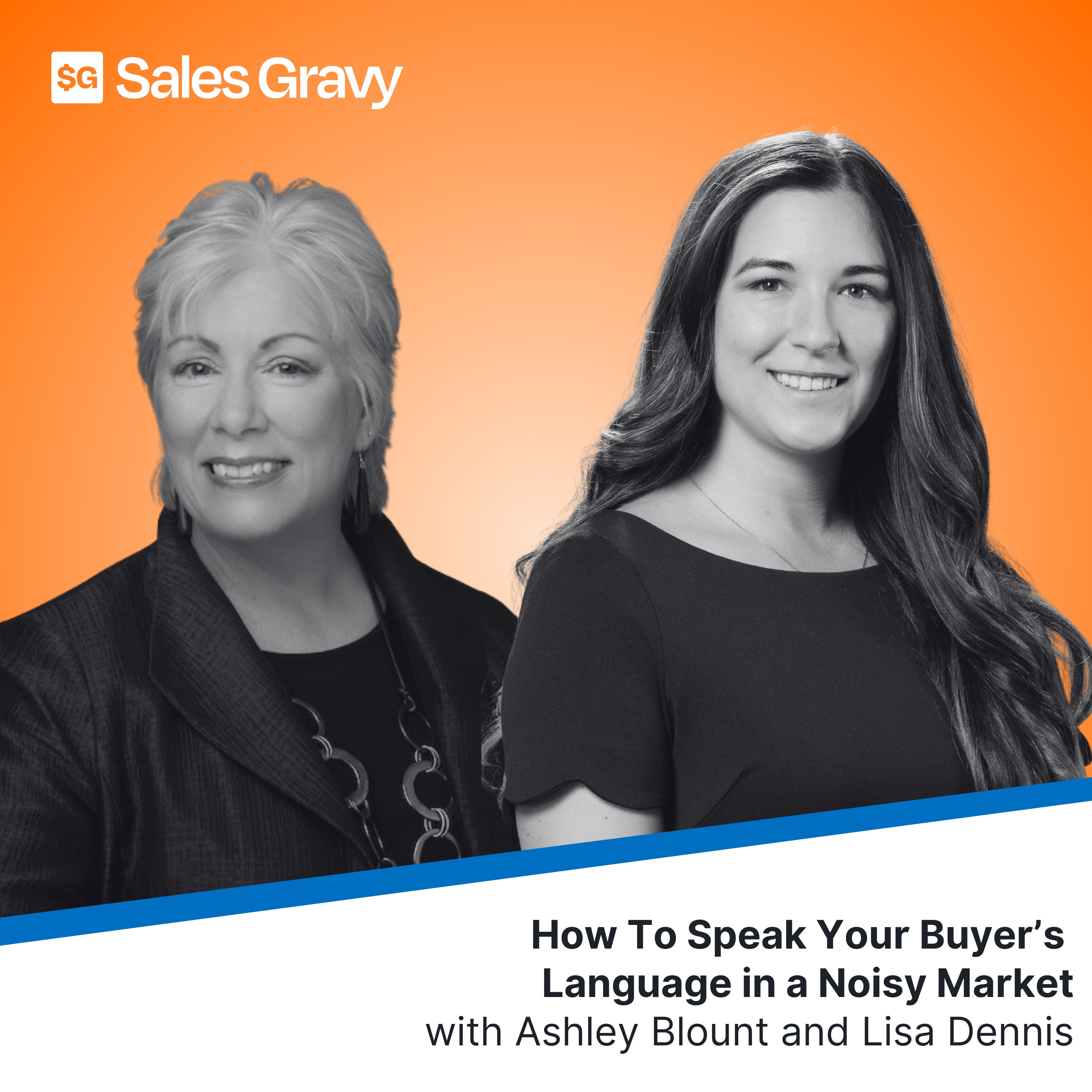
Most B2B messaging fails for one simple reason: it speaks the wrong language. Lisa Dennis has spent over a decade proving that when marketing says one thing, sales says another, and the product team adds a third version, all the buyer hears is noise. Lisa joins Ashley Blount to unpack why account-based marketing keeps underperforming even when the strategy looks solid on paper, and why the fix starts with flipping the entire value proposition on its head. She breaks down the difference between strategy and tactics and how AI is actually creating more room for real strategic thinking instead of replacing it.
📖 Purchase Jeb Blount's book, 90 Days to Level Up Your Sales Skills
💻 Enroll in Sales Gravy University Courses with Lisa Dennis
👉 Download our free guide for 25 Ways to Ask for an Appointment on a Cold Call