Ask ChatGPT


 Sales Gravy: Jeb Blount
11 Sep 2026 · 27m · 9 chapters
The episode argues that effective prospecting and selling should feel like therapy: build trust through deep listening, emotional intelligence, and self-awareness rather than pressure or persuasion. It explains frameworks like “cascading Y” (Y-ladder) to move from symptoms to intrinsic motivation, “softening the blow” (permission-based, less confrontational questioning), and “overcorrection” (exaggerate a claim to prompt the prospect to correct you). It also covers ethical selling: create a safe space, front-load objections/bad news, and aim for clear yes/no outcomes.
Jack Frimston and Zach Thompson, directors of We Have a Meeting (B2B outsourced sales for C-suite meetings using ethical practices) and Wham! sales consultancy. They wrote Sales as Therapy, blending psychology and sales.
A food-and-drink software deal where the real motivation was fear of going to jail; a “cassette player broke” example showing symptoms without motivation; Samaritans-style “make it about the other person.”
Written by AI. May contain mistakes.
Explore how sales techniques can be enhanced by principles from therapy.
“So you wrote this book and you make this really interesting comparison between sales and therapy.”
Learn how to apply therapy techniques to foster deeper connections in sales.
“Frimy Dog, I don't know if you've got anything you want to add to that, sir.”
Discover how to identify and address the real motivations of prospects.
“We think a lot about, obviously, problems and impact, don't we?”
Learn effective techniques to encourage prospects to open up during conversations.
“I love that you almost bridged into my next question for you, which is sales training.”
Learn how adapting your personality can enhance sales interactions.
“If you read this book, you're going to have a good lap all the way through.”
Understand why self-awareness is crucial for successful selling.
“and use code JEB to get 10 % off your purchase.”
Explore what ethical selling means and how to implement it effectively.
“about it before you even have this conversation with me.”
Learn strategies to build trust and rapport with prospects during sales calls.
“The hard thing is that you can never tell somebody, okay, because it wouldn't work.”
Explore how adding a 'pinch of salt' can enhance both food and life experiences.
“Sometimes flavors need a pinch of salt to unleash their full potential, and life works the same way.”

Get the gist, explore an idea or ask about something said.
 Claude
On Sales Gravy: Jeb Blount, what are the key points of this episode?
Searching your listeningAutomatic transcript. May contain errors.
0:00Every sales leader wants the same thing. A team that's in front of more prospects, following up faster, and closing more deals. But most teams are losing hours every single week to admin work that has nothing to do with selling. Belay's sales assistants are U.S.-based professionals who go through rigorous vetting processes before they even join the team. Less than 3 % make the cut. They're matched specifically to sales teams to take that operational weight off your reps so that they can do what you hired them to do. close deals. Download Belay's free guide called The 5 Reasons You Aren't Hitting Quota, The Sales Operations Gap Examined.
0:35Pick up that guide today at belaysolutions.com forward slash gravy or text gravy to 55123. This is the Sales Gravy Podcast. Hi, I'm Jeb Blunt, bestselling author, fanatical prospecting, objections, sales EQ, and inked. And I'm here to help you open more doors, close bigger deals, and rock your commission check. Jack Frimston and Zach Thompson, thank you so much for being here. You are the directors of We Have a Meeting, Wham!, a sales consultancy that's challenging the traditional sales playbook. Instead of outdated pushy tactics, they focus on trust-based conversational approaches, one that makes sales feel more human and ethical.
1:15Their book, Sales as Therapy, takes that idea even further, blending psychology with sales to show how emotional intelligence, self-awareness, and deep listening can transform the way people sell. It's not just about closing deals. It's about understanding people, breaking unhelpful patterns, and having real meaningful conversations. Jack, Zach, welcome to the Sales Group Podcast. So you wrote this book and you make this really interesting comparison between sales and therapy. Most people are just not going to like compare those two things on a daily basis, but you do it really well. And the way you explain it, it makes a lot of sense.
1:51Can you walk me through how you landed on that idea and what that really means for salespeople? When we did discovery calls, we were noticing a trend where people would say, wow, this feels like a therapy session. But anecdotally, we were getting that feedback from our prospects and there was something in it. It wasn't just me. It was Jack. It was other people who work in the team when they were doing cold calls, when they were doing discovery calls, they were getting that feedback quite a lot. And actually, it was really nice to hear because a lot of what we'd used and a lot of the techniques we'd built upon, I stopped taking them from sales books.
2:21I started building things from therapy instead, because I thought when you go to a therapist, who better to find the problem you're trying to solve, the true intrinsic problem, and the motivation to fix it. A therapist is amazing at that. And they do it completely getting out the way. You'd never go and see a therapist and they give you their creds deck and their awards and all the great people they've worked with, they just sit down and make everything about you. And they follow a really nice, easy to follow framework, which is, can I get you to think deeply about a problem? When you think deeply, you attach an emotion.
2:55And as human beings, when we attach an emotion, that's when there's action. So taking all that pressure away from metrics and selling and pressure and just focusing on that as a very simple framework and a very simple goal opens up conversations to feel a lot more like therapy than sales. But that's typically where I see the overlap. Jack F. Frimy Dog, I don't know if you've got anything you want to add to that, sir.
3:19Zac Thompson: In the UK, I don't think it is an American thing, but we have Samaritans, which is like a crisis hotline. So if you're feeling down, if you're feeling low, and the Samaritans have a rule that they cannot talk about themselves. Because if you're feeling suicidal or you're feeling lost in life, and I rigged you, Jeb, and I say, this is how I'm feeling at the moment. And you say, actually, that's a lot like me. I've been doing this recently. You're going to think, who is this guy? Why is he not talking about me and my life? I'm the one that's feeling down. So we apply those principles throughout our sales calls.
3:50Zac Thompson: And can we make it all about the other person? Tell me about your world. Tell me about the problems you're going through. Paint a picture. Tell me what the effects are, the impact. Show me why you're motivated. And we're just there to be a lazy river and nudge you along gently and guide you through that process. I love this principle. The way you lay it out in your book, it makes so much sense. It's what we talk about at Sales Gravy in many cases, because as a sales professional, you walk into the room and in many cases, there are people who say, look, we've worked with the biggest Fortune 500 companies in the world.
4:22We have X number of billions of dollars of revenue that we produce. We've done all X, Y, and Z and all the trophies on the case. And therapy, as you point out, is a really great case study in conversation. And really great conversation starts with getting yourself out of the way of other people and allowing them to have their story heard because when they feel heard, they feel like they like you, that you understand them. And I wonder from taking all these principles out of therapy and putting them into a practice where you were receiving these anecdotal, hey, this kind of felt like a therapy session, which is sort of a weird thing to hear in a sales call.
5:01I'm sure the first few times you heard it, you were taken aback a bit. But can you walk through some scenarios, anecdotally, that you have in your storybook that you've been able to really apply these well, where the person that you were speaking with was not only able to tell their story, but felt better and was better off for having the conversation with you as a sales professional after that 30 minutes or an hour they had with you?
5:27Zac Thompson: We think a lot about, obviously, problems and impact, don't we? in sales. So you can have a problem, but without the motivation. So a great example of that is the cassette player broke in my car. Okay. But does that mean I'm going to buy a new car? No, I just got one of those fancy dongle devices and that's going to play music. So I've got a problem. It doesn't mean there's any motivation to solve that problem. So I think this is where a lot of sellers go wrong. When we've had conversations where we get into the actual impact, the actual effect of the problem and they're saying things like yeah because of this it's quite manual well okay because it's manual then what happens what does that actually look like tell me in your day to day life what's having a knock on effect to well i don't get to leave the office on time i'm not seeing my kids i'm not present on the weekend it's making me go through a divorce these are the actual motivations that help when it comes to selling because as we say in the book selling is human and so many people and it's not to say that there isn't a place for it but go what's the effect on the business?
6:30Zac Thompson: Well, yeah, time, money, risk, we get that. But a business is just an amalgamation of hundreds or thousands of people. What would motivate them to go and be an influencer or a champion? What would motivate them to make a change? So I think that that's one of the big things for us is what's the actual motivation? What's the knock on effect? What's the impact? I mean, if we're looking for interesting anecdotal pieces, so depth is everything, right? There's a therapy technique in the book called the cascading Y or the Y ladder. It came from Socrates in ancient Greece. He would take someone down a path if they would say, I've got this idea.
7:05It's a really solid idea. And he would take them down a path where actually the idea felt less certain. And what we're really trying to do is not just take a symptom of a problem. So often I think that's what we're doing as sellers as well as we're hearing a symptom of a problem. So Jack just mentioned one then around manual processes, right? And there's a lot of software out there that says, I solve this problem. Manual processes come in, I solve them. Or I have a CRM system that solves a organizing your leads problem. Why do you need to solve that? Well, because if we don't organize the leads, we don't know when we're going to hit target.
7:36Why do you need to know when you're going to hit target? And suddenly the further down the ladder you go, you get to a point where the problems become very, very personal and intrinsic in a way that sometimes people hadn't seen them before. To give you an example, we were selling a piece of software on behalf of one of our clients to someone in the food and drink industry. And the point we got to do with him was he said, well, if I'm honest with you, if I don't fix this, I'm worried I'm going to go to jail. And we got there after probably 20 minutes of talking about like, oh, I'd need it to do this kind of feature and plug into this API.
8:07And it was very, very technical, typical sales conversation. And then suddenly it was like, if I don't fix this and someone catches me, I go to jail. and then when we get someone to that level, why would they not be motivated to create that impactful change? If it doesn't connect to these APIs and if it doesn't do this manual process, like those are all symptoms as you're talking about them. But like you said, Jack, it's not the, you don't need to replace the car. If you can't play music, you need a dongle. That's not motivating enough for me to make a change. But if I'm driving a car that I think might put me in jail, I love that you almost bridged into my next question for you, which is sales training.
8:45So a lot of sales training, and we come across this as well, is based on persuasion, how to handle objections, how to win conversations, how to push people to a closed one deal, how to get the revenue out of this deal the fastest. But you all mentioned and you've been talking about, you take a very different approach to that, which is you're really focused on connection and understanding. And when you think about that shift in that conversation between connection, understanding, and helping people get to a place where they're willing to open up. If I feel like I'm going to jail, how do you get someone to open up to you in a conversation about that?
9:17Therapists maybe don't have as much of a challenge because when I walk into a room with a therapist myself, I'm going to talk to them. I'm going to start talking about my problems because I understand that's why I'm there. But when people meet with sales professionals, they maybe will tell you the symptom, but they're maybe never even thinking about telling you the problem because they don't want you to leverage that against them. leveraging your sort of approach to this, how do you help people and how do you help your organization when they're working with you to, I guess, pull that out of a high level conversation?
9:47I'll put this in real world, right? If I said to you, Jeb, what did you do on the weekend? You're probably going to say like you did something cool. Maybe you went to the beach or something. I don't know. And then I say, how was it? Fine. You're happy to tell me how it was. It was great. I had a really nice time. When I ask you, why did you do it? You're like, what do you mean? Why did I do it? Suddenly kind of the back gets up a little bit. You feel like I'm challenging you. And as salespeople, often we walk into those kinds of conversations and we actually feel it as the seller. We feel like, oh, actually that felt kind of blunt and didn't land right.
10:16So a technique that we can use here when we're trying to get people to open up is actually softening the question. So there's a chapter in the book called softening the blow, which is all around how to soften questions. So an example of that might be, if I was going to ask you a why question, I might say, oh, Jeb, how do I ask you a really direct question without you wanting to punch me in the face right now. You're like, well, what is it? And I'm like, well, do you mind if I ask? I've got the permission first, but you naturally as a human being with all your negative survival wiring, think I'm going to ask you something terrible.
10:44And when I say, why did you go to the beach on the weekend? And suddenly the question lands totally differently. Rather than you just kind of running in with a sledgehammer, like, why are you doing things like that? If I use those little softeners to get you to open up, that can work really, really nicely. And then the second technique I'll give you is we also talk about a technique called overcorrection. Now, overcorrection is leaning again into human psychology. If I purposefully get something wrong and I say it as a statement, there's almost this itchy desire in us as people to correct. And not only do we tend to correct, we tend to overcorrect and give more information.
11:21So if I was sat with a salesperson in your team or in my team, and I say I was reading something this morning and it said, salespeople have the highest job satisfaction in the whole world. They're going to say, what are you talking about? Where did you read that? That's not how I feel about my job. Here's how I feel. And then other people in the team are going to join in that conversation. I didn't even need to ask a question. All I did was made a statement, slightly exaggerated, and then I waited for my counterpart to correct that statement. Jack, for you and your conversations, you're leveraging, I'm sure, what Zach has talked about, but any other ways that you help.
11:56And I love that softening the question is a really powerful tool. I think easier to deploy than the over-exaggeration. One, Zach, I love it, but you have to practice this. You have to maybe get in the mirror and say, I'm going to over-exaggerate this point. You have to give that a little bit more thought. Softening the question maybe comes a little bit more naturally, but Jack, for you, how are you pulling that critical information from your prospect without making them feel like you're persuading them or manipulating them into a place where you can close them.
12:25Zac Thompson: You've got to be listening all throughout the call. And I'll give something anecdotally, but we had a guy here that was on the phone that was very good on the phone and was asking questions. It felt like a therapeutic call. And then all of a sudden he asked one question, it might have been something like, what's the impact on the business? And it was like a very typical salesy question. And the guy on the other end of the phone went, ah, you were doing so well, actually just send me an email. And you've got to remember that we've got these survival instincts within our brain to keep us safe. And actually they're listening out.
12:57Zac Thompson: We let our guard down. If we feel like we're part of a therapeutic call, because we're having a human-to-human interaction with somebody that we feel genuinely cares and is genuinely interested. If you can actually be interested in somebody else, well, then you don't have to fake it. One of the things that we also say in the book is imagine that everybody you're speaking to has an invisible sign around their neck that says make me feel important so if you can remove all the targets and the commission and you can actually have genuine conversations and be genuinely interested that's kind of one way of of doing that and there are obviously levels to listening so are you listening to the words they're saying are you listening to the way they're saying and are you listening to what's not be instead maybe the subcontext or the tone a great way to kind of extract that information and be human we talk about these four different characters throughout the conversation and they are the actor the lawyer the therapist and the idiot and they all play a brilliant part but if you're wanting to be on their level obviously they say people buy from people they forgot to finish that sentence before they pass it all around linkedin it's people buy from people like them but the actor is moldable i'm adaptable i'm the improviser am i having a conversation with you and you're energetic and you're fun well i'm probably going to be more fun and energetic and you're going to think oh i like this guy i'm on the same wavelength we're having a good conversation you're probably going to let your guard down a lot more if you're really rational analytical quite strict quite reserved and i'm there and i'm like we're gonna have fun today on this cold call you're thinking get this schmuck off the phone straight away it's about how you adapt in those situations, how you bring those four different characters into play.
14:39If you read this book, you're going to have a good lap all the way through. You both are incredibly articulate and you do a great job of levity, which is a great part of sales conversations is bringing some levity to it that allows you to say, soften the question and lead it in. Like you're going to have the deepest, most personal question that you've ever asked in your life and say, you know, why did you go to the beach? And it just, it gives it a little bit of fun. And I love what y 'all do with this. And therapy, sales is therapy. the title of the book, one of the challenges that therapists have is helping those who are in their sessions have self-awareness.
15:12You know, one, you have a problem and you know you need to fix it. You're not self-aware enough to see the problems that are in between the problem and the solution. And I think that as a salesperson, self-awareness is so important, but you bring this up beautifully in your book. Going into a follow-up call, I want every important note right at my fingertips, not buried somewhere in a scribbled stack of notes. And with Plod Notepin S, I always have them because it's a wearable, portable note taker that lets me stay present and focused on customers during every single meeting. Plod captures the conversation and turns it into organized summaries and action items so I can follow up faster.
15:47And if I need a specific detail, Plod's Recall has that ready for me. And that's why Jeb Sr. and I and all of Sales Gravy trust our Plod Notepin S. Try Plod and stay focused on the conversation while it handles all of your notes. Go to plod.ai forward slash jeb. That's plod.ai forward slash jeb and use code JEB to get 10 % off your purchase. So Jack, I'll go to you first. Why is self-awareness so important for a seller to have?
16:14Zac Thompson: It's picking up on the views, picking up on everything. And the self-awareness also comes into play really, really nicely with the lawyer. And like, okay, you've said this, you've said that. There's actually contradictions there. We're having a long, long conversation. Well, what have you contradicted? What have you gone against? What have you said earlier that actually doesn't make sense anymore? And like Zuck said, with softening the blow, you don't have to be confrontational. You can ask direct questions. You can challenge. So many salespeople will put their prospects on a pedestal. They think I'm in this commission race.
16:50Zac Thompson: It's actually 50-50. You are going to have to kiss a few frogs. You are going to have to face a lot of rejection. that actually you've got to put yourself on the same level because we know, and you know probably as well, Jeb, that there are probably companies that have come to you at Sales Gravy that didn't know how to sell and they've left and they know how to sell. Their revenue goes through the roof. They're grateful. You've solved the problem. You've solved a genuine problem. So I think if you can have that self-awareness of you are solving problems, you are helping people, you are getting people from A to B, that's kind of where it comes into play the most for me, I'd say.
17:27I think the self-awareness is not only a negative thing. People think of self-awareness as here are all the challenges and problems that I have and I'm aware of them, but also being aware of the positive impact that you can have as a seller. And in that 50-50 conversation saying, I'm in this with you. I'm a partner with this prospect. I am not a lawyer who's interrogating and I'm also not putting them on a pedestal. And Zach, how do you see that impacting the sales process or prospecting or the ability to win both for your business and for the client? Yeah. So for sellers, there's an important rule to remember.
18:00There is no self-development without self-awareness. You can read all the self-help books you want. You can invest in all the self-development practices that you want. You must be self-aware to be able to practice them. So first, we must see that in ourselves, I think, first and foremost. Now, the second thing, and it's a really interesting point, the self-awareness for the prospect to recognize, okay, I have a problem and I'm going to go against my desire not to change. Like human beings hate change. I'm going to go against that desire to change. And one of the ways that we can do that is actually invert things, right?
18:35So I'll give you a therapy example first. So if I'm someone who's an alcoholic and I go and see a therapist and the therapist starts to tell me why it's bad to be an alcoholic first and foremost, reactance kicks in. My guard goes up, And I think, yeah, I know that already. Like I'm not here to kind of be lectured, you know? Whereas instead, if I say, well, what does alcohol do for you? You've been drinking now heavily for 10 years. What does it do for you? Well, it stops me feeling socially anxious. It stops me feeling nervous around rejection, the different things that they might share with you.
19:08Okay, well, that actually sounds like quite a good spot to be in. Obviously, it's not a great thing, but it sounds like it actually serves a purpose for you. So why would you want to stop drinking? in. What I'm saying is we've gone for the inverse first. And we, on our discovery calls, to give you an example, it's in a sales setting, we start off with all the bad news first. All the objections, all the reasons not to work with us, we front load it right at the start of the call. So we say, look, before we jump in, I want to make this as ethical as possible for you. I'm just going to share probably the top three reasons why these calls don't go anywhere.
19:40Is that okay? Yeah, of course. And if there's any red flags in here, don't worry, I'm in sales, as I can take rejection. There's a bit of a laugh. Okay, fine. And I might share how much it's going to cost roughly X to Y, how long we're going to have to work together. And then I might share something around and I'll probably have to ask you some quite uncomfortable questions as part of this call. Usually in there, there's a bit of a red flag and you might want to go away and think about it before you even have this conversation with me. Not only that, but they get over some of those things that might be stopping them from engaging in the selling conversation and the problem conversation.
20:11Because in the back of the mind, they might be thinking, well, I don't trust this guy. He's going to hit me with a price in the minute. He's going to try and tie me into a contract. By putting that at the start, it allows us to have a very self-aware conversation that we've made possible because we've created this kind of safe space where you know there's nothing kind of jumping out of the closet. I've given you all the bad news already. There's nothing scary about to happen. We've already done that. Self-awareness for the prospect, you can develop that as a salesperson in that conversation. I would say go listen to how Zach put that because it's really important that you aren't in a, it's my turn, it's your turn, it's my turn, it's your turn.
20:47And I'm interrogating you for all this information. And prospects will believe if you present that you have an ulterior motive in mind, which is to close the sale. And if that's the agreed upon end goal without either of you talking about it, it's going to be more of a battle rather than a partnership working towards solving a problem. them. And you mentioned ethical. So ethical selling. And I'm just going to ask you both this open-ended question because I know you can take it in many different directions. But Zach, ethical selling, what does ethical selling mean to you and Wham? And how do you help both the people who come to you for your services understand this?
21:25And how do you also bridge that gap with the prospect? When I got into sales, I saw it probably like most people did. I got into sales just before the Wolf of Wall Street came out it felt like a bit of a strange place for you to come out of university and start working in it felt like a place that had a lot of unethical practices and it felt like a place that was very company bottom line focus so it felt like I'm actually about all about kind of lining our pockets and I saw a lot of people sign clients on board that were really unhappy afterwards I saw a lot of practices behind the scenes I thought I don't know if I like this.
22:02And in starting our business, we wanted to give people foundational life skills around communication, because I probably don't think schools do much around this anymore, but actually show people that selling can be used as a force for good. If we accept the idea that I'm not here to persuade someone to do something they don't want to, I'm just here to take them down that path of, do you have a problem? And is there a motivation to fix it, everything becomes quite nice. And another thing that we try and encourage our team to do is sales is about certainty. So what I'm looking for is, can I get someone to a certain yes?
22:37Okay, that would be amazing. But also, can I get them to a certain no? The bit that you don't want, and the bit that would need refining, is if when you look at your pipeline, if you're sat with lots of maybes, might dos, think it overs, there's a guy in here every quarter who comes back, It's this promised deal that's going to happen. If you just work on your skill set of getting people to a yes or a no in an ethical way and a team that doesn't feel like they're forcing the issue, well, naturally you're going to have a very ethical environment. And hopefully if we all did this, sales probably wouldn't have the Wolf of Wall Street name that perhaps it does.
23:13When rubber meets the road and you're in front of a prospect, they have the Wolf of Wall Street in mind and you're trying to sell ethically. How do you bridge the gap effectively that doesn't feel like pandering and it doesn't feel like you're trying to pull something over their eyes, like the wool over their eyes, that you are an ethical seller only in name, but not in practice. How do you start to build that trust within the sales process?
23:39Zac Thompson: The hard thing is that you can never tell somebody, okay, because it wouldn't work. If I went up to you and said, Jeb, I'm really, really funny. You're going to enjoy the next 45 minutes. I'm really, really funny. You'd be thinking, who is this guy? Or if I said, I'm a really good listener, you either make somebody laugh or you listen to them. Okay. I can't actually say I'm ethical and I'm going to sell to you ethically. So I have to think, what is the opposite of ethical selling? Okay. Well, it's probably being pushy, probably talking about ourselves. It's probably very feature and benefits heavy, talking really fast.
24:12Zac Thompson: There's all of these things that are probably the opposite. What is the opposite of ethical selling? We start our sales calls. We like to think it's a very ethical way. there's psychology behind it as well but we will start job i'll say jeb i'll be i'll be honest with you it's a sales call you can hang up or let me on 30 seconds and there's a psychology behind why that works and humor allowing them room to say no etc etc etc but i think that's probably the most ethical way to start a conversation the most unethical way which sounds like a sales call is hi jeb it's jack calling from we have a meeting how are you today well the reason for my call is we are an award-winning blah blah that's not ethical because you're just going to bore them to death and you're just trying to talk about you and hope that something lands, what would be an ethical call?
24:56Zac Thompson: Listening. Asking thought-provoking questions. To listen all the way through this podcast, you're not going, yep, yeah, I get it. Yeah, that's me. Just sat there. You're listening. Okay. And then the questions you ask, show me that you've been listening or they've showed me that you've read the book or those kinds of things. So you've done the bit. You don't need to tell me you're listening and that you care. You can show people and your actions speak louder than words. So I think that that's probably the most important thing when it comes to being ethical with the prospect. I really appreciate the distinction there that you both put into your book, all of your language in your business as well.
25:31And I want to give you some space here because you are doing some really impactful things both in the UK and I think internationally as well now. Where can people find you? What's the next step for people to get more information about how they can better their business and better their world by following you? LinkedIn is always a good place to find us. Zach Thompson, Jack Frimston. Don't get them mixed up. Zach and Jack sound very similar. And there's two main businesses that we've got. So we've got, we have a meeting, which is our core business, if you will. We effectively do the lifting for you.
26:04We're a outsourced sales business. Predominantly our sweet spot is we get booked in to help people get in front of C-suite individuals and sell their products or services within B2B. We use all these ethical practices so that the meetings you get tick the boxes of does someone have a problem and the motivation to fix that problem. Now the other business that ties into the book is we started a business called a sales consultancy. That is to help people build these ethical practices and build sales as therapy into their own businesses. So almost as a consultancy and a coaching business is to help businesses build this in.
26:44So those are the two things that we help people with. But if you want to just see two guys being ridiculous every day, LinkedIn is a great place to start.
26:54Zac Thompson: Jack, anything to add? The only thing probably to add is we have a podcast where we sit with people from the sales world. We also sit with people that might be FBI negotiators or therapists or doctors, or we just did an episode recently with a neuroscientist or an entrepreneur. We're always thinking, where can we learn sales skills that aren't necessarily hidden in the back of a sales book because as we know life is sales everybody works in sales so where can we uh where can we find the best things so we share those conversations we also have a silly little 10 minute segment once a week when me and Zach get very childish with each other that's called we have a meeting the podcast well check out Zach and Jack Jack and Zach we have a meeting the podcast we have a meeting the business and also sales is therapy the book these are wonderful wonderful people to learn from and work with i really appreciate you both being on the sales gravy podcast my pleasure thank you
28:11Sometimes flavors need a pinch of salt to unleash their full potential, and life works the same way. Sometimes you just need to get a little salty to keep life interesting and deliciously sweet. Fuel your salty sweet cravings with Kachava's new Salted Caramel All-in-One Nutrition Shake. Just two scoops provide the complete nutrition your body craves with protein, fiber, grains, and more. Embrace your salty side. Go to Kachava.com and use code FITNESS for 15 % off your first order. That's K-A-C-H-A-V-A dot com code fitness.
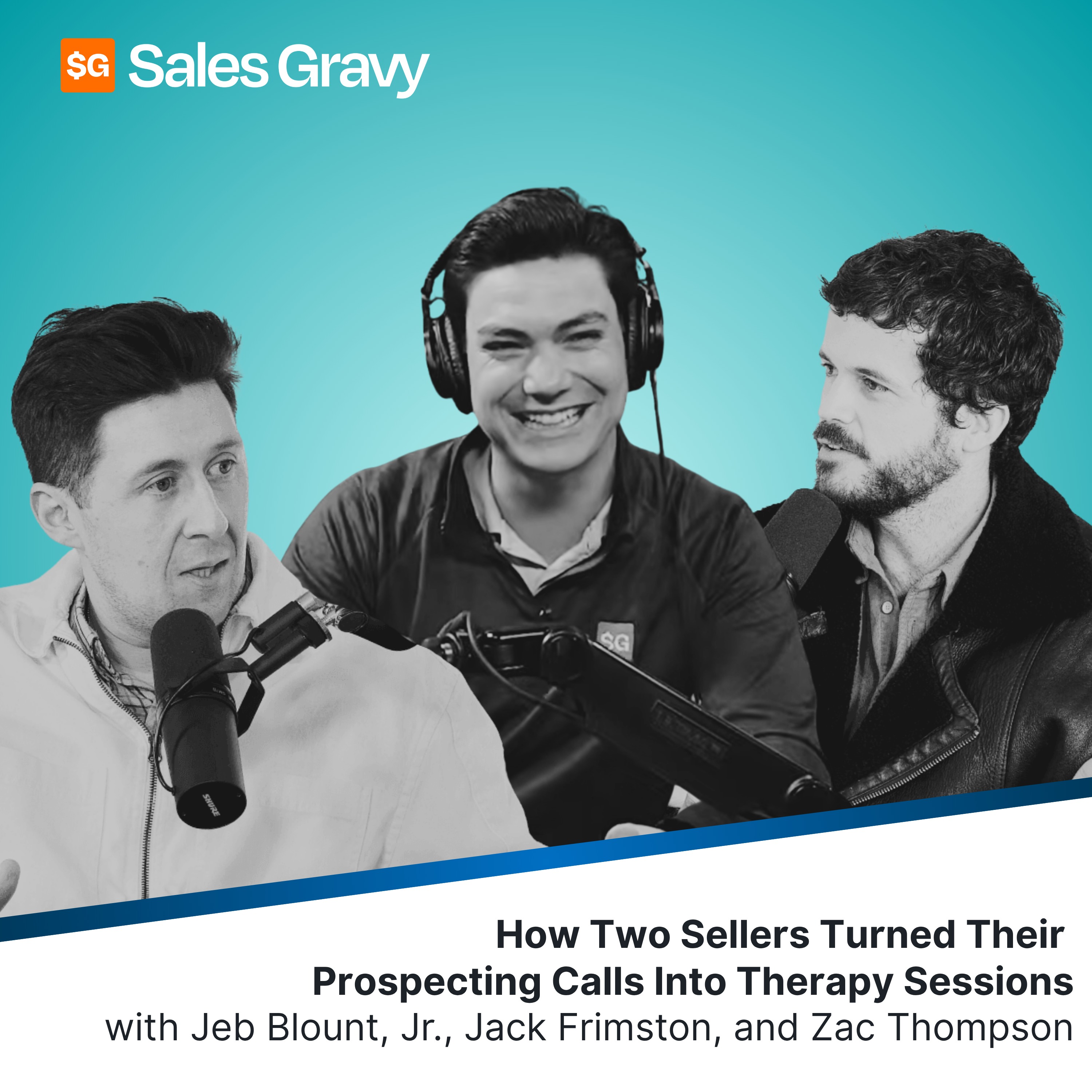
It sounds unusual, modeling an entire sales methodology off the principles of therapy. But it’s exactly what Jack Frimstone and Zac Thompson did, and it works. Jack and Zac, co-founders of the UK sales consultancy We Have a Meeting, sat down with Jeb Blount Jr. to break down this idea, which they discuss in their book, Sales as Therapy. They go over prospecting techniques that uncover real, often personal stakes behind a buying decision. They also discuss two tools that get more guarded prospects to open up.
📖 Purchase Jeb Blount's book, 90 Days to Level Up Your Sales Skills
👉 Download our free A.C.E.D. Buyer Style Playbook for Sales Professionals