Ask ChatGPT

 Sales Gravy: Jeb Blount
28 Oct 2026 · 14m · 4 chapters
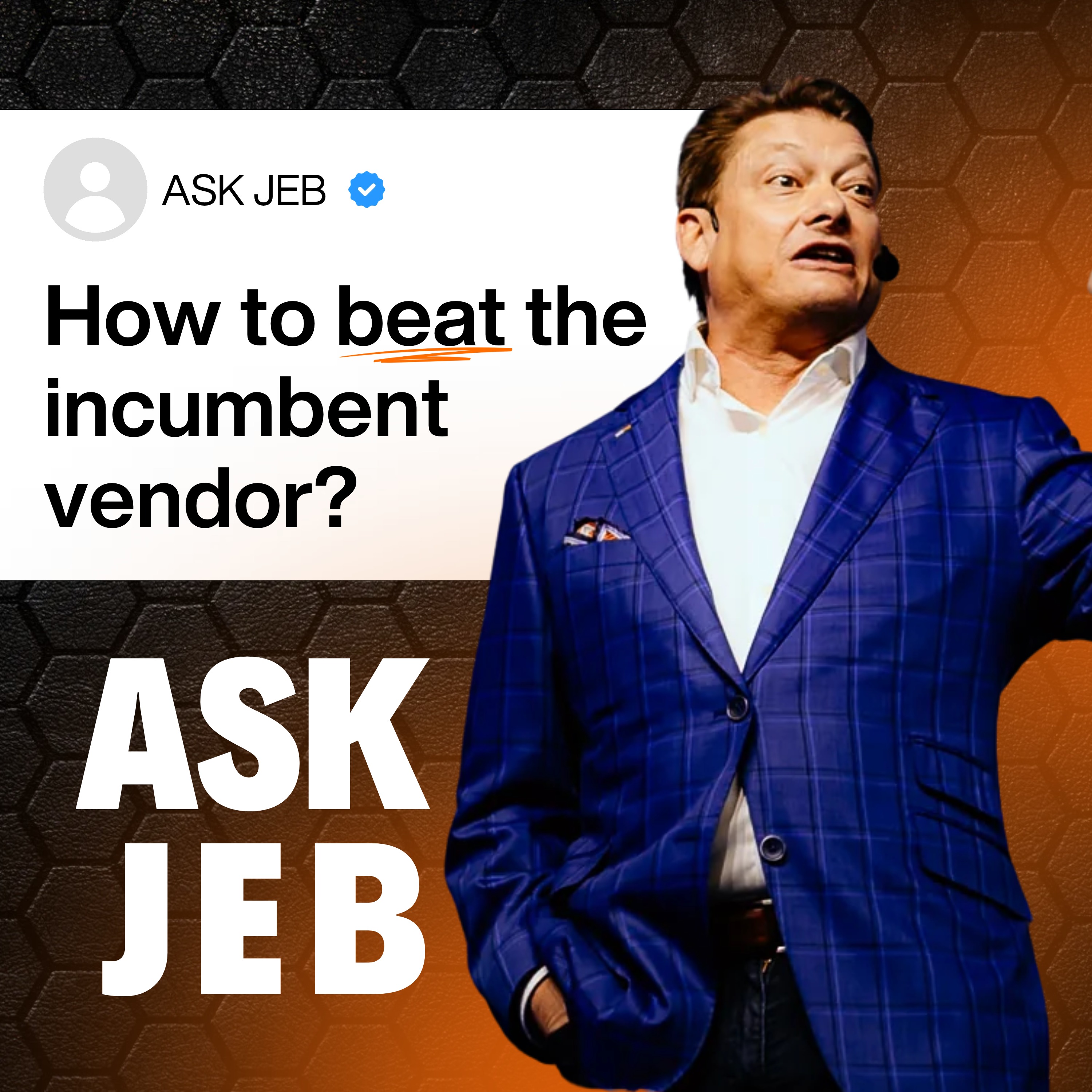
Why prospects stick with incumbents in competitive markets where vendors look the same, and how to increase odds of displacing the current provider using discovery, process steps, and “takeaway.”
Jeb Blount (host; author of Fanatical Prospecting, Objection, Sales EQ, Inked; 20+ years in sales; previously sold TV, now digital advertising). Guest speaker: “Jen” (caller; sales leader at a digital/SEO/PPC provider; describes losing deals to existing digital marketing vendors).
Buyer emotional journey during the sales process predicts outcome more than tactics; engineer relationship via discovery; add commitment steps (e.g., analysis) to create investment effect; create a wedge between prospect and incumbent; don’t over-propose if incumbent relationship is pristine; use “takeaway” (withhold proposal info) and leverage.
Past customers who request pricing but still choose status quo; an orthodontist where a 2.5-hour discovery with CEO/marketing coordinator led to a customized proposal and revised third meeting, yet they stayed with their SEO/PPC provider due to relationship strength.
Written by AI. May contain mistakes.
A discussion about the challenges of closing deals in a competitive market and the importance of differentiating oneself.
“I don't think it's completely a done deal.”
Jeb emphasizes the significance of discovery in sales, highlighting how understanding the client's business can impact outcomes.
“That's where I would start is I would get that whole list of all the past customers.”
Jeb shares strategies to create a competitive edge, emphasizing the importance of emotional connection and asking the right questions.
“and I and all of Sales Gravy trusts our Plod Note Pen S.”
Learn how to maintain equilibrium in your sales approach.
“balance between the beginning and when you feel like you've got both feet on the ground.”

Get the gist, explore an idea or ask about something said.
 Claude
On Sales Gravy: Jeb Blount, what are the key points of this episode?
Searching your listeningAutomatic transcript. May contain errors.
0:00This is the Sales Gravy Podcast. Hi, I'm Jeb Blount, bestselling author of Fanatical Prospecting, Objection, Sales EQ, and Inked, and I'm here to help you open more doors, close bigger deals, and rock your commission check. My question is around closing. I've been in sales for about 20 plus years. I recently switched from a TV company where we were, you know, like you're sort of a big deal. And now I'm with a digital company and there are thousands and thousands and thousands. So I've had three meetings now with a couple with past clients that I worked with before and a couple with new clients.
0:36And all of those three have stuck with their status quo. Their current digital provider, whether they don't necessarily do what we do or have the same opportunities, for now, just decided to stick with what they're currently doing. And so I'm keeping them on my list. I'm going to stay in touch with them. I don't think it's completely a done deal. I feel like, what am I doing wrong? because usually I would find that these people would close and it would be fine and they would become partners and clients and we'd move forward. And I'm not finding that. You're selling in a market where there are lots of competitors.
1:07For you to win, someone else has to lose, right? In order for you to win, they've got to kick out the current, the incumbent vendor. Everybody actually looks exactly the same. Every company looks the same. Every product looks the same. And the only way I win is for my competitor to lose. That became the basis of a book I wrote called People Buy You because People Buy You was the way that I went to market. It was a way that I sold in a market where truly I'm talking about even the product itself was exactly the same. The only difference was me. I was it. What am I bringing to this conversation that is different than someone else?
1:38Some of that's just your expertise. And so if you move for example, from TV, what insight can you bring? How can you go through and take a look at what they're doing and offer recommendations and solutions that they don't perceive that they had or that they didn't understand. Like, how do you do that? For me in that world, it was primarily getting to know their business, like really understanding them. And when I say I sold something that was just like everybody else's, it was just like everybody else's. And oh, by the way, it was a product that was completely commoditized that I decommoditized through the way that I did business.
2:11You know, my company says, okay, just go give them the presentation, just be a transaction. That's what most people did in that business. Like if you, they just went in, they just pitched the product. And then the person said, well, why would I change to you? I'm just going to stick with what I'm doing now because the only difference I can see is in pricing. I mean, you can change pricing a little bit, but often not enough to get someone to go through the pain of changing. Make sense? What I did was I ran a process. The process began with discovery, right? It began with getting in and understanding their business.
2:39Everybody was happy. Like I would call and they'd go, I'm really happy with what I'm doing right now. I know that you're probably experiencing the same thing. I sell digital advertising. They go, well, I've got somebody and I'm really happy. I had to get there so I could win. And I had to get in a place where I could do discovery. I walked them through a process. So those five decisions Laura and I were talking about, do I like you? Do you listen to me? Do you make me feel important? Do you get me in my problems? Do I trust and believe you? Well, those decisions are made through a sales process.
3:04So what I would do, Jen, is I'd first look at your sales process. So the sales process should be set up so it's engineering the relationship. In other words, the sales process creates the environment that allows you to walk them through those five decisions. Because the one thing that I know to be true, especially in a competitive displacement cell like yours, your buyer or your stakeholders' emotional experience as they go through that journey with you, that decision journey, is a more consistent predictor of outcome than any other variable. And what we have a tendency to do in situations like yours is fixate on closing the fact that the person's not making a decision, status quo, no decision, rather than fixating on how are we organizing this process.
3:44And let me give you an example, Jen. I'm not saying this happens to you, but this happens in a lot of situations where there's a lot of competitors and everybody looks the same. You engage the prospect and it could be a past customer, which is a good place to start, by the way. That's where I would start is I would get that whole list of all the past customers. And in fact, I would find all the past customers that used to work with other salespeople and I would call them all because at least you know that they're buying digital advertising and they know you. But you call up and they go, well, yeah, we already got somebody, but I'll entertain something like what you got.
4:12And then you go blah, blah, blah, blah, blah, blah, blah, blah, blah, blah, blah, blah. And they go, that's pretty good. Well, blah, blah, blah, blah, blah, blah, blah, blah. And they say, well, send over some prices. And so you send over a proposal and they look at it and you call them back. Hey, you want to do business with me? They go, well, you know, we're going to stick with what we're doing. It's kind of the same. It's very much about the discovery. So this one client in particular was a new client, but they already have a provider that does like SEO and pay-per-click and stuff like that.
4:34And they really liked them. They worked with them for years. We had an initial call with the marketing director. She then left. So we came back and did a whole new discovery with the CEO and his new marketing coordinator. We sat down for two and a half hours he gave us. And we talked about the business and what was going on and how we could help. Because he came in, he's like, we don't want to do this. And then we talked about what they needed. So we came back with a very customized proposal. So when you said he came in and said he didn't want to meet with you or he didn't... Yeah, at first he's like, I don't even know why you're here.
5:01I know our marketing director engaged you, but we don't really need your services. And we really got into detail on the business and what they needed and what they were looking for. It was an orthodontist. They always need new patients because you don't get braces usually more than once. presented, talked in even more detail about what they wanted. I got information from them afterwards. I felt like the discovery and the relationship, a lot of that was really there. And it really just came down to, I couldn't compete with the relationship that they had with their current provider, even though we have, we were trying to get them to take a step up.
5:32It sounds like you're doing all the right things. I go back to my process. I'm a CEO. You say SEO and pay-per-click. I got four prospecting calls today. Actually, they were emails on SEO and pay-per-click. Right. So it sounds like you got in front of people, like you sit down, you do a good discovery meeting. Two and a half hours is a lot of time to spend. What's the next step after that? Going back, asking a few follow-up questions via email that they had said that was fine. If we did that, they sent me the information. You know, we had set the meeting before we left. We had put together a customized proposal that really accomplished what they were hoping to accomplish that was doing something totally different than they were currently doing with the SEO and pay-per-click.
6:08So we sat down, we went over that. They asked us to dial it in even more. So we had a third meeting and we came back with a revised proposal. And then after that, they went back and talked and decided to just stick with doing a field. One thing I would look at, and I would go back to your leader and go back to your team and say, is there like, after you do that first initial discovery meeting, is there another step that you could schedule with them that would require them to do something? It sounds like you went back and did a proposal. They asked if you could dial it back in. You don't do a proposal.
6:39You go through and say, here are the things that we're thinking. or maybe you do an initial analysis. It's pretty easy to do an SEO analysis. I mean, you can grab one of your tools, you know, completely do their keyword analysis, but you come back and review that with them. Part of the reason why you're doing that is to find out if there's even a basis to move forward. If you look at what they're currently doing, look at what you're doing and you go, there's no reason for us to even move forward because their current provider is doing this just as well as anybody else could. You might do that, but it does require them to jump through another step.
7:07So one of the things that I do in a situation like this is I want to create as many steps in the process as I can without completely blowing out the sell cycle, but as many as I can to require them to do something, right? So that they're having to make a commitment. That creates some ownership in their part. It's called the investment effect, but I want to do that. Other problem that you have is driving a wedge between them and their current provider. Going into a follow-up call, I want every important note right at my fingertips, not buried somewhere in a scribbled stack of notes. And with Plod Notepin S, I always have them because it's a wearable, portable note taker that lets me stay present and focused on customers during every single meeting.
7:46Plod captures the conversation and turns it into organized summaries and action items so I can follow up faster. And if I need a specific detail, Plod's recall has that ready for me. And that's why Jeb Sr. and I and all of Sales Gravy trusts our Plod Note Pen S. Try Plod and stay focused on the conversation while it handles all of your notes. Go to plod.ai forward slash Jeb. That's plod.ai forward slash jeb and use code JEB to get 10 % off your purchase. They had made it clear that they weren't going to get rid of them, but they could maybe move dollars away from them. What I usually do is I'll research the current provider, see what we can do different, see where our differentiation is, try and tie that back to the client and what they're looking for, what they're hoping to accomplish.
8:28But I don't know. Let me throw a couple of strategies out there. So just a couple of things to think about, okay? If you want one more hoop that they have to jump through, like they have to agree to of the meeting, you have to sit down and walk them through that. That will help you at least decide whether or not they're completely engaged, right? One of the problems with this is that people are happy to get your proposal, but are they really engaged in the process? The issue with the current provider, like when they said to you, we're not going to get rid of our current provider, that would have been for me spidey sense in the air.
8:55Like I would have, my antenna would have been up and I'd have been, okay, this probably ain't going to work. Why would the current provider allow you to take part of their business? They already have the relationship. They have the reason to walk in there. If I'm them, I probably got your proposal because they gave it to me. And I said, oh, I can do all these things. That just happened to me. I've got a client of mine who's working on a project with their sales team who went to a competitor because it was a very specialized product, got a proposal, came to me and said, can you do this? And I went, yeah.
9:25They sent me the proposal and I'm like, oh, I'll just do this as part of your current program. I won't charge you anything for it. Another client that I'm actually doing that same thing with today. right? Yeah, exactly. So it's working both ways. Yeah. Yeah, exactly. So they're not going to give that up. So when we think about competitive displacement, sometimes you got to think to yourself, Jen, am I even going to win this deal? And if you're not going to win the deal, your best situation, the best situation is to take your ball and go someplace else. So you say things like, listen, I'm just listening to you.
9:53It sounds like with your current provider that they're able to handle everything that you're working on. So I just don't think this is a good fit. So before you put together a detailed proposal and show your competitor what you do, because they're going to hand it to them, don't give them that information. Use that as leverage to cause them to say, oh, no, no, no, no, no. They're not doing all these things. So that's called the takeaway. And I use that all the time. Like they go, hey, everything is great. We're doing good, but we'll take your proposal. I don't really think this is a good fit for you.
10:21I mean, if you don't have anything wrong, why should we talk? Oh, no, no, no, no, no, no. We do have problems. Okay, great. We can talk then. The second thing you want to think about is in your discovery process, are you asking questions that allow you to uncover where your competitor is taking them for granted? 70 % of the time, it's completely because the other rep took them for granted. They weren't paying attention to them. They weren't showing up at meetings. They weren't doing those things that you would typically do to maintain an account. If the relationship is pristine, they're doing everything right, and you can tell they're doing everything right, don't propose the business, just walk.
10:54But when you see that they're doing the wrong things, this goes back to, do I like you? Do you listen to me? Do you make me feel important? You get me in my problems of trust and believe you. Very last thing you wanna do is tell them that their baby's ugly. So if you point out the competitor's doing this to you, you got a problem. What you really wanna do is start shaping your discovery questions so that you're asking questions that cause them to become aware that they're being taken for granted, that they're being used. So when I look back at my process, you get that process down and you recognize that their emotional connection with you matters more than anything else.
11:26What am I doing on this chessboard to give myself the highest probability of displacing this competitor? Number one is your willingness to walk. It's your willingness to, if you don't see that there's an opportunity there, don't give all your information out. And by the way, if you're gonna give a proposal and you know you're not gonna be able to keep the business, make the other company buy it. You go low so that they have to pay for it. Like you were gonna cut their legs out from underneath them. Most of the time, you don't want to do that at all. You want to use that as leverage. I've got information.
11:56You want my proposal. You want my data. You want this. You got to do these things for me. And if you're not willing to do those things, I'm not willing to give it to you. The most important thing is you're helping them become aware that they're not getting what they're paying for. And in your space, especially with agencies who do digital PPC advertising and SEO, most of the companies suck at a level that is really hard to explain. You see it every day, right? They don't do their jobs. But if you tell them that they're not doing it, it doesn't change their mind. They have to tell themselves. So you wanna start thinking about your discovery process in a way that is setting this up.
12:32And oh, by the way, if they say, well, I'm gonna go back and talk to them, tell them the questions to ask that will cause the other person to be deer in the headlights because they don't have an answer for it. That's how you begin to win these things. Now, in this world, Jen, you're not gonna win them all. So I don't know what your close rate's gonna be, but it's gonna be in probably the 20s or 30s. One of the things is really getting dialed in on working and spending your time and effort on accounts that you can win. As you get prospecting more, as you build a bigger pipeline, you're gonna be able to see that.
13:01The most important thing is you have gotta put a wedge between them and your competitor. As soon as you can break trust, you have a chance of winning and you have a chance of closing. But in this situation, like with this account, I don't have a closing easy button that I can give you. Well, just go do this. And all of a sudden they're gonna say, yes to you. I used to love the takeaway and like walk away. I was fine walking away from business when business is good, right? Like since I'm sort of growing everything now, it's really hard to walk away from business. And so that's great advice and you can't win them all.
13:32And maybe I should bark up some different trees. I can give you the greatest strategies in the world, but probably the easiest way to learn your marketplace is to go out and bang your head on some brick walls. Like go out and take on some deals that in your heart, you know, you probably don't have a chance that just as long as you're aware of it, because you're going to learn a lot about your market. You're going to learn a lot about your competitors. It's just that you want to make sure that at some point you begin to transition your pipeline so that you're only working on high probability deals.
13:57And if there's not a shot at it, you just walk away and leave it. There's a balance between the beginning and when you feel like you've got both feet on the ground.
14:18Thank you.
When every product in your market looks the same, the only way you win is for your competitor to lose.
In this episode of Ask Jeb on the Sales Gravy Podcast, Jeb Blount takes a question from Jen, a 20-year sales veteran who moved from TV into digital advertising and has watched three deals in a row end with the prospect sticking with their current provider.
Jeb’s advice starts with the sales process. The buyer’s emotional experience is the most consistent predictor of whether you win, so stop fixating on the close and look at how you run discovery, how many commitments you ask for, and whether you can drive a wedge between the prospect and the incumbent. Sometimes the right move is to walk away before you hand your competitor your proposal. If you sell in a crowded market and keep losing to the incumbent, this episode will help you lay the groundwork for competitive displacement.
What You’ll Learn:
-
Submit your question: salesgravy.com/ask
Purchase People Buy You by Jeb Blount: https://a.co/d/0eETyHhc
Grab your tickets for OutBound Conference