Ask ChatGPT

 Sales Gravy: Jeb Blount
4 Sep 2026 · 35m · 17 chapters
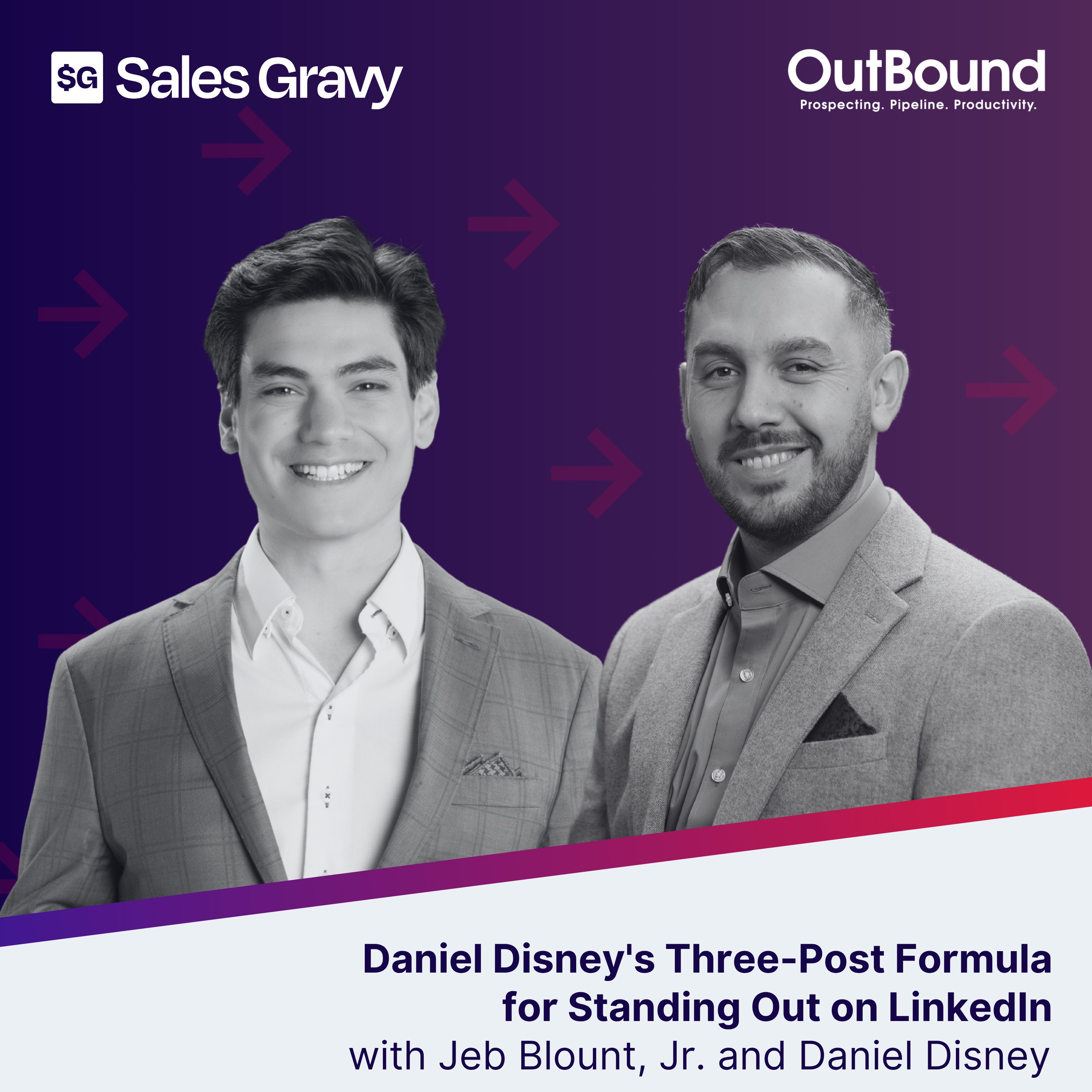
Leadership social selling on LinkedIn—why sales managers should post, what to post, and how to structure content to generate pipeline, hiring, motivation, and recognition.
Daniel Disney, founder of The Daily Sales and author of The Ultimate LinkedIn Sales Guide; a well-known sales influencer focused on connecting marketing/sales with LinkedIn and Sales Navigator.
The leadership gap is mainly middle sales leaders, not CEOs/CMOs. Leaders should use LinkedIn to recognize reps and build trust with prospects/customers. Posting should be optimized for fast mobile scrolling: deliver value early, use short lines, and include a clear hook plus call to action.
A “bracket” weekly plan: 1) recognize a team win, 2) share a customer success story, 3) highlight company/team environment. He cites a case-study-style hook like “helped a customer increase revenue by 20%.” He also warns against political posts and excessive vulnerability/cursing.
Written by AI. May contain mistakes.
Discussion about the upcoming Outbound Conference and Daniel's participation.
“Daniel Disney, founder of The Daily Sales, author of The Ultimate LinkedIn Sales Guide.”
Discussion about the upcoming Outbound Conference and Daniel's participation.
“We are staying at the beautiful Red Rock Resort off the Strip in Las Vegas this November 9th through the 12th.”
Daniel discusses the importance of leadership in leveraging LinkedIn for sales.
“which is going to be really exciting because we are having a full summit for sales leaders.”
Daniel shares insights on the gaps in LinkedIn usage among sales leaders today.
“I want to ask you maybe a hard-hitting question here.”
Discussion on the importance of recognizing team achievements on LinkedIn.
“sales day or sales process or just something that happened in the working office.”
Daniel outlines practical examples of what sales leaders should post on LinkedIn.
“Or imagine you're a potential customer and you see a sales leader praising someone in the sales team, but not focusing on how much they closed, but the impact they had on their customers.”
Discussion of common mistakes leaders make when posting on LinkedIn.
“Post number two can be a post focused on your customers.”
Advice on how to structure posts for maximum engagement on LinkedIn.
“This is what you should do, but we all know that LinkedIn, the internet is full of nuance and the internet doesn't like nuance, but it requires it.”
Learn how to structure engaging posts for maximum impact on LinkedIn.
“When you talk about a post and you bring value as quickly as you can, not taking too long to bring value, what does that look like in practice?”
Discover how AI can streamline the process of creating LinkedIn content.
“And whether it's bigger tools like ChatGBT or Claude, or whether it's specific LinkedIn content creation tools that actually create fully optimized LinkedIn content in your voice based off of your profile.”
Understand the importance of balancing personal and professional content on LinkedIn.
“a slightly longer video or you're going to write an article and that might take a bit longer and that's fine.”
Learn how to handle sensitive topics and maintain professionalism on LinkedIn.
“just like in every in-person sales conversation, phone sales conversation.”
Hear testimonials about the transformational experience of attending Outbound.
“You know, great if you work for yourself and you get to be that picky.”
Learn why the Outbound Conference is a must-attend event for sales professionals.
“I'm in a very lucky position where I've got to experience outbound before.”
Discover essential items and strategies to maximize your experience at the conference.
“You are all coming from places like Australia and the UK, going to Las Vegas, which is quite a long way.”
Hear about impactful advice and presentation styles that can enhance your own speaking skills.
“If you're tired of, if you're tired of not getting the results that you think you should be getting, whether it's for you or for your team, you're tired of not hitting the achievement.”
Explore the concept of a 'sales spirit animal' and what it reveals about your approach.
“If you want to learn how to speak in the best capacity possible, go watch Victor Antonio in his podcast, in his trainings, in his speaking.”

Get the gist, explore an idea or ask about something said.
 Claude
On Sales Gravy: Jeb Blount, what are the key points of this episode?
Searching your listeningAutomatic transcript. May contain errors.
0:00Companies shouldn't have to choose between speed and control. Amex Corporate connects cards with flexible spending controls and real-time visibility to help teams adapt faster. Built to simplify, designed to scale. This is Amex Corporate. Get started at go.amex slash amexcorporate. Terms apply. This is the Sales Gravy Podcast. Hi, I'm Jeb Blount, best-selling author, fanatical prospecting, objections, sales EQ, and inked, and I'm here to help you open more doors, close bigger deals, and rock your commission check. Welcome back to the Sales Grevy Podcast. I'm Jeb Blunt Jr. And today we have an amazing guest.
0:36I'm really excited for these conversations. Every single time he's on the show, he has built one of the most recognizable brands in the sales influencing space. If you've spent any time on LinkedIn, you probably have come across his content. We've got Mr. Daniel Disney, founder of The Daily Sales, author of The Ultimate LinkedIn Sales Guide. He's got all kinds of books up behind him. You got to go check out all of Daniel Disney's content. But Daniel, we're so happy to have you on the podcast today because we're talking about Outbound Conference and you are going to be at Outbound Conference this year, which is an incredible get for the entire Sales Gravy team.
1:06We are like up in arms about how cool it is to have Daniel Disney from across the pond coming to Outbound. Welcome back to the show. Well, thank you for having me back on the show and even more so thank you for having me back at Outbound. I think it was 2022 where we did Outbound in Atlanta. And it was hands down one of the greatest sales conferences I'd ever been to, let alone got to be a part of. So I am so, so excited for this year. Before we get into the conversation, if you are listening to this and you're excited about seeing Daniel Disney, you need to go to outboundconference.com. That's outboundconference.com.
1:40Go get your ticket. You got to go check it out right now. We are staying at the beautiful Red Rock Resort off the Strip in Las Vegas this November 9th through the 12th. So go check out those tickets at outboundconference.com. Daniel's going to be with us for our leadership day, which is going to be really exciting because we are having a full summit for sales leaders. And Daniel, you are one of the foremost leaders in LinkedIn and combining that with sales, we were just talking about. You're an inbound speaker tying the knots between marketing and sales and LinkedIn in-mails and messages. As you head into a leadership conference at a conference like Outbound, where does your head start to go as far as what you want to teach?
2:15What do you want people to walk away from foremost when they come away from the leadership summit? Middle person, I guess, in the scenarios that I'm often faced with, which is training sales teams how to leverage LinkedIn and social selling and sales navigator to build pipeline, find prospects, close deals, grow revenue. And between me and the sales teams is the leadership department, whether it's a single sales leader, whether it's a VP and a manager, whatever that structure might look like. The leadership component is often what is missing from a lot of companies' social selling success. They'll often hire LinkedIn trainers like myself to come in and train the teams.
2:53But what is missing is leadership utilizing it themselves. And there are so many missed opportunities that hopefully we can dig into today where a leader can benefit from using LinkedIn, if not just to lead by example. But honestly, the benefits to them as a leader is phenomenal from hiring, motivation, recognition, reward. The list kind of goes on. And that's something that is not talked about enough. I want to ask you maybe a hard-hitting question here. You know, maybe 10 years ago and maybe even five years ago, I'm thinking about my own career. You know, when I was really young and just making cold calls and doing a lot at Sales Gravy when I was like 16 years old, the conversation on the blogs and on YouTube and on the podcast with Jeb, when they talked about LinkedIn was that most people saw LinkedIn as a resume site and then they needed to use it for influencing.
3:40They don't think that that's necessarily the gap anymore for leaders. I see leaders using LinkedIn a lot in my personal experience because I'm connected with a lot of them. But I wonder from your perspective, what is the gap today from true leadership, from a social selling perspective as leading by example for your team? What are you seeing in the field as the gap today for most sales works? I think the gap is still sales leaders. We are seeing business leaders, CEOs and managing directors, but not your direct sales leadership positions. I very rarely see those being active and especially in some of the most crucial ways, whether it's down to promoting the team or company as a workplace or even down to recognition.
4:21I would love to log into LinkedIn and at least once a day see a sales manager recognizing the achievement of one of their sales team for success on cold calls, for success with their pipeline, a new start to success. That's the sort of stuff we want to see. And again, the ripple effects of positivity of those things goes, you know, miles. It's really interesting you say that because I think I see the same thing. If you've got CEOs, you've got high level VPs. I think about one of my partners who has lots of lots of leadership posting on LinkedIn, but those middle managers are not what I'm seeing a lot of.
4:55And this is a really interesting gap because I think the culture is shifted where these CEOs and maybe people who are managing director positions or high level VPs, they see the value and their voice being out in the world as a marketing tool, but also as an inbound lead channel. And then salespeople in the bottom end are starting to see the inbound lead channel, the effectiveness of their own content and their personal brands. Then there's that leadership gap right in the middle where it just doesn't exist, at least in terms of their engagement and what they do. You mentioned people recognizing their team for achievements in particular areas of the sales day or sales process or just something that happened in the working office.
5:34And I think of my own content. You think of content all the time. That's like free content. People are doing things all the time. So why do you think that those middle managers are struggling so much with putting their time and effort into a social channel like LinkedIn? I guess there's a lot of confusion. I mean, you and I both know in the sales world, are the majority of sales leaders active in their roles? You know, are they making calls? Are they sending emails? You know, sometimes sales leadership has fallen into, it can often be a sort of slightly laid back where it's focusing on the leadership and maybe not so much leading by example.
6:13And I'm not saying that a sales manager should be there making calls day in and day out, but leading by example is a huge missed opportunity. I've certainly experienced in the companies I work with. I think we see that we also have this sort of disparity. So when you've got, say, someone who's in an entry-level sales position, and then you've got the CEO posting on LinkedIn, it creates the same challenge 99 % of people have when they come on LinkedIn, which is, well, I'm not an expert, so why should I be sharing content? And it's easier if you're the CEO, you've got tons of stories to share. But what we know is that there is value from everyone in the organization, from, you know, one day starter salesperson through to a sales leader.
6:57What we have, I think, is just, again, it's just confusion. You've got sales leaders that aren't really sure why they should be active on LinkedIn. They don't really understand the benefits because the CEO posting is getting very different benefits. The marketing team probably focusing on more advertisement style stuff. So there's just this like confusion, foggy area. And that's what I'm trying to clear up and help sales leaders understand that, look, there are so many benefits from direct inbound leads and pipeline through to closing sales and getting referrals through to attracting top talent into your team through to motivating your staff.
7:38Think about how great you would feel if your leader posted something on LinkedIn in front of the whole world, in essence, praising your success. Or imagine you're a potential customer and you see a sales leader praising someone in the sales team, but not focusing on how much they closed, but the impact they had on their customers. Or the customer satisfaction survey that came back and showed that their customers were the happiest. You can understand how all these things tie together to create so much potential. So I was going to ask you to answer that question that you kind of posed at the beginning of your answer.
8:13I want to tie those ideas a little bit more down to earth because they're so impactful. If you are a potential candidate, I mean, if you're a sales manager, you have to be hiring for your team at all times. Your pipeline of candidates is the same as your pipeline for sales. If you're a potential prospect, you're looking around the Internet at different things. and you see Daniel Disney has given Jeb Blunt Jr. praise because he helped a customer increase revenue by 20 % and this is the case study that it was and you put that all on a LinkedIn post. That's a really compelling piece of content. Where do you think leaders can start to really diversify their content?
8:47What are some examples, maybe some more concrete examples of what you've seen work or what you would recommend that works? I really love these real world examples of how a middle manager can actually use LinkedIn and not just use LinkedIn by like reposting the daily sales posts. They're really, really good, but they're not necessarily speaking a lot for your brand. They're speaking a lot for Daniel's brand. It's a fair point. And it's a very good question. And there's a lot of layers to this, but to try and simplify as much as I can, I would focus on creating brackets of content that you want to share.
9:18So across a week, you would want to have one post that perhaps recognizes one of your team and a success they've achieved. And that could be big to small. It could be something happened that day, something that happened that month, whatever it may be. But have one post that week is purely focused on someone in your team and recognizing something they've achieved. So that's one post done. Post number two can be a post focused on your customers. So again, it could be a customer success story in an engaging way. It could be something talking about a relationship or a referral or something that, again, creates a storytelling narrative that highlights the benefits that you provide, the solutions you're providing.
9:57So it's not about the product. It's about how your customers are benefiting. So that's post number two. Now, post number three could then be about the company and about the environment. And maybe it's the training you just about to provide for your team. And maybe it's an SKO, you know, maybe it's some of the perks or, you know, one of your team is just unlocked X achievement. Things that again, highlight your team and company is a great place. You've got three posts there that their impact alone is massive. But step one is, okay, these are the three types of posts I'm going to do on a weekly basis.
10:33That already gets you a couple of steps in where it's like, okay, what can I do for this one? What can I do for that one? And what can I do for that one? And that's three. Again, there's lots of others you can throw in there, but just having that structure kind of helps you with the focus. And I'm pretty sure most sales leaders, if I said you need to create. one of each of those posts, I don't think any leader would actually be able to struggle with that. Most of them would probably find it quite easy to do a post on each of those on a regular basis. I love that those are the brackets. And if you listen to Daniel's prescription here, that's three posts a week.
11:07For example, I think Daniel, you post like 27 ,000 times a week, something like that. Roughly. I post about seven times a week. It can be repost, but I usually post one piece of organic content every working day because LinkedIn falls off on Friday and doesn't come back until like Monday afternoon. But if I post five times a week, 99 % of LinkedIn doesn't post more than once a week. 99%. If you post twice a week, you're already in the 1%. So if you post three times a week, you'll start to see your following increase. And just for my own example, following Daniel's prescription, like I read the ultimate LinkedIn sales guide, I started to put into these practices, and this is a testimonial for his work.
11:41When I started posting five times a week, my followers went from like 3 ,800 people, maybe at 4 ,200 at the beginning of this year, I have since crossed 7 ,500 people and that was in about six months. I was gaining a hundred and something followers a day. I mean, it is just because you put up content that is relevant to people. People like to see authenticity. And this, it brings me around to this question. You mentioned all of these brackets and this posting and it seems really easy. This is what you should do, but we all know that LinkedIn, the internet is full of nuance and the internet doesn't like nuance, but it requires it.
12:14What should people not be doing? Like what are some of the categorical nose, red flags for leaders in their posting that would just turn people away from them, from their brand, from their business, anything like that. So I guess things to avoid. I mean, your formatting is very important. So some of the traps, if you just jump in to start creating content and maybe you haven't done any sort of learning or looking into how to do it, sometimes people get quite blocky with their texts. So LinkedIn is optimized to have sort of single line sentences. Remember, people are scrolling. Make it easy to read.
12:46Big, chunky paragraphs are going to scare people away. Equally, if it takes you too long to give any sort of value in your content, you will lose people. We scroll fast and we are looking for hooks to capture us in very quickly. Our attention spans are so intense. So what you need to do is give value very early on, either in the initial hooks or the opening sentence of your post or very quickly into it. I've seen examples of videos that salespeople, leaders, entrepreneurs have created. And sometimes it's like one minute, two minutes in before you actually get anything from it. And unless you have to watch that, most people would have scrolled past by that point.
13:27So again, taking too long to give something, you know, it's going to run the risk. And LinkedIn is becoming a noisier and noisier place. We're all fighting for attention. And as LinkedIn grows in popularity and more and more people start posting and creating content, it is going to become more and more important to stand out. So quick to deliver value. Make sure your posts are optimized for LinkedIn. Again, people are on their phone. I think it's usually a 50-50 split. People using it on their phone to using it on their laptops. Either way, they are scrolling. So make it easy and as engaging as you can.
14:00This is a real tactical thing. When you talk about a post and you bring value as quickly as you can, not taking too long to bring value, what does that look like in practice? How would you maybe structure the value of that post so that it hits people's eyes quicker than at the end when you're kind of, you know, think of like a keynote. You kind of want to deliver the best joke, like right at the end of it or right at the beginning. How do you start to build your posts so that it's impactful? Well, think about it in these two ways. Number one, your hook. So again, the opening one or two sentences of that post or video, whatever the form of content is, that gets their attention.
14:33So that has to be big because otherwise they'll scroll past it. And then your goal at the end of the post is to have an engaging call to action that's going to encourage them to engage. So again, to like, to comment, to share, etc. Those are your two most important parts. Now, if we're talking about a customer testimonial, this is a really common one that marketing teams mainly fall down on because they tend to be the ones that create your case studies and your testimonials. And the common trap is they sort of assume people are going to be interested. And let's be fair, 99.9 % of people are not interested in your case studies or testimonials.
15:06It's only your proper top current pipeline that might be interested if they're really close to buying. So what you want to do is really make it stand out. So as an example, you mentioned earlier as a hypothetical example that you helped the sales team increase their pipeline by 20 % with your training. That's your hook. The hook is the impact you made. We just helped this company or a company increase pipeline by 20 % in two months, in one month. You make it really tangible, a really tangible hook of what they've achieved. That is going to stop most sales leaders. Oh, I want to achieve that. So then they're going to want to know what it is you did to achieve that.
15:46And then your sort of goal at the end, your call to action could be what's the biggest increase. I don't know. It could be anything like that. But that hook suddenly turns a very boring case study or testimonial into a FOMO, a fear of missing out, creating high interest and making it something that people or your target ICP, your customers are going to want as well. The hook is highlighted as that's the impact that you've made from a case study perspective. Or, you know, if you're looking at these other posts, like how are you drawing people in? And that usually is leading the witness a little bit.
16:19Like, you know what the outcome is in the rest of the post, but you're giving it to people up front so that they want to read the rest of it. And then you have that call to action at the end. I find that even in my day as a salesperson, as somebody who is a frontline revenue generator, and then when I work with leaders, the conversation is really smooth up until the point where the rubber has to meet the road. So they get all of this. They understand the logic of it. They're like, yeah, you know what, Daniel, you're right. I should be doing this a lot more because it means a lot more for my business.
16:48And then you leave, I leave. We go back to our businesses. We go help a single post. And usually the conversation is, it's just so much time. It's emotional effort. Maybe they're not willing to admit it, but like they have the time, but like it just takes, it takes a part of your brain, the creative part of your brain that we're not usually used to working on as salespeople. We want immediate satisfaction. Speaking to all of this, it doesn't feel like that takes a lot of time to get these posts done. How much time should someone actually spend creating posts like this in their week as a busy business leader, someone who's responsible for lots of revenue in an organization?
17:27So I'm going to give two answers to this. Number one, A, it will take you a little bit longer at the start. When you do something new, it's going to take you longer. So whilst I might suggest five to 10 minutes max is the amount of time you should spend creating a post for LinkedIn when you are confident in doing it, at first, maybe it takes you 20 minutes. Maybe it takes you 30 minutes. Maybe it takes you a bit longer because everything does take us longer at the start. I just want to add that sort of caveat. But number two, here's the best news. We are living in an AI world. And whilst AI can be misused and can create really bad content if you don't use it the right way, it is one of the single most game-changing things out there for helping people create content in a fraction of the time when you use it properly.
18:10And whether it's bigger tools like ChatGBT or Claude, or whether it's specific LinkedIn content creation tools that actually create fully optimized LinkedIn content in your voice based off of your profile. I mean, there is no excuse now. You can have content created in a couple of minutes and posted. I'll give you one very quick example. I did an SKO recently and we were in the Philippines and the VP of sales literally just as they were checking into the hotel, took a selfie, typed in a nice little post about the SKO and the sales team and rewarding it. The engagement was huge. It took two minutes to take that picture, write a quick little post and post it.
18:51There's nothing complicated about it. It's a photo. It's a bit of text about what's happening. You know, again, this isn't rocket science, but it takes time to get comfortable doing it. What I would suggest is five to 10 minutes is kind of the ideal amount of time you want to be spending creating your quick post. And then maybe every so often you're going to record a slightly longer video or you're going to write an article and that might take a bit longer and that's fine. But your sort of day to day shouldn't take too long. I actually really love that CEO example in the Philippines, which by the way, the Philippines is so cool.
19:22I've noticed that that CEO takes a selfie, posts something kind of, you know, not necessarily non-valuable about the SKO, but it's more just, hey, here's the SKO. LinkedIn has become more like Facebook in a lot of ways in the last several years. I find that, you know, myself, some of the most engaged posts I have have nothing to do with valuable content. There are videos of me just talking about swimming or going on a run, or sometimes it's just like loose content that I was, it was a Thursday afternoon and I really didn't have anything. So I made some stuff up and I've found that those, those posts tend to get a lot of engagement.
19:54I guess I don't necessarily need to know how you feel about both the Facebookification of LinkedIn, because it doesn't really matter how we feel. That's the way that it's moving. What are your thoughts on content? That's not necessarily driven by that value, that hook, that impact, something that maybe doesn't even have value in the middle of it. It's just a post to put up a post. How do you feel about that? What are your thoughts around it? And how might you throw that into a strategy if it's something that's worth using? Well, sometimes what I love doing is connecting dots. And I think sometimes we fall into that line of thinking, which is, you know, LinkedIn has become Facebook or it's too many personal posts.
20:29Where's the value? How are we going to generate pipeline and sales from a picture of you out at the weekend? You know, those are sort of trap mindsets where actually let's connect the dots here to what this is actually like. imagine you go into the office and you're talking to your colleagues. What is the split of conversation? It's usually 50-50, 50 % personal conversations, 50%. Let's think about the conversations we have with our clients, our prospects and customers. There is a percentage which is personal. You're asking them, you're getting to know them. And once you've built rapport, well, how was your kid's party at the weekend?
21:05What did you get up to? Did you watch the golf. So all our conversations in life and work are usually a split between personal and professional. But when we look at LinkedIn, we fall into this trap where, nope, it has to be 100 % professional. And that's the only way we're going to generate business. But actually, in the wider world, that's not how our business world works. We work by building a personal and professional relationship. And that's where the key is. That's why professional posts and personal posts both work. It's when the scales tip. And if you only share personal posts, which some people get tricked into doing because that's where the high engagement is, they think that's what's going to work, or they'll struggle to sell.
21:44They'll struggle to generate leads, good quality leads. They'll struggle to build pipeline. So it's trying to find that split. I think personal posts have a huge place on LinkedIn, just like they do in every professional conversation we have with prospects and customers. It's about keeping that balance and making sure that, yeah, it's great to share that personal content, but you have to balance it with the credibility stuff, with the professional stuff that's going to make people feel comfortable buying from you when you get that balance right, just like in every in-person sales conversation, phone sales conversation.
22:16It's that balance that's key. What I like to this from a leadership perspective too, is that as someone who posts a lot on LinkedIn, I learn, I actually learn a lot more about people's personal lives through people who are willing to authentically post on LinkedIn than I would in maybe even just conversation in the office. It allows me to connect with people. And then I can walk into the office and say, hey, Daniel, I saw that you were hitting the golf ball over the weekend. I didn't know you played golf. And that becomes like a conversation where we can have that connection. It's not a firm line.
22:44There are firm lines that you should hold, but the line between personal and good for LinkedIn versus personal and maybe for Facebook or for Instagram or for some other social channel. Have you seen leaders talk about this? Where do they kind of find that line? Where do you find that line? Is there a good answer to that question? I'm aware that some of this might be a personal opinion for me, but I will add the caveat that a lot of my opinions on LinkedIn come from observation of not just what I feel about a type of post, but equally how the audience responds. So how much engagement is it getting?
23:16What are the comments saying? I think where we tend to get into the sort of, well, I would say the no-go area, political posts. Anytime people start to share political opinions, you wouldn't really do it a lot in a workplace anyway. You definitely wouldn't advise doing it with prospects and customers. But some people just think that because LinkedIn is a social network, like they might share those opinions on Facebook, it's okay to share there. There is very little, if any, benefit and probably the significant negatives of being so polarizing sometimes. I think anything like that, you probably want to avoid.
23:49Equally, sometimes people go too vulnerable. So I talk a lot about, you know, opening up personal posts, all that kind of stuff, but there is a line and some people, again, on other social networks might share really deep, vulnerable, open stories, which again, drive engagement, but you've got to think about your professional reputation. You are, if you are in sales or you're a sales leader or a business owner or any sort of leadership position, your goal is ultimately to represent your company. You want to inspire people to have confidence in buying from you, your brand, your business, your sales team, whatever it may be.
24:23So we have to be aware of everything we say will contribute to that for good or for bad. So if you've got content going out that people might look at and think, I don't think that makes me want to buy from that person or that company or brand, then we need to start asking those questions. I want people to be authentic. I want people to be genuine, but we are professional. As salespeople, we all have to be aware of what we say in our customer conversations. I'll give you one very quick example. There was a time a couple of years back, actually, where there was a conversation around swearing on LinkedIn.
24:55And there was the common narrative, which is, well, I'm being authentic. I swear in my life. So if you don't like it, then you're not my target customer. You're not my tribe. And as salespeople, you can't afford to be like that. You know, great if you work for yourself and you get to be that picky. But as salespeople, we don't go into every conversation swearing at our customers. And if they don't like it, then they're not the right customers. That's not how it works. It's extreme qualification. Actually, that's our next book, Daniel, is Extreme Qualification. Just Curse of Customers. That is the best book title I've heard.
25:27But that is the reality. And I think that we have to treat LinkedIn in the same professional way we would act when we're representing our company, our brand, et cetera. That should help us navigate. What would you not say or what would you say in front of a real prospect or customer? That's kind of the borderline. The difference is on LinkedIn, thousands, tens of thousands, hundreds of thousands of people are going to see it. So there's even more responsibility to be aware of what you're saying. And sometimes because it's a social network, because we only use social media outside of work, LinkedIn is this blurry area that confuses our mind.
26:01We think of it like our personal social networks, but we're using it at work and it's confusing. And so again, it's just about realigning, understanding that this is a work tool for 99 % of people. We're using it for work. So we need to treat it the same way. I would actually have people go look at LinkedIn when you make posts. Go look at how many people you have seen the post, like the impressions that you've made versus how many people engage with it. It is usually like 10 times the amount of impressions versus the amount of engagement. And I really like your points around politics and cussing and all of these things.
26:33Usually it's not the people that we're talking to that have trouble with this. There's people who are just, if you're hearing this and you're one of those people who's I'm going to custom LinkedIn because that's who I am. We're probably not really talking to you. You're going to do what you want to do either way. If you're foraying into this and you're trying to find that ground, I just find that it's really easy to kind of overdo it sometimes. And then you end up in this place where you have all these comments because you made a post that was a little bit too disruptive. I think I had one a few months ago that got like a hundred comments on it because I was calling something out that I thought was kind of funny about Trojan horsing on LinkedIn and LinkedIn messages.
27:06And it really blew up my world. And I was like, wow, that was too much. I did not want to do that. If you're going to post something and it is a divisive by any means, like not devices intentionally, but like overly divisive, you're going to have a tougher time recovering from that whole scenario that happens on social media. Because again, the internet with like a nuanced opinion, if you have a really nuanced opinion, you either have to write the book or article about it that might give you some cover on it. If you're just going to post a meme or a post or a couple paragraphs, and it's really a nuanced opinion, my advice would be follow Daniel's advice.
27:40Don't do that. Make it simple. Make it easy. Make it clear. You're going to be heading out to Las Vegas this November 9th through 12th for Outbound. What makes you so excited about Outbound? Give me your three words that you would describe Outbound as someone who's been in 2022 and someone who's coming in 2026. Highest level of learning. That's really good. No, no, stick with that one. I like that one. Now we're going to cut the podcast. It's all over now, okay? I'm in a very lucky position where I've got to experience outbound before. And I can tell you without question, it is the highest level of learning experience I've ever been to for sales, for sales leaders especially.
28:17There's nothing that even comes close. You are talking about the best, I'm not going to put my ego, don't include myself on that list, but there are the best sales experts that are speaking. No other event gets anywhere near a lineup as higher quality as outbound. And again, as someone who has witnessed it in real life, I can tell you everyone. And I remember being there and everyone telling me the buzz, the energy, what they're learning, the amount of paper that people have been writing notes on. I mean, I got to witness some of these talks and they blew my mind. It's just, there is nothing out there like it.
28:51And I can promise you when it comes to the day and the week after, all you're going to see on LinkedIn is people posting photos, videos, lessons, stories, and the FOMO you're going to feel if you've missed it is going to be very real. These events don't come along often. And yeah, I can promise you, you don't want to miss it. It is something that is going to be transformative for everyone that attends. You are one of our three speakers who are traveling from abroad. You are all coming from places like Australia and the UK, going to Las Vegas, which is quite a long way. I think we have several attendees who are going to be coming from across the pond as well.
29:28And I wanted to ask you, since you've already been to Outbound before, what is one thing an attendee should pack besides a notebook for Outbound Conference? A notebook was where I was going to go. Probably a pack of pens to go with your notebook. I mean, beyond that, that's what you're going to, you want to write down as much as physically possible beyond that, anything that's going to help you decompress at the end, because I promise you, we all walk out of each day with our heads, like just full of information. So be ready to network afterwards. Not only are the speakers incredible, but the attendees are incredible.
30:00You've got sales leaders, as you say, coming from all over the world, from companies of all sizes, that the best conversations happen at outbound. So, okay, here we go. Business cards, you know, make sure you've got your LinkedIn profile either on there or the QR code. Be ready to share your QR code. So here's a big tip for everyone who's attending. Have the LinkedIn app on your mobile phone. And then whenever you see someone, all you do is press and hold the app on your home screen, and it will give you the option to share your QR code. People could just scan and connect with you directly. It's going to save a ton of time and you want to connect with everyone you meet, because then you get to take the offline back to online and grow those relationships.
30:38But yeah, pens, pads, business cards, and just be ready. Just throw yourself in because I promise you, if you throw yourself in, you're going to leave with a ton of good stuff. Big tips from Daniel, take care of yourself at the end of it. So pack the swimsuit, pack the golf clubs if you can, pack anything that's going to help you decompress and connect with people more. Also, big tip on the QR code. If you just hold down on the home screen on the LinkedIn app, it will pull that up. If you are coming to Outbound, it is because you care about sales, but answer this question for me, finish up the sentence.
31:07You belong at outbound. If you're tired of, if you're tired of not getting the results that you think you should be getting, whether it's for you or for your team, you're tired of not hitting the achievement. You know, you or your teams can outbound is the place that's going to help realign you. And the amount of people I see that come out of outbound with everything they need to know, they're inspired. They go and apply it. And then it transforms their results. That's the type of people we see. We were lucky to have you at Outbound, Daniel. What is your come up song? What is the song that you have playing in your mind, playing in your headphones before you get up and you hit your first tee shot before you go up on stage and you deliver your keynote on a stage like Outbound?
31:48So it's probably a little bit psychotic, but it's only because I can't remember the name of the film on Netflix. You might know it with Taron Egerton and the Chemical Brothers Go. And it's such a cool song now because he in the film is a little bit intense the way he does it turned into a meme and went viral. But for me, I mean, I love that song back when it came out. That just gets really pumped up in a headspace where I'm like, yeah, let's go. And honestly, whether it's on the golf course, whether it's going to be walking on stage, I'm going to be putting all that energy in and making sure that, again, we have a great time.
32:17I love that song. I think that's a great pick. What's the best advice you've ever gotten from an outbound speaker? Oh, best advice. Do you know what? One of the speakers that stood out for me, A, because he's probably one of the greatest speakers out there alongside Jeb and Anthony, but Victor Antonio just brought a whole different level of energy to the stage. And I think what stood out for me, and he sort of spoke to me afterwards, the way he talks is like he's just talking to you, not to an entire audience. It's like he's talking to you. And he does this great thing of engaging the audience in such an authentic way.
32:48He's not sort of thinking about what he's saying or looking at his slides. He is literally immersed in the audience. And that was something I really took away having watched him speak, having gotten to speak to him. And I've tried to bring into my talks as well. So it's about, again, being there with the people, being there with the room. That energy just really transforms what can be, you know, sometimes quite an intense keynote of learning into what feels more like a conversation. If you want to learn how to speak in the best capacity possible, go watch Victor Antonio in his podcast, in his trainings, in his speaking.
33:22He actually dubbed me JBJ at one point. The dude is a absolute outbound legend. I got one last question for you, Daniel. What is your sales spirit animal? Oh, my sales spirit animal. I mean, I would lean towards a great white shark simply because that's my favorite animal. So I don't know if it's really, but there's sort of an energy and a drive. Between that and a tiger, probably my two favorite animals, fish, mammals, however. You know, I feel like the great white shark is underrated in terms of a sales spirit animal. I think most people wouldn't pick it because they feel like it's like an ego choice.
33:52And I actually like that you've picked it because I've never heard someone do it. And I think that that shows that you are a killer. You see things a little differently than other people. I can tell you right now that the Great White Shark will be at Outbound Conference for the Leadership Summit. He will also be there for all the other days, I assume, at the Red Rock Resort, which is going to be an incredible, incredible venue off Strip in Las Vegas. It'll be November 9th through 12th. Go get your tickets now at outboundconference.com. That's outboundconference.com if you haven't gotten them yet.
34:20or if you want to bring your team, give us a call. We have group discounts. It will be a ton of fun. We're going to be really excited to be there. Daniel, thank you so much for joining me on the podcast and we'll see you in November. Thank you for having me. We'll see you in November. And anyone who's thinking about it, go and check it out. You will not regret it. Thank you so much, Daniel. And we'll catch you next time on the Sales Gravy Podcast.
34:57All new drinks are now at McDonald's with refreshers like the strawberry watermelon refresher and the mango pineapple refresher with popping boba to crafted sodas like the Sprite Berry Blast with berry flavors and cold foam. Who knew ice cold drinks could be so fire? Six all-new drinks are here. Now at McDonald's. Refreshers contain caffeine.
LinkedIn feels like too much work for a lot of professionals, but neglecting it completely leaves one of your best sales tools on the table. Daniel Disney sits down with Jeb Blount Jr. to break down why so many salespeople stay quiet on the one platform where their customers and prospects are logging in daily. Daniel shares his weekly three-post formula that spotlights his team, his customers, and his company. He emphasizes starting your posts with a hook and ending with a reason for people to engage. Lastly, Daniel and Jeb talk about OutBound and why it's the best investment you'll make in your sales career.
🎟️ Grab your tickets for OutBound Conference
💻 Enroll in Sales Gravy University Courses with Daniel Disney
👉 Download our free LinkedIn Profile Makeover Checklist for Sales Professionals