
 Ask ChatGPT

 Second in Command: The Chief Behind the Chief with Cameron Herold
28 Jul 2026 · 46m · 21 chapters
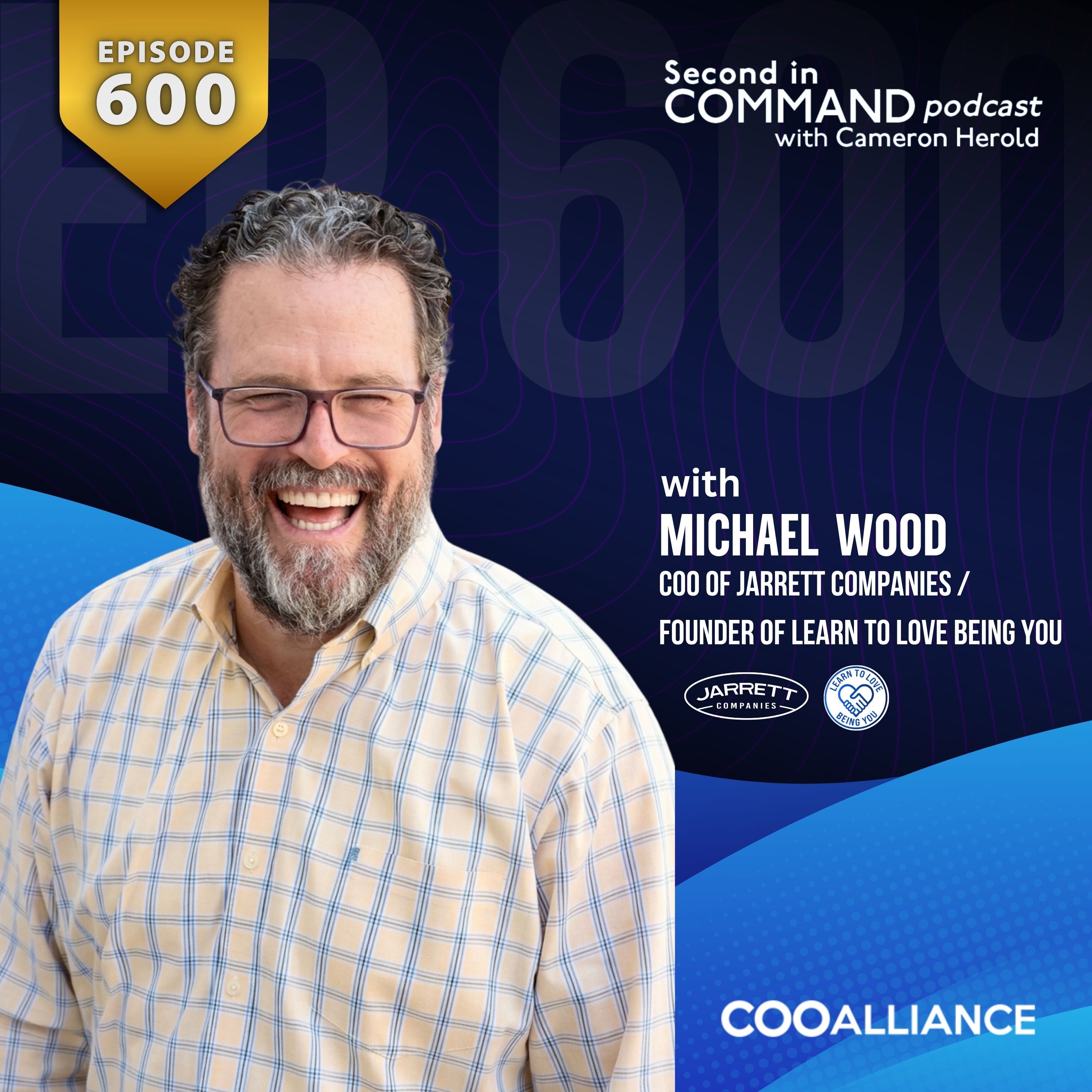
How Mike Wood, COO of Jarrett Companies, scaled a 7-company group from about $2M revenue to over $100M by building “double check” systems, delegating without ego, handling conflict fast, and doing personal transformation (identity removal, forgiveness, extreme ownership) to quiet “noise” and lead with safety.
Mike Wood is a conscious awareness professional and creator of the “Learn to Love Being You” 10-week program. He has 10+ years as COO of Jarrett Companies in Nashville, leading hundreds of high-stakes, emotionally charged conversations. Jarrett scaled from ~$2M to ~$100M+ across seven independent profit centers with shared accounting/admin.
Replace yourself by building trust; solve issues quickly (no lag); create psychological safety before hard conversations; leaders must take ownership of failures; systems fail, so add double checks; remove COO identity and ego to stay calm; personal work improves company health.
A $1M flood claim in a fire protection business where he took 100% blame to trigger team ownership; early five-days-a-week 6am–9am manager meetings using tools like Smartsheet; contract and process double reviews; removing political identities (stopped arguing, turned off news).
Written by AI. May contain mistakes.
Learn about the importance of AI in driving business results and Cadre AI's role.
“AI is not about chasing the latest tools.”
Mike shares his experience scaling Jarrett Companies from $2M to $100M.
“And after rebuilding his own life from the inside out, he's dedicated himself to helping others and also bringing these leadership skills into the companies that he runs.”
Discussion on the changes in responsibilities and team dynamics during company growth.
“So Mike, welcome to the Second Command Podcast.”
Mike discusses the importance of systems and accountability in managing growth.
“Yeah, so I really appreciate you having me on your show.”
Mike talks about the challenges of replacing oneself and dealing with self-doubt.
“Yeah, just growing a team and building systems, right?”
Discussion on navigating office politics and maintaining a healthy culture.
“And it was even a bigger problem because I didn't necessarily have a lot of that myself, although I did have a little bit of noise in the back of my head.”
Mike shares his approach to handling conflict and difficult conversations.
“handling conflict or did he try to defer that often?”
Emphasis on the importance of addressing employee issues quickly to prevent escalation.
“And they're like, hey, I didn't even know that you were mad at me.”
Mike discusses techniques for creating a safe space for honest conversations.
“have a conversation because if somebody is doing something that's on a scale of one to 10, a six, and that six will eventually get you fired over six months time.”
Exploration of using emotional intelligence to enhance leader-employee relationships.
“And one of the things that we try to do, you got to create safety, right?”
Learn about personal development as a leader and how self-reflection enhances team dynamics.
“Cause I talk about when you, I feel I need, how do you feel?”
Discover the importance of humility and introspection in effective leadership and personal growth.
“And it made them feel emboldened and part of the team and part of the creation because I got out of the way.”
Explore Mike's journey through personal challenges and how they shaped his leadership style.
“I was spending working about 90 hours a week on the company, right?”
Understand how dyslexia influenced Mike's leadership journey and personal development.
“Nobody diagnosed me because they didn't at that time.”
Learn about taking ownership of failures and its transformative impact on team dynamics.
“And so as I dove through all of that stuff, it culminated in me creating a program to help others because I literally just changed the entire structure of my life and how I lived.”
Discover how to implement systems in leadership to enhance operational efficiency.
“It's kind of like what husbands are being told when our wives are talking is don't try to solve the problem.”
Learn how implementing effective systems can mitigate errors and enhance accountability.
“It made it easier to, I couldn't wait for the next opportunity for something like that.”
Discover strategies for effectively managing numerous companies and maintaining focus.
“How did you avoid getting sucked into all of the details that could have been or all the meetings?”
Understand the importance of clear communication and trust between COO and CEO.
“And then, yeah, so we kept leveraging those clients and now we've got it into the fire suppression business is phenomenal because it's life safe.”
Reflect on the lessons learned and advice to impart to a younger version of oneself.
“It's kind of miserable and it's been miserable for him because he's a stress ball.”
Explore the journey of self-acceptance and the program designed to help others do the same.
“Now, I need to ask you what's something that you're working on.”

Get the gist, explore an idea or ask about something said.
 Claude
On Second in Command: The Chief Behind the Chief with Cameron Herold, what are the key points of this episode?
Searching your listeningAutomatic transcript. May contain errors.
0:03AI is not about chasing the latest tools. It's about driving real business results. That's why we partner with Cadre AI. They help leadership teams build and execute AI strategies that increase efficiency, profitability, and revenue. Check them out at cadreai.com.
0:27It's very easy to open up and be honest and truthful about whatever is going inside and whatever failures because it's an opportunity to learn, right? All those things are an opportunity to learn if you take it the right way or you can defend it and get mad and whatever and you'd be stuck in the same spot. But you start realizing that every failure, you move forward and get better.
0:50Welcome to the Second in Command podcast, produced by the COO Alliance and brought to you by its founder, Cameron Herold. In the Second in Command podcast, we talk to top COOs who share the insights, strategies, and tactics that made them the chief behind the chief. And now, here's your host, Cameron Herold.
1:15all right our guest today is mike wood mike is a conscious awareness professional and the creator of a program called learn to love being you program but today we're actually going to talk about his 10 plus years of being the coo of jared companies which is a seven company group that he has helped scale from 2 million to over 100 million dollars he's got some incredible insights related to leadership, his ability to put systems in place, never being the people when there's problems or balls being dropped. And after rebuilding his own life from the inside out, he's dedicated himself to helping others and also bringing these leadership skills into the companies that he runs.
1:55As the COO of Jarrett Companies, he's led hundreds of high stakes, emotionally charged conversations. We're going to talk about that. He also goes into really working with this kind of no-nonsense approach to personal transformation and growing people but also being able to show up grounded in his role as COO of a very complex company. He blends spiritual insight, grounded psychology, and a goofy sense of humor to help people open up, relax, and finally breathe. And you're going to love this episode. So we'll see you on the inside. Again, today we have Mike Wood, who is the COO of the Jarrett Companies.
2:30We'll see you on the inside. So Mike, welcome to the Second Command Podcast. I appreciate you having me. Yeah, looking forward to this. You're down in Nashville right now. I'm up in Vancouver, Canada. I love the ability to leverage technology and connect with each other. I wish I was there in person, but nice to meet you and be able to put a face to a name. I want to dive in a little bit about some of your story. And there's one fun fact there for everybody. You and I have a very similar trajectory. You joined the Jerick Group when there was only$2 million in revenue. And you've grown to over$100 million in revenue.
3:05And that was my exact story from those exact numbers, 2 million to 106 million with 1-800-GOT-JUNK back in the day. So clearly it was the same, right? Every single business was exactly the same. What are some of the distinct changes that you saw at different sizes of the company? Can you walk us through some of those? Like go back to what it was like being a second in command and in a very small entrepreneurial company. How have you had to change? How has the company changed? How does your day-to-day spend some time on that with us? Yeah, so I really appreciate you having me on your show. And to answer your question, it was an evolution of when I showed up, I knew how to do the job as an estimator and a project manager.
3:51And as we were scaling and growing, I was constantly replacing myself. And that was one of the biggest lessons that I learned through the growth. Because we ended up building seven different companies. and every time we were growing one facet of the company, it was a repeatable process. We constantly had to find a replacement for that guy so he could do more. The most valuable guy in the group needs to be able to sell and be the face of each division because each one of the seven companies that we have, they run independently of each other. The accounting and the admin parts of our business, they all function as one.
4:33Everything flows through one. But other than that, everything is its own profit center. Everything is operating and functioning as its own independent company. Obviously, we leverage our clients against each other and everything. But that was one of the bigger issues that we had. And the next biggest thing was just me learning. What was the issue? Was it the shared services and how to manage it that way? Or what was that issue. Yeah, just growing a team and building systems, right? So the big issues that we were having is just, you know, you're growing that fast, there's mistakes going to happen.
5:11And so very early on, we started putting systems in place. It's almost like a double check. We basically had meetings five days a week from six o 'clock in the morning till nine o 'clock in the morning. And so we were stuck in this room, but we created, well, we used smart sheets at the time. And now we've kind of moved on from that, but we basically address every job that we had going on at least once a week with the managers. And we would put, write down all their tasks and hold each one of them accountable so nobody can get sideways because next week we would look at it again. And so we started putting systems in place that were double checks on everything in the building because we were making mistakes.
5:51Every time we made a mistake, we ended up putting another system in place. And after five or six years of doing that, you know, we had a well oiled machine and adding more divisions and more companies to it. It was just a matter of finding the right people at that point. That was a good place to be. You mentioned something about constantly replacing yourself. In the earlier days, were you ever worried about, well, if I hire somebody to do everything I'm doing, what am I going to do? Like, was that ever anything you had to work through that either a little bit of imposter syndrome or just wondering what the heck is my job going to be if I delegate it to everybody else.
6:29It's like you've done this before. A hundred percent. That's a big problem. And it was even a bigger problem because I didn't necessarily have a lot of that myself, although I did have a little bit of noise in the back of my head. But most everybody that I was trying to get to replace themselves, we ran into that problem. Everybody's worried that if I allow somebody to do what I'm doing, you're going to just let them do my job and run me out of here. So we had to build trust with people, make them feel safe, show them, not just tell them what to do, but show them the benefits of this and how it's going to move forward if we do this.
7:04But yeah, absolutely. I 100 % had imposter syndrome and I got to see it in a lot of other folks along the way. It's interesting because the entrepreneur tends to be much better at delegating everything except genius. And then I think the COO tends to be pretty darn good at it pretty early. But it is some of those earlier stage managers that tend to struggle with that. Sometimes they seem to almost like hold on to responsibility to build something out and that almost becomes political. Did you ever have to deal with any politics inside of the org or were you able to keep that fairly clean considering you were running the seven distinct businesses?
7:42There's been some, but we filtered through it pretty quick because one of the things that you know the boss jason jarrett was very good at is relationship building and so whenever there was an issue i mean it would be seven people in the room talking about it and and it taught me very early on that that is a very intelligent way to solve a problem and keep the division you can't go to this side over here and start having a conversation because if it makes it back over here we're all going to go right back in that conference room and I'll talk about it. So people really quickly learned that you couldn't just have a conversation.
8:17And if somebody was carrying on negative negativity and trying to create division or politics in the office, then they didn't exist. They moved on pretty quick. Yeah. They get pushed out of that culture pretty quickly. Was he, was Jason pretty good at handling conflict or did he try to defer that often? I find some of the more entrepreneurial, newer entrepreneurs tend to struggle with conflict situations. They like to avoid it. Sometimes they're trying to be liked. Maybe they often either avoid it or they want someone to handle it for them. Was he good at handling that stuff or did he deflect some of that to you?
8:56So we worked through it together early on. And so we both had different approaches. I was very calm, analytical. I could get excited too, but he would be like a firecracker. He would explode. And so we had to find a balance between exploding and being too calm and nice. And ultimately, he probably agreed that I won that war, but it took a long time. Once the company started making money and we were financially stable, then his ability to pop quick would leave. And by that time, I got really good at having an honest conversation with people. and once I showed Jason like look I don't have to get mad but I'm gonna let them know really quick like hey this is the problem I care about you you've done a good job up to this point but you got these things going on here and if you can't fix those things you can't be here anymore and just having those really harsh honest conversations kind of swung the pendulum to where I was able to have most of those conversations and they were very uncomfortable at first but after a while you get used to being honest with people because you'd rather super honest with somebody and have that conversation, then blow up, get mad and fire somebody and regret it.
10:11And they're like, hey, I didn't even know that you were mad at me. How often were the conflict discussions or the issues that you were addressing, how often did they get to the, you know, if you can't fix this, you can't stay here versus, you know, here's something we're struggling with. Let's work through it. Like, how often was it more of that come to Jesus style meeting? you know in the beginning we were working it out because neither one of us had done it at the level we were doing so i would say the first two or three years it was this battle of we'd let some things go before we had the balls to actually have a real conversation and then we would get mad and have a conversation but somewhere five six years into it it is immediately because lag time is a big issue if you let an issue go on for too long it creates more animosity more scared people in the room.
11:01And what I've learned just personally, and I think we all agree here at Jared at this point, like if you're having a problem with an employee, there is no time to waste this week. You need to sit them down and have that conversation within days. You need to have a conversation because if somebody is doing something that's on a scale of one to 10, a six, and that six will eventually get you fired over six months time. like let's not wait until two months and now we're all pissed off we can handle it this week and get everybody back on board so part of the growth process we've gotten very good at having those conversations early I like that you actually addressed the the having them early as well I think in my I launched a course a few years ago called invest in your leaders and it's the 12 core management and leader skills that everybody needs to be good at and one of the modules is conflict management.
11:55And I talk about racing to the conflict that you need to address it quickly, but I always like to have a diffusing period before I race to it. Like, you know, if I'm pissed off or I'm upset or something's really struggled, I need to get my energy level down a little bit to then race to the conflict. How do you get your energy level under control or how do you control some of the EQ going into that, you know, emotionally charged conversation? And then when you're in it with the other individual, how do you bring them back and center them as well? Do you have any things that you say that you approach it?
12:28Absolutely. So I've been teaching a leadership course for the last couple of years that we developed for our younger leaders. And we talk about this specifically. And one of the things that we try to do, you got to create safety, right? If I come in to an employee and I'm just pissed and I'm giving giving all these things about what is going on, they're going to immediately feel defensive and they're going to have a hard time hearing anything I got to say after that. They're going to put up their dutes. So I like to create a safe environment by sitting down like, hey, Jimmy, I care about you. You do a great job, A, B, C, and you create space.
13:06And that helps in that environment when you first go in there. But if you live that way as a businessman and you actually ask your employees how they're doing, you actually know what's going on in their lives, it helps those conversations become even better. Because when you do engage with them in a difficult conversation, they know that you actually care. So it's not a false, like, I care about you now when we're having a hard time. You really do give a shit. Yeah, absolutely. And so then the second part of it is when we're trying to get to something and it can get back and forth, we try to address the feelings of what's happening.
13:41Because when you identify the feelings, everybody's able to say, well, look, man, when you're doing A, B, and C, you're making me feel this way. And now all of a sudden you're disarming everything. Everybody's, and then they'll tell you how they feel. And you can get a full dialogue of a conversation going on. And it's, it's actually, it can be beautiful sometimes. It's almost like you co-wrote my course for me. Cause I talk about when you, I feel I need, how do you feel? And I get those feelings out there and there's really nowhere to go when you drop them in. But I also really like that You started with the whole safety and security.
14:14And if you look at Maslow's hierarchy of needs, that's the second tier. The first one is just base pay and making sure that they can afford to pay for their life. The second one is feeling like safe and secure. And it's kind of like addressing conflict with our kids, right? If one of our kids does something wrong, we're like, hey, I love you. You're amazing. And you can't do this like this anymore. This is how it's making, right? So yeah. Do you ever tie leading people back to like living as an adult in relationships? Or do you frame leadership in other ways at all that help you? Yeah. So I try to get folks to, you know, work on themselves and create that safety within themselves.
14:58You know, I've been working really hard on that myself. somewhere about seven years ago in the middle of this thing, I started working on myself. Our company was going on a downward bit of a spiral there, having a really hard time. And so I dove in 80 hours a week. And through that process, once I got done and we moved people around and we put double checks on some of these things that were costing us money, contract reviews and some pretty powerful points that we fixed. It took about six months of just crazy time. I got to the end of it. I realized how many of the mistakes I made personally to create those problems.
15:40And so to answer your question, one of the biggest things that I did is I read Jocko's book on taking extreme ownership. And I implemented it into all facets of my life, into a personal, but the business part of it. And just helping folks understand that if you're constantly thinking negative thoughts, fearful thoughts, your body literally goes into a chemical state where you're producing cortisol, you go into the default mode network, and we lose our intelligence, right? So as a leader, if I get excited and pissed off, I'm going into the default mode network, becoming dumber, and now I'm trying to address and solve problems at half capacity.
16:27And I'm not very effective. And I realized I was doing a lot of that. I realized I was going to meetings and I was answering all the questions, although half the crew could have answered those questions. So I started shutting up. I started working on a lot of things on myself that really ultimately took the company that we were at. It allowed it to flourish and allowed it to grow because these young leaders were now able to speak. And it made them feel emboldened and part of the team and part of the creation because I got out of the way. There was a lot of taking ownership of my own egoic problems.
17:01And through that process, that's what I try to teach in my leadership courses now is to work on ourselves. to be a true leader. And you have to be able to project safety onto your team. And you also have to be able to use the full capacity of your brainpower. And in order to do that, you have to be able to stay in a calm, safe space internally. And it's not easy to do. There's simple manual tools to do it. And you can take it further and actually go back and heal things. And, you know, obviously I'm not telling our team to go heal, but, you know, definitely got to get calm. Well, in some ways, maybe that is growth in the right time and in the right place for them when you're going through some personal development, sometimes some childhood traumas or, you know, traumas that are layering up at work.
17:44I think often I've always felt like we're 15 year olds trapped in adult bodies. You know, I'm still my 15 year old little kid. You're your 15 year old Mike Wood. At the end of the day, we're still struggling with some of that same shit that we then bring into the boardroom or into meetings. and I like you are examining your contribution to the issues, but you're also working on your growth as well as leading others, right? Versus just pointing the fingers at them. You mentioned in the growth of the 2 million to 100 million that there were some mistakes along the way. I mean, that's obvious. Every company has them.
18:17I did a speak event in Austria to a group of CEOs about six months ago. And at one point, I kind of broke up in some tears. I was doing a fireside chat and I decided to do the entire 90 minute presentation about failure. And I never talked about one thing I did well. It was fucking hard, man. I had a lot of examples, but it was hard to get that raw and that real. But I think that is where some of the growth comes from. Right. And I think when we, so what was a good failure that you had, you know, in your time as COO and what was the big lessons or the big ahas from that for you? You know, I was kind of an arrogant shit bit to think that I was, you know, yeah, I was the man over here, you know, doing all these things, but I, I was causing problems to think that I wasn't part of any of the problems that were happening was arrogant.
19:06And, and I didn't want to hear it in the back of my head. And honestly, that was the biggest one for me. You know, it changed my entire life in so many ways. And was it that one book that really gave you the big aha moment? No, no, man. I had a full spiritual awakening. I was telling you that story. I was spending working about 90 hours a week on the company, right? I basically got hit, ran into a wall and I looked around. I didn't know what to do. Everything was fixed. We downsized the biggest one that was causing the problem. Everything was moving great. And that was smaller. It was calm, right?
19:42And we were doing business with just high quality customers. We had down cut our field staff in half and they were the top guys. So everything started running really smooth after we got done. Contracts were getting double triple reviews, double triple reviews. Like, so all the problems that we were having were kind of fixed, but I was sitting in my office just staring at my fish tank, didn't know what to do. And the noise in my head was screaming at me. Like I was literally more miserable at that point than I'd ever been in my life. I was making more money. My wife was able to stay home. Kids are happy and healthy.
20:16I had a great job and I was more miserable at that point than I'd been in any point in my life. And I turned that focus. I realized that how many of those problems were mine and that noise in my head, I told my boss at one point that I was going to quiet my mind by any means necessary. And I didn't know what that meant, but I did mean it. I just didn't know what it entailed. And I just turned my focus inward. And when I did, it was just. What was the noise in your head. What were you saying to yourself or what were you hearing? Oh man, I was unworthy. I was stupid. So I learned how to read past the second grade, 25 years old.
20:58All right. If you're the COO of a company that does at least 2 million or greater in revenue, or you're the CEO of a company and you're in the United States or Canada, if you would like a copy of my book, The Second in Command, for free, go to cooalliance.com forward slash free book. That's cooalliance forward slash free book, and I will mail you a copy for free. I will even cover the shipping. Jump on that one today.
21:35I'm a form of dyslexia, and I just basically scrambled through school. They just pushed me on. Nobody diagnosed me because they didn't at that time. They didn't know anything about dyslexia. At least a rare few did know about it. And it wasn't that I couldn't read because with every curse, there's a blessing, right? So I could do math in my head when I was three years old. Basic division and problem-solving skills is really what I think my true gift is. But when you're a little kid and you feel less than because you can't read like the other ones and you're embarrassed to read out loud, it leaves old negative core beliefs that just sing their song.
22:15Every time there's a problem, they're singing, and they get louder and louder, especially in stressful situations. And that's the stuff that makes us respond instead of or react quickly and in a negative way versus thinking and responding in an intelligent way. And so as I dove through all of that stuff, it culminated in me creating a program to help others because I literally just changed the entire structure of my life and how I lived. Everything that was inside started to get clean. It was like having a spring cleaning. And through that process, it completely affected everything at the company.
22:51Everything changed in a positive way. We started attracting better employees. Everything started to move in a different way. And I truly believe that a healthy leader is going to, you know, have a much better chance of driving a healthy company. I love that level of introspection. I mean, I heard a couple of things. One is that every time we point a finger at somebody, there's three fingers pointing back at us. And it takes a lot of courage to examine our contribution to the issues. But the other one was that you learn to not speak up as quickly and to let the people in the room speak. I've always said the leader needs to speak last.
23:29And our job is to grow their confidence and their skills. And we can't grow either if we're giving them every answer, if we're speaking all the time. How did you learn to shut up and to not speak? Did you sit on your hands? Did you force yourself to ask people what they thought? Like, was there anything you did? Or did you just get real cognizant of it and work at it? Yeah, I got real cognizant of it. And I don't remember the exact moment, the exact lesson that I learned. But Cameron, I dissected everything. Identities, that was another big one. Removing the identity of being a COO, it sounds like a crazy thing, but you can remove that in a matter of seconds.
24:06And somebody could walk in 10 minutes later and say, hey, Mike, you know, I'm pissed off you did this, this, this, this, and this. Well, eight years ago, I would have been fighting mad, wanted to run him out of the building, maybe beat him up in the parking lot. Now when they come in and do that, I'm like, all right, man, slow down, slow down. Help me understand what you're saying here. I'm not taking any offense and I'm having zero physical reaction because my subconscious mind isn't reacting to defend myself. In my personal life, it's even had even a bigger effect with my wife. I'm not a husband.
24:37I'm not a father. I'm not a grandfather. I'm so much more than all those things, including a COO. And so now removing those threats where my subconscious mind doesn't have to defend all that, it just makes it so much easier to do like you did on that speech that you gave because there's nothing to defend. It gets very easy to open up and be honest and truthful about whatever is going inside and whatever failures because it's an opportunity to learn, right? All those things are an opportunity to learn if you take it the right way or you can defend it and get mad and whatever and you'd be stuck in the same spot.
25:12But you start realizing that every failure you move forward and get better, it's like, holy moly, I can't wait for the next failure. This is going to be great. Like I'm going to get to learn again. It's kind of like what husbands are being told when our wives are talking is don't try to solve the problem. Just listen to them. And at the end, they go, well, thank you for just listening. Sometimes our team needs the same thing, right? Somebody just to listen and to care and to hear them out. But so I'm curious, one of the things that I've always said about COOs is our job is to make the CEO iconic, right?
25:43Our job is to make the entrepreneur look good, which means we're often in the shadows, right? We're often not the face of the company. I think you said that, you know, your wins are the company's wins, but your losses are yours alone. Absolutely. How do you work through that and own that? And how do you rationalize being okay with that? Is that an ego thing that you've just worked on? Is it a skill set you had to develop? And do you really mean that or do you struggle with that? No, because it opens it up, creates safety. I can give you a great example of this. So we built a fire protection company.
26:19I've never been in the fire protection industry. I don't know. I can't hang a sprinkler head, right? But now we're running this company and we, about three years in, we flood a high rise building. It ends up being a million dollar claim. And if we continue to do that, we don't be out of business. We won't be able to get insured. So we got this big problem on our hands and it's up to me to solve this problem. Right. And then Jason's involved, but I'm taking the charge here to solve this. And so I knew going into that meeting, I needed to take a hundred percent ownership of that problem. So I walked into that meeting and I was like, how do I do this?
26:55All right, well, simple. All right, guys, we've been here for three years. Before we get started here, I want you guys to know that this flood is my fault. And they're kind of scoffing at me and laughing at me. And I said, no, how many times you guys been trained in the last three years? And they all looked around and said, no, none of us been trained on anything. I said, how many Shuroffs are in your trucks that could have prevented this flood? Well, none. I said, those are both my fault, right? We could have put implemented training and we could have made sure that you had the tools you needed to prevent this.
27:27And those are my fault. And immediately the guys around the room were starting to go, Mike, that wasn't your fault. I could have done A, B, and C. And then it just went around the room. And it was one of the most beautiful moments where everybody started taking ownership. So to go back to your question, because it's a little off point, but when I started having those wins, we created success out of that. That's what made it so easy for me to continue to do that and to own my own stuff is because I started to see how amazing it was when I took all the pressure off of everybody. It made it easier to, I couldn't wait for the next opportunity for something like that.
28:06Michael Gerber years ago wrote a book called The E-Myth Revisited, and he talked about that people don't fail, systems fail. I think it was very much that mindset that you went into, because you talked a little bit about that, that when something went wrong, you would look for a system to figure out or systems to take care of making mistakes. Was that a kind of mantra that you operated with? And how did you approach putting systems in place? I had a CEO that I coached years ago, one-on-one for a couple of years. And one day he said that they'd put 82 SOPs in place. I'm like, dude, you've probably wasted your time on 72 of them.
28:40Like, how did you know what to really spend time systemizing and what to let just run as it on its own? What I understood, and I kind of started this at it. I was a construction manager of a company before I came to Jared. It was an engineering firm that managed paving programs. And for Davidson County, I was over the paving program for Davidson County. And I put this system in place because they were dropping balls left and right. And so basically what I come up with this idea in my head and I carried it to Jared. And basically what I did is I hired a very super OCD girl to work with me. And she's the opposite of me, right?
29:22I'm this guy that can't read, not find details. So this girl is taking care of my contract. She's putting everything in a spreadsheet for me. And if anybody gets out of whack on that spreadsheet, I get an email, right? And so you're right. Do you need to create 80 something procedures? Probably not. But what I would say everybody needs is a double check on everything. Two separate systems running on the same thing. Like if I got a project manager that's running a job and they got to do all these things to get a job completed. Well, I've got a project coordinator that is my right hand that doesn't work for them.
29:59They're working alongside them as an equal. And their job is to make sure everything gets done properly. And if it doesn't, then I get notified because I can't get involved in everything that's going on when we're running this at a certain level. And so what I would argue is regardless of how many SOPs you have and how many different systems you have, there just needs to be a double check on everybody. That's my philosophy that I run on is we have a double check on everybody in the building because, you know, I did it before. I get to work every morning at 545. And for about six months when we went through that problem, I went to a job, a$16 million construction job for the MPSU here in Murfreesboro.
30:42And it was 10 minutes from my house because nobody was watching. I was showing up to work barely at six o 'clock. But when I had to drive 45 minutes and everybody was going to be there, I was 15, 20 minutes early every day by clockwork. When nobody's watching, it's the hardest thing for an owner to do is to show up every day on time because nobody's watching that owner. The owner could sleep in and nobody could say anything. And so I think that's human nature. And when we put these double checks on everything and hold everybody accountable with just transparency is all it is, then I think those systems, they work.
31:18So whenever we come into a problem, we just put that double check system into effect and it typically solves the problem. Solves everything. I'm curious how in terms of building out these seven different companies, how did you orbit the kind of giant hairball? How did you avoid getting sucked into all of the details that could have been or all the meetings? Like, how did you focus your time and decide what to spend time on when there was so many potential moving parts? So, like I said, I was in meetings five days a week from six o 'clock in the morning until nine o 'clock. So we would stagger meetings depending on some companies, like especially fire, because they had so many different divisions.
31:58They would be spread out through the week, but it would be 45 minutes to an hour meetings. And so we would just go through them. And after those meetings, I would basically trust them. But we got to find the right leaders to lead and get out of their way, right? We're going to hold everybody accountable in these meetings. We're going to make sure the client is being taken care of in these meetings. But after that, you know, like, do your thing, baby. Like, here's the plan. Let's go. We trust you, you know, run hard. And as long as you got the right leader and you incentivize them, and that's one thing I got to give Jason credit for, the owner here, is that he's had no problem sharing the profits with folks.
32:38We would incentivize folks, the leaders, the true leaders, the earners, they would get profit share agreements. And when you got somebody who's a good employee that's going to run and you incentivize him, man, now you got another owner here and they're going to run hard. And as long as you have that guy putting all the double checks in place and letting him run and having an open door where he can come to you and he's not hiding things, the thing will, it'll virtually take care of itself to some extent. Were these seven companies truly like separate, separate, separate companies or were they just more separate products but to the similar customer base?
33:18similar customer base so like yeah so we got we started with a grading in underground utility company which was the mother chip and then we added paving concrete so we're paving roads parking lots that's paving and concrete was kind of like a utility tool to go with them and then from there we built a fire suppression because it was all the same clients fire suppression added to it. And then, yeah, so we kept leveraging those clients and now we've got it into the fire suppression business is phenomenal because it's life safe. Everybody wants it. And so we built a massive service division. We were doing all facets of it, tenant and contract.
33:58But what my passion was, was the service department. So we ended up selling our fire protection company to a PE firm Well, since then, we have started a service department that has HVAC, electrical, and plumbing. And now those are all taking off. Yeah, those are all very different companies, for sure. I mean, when you explain the high level of each of the products, those are pretty darn different. You mentioned that you're constantly translating between vision and operations. You've got to think like the CEO, but execute like the team. How do you do that? How do you stay on the same page with the CEO and then communicate that vision to the team?
34:39And then how do you make sure the CEO is up to speed with what you guys are working on and how you're making the vision come true? So, you know, Jason and I have become pretty good friends over the years, and we built a really good trust. So I know where my boundaries are. I know what I need to take to him. I know when I can make a decision, and I really need to get him involved. and I know when I can handle it and I never need to know about it, right? We could just work through it. And because at the end of the day, he's getting to the point where he'd like to not do this anymore. It's kind of miserable and it's been miserable for him because he's a stress ball.
35:18Yeah. So I try to balance that out. But in order to communicate that, you know, we've got seven companies and we've got seven leaders of these companies. And one of the best ways I can communicate where we're going, what we're doing is just to have a really solid relationship with all of them in the next level below that as well. But, you know, just building those relationships, having a conversation, trying to push them for growth, trying to help them facilitate where we're going and have that take over the world mentality with, you know, within reason, not trying to run yourself into the ground either.
35:54But we want to continue to grow and make money. I like it. I want you to think back to when you were a little younger. You know, you're 21 or 22 years old. You're just starting out in your career. I imagine you still had some of that childhood wounding of the really rough ADD that you had or dyslexia, I'm sorry, that you had. What advice would you give the younger you that you know to be true today but you wish you'd known when you were a little bit younger? I would tell them, you know, show up early, stay late. you know learn how to do your boss's job you know become so valuable whatever your boss is doing just pay attention and and try to take something from them you know oh you're doing that i got you i got you i'll stay a little later and i'll do that or get it done in your normal day and before long your boss is going to look to you when there's an opportunity and you're going to get an opportunity that would have been the first thing that i said but then you know my younger 20 year old self probably couldn't have handled some of the other advice I gave him because I was still mentally not okay to handle some of it, right?
36:58Like I probably wasn't, but that one - We were retarded at 21. Yes. Yes, I was for sure. I was dealing with so much internal pain that I couldn't have processed most of the information that I would give to my younger self. Now, I need to ask you what's something that you're working on. I don't know if this is a passion project or something you're also doing to make money. But you've got kind of down here that you're the founder of Learn to Love Being You. And I want to ask a little bit about that. What is that all about, learning to love being you? And how have you learned to love being you in your journey as an adult, as a leader?
37:34It's changed everything for me. It's kind of a passion project, but it's like, it's what I don't ever want to quit working. I love continuing to do this, but what I want to do in the next chapter of my life is help people. And so the journey that I went on, I turned it into a 10-week program. And the first three weeks are basically learning how to take manual control over your thoughts and learning how to bring yourself down to zero to where you have full capacity of your brain and not be just drug around by our thoughts and emotions. Once we get through that, then we really, the main three things are removing identities like we spoke about earlier, just going through that process.
38:19And because it's such a liberating, freeing thing. The first time I did that, I removed a Titans fan and politics from my, I won't tell you what side of the fence I was on, but I would just obsessively want to talk politics all day long. And I'm going through this process. I removed it in one day and all of a sudden I wasn't arguing anymore. I turned off the news and my life just got so much better. And when whenever one party would say something, it didn't physically I didn't have a response to argue and get mad anymore. I just was able to just relax and be removing identities is super powerful thing for anybody to do.
38:56You know, that's very European, by the way. I've been in 80 countries in the last five years. I'm heading off tonight to the UK. I'll be in three countries in the next four weeks. the Europeans talk about politics as if they're passionately engaged in talking about a football game, like a soccer game as well. And as soon as they've told their buddy that they're an idiot and their opinion is stupid, and here's my opinion, then they're like, all right, we're done. Let's go for beer together. Like they stay good friends. Like they're just passionately engaged and stuff, but they're not so oppositionally defiant that the other person can't be their friend.
39:30And I think we have more of that. We need to be able to, to debate and discuss, but I like that you were able to then, you know, divorce yourself from it as well. Yeah. Yeah. It was, it was liberating. The next part of that program is just forgiveness. And then the part, the reason I, I truly created this program is because I developed a writing program to go back to those childhood memories, reframe them with love, compassion, and forgiveness, and they stop haunting us. So the noise in my head that used to tell me I was stupid or dumb or not as smart as everybody else, it stopped. And it took me a couple of years to really get through all of that.
40:05And then I found so many more that were haunting me as well, not the obvious ones that you would think. And as I got those out of the way, it's like this started to naturally get quiet. So I didn't have to just use the manual tools to calm myself down. It started to get naturally quiet on its own. Doesn't mean I don't have thoughts anymore, but it just changed every aspect of my life. Work was probably one of the major ones, but my relationship with my wife and kids just became more present. I would have never said this five years ago, but the most valuable thing that we can give anybody is our presence.
40:42And to be actually be present and not waiting to talk and hear somebody out and whatever, it enriches all the relationships that I have with people. And I couldn't have done that. And I'd like to be able to continue to share that with other people. And that's what that program is about. Thank you. I love that you were also able to quiet the noise in your own head, even if it wasn't getting you to want to talk. Whatever that chatter was, was removing you from staying present. And you seem, you know, very, very grounded. Well, Mike Wood, the COO of Jarrett Companies, thanks so much for sharing with us today on the Second Command Podcast.
41:19Super appreciative of the time and the wisdom you shared today. Yeah, appreciate you too. Thank you. All right, man. Thank you very much. You've been listening to Second in Command brought to you by COO Alliance founder Cameron Harreld. If you enjoyed this episode, please be sure to like, share, and subscribe to us on Apple Podcasts, Spotify, and our other podcast streaming platforms. For more best practices from industry-leading COOs, visit COOalliance.com.
42:05All right, listen up. If you're the COO or a second-in-command leading a company doing between 2 million and 200 million a year, this is for you. We connect you with a vetted network of elite operators designed to help you grow faster and make better decisions. We have over 175 members globally, and we've had 800 COOs join us. And if you don't get at least 10 extra investment in revenue or cost saving ideas, we'll give you your money back. Here's how it works. First, the vetting. Most COO networks are built for volume. They accept almost anyone, regardless of experience, role, relevance, or really even what area of the business you're operating in.
42:43That puts you in a room with people at completely different stages, facing completely different problems, which makes the conversations less useful. We don't do that. Every member of the COO Alliance is a true second in command inside of a$2 million plus company, actively running a team, and every applicant goes through a live vetting call before joining. So that's what keeps the network relevant and high level. Second, the group model. A lot of networks group people at the exact same level. It creates comfort, but it doesn't create growth. We intentionally build groups with a mix of people slightly ahead of you, people that you can help and people that can help you because they're all operating at roughly the same level.
43:23This creates better conversations, stronger thinking, and real forward movement. Third, structure and community. Most networks lack structure. There's no agenda, no accountability, and no clear outcome. We fix that. With every session designed with a clear objective so you leave with decisions, not just random discussions. And outside of the sessions, you're part of a real network that you can tap into anytime with people you've already solved problems with that you're dealing with. Everything is confidential and everything happens consistently. You get 12 monthly mastermind sessions. You get AI focused sessions.
43:58You can come to two of our in-person COO Connect events every year and now a third that we're operating globally. Because as an operator, you don't rise to your goals, you fall to your systems. We build that system for you and here's our commitment. If you attend at least 10 sessions over the course of a year, if you show up and engage, if you don't discover at least 10 times your investment in value through new revenue or cost savings, we're giving your money back. And out of the 800 plus members that we've had, only four have ever asked for that refund. This is why the best operators don't do it alone.
44:33So if you're the COO running a$2 million plus company and you're still figuring it out alone, or if you're the CEO running that company and you think your COO is, apply now or drop us an email. Check us out at COOalliance.com.
Ever wonder what happens when the COO who scaled a company to $100 million realizes he was the problem?
In this episode, Cameron sits down with Mike Wood, COO of Jarrett Companies, who joined a $2 million Nashville construction firm and helped grow it into seven companies doing over $100 million.
They get into the machinery behind that growth: meetings from 6 to 9 a.m., five days a week, a double check on everybody in the building, and profit sharing that turns leaders into owners. Then it goes deeper. Mike opens up about learning to read at 25, the misery that followed his biggest turnaround, and the million-dollar flood where taking full ownership changed his entire team.
If the noise in your head is louder than the problems on your desk, this conversation is your way out. Listen now.
Sponsored by:
STS Capital – A global M&A advisory firm helping entrepreneurs achieve maximum value when selling their business, with a focus on strategic buyers and life-changing exits.
Learn more: https://stscapital.com
Timestamped Highlights05:30 - Two million to one hundred million: why Mike had to keep replacing himself, over and over
07:38 - Meetings from 6 to 9 a.m., five days a week: the double check habit that ended repeat mistakes
13:16 - The six out of ten rule: why waiting two months on a problem employee costs you everything
15:51 - How to create safety before a hard conversation, so people can actually hear you
18:41 - The science of angry leadership: cortisol, the default mode network, and why exploding makes you dumber
23:26 - More money, happy family, great job, and the most miserable he had ever been: the fish tank moment
24:30 - Learning to read at 25: how a rare form of dyslexia wrote the negative script in Mike's head
30:28 - "This flood is my fault": the $1 million claim that became a masterclass in taking ownership
34:32 - What owners do when nobody is watching, and why every person in the building needs a double check
42:10 - Inside Learn to Love Being You: removing identities, forgiveness, and rewriting the stories that haunt us
About the GuestMike Wood is the COO of Jarrett Companies, a Nashville-based commercial construction group spanning site work, paving, concrete, fire protection, and mechanical services. Since joining as an estimator and project manager, he has helped grow the business from $2 million to more than $100 million in revenue across seven companies, including a fire protection company later sold to a private equity firm. Mike is also the founder of Learn to Love Being You, a 10-week program that helps people quiet anxiety and self-doubt through the same inner work that transformed his own leadership.
Mentioned ResourcesThe Second in Command Podcast is an original production hosted by Cameron Herold. Brought to you by COO Alliance. Production and editing by Podcast Your Brand.
Sponsored by:
STS Capital – A global M&A advisory firm helping entrepreneurs achieve maximum value when selling their business, with a focus on strategic buyers and life-changing exits.
Learn more: https://stscapital.com


