
 Ask ChatGPT

 Second in Command: The Chief Behind the Chief with Cameron Herold
11 Aug 2026 · 50m · 20 chapters
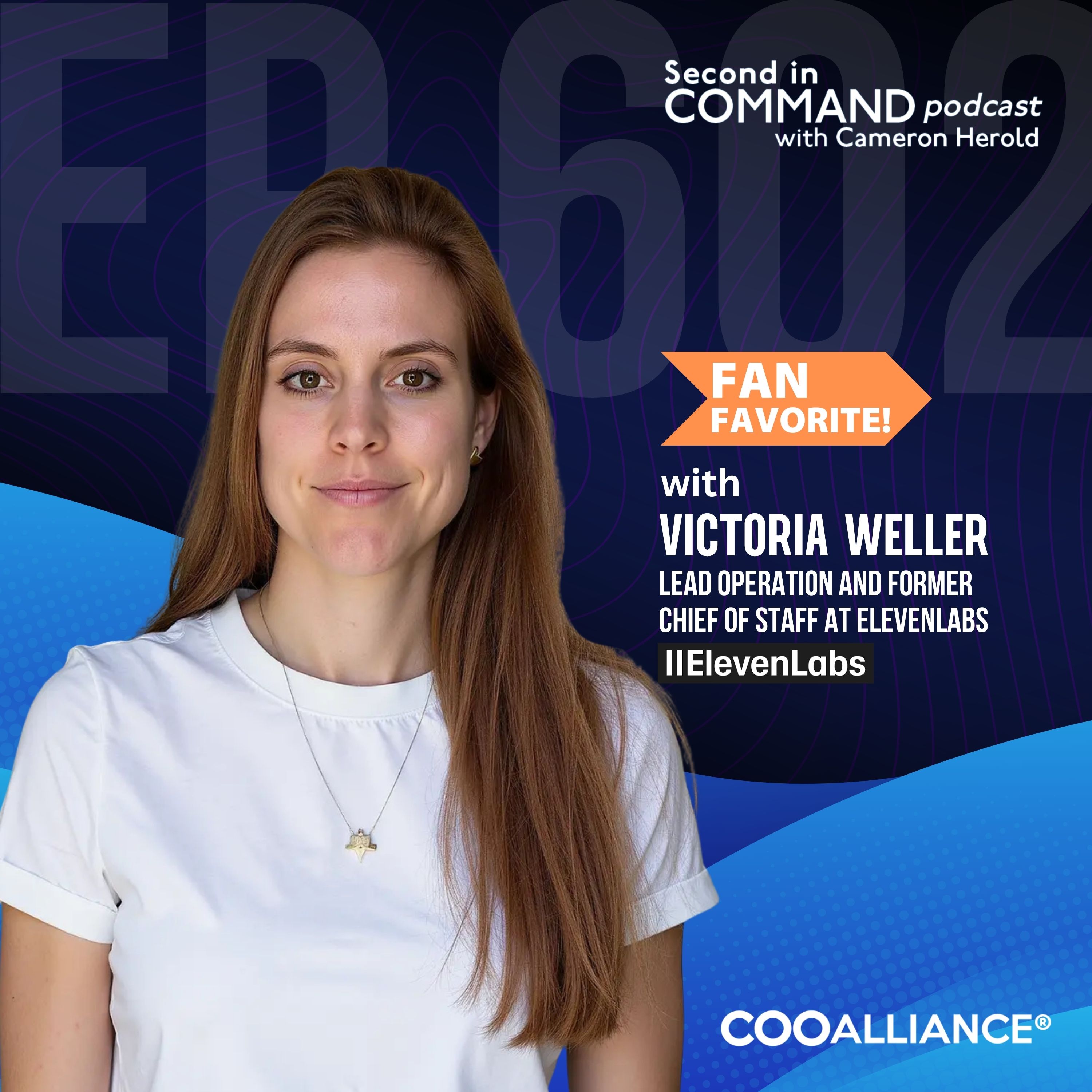
Victoria Weller (ElevenLabs chief of staff) explains her path from astrophysics/space medicine into AI operations, then details ElevenLabs’ text-to-speech mission, product use cases, and safety/compliance for voice cloning and deepfake prevention.
Weller grew up in Munich (international school), studied astrophysics at Edinburgh, researched cardiovascular changes in microgravity at Berlin’s Charité space medicine center, and did satellite simulation work in Berlin. She earned a master’s in applied physics at Columbia, worked in quantum-secure encryption startup Crypt, then joined Palantir (reliability engineering) in 2019, relocating to London during the pandemic. She joined ElevenLabs in May as chief of staff, owning internal operations, compliance, hiring, and HR.
ElevenLabs aims for universally accessible content “in any language and voice.” It raised $20M at a $100M valuation in 2023, has millions of B2C users, and launched public beta in February (incorporated earlier). Great operators “never wait for the answer” and instead figure things out.
dubbing a podcast into another language while keeping the original voice; generating audiobooks from EPUB with character-specific voices; contextual emotional speech (“sad” vs “happy” sounding different); hospital pre-surgery side-effect readouts; bus-stop announcements; accessibility for visually impaired users and people who lost their voice. Voice cloning safeguards include voice capture/proof of rights and an AI speech classifier to detect ElevenLabs-generated audio.
Written by AI. May contain mistakes.
Victoria shares her diverse living experiences in major cities around the world.
“So Victoria, welcome to the Second Command podcast.”
Victoria discusses her education in astrophysics and early career in space medicine.
“Yeah, I've been very lucky to be able to move around that much.”
Victoria explains her transition from astrophysics to the tech industry and data science.
“I would have really liked to continue thinking about astronauts or maybe even becoming one.”
Victoria describes her current role at Eleven Labs and its operations.
“The startup is called Crypt and they do quantum secure data encryption.”
Victoria discusses the leap from astrophysics to business, emphasizing logic.
“So I was at Palantir in New York for the first couple of months until the pandemic hit, relocated with them to London, stayed for another couple of years.”
Victoria and Cameron ponder the existence of extraterrestrials and simulations.
“Yeah, for me, it was in the end, mostly it came down to logic for that leap.”
Discussion on how human physiology differs in space versus Earth.
“So I got to ask you one final question around physics, and then we'll kind of dive into 11 in the business world.”
Explore how space affects the human body, particularly cardiovascular health.
“They just want to think about solar bursts all day.”
Learn about Eleven Labs and its advancements in making content accessible through AI.
“I mean, clearly it is the hottest, you know, industry and, you know, business areas being talked about today.”
Discuss unique AI applications in various industries and accessibility enhancements.
“And if you're talking to them, let them know that Cameron at the COO Alliance recommended you go there as well.”
Learn about various applications of voice cloning technology, including personal and enterprise uses.
“For those that have changed their voice over the course of time, they can have their old voices back or even their voice back, period.”
Discuss the ethical considerations and legal challenges surrounding voice cloning, especially regarding deep fakes.
“But even there, like in day to day life, there's so much text to speech that could be leveraged.”
Understand the importance of public awareness and education on AI technology and its implications.
“One of the questions I had written down was around the legality of it and the prevention of the deep fake, you know, videos and audio.”
Discover the tools and safeguards AI companies can implement to prevent misuse of voice cloning technologies.
“So if you were targeted and got a voice memo saying, I'm in trouble, don't email me, don't text me, you could upload it to the AI voice classifier.”
Learn about the responsibilities and challenges faced by the Chief of Staff in a growing startup.
“Is there a tie-in with 11 Labs and what is going to be happening with the AR glasses?”
Explore the career trajectory from a Chief of Staff role to a Chief Operating Officer in a scaling company.
“So I joined 11 Labs and the first thing I did was compliance.”
Discuss the motivations and challenges of moving from a large tech firm to a startup environment.
“almost as if you, a chief of staff is like a SWAT team.”
Victoria discusses the inception and rapid success of Eleven Labs.
“He had left almost a year before me to start Eleven Labs.”
Exploring what attracted investors and how the funding benefited Eleven Labs.
“And we exited bet in August of this year.”
Victoria shares valuable advice for young adults entering the workforce.
“This could go on for days because I'm so intrigued with the space with you as a leader.”

Get the gist, explore an idea or ask about something said.
 Claude
On Second in Command: The Chief Behind the Chief with Cameron Herold, what are the key points of this episode?
Searching your listeningAutomatic transcript. May contain errors.
0:02All right, if you're an entrepreneur, you've got to go check out the Genius Network. The Genius Network is for ambitious, giving entrepreneurs who want to be part of the highest level connection group. And it's not just another mastermind. In fact, I have been a Genius Network member for eight years. Genius Network helps build a better entrepreneur by focusing on health, wealth, and making your business and life more ELF, which stands for easy, lucrative, and fun. Don't apply if you're just a taker, but do apply if you're a giving entrepreneur and you earn at least a million dollars or more in revenue.
0:36And to see if you qualify, go check out GeniusNetwork.com forward slash apply. Again, that's GeniusNetwork.com forward slash apply.
0:4911 Limes, as you mentioned, is a text-to-speech company. And our mission is to make content universally accessible in any language and voice. So you could dub a podcast that is still spoken in your voice into another language. That's like the goal. The more immediate use cases are inputting text and outputting audio. For example, if you want to create an audiobook, you can upload the EPUB file. That is the format in which audiobooks come. And then you can immediately instantly create the spoken version of that.
1:23Welcome to the Second in Command podcast, produced by the COO Alliance and brought to you by its founder, Cameron Herold. In the Second in Command podcast, we talk to top COOs who share the insights, strategies, and tactics that made them the chief behind the chief. And now, here's your host, Cameron Herold.
1:47All right, you're going to love this episode that we have today. you're going to want to watch this one on our Second Command podcast YouTube channel as well. We've got Victoria Weller, who is the chief of staff from Eleven Labs. She's going to talk about her background in astrophysics around the safety of artificial intelligence, about why Eleven Labs is one of the fastest growing companies in the AI space in 2023, having raised$20 million at a $100 million valuation because they'd already had millions of customers. Yeah, millions. Her background in space medicine and also going to talk about the leverage and what their company 11 Labs does in the AI space of text to voice technology.
2:25We even talk a little bit about extraterrestrials. You're going to love this episode. We'll see you on the inside. So Victoria, welcome to the Second Command podcast. Thank you for having me. Yeah, very much looking forward to doing this episode with you. Really looking forward to learning from you. I love just before we went live, you explaining that you've lived in London, you've lived in Berlin, you've lived in Edinburgh, you lived in New York. What an amazing opportunity as a human to be able to live in some of the best cities in the world. Tell us how that all happened. Yeah, I've been very lucky to be able to move around that much.
2:59And I think there's something that I was able to take from each of the places I lived in. But to go chronologically, it happened that I went to an international school in Munich where I grew up. So it was always tailored, my education was tailored towards going abroad to study. And I never even considered staying in Munich or even staying in Germany for my education, but only looked across at the US or in the UK for universities. And then got accepted into Edinburgh. I had applied for architecture and then last minute pivoted to astrophysics. And Edinburgh was open enough to, as they mentioned, as they called it, opened an experiment to see whether I would be successful at studying astrophysics, even though I hadn't done physics higher level in my IB.
3:48And it was successful in the end, loved my four years there, and then had an opportunity for a role at the Center for Space Medicine in Berlin. It's part of the Charité, which is one of the biggest hospitals slash medicine universities in Germany. And I was a research assistant there for a year, both teaching the medicine students in some of their modules, but also doing a literature review of every piece of research that had been done on how the body changes and more specifically, how the cardiovascular system changes in microgravity. So what is different about the blood system of an astronaut versus the blood system of everyone else, like every one of us down on Earth.
4:36And what are the complications that this can lead to both when going to space, but also when coming back to Earth? That was really exciting. We ended up publishing a Springer brief, a small book about this at the end of the year. I love my time there. I would have really liked to continue thinking about astronauts or maybe even becoming one. But for a career at the Center for Space Medicine, as the name says, it would have been crucial to study medicine or at least physiology. And so I also realized that I really miss physics and the rationality behind that and the formulae and the Greek alphabet.
5:12So I started looking to doing a master's degree in physics again, started applying for that. And while I was going through the applications, did an internship at a microsatellite startup in Berlin, which was also really exciting, and spent three months simulating their sun baffles. So thinking about when you want to take a picture of stars from a satellite in space, you want it to be as dark as possible. You want to get only the light from the star. And to get as much light as possible from the star and little interference from everything else around all the other stars and galaxies. They put baffles on top of the cameras on the satellites.
5:56And you can have different shapes and steps and different colorings and coatings. And we were running simulations often like overnight of all the different geonomical positions we could have of the sunlight baffles to find the best one to construct and then put on these microsatellites to send to space. And after I'd gone, I'd been done with, it was called Berlin Space Technologies, got accepted to Columbia University and went to New York for a master's in applied physics. So less extraterrestrial, more down on earth physics and did my master's in New York, which was an incredible experience, both from the education at Columbia, but also from living in New York in my early twenties.
6:41That was an incredible opportunity. I loved every day of it. And I loved it so much that it went so fast. I felt like I blinked twice and I had finished my master's. And so I decided to take the opportunity that you get after getting a degree in the US, if you're a foreigner, German, at least you have an OPT. So you're allowed to stay for three years with a STEM subject to work. And I got a job at a startup, which was in hindsight a perfect segue for me into the data tech world. The startup is called Crypt and they do quantum secure data encryption. And they had both hardware components and software components.
7:26And this was a perfect combination because I could speak to the hardware components on which lasers were split, phase shifted and interfered to create quantum random numbers that were then used for the encryption of data, but was also working on the software pieces in a sort of project management role and moved closer to tech and understood the importance of data and the use of data and then found out about Palantir and applied there as a reliability engineer and joined Palantir in 2019, which was actually my most recent position before 11 Labs. So I was at Palantir in New York for the first couple of months until the pandemic hit, relocated with them to London, stayed for another couple of years.
8:18And now in May, switched to a startup called Eleven Labs, which does text to speech AI. and I'm working there as chief of staff and own all the internal operations as well as compliance and hiring and HR and a big hodgepodge of things that are super fast moving and really exciting and exactly what I want to do at the time being. I think you can tell that there's like so many different things that I did, but now in one role I get to do so many different things, which I really enjoy. I'm kind of dumbfounded. I mean, anyone who's watching this on our YouTube channel, we have the Second Command Podcast YouTube channel, will see why I'm done founded.
9:01You don't look old enough to have done all this stuff. But even when you said, you know, you got your master's in your early 20s or you started your master's in your early 20s, you've really done a lot at quite a young age. You know, clearly, I mean, anyone clearly to work in astrophysics is clearly smart. I'm glad you gave us a bit of a glimpse as to what astrophysics is. I've heard of it. And physics was really one of the only courses in high school that I loved. And I was never like fantastic at, but it made sense to me. I think it appealed to the logic side of my world. So I'm curious how you go from all of this real science, real kind of esoteric, real kind of, you know, mathematical, and then into the business world.
9:41How do you make that leap? It doesn't seem like a very logical leap, but I know that you've done it. And many engineers are running, you know, tech companies. So how do you learn business and how have you made that leap? Yeah, for me, it was in the end, mostly it came down to logic for that leap. And the more time I spent with astrophysics or with physics and research, I realized the time frames over which huge changes and impact happens. Before going to Edinburgh during my studies, I also did an internship at the Max Planck Institute for Extraterrestrial Physics. and for my entire summer I was analyzing the gamma ray burst and the spectral catalog of these explosions that had been seen over the last two years and I spent six weeks just selecting the background and the foreground and this was a tiny part of a huge spectral catalog which in turn was a tiny part of a bigger piece of research which might take someone a lifetime to find something that is truly life-changing or in their world life-changing and then ends up being not really life-changing to the rest of the civilization.
10:56So I realized that you are very much in a niche that not many others care about, but you also operate on terrestrial or extraterrestrial time frames where it's taken the light millions of years to reach you and it might take you many years as well to have an aha moment from it. And so I realized that wasn't the speed that I want to operate at, as well as the locations usually where these things happen, especially astrophysics research happens. I spoke briefly about the light interference of satellite observatories, but for observatories on Earth, that's an even bigger consideration. You can't be close to city because the city lights and the pollution and the scattering of light makes all of your extraterrestrial observations worse.
11:47And so you end up being in the Atacama Desert or anywhere by design that is dark and is far away from civilization, but is also like in need of a lot of space and therefore cheap. And I like Berlin and New York and London. And so there was a contradiction there as well. And then there's a financial aspect. And then there's, for me, it's really important to get along with colleagues and love who I work with. And at some point, I also realized that those people are more in the business world rather than in the research world. Okay. So I got to ask you one final question around physics, and then we'll kind of dive into 11 in the business world.
12:26Are there extraterrestrials and are we living in a simulation? Both amazing questions. I don't know how you expect me to answer them really quickly before talking about the lemon labs i don't know uh it would be really fun if either of these were true for the first one i would say like what gives us the right to think that we're the only civilization out there the universe is so vast like surely but i don't have better insight there uh to to other people but i think for that one i if you if i had to choose i would like to believe that yes yeah and for the latter i think i think not i think this is this is real i think who knows i think for the latter it's a fun burning man conversation but it's not thoroughly that's not necessarily one that really makes sense but yeah for the actually it just doesn't make any sense how we can be the only species in the entire solar universe it it just makes no sense and and that will probably be the one regret that i would have before i die that we don't find something like it would just that's kind of the one unanswered thing that would be kind of cool other than like why are we here which yeah we'll never figure that one out that's another really frustrating thing about physics is you spend so much time trying to find the answer to these unsolved problems and you might die before the answer is found and it's just so frustrating to think that you might never know like we will never know we won't be there for the answer of these things and that's maybe another thing that deterred me from physics it makes sense that it would deter you because I think all of a sudden your intelligence and logic would kick in and say like what's the fucking point of doing all this work if it just isn't going to be used or pay off or if no one's really going to care like I see that one solar burst and great three people care like really I just spent a year doing something no one I get it so it makes sense I think it really depends what motivates you some people are excited by seeing those solar bursts and that's all they care about they would do it even if no one read the papers or they wouldn't even get to write the papers.
14:26They just want to think about solar bursts all day. But I'm personally someone that's also motivated by the recognition and therefore want to do something where I see the impact either directly or indirectly on the way that we live our lives. I wanted to ask you about that. You mentioned when you were working in space medicine, which also is super intriguing, like, holy shit. By the way, just like a quick question. How different is the physiology and the needs of the human body in space versus on earth like is it yeah drastically different or is it yes kind of similar i mean it's still a human body and you still have to eat and digest um the impact of gravity on the human body though is so much more profound than you will think we're so used to like standing up from a chair and like when we're in a headstand it just feels different And in space, that is taken away.
15:18And there are many things that happen as a consequence that you wouldn't think of right away. The impact that I spent most time thinking about was on the cardiovascular system, where it also had... That's what I was just starting to think that, yeah. Yeah, probably the hardest impact, apart from muscle dystrophy. So astronauts have to work out for several hours per day to keep up their muscle, but also their bone mass as a result so that they're not completely weak and unstable when returning to Earth. But other than that, the cardiovascular system takes a huge hit as a result of gravity not pulling down all liquids to your lower extremities.
16:00But rather everything kind of moves up a little bit like you're in a handstand, but maybe somewhere in between. and the human body has baroreceptors so ways of measuring the pressure in the upper part like of your body around your chest area sure and if all the liquid is pushed up the baroreceptors are like oh pressure is higher it must mean that there's too much liquid and then astronauts that just arrive in space there the body is like okay signal too much liquid let's start reducing our blood volume yeah they pee a lot reduce the blood volume everything's back to normal they have a great time while they're up there and everything's like transferred the blood is transferred up but then when they go back to earth and everything's pulled to their feet they often like they can't walk or they would faint when they walk and there are many things that you can do to prevent that in a couple of chapters in that book were also about like what you can do to one, like study it on earth without having to go to space to see what happens, but also what can you do, be it like drink a bunch of salt water before returning to earth to make sure that once you arrive, you are actually more okay than you would be if you didn't have any anti-precautionary measures.
17:17Okay. So like that science seems to be extraordinarily fascinating and also extraordinarily useful considering that we're working towards this being an interplanetary species where we are you know doing more in space we are looking at potentially colonizing mars like these are answers that are not only intriguing but also we need to understand this soon yeah soon soonish soonish okay i think i think relevant for mars one but um i think ai is more relevant to the average. All right, so better left for a dinner party conversation than still. Another Burning Man conversation. Yeah, another Burning Man conversation.
17:58So then you get to work in AI. I mean, clearly it is the hottest, you know, industry and, you know, business areas being talked about today. And you're in the kind of text to speech side of things, which is also super intriguing because, so talk to us a little bit about what 11 Labs is working on. Yeah, 11 Labs, as you mentioned, is a text-to-speech company. And our mission is to make content universally accessible in any language and voice. So you could dub a podcast that is still spoken in your voice into another language. That's like the goal. The more immediate use cases are inputting text and outputting audio.
18:42For example, if you want to create an audiobook, you can upload the EPUB file. That is the format in which audiobooks come. And then you can immediately instantly create the spoken version of that. You can even go as far as instead of having one voice read the entire audiobook, you can give each character their own voice and then have the dialogues with different characters, which I think is such a fun improvement to how we know audiobooks at the moment. So those are two examples of how text-to-speech can be used. And Eleven Labs is one of the leading AI companies in that space with the best models that are really great at creating emotionality in the voices and having contextual awareness as well.
19:33And this contextual awareness is where AI really, really feeds in and where AI has allowed a breakthrough for text-to-speech compared to how, you know, Alexa speaks or Siri speaks, where the model understands what it is saying and therefore can say it in exactly the right way. So you could say a sentence and it's like, hi, my name is Victoria. I'm really sad. And that will come out sounding a lot sadder than if you would say, hi, I'm Victoria. I'm so happy. That would come out like more excited because of the context of that sentence. And you could also clone voices. So you could have that sentence spoken in by me without me having to sit and court it in the first place in the happy and the sad version potentially.
20:20Yeah, what I love about Eleven, and I've heard about Eleven now over the last few months, almost weekly. Someone is mentioning it for a few reasons, and I'll talk about why I'm excited. I'm going to become a client quite quickly. I love also that it can also add the inflection and the intonation into the speech as well, so that it literally does take the written word and it doesn't sound robotic. It really does sound like we would speak. So the reason I'm excited about it, I went into studio a year ago today to record my sixth book. It's called The Second in Command. And I spent two and a half days in studio in Dubai recording my audio book.
20:58And I literally felt like poking my effing eyes out with my pen. Like I was just like, someone kill me. This was eight hours a day standing, trying to actually be excited. Well, my content's really good, but it's hard for me to be excited reading it. I'm also not that great at reading. I'd rather stand in front of a thousand people than stand and read to someone. And then to try to throw the inflection and the intonation in and without having to like read it and then also go on these little hyperlinks because I wanted to add more information that was probably coming in the next chapter anyway.
21:27And then all of a sudden I find out that I could literally now, now that I've read that entire book, I can upload it. I can take a few of my speaking events and upload that content that will train your system AI. and then I could upload my other five books and your system could literally punch out the audio recording for me without me having to spend what would now be 14 more days in studio. Exactly, you could be done today. It's fucking amazing. Yeah. So it also, when I had to pay the authors to read my other five books, I paid them$6 ,000 each. I don't love their voice. They do sound a little bit kind of robotic.
22:06And strangely, people still want, because I've done so many paid speaking events, I've been paid to speak in 28 countries. I have this audience of people that want to read my content, but they want to hear me reading it for some reason. Like we want to hear. And then when your voice. Yeah. And they just don't like Fred who's reading it, even though Fred sounds fine. Right. So, so how the fuck does the system work? How does this, how does 11 work? Yeah, that's a great question. And another use case also quickly before we dive in a bit more into the tech the other day, when you lost your voice, you potentially could have continued recording podcasts if you would have implemented some text-to-speech there as an idea.
22:45So both saving time in the studio, but also saving time at home. I did actually also write down that I'm going to take a look at using 11 to also transcribe our podcast into a number of the best languages. Like, there's no reason why we shouldn't do, you know, Mandarin, Spanish, French, German. That's probably enough. I mean, like what would the big five or six be? Those are definitely on the top of the list. Definitely some that we, that 11labs offers as well. 11labs has 28 languages that you can choose from many, many more voices, but you can also upload your own voice. And Mandarin, Spanish, German, French are all in there.
23:26You could even do English to English from your voice to Fred's voice or vice versa. Before we continue, today's episode is supported by our trusted gold partner, Redirect Health. If you've ever felt like you're overspending on health care and your employees can't even afford to use it, then listen up. Redirect Health offers health care benefits that finally make health insurance optional. It's a 24-hour online primary care and RX membership that protects your business by guiding employees before problems happen. That means you're not overpaying for coverage that you don't need. It's like your mom is your doctor.
24:04You'll always know the healthcare you need, where to get it, and when it makes sense to use insurance so that you can pay the least. Redirect Health, Protection for Business, and Guidance for People. Go check out redirectcoo.com. That's redirectcoo.com. And if you're talking to them, let them know that Cameron at the COO Alliance recommended you go there as well.
24:31Yeah, I've gone to the main five-day TED conference for 11 years. and at TED, I think it was last year. It was either last year or three years. It must have been last year. They had this guy on stage singing and then all of a sudden his voice changes and it's this woman's voice and you see his mouth moving. You see him singing into a microphone and AI literally changed it to this woman's voice in a different language. We're like, what the fuck? This is like, it's really cool shit. This isn't, and what I'm really frustrated around people speaking about AI right now is they're all talking about AI and they're talking about one software.
25:08They're talking about ChatGPT. That's one tool. I have a dashboard called There's an AI for that. And there's something like 8 ,000 different AI tools that exist. And everybody's talking about one of them. So how do we get people to understand what 11 does and to play with the tool? Who would you want playing with the tool to see the opportunities? Yeah, I do think that OpenAI has like a pioneer in creating that fundamental shift or creating that mind blowing moment for people first interacting with ChatGPT and understanding like AI is here to change the world. But then I think from the text space where ChatGPT operates to the visual space where Dali or Midjourney operate and then the voice space where Eleven Labs is dominating at the moment.
26:01And I think the people to your question of who should be using it, I think there's also almost no limit to this. The immediate thought is content creators. So, for example, you with podcasts or audio books, but also with a shorter narration of videos or shorts even, like the voiceovers for any length of video or movie or film can be done with 11 laps. But then you can continue thinking about it. And if you have awareness just going through your day, you can see almost infinite use cases for text to speech. One of the most unique ones I found within our customer base is a hospital that uses 11 labs to read out before a surgery all the possible side effects and consequences and everything that has to be read out to the patient before the surgery.
26:54And for that, also you understand why you wouldn't want it to be too robotic. And maybe even a doctor that reads this has to like rush through it and do robotics. So a really good use case for that, but not one that I would have thought of in a dark room coming up with use cases. But one that I'm also really excited about is for accessibility. So we found that on the B2C side, there are many users that use 11Labs for text-to-speech, be it because they're visually impaired and they have a hard time reading. And it's so much nicer to have a human voice reading things to you rather than a robotic one, especially if you spend the majority of your day with text readers, etc.
27:40Or people that have lost their voice as a result of throat cancer or similar and or have trouble like with stutters or finishing their sentences. There's so many physical things that can impede your speech where 11Lab unlocks the option to speak again and even to speak again in your original voice. For those that have changed their voice over the course of time, they can have their old voices back or even their voice back, period. So I think in the accessibility space, it's also super exciting. That's on the B2C side. And we also serve to enterprise customers. And there it's another, you open a Pandora's box.
28:23And there's just so much in there, like from automotive to like that hospital use case, to gaming studios, to production companies, everywhere. The first aha moment I had with Eleven Labs was when I heard about it and then I took the bus home. And every station, there's a voice that announces the next stop. And my mind just went to the operational costs of creating these recordings for me to know which bus stop is next. And then there's a diversion and suddenly the bus driver has to tell me what the next stop is. And somehow it's almost impossible to understand them. And so for me, I was like, OK, transportation, huge use case, probably a smaller one if you look at our enterprise suite now.
29:10But even there, like in day to day life, there's so much text to speech that could be leveraged. So I just thought of a bizarre use case. My mom passed away 20 years ago and there's an email that she wrote me that I reread frequently. And it would be wonderful to be able to hear it in her voice. And that would be something that if we ever had her voice, that could easily, if I had videos of her speaking, I could train AI to be able to speak and then have her read the email to me. Yeah. You know what? That is actually a use case that comes up a lot for mothers, but also other family members. And we've just implemented a workflow specifically for that, for the compliance parts of it.
29:50There are two ways on 11labs to clone a voice. The first is instant voice cloning, where you upload 30 seconds of audio and then you get a voice clone. And you can read any text out loud in the specific voice. And then there's professional voice cloning, which is a higher quality voice clone for which you need 30 minutes of input data. And because we want to ensure that people cloning those voices have the rights to the voice, that it's their voice, we have a voice capture as part of the flow. So you upload your samples and then there's a flow in which you are confronted with a random sentence and you have to read it out loud.
30:33and then we manually go through to ensure that those voices are the same. And only if that proof exists that it's your voice, we allow the model to train on the uploaded data. And if you wanted to do that for your mother, there would be no way to pass that voice capture. So we've implemented a workaround where if you provide sufficient information to prove that you are like the next of kin or have permissions over your mother's voice, we allow to professionally train, professionally clone those voices as well. That's incredible. One of the questions I had written down was around the legality of it and the prevention of the deep fake, you know, videos and audio.
31:16One of the big scary, I don't think it's a meme, I think it is actually happening, are these audio messages, like voice messages that someone is getting from their mom. You know, I'm in trouble. Don't call me. Don't email me. send money to this number or they're going to kill me. And it's a fake. It's literally like, how are we preventing those kinds of things from happening? Is that from the training? There's so many aspects of this and definitely something also that's really important to think about and to continue thinking about as AI gets better in all the different facets that exist. And I think a huge component of this is education, being aware, creating that awareness in the public that AI can now be almost anywhere and to have a critical eye when being confronted with a piece of content.
32:06The first pieces of this, I think I remember when Photoshop was being used more and like you would see posters of photographs and you would think like, oh my God, these people are flawless. And then it would be like, no, things are Photoshopped. And I think the next shift of seeing or hearing content should be to think like, is this real or is this generated? So I think there's a huge educational component. But of course, a single company, it would be lazy to say the public just has to be aware and then we solve it. There are also safeguards that we can roll out as part of developing the tech.
32:48And I think every AI company that is innovating at the moment has an ethical responsibility to develop safeguards. Is that like watermarks? Like the kind of watermarks? For example, for example, watermarks. We have, as an example, what I just mentioned with the voice captures implemented that, but we also have a service called AI speech classifier, where you can upload an audio snippet and it will tell you whether it was generated with 11 labs. So if you were targeted and got a voice memo saying, I'm in trouble, don't email me, don't text me, you could upload it to the AI voice classifier. You don't even need an 11 labs account for that.
33:31And then it will tell you with 90 % certainty whether or not it was created more than 90%. I think it's like almost 100 % certainty whether it was created with 11 Labs or not. And that's a really handy tool to have for certainty around audio content. Is there a person on your team who could do a 20 or 30 minute demo of and Q &A of what 11 Labs could do? We have, you know, members from 17 countries in our COO alliance. I would love to get them some exposure to what 11 Labs is doing. Is there somebody that I can reach out to you later and get them to do a demo via Zoom to our team of, you know, three to five B2C, a few B2B, et cetera, use cases?
34:15Yeah, for sure. I think I wouldn't even be able to do that. That would be amazing. Put you in touch with someone from the revenue team that is closer to the enterprise customers. Maybe we'll have you both show up and maybe you can do a Q &A on the CEO side. So is there a tie-in? And I've had these, the Facebook Ray-Ban glasses for about a year, and they've just come out with the newest version of them. Is there a tie-in with 11 Labs and what is going to be happening with the AR glasses? So that if I'm looking at a sign, like I just walked into my Airbnb in Mexico and there's a sign and I can't read it.
34:48And is there an opportunity to have that translated, but then read to me? Are you working on that kind of technology or does that already exist? Not at the moment. So in a way, yes. Like if the company of those glasses would want to incorporate that, they could easily build on top of 11labs. They wouldn't even have to get an enterprise account with any of our self-serve accounts. You get access to our APIs and you can build your own wrapper in a way on top of 11labs. So all that would be needed then is to input the translated text, shoot us an API call, and you get back the audio, and it could be read out loud through those glasses.
35:30So it is definitely a use case that 11labs would support, but it is not one that we are working on in-house explicitly. It's a conversion. I don't remember what this is called, but it's a conversion of all of these voice and audio and photo and video that is converging. What's that called in AI right now, the convergence of all this? I'm actually not sure either. It's like multi something or. Multimodal. Multimodal. Yeah. Yeah. And I think that's what's really exciting is that like three years ago, I wore a pair of contact lenses and by moving my eyeball around, I was able to play a song off my iPhone.
36:07I was in a lab using it. I'm like, this is crazy that using my eye, I can turn on a song on my phone. Like, what the fuck? I think that's going to be really cool with your technology as well. the ability to have that multi-mobile kind of interface. You've experienced some cool gadgets, AR gadgets. I'm a geek. I don't know. I like this stuff. So I need to know from your perspective and from your experience, what is the chief of staff title and where is it now fitting into it? Because it's a title that used to be only in government and now has really aggressively migrated into the business world in the last probably 10 years.
36:42Yeah. I think that the chief of staff title, at least in the sense that I've experienced it and now that it is at 11 Labs is that I get to fill all the gaps that exist at a small company where the certain functions and projects haven't been set up sufficiently with their own role or even department. So I joined 11 Labs and the first thing I did was compliance. And I'd never thought about compliance before, but I ramped up to understanding what is SOC 2 compliance? What do we need? How do we get there? And how do we get there as fast as possible? And by adding this last factor of as fast as possible, I was able to make compliance something that's fun for myself, someone who isn't naturally drawn to compliance and got through the entire SOC 2 process within seven weeks.
37:32And now we have our SOC 2 compliance. But that's one example of the gaps. the next one was hiring. There are a bunch of internal operations, even taxes, entity setup, all these different things that it takes to run a company that are a little bit falling through the cracks. If you're only 10 to 20 people, the chief of staff gets to pick those up and carry those across the line. And those are a lot of tasks that would naturally fall on the CEO. and by picking them up, it makes more space for the CEO to focus on the expansion and focus on outward things or focus on the bigger topics that need more of, in this case, his attention and kind of make room for that and more peace of mind as well.
38:23By being really strong operationally, and I think that's one of the core things you need as a chief of staff, you also alleviate not only by picking up those things, but by tracking them and making sure that They never have to think about this again. They know that it's in good hands and it's going to be done, executed fast and well. I think to be a really good chief of staff, you have to be very entrepreneurial, like kind of, you know, problem solve, think on your feet because nobody has the system for you. You need to be very good at project management, very good at time management, probably a quick start that you say yes, and I'll figure it out as we go.
38:56Do you end up putting yourself out of a job over the next few years? because as you said, that it almost seems like it's kind of like a jack of all trades, master of none, that you're just freaking good at everything. But sooner or later, you're going to have an expert running each domain area. Do you then migrate into a COO kind of role where you're leading all those people, which you already are doing? Because you said something that was really intriguing, which was, it almost seems like a chief of staff is an early stage company role. And then as you get to a midsize enterprise level, that role doesn't exist anymore because now you have functional heads.
39:31Is that accurate? That's a really good question. I think for me, it's an early stage role because that's where 11 Labs is at the moment. But I think even at the mid-stage company, there are always like ad hoc projects or like almost as if you, a chief of staff is like a SWAT team. So you can throw them at a specific thing that isn't going well and they will figure it out. At Palantir before, I was functioning kind of as a chief of staff and Palantir is at 3 ,000 people, but it's still possible like within the sub organizations to have a need for that type of role. But I do think that the growth path of someone that joins early as a chief of staff can be to a COO role.
40:13And definitely for most of the things that I am setting up at the moment, the plan is to hire someone for finance, hire someone for talent and hire someone for compliance. It's very similar to my days at 1-800-GOT-JUNK when I was the chief operating officer. My first two or three years, I was probably more chief of staff because none of the business areas even existed. I had to build out every single business area. I came in as employee number 14. I left. We had 3 ,100. And then by the time I was at that third, then I was COO. But it was a very different role than the early days. It's why it's super intriguing to me.
40:46So, all right. What was it like going from a big organization like a Palantir to an 11? Why did you make that jump? And what did the CEO see in you that made him realize that you weren't going to be this corporate bureaucratic, you know, researcher? Yeah. The reason I wanted to leave Palantir is because I wanted a faster pace. I think out of big tech corporations, Palantir is probably the fastest. But after being there for almost four years, I feel like I had figured out the system and I kind of knew where the bar was and how to just slightly exceed it with more limited speed. Yeah. And so I was looking for something that's quicker and maybe even higher pressure.
41:33And so at a point in my life where I want to put my career first rather than comfort first. And so I realized an early stage startup is where I can both operate faster, but also do this thing that I love where I get thrown at something that I have no idea about and then figure it out and operationalize it. And then it's fixed quickly. And then I found Eleven Labs because the CEO is actually also Palantirian. He had left almost a year before me to start Eleven Labs. So I knew about its inception from even before it was incorporated. I knew Matty from Palantir days and had been following Eleven Labs.
42:12And then when Eleven Labs launched in February and it was a huge success, we caught up and spoke about the needs, the operational needs of the company at that moment. And I came with some ideas for each of those. And we had a few conversations around that. And I think both that plus knowing many of the people that I worked with and speaking to them about it was what convinced him that I'm not a bureaucratic corporate worker. And I think that has proven successful as well. I think one of the best consequences of it is that there's a lot of trust between the CEO and me. from knowing each other from the previous workplace as well, or knowing each other outside of this role.
43:00And I think that is something that really helps or accelerated the ability for the two of us to work together productively from the very beginning. That's incredible. Did I hear you right, though, that 11 only started in February? Was that February of this year or February of last year? February of this year, we launched the product publicly in beta, but it was incorporated a year earlier. So the CTO and the CEO started it in 2022 and were developing the model until it was released in February of this year and then launched super successfully and now has over millions of users on the B2C side.
43:38And we exited bet in August of this year. Yeah, it's a ridiculously fast start. You've raised money. I think you raised$20 million at$100 million valuation. When you're raising$20, it doesn't even matter if that's pre or post money valuation. That's a hell of a raise. What do the investors see and how are you using the money and then how did it change the company? Yeah, it did happen super fast. In fact, there was a pre-seed round when they started the company and then skipped the seed round straight to Series A of this year. And I think what the investors saw, to be bluntly, they saw the numbers.
44:18They saw how much users were loving this and how much it could uptake in just a few months. It was probably the fastest growing company in the world for a while of this year. And so that is already something that's convincing to the investors. But I think there's also an atmosphere shift from when Eleven Labs was first incorporated and it was maybe a little bit harder to raise money in the pre-seed round to the world we are in in 2023, where the potential upside of AI is so much more prevalent and something that investors are seeking out and realizing as well. All right. This could go on for days because I'm so intrigued with the space with you as a leader.
44:59We've got to wrap up. I'll ask you kind of my one standard question. What advice would you give to the 21 or 22 year old Victoria? You know, maybe she's just heading off to do her or just finishing your undergraduate degree. What advice would you give yourself that you know to be true today, but you wish you'd known back then? um i think it would be that no one else knows better i think often you think that okay i'm confronted with this question i need to find someone that knows the answer to this question and in the workplace that's often like escalating to your lead and being like i we need to file our end year report in with hmrc what do we do um as like a recent example and the answer is so frequently, I don't know.
45:44So if you start with the assumption that no one else knows better or knows the answer immediately, allows you to go and seek it out yourself and find a way to get it done yourself. And I think for me, that is one of the pieces that are like core to the way I work now and what has made me valuable to the places I work at as well is because I just go and figure out how to do the thing. I love it. This is going to be a really fun ride to watch. I think you and Eleven are going to be doing some incredible stuff. I definitely need you to let me know when you're going public, please, please, please.
46:19I've missed out. I've missed out. I told the founder of Uber it was the stupidest idea I've ever heard. I missed out on the founders round of a couple other companies. I'm not missing out on this one. Victoria Weller, the chief of staff for Eleven Labs, thanks so much for sharing with us on the Second Command podcast. Thank you for having me. you've been listening to second in command brought to you by COO Alliance founder Cameron Harold if you enjoyed this episode please be sure to like share and subscribe to us on Apple podcasts Spotify and our other podcast streaming platforms for more best practices from industry leading COOs visit COOalliance.com
47:17All right, listen up. If you're the COO or a second-in-command leading a company doing between 2 million and 200 million a year, this is for you. We connect you with a vetted network of elite operators designed to help you grow faster and make better decisions. We have over 175 members globally and we've had 800 COOs join us. And if you don't get at least 10 extra investment in revenue or cost saving ideas, we'll give you your money back. Here's how it works. First, the vetting. Most COO networks are built for volume. They accept almost anyone, regardless of experience, role, relevance, or really even what area of the business that you're operating in.
47:55That puts you in a room with people at completely different stages, facing completely different problems, which makes the conversations less useful. We don't do that. Every member of the COO Alliance is a true second command inside of a$2 million plus company, actively running a team, and every applicant goes through a live vetting call before joining. So that's what keeps the network relevant and high level. Second, the group model. A lot of networks group people at the exact same level. It creates comfort, but it doesn't create growth. We intentionally build groups with a mix of people slightly ahead of you, people that you can help and people that can help you because they're all operating at roughly the same level.
48:34This creates better conversations, stronger thinking, and real forward movement. Third, structure and community. Most networks lack structure. There's no agenda, no accountability, and no clear outcome. We fix that. With every session designed with a clear objective so you leave with decisions, not just random discussions. And outside of the sessions, you're part of a real network that you can tap into anytime with people you've already solved the problems with that you're dealing with. Everything is confidential and everything happens consistently. You get 12 monthly mastermind sessions. You get AI focused sessions.
49:10You can come to two of our in-person COO Connect events every year and now a third that we're operating globally. Because as an operator, you don't rise to your goals, you fall to your systems. We build that system for you and here's commitment. If you attend at least 10 sessions over the course of a year, if you show up and engage, if you don't discover at least 10 times your investment in value through new revenue or cost savings, we're giving your money back. And out of the 800 plus members that we've had, only four have ever asked for that refund. This is why the best operators don't do it alone.
49:45So if you're the COO running a$2 million plus company and you're still figuring it out alone, or if you're the CEO running that company and you think your COO is? Apply now or drop us an email. Check us out at COOalliance.com.
What does it take to go from astrophysics to running operations at one of the fastest-growing AI companies in the world?
In this Fan Favorite episode, Cameron Herold sits down with Victoria Weller, former Chief of Staff and now Lead of Operations at ElevenLabs, to revisit one of the show’s most fascinating conversations. Victoria’s path is rare: astrophysics, space medicine, quantum encryption, and Palantir, before landing at the AI voice company reshaping how the world listens.
She breaks down what a Chief of Staff really does at an early-stage startup, how she cleared SOC 2 compliance in seven weeks, and why ElevenLabs grew so fast. They also get into voice cloning, deepfake safeguards, and surprising use cases across hospitals, transit, and accessibility.
Whether you want a COO seat or you are building functions from nothing, Victoria’s story is a masterclass in figuring it out fast. Listen now.
Redirect Health - Affordable healthcare benefits designed to make traditional insurance optional, with 24/7 access to primary care and Rx support that helps businesses reduce costs while keeping employees covered.
Learn more: http://www.redirectcoo.com/
Timestamped Highlights[00:00:44] – The ElevenLabs mission, and why an EPUB can become an instant audiobook
[00:02:55] – Munich to Edinburgh to Berlin to New York: a career across four countries
[00:04:06] – What actually happens to an astronaut’s blood in zero gravity
[00:07:54] – Lasers, quantum encryption, and the pivot toward tech
[00:13:06] – Cameron asks the big ones: aliens, and are we living in a simulation?
[00:19:12] – What ElevenLabs is really building, explained simply
[00:20:50] – How context lets an AI voice sound genuinely sad or genuinely happy
[00:28:12] – The accessibility use cases the team never saw coming
[00:31:03] – Cloning a late loved one’s voice, and the compliance behind it
[00:33:16] – Stopping deepfake voice scams: watermarks and the AI Speech Classifier
[00:38:31] – What a Chief of Staff actually does, and why it feels like a SWAT team
[00:40:32] – Does a great Chief of Staff work themselves out of a job?
[00:47:07] – The advice Victoria would give her 21-year-old self
About the GuestVictoria Weller is the former Chief of Staff and now the Lead of Operations at ElevenLabs, the AI voice company behind lifelike text-to-speech and voice cloning, where she owns internal operations, compliance, and hiring. She cleared the company’s SOC 2 process in seven weeks. Before ElevenLabs she was a reliability engineer at Palantir Technologies in New York and London. Her background spans astrophysics at the University of Edinburgh, space-medicine research in Berlin, and a master’s in applied physics from Columbia University.
Resources & MentionsNote: This Fan Favorite episode is a recast of one of our most impactful interviews, still packed with insights for second-in-command leaders. Whether it is your first listen or a revisit, there is timeless value inside.
The Second in Command Podcast is an original production hosted by Cameron Herold. Brought to you by COO Alliance. Production and editing by Podcast Your Brand.
Redirect Health - Affordable healthcare benefits designed to make traditional insurance optional, with 24/7 access to primary care and Rx support that helps businesses reduce costs while keeping employees covered.
Learn more: http://www.redirectcoo.com/


