
 Ask ChatGPT

 Second in Command: The Chief Behind the Chief with Cameron Herold
1 Sep 2026 · 52m · 23 chapters
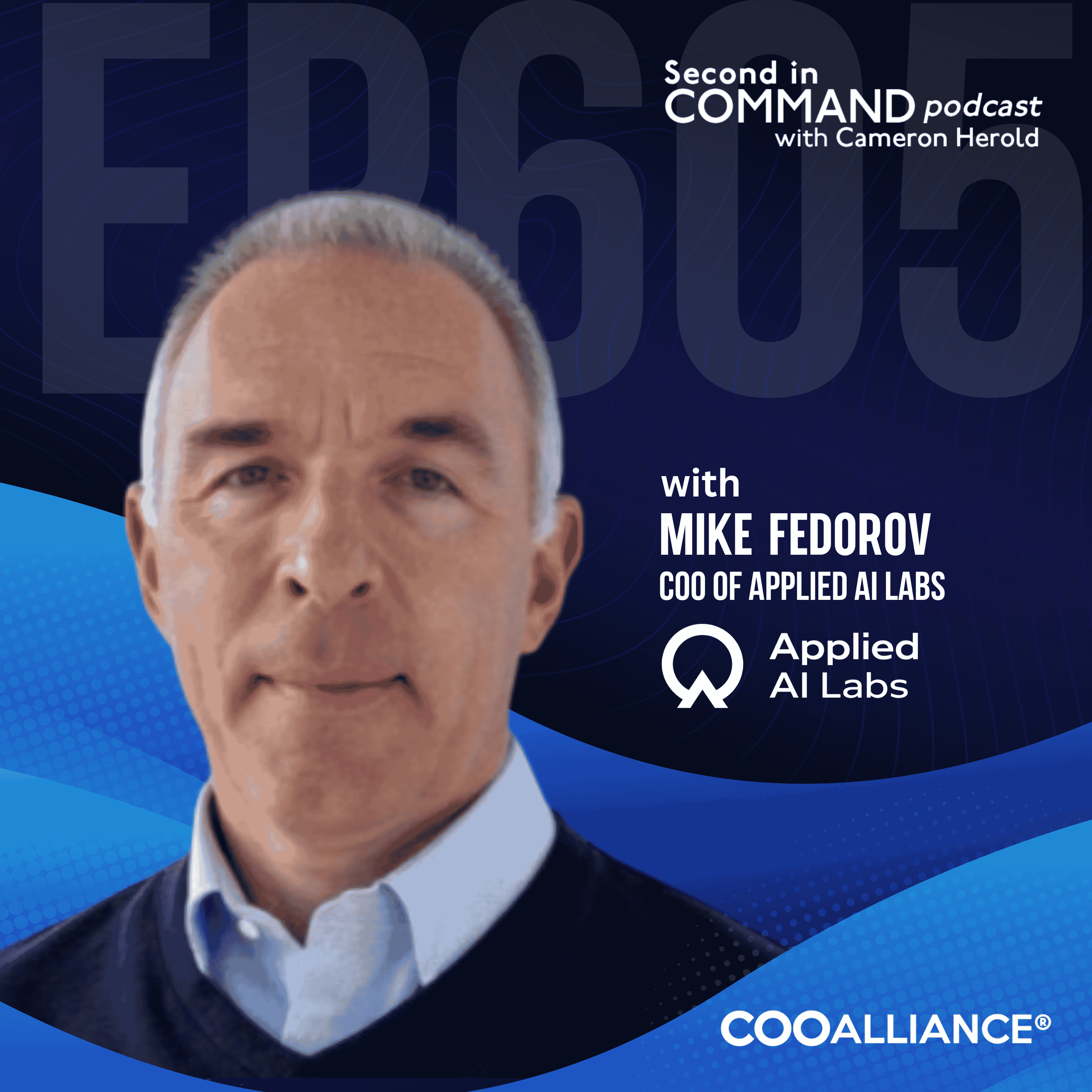
Applied AI Labs COO Mike Fedorov argues that “autopilot is the enemy of excellence.” He contrasts keeping operations stable (“keep the lights on”) with staying nimble (“keep the lights better”), and explains how AI should be used as a coordination copilot—not a silver bullet—to improve communication/escalations across operational systems. He also discusses flatter org structures enabled by delegation, and why replacing humans with AI (e.g., in recruiting) often fails.
Mike Fedorov spent 26 years in operations and supply chain, including 15 years at Mars and 10 at Accenture. He is COO of Applied AI Labs, leading AI-driven operational performance improvements for mid-market companies.
AI excels at coordination tasks humans struggle with (aligning plans, handling edge cases, integrating many data sources). AI amplifies good human judgment; AI alone amplifies “zero intelligence.” Autopilot routines reduce excellence unless leaders embed mechanisms to force thinking.
AI-assisted recruiting that screens for fake applicants; AI can’t reliably judge culture from resumes. He cites a case where AI found ~30% of applicants were fake.
Written by AI. May contain mistakes.
Mike discusses his background and his role at Applied AI Labs.
“Hello, and welcome to another edition of the Second in Command podcast.”
Mike elaborates on the operational challenges and opportunities AI addresses.
“So why don't you tell our audience a little bit first about Applied AI Labs.”
Mike shares his responsibilities and priorities as a COO.
“So as COO, what are your general responsibilities within the organization?”
Mike reflects on his journey to becoming a COO and the essence of operations.
“So I'm sure that as you were a child and growing up, you didn't think, well, when I grow up, I'm going to be the person that keeps the lights on.”
Mike discusses his observations and the importance of a robust operational network.
“What do you oversee on a day-to-day basis specifically?”
Mike talks about his team structure and the value of consultants in operations.
“I think you would do well in that room if you're as curious as you say you are.”
Mike compares operational strategies in large versus smaller companies.
“report up to you because you'll spend your entire day just going through and reporting with people and not being able to impact the business is the way that you want to.”
Mike emphasizes the need for nimbleness and adaptability in operational models.
“So you've worked for companies that have been very large in size and some companies that are still a little bit on the smaller side.”
Learn how executives balance routine and adaptability in a changing environment.
“are those that are nimble, those that say this is our guide, but we have to know when this guide isn't working anymore and when we need to change based on the climate or the clientele or the technology.”
Discover why AI is not a silver bullet but a tool for enhancing operations.
“How are you leveraging AI inside of your business?”
Explore the critical role AI plays in operational coordination rather than direct production.
“If you think about the world of operations as two distinctive descriptions.”
Understand how AI complements human capabilities instead of replacing them.
“A person on their own is a person with limited capability, capacity, and hours per day that the person can concentrate on things.”
Examine the potential job transformations driven by AI rather than job losses.
“I think that so many people were afraid that AI was going to come in and it was going to take everything away and the world was going to be run by robots or AI bots or whatever you want to call it.”
Learn about the pitfalls of relying solely on AI for recruitment and the need for human judgment.
“They look at a problem, and even the workforce would say, we need more people, we need more people, we need more people.”
Discover how AI can streamline recruitment while still valuing human insight.
“And the outcome is that you get a bunch of irrelevant folks who don't know what to do with your business.”
Learn about the significance of mentorship through personal anecdotes and insights.
“I was looking on LinkedIn the other day and a post had come up and it said over 1 ,000 applicants.”
Explore how pivotal advice from mentors can shape career trajectories.
“Mike, thinking about everything that you've done in your career, what would you say has been a defining moment for you?”
Get practical tips on how to identify and connect with potential mentors.
“My point is listening to people who are much wiser, much more mature, has been definitive in multiple cases, multiple times in my career.”
Understand the advantages of having a structured mentorship approach.
“Do you think it's best to have a formal mentor or can it be informal where you just reach out to people in your circle?”
Gain insight into Applied AI Labs' strategic approach towards growth and client engagement.
“What's next on the horizon for Applied AI Lab?”
Learn how to quickly realize value for clients by prioritizing operational improvements.
“That is, what are the improvements that we can bring fast?”
Explore how personal experiences can shape humility and collaborative leadership.
“But more seriously, I think with the experience, I realized, you remember that fable about two wise people, one knowing a lot and showing the big circle, and one knowing a little and showing a small circle.”
Understand the importance of identifying strengths and weaknesses in mentorship roles.
“And oftentimes you can actually refer people to folks who know better in this dimension.”

Get the gist, explore an idea or ask about something said.
 Claude
On Second in Command: The Chief Behind the Chief with Cameron Herold, what are the key points of this episode?
Searching your listeningAutomatic transcript. May contain errors.
0:02All right, if you're an entrepreneur, you've got to go check out the Genius Network. The Genius Network is for ambitious, giving entrepreneurs who want to be part of the highest level connection group. And it's not just another mastermind. In fact, I have been a Genius Network member for eight years. Genius Network helps build a better entrepreneur by focusing on health, wealth, and making your business and life more ELF, which stands for easy, lucrative, and fun. Don't apply if you're just a taker, but do apply if you're a giving entrepreneur and you earn at least a million dollars or more in revenue.
0:36And to see if you qualify, go check out GeniusNetwork.com forward slash apply. Again, that's GeniusNetwork.com forward slash apply.
0:4810 years ago, having more than eight, nine direct reports would be catastrophic. would mean that you will actually spend your whole day just managing people. I am seeing these days with better systems in place. And what is more important, I think, with more better coordination in place, once you start delegating instead of controlling micromanaging people, then it actually unlocks and allows you to create a flatter structure. You don't really need for a company with 100, 200 people, you don't need three, four layers of executives. For a company with 70 ,000 or 700 ,000 people, I am seeing the same exact trend.
1:28People are removing whole layers of leadership because the operations are now helped by the right coordination layer and helped by the delegation principles rather than just micromanaging layers.
1:45Welcome to the Second in Command podcast, produced by the COO Alliance and brought to you by its founder, Cameron Herold. In the Second in Command podcast, we talk to top COOs who share the insights, strategies, and tactics that made them the chiefs behind the chief. And now, here's your co-host, experience-driven growth strategist, former chief strategy officer, and author of No One Needs Another Company Mug, Lindsay Smith. Hello, and welcome to another edition of the Second in Command podcast. My name is Lindsay Smith, and today I'm excited to bring to you our guest, Mike Fedorov. Mike spent 26 years in operations and supply chain, including 15 years at Mars and 10 with Accenture.
2:31He's helped companies navigate operational challenges and transform complex supply chain while staying closely connected to the realities of the day-to-day operations. Today, he is the COO of Applied AI Labs, where he leads using AI to help mid-market companies quickly improve performance without overwhelming their teams. Welcome, Mike. Hi, Lindsay. I'm glad to be here. So why don't you tell our audience a little bit first about Applied AI Labs. What does your company do. This is the mission that myself and other executives decided to undertake when we have seen how many new opportunities are brought in a very specific way, in the operational way, to the companies by the new technologies.
3:19We put AI in our name consciously, but now we are really not sure that that was a good idea because so many people, so much noise about this. But if you think about the reality. In operational complexities, AI can help quite a bit. And that's what we've found specific ways to do. That's why we create this company. That's why I joined it as a COO. So as COO, what are your general responsibilities within the organization? It's a double-edged sword for me, first of all, to make sure that the lights are on. I think for any operational leader, that's the first priority, because if that doesn't work, everything else is not important.
4:06But the other first priority for me is to figure out how to keep the lights on better. That is how to set up the operational system, how to improve it, how to make sure that the lights are on in a productive way. I like that. How to keep the lights on and how to keep the lights on better. I'll have to borrow that for the next time somebody asks me what a COO's responsibility is. I'll credit you, of course. So I'm sure that as you were a child and growing up, you didn't think, well, when I grow up, I'm going to be the person that keeps the lights on. How did you end up in this role? Not at all.
4:44But I think I've been dreaming about similarly exciting jobs. I think a firefighter, an astronaut, maybe an officer in the Air Force, something like that, along those lines. But if you think about what is really terrific about all these dreams, all these normal childhood dreams, it's really about operations. At least maybe my distorted brain is thinking this way about it. Because that's how the world operates. We use this term to explain how things work. And work is also operate. So to me, what I realized at some point in time, probably through my college, is that I took pride in understanding what was the springs and levers behind the scenes of laws of nature, if you will, of why things go this way and that way.
5:39And by learning those laws of nature and levers, I figured out how to affect the outcomes. And to me, that's exactly the operations. There are people who are researchers. There are people who are communicators, connectors. And there are people who run this. So I thought that researchers, too theoretical for me, communicators, I'm not good enough, not as good as the best communicators I know. Leave this role for the CEOs. And getting things done, working things out, that's mine. When you look at the COO role, it's so interesting because no two COOs are the same, no matter what your commonalities in industry are.
6:26What do you oversee on a day-to-day basis specifically? In my case, it's more interesting than for many, if not most, of the CEOs, because in our case, we look at our own operations and we look after operations of our clients, our businesses, really, to help our clients' operations. So for me, it's twice as important to be observant and to be very critical to problems that I see and to be very excited about the opportunities that I can see. So for me, every observation of what's going on in our company leads to a question. Is it unique to us? Is it something that I can pursue to help our clients?
7:20And by the way, this is a real reason for me to maintain a network around the operational people. My operational network is perhaps a few hundred CEOs at this point in time, because I am curious. I am curious what keeps them up in the evening, in the morning, what they wake up with. And that is, for me, a part of my operations. So now think about picture-in-picture, operations-in-operations. That's probably the different thing about me versus my colleagues who are just watching their own things. Sure. The COO Alliance has a similar network where everyone is curious and everybody comes from a place of how can I share something that I know to help you?
8:08And how can I learn from something you did that maybe will help make my decisions easier? One of my favorite things that they do is their COO Connect events where they bring all of these really curious minds together. I think you would do well in that room if you're as curious as you say you are. I'm thinking about that. I was a bit humble for that because there are CEOs of very different operations. And when I was working with my biggest clients, think PepsiCo, Walmart, Calibre, the top of the top. When I'm looking at what these people are doing, I know some of them by first name, and those are amazing people where I would be humbled to join them in the round table and talk as peer-to-peer.
8:52That's why I was taking my time to join that. But yes, you are absolutely right. These are also good people who grew up having their childhood dreams and somehow transferring into those roles. And I think in the end of the day, this is what all we do to get to success, learning from each other. 100%. We can't do anything alone. Speaking of not doing anything alone, what does your team look like? How many direct reports do you have? Right now, you would be laughing at me. I don't have permanent direct reports. I got contractors who are working for me. Right now, it's five people who are in my team.
9:34but this is because we want to tune our operations before we grow bigger. That's really smart. I think that consultants are often overlooked and they're a really great way to help you kind of dip your toe in and figure out what it is that you need so you can build the right systems, the right roles, the right infrastructures to then be able to take your operations to the next level. So I think that's a really smart way of approaching it. So we understand that scaling is the next step after excelling. We've got to figure out the main parts of our operations before we want to add more people. But again, for our model, I think my target in three, five years, I would have 15, 20 people as my reports.
10:28I don't want more in this kind of business. Oh, no, you can't have more than that. I mean, even that's a lot. I'd say you should cut that and, you know, have some other people lead some teams that report up to you because you'll spend your entire day just going through and reporting with people and not being able to impact the business is the way that you want to. That is a good part of the truth. But also the world is changing. The way how I'm seeing it, Lindsay, is that, say, 10 years ago, having more than eight, nine direct reports would be catastrophic. Would mean that you would actually spend your whole day just managing people.
11:11I am seeing that these days with better systems in place and what is more important I think with more better coordination in place once you start delegating instead of controlling micromanaging people then it actually unlocks and allows you to create a flatter structure. That is, you don't really need for a company with 100-200 people, you don't need three four layers of executives. And for a company with 70 ,000 or 700 ,000 people as in my previous company, I am seeing the same exact trend. People are removing whole layers of leadership because the operations are now not really driven by different technologies so much, but helped by the right coordination layer and helped by the delegation principles rather than just micromanaging layers.
12:09So you've worked for companies that have been very large in size and some companies that are still a little bit on the smaller side. What are the biggest differences you've noticed between the two types of companies? That's an excellent question. First of all, the big companies, they grew big not by an accident. They all grew big because they had really important findings of how to structure their business. I would say they had a combination of strategy, right strategy, and excellence in operations. So that's how, like if I reflect on Accenture, for example, one of the best and biggest consulting companies in the world, they grew because they found the operational model that worked really, really well and executed it for a couple of decades, growing from a few thousand people to hundreds of thousands of people.
13:02And for them it was the model where people were incremental. How you grow a business in that area is by adding more consulting hours for that you need more bodies and that was essential for that. However, let me generalize, because I've been working for a few other really good and big companies. It's finding the operational model, it's executing it well, and it's being nimble over years, decades of when things change, you change the operational model as well. Which brings us back to our question of what really good COO would look like, right? Right. I think the nimbleness is something that's often overlooked in operations.
13:49And they get this SOP manual or they have this plan about what things are supposed to do. And, you know, you're supposed to follow these steps. And I found that the best operations are those that are nimble, those that say this is our guide, but we have to know when this guide isn't working anymore and when we need to change based on the climate or the clientele or the technology. Would you have any thoughts around that? That's precisely the tangent, the key tangent. I mean, every executive would have the contradictive priorities to deal with. Every executive has to be good at that. However, for the iteration executives, the core tangent is keeping the lights on versus making the lights better or adjusting the lights to the environment, to what environment changes.
14:39Now, you have to have stability. You have to have a cadence, you have to have a daily, weekly, monthly, quarterly routine. The problem is that for our people brains, we're all humans, and for our brains it's very tempting to just follow through that routine, to kind of turn autopilot on and to just go through the motions. And that's the enemy of excellence. That is where what my experience is, the best leaders are embedding that little engine that disturbs that smooth flow of day-to-day, quarter-to-quarter, and everything in between. They would put something in place that creates the mechanism to think, to actually turn on thinking every time.
15:32Every time you get into that routine, execute the routine, great, and then turn on thinking to figure out what has changed What do you need to react with? What do you need to do to proactively adjust to the changes that are inevitably coming in a year, in a day, anywhere in between? You might need to write a book because that's the second one-liner that's almost stopped me in my tracks today. Autopilot is the enemy of excellence. Correct. Well, it's actually a friend and enemy at the same time. It's a friend of excellence when you talk about keeping lights on. It's the enemy when you talk about adjusting the lights to the environment.
16:18It's really, really, really smart thinking. Well, that's exactly what we are building many businesses on, that kind of thinking. I think everybody has it in some form or shape in their mind. I'm just doing my best to look at the operators that are most successful and summarize what they are doing the best so that I can help the others do the same. How are you leveraging AI inside of your business? Exactly the way that we propose to our clients to do this. So for us, what I found is, let me share a secret with you. AI is just a technology, right? AI is not a silver bullet. AI cannot fix everything.
17:05Let me be more specific. If you think about the world of operations as two distinctive descriptions. One is the machines, like the engines that work to get your company what it does. Like literally in a plant there would be machines that make the parts or assemble them. And there is a coordination layer between those. So the coordination is how 10 machines on your factory floor work together, or more broadly, how you schedule those machines and get people to them and get materials to them and figure out what demand is and figure out where to put things into the warehouse and figure out how to sell the results.
17:54That is the coordination. So what I have observed is that the machines inside the department, the machines that are responsible for individual bits and pieces of work are actually pretty good. Most often, we have made those machines work well. Exceptions are there, but for now, let me just defocus on this. What doesn't work very well is the communication, connection, those escalations, those pesky things of, hey, did you look at this? Did you look at that? Is this plan aligned with that plan? That is a coordination layer to me. And that is where we are much less excellent than in working individual machines.
18:41Now, back to your question about AI. This is exactly where AI is good at. So AI, if you ask AI, can you run my machine that produces metal parts, just produces 20 parts a minute? can't produce 40 parts? No. AI can't do that. The machine is already pretty efficient. AI wouldn't be able to make this machine work faster because the speed is limited by physical laws of nature. It won't be able to make details with higher quality because it's already optimized. What AI can do is coordinate the things better. So, for example, React, that, hey, your demand has changed, you actually need to produce a different part on this machine.
19:29Or, you know what, you will have, your demand is high and you plan to work over the weekend, but you are going to run out of the materials by Monday. So there is no rhyme and reason working this weekend, because then you would be idle on Monday. These are the things that require a lot of, like, work, a lot of coordination, a lot of work that human beings are not very good at because it requires looking at 20, 30 ,000 different sources, making sense out of different data points in data that is not the same. And some of the data is wrong. So if you create a piece of program, a few lines, a few thousand lines of the whole Java code, you would have 20 ,000 edge cases and you would spend a year, two years, three years debugging this.
20:26AI is very good at those things where you can describe what good looks like and get a pretty good result fast in coordination in solving those tasks. Would you say that AI makes the human better? Absolutely. Being used in the right way. the way how I see it and the way how I've learned this in my last few years of consulting work is that for whatever reason many people think about this as science fiction came true silver bullet artificial intelligence just can't do things much better and will replace us best case scenario will be protected animals in the zoo worst case scenario will be extinct by the Skynet in reality, artificial intelligence, at least in the foreseeable future, as far as I can tell, is a very good co-pilot.
21:25And co-pilot, don't take this anything about Microsoft. Microsoft used this word in a very nifty way. But this is the wingman. This is a goose, if you will. And AI can amplify your abilities. Of course, there needs to be the ability to amplify first. And the problem is if AI is let on its own, it's basically like it's working with people, with a person who is missing. Zero intelligence. It amplifies zero intelligence. Guess what? Zero multiplied by 20 is still zero. If you have a good person with a judgment, with the breadth of view, with the goals, with the emotions, with the desire to get things better, that is what you want to amplify.
22:18So AI on its own is a good engine, is a good tool. A person on their own is a person with limited capability, capacity, and hours per day that the person can concentrate on things. together it makes a much better much better unit if you will a duo so people said it I think very eloquently a few months ago maybe a few years it's not that an AI would be competing with a person and would eat your lunch it's really the person with AI will compete successfully with a person without AI and make the person without AI irrelevant in many places. I think that so many people were afraid that AI was going to come in and it was going to take everything away and the world was going to be run by robots or AI bots or whatever you want to call it.
23:20But the reality is, you said it a few moments ago and not these words, but it amplifies what the human's able to do and what the human's knowledge is and gives them things to make decisions that without AI they wouldn't have had. So I hear you saying it allows people to make better decisions with more information the first time rather than having to make mistake after mistake after mistake to learn what AI was able to tell them. Correct. And this is not just a dream. This is the evidence from the market that I am observing right now. There are many different people with different ideas, and I see attempts to just reload this, reload the whole human jobs on AI.
24:09For example, in HR, I've seen this time and time again. The recruiters would, oh, the leaders above recruiters would try to remove recruiters from the equation altogether and have the candidates come to see AI, and then AI advances them to the next stage, and then AI maybe even makes a decision of whom to hire. It doesn't work. So far, the only impact that I have seen is that people are scrambling after a few months of trying this scrambling to find good recruiters back. It doesn't work this way. Just the evidence is that the success of people hired this way is much lower than the success of the people that are hired by recruiters.
25:02And I would argue that the success of people hired by recruiters with the help of AI is going to be higher. So it was people needed to experiment and go to the lower point to understand that it doesn't work this way. And my experience, let me expand it to a broader field. I gave you an example where I've seen that from my friends in this area. and I got some feeds of non-public information of how exactly it was unwinding. That's why I'm judging with confidence that that's what I'm seeing. But if I generalize across the functions, maybe to some extent across the industries, what I've seen so far of successes is that when people are amplified by AI, that's a success.
25:56When somebody tries to replace people by AI, that's in majority of cases, if not all, it's a failure. So my prediction is that we won't see massive job losses because of AI. We'll see massive reformatting of the jobs. People tend to be not too good and actually don't like the jobs that AI is very best at. That is coordination, coordination kind of activities. So we will see people much more successful. We'll see the places where jobs will disappear is not because AI takes over. It's because the leaders are trying to flood, to basically buy the way out of their ineffective structures, ineffective operational networks, buy the way out of that with just adding more people.
26:53And those people would disappear, not because jobs disappear, but because these people weren't needed to begin with in those jobs. Well, I think a lot of times companies look at a problem, or at least they used to. They look at a problem, and even the workforce would say, we need more people, we need more people, we need more people. But the systemic problems were never fixed. And to go to your example about the recruiters, AI can't screen for culture because all they have is a piece of paper. And so they can screen for basic skills and they can screen for relevant history. but you're going to miss out on really great cultural fitting people, which you need to grow your company.
27:35If you rely solely on AI, which doesn't have that emotion, it doesn't have that feeling. And it certainly doesn't understand from a piece of paper what culture is going to thrive inside of a specific company or organization. Furthermore, AI is pretty good at faking those pieces of paper. So when people start playing this game, on the recruiting side. The candidates happily continue playing this game on their side. And the outcome is that you get a bunch of irrelevant folks who don't know what to do with your business. You start failing. What works really well, and a friend of mine has been running this kind of business for a while, for about a couple of years by now, is, say, the checks, the background checks.
28:25that's where AI excels because that's where you ideally want to check so many points that if you assign a human being it's going to be A, expensive B, long time and C, it's just not fun it's the type of job that you need to type 20 ,000 different points in Excel you don't want to do this good people don't want to do this they won't do this but AI can and will So what I've seen is that we had a conversation with the CEO of that company a few months ago. And he was excitedly telling me that, hey, do you know, I found like 30 % of the people who were applying for this role were fake. And I found that, my AI found that with evidence.
29:20That is where a good recruiter who can judge you by the cues, by the way how you speak, by what texts you and what doesn't, with AI who can actually check the real background references and all that stuff much more thorough than a person would like to. Together, that tandem gives you a great result. And to your point, with AI creating these fake resumes and building all of these things up, it's so easy to apply to jobs and end up in this massive pool that's just being screened by yet another level of AI. I was looking on LinkedIn the other day and a post had come up and it said over 1 ,000 applicants.
30:09And I thought, well, who in their right mind can go through 1 ,000 applicants in a way where they're really going to remember the difference between A and B? So, you know, I think that there are certainly some good case uses to help get to a manageable pool. you want to shrink that pool to probably 10-ish candidates whom you want to review, whom you want to actually get a sense what these people are. And after that, you would probably have an understanding, hey, this is somebody who is really best right now, and that is somebody who has best potential but needs input, development, investment. and your question, the human judgment would be, which one is better for me?
30:56And this is a conflict of priorities. This is where the AI would not be good at doing this, at solving this. That's where you need a person. That's where you need a person, a recruiter, who formulates that, who finds, discovers that, and communicates with the leader responsible owning this role. Hey, these are two cases that are good. which one is better for you. And then we need to have judgment on that side. That would be really something that AI cannot do. Mike, thinking about everything that you've done in your career, what would you say has been a defining moment for you?
31:37That's a good question. I think I had many of them, but the most defining for me personally were tidbits of communication from my mentors. Let me explain. I was blessed to have really good mentors in different kinds. And every time I would have the, how to say it better, the wisdom to actually listen, years later, I would have found that that was a really good idea for me to have a mentor and to listen to that mentor too.
32:21So 20 something, 25 probably years ago, I was extremely lucky to have a fantastic mentor who was then a few months after taking me as a mentee advanced to the second and then to the first level position in a S &P 300, I think, company back to those days. Extremely accomplished and very wise person. He told me a few things of how to look at the things. And one of the bits of wisdom that he shared with myself and a bunch of other operational leaders in the plant where I was working that time. That was at the point where he came after a meeting with Warren Buffett who bought the company, who participated in buying that company.
33:17Let me put it this way. And everybody was looking at this executive like, what do we do? Are we going to lose our jobs? Are we going to be like in a bad shape? They just bought us. And he said, listen, calm down. Here's my philosophy about this. You shouldn't be worried about external things, like somebody's buying the company. Think this way. Worry about your capability. Worry about your capacity to do good things. Worry about your ability to operate, to be the best operator. This is inside your circle of influence. if you do this, if you worry about this, if you develop this capability. And whatever happens, the company decides that they don't need your role, they get rid of you, you would immediately or very fast find a better role.
34:19But listen, a good company wouldn't want to lose you. So don't worry about things that are relevant, worry about things that are relevant. And that actually landed really well in that room, the room of managers and directors and a very high level executive leader sharing that wisdom. I remember that and a few of my friends from that room, we are still in touch and I think they also remembered that. So that was probably the most definitive moment for me in my early years of career, and now I am passing it to new generations time and time again, but that's just an example. My point is listening to people who are much wiser, much more mature, has been definitive in multiple cases, multiple times in my career.
35:18And that is what I would say. These were the most definitive moments for me. How did you find your mentors? That's a great question. I think sometimes it's pure luck. But I think the biggest part of that is the understanding that having a mentor is a great idea. So think this way. A person who doesn't think that they need a mentor is very unlikely to find one. A person who has the wisdom early on to understand that having a good mentor is a great idea, no matter how smart and good I am, many people start feeling that they are very, very good early. So if you have humility, that you understand that having a mentor is a good idea, and that mentor might be actually more experienced and capable than I am.
36:15That's the first step. And then looking for the mentor and formulating for yourself what I want from a mentor, what a good mentor could look like. That's the second step. And then there's a bit of luck after that. Can you find such a person? Can you not? But you'll probably find a good mentor, if not amazing mentor, with this approach. Where do you recommend people looking for mentors, those that have the humility to know I need a mentor? Where do you suggest they look? professional communities. I would love to have this capability on LinkedIn, but unfortunately developers of LinkedIn aren't there yet.
36:58In reality, I would say the communities of professional excellence are probably the best ones where you can first come up with the idea, hey, I want to have a mentor, and who could be a good fit for me? out of more experienced people. Second piece, many workplaces have this feature as well. I would say Accenture, as I remember me working there as a mentee and as a mentor as well, has the feature of, hey, this is how it works in multiple levels. So you can be in the marketplace for mentors and mentees. And I think this is one of the great examples of how those little things in the company's operational system lead to fantastic outcomes.
37:52So professional communities, workplace, personal networks. Do you think it's best to have a formal mentor or can it be informal where you just reach out to people in your circle? I tend to believe in operational systems, but this might be my professional deformation. The way how I see it, if you just occasionally, almost randomly reach out to a person without any framework behind it, you might have grains of value here and there. But I think if you have almost a contract, I don't mean a written contract, but I mean the mutual understanding of you as a mentor want X Y and Z I as a mentor wants to provide a B and C and those two things those two sets are correlated they are compatible with each other if we have this mutual understanding I would be practically looking at how to help you you would be very deliberate in reaching out in the moments where you need help.
39:05You would know which moments you want to reach out. So this collaboration, this relationship would be much more productive if there is a framework, if there is an operational system behind it. So I would call it formal. Yeah, I know. But this is, if you ask a marketing officer, you'd probably have a different answer. But this is where I believe in operational systems. And I think you can just leverage them on many levels, including in your mentor-mentee relationship. What's next on the horizon for Applied AI Lab? We are finalizing our portfolio of the types of the cases where we want to help, where we want to focus.
39:51And once we nail this down, we are looking for growth. So that's always the case. You figure out your operations and then you scale them. Right. Where are you currently serving from a market standpoint? Right now, we want to focus, we want to keep focusing on the smaller organizations. We define this as a mid-market. that is the companies between approximately 30-50 million dollars of revenue a year to about half a billion maximum a billion dollars a year these companies have interesting complex operations where we think we can help but at the same time they don't have the political part of existing ecosystems of how people think about it, how people commit for multi-year roadmaps.
40:52So that's where I think is our next two, three years of focus. And when you're going into these organizations that you're helping, talk to me about what that engagement looks like. Typically, it's a two-part. First of all, we want to diagnose before we prescribe anything. So we want to run a one to two weeks of deep review of a few very specific things. We preset our hypothesis using AI, of course, using the openly available data, and sometimes the data sets, the specific data sets that we agree with the client that they would be able to help us with to better understand them. We come up with the hypothesis.
41:37We check those hypotheses in a very focused way, taking half hour, an hour per leader or per operational manager within the company. Finalize our understanding by confirming, refining, tuning the hypothesis. So after a week or two, we have a solid list of value ease. That is, what are the improvements that we can bring fast? fast I would define two to four weeks where we can get our partner our client to the value realization then the second part is to go after the top top parts of this list the easiest things things the the most valuable things on that list and just crank it up to two three four weeks something tangible something meaningful.
42:34Next two, three weeks, another thing, and another, and another. So typically, it's two, three, four things that we can find that would be operationally viable and very tasty, I should say, for my partners in crime on the operational side. And are you giving them the roadmap for them to do the things, or are you engaging with them and doing it for them? What does that look like? We steer clear from the strategy and long-term operations just because this is very unique for the companies, and this is where we don't feel that we can bring much more value fast. And we are, again, what we are focusing on is fast.
43:20So for us, what we normally do, we come up with a list of the things that would be material a tangibly improving EBITDA of the companies we work with. And some of those things are valuable, more valuable than the others, and some of those things are easier or faster to realize than the others. We focus on the stellar quadrant of most valuable, most easy, or most valuable, fastest, I should say. But what remains for the organization is the backlog of the things that are still valuable but take more time. That's not what we want to address, that's what not we focus on, but that is valuable, that's what we leave behind as the legacy of, hey, you might want to deal with this as well.
44:16As well as things that are easy but not as valuable, where, again, depending on the priorities, depending on how it changes over time, it might become more valuable. It's easy to implement. Again, it's just not something that we feel that we want to do. Mike, how have you changed over the course of your career? You mean me personally? Yeah, personally. How have you changed? I became older, for sure. So I lost some hair. But more seriously, I think with the experience, I realized, you remember that fable about two wise people, one knowing a lot and showing the big circle, and one knowing a little and showing a small circle.
45:10So the one with the smaller circle had much smaller frontier with the things unknown and thought that he knows actually more. And the one that knew more, in fact, had bigger frontier with the things that he didn't know. So he knew how little he knew, right? So to that point, with the experience, I think I see how much more I still don't know, don't understand. And it makes me look at my colleagues with more humility and approach that, hey, let me tell you what I know and let me acknowledge what I don't. And I'm not ashamed. I'm not shy that I don't know it. I'm willing to figure it out. I am open to listen and understand.
46:02So that is probably the biggest change from the perspective on the top of losing care and gaining some additional knowledge. I think that's a really hard thing for people to learn and to understand. There's this unspoken, if you don't know it, you shouldn't ask for help because, you know, what if someone's coming after you or someone wants to take whatever from you? But when a person is in a position where they're able to say, I now know what I don't know and know who I need to call in, I think that's when their lives change and their businesses change because they realize they don't have to carry the load by themselves.
46:45That helps. That removes the load from your shoulders of trying to pretend that you know everything. And that also builds trust oftentimes because when people see that you are open, that you don't shy away from sharing what you don't know, it means that what you know is what you really know, right? So that's my personal learning and that's why I'm getting less worried about not knowing everything. Well, it makes you a better mentor and better mentee when you're able to identify, hey, I can help you with this, but I can't help you with this. Or I know this, but I don't know this. That's exactly the point.
47:26And oftentimes you can actually refer people to folks who know better in this dimension. And I think that's making the world a little bit better place. Well, I think so too. I mean, I see a vision of everybody just giving a little bit to the person next to them. And before you know it, you'll have everybody knowing all of the things because they got it from their friends. I think so. Yeah. Well, Mike, it was really such a pleasure connecting with you today. I loved learning about all of the things that you've done and just really hearing the humility and the mentorship and the way your operational mind works.
48:05I think that there's still plenty to come on your horizon. And I think Allied, applied AI labs rather, is going to have quite a successful future with you in the operational helm. Thank you, Lindsay. I hope so as well. And I'm working hard to make it happen. All right. Thank you. You've been listening to Second in Command, brought to you by COO Alliance founder Cameron Herold. If you enjoyed this episode, please be sure to like, share, and subscribe to us on Apple Podcasts, Spotify, and our other podcast streaming platforms. For more best practices from industry-leading COOs, visit COOalliance.com.
49:00All right, listen up. If you're the COO or a second-in-command leading a company doing between 2 million and 200 million a year, this is for you. We connect you with a vetted network of elite operators designed to help you grow faster and make better decisions. We have over 175 members globally and we've had 800 COOs join us. And if you don't get at least 10 extra investment in revenue or cost saving ideas, we'll give you your money back. Here's how it works. First, the vetting. Most COO networks are built for volume. They accept almost anyone, regardless of experience, role, relevance, or really even what area of the business that you're operating in.
49:38That puts you in a room with people at completely different stages, facing completely different problems, which makes the conversations less useful. We don't do that. Every member of the COO Alliance is a true second command inside of a$2 million plus company actively running a team and every applicant goes through a live vetting call before joining. So that's what keeps the network relevant and high level. Second, the group model. A lot of networks group people at the exact same level. It creates comfort, but it doesn't create growth. We intentionally build groups with a mix of people slightly ahead of you, people that you can help and people that can help you because they're all operating at roughly the same level.
50:17This creates better conversations, stronger thinking, and real forward movement. Third, structure and community. Most networks lack structure. There's no agenda, no accountability, and no clear outcome. We fix that. With every session designed with a clear objective so you leave with decisions, not just random discussions. and outside of the sessions, you're part of a real network that you can tap into anytime with people you've already solved problems with that you're dealing with. Everything is confidential and everything happens consistently. You get 12 monthly mastermind sessions. You get AI-focused sessions.
50:53You can come to two of our in-person COO Connect events every year and now a third that we're operating globally because as an operator, you don't rise to your goals, you fall to your systems. We build that system for you and here's our commitment. If you attend at least 10 sessions over the course of a year, if you show up and engage, if you don't discover at least 10 times your investment in value through new revenue or cost savings, we're giving your money back. And out of the 800 plus members that we've had, only four have ever asked for that refund. This is why the best operators don't do it alone.
51:28So if you're the COO running a$2 million plus company and you're still figuring it out alone, or if you're the CEO running that company and you think your COO is, apply now or drop us an email. Check us out at COOalliance.com.
Most operators never learn to fight autopilot, the quiet enemy of excellence.
In this episode, Lindsay Smith sits down with Mike Fedorov, COO of Applied AI Labs. With 26 years in operations and supply chain, as a former Accenture Director and Mars operations leader, Mike built his reputation staying on-site, in the detail, close to where the work breaks.
He shares his philosophy that a COO's first job is to keep the lights on, and the second is to keep them on better, explaining why flat structures are replacing layers of management, how AI works best as a coordination layer, and the defining power of mentorship in his career.
Sponsored by:
STS Capital Partners - Your expert guides on the journey to an Extraordinary Exit™. To learn more about STS Capital Partners and how they achieve maximum value by Selling to Strategics™, complete the inquiry form here: https://stscapital.com/coo-alliance/
Timestemped Highlights
00:00 The Future of Flat Organizational Structures
01:44 What Applied AI Labs Does
02:38 The COO's Real Job: Keep the Lights On, and Better
05:11 A COO Who Watches Two Operations at Once
08:08 Scaling After Excelling: The Contractor Approach
09:18 Why Flat Structures Are Replacing Layers of Management
11:01 What Big Companies Get Right About Operations
12:45 Nimbleness vs. Routine: Autopilot as the Enemy of Excellence
16:06 How AI Actually Helps Operations: The Coordination Layer
18:44 AI as a Copilot, Not a Replacement
20:06 AI in Recruiting: What Works and What Fails
27:34 Defining Moments: The Power of Mentorship
30:52 How to Find and Structure Mentorship
38:55 What's Next for Applied AI Labs
43:55 Personal Growth: Knowing What You Don't Know
About the guest
Mike has 26 years of experience in operations and supply chain, as a former Accenture Director and, before that, leading operations planning and execution for Mars. He has run and turned around operations for some of the most complex and demanding companies in the world, and has saved major clients that were ready to walk. He leads engagements the way he has always worked: on-site, in the detail, close to the people who know where the work breaks. Operators trust Mike because he has done their job.
Mentioned Resources
About the Co-Host
Lindsay Smith is an experience-driven growth strategist and former Chief Strategy Officer. She previously scaled a new region without a traditional sales team or bloated marketing budget by turning relationships, culture, and execution into revenue. She is the author of No One Needs Another Company Mug, Stop Branding, Start Experiencing, and helps leadership teams use experience as a competitive growth lever.
Important Links
Connect with Cameron: Website | LinkedIn
Explore the COO Alliance – The World’s Leading Community for Seconds in Command
Get Cameron’s book: Second in Command, Unleash the Power of Your COO Book
Claim your FREE copy: Second in Command: Unleash the Power of Your COO Book
Take his course: Invest In Your Leaders Online Course (Use promo code PODCAST10 before the end of the month for 10% off)
Chat or video call with AI Cameron via Delphi


