
In short
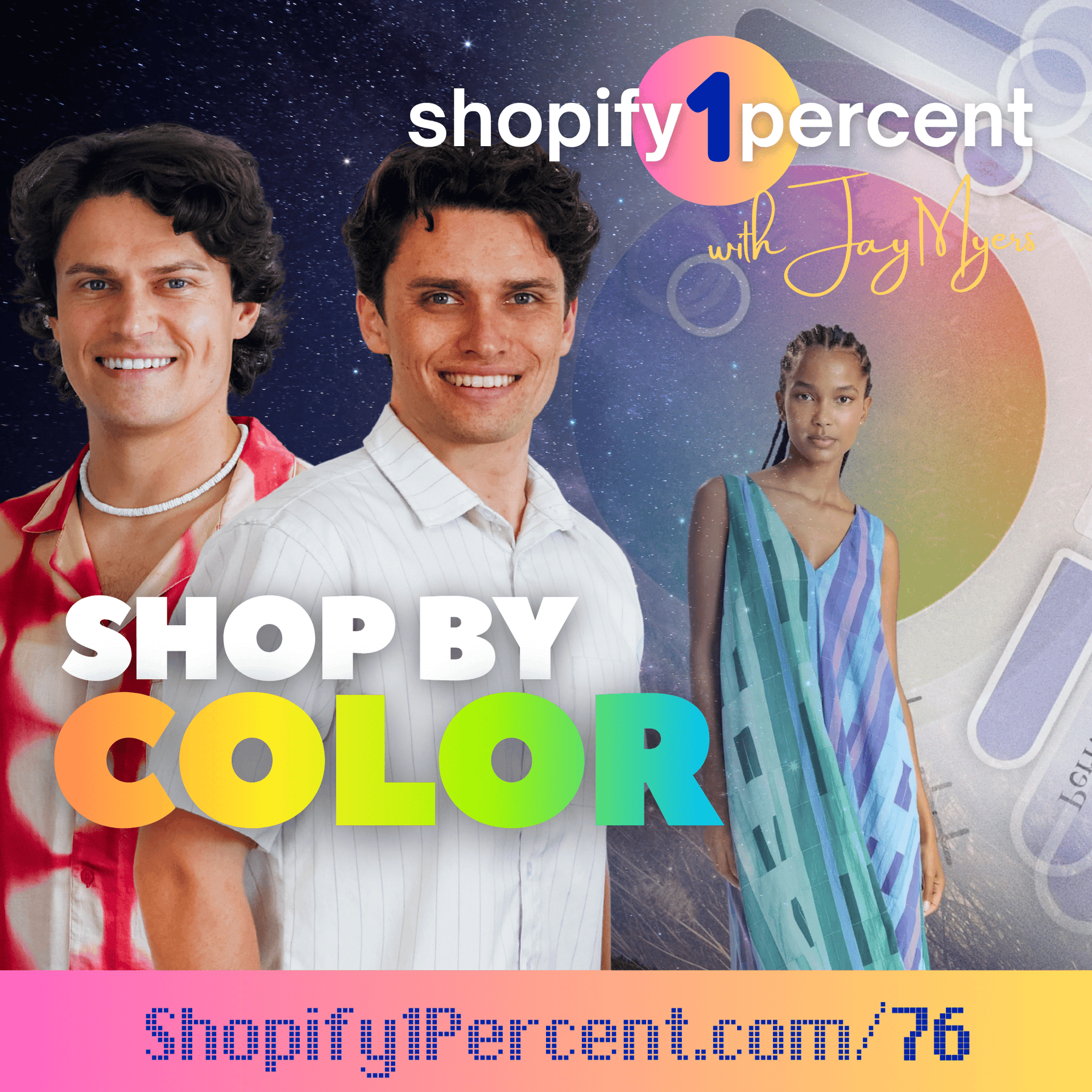
Hoppin’s “infinite color search” for Shopify replaces text-based color filters with a color wheel that lets shoppers dial in exact shades (including multi-color products) and helps merchants understand unmet color demand.
Guests
Bridger Hart and Carson Hart, founders of Hoppin. They built a patented color-wheel search now used across Shopify stores; they were recognized in 2026 Forbes 30 Under 30.
Key claims
Color is among the most common e-commerce filters; shoppers who use color have ~60% higher checkout size, ~1.3x AOV lift, and ~3.5x conversion lift vs the rest of the site. Hoppin automates color tagging via AI that extracts weighted color values from product images/titles/descriptions, avoiding inconsistent merchant color names. It also maps catalog colors in 3D space (lightness + chroma axes) to what shoppers search.
Notable examples
Adidas has a generic “shop by color” button; Hoppin cites a Netherlands sneaker marketplace, plus yarn/material sites where color is the main differentiator. They observed Stranger Things-related two-tone searches (30% two-color, 5% weighted).
Written by AI. May contain mistakes. Listen to the episode to check what was said.
Chapters
Tap a time to open that second in VOImpact of Color on Shopping Behavior
0:45 to 1:20
Exploration of how shopping by color can increase checkout sizes.
“And so it's applicable to home decor, like wallpaper, photography, art.”
Access to Color Data
1:20 to 2:00
Discussion on brands lacking access to specific color data that customers seek.
“OmniSend just shipped something that I've always wanted.”
The Origins of Color Search Technology
2:00 to 4:20
Introduction to the founders of Hoppin and their patented color wheel search technology.
“Just give them five days and then you show up with everything set, ready to go.”
Challenges of Color Naming and Filtering
4:20 to 6:40
Examining the issues merchants face with color naming conventions and filtering.
“It's something that helps increase conversion.”
The Importance of Visual Search
9:30 to 11:10
Discussion on the significance of visual search in reducing product returns.
“like when that decision when it switches and even with this we're just talking about color as if products are just a single color.”
AI-Powered Color Extraction
11:10 to 14:00
Explaining how AI can determine colors from product images to improve search.
“So I know a lot of our listeners are on Apple or Spotify right now.”
The Impact of Color Search on Conversion Rates
14:00 to 16:16
Learn how a color search tool enhances user experience and boosts conversion rates.
“And we're finding a 3.5 times conversion rate lift.”
Seamless Integration of Color Tagging
17:35 to 23:20
Find out how automated color tagging improves product visibility for merchants.
“And so we found a couple seamless ways to integrate.”
Broad Applications of Color Search Technology
23:20 to 28:01
Explore various industries benefiting from advanced color search functionalities.
“Now, obviously, clothing is the top thing, comes to mind as like a surefire win would do well with this.”
Understanding Color Nuances in Shopping
28:01 to 30:00
Learn how specific shades of color influence purchasing decisions.
“it's not even necessarily them searching for what people would consider color, but they're looking for a very specific kind of off-white or a very specific kind of black.”
Show all 19 chapters
The Value of Saving Colors for Customers
30:01 to 34:30
Discover the benefits of saving color preferences for online shopping.
“Yeah, there's 16.7 million unique RGB colors, so you got to have some tolerance there.”
Color Filtering Failures in Ecommerce
34:31 to 36:45
Explore common mistakes in color filtering on Shopify stores.
“And I want to tell you why that's even bigger than it sounds.”
The Three-Dimensional Nature of Color
36:46 to 39:36
Understand how color operates in a three-dimensional space and its implications.
“If you are a certain palette having in the search results, like here's all the color, other colors that fit with this palette would be really interesting to have as another section.”
How Color Searches Influence Product Offerings
39:37 to 42:02
Learn how customer color searches can affect brand inventory decisions.
“And now you can see how one color just naturally flows to the next, there aren't these rigid borders between color, like green or blue or brown.”
The Importance of Color in Sales
42:02 to 42:59
Learn why color is a critical factor in driving sales for e-commerce brands.
“Adidas has an actual shop by color button in their header.”
Engaging with Shopify Agencies
43:00 to 44:00
Discover how to connect with Shopify agencies and enhance brand engagement.
“So, you know, we're looking to have early conversations.”
Top Navigation and Its Impact
44:01 to 45:18
Explore the significance of top navigation items on e-commerce sites and their influence on sales.
“I don't believe I'm aware of a, other than you guys now, a thought leader in the space of color for commerce.”
Marketing Potential of Color Features
45:19 to 46:35
Understand how to leverage new color features in e-commerce marketing strategies.
“is something we haven't even touched on in this call.”
Call to Action for Hopin
46:36 to 47:16
Learn about the Hopin app and how to access it in the Shopify app store.
“I would literally, I would send an email with the color wheel and just say, what color are you going to pick?”
Transcript
Automatic transcript. May contain errors.0:01Bridger Hart:Most stores have a color filter. Why did you guys build this?
0:03Carson Hart:Color is among the most ubiquitous filters you're going to see in e-commerce.
0:08Bridger Hart:When they shop by color, their checkout size on average is 60 % higher.
0:13Carson Hart:Brands have never had access to the exact colors that shoppers are looking for. I mean, down to the Xcode. We're able to actually plot three-dimensionally every single product in their entire catalog by color and then map those discrepancies to what people are actually searching.
0:28Bridger Hart:In the fast-moving world of e-commerce, Bridger Hart and Carson Hart transformed the way people search for products online. Pioneering the patented color wheel search used across Shopify stores worldwide, their innovation didn't just stand out. It earned them a place on the 2026 Forbes 30 Under 30. Does it work on lifestyle photos? Color is universal. Most people see color in the same way. And so it's applicable to home decor, like wallpaper, photography, art.
0:54Carson Hart:Adidas has an actual shop by color button in their header. You know, it's really generic. I like what we're doing, but it says something when, you know, these billion dollar companies are putting an emphasis on color. Now imagine if they actually had the data that we're providing.
1:10Bridger Hart:You know, certain people, they have a limited color palette. They know what they like. If they can shortcut straight to that, that's a great user experience.
1:20Bridger Hart:OmniSend just shipped something that I've always wanted. You can now connect OmniSend to ChatGPT or Claude and just say, where can my email and SMS campaigns be making more money? And it actually figures it out. It reads your store data, all your campaign details, your store history, and it tells you and the insights are legit good. And even better, you can then say, okay, let's fix that or build that campaign. And it actually does it right from your chat. It's wild. Now, if you're one of our listeners, you can get 30 % off for three months on OmniSend. Just go to the show notes. There's a link there.
1:51Bridger Hart:Or you can just use the code J30, J-A-Y-3-0 when you sign up. Now, if you're using another email and SMS platform and you want to switch to OmniSend, which is a great idea, they will do the migration for you. Just give them five days and then you show up with everything set, ready to go. Now, they've migrated thousands of stores from Klaviyo. And on average, they're saving 35 % on their email and SMS bills. If you're listening to this show, you clearly care about your Shopify business. If your store isn't backed up and protected, it could all be for nothing. That's why I tell every store owner I know who cares about their business, you 100 % need Rewind installed.
2:27Bridger Hart:It's a non-negotiable for me. One bad CSV import, one app that edits your store the wrong way, which has happened to basically everyone I know. One bulk edit gone wrong, and now AI making changes for you. Listen, Shopify does not have an undo button. Rewind is the undo button. Go to shopify1percent.com slash rewind for 30 days free on us. Links in the show notes too. Last year, I went to Commerce Roundtable in San Diego and it was so good. I'm going back again this year. It's September 21st and 22nd. And honestly, you should come to. It's the one e-commerce event that I recommend to everybody without blinking.
3:07Bridger Hart:It's not a trade show. There's no booth demos. It's really just operators on stage sharing what's actually working in their stores right now. and it's basically a room full of all founders. I was actually scrolling through my camera roll from last year and I have over a hundred pictures of slides from people's talks. It's, I learned so much. It's that kind of an event. Now I have five passes to give away for a 30 % off ticket. It's first come first serve. So if you're interested, email me jay at shopify1percent.com and I will hook you up. They will go fast. So email if you're interested. And if you're going, come say hi.
3:42Bridger Hart:Let's grab a coffee or a drink during happy hour. I'd love to meet you. I don't know if those of everyone listening knows. Back in 2013 at Bold, we launched a product options app that had this concept of a color swatch in it. It was a little bit primitive at the time. That was 13 years ago. A lot of things have changed. We actually don't own the app anymore. Another company does. It's still running. It's great for a lot of things. But color swatches were always a challenge. and the it's such an important thing in fact i was doing a little bit of research before this episode and over a third of people who shop have used some type of a visual search and more than half of people say that visual info matters more than the text on the page when they're shopping but it's one of the top reasons it's also one of the top reasons people return products is it's the wrong not just the wrong size but it's the wrong fit and it's the wrong color so color isn't just an easy filter.
4:42Bridger Hart:It's something that helps increase conversion. It's something that helps reduce returns and it builds a better brand experience. And so I brought on the founders of Hoppin. I got Bridger and Carson sitting here at chomping at the bit, waiting to tell us all about it, but they have created something that solves and bridges this gap of color. And I find it fascinating. I'm really excited to get into it. First of all, welcome to the show, gentlemen. Thanks, Jay. Happy to be here.
5:10Carson Hart:Yeah, same.
5:11Bridger Hart:So most stores have a color filter. Why did you guys build this?
5:15Carson Hart:Yeah, so color is among the most ubiquitous filters you're going to see in e-commerce. You know, when you have a large catalog site, let's say you have over 150 products, you're going to need a way to filter down that data set or else people are just not going to see your entire catalog. Do you end up, you know, latching on to search and filter and people break things down by price or by size, by brand? And color is among the top three most prevalent filters you're going to see in e-commerce. And we saw an opportunity to take this thing that every site is using and dramatically improve it because we understand color in a different way.
5:50Bridger Hart:One of my pet peeves when I'm shopping is when stores have fancy names for colors like Midnight Sand or I'm sure you've probably seen them all. Even, you know, denim, which might be a color that's very subjective too, right? Was this also an attempt to solve a little bit of that problem? Like if you're picking a color by name versus visually, I imagine that's a big conversion and returns challenge as well.
6:19Carson Hart:Exactly. I mean, people can't really use a search bar to search for color in a very effective way because chances are the way you describe a specific color is not going to align with how the merchant has actually tagged that product. And if you're running, let's say it's like a boutique shop or marketplace, you could have 10 different brands and they're all going to call the same product a different color. One brand might call it maroon, one might call it wine. You have all these different artistic names that are more marketable names for the product. But when it comes to being like an actual filterable attribute, it's kind of useless.
6:54Bridger Hart:Yeah, because in the back end, it's just a whole bunch of tags, just words. Yeah. The whole tag a product a certain color has actually nothing to do with what the color of a product actually is.
7:06Carson Hart:Yeah, there's not really a universal alignment on how to name specific colors, and it varies by locale and geography and just all kinds of factors.
7:16Bridger Hart:Yeah. Sorry, go ahead. I feel like a lot of people, when they think of color names, they kind of jump to, you know, the generic red, orange, yellow, green. They might get a little more granular with like navy or light blue, but there are a lot of really interesting colors that people love and they might be like the trending colors these days, but they're still hard to describe. There's a lot of like muted colors, especially, and oftentimes people dress more muted, but these color attributes, the descriptions are usually leaning more towards vibrant colors. and that's just not what everyone's looking for.
7:51Bridger Hart:And if you can't find a color on a site, I've had this where I've been shopping for a specific color of a shirt or something and if it's not easy to find, I just, I bounce. I'm not gonna go sifting through thousands of SKUs.
8:05Carson Hart:So there's a problem that like every merchant goes through and they think about adding a color filter to their site. They could either take the generic route, they could add a yellow, blue and green filter and just make it like a Crayola crayon box of colors. Or they could get very specific. They could do light blue, medium blue, dark blue, and then they could, you know, break it down that way by every color. Then you end up with this list of like 50 different color filtering options that you have to go through. And when you go to filter by light blue, for instance, you end up excluding so many products that the end results, it might say like, here's three products.
8:43Carson Hart:And so you end up with this dead end. It's a lot, there's a lot of dead ends in the shopping experience. That's one of the things that we've solved with this product, but it also creates this nightmare for merchants to tag things. Yeah. Because like, how do you decide, does this, is this light blue or is this medium blue? Because a lot of products are going to fit right in the middle. And even when you have these generic categories, like even if you have green and blue, if you have a turquoise product, like where do you tag that? And then the shopper is thinking that they're thinking like, where am I going to look to find that product and it's not just green and blue like every single color naturally blends into the next there is no border between colors like if you take the color orange and you keep darkening it eventually it's going to become brown it never just switches it's a slow yeah and it's subjective like when that decision when it switches and even with this we're just talking about color as if products are just a single color.
9:40Carson Hart:If you're looking at like sneakers, for instance, there's often multiple colors within those products, the same colors, little details.
9:48Bridger Hart:I actually had that on my, one of the questions I wanted to ask is how do you handle multi-product, sorry, multi-color products?
9:55Carson Hart:Yeah. The biggest thing that we're doing differently is we take the guesswork out of this because we're not asking a merchant to go in and tag things by green or blue. we actually have this AI automated system that we built that can extract the colors directly from the product image. So it's able to identify and segment the exact product off the model in the background. And so we can extract a plethora of weighted color values. If it's a Hawaiian shirt, maybe it's 70 % light blue with like 30 % little yellow accent colors throughout it. We're capturing all of that nuance. And so when you search with our color wheel, it's ranking based on color distance to all the different colors within that product, as well as the weight of those colors.
10:40Yeah. It's not even, it's not just for fashion either.
10:44Bridger Hart:Like artwork works great. So like even this piece behind me, you know, that it's like, how would you describe that? There are so many colors that exist within it. And so what's exciting is that maybe you search this very specific like that green up there it's still going to show up it might not be at the very top but it's able to surface in a way that it never would have been able to before my mind is going to so many potential options i don't maybe hoppin does this i but if you have an existing i don't know piece of artwork or piece of clothing and you want to match it there's potential for that as well too i'd imagine i don't know if it i don't think it does that right now but like down there because you're indexing these colors you could theoretically let someone take a picture with a phone or something and then exact match correct yeah that's correct that's i mean that's on our roadmap
11:31Carson Hart:yeah for now it's so intuitive to be able to just touch a color on the wheel yeah you visually see it yeah and if you and it's instant feedback like if you select a brown and then you're like wait a minute that's slightly too green then you just shift it a little bit on the wheel to more of a reddish color and you find what you're looking for.
11:48Bridger Hart:Yeah. So I know you have it. I'd love to actually visually see it. So I know a lot of our listeners are on Apple or Spotify right now. Just before this episode, we started recording. The guys showed me they've got, they can actually show how this works. So if you want to hop over to our YouTube channel and see how this actually works, you're welcome to. We'll kind of talk through it. I think you'll probably get it. But if you want to visually see, go to our YouTube channel, but show me just how does this, like what does it look like for a shopper i'd love to see that experience and then how does a merchant maybe set this up in the in their back end yeah so we cover so many different industries so i'll
12:27Carson Hart:show you a couple examples but this is what's possible with sneakers so this is a large sneaker marketplace based in the netherlands actually and you could see how with this experience using the wheel you could just pinpoint exactly where your intent is like do i want something that's more of like a gold color. You could just dial in what you want. If you want a darker, it's going to essentially rank things by distance. So it's going to show the closest matches near the top. And as you scroll down the page, it's going to get progressively less accurate in all directions. So for instance, you know, I'll pick a kind of like a middle of the pack color, like a greenish brown.
13:09Carson Hart:And you could see how as I get farther from that color on the wheel, now it's starting to venture into these analogous and harmonious colors things that are doing well like a professional merchandiser which is what they would do which is curating these things that could visually work well together interesting so this is where we found you know thinking of us as like a merchandising experience this is where we're finding that it's increasing the checkout size by 1.6 times across all of our brands. That's like the group average and a 1.3 times average order value lift. Yeah.
13:46Bridger Hart:When someone uses the, when they shop by color, their checkout size on average is 60 % higher. Yeah.
13:55Carson Hart:Well, when they shop by color with infinite color search.
13:58Bridger Hart:Yeah. Correct. With our wheel. Correct.
13:59Carson Hart:Yeah. Yes. Yeah. And we're finding a 3.5 times conversion rate lift. relative to the rest of their site through the wheel. So again, people are able to find exactly what they're looking for. I mean, think about how hard it would have been to search across nearly 4 ,000 products to find all of these. And then to have the confidence that, you know, maybe I like this shoe, but I actually really like this design a little bit more. To be able to kind of comparatively shop within a site, this makes that much more natural.
14:31Bridger Hart:I think one of the most exciting aspects of this is that we're essentially introducing full personalization to every single shopper without having any kind of prior data on them. Because they're telling us exactly what they want. And so they're actually giving us data as to what the customers are shopping, what they're buying. But it's not like we need to learn from them. They just tell us immediately what they're looking for. Right. Is there any type of feedback to the merchant on colors being searched for that don't have results? And I don't know, maybe they want to add that color.
15:08Carson Hart:That's what's so exciting about this is brands have never had access to the exact colors that shoppers are looking for. I mean, down to the X code. It's only what's on the list. Yeah. So to be able to see that in real time and also to be able to see that maybe someone's searching for a specific shade of teal, but they don't have any products in that. Like we're able to actually plot three-dimensionally every single product in their entire catalog by color and then map those discrepancies to what people are actually searching. So we can point out that every brand has their focus. Like traditionally, like fashion brands, they might have more of a warm to cool access.
15:44Carson Hart:Like you could see that when you actually analyze their product catalog. and they may have little accents here like a touch of neon green, touch of purple but they're going to have their strength their color swatches that they do better than anyone else and so we're able to point that out in a much more clear way
Read the full transcript
16:02Bridger Hart:Now what does it look like or what's the experience for a merchant if I install this, does it just scan my products or do I have to do any work to index all the products tag things or what's that look like? At the beginning of the show, I told you why everyone serious about their Shopify business should have their store backed up and protected with Rewind. There is no excuse not to. There literally is no undo button for Shopify. Shopify's own terms actually say that your data is 100 % your responsibility. Your products, your theme, your customizations, your settings, everything. They don't back up any of it.
16:42Bridger Hart:And no, a CSV export does not cover it. With CSV exports, there's no images, no meta fields, no themes, settings, etc. Nothing. I was talking to the people at Rewind about a brand where one team member actually ran a bulk update and accidentally overwrote 11 ,000 products. Orders, customers, contacts, all of it gone in a single action. Luckily though, with Rewind, it was a simple one-click rollback. It could be anything, a bad CSV import, a random app you just installed that messes everything up, or all of these AI tools that everyone's using to manage their store now. I have heard so many horror stories.
17:20Bridger Hart:Rewind just gives you peace of mind no matter what. If you don't have Rewind installed, you absolutely should have it. Go now and get it. Shopify 1 % dot com slash rewind. You'll get an exclusive 30 days free on me. The link is also in the show notes.
17:39Carson Hart:so we had our own experience running a marketplace working with a lot of different brands we know how busy brands are so we made it a priority from the very beginning to have just the most seamless integration we could think of so we fully automate the color tagging process like i mentioned with the ai so after they install and improve the subscription we could go through about 1500 products in an hour we just go through the whole catalog and once that's ready they can launched on their site. And so we found a couple seamless ways to integrate. One of them is a very kind of creative approach here.
18:14Carson Hart:I'll screen share again. Yeah. We took inspiration from the whole chat widget type apps out there where we came up with this idea to do essentially this floating discovery tool. So search color widget, this is an optional integration we have. And when you click on that, it takes you right to the experience. And it remembers what you last searched and where you were scrolled within that. So I could click on a product, go to the product page, and then I could just jump right back into this. It's a very useful experience, especially on mobile devices.
18:47Bridger Hart:I went to, was it Spider Surfboards before this? I saw one of your clients. I checked out their site and I saw that too. It's such a fun way to shop too. like I picked a color I saw all the gear and clothing and everything they had and it made me think like oh what if I just moved it a little bit this way I could experience products so much faster than I would by clicking through collections like it's like dialing I don't know it was fun as a customer it was a fun shopping experience yeah it's a lot of fun it's like iterative right kind of it's experimental too in a sense but it's also it's like a fun surprise because never before have you been able to just like match all of these like-minded products.
19:32Bridger Hart:Yeah. So there's like a level of satisfaction when you hit the results. It's almost like a mini dopamine hit. Totally. You're sliding the color thing. You're clicking this and you're seeing everything change as like the products that are available in that color. And like you don't, you will, I guarantee you just, you discover more products and I, you probably stay on the site longer too, because I don't know if you have that data, but the session length of a shopper, I bet you is higher because if I click on one color, I'm almost guaranteed I'm going to slide it over and click on some more color and see what's available.
20:06Bridger Hart:Do you know that data? You can guarantee people
20:10Carson Hart:are going to be more loyal to a site where the discovery is easy. If you have broken filters, you're going to bounce and go to a better site. So there's a loyalty aspect that keeps people there longer and coming back. But going back to the integration options, we also have the ability to link to that color search overlay through buttons across the site. So the most popular option we see is brands will add a dedicated shop by color page within their header. So I'll jump back into our partner, Natalie Martin here. So you can see that this is a brand that they've always had this shop by print section in the header.
20:48Carson Hart:Now they have shop by color. When you click on that, it just launches the overlay experience. So it takes people directly where they're already shopping. Yeah, that's amazing.
21:01Bridger Hart:Now, does a merchant need to have like these product images I see there were very clean, consistent background? Does it work on lifestyle photos where the background is messy, they're outside or at a coffee shop and there's like a whole bunch of stuff going on? Or does it need to be a specific type of a photo?
21:20Carson Hart:Yeah, so our AI actually, it reads the product title and description. So it can take all of these words, like let's say they're describing a UV protected lens with a retrofit. And maybe they don't use the word sunglasses anywhere, but like our AI can piece it together and understand that's what it should identify. So then it's able to draw a bounding box around that product within the image and just segment those pixels. So it could be an environment shot. Yeah. Ideally, you do want to photograph it in a way that's going to accurately represent the color, but that's in their best interest. Otherwise, they're going to get more returns if they're just misrepresenting the color.
22:01Carson Hart:Right.
22:01Bridger Hart:And if it accidentally picks up the wrong thing for some reason, can a merchant go in and adjust?
22:08Carson Hart:Yeah, we're able to reprocess things and we always keep a close eye on the results.
22:13Bridger Hart:Yeah. Amazing. So how about like nuanced colors that I guess there is no such thing as a nuanced color. It's the whole spectrum. That's the, yeah, like if a color is a certain shade or faded or...
22:27Carson Hart:Yeah, it actually thrives in that sort of environment. You know, a lot of these really tough to describe colors, like even this shirt is slightly purpley kind of charcoal. So to be able to touch that on the wheel and you see the results, it's unlike anything you've tried before.
22:44Bridger Hart:Right. And what's the experience like on mobile, just out of curiosity? It's about the same. So it's that same overlay experience. You dial with your thumb, the color? Yeah. Okay.
22:55Carson Hart:Yeah. So you can hold it. Carson can show you. I'll pull it up right here. So essentially we got a little bar right there.
23:01Bridger Hart:Tap on that. It brings up the wheel. You make your adjustment and then tap to search and there you go. And then it brings up your colors. And then when you, if you were to tap on the product, goes right to the item page, you got the widget or the header collection brings you right back into it. Yeah, that's always the test, right? The drunk grandma test. Yeah. Yeah. Now, obviously, clothing is the top thing, comes to mind as like a surefire win would do well with this. But you mentioned artwork. That makes a lot of sense. Are there other verticals that you've seen install this that have surprised you and you've gone, oh, that's a great use for it?
23:43Bridger Hart:Or other areas that you didn't originally inspect? So when we started this, we had originally designed it with fashion in mind. Like you said, it's an obvious decision. We're both into fashion, so we personally have experienced bad color filters and wanted a better solution. But as we were building this, we knew that color is universal. You know, like everyone's, most people see color in the same way. And so it's applicable to home decor. It's applicable to like wallpaper, photography, art. And one that was really interesting to us and like kind of surprised us at how effective it is are material sites.
24:23Bridger Hart:So think about sites that sell a single product like paper or yarn, for example. We have, I think, five or six yarn sites. And for the shoppers there, when every single product is the same, the differentiator is the color. And it's the job of these businesses to essentially cover every single color because they're catering to artists. And so what we're finding is that these brands are just absolutely killing it with the color search. Everyone's using it because it's just the most effective way to navigate their website. And at the end of the day, that's like, if I'm buying yarn, I'm not even reading the description.
25:01Bridger Hart:I'm just looking for a color. Yeah, exactly. And especially if you're a returning customer, you know the product, you just need to re-up on certain colors, like you just dial it in and add to cart. So yeah, it's pretty exciting. Does the merchant get any metrics in terms of like sales assisted by a color search or engagement with the widget, how much it's being used, or you probably can see that in your backend, but does the merchant know any of that?
25:29Carson Hart:We do individual case studies with brands. We're early on, so we haven't built out that massive infrastructure of providing those insights in real time. We always surprise our brands. Usually after they install, we'll give them a visual of all of their product colors mapped out so they could see exactly how much they have in a specific color. And that's not even something they know when they install their app.
25:55Bridger Hart:Yeah. I just feel you're sitting on so much data where I would love to see the, well, first of all, like 29 % of all sales started with a color search and this was the most popular color. The best complimentary color for this might be this or just like, I think from a merchandising standpoint, you have a lot of data. I mean, that could be a potential even more value down the road.
26:20Carson Hart:Yeah, we've had these one-on-one team calls where we discuss the results that we're seeing. We've met with like the designers behind a brand to be able to point out this is where there's demand in this color range and it gets them thinking and sometimes even acting on that data and producing product new colorways in that
26:37Bridger Hart:range yeah it's amazing i mean that would be one of the biggest insights for me because like you said before if you're just picking from a drop down you don't know that they actually want a slightly different shade or in fashion i'm not huge into fashion but i know that colors are nuanced. Like my wife and daughter will tell me that like certain shades are in of a color one year or like past a pastel blue, not a dark blue or not in like it like, Oh, that would never come. It's very granular.
27:09Carson Hart:Yeah. Yeah. I think a lot of people understand that when they think about interior design, like if you've ever painted a house, you're gonna you're not just gonna pick up. Well, for one, you're not deciding between green or blue, you're deciding between five different shades of blue. Like you've already clued in on like what you're looking for generally. And then you take a bunch of swatches, you paint them on the wall and you look at it in different lighting conditions. You're like, that's the one I want. So people think that way about fashion too. Yeah. Especially stylists will find this to be a huge time saver because they might spend hours looking for a particular shade of olive green going to a lot of different websites.
27:49Carson Hart:If they knew that there was a site that allowed you to see that color they're looking for immediately, then that's going to be their go-to set.
27:57Bridger Hart:And another thing that's, I think, really surprising is with these stylists, it's not even necessarily them searching for what people would consider color, but they're looking for a very specific kind of off-white or a very specific kind of black. And not all black colors are the same. It's like Bridger was saying earlier with his shirt, someone who doesn't really think in terms of color, they might just say he's wearing a black shirt. But you hold his shirt up next to your shirt, Jay, and this is very, it's yeah, yours is a much darker black. And there's a lot of nuance to not only the lightness of the black, but how much pigment exists within that black, like Bridgers carries more pigment.
28:36Bridger Hart:And also just the hue, like some blacks shift towards blue. And when a stylist is merchandising a fit, and they're trying to find a very specific kind of black, they might need a black that actually leans more towards a green. And like that is literally the difference maker between buying a shirt or not. Yeah. I have a question. I don't know if the app does this, but if not, put it in as a feature request for me. But the first thing I did when I went on a site and I clicked a color, I went on that surf, was it spider surf site? It was.
29:07Carson Hart:Yeah.
29:08Bridger Hart:And I found this color I kind of liked and I saw they had some gear and I was like, oh, this is awesome. Yeah. I actually liked the products. And then it's like, I want to save this color. And does Does that exist? Yeah. For the customer?
29:18Carson Hart:Not currently, but we've concepted almost like a history bar. Okay, yeah.
29:23Bridger Hart:Like if I now shop on another site, rather than copying the hex code, I don't think the hex code even is visibly available to the customer, right? They just see the other wheel. So to save it, first of all, as a customer, I would love that because then I could shop another site the exact same tone. And then, but also identify me as a customer who saved that and then for the merchant when they release products to be able to notify me in some way that six new products are available in your saved color. Yeah. Or within a range of the saved color, right? Of course. Obviously, if it's going to be a hex key, it's...
30:02Bridger Hart:But, yeah.
30:03Carson Hart:Yeah, there's 16.7 million unique RGB colors, so you got to have some tolerance there. Yeah.
30:11Bridger Hart:So I think that's a really interesting point, and it's something we've been talking about for a few years now. I fully agree. I think saving colors is incredibly useful because certain people, they have a limited color palette. They know what they like. If they can shortcut straight to that, that's a great user experience. I think one of the main challenges is there isn't a unified account across every single website. So you would essentially have to create a separate account for it to save per Shopify store. You know, one day when we introduce the ultimate aggregator of every website using infinite color search, you'll be able to create an account there and essentially save your favorite colors across your favorite stores.
30:53Bridger Hart:Yeah, it would maybe also create a bit of a pull demand from customers, right? so if there's push demand where you're pushing the product to a merchant but also pull would be if i save my color and i shop on this site i shop on this site and now i go to a site that doesn't have hoppin i'm like i might message him hey i want you guys get hoppin because i got my color profile saved i wish i could just pick it and then for when if customers can start demanding it then then you've games over you guys win we find a lot of partners discover us through other
31:25Carson Hart:sites. In our color wheel, it's almost like our second logo. It's so recognizable. So once a user has tried it, they have this trust, they know it works well. So when they see it on another site, if they see that floating search color widget, chances are they're going to use it. So I think the usage is going to increase over time. Totally. Okay.
31:45Bridger Hart:I got a few rapid fire questions I want to fire your way. What's the worst color filter implementation you've seen on Shopify stores?
31:53Carson Hart:So I'd say the worst ones are kind of generated automatically where they essentially go through every product in the catalog and they look at all the unique color variant names and then they just throw that together in like a menu. So you end up seeing like 10 different swatches that are all blue but they're like typed out slightly differently. We genuinely see that like pretty frequently even on big sites. And the most common error we see is brands, they just stop tagging things by color. After a certain while, like they might keep it up for a little bit when they first launched their color filter, but that extra manual step is just too much for a lot of brands.
32:35Carson Hart:And so even, you know, massive sites like Nordstrom, like I'd click on blue and I know it's not showing me every single product that's blue. Like I know they're missing things. So that is something we just see across the board. I've got two different examples of bad color filtering that I've experienced on
32:53Bridger Hart:a lot of sites. One is the massive grid of circles. So I've seen, you know, there'll be a grid of, say, 10 by 15 circles, 150 circles with all these different nuanced colors, but they're kind of like randomly, they're not organized, so they're randomly placed within that grid, and they're crazy filtered down. So if you click on one, you might see like one product. And so that is just a really frustrating experience because then you have to, your eyes are just bouncing all over the place trying to find the color you want. And then the second is kind of on the opposite end of the spectrum, which is there are no colors.
33:27Bridger Hart:It's literally a long list of words that might have 25 different color names. And I have to go and read manually down the list and try to not only read the word, but then translate that word into what I think that color is going to be before I even click on that.
33:45Carson Hart:Yep. So there's a lot of approaches. Jay, this is the crazy part. So a lot of these big brands, they don't have very good color filters. And what they end up seeing is they're not seeing a whole lot of people shot by color. And they don't really think that reason is because their color filters don't work very well. If they had a better experience, then there could be a lot more people shopping by color within their site. That is one of the battles that we're up against as a company is like, we are doing something significantly better than how it's been done before. And so, you know, we meet these brands sometimes where they get this like warped perspective on what their customers actually want because they don't currently have an experience that's anywhere close to what we have.
34:30Bridger Hart:At the top of the show, I mentioned OmniSend can now talk to ChatGPT and Claude. And I want to tell you why that's even bigger than it sounds. So if you missed it, quick catch up. OmniSend is what I use for email and SMS on every Shopify store I work with, plus for this show as well. And you can now connect your AI, Claude, ChatGPT straight to your OmniSend account. Your data, your campaigns, your flows, everything. You open a chat and you ask, what should I focus on this week to make more money? And it will come back with real answers about your store, which flow is underperforming, which automation needs improvement, which customers are going quiet, what's missing, everything.
35:09Bridger Hart:My favorite part, though, is AI segments. I used to build these by hand, clicking through filters forever. Now I just type something like customers who bought twice but ignored my last campaign and it just builds it. and anything it writes already sounds exactly like your brand because it pulls from all your previous emails, from your website, your logo, your color, your voice, everything. I've been doing this for 15 years and this is the closest I've ever felt to having a full-time marketer sitting right beside me. I have a link for you in the show notes that will give you 30 % off for your first three months or you can just use code J30 when you sign up, J-A-Y-3-0.
35:45Bridger Hart:If you're ready to migrate from Klaviyo to Omnisend like thousands of others, they will do everything for you. You just show up and all your campaigns and automations from Klaviyo will be set up and running in OmniSend, ready to go. And usually at 35 % less what you were paying Klaviyo.
36:05Bridger Hart:The possibilities just kind of my mind keeps going to like, you probably also have the data on people who buy a certain color also buy this color. like I'm just thinking of the person that's like well I only wear pastels or I only wear this tone or I this is my color palette like if I buy a certain color it's like Amazon if you go and you search in Amazon and you search for an HDMI cable it's not going to be all HDMI cables the first three or four results will be an HDMI cable and then the next thing will be like maybe a maybe an like a USB hub because people also buy that when they're buying an HDMI cable or something else.
36:45Bridger Hart:It's like similar products, but you're not going to see 20 HDMI cables all in a roll because there's an aspect of discovery. I feel like color is that way too. If you are a certain palette having in the search results, like here's all the color, other colors that fit with this palette would be really interesting to have as another section. And then you know, you start going out into the other ones. But yeah, the foundation for what you've built is amazing. I just, my mind just always keeps going to these opportunities.
37:19Carson Hart:Yeah, the data, I'd love to dive in the data side too. But there are ways to predict what colors people want, even attributes like eye color, like I have green eyes, and like a deep forest green is like my favorite color. Everyone has specific colors that are their favorite colors. And, you know, we're giving brands the opportunity to ask their customers, what is your favorite color? Tell us the exact thing and we'll show you products that match it. Also been able to see what happens when people search multiple colors, because our wheel allows for that. It even allows for multiple weights. So let's say I want a sneaker that's 90 % black with a 10 % yellow accent color.
38:01Carson Hart:You can dial that in and see those results. And we've been able to recognize these interesting cultural moments in real time. Do you watch the show Stranger Things? Yeah. Yeah. So in the last four episodes, I didn't see the last season though, but yeah. No spoilers, but she's wearing a body glove wetsuit. Body Glove is a partner of ours. And what's been so interesting when that happened, when those episodes aired, we could see in real time that customers were going into the wheel and they were searching for the exact colors in this wetsuit here. Look at that. So they were searching a two-tone match.
38:40Carson Hart:They were actually searching red mixed with that light blue-green green color. And so that type of insight, like to be able to see that people are actually searching for that two-tone combo, 30 % of the searches that actually happen through our wheel are two-color searches. And 5 % are weighted. So that's like, you know, looking for 30 % one color, 70 % another. That is so interesting. The other thing I'd love to dive into, and this is where I think the industry is just misunderstanding how color actually works. Color is a three-dimensional data point. So you essentially have this XY plane, which is the chroma.
39:19Carson Hart:You have a warm to cool axis and a green to magenta axis. And then the Z space is the lightness. So as it goes up, it gets lighter and down, it gets darker. So you can actually plot any product three-dimensionally within that space. That's how you should understand color. And now you can see how one color just naturally flows to the next, there aren't these rigid borders between color, like green or blue or brown. That doesn't really exist here. It's just sort of like this construct that we've all agreed on for a couple of decades now, but it's really not the right way to handle color. What you're seeing here is an actual product catalog from one of our partners.
40:01Bridger Hart:This is so cool to be able to look at this and see where the density of search, that's what this says, right? Where when people click, this would be the density of search in that area.
40:11Carson Hart:This is actually product color. So this isn't even the searches. These are the products. Yeah. And what's amazing about this is, you know, this is one of our best partners. They had a 67 times ROI. So we generated a lot of sales for them. And you could see they don't even color, they don't even cover every possible color in the spectrum. They clearly have certain colors they do better in but because our system is able to essentially pull the closest match we get them to what they're looking for a lot closer one of the things that uh-huh well i was gonna say and then they the question just becomes then from a branding standpoint do they want to stay within
40:49Bridger Hart:that color spectrum or they want to fill all the colors like it's awesome when you go on a site and you can slide it anywhere i went in a couple and there's products in all the colors i'm i think that's good but maybe some brands want to say like no we play in this range of color so at least they then can see like oh there's a gap here product gap in this yeah yeah for sure i mean not every brand wants to be a rainbow brand that's totally fair right and but i think what's really interesting is that these searches can influence future collections and so if a brand is already looking to branch out, add another color within their catalog, this could help influence that decision and with confidence that this is actually something that people are searching for.
41:38Bridger Hart:So it's just really, regardless whether they capitalize on this data or not, it's still useful. So cool. So cool. Well, I've learned a ton. What else do you want our listeners to know about color? I feel like I've learned. I did not know it was three-dimensional. what what do you want someone listening to know who thinks color they can go on my site i got a color picker i got it's the most important message you have to share people need to wake up to the
42:08Carson Hart:idea that color is a significant driver of sales and big brands recognize this to some extent like if you go to nike's website their color filter is above price and size that's where they rank it the actual order on the page. Adidas has an actual shop by color button in their header. And of course, it just takes you to a page where you could do green or blue or yellow. You know, it's really generic. It's not like what we're doing. But it says something when these billion dollar companies are putting an emphasis on color. Now imagine if they actually had the data that we're providing. So color is much more than meets the eye.
42:48Carson Hart:I think it could be the biggest value in lock 2026. And we're new as a company. We've been out as an app for a year now. And Carson and I recently got recognized on the Forbes 30 under 30 list for what we're doing in the space.
43:02Bridger Hart:I saw that. That's huge. Thank you.
43:05Carson Hart:Yeah. So, you know, we're looking to have early conversations. You know, if you're listening and you work with a Shopify agency and you haven't had a meeting with us, go book some time in our calendar because we're doing personal walkthroughs at this stage with brands.
43:18Bridger Hart:it's amazing i will make sure to include details on that in the show notes is it just to your website or do you want to share a link or what should i put in the show notes for that hoppin.com has a get started page and good calls with us and if you go there then they can okay amazing awesome last thing where are you most active on social if people are like i'm fascinated about this i want to follow these guys on social where are you hanging out i'd say right now linkedin for sure. I try to share about four days a week. So a lot of it is more either design focused or color focused, talking about our product, exciting new partnerships, insights that we're driving from our partners.
43:58Bridger Hart:So yeah, Carson Hart on LinkedIn, Bridger Hart on LinkedIn. Amazing. I don't believe I'm aware of a, other than you guys now, a thought leader in the space of color for commerce. It's something that I think has been overlooked and the more, the data that you shared there showing that model I think was fascinating and more information like that I think brands would just eat up. So for those listening definitely give them a follow because I think you're right. I think the fact that Nike and Adidas have they know that when customers land on their site that's what they're looking for. There's a reason that's in their top nav.
44:38Bridger Hart:It's like arguably the most precious spot on a website, I often say that the only thing that should go in a top nav are things that lead to money. Like not your about us page, not your, put that all in the footer. So if that's in the top nav, search by color leads to money. So yeah.
44:56Carson Hart:And Jay, we want to be there too. We want to be on Nike's site. So we're meeting with those large enterprise companies right now, even though our focus is the Shopify app, we also are building out this custom solution. So headless stores and these massive enterprise companies would be able to integrate alongside their existing search and filters or launch their own dedicated shop by color page. I think the marketing angle of this is something we haven't even touched on in this call. But when brands launch this on their site, they make posts about it. They actually drive traffic to their site just so people could go try it out.
45:30Carson Hart:And so that's one of the first things we recommend when a brand launches this is it would be a mistake not to announce this in some fashion to your audience. Because how often do you have a new feature in e-commerce that's like, really unique and exciting to go try out? There's a lot of like, incredibly smart optimization tricks in our industry. Yeah, there aren't too many like, experiences that really are eye catching like this. Yeah, I mean, oftentimes,
45:56Bridger Hart:they're these site improvements are behind the scenes, or it might not be something they want to talk about because you know like bridger says they're they're just like some kind of potential psychology trick subtle ways to improve sites or layouts or upselling but for us it's like we're a b2b business but we're selling a consumer facing product and this product is like visually exciting it's something that does really well on social and has potential for pretty big virality if partnered with the right brand. I think it's such an organic, natural way to drive someone to your site that's not a promo or a sale or anything.
46:35Bridger Hart:It's just like, I would literally, I would send an email with the color wheel and just say, what color are you going to pick? Come pick a color and see what's out, see what, I don't know, whatever, right? Like just like, there is like a dopamine hit of like, I want to click that color and see what's there. Like huge opportunity to drive people to your store in a way that's just not more marketing promotion, right? So I love so much opportunity. Yeah. This has been fascinating. I'm going to make sure I put all this in the show notes and like everyone listening, definitely check out Hopin. It's live in the app store.
47:12Bridger Hart:Put the link on the website, but it is in the Shopify app store as well too. But if someone wants to learn more, go to Hopin and click on contact and you're giving live demos, you said.
47:23Carson Hart:Yeah. Yeah, it's us. We're taking the calls.
47:26Bridger Hart:let's keep these boys busy yeah all right thank you guys so much this has been a ton of fun
47:31Carson Hart:yeah thanks jay great time thank you
From the publisher
⭐️ Try SATHI, the best affiliate platform built for Shopify brands. Our listeners get early access at MySATHI.io 20% off with code: JAY ⭐️ Why don't Shopify color filters ever show you the right color? Color is one of the top three filters in all of ecommerce, and most stores still run it on made-up names like "midnight sand" and a box of Crayola tags. Over a third of shoppers use visual search now, and more than half trust what they see over whatever you typed into the product description. Bridger and Carson Hart built Hoppn to fix exactly that, and Shopify brands using their color wheel are seeing 1.6x bigger carts. Your "denim" tag never stood a chance.
So if you're asking yourself "how do I add a shop by color feature to my Shopify store?" or "why don't my Shopify color filters actually work?", this episode of Shopify1Percent is for you!
💡 KEY TAKE-AWAYS:- Why is "blue" the most useless filter on your entire Shopify store?
- How a Body Glove wetsuit on Stranger Things turned into real-time color searches the night the episodes dropped
- The reason even Nike and Nordstrom can't actually show you every blue product they sell
- How some brands are hitting 1.6x bigger carts and 3.5x conversion just by changing the way shoppers pick a color
- No black is the same black, and that tiny difference is quietly costing you sales you'll never see
- Color isn't a word, it's a three-dimensional data point (and yes, that should change how you think about your catalog)
- The only things that belong in your top nav are the ones that lead to money, so why is "shop by color" sitting in everyone's footer?
- Hoppn (Infinite Color Search): https://hoppn.com/
- Infinite Color Search on the Shopify App Store: https://apps.shopify.com/infinite-color-search-by-hoppn
- Spyder Surfboards (go try the color wheel live): https://spydersurf.com/
- Natalie Martin (shop by color, right in the header): https://nataliemartin.com/
- Body Glove: https://www.bodyglove.com/
- Bridger Hart on LinkedIn: https://www.linkedin.com/in/bridger-hart-760376178/
- Carson Hart on LinkedIn: https://www.linkedin.com/in/carsonhart/
🎁 Special offer for listeners: Bridger and Carson are personally running live demos and walkthroughs for brands right now (the actual founders, not a sales bot reading a script). Grab a time at https://hoppn.com/get-started