
In short
Podcast Summary: Slo Mo Rewind with Mo Gawdat and Yanis Varoufakis
Episode Overview
In this episode of **"Slo Mo
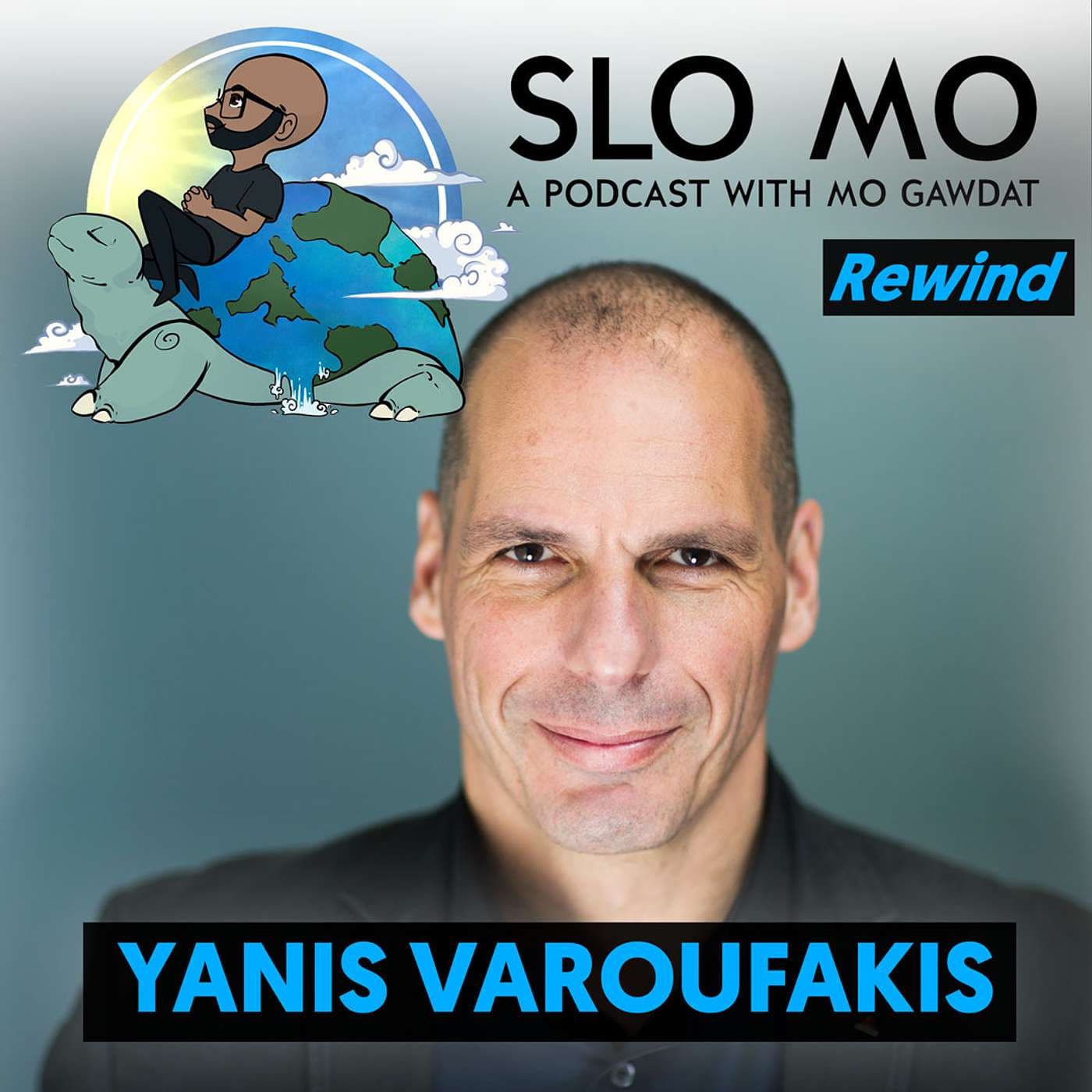
A Podcast with Mo Gawdat," the host Mo Gawdat revisits a conversation with Yanis Varoufakis**, a prominent economist and former Greek finance minister. Varoufakis is known for his bold stance during Greece's financial crisis and his critique of existing economic models. The episode explores themes of economic justice, democratic reform, and the structures that define our modern financial landscape.
Key Themes and Discussions
The Journey of Yanis Varoufakis
- Background: Varoufakis was propelled into the political spotlight during the 2008 financial crisis, where he took a stand against the austerity measures imposed on Greece.
- Fan Experience: Mo shares his admiration for Varoufakis, likening his following of Varoufakis's negotiations to a sports fan.
The Nature of Money
- Illusion of Value: Varoufakis discusses the concept that money is fundamentally an illusion, created by banks and financial institutions without intrinsic value.
- The Role of Debt: He argues that modern capitalism is fundamentally built on debt, which serves as a means of control over individuals and states.
Critique of Capitalism
- Historical Context: The conversation touches on the transition from feudalism to capitalism and how this shift has altered the mechanisms of production and distribution.
- Centralization of Power: Varoufakis highlights the dangers of concentrated economic power and suggests that the current system has strayed from its original intent, leading to what he terms "techno-fuedalism."
Vision for an Alternative Society
- "Another Now": Varoufakis introduces his fictional novel, *Another Now*, which imagines a world without banks, stock markets, or billionaires. It serves as a thought experiment to envision a fairer society.
- Goals of the Novel: The book aims to challenge conventional economic thought by presenting alternative structures for corporations, trade, and governance.
The Mechanics of Modern Economics
- Impact of COVID-19: Varoufakis asserts that the pandemic accelerated existing economic issues rather than creating new ones, highlighting the structural flaws in the financial system.
- Government and Central Bank Dynamics: The separation of government and central banking is discussed, emphasizing the need for a more integrated approach to economic policy.
Recommendations for Individual Action
- Invest in Yourself: Varoufakis emphasizes the importance of personal development and education as fundamental forms of capital in a flawed economic system.
- Skepticism of Financial Systems: He warns against reliance on speculative assets like cryptocurrencies without a solid backing or purpose.
Key Takeaways
- Reality of Money: Understanding that money is a social construct can shift one's perspective on wealth and value.
- Power Dynamics: Acknowledging the role of debt in controlling populations helps contextualize contemporary economic struggles.
- Rethinking Economic Structures: Imagining alternative societal models can inspire change and foster discussions about economic justice.
- Personal Responsibility: Investing in personal skills and knowledge is the most reliable way to thrive in an uncertain economic landscape.
Conclusion The episode serves as a profound exploration of economic systems, personal responsibility, and the potential for a reimagined society. It encourages listeners to reflect on their own roles within these frameworks and consider the implications of current economic practices. Yanis Varoufakis's insights offer a blend of critique and hope, pushing for a deeper understanding of the forces shaping our world.
---
This summary provides a structured overview of the themes and discussions from the podcast episode featuring Mo Gawdat and Yanis Varoufakis.
Written by AI. May contain mistakes. Listen to the episode to check what was said.
Transcript
Automatic transcript. May contain errors.0:01I am so glad you could join us. I'm your host, Mo Gaudet This podcast is nothing more than a conversation between two good friends sharing inspiring life stories and perhaps some nuggets of wisdom along the way This is your invitation to slow down with us Welcome to Slow Mo
0:34It must have been in 2006, 2007, sometime when YouTube started, because I remember I saw it on YouTube, that I saw a documentary that was called The Ascend of Money. If you look for it now, you probably may not find it. But at the time, until then, I was constantly buying into the capitalist model, if you want, of money is good, more money is better. You can make money, you can invest money, you can grow your money. And that documentary was called The Ascend of Money, basically said money doesn't actually exist. That because of the ability for banks to print money on demand, you're chasing something thinking that it has value, but it really has almost no value at all.
1:30It's constantly inflated and accordingly it reduces its value over time. And while you have to labor for it for years, others can literally create it as a few numbers on a spreadsheet. 2008, though, the economic crisis, Greece was the center of the focus of the finance world. Greece as a country went bankrupt, and it really, really struggled. I worked at Google at the time, and I worked with Greece closely. And at the time, I think one of every two people were out of a job. It was a very tough time. And there was a minister of finance that became honestly, as he was called, a rock star politician who took on the European Union.
2:24Yanis Varoufakis. Yanis Varoufakis, he's a professor of economics at the University of Athens and the author of many, many best-selling books, you know, nonfiction on the topic of economics. And he simply refused to sign. He was the center of the news around the economic crisis with his country attempting to be bailed out and organizations such as the IMF and the US Treasury and so on dictating terms and he refuses to sign. I was watching literally like a football fan following his favorite team as he negotiated with Kristen Lagarde at the time and Jack Lowe of the U.S. Treasury. And, you know, it was such an amazing view of someone actually standing up for his country.
3:16My guest today, of course, as you may have guessed it, is Yanis. And Yanis has just released a fiction, a fictional novel called Another Now, which is truly refreshing. It's a novel where he asks us to imagine a world where there are no banks, no stock markets, no tech giants, no billionaires, a fair and equal society, if you want. And he asks us to imagine what that would look like. I haven't finished it yet, but it's definitely a utopian fiction, if you want. It contains a bit of tech, a bit of politics, a lot of sci-fi. It's funny, it's brainy, it's moving. It's sort of a post-capitalism and technology novel that really, really addresses the human condition and why it is that money put us where we are today.
4:14I'm gearing up for an incredibly exciting, though it might be a little bit of a complex conversation about money and economics with one of my absolute heroes, Yanis Varoufakis. Hi, how are you? I'm good. How are you? Thanks for joining me. You're most welcome. It's a great pleasure. No, no, no. It is a pleasure to me because you may not know this. You know how football fans watch their teams playing? Yeah, more or less. Yeah. Do you think During the economic crisis, I was watching you. And I was fascinated by what you did. At the time, I worked at Google and I was running emerging markets for Google.
5:03And then when the crisis hit, we took a very interesting position. My team basically decided this was about helping as much as we can. A very unusual position for a corporate, if you think about it. And so among emerging markets, which one was the one to learn from? Greece. So I actually went to Greece many, many times, tried to talk to corporates and businesses and so on. And then I started to observe you and learn what you're doing while you were negotiating with IMF and with the US Treasury. And it was quite a game, I have to say. I mean, you scored quite a few goals. So, yeah, I'm a big fan.
5:46I really am a big fan. Thank you so much for putting in the time. That's very nice of you to say. Yeah, it must have been fun when you did that. I mean, it was the worst time ever, but I think you did it very differently than anyone I could have. Tell us a bit about that. I want to bring us to a very interesting other topic, another now, but I want people to get to know you as much as I know you first. So how was that like? You are running a country that is basically bankrupt, right? And everyone is attacking. And you're there trying to sort of defend, basically, and gain a little bit and score a few goals.
6:27Tell us about that. Well, the bankruptcy of the country was not incidental. The only reason why we were elected, and me personally, was because it was bankrupt. I had no intention of being a politician. I'm an economist. at some point I started kicking and screaming because the most bankrupt European state was given the largest loan in the history of humanity under conditions of crashing further the incomes that were initially so low as to make it bankrupt. So it doesn't take much to realize that this is a violation of basic logic. And I stood with a very clear platform, personally. The party I stood with supposedly adopted this platform, and this is why I agreed to run with them.
7:16The platform was very simple. If a debt cannot be paid, it is either haircut or it is perpetuated through extending and pretending. And since the powers that be, the IMF, the European Central Bank, the European Commission, Berlin and so on, were only interested in pretending that we were not bankrupt and the only way you can do that is by kicking the gun down the road by extending and pretending, the proposition I had put to voters was, you know, if you vote for me and I become finance minister, I'm not going to sign another on the dotted line of any other credit card agreement. So So there's going to be a clash.
7:56So was it fun? Yes, it was fun. And at the same time, it was a complete tragedy because people were actually starving. People on the street were suffering. People in their homes were privatizing their despair. The suicide rate more than doubled. Oh, my God. And we had a genuine humanitarian crisis. So it wasn't a laughing matter. but was it to some extent spiriting to be able to say to the most powerful financiers, the institutions of the world, I'm not signing? Yes, it was. It was very liberating for many people in Greece too because the most astonishing thing that people don't realize is that we were a minority government.
8:41Our party got 36 % of the vote, which was enough with the electoral system that we have to give us more or less an absolute majority in parliament so that we could form a government. But let's say we had about 40 % of the people with us when we were elected. That's not nearly half. And to clash with the most powerful institutions in the world, even 50 % plus one is not enough. You should have 60 % of the people with you at least. And what was quite remarkable is that during those six months when I was in the ministry, we managed to increase the amount of support that we had, even though we were clashing at the expense of the majority of the Greeks with the most powerful institutions.
9:25We managed in July, that is five and six months after we were elected, more or less, to score a fantastic 62 % support level at the referendum that we held on the 5th of July. So we managed to carry the people with us during thick and thin. And tragically, on that very same night of the referendum, my colleague, who was prime minister at the time, surrendered. And I resigned. And that's it. I mean, it is, I don't know how to say it any other way. It's sad that this is the reality of our world. So the reality of our world is that the largest financial institutions are constantly putting everyone in debt.
10:05And nobody's even from the general public is aware of what's happening. That's number one. Number two, the reality is there are very few that actually take a stand and say, I remember the time one of every two Greeks was out of a job. I mean, I don't know if those numbers were publicly announced, but basically the amount of income in the country was cut by. And even those who were working, if I remember correctly, were accepting two thirds of their pay, sometimes half of their pay because there was no other way. And so no politician, sadly, rarely ever would stand up and say, you know what, we're not going, this is a humanitarian crisis, as you rightly said it, and we're not going to work against our people.
10:48So that's number two. And number three, which I have to say to me, so I'm an avid reader. And to me, I read massively at that period to try and understand what was going on. and there was so much written about Greece, so much written about your policy, and most of it was sort of fictionalized, if you want. People were mixing up the reason why Greece got there with the current policy and the reason, right? And it was just a mess. And yet you stood firm. This is not politics, if you want. This is sort of almost heroic. No, it was not heroic. It was the result Not of the fact that I didn't care about a political career.
11:28I was not a politician. I didn't want to be a politician. I have to tell you that the day I resigned the ministry, I was relieved because it wasn't something I liked doing. It was like a chore. It's like, I keep saying this, people don't like me saying this, but I keep saying it's like taking the garbage out at night. It really is, actually. A lot of garbage as well. Somebody has to do it. And you do it out of a sense of public duty. But when they're not letting you, I was not going to stay on just in order to be a minister. And there were moments when I realized inside the European Union meetings, the Eurogroup meetings amongst other finance ministers, and even my colleagues in the cabinet in Athens, that I had degrees of freedom that nobody else had.
12:10Why? Because I didn't care about the career. If you care about your career as a politician, then you are absolutely bound to a system that pushes very clearly to you. Toe the line or you're out. If you don't care about getting out, then you have the freedom to speak your mind and to do that which people voted for you to be in there for. So in that sense, yes. But on the other hand, I was demonized. And you're right. There was a narrative of demonization, of obfuscation, of distortion. I couldn't recognize myself in the things that the Wall Street Journal or the financial clients were writing about.
12:56Yeah, yeah, yeah, yeah. Those were not my views. They were not the things I said, and yet they were being reported extensively. And, you know, I noticed the ripple effect of official establishment fake news. one of those outlets would publish a complete fiction about something I had said, which I had not said. And then suddenly it was being reported all over the world as a fact. And it was impossible to alert the media to the fact that it wasn't a fact. Because it's the sensational news. They want something controversial to talk about. And if you say, but I didn't say this, that's not exciting enough for them to report about it.
13:41Yes, and also it's the quantity. Quantitative effect leads to qualitative effects. So if everybody's reporting the same thing, you know, some of the things they were reporting, they were not even sensational. They were minor details, which were wrong. And yet, because everybody was reporting the same thing, when I would come out and contradicted the news that that would cause was, oh, Varoufakis is taking it back. No, I'm not taking it back because I never put it out there. In the first place. Yanni, so this is why when I heard about Another Now, I spoke in the introduction about how you're writing a fiction, a fiction about a world without that system.
14:26I was like, that is so clever. This is the way to tell the world without really talking about the facts, if you want. Of course, you do a little bit, but without that, you know, we can say, how if we imagine a world that doesn't have all of this? And I want to take our listeners through that. And it's definitely a highly recommended book for everyone listening. And we're going to talk about it in a minute. But let's put the facts in place first, especially for those who may not understand economics very well. I want to start with the reality of our world today. I want to start with the reality of debt followed by the reality of what we think is the governing system, you know, capitalism and socialism and so on and so forth.
15:06Then let's go maybe even deeper and say how the world has changed over the last couple of years. Let's take this step by step to paint the picture of the current world first before we tell them about that fictional world that you're dreaming in another now. So let me start by that idea of debt. almost every finance organization out there, including the very, very big ones, the central banks, the feds, the IMF, and so on, are literally saddling everyone in the world with backbreaking debt. That's almost entirely unpayable. They know it's unpayable, and yet they're still doing this. Why is that the case?
15:42Why is that the system that's in place today? Who does it serve? Well, let me begin in a Hollywood manner first before answering seriously. you will recall that in the first movie of the Godfather series, at the very beginning, Godfather 1 begins with a wedding. Godfather's daughter is getting married. And there's this scene in his study when in the gardens there are celebrations and the wedding parties unfolding. And the Godfather, Manu Brando, is receiving one minor or head of one of the minor Italian families, Italian-American families, who is asking him for a favor. His daughter has been abused by some person and he's asking the godfather to teach him a lesson, to break his knee or kill him or something.
16:37I can't remember exactly what it was. Offers to pay him. And the godfather is offended. And he says, you are offering me money for this? No. I'm going to do it. so that you are in my debt. So debt is power. Yeah, this is, debt is power. I felt that in 2015 when I was negotiating with the IMF, with the bankers and so on, that the worst thing that could happen to them, seriously, the worst thing that could happen to them is if somehow I had discovered a treasure and I had a 300 billion that they sold and I gave it to them. That would have been their nightmare because the difficulty of my negotiations with Greece's creditors in 2015 was that they didn't want their money back.
17:23They wanted us to remain permanently indebted and bankrupt because that gave them immense power. And if you want to know why, just look at Greece today. This perpetual bankruptcy has allowed them to take our airports, to take our ports, to take effectively every asset there is for free and to keep taking forever. And, you know, we are constantly buying armaments from the French, from the Germans, from the Brits, and, of course, from the United States. So you indebt somebody, you put them in your debt like the Godfather did, and then you are the feudal lord. It's quite straightforward. But let me now be serious in my answer.
18:08Serious, that is, give you a proper economist's perspective on the role of debt in capitalism. Now, I always begin this explanation by comparing and contrasting feudalism with capitalism. Because under feudalism, we had a sequence. First came production. The peasants worked the land and produced wheat, corn, potatoes, whatever it is that they produced. Then, once the harvest came in, there was distribution. The Lord would send the sheriff to the peasants to claim the Lord's share. So production followed by distribution. And then there was finance. At the end, finance. In what form? The Lord's share was large enough.
18:56It was too much for the Lord and his cronies to eat. So a large part of that was surplus, and the Lord would sell it in nearby markets, financialize it and then use that money to lend money out so you had this sequence you had production, distribution, finance capitalism amongst other things that it did reversed the order once the land was commodified parceled up and closed and rented out to former peasants maybe to the former sheriff who acted as a proto-entrepreneur, this proto-entrepreneur had to pay rent to the landlord, to pay wages to workers, to pay for the seeds in advance. He didn't have the money, so he had to borrow it.
19:53So debt finance came first. Then came distribution, because when you say to the worker, I'm going to give you a loaf of bread a week or a day for you to work, the wage, this is a distribution of the surplus that has not been produced yet between labor, capital, and the landlord who collected rent. So, whereas in feudalism we had production, distribution, finance, or debt, in capitalism we have debt, distribution, production comes at the end. Now, this reversal unleashed gigantic productive hours. But what it also did was it made debt central to the production process because it came in first before anything else.
20:39So bankers become essential in providing the fuel to the engine of growth under capitalism. And because the debt comes first before production happens, it's all fictional money. So the bankers were forwarding, giving effectively all draft facilities of money that didn't exist. So they were conjuring up, as if by black magic, money that had not been produced yet. So when you go to your banker and you get a hundred thousand dollars or a million dollars to buy something, either a property or to refurbish your shop or whatever, that money doesn't come from the savings of somebody else. It is numbers on a spreadsheet.
21:28It is thin air or hot air. The hope is that the money will be taken by you, you will put it into good productive use, you will generate production output, you will produce the value so that you can repay the future effectively. So that you can repay the future and the bank can repay the future and keep its cut. While this is working beautifully during the good times, bankers have an incentive to lend more and more money that doesn't exist, that is effectively to borrow from the future, to bring from the future money that hasn't been produced yet, or value that has been produced, to bring it to the present.
22:13The better that works, the more profitable that is for bankers, the more they will do. At some point, they will borrow so much from the future that the present cannot repay the future. And that's when you have a crash. This is why we have central banks, because crashes have been periodic, ongoing. They are a feature of capitalism. They are not an accident, for the reasons that I outlined. Things came to a head a number of times. In 1929, you had the worst crash, because the Roaring Twenties before 1929 were the result of the first networked large-scale companies like Edison and Ford and so on, that needed huge quantities of capital and therefore you needed huge banks, agglomerations, cartels of banks to come together and conjure up mountain ranges of non-existent money to give to them, which then created a rational exuberance in stock of change and so on.
23:13So the whole thing came down in 1929, New Deal comes in, Bretton Woods extends the New Deal after the war internationally. And one of the provisions of the New Deal and Bretton Woods is that the bankers are not allowed to do this anymore. You have capital controls. You have boring banking. Bankers have been put like the genie into the bottle by Franklin Roosevelt and then by Bretton Woods. 1971, Nixon shock, 15th of August 1971. The whole thing blows up. Let's explain Bretton Woods to everyone. This is basically tying money to the gold reserves. So basically banks cannot make money. Not really.
23:52Yeah, okay. That's a fiction. That's a fiction. Up until 1929, supposedly the quantity of printed money, paper money, was linked to the quantity of gold every central bank had in its vaults. Correct. That never worked very well. And because, of course, when a private bank gives a loan, that becomes money. And so the quantity of gold and the quantity of money are absolutely decoupled, even if formally, legally, we have the gold standard. So this thing collapsed in 1929, and then Roosevelt comes in 1933 and effectively ends the gold standard and says the dollar is its own anchor. But bankers are not going to be allowed to conjure up money without permission from the state, effectively.
24:41There were severe restrictions in how much money, private money, the bankers could create. Now, the new deal essentially was what? It was the federal government playing two roles. The first one was to ensure that the level of demand for goods and services was raised sufficiently to absorb unemployment. That's the works program. This is the fiscal part, the investment part of the new deal. The second thing he did was to effectively constrain the bankers so that the bankers cannot, through the process of conjuring up money from thin air, A, appropriate value that they never created, and B, cause a blow-up in the future.
25:32In 1944, as the war was ending, it had not ended. The Americans, the Brits, and the Canadians were about to invade Normandy. It was at the same time as the Normandy invasion. But it was clear that I think it was on the wall, that the Allies would win. Roosevelt convened in New Hampshire at Bretton Woods, the Bretton Woods Conference, which, to cut a long story short, what it did was it extended the New Deal to the rest of the world. and made the dollar the gold standard. So in theory, the dollar was convertible$35 an ounce. That was in theory. In practice, the dollar was the anchor of the world system.
26:14And the bankers were kept in their place with capital controls, with an expected ban on betting in the stock exchange, an effective ban on creating too much money and too much debt. That's until 1971. That's in 1971. In 1971, that system ended because this whole system was predicated upon the assumption that the American economy would be in surplus vis-a-vis the rest of the world. That the dollar would be the currency, the global currency, exchange age would be fixed, and what would keep them fixed would be, that was never actually spoken or written down, but it was assumed that when Europe or Japan had a balance of payments problem, the surpluses of the United States would somehow be channeled either to Japan or to Europe in order to stabilize Japan in Europe.
27:14The Marshall Plan is one example of that. The way in which the Americans opened up their markets to Japanese imports, cars, electronics, and so on in the 1960s, against the interests of American multinational companies, is another example of how American surpluses were being used in order to stabilize the Japanese economy because the global system that was dollarized had to be stabilized by somebody. It was a surplus country in the United States that did it. But from the mid-1960s onwards, because of the Vietnam War and because of the Great Society, which was quite expensive, the Lyndon Johnson program for reducing poverty, America went into the red, became a deficit country.
27:56And the system collapsed in 1971. And with so many dollars circulating around the world, because the dollar was the world currency, It was a very clear choice by the Nixon administration. People like Paul Volcker, who was part of that administration, people like John Connolly, the Treasury Secretary of Nixon, who used to work with the LBJ before that. He shifted from the Democrats to the Republicans. It was a very clear choice. We are going to inflate the economy in order to cause the dollar to lose its value vis -à-vis the yen, the Deutsche Mark and so on, in order to effectively haircut American debt.
28:37And the way in which, however, America remained hegemonic at the time of a devalued dollar, that was quite spectacular, was by increasing its deficits. This is quite a paradox. If a German finance minister realized that Germany is in deficit, immediately they slammed the brakes. They tried to reduce the deficit. What the Americans did was to say, okay, we're going to accelerate the deficit, increase the deficit. And who's going to pay for that? The rest of the world. And how will the rest of the world pay for that? By sending their profits from selling stuff to the Americans. They're going to send it to Europe to be invested.
29:20So there's this feedback loop that was closed. But to do that, they had to unleash Wall Street. They had to allow Wall Street to do whatever Wall Street wanted to do. So that's the end of Bretton Woods. It's the end of restrictions to the banks. The banks can now, from 1975 onwards, do whatever they want. And they could go back to the 1920s model of creating huge quantities of money, money that didn't exist out of thin air. And that worked until 2008. Because financialization, the creation of tons and tons of money that had no connection to really existing capitalism, at some point led to this avalanche that was the crisis of 2008.
30:05Let me try and put this in layman's terms and then correct me if I'm wrong. So since that change, basically we went back to the idea of banks being able to create money on demand. So I'm dreaming of this house. I don't have the money for the house. Somehow we created some kind of a magic formula that basically said, I don't need the money. I can just borrow it. And when I borrow it, I have the house, but I don't actually borrow it. What I do is I snap my fingers and the money gets created. It suddenly lands in my bank account. It never existed before. The only thing is that this magic formula involved the bank in the middle.
Read the full transcript
30:45And the bank said, to allow you to snap your fingers i'm gonna have to charge you five ten percent more right and since then everyone is running to pay back and pay back the 10 more actually it's even worse than that because you see financialization what they started doing after 1975 73 74 75 is the beginning of the options of their collateralized debt obligations and so on oh yeah they started doing was something quite preposterous even by the standards of bankers. You see, if you're a banker and I come to you and say, give me a million dollars, I want to buy a house, you used to be worried that I may not be able to repay you.
31:26But they overcame that fear. They overcame that fear because they found a way of not caring about whether they would repay. So what they would do is this. I would come to you, I would ask for a million dollars, you give it to me. That debt that you now hold, which has collateral, the house that I bought, right? That debt, you immediately cut it up in tiny little pieces. You cut up other debts into little pieces. American government debt, that is U.S. Treasuries, Japanese government debt, the debt of companies, the debt of other householders, some of them with more money than I have, safer debtors than me, others less safe.
32:10So you chop up all the debts that you've given out. You've chopped them up in tiny little pieces. Then you take a little box, a box, and you put some pieces of this, some pieces of that, some of the other, and you sell this in the same way you would sell a share or a bond. And this box inside contains bits of different governments or people's or companies' debt with different interest rates, different probabilities of default, and so on. and they were so devilishly complicated that nobody knew what was inside those boxes not even the people who actually created them but once it started selling them right they started selling like hot cakes because when everything was going up everything was going up including those things so if i were to say to you look this is this piece of paper you don't know what's in it what it is you have no idea what it is but let me tell you and let me say that i can actually prove that it's not just here, that I bought this piece of paper for$100 ,000.
33:12And I bought it from somebody who two days ago bought it for$50 ,000, who had bought it from somebody else who a week ago had bought it for$1 ,000. Immediately you want it. You think, my God, this went from$1 ,000 to$50 ,000 to$100 ,000 in a week, in two weeks. So imagine if this is happening now for 10 years, and these bits of paper, all these boxes of different kinds of decks containing different pieces of debt, have been going up and up and up and up. Everybody wants them. Now, this then started the capacity to create those boxes is the equivalent of printing money. And the banks could do it.
33:49So I would then come to you to get a loan from you. You didn't give a damn whether I would be able to repay it. You were actually not waiting for me to come to you to ask for a loan. You would seek me out and push a loan like a predator lender down my throat. and say, no, no, no, I've got a million for you. Take it. Please take it. I don't even want to see any pay stubs from you, you know, whether you have a job. I don't care. I really don't care because I'm not going to be the one who has to repay it if you can't pay because I will chop it up in tiny little bits, put it in different boxes and sell them.
34:24Somebody else can do that. And because they also had this view, this absolutely audacious and crazy belief that this wasn't a problem. Why? because my debt was chopped up in tiny pieces and it was spread out in different boxes, all over the world. So even if Yanis defaulted on his debt, nobody would suffer much because this million dollars that I owe was chopped up in tiny little bits. People wouldn't even notice if one of those bits defaulted. But when every bank was doing the same thing and one bank was buying the other bank's CTOs, derivatives. And then in the end, you had a situation where, let me give you a number, in the year 2000, total income, aggregate income, GDP, planetary GDP, was something like 50, 50 trillion dollars.
35:21The value of these derivatives was around 45, 50. A lot, right? As it means. Now, hang on a second. By 2007, world income had gone from 50 to 70. From 50 to 70. The value of these derivatives had gone from 45 to 800. Oh my god. So, planet Earth was not large enough to contain them. So, they exploded and they burned down into the year 2000. And it is then that we had a new 1929, except that there was no Roosevelt. unfortunately we had Obama Obama, Gordon Brown in Britain the European Union and so on you're not saying 2000 this is 2008 right? this is not 2000 2008, 2009 by the time the crisis had to be sorted out which was in the spring of 2009 Obama was in the White House and Gordon Brown was in London Merkel was in Berlin and so on and the one thing they agreed to do the one thing they agreed to do at the GE7 meeting in April 2009 in London, was to get together all their central banks to print mountain ranges of money gain in order to reflow the banks.
36:39That was the moment, in my view, capitalism died. Because I have this very weird theory that what we are experiencing today, I mean, capital is everywhere. Markets are everywhere. Capitalism is everywhere. But this is It's not capitalism, it's something worse. I call it techno-fidelism. Why am I saying that? Because in 2009, for the first time in the history of capitalism, you had a major transition. Instead of the system, the economy, being driven by profit, by private profit, it is being driven by central bank money. Correct. The workers, especially the money markets, are completely addicted to central bank money.
37:20if you look at the goldman there's a very famous index by goldman sachs the index of unprofitable of the value of unprofitable corporation corporations don't make profits if you look at the share values going through the roof why they're not making profits they're loss making and yet their value is going through the roof what the reason is that the central banks are printing money and throwing them at the markets correct so you don't give it down where a share is going to give you dividend All you care about is that the share is going to go up because more money is circulating in the stock exchange, chasing after the same number of shares.
37:57And companies borrow money from commercial banks that borrow money from the central bank to do what? To buy back their own shares. So you've got this complete decoupling between really existing economies and financial markets. Isn't that magnified even 100 times in cryptocurrency, which really produces nothing, but basically is getting floods of money coming in to chase it? Of course. Because you see, today, look, since 2008, we had tens of trillions of dollars that were printed by the central banks and given to commercial bankers. Commercial bankers who can only make money if they lend it on, they are at a loss because they look at little people out there and they think, no, no, no, no, little people are not safe, bets.
38:46So we're not going to lend money to small businesses, medium businesses, to people actually capable of doing useful things with their money. So they pick up the phone and they call Apple, they call Volkswagen. Now the thing with Apple and Volkswagen is that they have savings, which in itself is a sign that there's something very badly wrong with the economy we live in, because corporations are not supposed to have savings. You and I, households are supposed to be able to have savings and corporations are supposed to borrow in all the universities. So when corporations have savings, you know that there's something that matters.
39:16But anyway, so when Google is already sitting, Google, Apple, they're already sitting on tens or hundreds of billions of dollars of savings. Why do they want the money from the Bank of America or Citigroup? Why do they want to borrow money? They don't. But Bank of America wants to rent them. Bank of America gets its money from the central bank as negative interest rates, so from the European Central Bank, or zero interest rates in the case of the Fed. So free money. And they call up their friends in the corporate sector and say, look, we have free money for you. We'll just charge you 0.1 % more, you know, a spread.
39:55Will you take this money off our hands? Because a banker's nightmare is to have money and not being able to lend it on. So people in Google and Fox and Facebook say, all right, okay, send it off. Send it off. We'll do you a favor. And what do they do with the money? They don't need it because they have savings. They take it to the stock exchange. And Google buys back Google shares, Alphabet shares. Apple buys Apple shares. Volkswagen buys Volkswagen shares. Siemens buys back Siemens shares. So their share prices go up. They've managed to push their share price up without... It's no skin of their nose.
40:31They used money that came to them for free from the central banks. And it goes up much, much, much higher than the 0.1 % that they're paying anyway. Their salaries depend on the share price. So they get a lot of money. They go and buy houses in Manhattan, in Berlin and so on. House prices go up. Little people can't afford to live in their own cities. So inequality skyrockets. And this is a vicious circle. And capitalism suffers because profit is no longer made. Medium sized businesses are suffering. They have no profits. Companies that are not involved in the sexy part of the market do not make profits.
41:14Their share goes up because the whole of the share, the financial markets goes up. But they do not make profits. And suddenly the whole system is hooked on central bank money. So capitalism used to be a system that had two pillars. One was private profit. It was fueled by private profit. That's no longer the case. It is fueled by central bank money. And the second thing is that everything that happened in capital happened in some markets. The labor market, the market for goods, the market for services, which markets that were not always competitive. You had oligopolistic markets. The automobile industry was never competitive.
41:51There were five, ten companies. But still, it was a market. Now, markets are being displaced by platforms. When you go onto Amazon.com, this is not a market. It's like a digital space that belongs to one algorithm, to one man, effectively, Jeff Bezos. The algorithm decides what consumers see to buy. The algorithm decides what to promote, what not to promote. In the end, this platform resembles a feudal village belonging to a feudal lord where commercial activity takes place by permission of the feudal lord. So this is why I'm saying that the crisis of 2008 changed the world in the same way that 1991 ended communism.
42:422008, from where I'm standing, changed capitalism. Now, it's interesting when I say that, the people that loathe me the most are fellow left-wingers, because as you know, I'm a left-winger. You know, we socialists, we came to this world thinking that we would topple capitalism. So that my fellow left-wingers do not like hearing from people like me that capitalism did not wait to be toppled by then, that it toppled itself. And it gave rise to something called feudalism, not socialism. But the question is that we're building all of this on no foundation whatsoever. Money comes out of thin air, gets lent to people who don't really need it.
43:21then nobody cares if they pay it back. If they pay it back or if they don't, we're just borrowing more and more from the future and there is no limit. Comes to trillions of dollars. Countries themselves are borrowing. What I'm trying to say is actually there is no money. Money is an illusion basically. Money is... Money was always an illusion. Money was always an illusion. That is not a problem. The problem is that there used to be times when that illusion was useful and it could back its own illusions up with real things. The word money in Greek, or actually the name for currency, is nomizuma from the verb nomizo, which means to imagine, to think.
44:07So Aristotle had grasped it from the very beginning, from the ancient Athenian times, that currency has value just because we think that it has value. Even in ancient Mesopotamia, where Iraq today is, or Syria, the first civilizations, the first serious economies, agricultural economies, even then money was an illusion. How did it work? What was the first form of money? The rulers, in order to pay the workers for working on their fields, they would write on fragments of clay numbers. This is how numbers were invented. And those numbers corresponded to quantities of wheat, let's say, or corn or whatever it was that they were producing, that they would get at the end of the harvest.
45:01So it was like an IOU. But these IOUs, those shards of glass or shards of clay, they could only be redeemed at the end of the harvest, six months, eight months from now. But a farmer could use those to go and buy milk for his kids, and they were transferable. So transferable IOUs was the way in which money began. Now, as long as the system worked, as long as at the end of the harvest, the right quantity of wheat was produced to back up the value of that shard of clay, the system worked. So even though money was always an illusion, even when it was metallic, what we have done since 1971 in the end of Bretton Woods was to create circumstances in which the financiers have taken over the economy.
45:54Instead of being facilitators of economic life, of production, of output, of investment, they've taken over capitalism. They've turbocharged their capacity to expropriate large quantities of value that other people produced. And they kept doing it to such an extent that they blew up the system effect in 2008. And since 2008, we have a complete disconnect between the world of money, money markets, and the world of production. And now with Amazon, Google, with big tech, with the platforms taking over, and with enormous power to make people produce without being paid or being paid very little. Because if you look at what's happening now in the world of production, a lot of production takes place without pay.
46:51So when people are actually uploading things on Facebook, they're adding to the capital stock of Facebook, but they're not getting anything back for themselves. And then you have people working in the Amazon warehouses, precariously employed workers working for$15 an hour. and if they get fired, they get nothing, they don't have quality pay, they have no insurance. So either they get paid very little and precariously or none at all. Which means that the chasm between our society's capacity to produce things and the capacity of people out there to actually buy those things, this chasm is getting much greater.
47:33and the only thing that can fill in this gap is the state which keeps through central banks producing money but of course this money goes to whom to the very rich because you don't have helicopter money you don't have a basic income you have the same commercial banks giving it to the very rich to buy apartments in manhattan and hoping that some of it will trickle down to the many. And the result is a very unpleasant society, even for the very rich. If Warren Buffett, Gates, some of the richest people on the planet, especially in the United States, are seriously worried about inequality. It's not because they are philanthropic.
48:15It is because they see that the society that we are creating, that is emerging from all this, is going to be a very nasty and brutish society in which they will feel very insecure. Then we have to live behind gates. Gates will have to live in gated communities. Otherwise, its own safety cannot be guaranteed. So, in a sense, my criticism of the world we live in is not that it is unfair. It is that it is inefficient. It is that it is irrational that we move beyond capitalism, something that is closer to a digital version of feudalism, which is unsustainable. We're killing the planet, we are dividing ourselves, and we are creating technologies capable of producing things that people out there cannot buy.
49:06So before we go into where this is heading, I want to take the other major event recently. So we are killing capitalism, we're flooding the market with money that is government money, not profit and value-driven money. And then comes COVID. What was the impact of COVID on all of this? I'm going to surprise our viewers or listeners by saying that I don't think that COVID did anything new. COVID simply turbocharged what has been happening since 2008. I do strongly believe that in 2050, people are going to be looking back to 2008, 2008, not to 2020, as the moment capitalism died. Because if you think about what happened in 2020 with the lockdown, central banks started printing more money.
49:56But they had already started doing it in 2008. What did governments do? Very little. I mean, and whatever governments did, it was all financed by central bank money anyway. So it was good that governments stepped in and provided furlough schemes to workers and support businesses. They had to do it. There was no alternative. But the structure of fiscal policy, the structure of the taxation system, the structure of the real economy didn't change at all. All that did was the Fed, the European Central Bank, the Bank of Finland, the Bank of Japan, they started printing a lot more, flooding the markets.
50:30Isn't it not fantastic that when capitalism effectively was put on hold, financial markets were going through the roof, even Bitcoin, because people had so much cash, they didn't know what to do with it. They bought anything. It was the everything rally during the worst times of capitalism. So I don't believe that COVID had much of an influence except quantitatively. It made the bad thing worse. It made the bad thing worse. Can I ask you to clarify why you say governments and central banks as if they are two separate entities? Well, they are supposed to be. Yeah. In Europe, for instance, in the European Union, in our infinite wisdom, we created a European central bank, but not a European state, not a European government.
51:17Yes, correct. So we have a central bank, but we don't have a government behind it. And we have governments without a central bank, because the European central bank is not allowed by its legislation, by its charter, its constitution, to finance the governments that use the euro. The euro's best central bank is big. In the United States also, supposedly, the Fed is independent from the federal government. Supposedly. There is a degree of autonomy that the Fed has, but at least in the United States there is a modicum of logic and the Federal Reserve, the central bank of the United States, will never allow the American government to go bust, unlike the central bank of Europe, which allowed my country to go bust.
52:00They would allow Italy to touch and go whether Italy will go bust or not. So that's why I speak about governments and central banks, not believing for a moment that one is independent from the other, but there is a degree of separation between them. So who owns the central bank? Who owns the Fed? Ah, that is a very interesting question. You know what? Nobody knows. The Fed was created by JP Morgan, right, and other bankers. Why? Because JP Morgan had enough of bailing out his tail of bankers every time there was a banking crisis. So in the first decade of the 20th century, J.B. Morgan at some point had enough and gathered about the central bank and said, look, let's create the Federal Reserve so that we can bail each other out, which was presented, of course, as a federal government.
52:48That's why it's called a federal government institution. In the end, it really doesn't matter because the central bank is not banks. It's a state institution that provides bailouts to banks. That's what the deal is. But they're printing money. They're printing money. So basically the money in your country... They are only printing 3 % of the money. 3%. 97 % is printed by commercial banks. I'm not talking about the paper money. Paper money is printed by the Fed. Right? But that's only 3 % of the money. Even less. Today it must be about 1 % of the money that is doing the runs. Every time you pay in Starbucks with your card, that's not paper money.
53:34It's bank money. And bank money conjures it up from thin air. So central banks, look, the only way that central banks can influence, can railroad the private banks is by threatening not to bail them out if there is a bank run. That is the only way the Fed can threaten the Bank of America or Citigroup. It can control. But then, given that they are too big to fail. It's not a credible threat, really, because the good people in Bank of America know that they are not going to be allowed to go to the wall, because if they go to the wall, America goes to the wall. So, effectively, we have a system where the bankers are ruling the roost.
54:19They make a mint out of it, while the real economy is suffering. And the majority of people out there look at their kids and And they look at their grandchildren and they see people, younger people, who are going to have a much worse life than they did. And this hopelessness, this lack of hope for the future. The future, you know, my favorite expression these days is that the future is not what it used to be. This is what fuels racism. This is what fuels populism. This is what brought Trump to the White House. It's what creates discontent and leads to the breakdown of our democracies. And where is it heading?
55:00Is it heading to become worse or better? Is there going to be a change? Is there a time where it breaks? Yes, there will be a time when it breaks, but I hope we don't reach that time because if it breaks, you know, what does that mean? It means blood on the streets. It means civil war in the United States. It's a country that is prone to violence and it's a very violent state as well in terms of its influence on the rest of humanity. Here in Greece, I saw with my own eyes what happened when we had a complete collapse, implosion of the economy. We had Nazis in Parliament. We had Nazis on the street.
55:40We had people being killed on the streets by Nazi thugs, bearing swastikas. So, no, I don't see that. But look, I don't care about prediction. I'm not in the business of predicting. Because unlike the weather, which can be predictive, and which is okay to predict, because a meteorologist's job is to predict the weather. You judge a meteorologist according to how well they predict the weather. But when it comes to politics, unlike meteorology, where the weather at least doesn't give a damn about what we think of it. So if we get our weather focus wrong, the weather is not going to change what it's going to do.
56:19But in society, our predictions about society change what we do and therefore change society. So we have a moral duty not to predict, but to do that which is right. This is why I'm in politics even today. But what is that? I mean, so for the listener listening to us or watching us, what would they do in a system? Should I go to a bank and borrow as much money as I can and put it in Bitcoin? Because honestly, that's the way the system is working. Should I avoid that altogether? together we're living in an economy where the one currency that actually manages everything for us is fictional it doesn't really exist and it's affecting everyone's life and as you rightly said the rich are getting richer and the poor are really suffering you just reminded me of my dad who passed away a few months ago when i was very young he said something that has stayed with me He said, the only advice I can give you is to imagine that you are walking in life, on the path of life, like a completely shirtless refugee.
57:28Imagine you are a refugee. You've been spat out by some boat on some shore, and you have nothing except a pair of pants. What is the only capital that you are carrying with you? Your education. Your education. Your capacity to do things, your erudition, your knowledge of mathematics, your knowledge of medicine, whatever it is, your human capital. Try to improve that. There is no safe haven. Bitcoin is a pyramid, just like Madoff's pyramids were pyramids. Yeah, yeah, yeah, yeah, Bernie Madoff's, yeah. the dollar can inflate or a share may lose its value or bond yields may go through the roof and bond prices may collapse.
58:19There is no safe haven in a system which is unhinged. The system we live in is unhinged. This is the whole point of our discussion. So let's try to improve ourselves and let's try to improve the system, change the system. This is why I wrote Another Now. Let's talk about another now then. You see, the worst enemy of humanity is the false belief that there is no alternative. And the most hopeful thought that I can come up with is that, you know what, everything could be different. When Voltaire wrote a humorful novel called Candide, he conjured up this character Pangloss who was the tutor of Candide in Voltaire's little book and Pangloss had a theory his theory was that we live in the best of all possible worlds that this world could be horrible it may suck but it is the best of all possible worlds now my view is precisely the opposite that Pangloss was completely wrong that we do not live in the best of four possible worlds, that yes, we are fallible.
59:34We, as a species, we have huge disadvantages and tendencies for evil. There's no doubt about that. And stupidity, collectively and individually. But nevertheless, we have also wonderful capacities. And this world, despite our fallibilities, could have been far, far better. And we could make it much better. So how should money work? How should central banks work? Not how do they work, how should they work? How should corporations work? How should the use of land, of scarce land, be handled? Who should own it and who shouldn't own it? Let's reconsider, let's rethink our arrangements. not that we can just press a button and bring about a world according to our utopian thinking but unless we engage in this process of rethinking how things could have been we will be stuck in the iron cage of believing that as Pangloss did that we live in the best of all possible worlds and that is a great threat to our children and grandchildren so to put my money, proverbial money, where my mouth is, I decided to sit down and write a novel in which I described an alternative now, another now, in which book I tried to provide the reader with a blueprint of how the basics of our social economy could operate, from corporations, markets, land, money, international trade, migration, from governments, democracy, and so on.
1:01:23It was not an easy task, and I will leave a judgment of how successful it was to my readers, but it was fun trying, and I really have to say that I miss writing that book because in order to actually write it, I had to do it as a novel. Why as a novel? Because I disagree with myself on many of the things that I wrote. I come up with an idea, and then I disagree with it. And I come up with a second idea, I disagree with that idea. So I thought, hmm, how am I going to write a book when I disagree with myself on its contents? I thought, well, this is why people write novels, because you can populate a book with different characters and you can give different views of yours to different characters and let them fight it out.
1:02:08That's so interesting. So there are multiple Yanis in this novel arguing with each other. Indeed. Yeah. So when they argue, so let's start with the basics here. Okay, you're saying a world that has no banks, right? Of course, no banks, no central banks, and accordingly, no stock market. Oh, no, central bank there is. A central bank there is. Okay, so explain to me how this works. In a very high level, as I said, everyone should read this. It's a beautiful vision of what the world could have been or may become. But let's start. So no banks, no tech giants, no billionaires. How does it look like?
1:02:45It sounds like, when you put it that way, even I feel, oh my God, that sounds like a totalitarian regime. No, it's not. Because what I'm saying is markets are irreplaceable. Markets do a wonderful job at coordinating the activities of producers and consumers. But however, there are two markets that are highly problematic. One is the market for money. We've already discussed one. I'm not going to go through this again. And the other is the market for labor. The idea of the market for labor is that there are some people who sell their labor to others who buy it. That's the idea of the labor market.
1:03:26Now, why should somebody have the capacity to buy my labor? And why should I have to sell my labor to anyone? I mean, in the end, everybody wants to be an entrepreneur, right? Everybody wants to be in business for themselves. So by being in a situation where you're selling your labor to somebody, You are essentially in a subordinate position. Your capacity to be a ruler of yourself, and I'm saying this as a liberal, is diminished. Moreover, we've seen that Adam Smith, who was the greatest advocate of capitalism, of markets, and a guru of those who are speaking in theory of capitalism, Adam Smith was completely and utterly against public limited companies.
1:04:09companies that have anonymous shareholders, where the shares are like pieces of paper, or these days electronic shares, that are sold and bought anonymously in a share market. Adam Smith, the guru of capitalism, was against share markets. And the reason was because if you separate ownership from running the business, Adam Smith explicitly said that if you separate ownership from the running of the business, then you are inexorably leading to large corporations that dominate markets, create monopoly power, and therefore exploit consumers and kill off innovation. That's Adam Smith. I agree with him.
1:04:53So let's start from where Adam Smith began, that we do not want liquid ownership. We do not want the share market. So, if you do away with share markets, how can you do away with share markets? One way is to have companies like in Adam Smith's time that belong to a family, family-owned businesses. But we know now with the technologies that we have, you can't have a car company that belongs to a family. That would be feudalism, like the Agnelli family that had Fiat. That's not liberal and it's not efficient. and it really can't work, especially in the technology sector. Okay, so what's the alternative?
1:05:36The alternative is to have corporations where everybody who works in them owns one share. Owns a bit of them, yeah. One share, one share. And I envisaged it in the book like the library card that college students get when they enroll at college. You get into college, you get a library card. It's very useful. It allows you to take books out of the library, to register on the computer system of the university, to have your email account, to vote in elections, students' elections, to attend classes. You can't rent it out. You can't lease it. You can buy it. You cannot sell it. When you're out of college, you have to return it.
1:06:18End of story. Imagine if you had corporations in which when you were hired, you just got one of those votes. One share, one vote. And you participate in all the decisions of the firm. Now, that doesn't mean that everybody should be getting the same salary. Because if you and me and another hundred people create a company, and we need an engineer that does wonders, we will have an incentive amongst ourselves to pay that engineer a lot more money than we get. So this is not an argument for equal pay. It's an argument for equal say. Come to think of it, the moment you do that, the moment you do that, you don't have a share market.
1:06:56because shares cannot be bought or sold. So you don't go away with shares. And you have corporations that work far more liberally than today, and you have corporations that will choose not to be too large. Because if everybody has one share and one vote, right, then you don't want to be in a corporation that has 10 ,000 employees because it's very hard to manage it. Put it this way, if General Electric were to become a company like that, then the employees of General Electric will want to split it up into the division that makes fridges, another division that makes engines for aeroplanes, another division that does this, that and the other.
1:07:37They will themselves have an incentive to do it because it will be easier to run the businesses in a way that is meaningful to them. So it's not that the state comes in and breaks up companies, regulates. No. All you do is you change corporate law. You say one share on vote, non-tradable. and then suddenly the size, the optimal size of corporations gets smaller, you have more competition, right? And you don't have a share market. And then corporations for a change don't work for the benefit of the shareholders. They either work for the benefit of their customers or their employees or, you know, their...
1:08:12Well, the shareholders are the employees. Yeah, exactly. The shareholders are the employees. And then because they will be much smaller and you are not going to have this huge concentration that you have now. You're not going to have a situation where there will be so much market power concentrated in the hands of so few shareholders who own the big corporations. The corporation will be bigger and share ownership will be everywhere. Everybody who works anywhere is going to be a shareholder. Now, at the same time, take the system now that we now have. Central Bank prints money, gives it to the bankers, the bankers give it to their friends to buy their own shares.
1:08:52Well, that is not going to be happening anymore because the corporations will not belong to the friends of the bankers and they will not be able to buy shares anyway. So I am not a big state person who says, oh, ban the banks. No, you wouldn't even need to ban the banks. If there's no shares for the banks to finance the trade-off and if you cut the bankers out of the middle between the central bank and the citizens. So imagine at the moment if you ask the Fed Why are you printing money to give to commercial banks? The answer will be because we are stimulating the economy. We hope that the commercial banks will then give it to companies.
1:09:31The companies are going to employ people and so on. Well, why not simply cut out the middleman, the commercial bankers, and why not do that which the Chinese central bank is doing now, which is creating a digital currency, a digital cryptocurrency, a state currency, not a Bitcoin. So the renminbi becomes a digital renminbi. Imagine if the Fed turned the dollar into a digital dollar, which means what? Everybody has a wallet. You have a wallet. I mean, everybody who lives in the United States, every resident of the United States, or anybody who does business in the United States, gets a wallet with a central bank.
1:10:05And let's say that the central bank wants to stimulate the economy. Why not simply credit a basic income to every wallet? You don't need to go through commercial banks. And if you have inflation, you reduce the amount of credits that you give the basic income. So suddenly, everybody has a bank automatically, simply by being a resident of the United States. It's the same, the Fed. Everybody has a wallet with the Fed. To make a payment today, you need to go to the Bank of America and own an account. Otherwise, you can't get a card by which to buy a sandwich from Starbucks. But if you have the Fed providing everybody with a digital application on your phone, you don't need a commercial bank.
1:10:46You have the Fed. Now, you see, I didn't ban in my idea, in my blueprint. I haven't banned the banks. I simply have given them no reason to exist. Because if they cannot fund the purchase of shares, because their shares are not to be bought anymore, and if people can make payments without having a bank account, if the banks want to survive and they have something to offer you that the Fed's wallet cannot offer you, fine, let them do it. But I bet you they will not survive because nobody will want bankers, nobody will want to open a bank account if they can do without it, especially if the Fed's wallet is free.
1:11:27Interestingly, whatever comes out of the Fed at that time would not have to suffer all of the uplifts, if you want, the other people, the middle people that need to make profits in the process. and so inflation would slow down basically because money is not just being borrowed from the future all the time. And also the Fed will have direct, direct control of the quantity of money. The commercial bankers will no longer be able to print money, to create money. The Fed will determine that. And if we care, if many people say, well, I don't trust the Fed. I don't trust the Fed. Well, that's where blockchain comes in.
1:12:02So in my another now, the central bank, the Fed, European Central Bank and so on, they issue digital money using a blockchain. Why? Because a blockchain allows everybody to know how much money there is in the system. So the central bank cannot fool the people, they cannot create more money that people know that there is in there. And at the same time it guarantees the privacy of transactions, as in Bitcoin. So I'm all for blockchain, I don't like Bitcoin, I don't like cryptocurrencies, unless they are democratically controlled by a central bank which is answerable to the demos, to the people. So these are the kinds of ideas that are used in creating the other now, the alternative way of running a social economy, a liberal social economy, a social economy which has has a capacity, in my view, to appeal both to liberals and to leftists.
1:13:02Well, I think the idea of the blockchain is happening somehow, not in that exact same description. It's the absence of the stock market that is so eye-opening for me. I always thought the issue was fractional reserve and the ability to print money on demand. I think you highlighted to me today that the bigger issue is that the money being printed is not actually used in production at all. It's actually used in just speculation, really. Speculation in the stock market. Yeah, we're running a massive casino where money is placed as bets. And because the entire casino is inflating and more money is coming in, yeah, you seem to be making good bets, but the reality is you're creating zero value.
1:13:45I don't know. It sounds like an interesting dream, Yanis. I don't know how to tell you otherwise. I think you're highlighting what the challenges are, but at the same time, they're so entrenched in our system that I think it's actually difficult to eradicate so many millennia of habits and greed. So I think I'll go back to your advice, the one that you gave us. I mean, I know for our listeners, this might have been, especially those who are not into economics or finance and money and so on, it might have been a bit complicated, but It just gives you an understanding really of what's actually happening, the underlying infrastructure of money, which is not really what we think it is.
1:14:29That thing that you keep chasing constantly is actually not what you think it is at all. It doesn't really exist in the form that we think it is. And I'll go back to Yanni's advice. The one to invest in, the thing to invest in is you, is to become the best possible version of you because it doesn't really matter where the economy is going, how much money is worth, how much money is circulating up or down in the economy. As long as you're capable of providing some kind of a valuable service, you're okay, right? As long as you're the best version of you, that kind of valuable service is the highest value it can be.
1:15:12I think that's a profound advice. Honestly, I speak about that constantly from a spiritual or well-being point of view, that you constantly need to invest in yourself to be the best version of you. I think Yanis also opened my eyes today that you need to be the best version of you as a participating member of society, because then you are that production that is missing in this equation more and more. I can't thank you enough for your time today, Anja. I think it's fascinating. It's eye-opening. And I love the vision that you put in place of a world that doesn't have all of that. Because I agree with you.
1:15:52I think seeing that vision makes us inspired to maybe go a little bit in that direction. I really can't thank you enough for your time. Well, thank you. Thank you. The pleasure is mine. And I hope that those who actually read the book actually enjoy the storyline. the science fiction part in it as well. Yeah, yeah, yeah. I think it's a fascinating book. The science fiction part of it is quite funny. It's quite brainy. And it's a very moving novel, I think, in many ways. It definitely is a recommendation. Well, thank you very much. Thank you. For all of you listening, I can't thank you enough for the opportunity that you give me to meet some of my biggest heroes.
1:16:31And as I said in the opening, I definitely followed Yanni's work during the crisis. and I was a big, big fan, still am a big fan, going to continue to follow all of your work. Think about what we spoke about today. The only asset that you have is really you. And maybe take a bit of time to slow down and consider why you're chasing something that has always been an illusion. I love you all for listening, and I will see you next time.
From the publisher
Please enjoy this rewind episode with Yanis Varoufakis, globally recognized economist, and former Greek finance minister, famously known as the “rockstar politician who challenged the EU.”As voters across various countries prepare to make crucial decisions, Varoufakis's perspectives on economic justice and democratic reform provide valuable context and food for thought. Listen as we dive into:My fanboy experience watching Yanis during the economic crisis.Why Yanis refused to play politic...