
In short
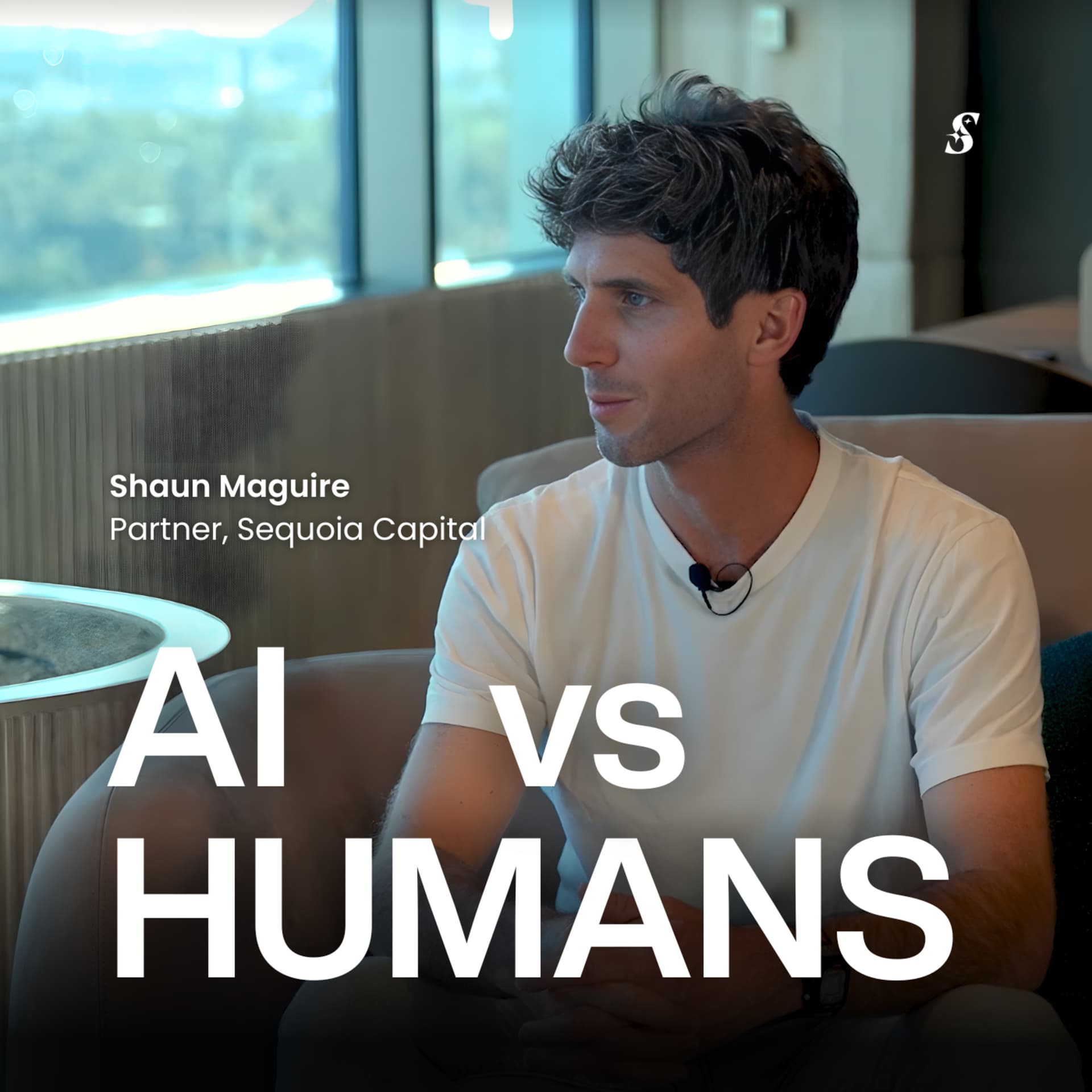
Podcast Episode Notes: AI vs Humans: Math, Physics, KGB Psyops, UAPs | Shaun Maguire, Sequoia
Episode Overview In this episode of the Sourcery podcast, Sequoia Capital Partner Shaun Maguire engages in a thought-provoking discussion with host Molly O’Shea. The conversation spans various themes including advancements in artificial intelligence, the philosophy of physics, historical insights on psychological operations, and perspectives on UAPs (Unidentified Aerial Phenomena).
Key Themes and Discussions
- Investment in Harmonic
- Background: Shaun discusses Sequoia's investment in Harmonic, an AI company led by Vlad Tenev, the CEO of Robinhood.
- Rationale for Investment:
- Vlad is viewed as a unique talent, having founded a billion-dollar company.
- The differentiation in Harmonic's approach is based on:
- Math and reinforcement learning
- Use of Lean for formalized proofs to enhance AI reasoning capabilities.
- Impact: Harmonic’s model is designed to outperform larger labs while using significantly less funding.
- Physics Worldview
- Philosophical Insights: Shaun shares his views on the limitations of human understanding of physics and the universe:
- Discusses concepts such as time travel, vacuum energy, and the speed of light.
- Emphasizes the need for scientific humility, recognizing that our knowledge may be far from complete.
- Loopholes in Physics: He believes that many established theories have gaps and that historical shifts in understanding (e.g., from Newtonian physics to quantum mechanics) demonstrate the evolving nature of scientific understanding.
- UAPs (Unidentified Aerial Phenomena)
- Personal Views: Shaun expresses an increasing belief in the possibility of UAPs having visited Earth, raising his confidence from less than 1% to over 10%.
- Speculation on Origins: He discusses the potential origins of UAPs, suggesting they may not be extraterrestrial but could be linked to past human actions or time travel concepts.
- Information Warfare and KGB Psyops
- Historical Context: The conversation touches upon tactics from the Cold War era, with Shaun claiming that many current societal issues are extensions of KGB psychological operations.
- Case Study: Cites the framing of Pope Pius XII as “Hitler’s Pope” as a strategic KGB operation that aimed to undermine religious authority and credibility.
- Contemporary Implications: He argues that similar tactics are being employed today to create divisions and manipulate narratives in Western societies.
- Free Speech and Censorship
- Concerns for Safety: Shaun openly discusses the threats he has faced due to his outspoken views, highlighting the importance of free speech in democratic societies.
- Investment in X (formerly Twitter): Explains Sequoia's $800 million investment into X as a commitment to freedom of speech, especially after significant censorship events involving public figures.
Key Takeaways
- Differentiated Strategies in AI: Harmonic’s focus on math and reinforcement learning is positioned as a potentially groundbreaking approach in AI development.
- Scientific Humility: A call for humility in scientific understanding, recognizing that established theories may not be the final word.
- Historical Psyops and Their Modern Echoes: Recognition of KGB tactics as continuing influences in current societal divisions and information warfare.
- Importance of Free Speech: An urging for open dialogue and the protection of diverse viewpoints in maintaining democratic integrity.
Conclusion The discussion between Shaun Maguire and Molly O’Shea weaves together technology, philosophy, and history, presenting a complex picture of how advancements in AI and societal narratives interact with human understanding and historical tactics. This episode serves as a reminder of the multifaceted nature of progress and the importance of safeguarding open discourse.
---
For more insights, subscribe to the Sourcery podcast through your preferred platform.
Written by AI. May contain mistakes. Listen to the episode to check what was said.
Chapters
Tap a time to open that second in VOVlad's Genius and Charisma
0:45 to 3:00
Discussion about Vlad's intelligence and his evolution into a charismatic leader.
“The ops are not necessarily still being run by the KGB, but they started the op, they created the playbook.”
UAPs and Cold War Psyops
3:00 to 6:40
Exploration of UAPs and their connections to Cold War psychological operations.
“He created a$100 billion company and again, I've known Vlad for a long time.”
Investment in Harmonic
6:40 to 10:00
Insights into the investment process and strategy surrounding Harmonic.
“And then we really liked the differentiated approach of just like RL math.”
AI, Math, and Reinforcement Learning
10:00 to 14:07
Discussion on how AI can revolutionize math through specialized approaches.
“a hundred times like richer and deeper underneath it.”
Understanding the Second Law of Thermodynamics
14:07 to 14:54
Explore the nuances of the second law of thermodynamics and the importance of humility in scientific understanding.
Curiosity About UAPs and Alien Visitations
15:56 to 18:11
Dive into the fascinating topic of Unidentified Aerial Phenomena (UAPs) and the speaker's shift in belief about extraterrestrial visitors.
“And by the way, the first time I met Palmer was arguing about quantum computing, which is pretty funny.”
Cold War Psyops and Their Legacy
18:11 to 19:32
Examine how Cold War tactics continue to influence modern events and the psychological operations behind them.
“All right, so we're going to go into a little rapid fire, uncensored for X content.”
The KGB's Operations Against the Catholic Church
19:32 to 28:00
An exploration of how the KGB framed Pope Pius XII, impacting perceptions and weakening the Catholic Church's influence.
“So there's a guy, Jan Pachepa, who's probably the most senior Soviet bloc defector ever.”
KGB Tactics and Modern Division
28:00 to 30:30
Explore how historical KGB tactics are influencing current societal divisions.
“It actually created a rift between Catholics and Jews.”
Comparing Venezuela and New York's Political Landscape
31:30 to 34:37
Discuss the political climates of Venezuela and New York, focusing on media portrayal and reality.
“Um, so how do you make out the current situation of Venezuela versus New York City being taken over by a socialist leader?”
Show all 11 chapters
Concerns Over Safety and Free Speech
34:53 to 37:56
Shaun discusses his personal safety concerns and the importance of free speech.
“Because you're quite outspoken about this on X and some other sensitive topics, this is a personal question.”
Transcript
Automatic transcript. May contain errors.0:00The thesis was very simple. One, Vlad is incredible. He's created a hundred billion dollar company. This is a math genius and I saw him learn how to be a charismatic person. He's still compounding, he's still improving. When you have people that smart that have a very differentiated approach, it's like, yes we would love to give you money and see what you do and they've done amazing things. We're talking about invisibility cloaks, but Palmer Luckey was saying that aliens and UAPs don't come from the future because the physics don't work out, they come from the past. Do you believe in UAPs? My odds that they visited Earth went from basically zero, from less than 1 % to more than 10%.
0:38In order of magnitude of yes. Everything is an offshoot of the Cold War. Almost everything we're seeing were psyops started by the KGB. The ops are not necessarily still being run by the KGB, but they started the op, they created the playbook. I've had so many death threats. I've had hundreds of death threats and probably a dozen semi-credible death threats. If we stop speaking, then the West is lost. Democracy does not function if people are afraid to speak. We invested$800 million into the X-Tick private. As we wrap up, I just have one question. Does that have payload?
1:22You invested into Harmonic. And I really believe in giving proper credit on things. It's just something that's very, very important to me. What was the process like for you? Why did you invest into it? And so I did it with Andrew and we were co-sponsors, but Andrew was really the primary person. Andrew invested in Robinhood and so he knew Vlad from Robinhood. And I knew Vlad from math, but not as well. I had actually helped. So Vlad reached out to Andrew on the harmonic investment. Vlad had reached out to me probably six to nine months earlier because I have a PhD in mathematical physics. He wanted my advice on the project and to tell me about it before it became a company.
2:09And it ended up leading to, I had a mentor at Caltech, this guy, Sergei Gukov, who was a legendary string theorist. And Sergei had probably like three years prior had told me he thinks that all of physics is going to happen with AI at some point. And he was trying to figure out what does he do with the belief that there's just massive change coming to math and physics. So when Vlad and I talked about it, I told him you should talk to Sergey. Sergey's really smart. And Sergey ended up consulting for the company. And then I sent in a couple other people to Harmonic early on before they even knew it was going to become a company.
2:48It was really kind of like a Vlad research project. and then when it became a company, Vlad messaged Andrew and said, we're fundraising and so Andrew and I teamed up and the thesis was very simple. One, Vlad is incredible. He created a$100 billion company and again, I've known Vlad for a long time. This is a math genius who, I don't know if he would agree with this, but to me he was, and I was too, we were both kind of autistic back when we were doing math PhDs. And I saw him learn how to be a normal, charismatic person. And then now in the last year, if you see these Robin Hood videos of him in Europe with these crazy dapper, I'm like, man, this guy's slope.
3:39He's still compounding. He's still improving. But so Vlad is a math genius. And also, if you know the history of Robin Hood, it's something like they started off doing infrastructure for high-frequency trading, and then it became like Cash Cats, where they were doing this other project, and then it became Robinhood, and then they scaled Robinhood. Vlad is just a consistent learner and compounder, and I just think unbelievably highly of Vlad. And then they had a very differentiated strategy in AI, and their view was that almost all of the big breakthroughs in AI I have come from reinforcement learning.
4:20You know, and I would say, like, when they started the company call two years ago, RL hadn't yet really made it into transformer architecture in a major way. It wasn't, like, it wasn't a huge part of, say, training GPT-4. I don't, definitely not GPT-3 or GroK-1. And these guys had this view that math is unique where you can structure the problem to where you're training in a way that's perfectly suited for reinforcement learning. Reinforcement learning is basically when you have the AI playing a game or competing with itself where there's a very clear reward function, very clear goal. and they decided to, there's this mathematical programming language called Lean where you can formalize proofs and you know that if like a Lean computer program compiles then the proof is correct.
5:31And they decided to create like the biggest Lean training data source. And then when you have that, reinforcement learning for math problems is like trivial. It basically comes for free. And so they were going to just focus on math with Lean and RL. And then you get this very fast kind of exponential feedback loop going. And so anyways, it's a very differentiated approach compared to the other big foundation model companies that were going for full general purpose, you know, like kind of all token or all text input, all character input possible. These guys were focused on math and RL. And I think it worked really well.
6:18Like the harmonic math results are unbelievable for the dollars. Like I would say they're at the cutting edge with the other big labs in math. And you see it in like IMO, their ability to solve IMO problems, for example. But they did it with spending almost no money. And so anyways, it's like bet on Vlad. And then we really liked the differentiated approach of just like RL math. Do you think they're going to solve time travel? Why not?
6:57Look, I'm just, I'm really, I'm bullish on the whole category. I just, if you back up, it's like, you know, in the, like, industrial revolution, like, do you want to invest in factories? And, you know, it's like maybe the early, you know, maybe the, and this is like later than the beginning of the industrial revolution, which is like the second industrial revolution. But investing in a microwave factory and a refrigerator factory and an oven factory, they all made tons of money and were all great businesses for 50 plus years. I just think AI is such a mega trend that I think there will be companies that are the biggest, but I think there's going to be like 100 companies that figure out their own factory for something very useful and are still like a meaningful company.
8:05And so when you have a founder as good as Vlad that's been so passionate about math his entire life, and for this sort of Vlad is a co-founder, Tudor, who's also a genius and incredible. So I'm sorry to not talk about Tudor until now. But like when you have people that smart, like that have accomplished that much, that have a very differentiated approach, it's like, yes, we would love to give you money and see what you do. And they've done amazing things. Andrew invested in Robin Hood. And so he knew Vlad from Robin Hood. And I knew Vlad from math, but not as well. Because you are a math geek, a physics geek, a space geek.
8:42I just thought of this. But when we had Palmer on, we were talking about time travel too. I'm just so stuck on this time travel thing. I think it's fascinating. I'll say this. I wrote I used to do a physics blog when I was doing my PhD and believe it or not some of these physics blog posts got lots of views a couple of them got over a million views some multiple millions and I wrote one post called I think the title was Hacking Nature Loopholes in the Laws of Physics and the like I was a hacker as a kid and I approach everything with this like mental model of like trying to find the edge cases trying to find the weird like where the definitions are not properly understood and I'll just say like I have never come across something a concept in physics that if you think about it deeply you can't find like a loophole in our current understanding And this is like a, this is level one.
9:52Level two is that kind of throughout history, everything that we thought was the end of physics or like a relatively complete theory, we ended up learning there's something that's a hundred times like richer and deeper underneath it. You know, like the most famous examples being going from Newtonian physics to quantum mechanics or from Newtonian physics to special relativity to general relativity. and now we know that these are not complete theories and we need deeper physics. But for the speed of light, this is a controversial thing in physics, but not all physicists would agree with this. For me, it seems very...
10:34We haven't been able to do these experiments, but for me, it seems very clear that we can do it. A lot of people don't even know what the definition is. The speed of light, the simplest way we call it the speed that photons move or massless particles move in the vacuum. Most people don't think about what is the vacuum, though. And in quantum mechanics, the vacuum, it's not what your intuition says. Your intuition says that the vacuum is empty. In quantum mechanics, the vacuum is not empty. The vacuum is filled with energy and with what we call virtual particles. These are particles that get created for very short durations and then they go away.
11:20Like you get electrons and positrons will get created out of nothing and then they'll recombine and become energy again. But anyways, the empty space is not empty in quantum mechanics. It's filled with energy. and we can we know we do lots of experiments where we can disturb the vacuum there's this thing called the Casimir effect where if you take two mirrors any two conductive plates and you put them very close together then you actually weaken the vacuum what I mean by that is like the reason why the plates have to be conductive is because then you're putting basically like a boundary condition and electric fields in between like they have to have the same like this the same basically same like energy at the on the boundaries and the when you do this you're actually like restricting you're making harder for vacuum particles to get created in between the two conductive plates than outside.
12:27And so you actually have fewer vacuum particles getting created in between the mirrors than outside. And what this does is actually it creates a pressure because you have more of these random particles getting created outside than between. And so every time like they kind of the particles will randomly collide with these plates and more collisions are happening outside than inside. So it's pushing the plates together. It's actually an incredibly strong effect. It goes like one over the distance to the fourth power. So like the shorter the distance between these conductive plates, the strength of the Casimir effect is it's increasing like the fourth power of the distance, whereas gravity or electromagnetism only scale like the distance squared.
13:13So this force has become incredibly strong in very short distances.
13:21and this shows up in when you design chips. You have to take into account the Casimir effect. You can make things stick to walls via this effect. But in theory, because the vacuum has less particles in between these connective plates, it actually means that light should travel a little bit faster. It's not much. It's like 10 to the minus 35 meters per second faster. It's like a joke. It's like comically small change. But it is a change. And I think it just illustrates that most people, like when they think about something, they don't actually have much depth in terms of like their understanding of the definitions.
14:07the same is true with second law of thermodynamics where like the second law of thermodynamics is like it's a statement about averages is not an absolute statement like there's i could go through any law of physics and explain like some of the loopholes and for me the takeaway from this is like we should all have this extreme humility like we don't actually understand anything and so on something like time travel like anyone that rules it out i think is a fool like an absolute fool and so it doesn't mean I can tell you like the exact mechanism today but I just I've learned to have a lot of humility around what we know which is like I think rounds to zero in the space of all you know potential knowledge.
14:54Sorcery is brought to you by Brex, the financial stack trusted by more than 30 ,000 companies including one in three venture-backed startups in the U.S. Nearly 40 % of startups bail because they run out of cash. Rex is literally built to help founders avoid that. Unlike traditional banks that let your money sit idle, chipping away at it with fees, Rex is designed to help you spend smarter and move faster. Their all-in-one solution combines checking, treasury, and FDIC protection into one powerful account. You can send and receive money globally at lightning speeds, get 20 times the standard FDIC coverage through their partner banks, and even high yield from day one.
15:34With same day and even same hour liquidity, access your funds anytime. Companies like Scale AI, DoorDash, Service Titan, HIMSS, Anthropic, Flexport, Robinhood, and Plaid trust and use Brex. Start today at brex.com slash sorcery. That's B-R-E-X dot com slash sorcery. So Palmer Luckey had a good take on this. And by the way, the first time I met Palmer was arguing about quantum computing, which is pretty funny. I mean, he is fascinating and so smart. His argument, well... And that was in 2014 or something. So quantum computing was not very popular back then. Wow. So his take on this is, I don't even know how we got to this.
16:19Oh, we were talking about invisibility cloaks. But what we were talking about was Palmer Luckey was saying that aliens and UAPs don't come from the future because the physics don't work out. that comes in the past. Do you believe in UAPs? So I've gone very deep in this topic. I got interested in this. It's one of those things where like as a kid, of course, I was interested in the topic, but I didn't have any bearings. I would say seven years ago, I got quite interested the topic i um over the course of about a year my prior on like what is the probability that like uaps have visited earth like at any point in the last 100 years and uap could be like beings from the past it could be you know like aliens from some far away galaxy where they just traveled to great distance, whatever the definition is.
17:19My odds that they have visited Earth went from basically zero, from less than 1 % to more than 10%. So I'm within an order of magnitude of yes. And so my odds are definitely greater than 10%. And I've done a lot, a lot of research into this. but it's just one of these things where I can't say anything definitive at all and for it's worth you know like Elon's statements that he hasn't seen any evidence like that weights me down of all the things that like weigh like weight my probability estimates down in the last four years like that's probably the number one thing that you know lowers my confidence but you're you're saying it's not a no no I think it's a greater than definitely greater than 10 chance which again, that means it's within an order of magnitude of yes.
18:40S-O-U-R-C-E-R-Y. All right, so we're going to go into a little rapid fire, uncensored for X content. Great. Give me your hottest take right now. There's, you know, not much going on in the world, so I'm just curious. So I would say one take is that almost everything we're seeing right now in the world was started by, it was like everything is an offshoot of the Cold War. Almost everything we're seeing were psyops started by the KGB. The ops are not necessarily still being run by the KGB, but they started the op, they created the playbook, and either in some cases they are still running it, or the GRU.
19:24And then in a lot of cases, it's other countries figured out what the Soviets did, and they're running that op. I have an incredible story if you want me to you know tell it's not the quick take we can come back to it or I can tell you now no I want to know the story so I I've been I've really just been trying to understand like the history of kind of KGB's most successful operations and what they consider to be their most successful operations obviously a tricky subject and I'm lucky that I used to have security clearance and so I like and I worked in some of these areas and so I I have some grounding where actually I know classified versions of what's reality and what's not in certain domains, and that gives you more bearings to kind of jump off research points.
20:13So there's a guy, Jan Pachepa, who's probably the most senior Soviet bloc defector ever. He was head of the Romanian intelligence services, and he defected to America, you know, worked at the CIA for a while and he wrote a few books and like he, in one of his books, he talks about like what he considered, you know, as of the late 80s to be the most successful, so KGB op ever, which was the framing or defamation of Pope Pius XII. So there's a guy, Pope Pius XII. He was the Pope during World War II. He was the Pope from 1939 into the 50s. And Pope Pius XII, and this is like extremely documented, was hardcore anti-Hitler.
21:12and it was actually very risky for a pope to take a side in the war, including he leaked the Nazi war plans for the invasion of Belgium and Luxembourg to the Allies, which was really risky because if the Nazis would have won and learned that, then the church took a side and why would they? A historical approach would be neutral. Anyways, I could give you 10 examples of him being hardcore anti-Hitler. And he was very, like, he was a huge humanitarian for the Jews. And I could give you 10 examples of him doing, like, unbelievably generous and risky things to save and protect Jews during the war.
21:55And then after the war ended, one of the top Soviet goals, like, as they would take over a country, usually via rigged elections, immediately after a rigged election, they would go try to take out the Catholic Church leadership in that country because the Catholic Church was a parallel power structure. So imagine they rig an election in Estonia. And imagine then like two weeks later, the head of the church in Estonia says, the Soviets just rigged our election. We need to do another election. The Catholic Church is going to, we're going to run the election, like show up, we're going to do it on Sunday, come to the church, you know, over the country, we're going to be running polling stations and like vote for your candidate.
22:42It's an independent way to kind of undermine the Soviet power. And so what they did in basically every country, they would rig the election and then immediately frame the religious leadership, usually Catholics. And like a lot of people that meant tying them to the Nazis. So they would take, you know, religious figures that were not Nazis and say, because in 1945, if you said that the, you know, the bishop in, from Croatia or in Estonia or whatever, had secret ties to Hitler and was a secret, secretly a Nazi, and you put out propaganda or disinformation on this, like you would very quickly destroy their reputation and then run a sham trial, put them in jail or, you know, house arrest.
23:29And then you kind of create chaos in that local church and you have a couple spies of your own and they move up in the chaos. This was the playbook for the Soviets in the early days of post-World War II. And after they did this in a couple countries, Pope Pius XII, he passed an edict. I actually don't, it was later a pope did this exactly, but he basically took on the communists in a pretty hardcore way. And so he became like an extreme threat to the communists. And he, and so basically the Soviets, I'm sorry, I'm using communists and Soviets interchangeably. The Soviets basically tried to frame him in 1945 and started calling him Hitler's Pope, in quotes.
24:18And it didn't stick. It didn't work because during the war, Pope Pius XII had been incredibly outspoken on the radio and like you know in media and and so people knew that like no this is not Hitler's pope he was anti-Hitler they saw it with their own eyes heard it with their own ears so people kind of like laughed it off but the KGB ran a 20-year operation to try to frame this guy and it was only in the mid-60s when they were successful so they literally ran a 20-year operation to try to frame Pope Pius XII. And it ended up being once he died, he wasn't there to defend himself. And there's something very profound that people don't understand.
24:59But now when you go into the mid-60s, there was a new generation that wasn't kind of like alive. So anyone under the age of 30 was like less than 10 during the war. And so they didn't have that life experience of hearing Pope Pius XII talk about Hitler, talk talk about the war, talk about Jews, talk about morality, right and wrong. And so it made it much easier to frame because you had this blank canvas in people's minds. And they ran a very sophisticated operation to frame him where they basically got three Romanian priests to get permission to go to the Vatican archives, just under the cover of doing research.
25:41but their mission was to find any secret correspondences between Pope Pius XII and Hitler because if you can find, you always want to wrap a lie in some small truths if you can find any secret correspondence but like of course every world leader had secret back channels with Hitler that's just what you do during wars, diplomacy but so they found some of these secret communications it could be on the weather, it could be on anything but when you show that there were these secret communications there was a secret back channel between Hitler and Pope Pius XII. And those are real. And anyone that had access to the Vatican archives could go verify that these were real secret communications.
26:21And then you put in with those secret communications on the weather, and I don't remember what they were, but on something mundane, you then put in lies like a secret letter where he had said Pope Pius XII, and I don't know exactly how they framed him on this part, but saying things like, you know, like, you know, I support you or, you know, you can put in whatever you want. And then you can put in fake photographs, you know, later on as the technology gets better. And they created a play called The Diplomat, which basically was a giant KGB operation, which ran in Paris and Berlin and then on Broadway and became this incredibly popular play.
27:02and they were so successful at framing pope pius the 12th that most people alive today like you know between the age of 60 to 80 i don't know the exact age range like they basically all think that this guy was a nazi because that is what became the narrative and i was on wikipedia maybe a month ago or so to to like to see how they described him and they still today call him like a controversial figure with like alleged Nazi ties. And like this guy, Pope Isaac XII was the opposite. He was hardcore anti-Hitler and hardcore anti-communism. But this framing of him was, it undermined the Catholic Church deeply and effectively, which created an opportunity for basically KGB assets to fill power vacuums.
27:54And it weakened the church in terms of its credibility in all these countries where the Soviets were operating. And it created a rift. It actually created a rift between Catholics and Jews. And just so the KGB, one of their tactics was to just create division in all of their kind of enemy countries. And I'm giving you this as a specific example, but I could literally go through a hundred examples of KGB operations that are happening right now like at pretty big scale and they're usually designed to either like divide the west I'd say they're in like three or four categories one is divide the west psychologically so that we hate each other and we're less effective two to back separatist groups to you know be a rival and bog down the government, whether that was FARC in Colombia or the Palestinian movement, which the KGB was a very, very, very extremely deep backer of, like literally created the PFLP.
28:59This is extremely well documented.
29:04Or another is like to capture institutions or capture like an existing newspaper or capture, you know, like a UN body or whatever so that you can then use that institution kind of for your own purposes. and then the fourth is to basically make good people look bad and bad people look good try to paint Elon as a Nazi when he's not I go through many examples of this and so my hottest take is that everything we are seeing right now is literally just an offshoot of KGB tactics that were set in motion starting starting in the 1930s. We know that the KGB infiltrated Cambridge University starting in the 1930s.
29:55There's this thing called the Cambridge Five, where it was like five known very high level British intelligence officers that had been turned as spies while they were undergrads at Cambridge University. The Soviets went in and infiltrated Cambridge in the 1930s because they knew that Cambridge was the biggest pipeline, Oxford and Cambridge were the biggest pipeline to British intelligence services, MI5, MI6. And if you can turn these kids like when they're young, before they have counter espionage training and all these things, like they're going to go and do a lot of damage. It's crazy to know that all of this is happening and people just don't see it.
30:29Some of you may not have heard this yet, but our sponsor Public just launched something called Generated Assets, and it brings AI into investing in a way I've honestly never seen before. Here's how it works. You type in an idea like AI-powered supply chain companies with positive free cash flow or defense tech companies growing revenue over 25 % year over year. Publix AI then dispatches a swarm of agents that scan every single US stock, evaluates them, and instantly builds a custom index around your thesis. What really stands out is how clearly it explains why each stock is included. And before you invest, you can even backtest your idea against the S &P 500 so you're making decisions with real context, not just guessing.
Read the full transcript
31:08And beyond generated assets, public lets you invest in stocks, bonds, options, crypto, all in one place. They'll even give you an uncapped 1 % match when you transfer your investments over from another platform. If you want to build a portfolio that actually reflects your thesis, visit public.com slash sorcery, paid for by public investing. Full disclosures in the description. Damn, and I thought Scientology was bad. No comment. Um, so how do you make out the current situation of Venezuela versus New York City being taken over by a socialist leader? Yeah. I mean, look, I feel like we're living in the upside down world.
31:53You know, Venezuela for me. So I've never been to Venezuela, but I've been to almost every, been to most of the surrounding countries. I've been to over 100 countries. I've traveled almost all of Latin America. I have many, many friends. I probably have a dozen, like, decently close Venezuelan friends. And, like, I think it was an incredible liberation moment. If you have been following the history of Venezuela, like, people there the last 25 years have, like, it's been bad. It's been really, really bad. Like, people are starving. You know, people that speak up against the government are kidnapped, killed, tortured, disappeared.
32:32like this is a communist regime that was working with all of America's biggest enemies and it's just it's really crazy to me to have this moment where I would say 95 % plus of Venezuelans are thrilled and then to have a lot of western media turning it into this negative event and in the case in New York like obviously I've made my comments about Mamdani I love New York I'm wishing him the best but like I think the I think the thing that describes the state like Mamdani the best is that when Elon did this alleged Nazi salute the it was a front page of the New York Times it was all over the media when it's very clear that Elon is not a Nazi like an anti-Semite and when Zoran does the exact same salute no one covers it when he has a much more questionable like history on in terms of his opinion of of Jews and I just like there is so much power in choosing what stories you tell and then and then when you do tell a story choosing how you tell it and so like the way that we've told the Venezuela story the way we haven't told the Mamdani story around like the things his support for at least five terrorists in history and his, you know, support for communism, not just socialism, communism.
33:57Yeah. And then now we're seeing it in Iran where the media is barely talking about like an incredible revolution that's in progress that hopefully is successful where like a radical, tyrannical, theocratic regime has been subjugating the people for 46 plus years in what was once one of the great empires in the world. And it's barely being reported. The editorial decisions are very powerful in shaping people's worldview. And I have lived through this firsthand.
34:47Get visas handled fast and get back to building. Visit deel.com slash sorcery. That's deel.com slash S-O-U-R-C-E-R-Y. Because you're quite outspoken about this on X and some other sensitive topics, this is a personal question. Who would have thought? Are you at all ever worried about your safety? Extremely. I've had so many death threats. I've had hundreds of death threats and probably a dozen semi-credible death threats. And I've had many more than that. People go so far as to create burner Gmail accounts or phone numbers to send me hate mail and stuff. and I know their burner accounts. I've sent the IPs to friends.
35:47But look, I'll also say, look, I was friends with Charlie Kirk. I was very lucky to be friends with Charlie. I actually spent a meaningful amount of time with Charlie the year he was killed. I saw him twice the month he died. And that was very close to home. And I'm nothing like Charlie. in terms of like he was like at least in order of magnitude more outspoken and more prolific and more important than me but like to have a friend like killed for being outspoken like yeah I'm really really worried about it um and I you know but I think if we stop speaking then the West is floss like that is that is the goal of the enemies of the west is to get people to stop talking democracy does not function if people are afraid to speak yeah that's pretty impactful x has become a very very powerful we invested 800 million dollars into the x take private you know and i co-led that co-led that investment and i like a big part of it is because i thought eventually you know i believe in elon and thought he'd figure out how to turn it into a really good return but a giant part of it was knowledge that like i mean for me when x when prior when twitter banned president trump while he was sitting president like before the facts had really come out on you know on this is such i mean it's a controversial statement say this but before the facts had really come out on january 6th and like the whole surrounding topic like the fact that a sitting president was banned from a giant social network, for me that was a watershed moment that just like again I was just explaining talking about some of these KGB tactics like that's a classic KGB tactic and democracy doesn't function if people can't get their opinions across and if the sensors control the airwaves.
37:55As we wrap up, I just have one question. Does that have payload? No, no, we're safe. No explosives in there. Okay. Yeah, that was made by Mock, a drone company. And it was a nice gift from Ethan. Thank you, Ethan. But you're safe. Okay. But if you want a live one, we can go visit Mock or Neros. I would love to. Let's go. Let's go right now. It's not far from your house. No. Well, thank you so much, Sean. Thank you, Molly. You're the best. You're crushing it. Hey, it's Molly. If you enjoy our interviews, check out our newsletter, sorcery.vc, where we deliver a once a week top deals and tech headlines email and also go deeper on our podcast interviews.
38:36Subscribe to Sorcery today. And don't forget to subscribe to the podcast on YouTube, Spotify, Apple, or wherever you listen. Link in description to sign up. Thank you.
From the publisher
Sequoia Capital Partner Shaun Maguire returns to Sourcery for a conversation with Molly O’Shea on math superintelligence, physics, and the limits of human understanding.
Specifically, Shaun explains his and Andrew Reed’s investment in Harmonic, the new AI company founded by Robinhood CEO Vlad Tenev, and why math + reinforcement learning may unlock the next major breakthrough in artificial intelligence. Breaking down Harmonic’s differentiated strategy using Lean, formalized proofs, and reinforcement learning to train AI systems that reason rigorously about math, outperforming far larger labs with a fraction of the spend.
We also get into Shaun’s physics worldview from loopholes in the laws of nature, to time travel, vacuum energy, UAPs, Bayesian probability, information warfare and why he believes we understand far less about reality than we think.
The conversation expands into UAPs (UFOs), Palmer Luckey, probability, scientific humility, and how frontier intelligence, human or artificial, might reshape what’s possible in math, physics, and reality itself.
In an exclusive cut for X, Shaun discusses free speech, narrative power, and why platforms like X matter in an era of global information conflict (Sequoia invested $800M in the take-private) – making the case that much of today’s political and media chaos is the downstream effect of Cold War–era KGB psychological warfare tactics that never actually stopped — they just changed hands.
Shaun Maguire: https://x.com/shaunmmaguire
Molly O’Shea: https://x.com/MollySOShea
Sourcery: https://x.com/sourceryy
𝐄𝐏𝐈𝐒𝐎𝐃𝐄 𝐋𝐈𝐍𝐊𝐒
𝐒𝐏𝐎𝐍𝐒𝐎𝐑𝐒
• Brex—The modern finance platform, combining the world’s smartest corporate card with integrated expense management, banking, bill pay, & travel. https://brex.com/sourcery
• Turing—Turing delivers top-tier talent, data, and tools to help AI labs improve model performance—and enables enterprises to turn those models into powerful, production-ready systems. https://turing.com/sourcery
• Deel—Deel is the global people platform that helps startups hire, manage, pay, and equip anyone, anywhere. Trusted by more than 35,000 fast-growing companies, Deel is the people platform that just works, so teams can scale without the chaos. Visit: https://www.deel.com/sourcery
• Public–Investing platform Public just launched Generated Assets, which lets you turn any idea into an investable index with AI. With Generated Assets, you can build, backtest, refine, and invest in any thesis with AI. Gone are the days of one-size-fits-all ETFs. https://public.com/sourcery
Follow Sourcery for the latest updates!
Disclosure
Paid Endorsement. Brokerage services by Open to the Public Investing Inc, member FINRA & SIPC. Advisory services by Public Advisors LLC, SEC-registered adviser. Crypto trading provided by Zero Hash LLC, licensed by the NYSDFS. Generated Assets is an interactive analysis tool by Public Advisors. Output is for informational purposes only and is not an investment recommendation or advice. See disclosures at public.com/disclosures/ga. Matched funds must remain in your account for at least 5 years. Match rate and other terms are subject to change at any time.


