
In short
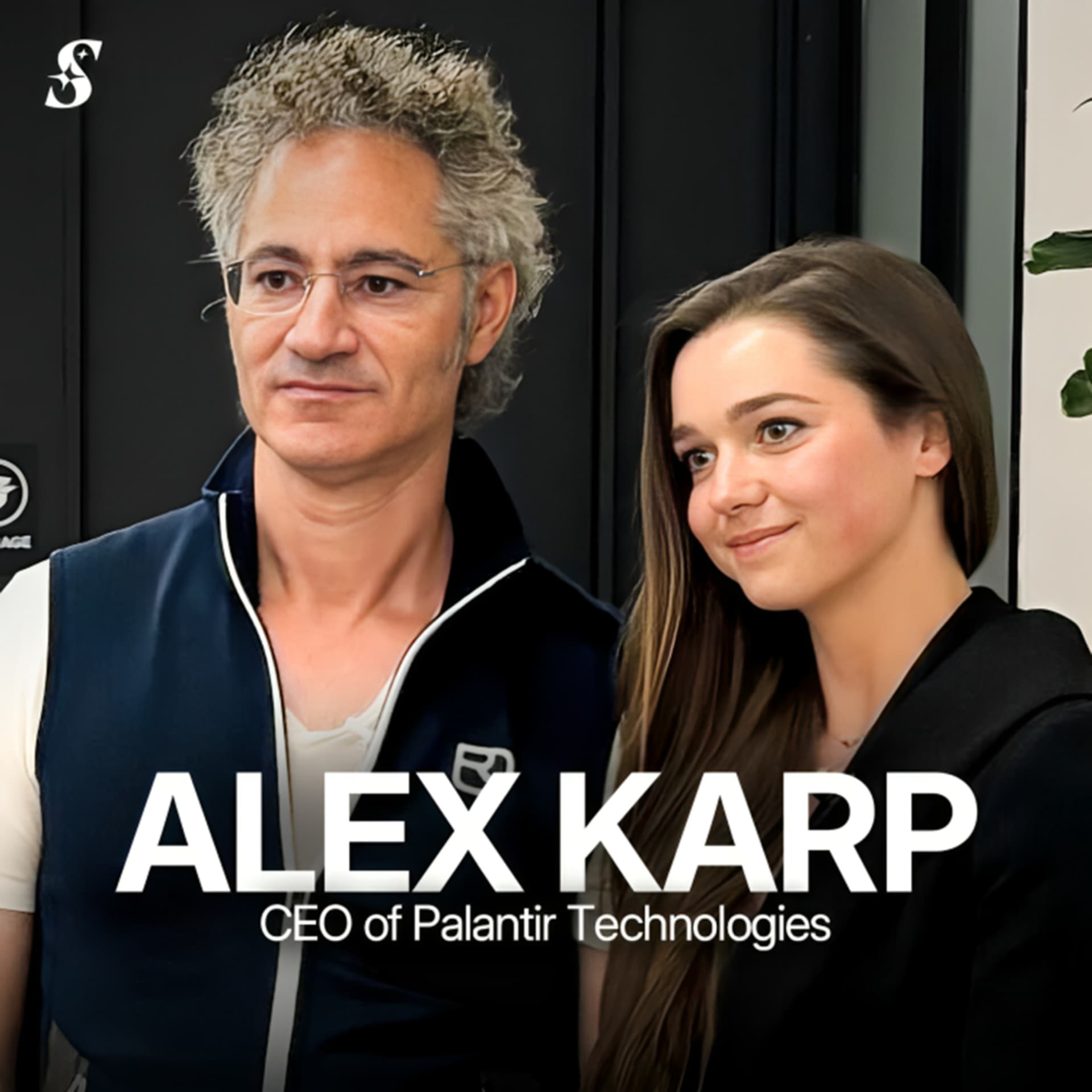
Podcast Notes: Sourcery - Alex Karp, CEO of Palantir
Episode Overview
- Host: Molly O'Shea
- Guest: Alex Karp, CEO of Palantir
- Focus: Insight into Palantir's operations, values, and vision in the context of recent AI advancements and their $500 billion market cap.
Key Highlights
Introduction
- Alex Karp shares a personal and professional update, reflecting on Palantir’s trajectory from being an “outsider idea” to a leading software company.
Company Evolution
- Market Standing:
- Fresh off record-breaking earnings.
- Nearing a $500 billion market cap.
- Cultural Vibe:
- Described as having a start-up atmosphere despite its scale.
- Emphasizes a flat hierarchy, fostering a meritocratic culture.
Vision for AI and Technology
- Palantir's AI Platform (AIP):
- Positioned as the operating system for the AI era.
- Shortens sales cycles, enhancing analytical and decision-making capabilities for clients in defense, industrial, and commercial sectors.
- Artistry in Innovation:
- Karp likens product development to an artistic process.
- Focus on originality and vision, resisting conformity and consensus in creation.
Moral Foundation and Purpose
- Karp articulates a broader mission beyond software: empowering American workers, military personnel, and investors.
- Emphasizes Palantir's role in enhancing U.S. competitive advantage globally.
Personal Insights and Leadership Philosophy
- Dyslexia Influence:
- Karp discusses how his lifelong dyslexia fostered a non-linear approach to leadership and decision-making.
- Moral Clarity:
- Advocates for a strong moral foundation in business, drawing parallels to historical struggles for civil rights and the importance of meritocracy.
Challenges in the AI Boom
- Karp expresses skepticism about the sustainability of the current AI hype, advocating for value creation over superficial metrics.
- Discusses the importance of genuine innovation versus adopting trends for profit.
Launch of AIP
- AIP’s launch is highlighted as a pivotal moment for Palantir, effectively integrating various components to meet evolving market needs.
- Karp reflects on the strategic timing and execution of the launch, underscoring a commitment to delivering client-centric solutions.
Cultural Commentary
- Karp shares thoughts on American values, including meritocracy and the collective moral responsibility of the military and workers in society.
- Discusses societal perceptions of risk and the role of expertise in analyzing value.
Closing Reflections
- Encounters with soldiers and workers shape Karp's commitment to their welfare and success.
- Emphasizes the importance of building a resilient company with a focus on ethical practices and innovative solutions.
Key Takeaways
- Palantir operates on a unique model that prioritizes creativity, meritocracy, and a flat organizational structure.
- The company views its mission as integral to national and global stability, particularly in the context of AI and defense.
- Karp’s personal journey influences his leadership style, emphasizing the value of intuition and non-traditional thinking.
- The discussion highlights a critique of conventional investment and analytic practices, advocating for deeper engagement with frontline realities.
Conclusion Alex Karp’s interview reveals a complex interplay between technology, ethics, and personal conviction, providing insights into how Palantir seeks to redefine software and its impact on society during a transformative period in AI.
Written by AI. May contain mistakes. Listen to the episode to check what was said.
Transcript
Automatic transcript. May contain errors.0:03We were the freak show and we spent 20 years for this moment. We're doing it. We're doing it. And I'm sure you're enjoying this as much as I am. If you were a cupcake, what kind of cupcake would you be? I don't want to be a cupcake because I don't want to get eaten.
0:27Alex Karp, welcome to Sorcery. I'm happy to be here. Well, we're fresh off of earnings. Palantir has hit$500 billion. dollars recently just released a new biography how are you feeling um i feel really good um you know look we started the company with a lot of ideas that were really exceedingly controversial until about two years ago fdes everyone thought that would destroy your company uh being fully marriageocratic everyone thought you're not supposed to do that um uh low hierarchy almost no one does that so like like eliano and i were only separated by one layer which is fictional because like we talk and it's a very very flat hierarchy um we were uh we thought we should give america an unfair advantage uh in government first and then in commercial um we built these products more like artistic things years before anyone thought their relevance pg the anti-terror product Gaia, the product that most special operations use in the world Foundry, Ontology, Apollo Maven, and we're still a freak show and you know if you walk around here, like the crazy thing about Palantir is you know I get invited to, like I meet lots of companies and we you know big companies, small companies, private companies, commercial companies the most famous people in the world, some people should be famous, but luckily for them aren't.
2:00And I would say Palantir feels like if you walk around here, it's like kind of a startup vibe, but with scale. And the thing that's special about Palantir, I mean, my version externally is we gave venture returns, not just venture returns. We gave venture returns as if you're like, I don't know, you're like Peter Thiel, Sequoia, Kostola returns to the average person who is willing to do their own work and stand up against kind of tried but not true ideas like playbooks. So we're like the anti-playbook company. And then, you know, I mean, you know, I'm currently in a battle with, you know, short sellers primarily because they could go short some carcinogenic company, but they have to short arguably the best company in this country and in the world by any metric.
2:53And by the way, judge us by our enemies. Look who hates us. I mean, go online. I mean, I guess people here have gone on X. Just forget any, you don't need to know anything else. Just look at who hates PowerShare and look who hates me. And then judge us by that standard. What should our market cap be based on that standard? So I don't know. I'm very proud of where we are. I believe I know it's the way beginning. You know, internally, we're kind of a very young company. I mean, I don't mean just in terms of age, which is also true, but it's just a young, fresh vibe. We've anti-aged. You've reached anti-aging.
3:32We've reached anti-aging. Well, I do think age of company is directly correlated with the rate of age or anti-aging is directly correlated with the layers of hierarchy. Our company is 20 years old and feels like it has scale of a 20-year company, but the vibe of a four or five-year-old company, meaning we know what we're doing. We have a way of doing things. It's very tribal. We stick to our tribal knowledge. But it's, you know, like, for example, you know, we put the whole companies, we bet on the U.S. military and on the U.S. commercial sector, and we pivoted the whole company to both, basically.
4:11I mean, we still have a massive presence outside of America. But we've been and like we can do we can make these decisions like in like somebody we last this marriage meritocracy thing, which is basically to give people who are tired of being discriminated against an application process a chance to come and learn something useful. And the people are, how long did it take to launch that? And I was like, yeah, I don't know. Three minutes. Three minutes. It's like decision. I don't know. Like a lot of like I was we were talking about this before, but like it's hard to be fair to the total bereft of common sense.
4:48And in practice, not particularly honest analyst expert class, not because they're wrong the first time, but primarily because they can't admit they were wrong the first time when they're wrong the 10th time. But if you want to be slightly fair to them, this company runs on like a much more artistic. It's more much more artistic than science. So where does that come from? You know, obviously primarily from my mom was a professional and world-class artist. And again, everyone says they're an artist. But then there's a very big difference between a glacial difference between like my mom is a above one rule of 100 artists.
5:29Like, you know, it's like in a very different sphere. And then on my father's side, they were heavily involved in commercial art and like textiles for like a thousand years. So, like, and what people always think of, like, the lay person thinks of art is you just doodle something. But I know it's crazy, but you're from, like, an artistic family. Yeah. That's what people think. But actually, art is you tap into something very, very deep that is not understood about the period of time you're in and does not become understood until, like, 20, 30 years later. and that are captures something in the zeitgeist that is so special but then the depth also transmutes to like something more universal do you think that's how palantir is being viewed right now well no i mean i think people like i think i think one of the one of the crazy things about our society is people who are more on the front line like soldiers workers uh vocational workers, what we call retail investors, they're actually looking at the frontline data in an unfiltered way.
6:44And then almost everybody else has outsourced value assessment and quantitative metrics to experts. But the experts in general, or even generalization, I can't think of any expert class that's been right about anything substantive in the last 20 years. And then, so at this point, when you're like, when the experts call the experts, the analysts, in this case, or journalists, or I don't know, you're a financial analyst for a paper, a hedge fund, like you are actually a medium and it's your job to transfer the reality on the ground into a reality you can understand. Yeah, but the reality you can understand is not reality.
7:27and like but then because there's like it's like a super unique uh bubble they can't quite allow themselves to say yeah but and so but one of the greatest trends is like i mean at the end of the day what makes one of the things that makes a great artist great is they have a vision of what they see in the world and they stick to that vision although everybody in the world said but you can't paint like that you can't write like that you can't you can't picture photography that way because it doesn't i don't know and then by the way most great artists like my mother end up with no money yeah and uh i mean that's the book has like a lot of tds in it but i mean it is true we were not economically privileged but you could look at it as like but why were we not economically privileged because like my parents had these super high level of intellect.
8:24Yeah, but it's also because they kind of stuck to the guns of how they saw the world. And that's where the experts are like, you know, like this isn't safe because in almost all cases, this doesn't work. Yeah, they're right. But in the one case where you change the world, it's the only way it can work. Is this why you're so committed to the American worker? And even in the recent earnings call, You called out you're giving venture returns to retail investors. You've created a really amazing cult behind Wall Street bets and a lot of retail. So how do you feel about retail? Well, I think, you know, I always think there's the economic and there's the psychological and really powerful things are aligned.
9:04So, like, you know, I in no way like I hate these victimhood BS things. And honestly, when you're almost everyone who believes in that is a mark, whether they realize it or not. But I mean, like they may not realize it, but you are the mark. And like and that's frustrating because a lot of these people who believe in that really deserve better. But it's hard to give better if you believe in an ideology that can't work. But I did come from an environment where it was not expected that I would be co-founder and have a but-for role in building arguably one of the greatest companies ever built. And I don't mean that even like in like the half trillion dollar market cap or whatever it is.
9:49I just mean in terms of how it's changed the lives primarily of Americans on the battlefield as investors and also on the factory floor. But the thing is, if you come from nothing and you're this amorphous, racially dyslexic person from a very specific kind of culture, not even Jewish culture, it's like super acrivic, Germanic, left-wing culture, you assume the world may not work out for you and is definitely not looking out for you. Okay, so what other group of people in this culture have exactly the same vibe? Yeah. Soldiers, people on the factory floor. Who does the dying and bleeding for us?
10:34Soldiers, people on the factory floor. Who gets killed because somehow constitutional legal scholars only read the Constitution so it's expansive to protect their rights? So their right to be happy, their right to go to Yale, their right to be wealthy, their right to be safe. But somehow the Constitution cannot be read to stop the reality of like in the last two years, more people have died of fentanyl than every single person who's died as a soldier since World War II. But they can't. And part of it is like they have a lot of intellectual reasons. But the real reason is they don't see themselves as having had the same fate.
11:11But if you're me, you look at those people. And then, quite frankly, look at the U.S. Army. Look who fought and died for our rights today. By the way, it was mostly working class people from what the elite calls flyover states. It still is. and then look at the U.S. military. It integrated, first to integrate, first to bring meritocracy. It still fights for meritocracy. It's the first major institution in the world to say, I don't care where you're from. And they did it way before American society. So that's that version. Then there's the economic stability version. My version of what, and by the way, a fair thing to ask people is, what were you saying 10 years ago?
11:57So one of the most amazing things about Palantir, like is, and you know this, but like you go online and people who like, you know, whatever, some people don't like my vast words of wisdom. And they're like, he's saying this now. What did he say 10 years ago? It's like, we're saying this, we've been saying this for 20 years. Close the border, get rid of the identity politics, victimhood bullshit. It's especially bad for the, for people who need it. Have a strong military, make that military the strongest of the world. Give an unfair advantage to America. Do not treat all cultures at equal. Simultaneously, do not get on the whole neocon, make the whole world like America thing because it doesn't work.
12:33Be skeptical of immigration. Technology will be the determinant variable in who runs the world. All this stuff you're learning at Berkeley about people are just going to inherently absorb American values is really just downtrend from our military superiority. You don't know that, but our adversaries absolutely know that. We've been saying this for 20 years. And the only difference now is people who are skeptical of us are forced to realize we could be right, which is why they run to short sellers and analysts who still can't rock where we're at. There was a part in the book where you had just won the Dwight Eisenhower Award.
13:09And this was a little bit of a surprise to your employees, but you got a little choked up because of the impact of what that is to troops. And so could you just explain what that experience was like for you? Well, first of all, Eisenhower has this German name. He's from a German religious minority family. He was a pivotal figure at gunpoint in desegregation. He helped win the war, or pivotal. But the main thing is, you know, I lived in Germany for a lot of my adult life, which was a phenomenal experience, which maybe they went into in too much graphic detail. What are you talking about? I was like, yeah, we got to know.
13:52It's like, it was, I went for the right reasons and I may have stayed for the wrong reasons, but it's okay. And so I have a lot of deep understanding and, and I'll get to this, and deep appreciation for the German culture. I think one of the craziest things is, you know, this whole thing online where people like, like laud the Nazis. Like I spent a lot of time talking to Nazis, like real Nazis. and like understanding what made them tick and what made them i mean part of the crazy thing about people a lot the nazis nowadays is there's not a single not nazi that would ever have included them in their movement and would have shipped them off to the camps and quicker maybe than they shipped me off to the camps uh but um and uh and it's like it's uh but thing that is crazy unique about America, whether it's, you know, somebody from Montana, Iowa, going over to fight because they believed in America and they believed in the greater good.
14:58And there really was, this was a primarily moral, it's like, honestly, it's like Lincoln. This guy fought to end slavery, it was not economic. It was moral. Like, what other culture actually engaged in civil war just because it was wrong what was happening in the South? That was the primary. I'm not... Like, the modern way of reading is, like, economics. It's like... Maybe. But the primary reason why Americans fought and died was moral. Primary reason why Americans fought and died in World War II was moral. And they had no tethering. Like when you're a soldier from the North dying to fight slavery, it's not that you have, I don't know, black relatives and friends.
15:49It's because you think this is wrong. When you were over fighting the Nazis or Imperial Japan, you were doing it because you thought America was a superior way of living and this wasn't wrong. Now you can, and like, and then whatever one thinks about these things, no other culture does this. It's the same thing of how did we get meritocracy until recently in America? Meritocracy is one of the things that we don't often value enough, even now in Europe. In Europe, I was involved in hiring at this institute I worked at. And one of the biggest problems was I was always like, of course, we need to hire the best person.
16:30That's not the way it works in Germany or Norway. The best person doesn't get hired ever. And so at our elite institutions, we embraced meritocracy, we embraced the higher good, and we fought and died for that. And then the fact that Palantir can bring that kind of person home more safely and arguably, whether people believe this or not, the primary purpose of Palantir is to be so dominant that those people don't have to fight and die. Because everyone knows you're going to die 10 times more if you attack America. You want to sleep at night. You want to make sure our soldiers don't have to fight and die.
17:08Make sure the adversary knows they are going to get totally effed up if they screw with us. And that's like a really noble purpose. And it's not any less noble than when we started the company. In fact, it's more noble. Sorcery is brought to you by Brex, the financial stack trusted by more than 30 ,000 companies, including one in three venture-backed startups in the U.S. Nearly 40 % of startups fail because they run out of cash. Rex is literally built to help founders avoid that. Unlike traditional banks that let your money sit idle, chipping away at it with fees, Rex is designed to help you spend smarter and move faster.
17:45Their all-in-one solution combines checking, treasury, and FDIC protection into one powerful account. You can send and receive money globally at lightning speeds, get 20 times the standard FDIC coverage through their partner banks, and even high yield from day one. with same day and even same hour liquidity. Access your funds anytime. Companies like Scale AI, DoorDash, Service Titan, HIMSS, Anthropic, Flexport, Robinhood, and Plaid trust and use Brex. Start today at brex.com slash sorcery. That's B-R-E-X dot com slash sorcery. In today's high-speed business world, staying ahead means using the smartest tools possible, including the powerful capabilities of artificial intelligence.
18:31Meet Turing Intelligence. Turing builds customizable AI systems designed to solve your mission-critical challenges no matter your industry. From expert guidance to tailored projects, Turing helps top companies realize AI that's more capable, more adaptable, and more effective. With Turing, discover how AI can accelerate your business growth. To learn more, visit turing.com slash sorcery. Spelt S-O-U-R-C-E-R-Y. That's turing.com slash sorcery. Sorcery is proudly sponsored by Carta. Carta is transforming the private marketplace, connecting founders, investors, and limited partners through software purpose-built for private capital.
19:10Trusted by more than 65 ,000 companies in over 160 countries, Carta's platform of software and services lays the groundwork so you can build, invest, and scale with confidence. Carta's fund administration platform supports over 9 ,000 funds and SPVs, representing nearly$185 billion in assets under management with tools designed to enhance the strategic impact of fund CFOs. For more information, visit carta.com slash sorcery. That's C-A-R-T-A dot com slash S-O-U-R-C-E-R-Y. One thing that was apparent through the narrative of the book was you're self-made, but you're not self-made in an economic sense.
19:51You're self-made in maybe a morals and values sense. So how did you become Alex Cart? Well, I mean, you know, there's all these variables, very smart parents, highly educated, crappy school, which I never would have done. Like, you know, it's like and so you learn like the world is violent.
20:14Dyslexia, meaning there's no playbook I could possibly follow. I think some of the reasons why dyslexics are so outperformant now is that we're in a non-playbook world and the playbook's not that valuable. But if you're dyslexic, you can't follow the playbook or only in the third rate way. So you invent new and generative things.
20:39Look, I've never been accused of false ill modesty. I think in the end, to do something important, whether it's me or like Eliana or look at all these people here, like these are among the best and most talented people in the world. At a certain level of accomplishment, you're in an artistic space where it's very hard to explain why you have your insights. And it goes way beyond experiences that, of course, also influence them. but like i just have artistic impulses and they shape my life and i've allowed myself or i've been forced to allow myself the freedom to live that way and in there's one country in the world where you know you get rewarded for that because in america if you deliver you can be you you know like you're your own boss right you decide you want to talk to you decide you don't want to talk to, you have ideas of things you'd like to advance on.
21:35And I think one of the biggest variables in my life is just simply, I live in a culture where if you deliver, in this case, economically, and by the way, at 18, for most investors, we were failing for at least 15 years. Many would say 18 years. Honestly, some would say until two years ago, right? And still, Oh, this is a culture where the FDA, ontology, superiority over the West, extreme meritocracy, the fact that I would just tell people basically, yeah, the financials are going to show up. You know, that's only possible in this culture. And I guess maybe because I lived abroad so long, it's easier for me to accept and rely on that.
22:17I think sometimes people who've lived here their whole life don't always exactly understand. This is a maximal freedom culture. It's the only culture like this in the world, and it'll allow you to self-express. And if you self-express, that self-expression, because it's not Playbook, creates an environment that is exceedingly hard to compete with and will piss off all the right people. How is a value creation for Palantir different than traditional SaaS companies? Well, first of all, it's important to remember we are valued. Like we drive our whole business based on a set of beliefs that are like America, superiority and so on.
22:56But then interestingly, that's tethered to the value creation argument you're asking, which is at the end of the day, if you believe your client is noble. Like I believe our U.S. government clients are not only noble, but they're more noble than I am. and I'm happy with myself, but they're doing missions that will change world history for the better. Okay. So if you know that, the thing that's going to happen downstream from that is you're going to resist building parasitic products, right? Because like, I don't want a product that will make me, despite what anyone, but like anyone who's been a Palantir will know this to be true.
23:37So we did not the audacity of just saying we're going to build a product in PGA that's going to make you safer. Let's go away from the ambient noise that will make you safer and more protected is audacious in a weird way that we didn't realize. The most audacious part of that was saying we're going to build a product that's actually what the client needs. because what you're supposed to be doing software is build the client that the client gets addicted to not the one they need and like this is like and this is absolutely a truism in in in software development of any kind and so the like the again the most radical thing we ever did was say yeah client or in this case partner that we look up to has these needs we didn't even give them what they asked for, we gave them what they ought to ask for, which again is very artistic.
24:36It's like any rational business would have said, I don't know, client A, B, C, D wants to be, at the very least, you just give them what they want. That's kind of what integrators do. And then what very successful software companies do is say, oh, they think they want X. We'll fake give them X, but we'll give them this thing that they can't get rid of. And then nothing else will work, but they'll just have to pay. And then I can hire 50 ,000 salespeople and get these wonderful economics. And then every single decision, like again, the FDE thing, now everyone copies it, but it was the most radical.
25:06You had everyone making fun of this for 20 years because that meant you were going to get a one multiple, but there was no way to extend PG. Essentially, you can think of PG as a precursor to AIP because you have free text that a computer could not understand. The NLP technology was primitive. The only way to extend that product to the bounds of technology now was to have people doing the impulse. And then the only way to build the next product or deepen that product was to understand what the customer ought to want tomorrow and build that into the product today. And so like that value creation, by the way, it ends up being very, very protective because, and, and then it, because the customer partner actually becomes, they may not like you, like some of our best clients globally, both in government and in commercial, we're like, I don't really like these guys.
26:00Yeah. But you know what? When you bring someone home safely, they learn to love you. And so, and then that allows us to have this privileged position that we now have. And now when we're launching, you know, when we, again, there's example, the most recent example that people will be more familiar with would be launching AIP. Okay. When we launched AIP or I launched it in like an artistic, I don't know if you know this story but in any case i launched aip in like the darkness of night the darkness of night yeah okay yeah on like uh pre-easter holiday because it would have been massively resisted and and i would say it's one of my favorite people said in any other company every the whole head of whatever part of the product that was going to be involved in this would have quit because it was just launched it completely artistic like this is where the world is going we have all the components.
26:53We had ontology of foundry, but the components need to be brought together. Okay. The thing is, if you're working back from what will sell, you would have said, well, wait a minute. Everyone's saying LLMs are going to solve all these problems. But I believed, and it turns out that LLMs are commodity products and orchestration would be much more valuable than the product themselves. You need both. We need the LLMs, but in reality, and that's part of the reason we have these numbers because it turns out we're right. But if you were working back from what experts think and what customers are asking for, you do not launch that.
27:29You launch something else.
27:35Okay. You can ask as many questions as you can. I have one more question. So it's Eliano. Okay. Eliano, she's the boss. How many questions would you like? 72 okay okay um why not yeah so on AIP it seemed like that was a big pivotal moment for the company and getting into this next realm of AI which is something in transformation that you've embraced full wholeheartedly versus maybe some other people um to the extent that you go into different corporations and then you make the products for them on top of our current products or we build new ones. Yeah, that's true. Would you say that that was a major component to why sales cycles have compressed and why it's been easier to sell?
28:23You know, it's a really good question. It is that, but also the zeitgeist has changed. Like, although there have been a lot of projects in AI that haven't worked, most leaders in the corporate world and government know of projects that have worked. Great portion of those are in Palantir. So in the government, there's a deep understanding of the government side of like Maven and other things, Hivemind. And then on the commercial context, we have all these very public customers and people begin to see their unit economics changing. And particularly important, they're able to change them while being in the public sphere.
Read the full transcript
29:02So you can do what you had to do in private. You used to have to buy the company, take it offline for like five years and then scrap the costs and resell. And then you could do this while remaining public. and there's lots of economic advantages to that. And so you can also do it in private context. And so the thing that you see as a common through line that in AI on the positive side is, there used to be no one believed the software would work. Now everyone believes it should work. And they wonder, well, if mine isn't working, where can I find something that is? And more and more and more people, especially honestly in the U.S.
29:41It's not true in Europe. In Europe, they're still like, it doesn't work, but hopefully this will fail because it's all American products. But in this country, people are like, I know this should work. I turned on TV and there was someone I know or someone I've talked to at a conference and said, yeah, okay, good. It is a little weird when they show up, the person showing up is going to be carp. That's not everyone's cup of tea and someone who's like looks 18 but is actually 25 and and it'll work i mean i think that's what's like going around the country and that means both like from introduction to sale it's quicker and as importantly from sell to actual output we have a lot more authority like we used to basically get in these enterprises and i have to spend a half my day explaining to people, look, I know the person down the hall is your tech person, but they used to be a school teacher in music.
30:37This is an actual real example. Yeah. And what, you know, I like the idea of a music, but it's like, and what they're saying about the tech stack, you know, and then, and you could do five years or you could do at the prime, I used to say five years versus nine months. Now it's like five years versus three months or two months and there's actually much more of a please just tell us how to do this not always yeah and i would say interestingly our newer partners customers are much more wanting to hear okay i know this works it's gone from i'm not sure this is works but my wife is on the line in commercial and government like five years ago to, I know this, I've heard and know this will work.
31:20How do I do this optimally? And then, you know, the bottlenecking we have currently means like, you know, I mean, I tell, I'm telling governments all over the world, look, we're not showing up to do a sales call for Maven. You know, it works. We know it works. Show up at my office, explain to us, explain to us how you're going to make this easy for us because we don't have huge bandwidth. I mean, I'm not talking about the US government. That's a completely different thing. We will bend over backwards and do whatever it takes. But allied countries in Europe, they're like, oh, we need five sales meetings and a PowerPoint.
31:54We're like, great. I can recommend some other company. It won't work, but you'll get all the sales reps, all that cycle, all the forms, everything you want. I was the other day talking to a very important European leader. I was like, look, you have an intel service, you have a military they should evaluate what works they're going to tell you this works nothing else really does you can buy you want the thing that doesn't work but sounds good they'll do lots of meetings with you we can't do them we just can't and in commercial it's not quite like that in the u.s but you know there's a sense that the demand is greater than what we can supply and you know and then we want and then we i was just we're just telling an older customer look, the way you're doing it will not allow us to create value.
32:42We're not a normal software company. If you're not creating value, how are we going to get paid? And by the way, you're going to want to get rid of us at some point. So the whole thing makes no sense. Like we're not selling you steak dinner. We're not selling you our charm. We're selling you significant value creation in ridiculously short times of period and value creation on top end and buy it. And like basically, Like, you know, and then another thing, by the way, I tell people is, you know, all the time it's like, look, I get to have an opinion because of our financials. Do you want to have an opinion again?
33:15You got to have financials like this. A lot of people want to be able to have an opinion again in public. You have VC returns for retail investors and now you're having PE outcomes for large companies. What's next? just being very very focused on the u.s growing the u.s growing the quality of the u.s there's a lot more interestingly when we're talking externally of course people want to know the financial metrics you know like these rule of 114 the 77 all these things that are crazy valuable but internally it's like really back to the like how do we make sure this implementation is the best how do we make sure the product is isn't advancing how do we make sure we're building the products of tomorrow?
33:57How are we in the U.S. government closest to the things that will give America a strategic advantage? Not just now, but for decades. How do we, on the commercial side, how do we make sure that, oh, it's just Palantir. People are roving around, no hierarchy. This is the Palantir thing. They're like, what are you doing here? Get out, I'm working. I have no time. CEO, move out of the way. Yeah. It's the other thing in Palantir. You know, we have, we value our work. Like he can have any opinion he wants. He can come in here and like do it. So you, you, you get to, you perform here. You get to be you, not just me.
34:36Um, you know, this concept of worker available GDP. Yeah. You know, you're going to participate in the AI revolution. He's going to participate in the AI revolution. We're building it here. The, the person on the factory floor right now wonders, are we going to get rich and are they going to get poorer? And is that, that will not work for our society. Yeah, no. So what's Palantir's role in re-industrialization? Making sure workers, I mean, first of all, there's like, how do you manufacture at scale? How do you manufacture in addition in this way? How do you bring, if you bring, let's say you bring Japanese, Taiwanese, Korean manufacturing to America.
35:18The interesting thing, people always think manufacturing is manufacturing. You actually have to manufacture their building the way you would do it in those countries. Because that's the – then you have to scale American workers. So, like, for example, we have American workers working at factories, like Japanese factories especially. And, like, they're American workers. They're not Japanese workers. But we can get – we can use foundry and ontology to bring out the advantages of an American worker and give them the capacity to roughly work like a Japanese engineer. And so like and honestly, at this point, we're really just showing rather than telling because you really have to show people the narrative working.
35:59And now in the U.S. military, that's going gangbusters because most of the people who actually do the work are domain expertise specific individuals. And they're seeing a while I can like like in special operations. As an example, people using our product are using our product. Yeah. It's not like there's not the like highly elite Yale grad. He actually is a Yale grad. Something like that. Yeah. Yeah. Something here we have like even more elite. Like we have the person creating the real value is someone who joined the military and they're just crushing it. We have some fun questions. OK, great.
36:40OK. I saved some fun ones. OK. So there was a heartwarming part in this book. Yeah. I wasn't expecting it. um there was a point in time in not my social life no well as your family life so can you tell me about rosita yeah um so uh when my parents there's a phase where my parents it was like the thing is when you are outside the norm and in the family there's a warmth in the family yeah so it's like like if you're like our family like total freak show and all variables so the outside is kind of like the freak show i'm sure when my parents came over people had to be warned kind of thing uh and like you know you may not be okay with this setup and then but on the inside because of that it was an exceedingly intellectual vibrant warm environment and then when we we when I was a little kid and we had moved, we had moved from New York, uh, an incredible city, which is largely, it was about to get the most horrifically and all likelihood ridiculous mayor.
37:47Um, uh, more than you want to hear from me. Um, my parents decided to get a dog. Obviously we wanted it. So if you're like in my family background, of course, the only place you're going to get a dog is in the pound because that, you know, you wouldn't get a fancy and a dog, of course you know so we went there and we went and then we come to the pound and the i even like in my mind's eye i remember remembering it but it might just be i've heard this story a thousand times but you know uh and then there's this dog that is and the person's screaming i hate this dog i hate this dog uh and then my mom said well why do you hate the dog it was like because the dog there's a lock that you know a human could understand but a dog shouldn't be able to and Rosita was breaking out of the lock.
38:28And then Rosita, that's not why she, like the warden, you know, it's basically a warden of death because they're like, they were going to put her to sleep the next day. And the warden's like, I can't wait till tomorrow. We're going to put, they became Rosita to sleep. And I was like, well, why do you hate the dogs? It's like, well, he's breaking out all the time. She's breaking out all the time. And mom said, well, okay, that's one thing. And even worse than that, Rosita would go back and break open the other locks for other people. Yeah. And then my mom was like, that's our dog. And then Rosita played a tremendous role in our life.
39:01It was more like, she's very, very high IQ. Like it was honestly more like a human, like than a dog. And yeah. And yeah, that's Rosita. And later on you exhumed Rosita's roommate. Yeah. There's a lot in the book I probably wouldn't have told, but like, Yeah. So one of the crazy things about having resources is you can do things that mean a lot to you. So I, through all sorts of ways, got in touch with the person who bought the house that was forced sold during the divorce. And the person was very generous and for lots of reasons agreed to have me exhume their whole yard. And then I took Rosita and now I have a burial site near my house.
39:45That's really sweet. Rosita was the best. Really? No. Okay, well if you're a cupcake what kind of cupcake would you be? I don't want to be a cupcake because I don't want to get eaten. I'm resisting being a cupcake. What's your favorite cupcake? No, I actually don't eat them that but I actually recently, in DC there's these very fancy, I just, it all comes down to the icing. It's just the icing. I don't know why people eat the cupcake. It's just the icing. Makes no sense. Yeah, it makes no sense. Why even have it there? Well, no, you have it. There's like a, I don't know, the same way. Transportation.
40:17Well, yeah, you have like a. It's a vehicle for the coffee. Yeah. Yeah. Yeah. So it comes down like there's really, I mean, a lot of places have good cupcakes, but very few people have great cupcakes. Okay. Well, before we head too far back into the office, thank you so much, Alex. Thank you. Very nice. Very nice to meet you. Hey, it's Molly. If you enjoy our interviews, check out our newsletter, Sorcery.VC, where we deliver a once a week top deals and tech headlines email. and also go deeper on our podcast interviews. Subscribe to Sorcery today. And don't forget to subscribe to the podcast on YouTube, Spotify, Apple, or wherever you listen.
40:52Link in description to sign up.
From the publisher
Alex Karp, CEO of Palantir, joins Molly O’Shea for a rare look inside Palantir (physically, inside their office). We go deep into their values, vision, and the moral foundation of technology in the AI era.
Fresh off Palantir’s record-breaking earnings, nearly hitting a $500 billion market-cap milestone, and the release of a new biography The Philosopher in the Valley, this episode explores how Palantir evolved from an outsider idea into one of the world’s most influential software companies.
Karp breaks down how Palantir’s Artificial Intelligence Platform (AIP) has become the operating system for the AI era – shortening sales cycles and giving companies premium analytical and decision-making capabilities. Today, AIP is helping U.S. defense, industrial, manufacturing, and commercial enterprises compete to win the global AI race.
Reflecting on the artistry behind innovation, Karp also describes how creating products at Palantir mirrors the creative process itself.. tapping into ideas ahead of their time, resisting conformity, and building with conviction over consensus. He explains how his lifelong dyslexia shaped a non-linear approach to thinking, decision-making, and leadership, allowing him to build a company that thrives on meritocracy, intuition, and rapid iteration instead of rigid hierarchy.
And more importantly, amid a severely unpredictable AI boom, Karp argues that Palantir’s purpose is bigger than software. It’s about helping Americans win, from empowering soldiers and engineers to giving “venture-style returns to retail investors” and “private-equity outcomes to enterprise clients.” The conversation connects philosophy and business, revealing how Palantir’s DNA: equal parts artistry, pragmatism, and moral clarity, has produced one of the most resilient and valuable companies of the 21st century.
Molly O’Shea: https://x.com/MollySOShea
Sourcery: https://x.com/sourceryvc
𝐒𝐏𝐎𝐍𝐒𝐎𝐑𝐒
- Brex—The modern finance platform, combining the world’s smartest corporate card with integrated expense management, banking, bill pay, & travel. https://brex.com/sourcery
- Turing—Turing delivers top-tier talent, data, and tools to help AI labs improve model performance—and enables enterprises to turn those models into powerful, production-ready systems. https://turing.com/sourcery
- Carta—Carta connects founders, investors, and limited partners through software purpose-built for private capital. Trusted by 65,000+ companies in 160+ countries, Carta’s platform of software & services lays the groundwork so you can build, invest, and scale with confidence. https://carta.com/sourcery
- Kalshi—The largest prediction market and the only legal platform in the US where people can trade directly on the outcomes of future events: https://kalshi.com/sourcery
Follow Sourcery for the latest updates!
𝐓𝐈𝐌𝐄𝐒𝐓𝐀𝐌𝐏𝐒
(00:00) Inside Palantir with Alex Karp
(00:01) Early days & Palantir’s outsider beginnings
(02:16) Building without hierarchy — the anti-playbook culture
(05:00) Artistry & conviction in product creation
(06:45) Ignoring consensus & betting on vision
(08:45) Helping Americans win — soldiers, workers, investors
(11:00) Moral conviction & the foundation of Palantir
(13:00) Meritocracy, realism, & Western values
(15:41) The Eisenhower Award & moral leadership
(19:45) Dyslexia, intuition, & leading through instinct
(22:38) Value creation vs. hype in the AI boom
(26:19) Launching AIP — Palantir’s turning point
(28:30) AIP as the operating system for the AI era
(33:15) Rosita — family, grounding, & perspective
(39:55) Cupcake


