
In short
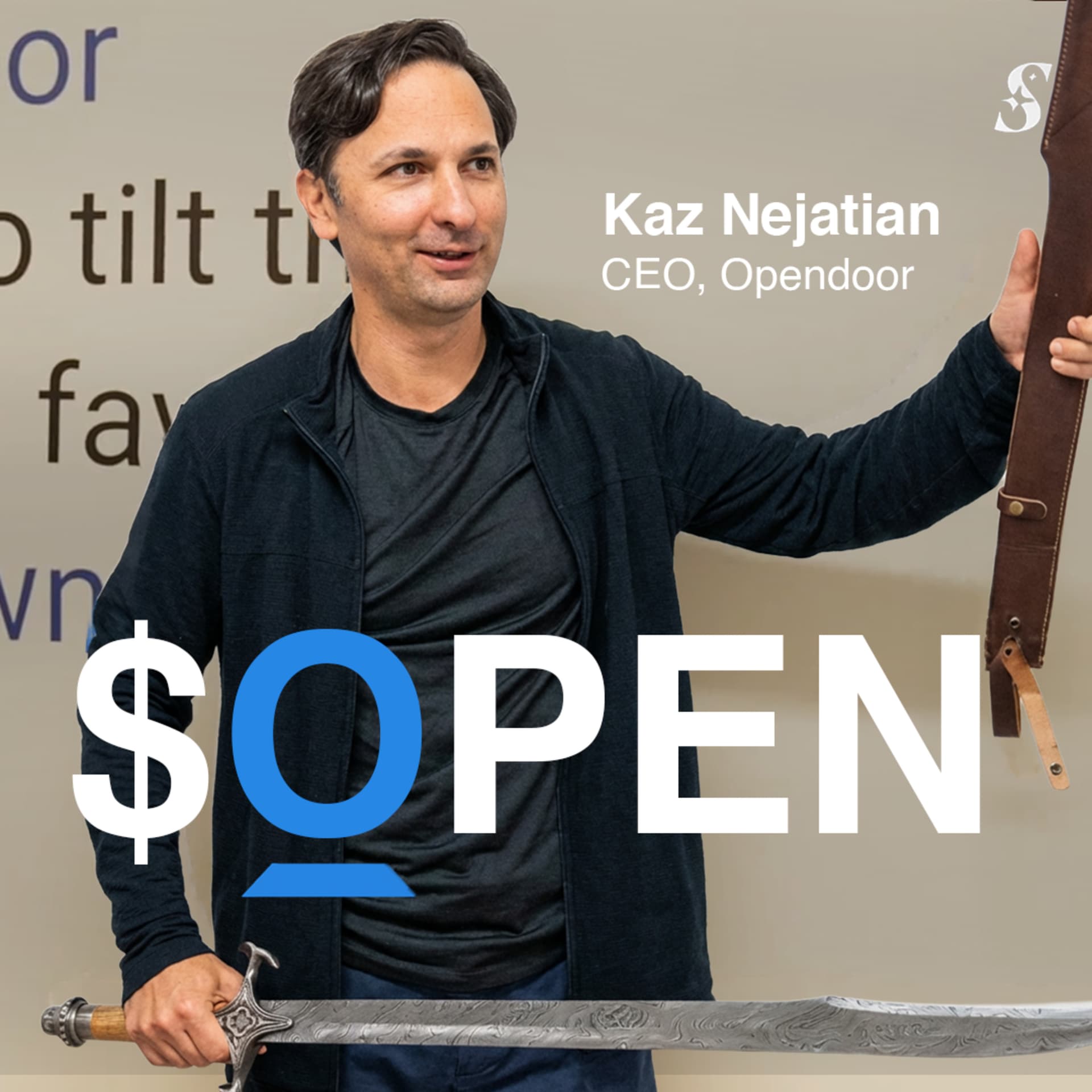
Podcast Summary: Sourcery - Episode: Can Kaz Nejatian Save Opendoor? Inside the $0.50/share Turnaround
Episode Overview In this episode of Sourcery, host Molly O’Shea interviews Kaz Nejatian, the CEO of Opendoor, amidst a critical phase in the company's history. Trading at around $0.50 per share, Opendoor faces risk of delisting and is struggling for survival. Kaz discusses the significant measures he has taken to turn the company around, emphasizing a focus on fundamentals rather than optics.
Key Themes and Discussions
Company Background
- Kaz Nejatian's New Role: Kaz stepped in as CEO after Opendoor's market cap had plummeted. His focus was on revamping the company's operations and culture.
- iBuying Model Challenges: The iBuying model, once seen as innovative, was now broadly criticized and written off.
Strategies for Turnaround
- Employee and Expense Review: Kaz undertook an exhaustive review of every employee and invoice, eliminating unnecessary expenses, including a $5M consultancy engagement that he deemed harmful.
- Restructured Workflows: Streamlined workflows previously involving multiple human touchpoints to improve efficiency.
- Incentive Structure: Introduced a unique compensation model where his salary is $1, with potential equity worth up to $2.8B if long-term goals are met.
Insights on Leadership and Company Culture
- Psychology of Turnaround: Kaz discusses the pressures of operating a public company, especially under scrutiny from investors and the media.
- Founder Mentality: Emphasizing the importance of maintaining a founder's mindset in a turnaround, Kaz believes it is crucial for fostering innovation and resilience.
- Focus on Fundamentals: Kaz argues that most public companies misprice long-term growth, leading to poor decision-making and short-termism.
Key Lessons from Experience
- Discount Rates in Growth: Drawing from his time at Shopify, Kaz discusses the importance of applying a near-zero discount rate to future growth, contrasting it with the common tendency to prioritize short-term gains.
- Handling Scrutiny: Kaz shares insights on how to maintain conviction in one’s strategies while being constantly observed by the public market.
The Future of Opendoor
- New Product Launches: Kaz expresses excitement about upcoming product launches, including a new mortgage product and enhancements in their underwriting model.
- Commitment to Community: Kaz underscores the significance of making home ownership accessible and believes in the positive societal impact of his company's mission.
Key Takeaways
- Kaz Nejatian’s approach to leading Opendoor emphasizes a long-term vision over immediate stock price concerns.
- The importance of team dynamics and bringing in talent with a founder mentality is highlighted for effective turnaround.
- Kaz's commitment to authentic leadership and transparency differentiates his management style, fostering a loyal workforce and community around Opendoor.
- The episode illustrates the complexities and pressures of turning around a public company, particularly in the face of market skepticism.
Conclusion This episode of Sourcery provides an in-depth look at the challenges faced by Kaz Nejatian and Opendoor as they navigate a critical phase of change. Kaz's insights on leadership, company culture, and future growth strategies offer valuable lessons for entrepreneurs and business leaders alike.
For more insights and discussions, subscribe to Sourcery for weekly interviews with influential figures in technology and finance.
Written by AI. May contain mistakes. Listen to the episode to check what was said.
Chapters
Tap a time to open that second in VOThe Job and Stock Price Dynamics
0:00 to 0:44
Explore the relationship between company performance and stock price.
“My salary is$1 and unless stock levels see levels they haven't seen in years, I don't get paid.”
Kaz's Transition from Shopify to Opendoor
1:13 to 3:14
Kaz shares his experience moving from Shopify to a struggling Opendoor.
“I don't know if it feels like a long amount of time or a short amount of time for you, but I interviewed Keith when you first started, and that was back in September of 2025.”
Passion for Opendoor and Company Potential
3:14 to 4:46
Kaz discusses his obsession with Opendoor and the potential he sees.
“And in February 25, I was flying from Dallas home.”
The Importance of Solving Deep Problems
4:46 to 6:42
Understanding why solving housing issues is crucial for society.
“Look, I think the problem Open Door is trying to solve is a deeply meaningful one.”
Public vs. Private Company Challenges
6:42 to 8:07
Kaz reflects on the pros and cons of running a public company.
“And like, it's a deeply meaningful problem to solve.”
Belief in Mission Over Monetary Gain
8:07 to 11:02
Kaz explains his motivation to work for a dollar salary at Opendoor.
“So when you joined, your salary is a dollar, you're weighted heavily on performance, and that's what your equity package will potentially award you.”
Focus on Value Creation Over Stock Price
11:02 to 12:54
The philosophy behind long-term value versus short-term gains.
“Imagine you're in a room with Jeff Bezos when Amazon dropped by 90%.”
Maintaining a Founder Mentality
12:54 to 14:00
Kaz discusses the importance of a founder mentality in corporate turnarounds.
“And that tends to get you to the right place.”
Critique of Corporate Practices
14:00 to 19:17
Explore how founder energy impacts company performance and decision-making.
“but i find in the history of american corporations and for what it's worth i think this is a uniquely like North American problem because it's not true in Japan, for example.”
Operational Changes at Opendoor
20:47 to 28:00
Delve into the significant operational and cultural changes at Opendoor.
“he mentioned a couple of very aggressive things that he wanted to happen to the company.”
Show all 27 chapters
Embracing Edginess in Leadership
28:00 to 29:16
Kaz discusses his unconventional approach to leadership and self-identity.
“And like I talked to company transparently about this.”
Success and Attention to Detail
29:16 to 30:50
Kaz reflects on the balance between macro thinking and attention to detail for success.
“My job is to actually describe the type of place this is, and lots of people will not want to work here.”
Cultural Identity and Professional Growth
30:50 to 32:36
Kaz shares personal experiences of cultural challenges and growth in his career.
“The answer to your question is I don't know how much of that is important for the average person's success.”
The Importance of Public Presence
32:36 to 34:06
Kaz talks about the significance of being public-facing and engaging with the community.
“It's so interesting you say that because for this role, this role in particular in this moment of time, for any public company, being public facing is key to it.”
Authenticity in Communication
34:06 to 35:39
Kaz emphasizes the value of authentic communication in the modern era.
“So you're very product driven, but this is also very marketing driven and being a public person.”
Regrets and Lessons on Social Media
35:39 to 37:59
Kaz reflects on past regrets and lessons learned from his social media presence.
“I admit, because I respond on X to people who DM me and sometimes I don't realize they're reporters.”
Mission-Driven Work and Its Challenges
37:59 to 40:09
Kaz discusses the rewarding yet challenging aspects of his mission at Opendoor.
“Like when you work like I do and have the job that I do, it is not, it's at times lonely.”
The Importance of Action Taking
41:13 to 42:00
Kaz advocates for quick decision-making and taking action without hesitation.
“I love how much all that stuff enrages you.”
Embracing Risk and Speed in Business
42:00 to 43:16
Learn about the importance of taking risks and prioritizing speed in decision-making.
“Like we've moved across country in one day's notice.”
Building an Effective Board
43:16 to 44:37
Discover the two approaches to building a board and their implications for company success.
“Now, like if we do things faster, we'll also be wrong more frequently.”
Communication and Board Engagement
44:37 to 46:46
Explore the importance of communication between CEOs and their boards.
“Who are the people that I would pay money to have dinner with such that they can talk about my job?”
Unconventional Leadership Approaches
46:46 to 48:58
Hear about unique ways of initiating office culture and leadership strategies.
“And I said, I had a similar conversation with a few of them.”
The Balance of Ambition and Discipline
48:58 to 50:47
Understand the rare combination of being bold and disciplined as a leader.
“It could be weirder, if I want to be honest.”
Lessons from Shopify's Founder
50:47 to 53:18
Learn how Toby from Shopify influenced leadership perspectives on growth and risk.
“From your time at Shopify, what were the biggest lessons you learned there from Toby?”
Exciting Developments at Opendoor
53:18 to 54:47
Get insights into upcoming product launches and team dynamics at Opendoor.
“I think it's partially because they do things that are just so different than every other company.”
The Importance of Detail in Business
56:00 to 57:20
Learn why attention to detail is crucial in business operations.
Setting the Stage for the Discussion
57:20 to 57:55
Explore the key metrics and macro situation of the housing market.
Transcript
Automatic transcript. May contain errors.0:00Molly O’Shea:I paid a company to work here. I pay open door money to work here. That's insane. My salary is$1 and unless stock levels see levels they haven't seen in years, I don't get paid. If you look at the companies you have made a meaningful difference in the history of the world and have become good companies, basically all the founders or CEOs of those companies would have said words that sound like mine. Increase the stock price tomorrow by a penny or by a dollar. That's not the job. Over a long period of time, the stock price converges with the company. The company is not the stock price. The stock price is not the company.
0:34Molly O’Shea:The company drives the stock price, not the other way around. So if you build a great company, the stock price will reflect that over time. Only way to build a great company is to build something people want. The single largest expense on our income statement was millions of dollars paid to a well-known consulting firm. The advice was basically the following tweet. Do everything worse, but cheaper. And so everything got worse, not cheaper, just worse. And our job is to make it easier for them to own a piece of America.
1:11Kaz Nejatian:Kaz, welcome to Sorcery.
1:13Molly O’Shea:Thanks for having me.
1:14Kaz Nejatian:I don't know if it feels like a long amount of time or a short amount of time for you, but I interviewed Keith when you first started, and that was back in September of 2025. how have the last six months gone i mean it's been like an interesting
1:30Molly O’Shea:it's a deeply interesting experience like i have a there's a couple of things that you kind of think about when you like are prepping for a new job and look i took i never thought i would leave my last job so taking this job was not unlike like a thing that I thought would happen but in hindsight it has been so just deeply meaningful for me and my family so like I judge my work week every week I just based on like the three vectors they called hard valuable fun was the week hard was it valuable was it fun and it hasn't been that many a week, but honestly, all of them have been hard. All of them have been valuable.
2:20Molly O’Shea:All of them have been fun. It does genuinely feel like we're making progress every single day, which is like very rewarding.
2:29Kaz Nejatian:And this was entirely disruptive to your life. You joined a company that was at 50 cents a share and it was about to be delisted. And then you get pulled in, recruited to this position. So what was it like going from Shopify where you, I don't know, maybe it was nice and easy and a little bit more linear to something that is completely abstract.
2:50Molly O’Shea:Okay, like the day I joined Shopify, I remember when I joined Shopify in 2019, I left Facebook to join Shopify. And the number one question that my colleagues would ask me when I chose to join Shopify was, what the fuck are you doing? That was number one question, because like back then Shopify was very broadly shorted. like the day I joined it was a short solid report that came out calling saying Shopify would go bankrupt in 12 months and like now like honestly like even at the time it was relatively obvious to me people were like Toby had built this wonderful thing and people were misjudging it but from the outside it was not like Shopify back then was not the winner it is today and the process if you forget the process of Shopify over the last few years was not the easiest one it wasn't you know going to covid wasn't easy coming out of covid wasn't easy like building like with ai wasn't easy getting what the logistics was it wasn't easy uh but it was rewarding which is like important um but the reason i like joined opendoor was from the outside like i had kind of become obsessed with the company like i remember so i for fun take apart companies for like for fun it's what i do Like, I read about the history of companies.
4:11Molly O’Shea:I take them apart. And in February 25, I was flying from Dallas home. I remember this like it was yesterday. And for reasons that I can't explain to you, I'm like, let's pick up our open door. Let's see what happened to it. And I was on a plane. And from the time I took off to the time I landed, it was like a three and a half, four hour flight. I remember getting off the plane and being just outraged by what had happened to this company. Really? I was just so angry about it. And like, so then I spent almost every weekend thinking about Open Door and going through Open Door and like figure out, using the product, figure out what had happened.
4:47Kaz Nejatian:What made you angry?
4:49Molly O’Shea:Look, I think the problem Open Door is trying to solve is a deeply meaningful one. And there's like nothing worse to me than seeing opportunities wasted. like when you see someone who doesn't know how to play basketball that well if they play basketball poorly they're like well you're not that good like it's fine you're good to go do something else when you see someone who's an excellent basketball player just throw away the talent like everyone gets angry everyone's like no this should turn out better and open door should turn out better um so like it got to a point where like at dinner every night my wife and I would talk literally only about Opendoor.
5:32Molly O’Shea:To a point where my wife at one point was like, okay, we've talked about Opendoor enough. Can we please just like, just go buy some shares in the company so we can stop talking about this? And I said, well, like, it's not really the type of company we can buy that much shares in because it's not that big. And then she said, how big is a company? And I think the market cap was a few hundred million dollars back then. I'm like, I don't know, a couple hundred million dollars. And then she said, well, why don't we buy it? um so like my wife's plan literally genuinely honestly was that we would like sell everything we owned leverage ourselves as much as we could to take open door private so we could fix it so i called keith back in april and was hey man i'm thinking of doing this uh will you do it with me so that's that was my intro to open door because from the outside i was just so like it was so obvious to me this problem was one worthy of solving it was a problem that you should dedicate your life to solving.
6:29Molly O’Shea:Because when people, when kids grow up in homes that their parents own, their life outcomes are better. Like when people buy homes, crime goes down in the neighborhood. And like, it's a deeply meaningful problem to solve. And it's been basically untouched by technology. So I thought it was one worth solving. And I'm just, you know, a couple months into the job, I still feel as strongly about it as I did back then.
6:59Kaz Nejatian:How do you feel about doing this correction, this turnaround as a public entity versus a private entity? Did you ever think about taking it private?
7:11Molly O’Shea:I mean, I was going to, that was my plan. My plan was to take it private. After joining? No, no, it's not. Look, I think there's like basically two reasons to take like this company private. And just only two. there's one way in which running a public company is harder than running a private company like one real way and that is people will write things about you in newspapers so if you care about what the wall street journal writes about you running a public company is difficult luckily for me, I just don't give a fuck. Like, I do not care what things look like. I care a lot about what things are.
7:55Molly O’Shea:And there's frequently a dissonance between those two things for a very long time, right? And over time, dissonance gets smaller and smaller as we execute against the mission. But at the beginning, lots of people are like, what the hell is this thing it will never work etc so that's like if you care about that this is harder but i never got into fancy clubs when i was a kid i never really cared about like i've never cared about being a forbes 30 under 30 40 i've never cared about these things um i care about other things just not these things so in that way it's not harder for me uh the second way in which like you could say well we should take open door private and that is i think you could reasonably argue that it would be um be more monetarily good for me and my family because we have higher like i believe in the company we've bought shares in the open market you can like i don't i also don't care about that like i just don't that much like i'm like my salary is a dollar for a reason.
9:09Kaz Nejatian:Yeah, let's talk about that. So when you joined, your salary is a dollar, you're weighted heavily on performance, and that's what your equity package will potentially award you. How do you balance that? And what is the motivation for you behind that versus having that job at Shopify?
9:27Molly O’Shea:Look, I think there's two things that are true. Let me just say both of them. The first is this. I find that if you do something for money, the half-life of your ability to put up with pain is very low. Everyone intuitively understands this. That's just a very real thing. But if you do something because you believe in the cause, like you will be much more durable you'll be able to do a lot more um so i do this i come to work every morning uh we work very hard at open door because we believe in the mission like everyone who works here believes in the mission i believe in the mission my family believes in the mission my six-year-old son believes in the mission like we believe in this mission so for us we're on this journey because the outcome matters like it matters to us what happens to the average homeowner and second i do think like i'm not indifferent to the stock price like um there's no one who's a more highly levered on open door stock price than i am like i'm number one by far right like i paid a company to work here like i get paid a salary of a dollar but i have to pay for my benefits So I pay the company, like I pay open door money to work here.
10:52Molly O’Shea:And unless the stock price gets to levels that has not been in in a very, very long time, like this would be a bad financial outcome for my family.
11:02Kaz Nejatian:I think that's insane.
11:03Molly O’Shea:I don't know. Like, I think generally, like if you look at the companies that have made a meaningful difference in the history of the world and have become good companies, basically all the founders or the CEOs of those companies would have said words that sound like mine. Imagine you're in a room with Jeff Bezos when Amazon dropped by 90%. Or you're in a room with Ernie from Carvana when Carvana dropped 90%. Like they didn't say that. Their position would not have been, my job is to increase the stock price tomorrow by a penny or by a dollar. That's not the job. like over a long period of time the stock price converges with the company right the company is not the stock price the stock price is not the company the company drives the stock price not the other way around so if you build a great company the stock price will reflect that over time and the only way to build a great company is to build something people want um i think the rest of it is just genuinely not like i think history is proven i don't actually understand this like there's like like i don't have like yahoo finance like on my laptop i just don't there's like you've walked around the office the stock ticker is nowhere.
12:28Molly O’Shea:I have a copy on my desk. There's a copy in the book bar of Bill Walsh's book, The Score Takes Care of Itself. Football players who look at the score all the time tend to be not very good football players. And people who watch ESPN and look at the football score tend to not be good football players. Like our job is to focus on fighting for every single inch, every single yard every single day. And that tends to get you to the right place.
12:57Kaz Nejatian:We were talking about how you took over the company. You're coming in with a mission. But I think more importantly, you're really bringing a founder mentality into something that was dead. It was like a shell of a company and shell of a culture. And now there's literally a cult following. You have the army around you, the open army and then you have uh yeah you have people like me and people like keith who are just pounding the table and want more open door so could you share like why is it so important to have a founder mentality with such a big turnaround like this in order to create things that have not been created before you need like exothermic energy like we're not a widget factory like the
13:43Molly O’Shea:thing we don't do is like optimize the creation of a thing over and over again and try to turn like a dollar 10 into a dollar 12 that's not our job right if that was our job then you can imagine like a professional manager being good at it right like just look at the knobs turn them slightly like but i find in the history of american corporations and for what it's worth i think this is a uniquely like North American problem because it's not true in Japan, for example. But in history of American corporations, you get these significant moments of alpha followed by a slow decline once managers take over, right?
14:26Molly O’Shea:And you can think of your favorite big company where it had that significant moment of alpha and then the decline happened. So I think the right words to use is not whether the founder is working at the company or not. the right words to use is the founder chair taken or not is someone sitting in the founder chair or is there at the around every single meeting table in the company an empty chair from someone whose job it is to call bullshit on things right so look i'm not anyone's um ideal dream of a corporate CEO. Like if you like go to Harvard Business School and imagine what a CEO looks like, it ain't me.
15:12Molly O’Shea:But I'm very good at building products, right? And I care a lot about the details of everything. And what that allows me to do, allows OpenDoor to do, is to do things that are unusual. We are not going to be a beta company. We're a high alpha company. You can only generate that we can only generate extraordinary outcomes if you do extraordinary things. But the best way to get the same outcome as everyone else is grab a consulting firm, ask them what is the best practice in X industry and do that. But what that gets you is what the industry does. Our job is to create a new world and you can't do that without founder energy.
15:56Kaz Nejatian:When you came in, And I heard you read all the expense items line by line and you came across a very chunky consulting fee that probably did nothing. But could you talk about the process of coming in and what you cut immediately?
16:10Molly O’Shea:I went through literally every single invoice the company had paid for the previous 12 months. I'm like, I did two things. I went A, through like every single employee and every single expense. I'm like, well, these are the capital allocation of the company is determined by who it hires. I'm like, what do we pay for? So I went through everything. And I was just genuinely shocked by how many consultants build open door money. Like it was just like dozens and dozens of external consultants who build open door money for things that I thought were useless. There were consultants building open door money to create presentations for internal open door meetings.
16:49Molly O’Shea:No. Yeah. And I'm like, this is insane. this is just like the nuttiest thing by the way i think it's a common pattern in american corporations where there are external consultants whose job it is to help you create presentations so you can present it to other people inside your company but that's just insane it's just nutty so two interesting things happen one is we were working on the earnings on the release that would announce me um it was um google doc we're working on a release and i'm reading this thing and I put in all caps on top. This is before I was working here. I put in all caps above the doc.
17:27Molly O’Shea:Who is writing this? Whoever it is, can they please stop working here? And I didn't know, transparently, I didn't know the Google Doc was open. I thought it was just me and the board member like going back and forth. But turns out our external PR firm who was drafting the release was in the doc. so um they um resigned before i showed up which was good because we didn't have to pay him their 90 days notice period which was helpful it's very helpful and the second thing that happened was the single largest expense on our income statement was millions of dollars paid to a well-known consulting firm uh whose advice can be approximated as the following we paid him five million dollars for this this voice was basically the following tweet do everything worse but cheaper and so everything got worse not cheaper just worse because that's literally what happens when you're when you come and say cool you're gonna do everything you're doing right now but cheaper and everyone rationally understands if you do everything you're doing right now at lower cost you get worse quality that's like not an it's a non-son like my my five-year-old daughter could tell you this but we spent millions of dollars to learn this lesson so um part of our job at opendoor and the company like the entire company is not dedicated to this if you go around um you'll see people have stickers um you can actually find them that say charges by the month pay with your life.
19:09Molly O’Shea:Like we are dedicated to getting rid of every single thing that we pay for that is not deeply useful to our mission.
19:17Kaz Nejatian:Sorcery is brought to you by Brex, the financial stack trusted by more than 30 ,000 companies, including one in three venture-backed startups in the US. Nearly 40 % of startups fail because they run out of cash. Brex is literally built to help founders avoid that. Unlike traditional banks that let your money sit idle, chipping away at it with fees, Brex's designs help you spend smarter and move faster. Their all-in-one solution combines checking, treasury, and FDIC protection into one powerful account. You can send and receive money globally at lightning speeds, get 20 times the standard FDIC coverage through their partner banks, and even high yield from day one.
19:57Kaz Nejatian:With same day and even same-hour liquidity. Access your funds anytime. Companies like Scale AI, DoorDash, Service Titan, HIMSS, Anthropic, Flexport, Robinhood, and Plaid trust and use Brex. Start today at brex.com slash sorcery. That's B-R-E-X dot com slash sorcery. Turing is training the next generation of AI with tasks that require real expertise and real-world judgment. That's why companies like NVIDIA, Anthropic, Salesforce, and Gemini partner with Turing. Turing builds realistic reinforcement learning environments and data systems based on real operational traces, the kind of infrastructure Frontier Labs need to train superintelligence.
20:42Kaz Nejatian:Visit turing.com slash S-O-U-R-C-E-R-Y. When I talked to Keith, he mentioned a couple of very aggressive things that he wanted to happen to the company. He rejoined the board. You joined the company. You're a CEO. The board seemed super hands-on. When I talked to him, he talked about how there were 1 ,400 employees. He wanted it to cut down to around like 300. Has that happened?
21:12Molly O’Shea:I mean, no, look, I think Keith's insight was a correct one, generally correct one, which is that for the output Open Door was getting, it did seem to have an unusually high OPEX. My problem is also a different one, which is this, which is I am offended when people do things that human beings should no longer do. Like if you walked into an office building and you saw someone using the Gutenberg press to create an internal memo for distribution, you'd be offended. If you saw a bunch of people running around delivering mail like it's 1962, you'd be offended. It's like, this is just not work human beings should do today because we've learned lots of stuff.
22:04Molly O’Shea:So I think generally, like I think there's like, there was a lot of work happening at Open Door where, let me give an example. When I got here and you went to opendoor.com and typed in your address. We'd say, great, we're going to send someone to your house to take pictures. Someone would come to your house to take pictures. Then we'd ship these pictures to overseas where someone on a laptop, on a very bad laptop on a Chromebook, would look at them, circle the areas that need to get repaired. Then they would send that to someone else overseas. And then they would just do that. And then they're down the chain.
22:43Molly O’Shea:So between the time you put your address in, And you got an offer to be 11 human beings who touched that. That's insane. That's just an insane outcome. Like today, zero human beings are in that loop in many of our flows. Like AI does all of that, which means our human beings can do things that are actually good for the mission. Let me give you another example. This is actually my favorite one. Because of the advice we got from this consulting firm, we offshored customer support of Ovidor to Mexico. and in my second week here i was sitting with the head of our customer support team i'm like let's call together our customer support line because i do this i use our product i picked up the phone and called the customer support line and i said hey i'm kaz i would like to buy this house that i'm seeing uh on the website how do i do that and the customer support agent said i'm not kidding about this said have you heard of google.com no i'm like yes he goes could you type in google.com on your browser and type in how to buy a home from open door i'm like i can i need to go down from there like if you have human beings doing that work it is bad for that person bad for open Door and bad for capitalism.
24:11Molly O’Shea:Like, I think we should have, what we should be able to say is this, that every single person that works at Open Door is a most efficient human being possible at the thing they do. And I think that's the end goal of the company. And we will work towards that every single day. So what employee changes have you made? I mean, look, one of the first things we did was Open Door used to be a remote company. You've noticed we're no longer remote. On my first day at open door i said hey we're going back to the office everyone has seven days uh and so a bunch of our colleagues decided not to join us on that journey and left the company because they didn't want to work for an in-person company and we wished him the best um you know we had double digit attrition because of that and it was you know we good people we wished him the best but the company got smaller as it was all for that we have a lot of um if you look around we have hired more YC founders into Opendoor since I started than any company.
25:11Molly O’Shea:Why? Because I believe that you can only do extraordinary things with founders around or people who act like founders. So if you just walk the floor, you'll see that there's a shocking number of people with an orange Y on their shirt. So quite a few of them are, you know, entire mortgage team is YC founders, entire escrow team is YC founders. And the goal of the company is to become far more technical, to look more like a software company than a manufacturing company. That's a path we're walking down.
Read the full transcript
25:48Kaz Nejatian:Has it been hard to maintain culture with that? If you're bringing in an entirely new culture to something that was...
25:55Molly O’Shea:I don't think Open Door had much of a culture. Transparently, I think what happens to companies when they're run by professional managers is culture atrophies. What happens, this is a real thing. People think, people have a caricature in mind of what leadership is. They think of a job of a leader is to stand in front of a room and be like mascot as CEO. Like, rah, rah, rah, we shall go over that hill. That's like, I guess not what the job is. The job is to hire great people, train them well, tell them what the priorities are and inspire them in that order. Right? That's the order of importance.
26:33Molly O’Shea:I think lots of people like pretend culture is like beer on tap in the office. That's just lazy. That's the abdication of your responsibility to people's careers. So like, I don't think Open Door had that much of a, I think it was like, I find the best thing for culture is this. Tell people who you are. Say things that people can reasonably disagree with. Because if you say a thing everyone agrees with, you've said nothing useful. Right? and then win together. Like the best thing for culture is doing hard things together in person. Like high school football teams have cultures because they do things together that are hard in person, right?
27:19Molly O’Shea:What isn't that much of a culture is like, you know, the Dunder Mifflin office in like the office. It's just not, it's not a culture, right? Like having Taco Tuesdays is not a culture. It's like a caricature of what other people should do.
27:35Kaz Nejatian:For you, it seems like you're entirely authentic to yourself. I listened to a couple of your interviews in the past. There's a really good one with Anthony Pompliano. And you were talking about how you sold a company, I think it was to Facebook, and you join and you're cursing around, you know, you're dropping F-bombs left and right. And you're hit with the reality that you can't talk like that in there. and it was a hindrance to you and your personality. So how do you carry that in this role?
28:07Molly O’Shea:It's generally hard. And like I talked to company transparently about this. I am not close to being well-rounded. I'm not a good approximation of an average human being. I'm just not. This is a very real thing. I'm edgy in basically every reason, the way one can be edgy. So I have two choices, right? choice one is i can go become well-rounded and become a pale pink imitation of myself uh or two i can be my like not become well-rounded become edgier and surround myself by people who are edgy in the opposite way i've chosen the second path because i don't want to pretend something i'm not i don't ask anyone to pretend something they're not but i think the best way to explain this is this.
28:54Molly O’Shea:If you go to an Italian restaurant and complain that the sushi is bad, that's your fault. That's just your fault. But if you go to a place labeled restaurant, where the menu includes literally everything on there that you can order, and you order something that's bad, that's their fault. Right? My job is to actually describe the type of place this is, and lots of people will not want to work here. In fact, less than one in a hundred people will ever want to work here. That's fine. Like we have a very high bar, like our career page tries to do a very good job repelling you and convincing you not to apply to come here.
29:37Molly O’Shea:But once you're here, we want you to be committed to the mission. My job is to accurately describe what it feels like to work here. I think people say I'm honest about it.
29:48Kaz Nejatian:Before we started and the cameras were on, we were talking about how important attention to detail is and staying true to your quality bar. And so with that and this aggressive personality, how much of that and that personality and maintaining a quality bar do you think is synonymous with success?
30:11Molly O’Shea:I don't know, honestly. I can tell you this. I try very hard to criticize things not the people who created those things i think it's kind of useless to hold your past self guilty so if you see me in a product review i frequently say this fucking sucks i very rarely say you fucking suck like the work is the work of open door so open door has failed when it produces something that is not good the individual people who worked on it may be excellent right so we just have to keep working at that and that's like a real thing i don't have another way of doing this for what it's worth i think there have been successful people who don't pay that much attention to details who are relatively macro driven they place good macro bets on what the economy is going to do and don't pay that much attention the details and that can be a very successful um or at least profitable career i'm not that guy i'm just not i care a lot about the pixels i care a lot about the api i care a lot about the database i care a lot about the words we say i call our customer service lines i talk to our sales people i care that this thing that we put out there is a reasonable representation of ourselves and every day we should wake up and be deeply ashamed of it and want to make it better.
31:46Molly O’Shea:So I don't know. I don't know. The answer to your question is I don't know how much of that is important for the average person's success. I can tell you that I don't know how else to do it. Like, if I can honestly, it's a very real thing. I grew up as an immigrant and I had a very hard time with cultural norms that were commonly understood if you grew up in North America.
32:12Molly O’Shea:So, there was a club I wanted to join. And I applied to join it when I was 18. I got rejected. I applied to join it when I was 22. I got rejected. I applied to join it when I was 25. I got rejected. I finally got accepted as a member of this club when my wife became the president of the club. like i'm just like not like i'm just not good at the type of things that the average CEO would be good at i'm terrible at glad handing i can't work a room but i can look at like you know i can look at dev docs and look at an api shape and look at the pennies that get spent adding product features and make them better.
33:08Kaz Nejatian:It's so interesting you say that because for this role, this role in particular in this moment of time, for any public company, being public facing is key to it. And having a presence online, you've had a tremendous presence on X. You're building out a community there. I know you're also doing a live stream on Robin Hood and throughout various chapters.
33:34Molly O’Shea:Our earnings was the most watched earnings in history. Really? The last National Open House we did broke records for how many people watched it. No. Yeah, by a lot. But not by a lot, by a lot. We should fact check this, but I think at one point we had 55 ,000 live viewers. Not like live viewers of the actual thing, which is like the average earnings call is watched by approximately 3.5 people. Like we had 50, like just lots of other people watching. We had 55 ,000 live viewers at one point.
34:02Kaz Nejatian:That's pretty cool.
34:03Molly O’Shea:Yeah.
34:04Kaz Nejatian:But it's okay. So how do you think about that? So you're very product driven, but this is also very marketing driven and being a public person. So, okay, how much of your role is the marketing part or the product part? Or is it both? And how do you do it all? I think there's a...
34:19Molly O’Shea:I am lucky that X and other tools allow me to talk directly to people. And long-form interviews are a thing today. I'm telling you, like, two decades ago, I would have been terrible. Because, like, when I can talk directly to people, I can look at someone in the eye, say, Hi, I'm Kaz, this is who I am. I think they can see me and see I'm being genuine and honest. And they're like, cool, let me give this person some rope. But when I talk to people through people and short form, like I end up always sounding like an idiot. Almost sounding like at least inauthentic. Like you have questions. Apparently you, like I had gotten some sense of like what this was supposed to be.
35:12Molly O’Shea:I didn't look at it because like having, if I had looked at it, I would have sounded fake.
35:19Kaz Nejatian:Yeah.
35:20Molly O’Shea:Right? So I don't prep for these conversations. If you, I came from there, sat here and we're talking. There's no like, we don't have a PR department. But if you email press at opendoor.com, get an email back saying, we don't have a PR department. If you want to talk to someone, DM Kaz on X. And then I usually respond. And I've gotten myself in trouble, I admit, because I respond on X to people who DM me and sometimes I don't realize they're reporters. Oh. And, like, that gets coded. And, like, so, anyway. But, yeah, I think, like, the modern communication methods allow me to be authentic in long form.
35:57Molly O’Shea:Which is, like, helpful. It helps a lot. It helps, like, fit me into this new world. Which, look, I wouldn't have had this job 10 years ago or 20 years ago. Just zero chance.
36:09Kaz Nejatian:Have you said anything on X you regret?
36:11Molly O’Shea:Oh, yeah, lots. Like what? Oh, no, no, like, lots. Like, I've said, like, so many things I regret. I tell you there was a thing I saw on X years ago that got taken out of context that I regret a little. I read a lot because I'm a nerd and I do. So there's a book called Protestant Work Ethic by Max Weber, which I think is insanely insightful about the modern world. so i i quoted it on like years ago uh talking about like the importance of protestant work ethic as a book not an idea like it was a capital p or like the book is called protestant ethic and like anyway it doesn't matter so i quoted this book i think people thought i was saying that like only protestants work hard which i thought was such an unreasonable take on like the post like you have to really twist yourself into a knot to believe that like i grew up muslim i've been to more mosques than the average person like and i thought it was like so that was like it was only annoying because i think like my colleagues had to defend me and i felt weird but no i don't like i don't i don't like i don't post things on x because i think there's zero chance of causing trouble i just don't um because if i did i would become like i'll be hiding in that corner crying that's just not what i do i don't know like i don't recommend that people adopt this method of running a company.
38:00Molly O’Shea:That's really weird. Like when you work like I do and have the job that I do, it is not, it's at times lonely. In fact, it's very frequently lonely. So I don't recommend doing it this way. If you can do it the way that it's traditionally done, I recommend you do it that way. But this is how I can do it. Why is it lonely? It's just like, look, it's a hard, it's a hard look i deeply admire my colleagues they're just wonderful just wonderful wonderful people but if you talk to like anyone who's a founder type like you're essentially at perpetual war and it isn't like it's not relaxing but there's a very real thing look i um it used to be true
38:53Molly O’Shea:that if you were a teacher, you could, on one salary, buy a home in Arkansas, raise your family, and be happy. That used to be true not that long ago in this country. And the fact that it used to be true that not long ago in this country is the main difference between America and the rest of the world. It is why America is a country it is, because people have owned the ground they stood on and raised their family there, and said, I belong here, you cannot tell me what to do. The fact that's no longer true is deeply saddening to me. So, like, I am only, like, I'm massively driven by the mission.
39:33Molly O’Shea:Like, we talk about that teacher in Kansas City, that plumber in Arkansas, and our job is to make it easier for them to own a piece of America. And so that makes it incredibly rewarding. It doesn't mean thought hard or lonely, but it is very rewarding. I think this mission matters so much. And that's what has kept me around so long. And what's kept the people who have been here for a while is recognizing how broken the existing process is. And the fact that we believe that our solution is not just important to our customers, but to America generally. And just having, again, another chance at, you know, kind of cracking that code is just something I'm really grateful for.
40:15Kaz Nejatian:Some of you may not have heard this yet, but our sponsor Public just launched something called Generated Assets, and it brings AI into investing in a way I've honestly never seen before. Here's how it works. You type in an idea like AI-powered supply chain companies with positive free cash flow or defense tech companies growing revenue over 25 % year over year. Public's AI then dispatches a swarm of agents that scan every single US stock, evaluates them, and instantly builds a custom index around your thesis. What really stands out is how clearly it explains why each stock is included. And before you invest, you can even backtest your idea against the S &P 500, so you're making decisions with real context, not just guessing.
40:54Kaz Nejatian:And beyond generated assets, Public lets you invest in stocks, bonds, options, crypto, all in one place. They'll even give you an uncapped 1 % match when you transfer your investments over from another platform. If you want to build a portfolio that actually reflects your thesis, visit public.com slash sorcery. Paid for by public investing. Full disclosures in the description. Founders.
41:32Kaz Nejatian:I love how much all that stuff enrages you. You're like, this is wrong. We need to redo it. And I don't know. I feel like some people would feel they would they would hesitate towards taking that action. but why do you think it's so important to take action?
41:48Molly O’Shea:I don't know. Look, I think there's, first of all, this is how I am. I've always been like this. The time between decision and action has been always short in my life. Like we've moved across country in one day's notice. Like I took this job within like the entire negotiation for this job was like 10 days or something. Like, so I've always been that person. But I also think that, like, people misprice risk in their head, and they think weighting reduces risk. And in my experience, it just fucking doesn't. Like, it doesn't, right? All it does is take time away from time you could be spending doing other things.
42:33Molly O’Shea:Like, what's the worst that could happen? We'll just paint over that wall again. Like, let's just go do that thing, then move on to the next thing, you know?
42:41Kaz Nejatian:And that's core to your whole, I don't know, what is it? It's not like a catchphrase, but I guess ethos or something like that. But it seems like it's entirely core to your whole faster.
42:53Molly O’Shea:The faster is not like a new line. I've been saying this my entire career. Like I value speed above everything else. Like everything else. My job is to learn more. Like all companies are, literally all companies are, are a collective effort to learn. And if we learn faster, we do more. That's all that matters, right? Now, like if we do things faster, we'll also be wrong more frequently. But we would have been wrong that frequently just over a more stretched out amount of time. Let's just learn faster.
43:27Kaz Nejatian:So who's on the board? I've looked at the list. It's an incredible list of names.
43:31Molly O’Shea:Look, our board, look, I think there's a kind of two ways to build a board. for a company. The first is you build a board such that people who are on the board get out of your way and show up to meeting once a quarter, have some shrimp cocktail, put up their hand, and then get back on the Pevajuts and go away. Like the most common way American boards are built, right? Like find people who sound impressive, like whoever had Korea, but who've usually been retired for many years. so therefore they don't have any recent experience, put them on a board and just optimize for them saying yes over and over again.
44:17Molly O’Shea:That's one way of doing this. That feels like an obscene waste of time and money to me. Imagine having to do a song and dance in front of people where you know the answer will be yes. Like, what is the point of that? That's just deeply useless. The second thing you can do is just say, hey, who are the people where I would pay money to have dinner with them? Who are the people that I would pay money to have dinner with such that they can talk about my job? So I talked to one of our board members this morning. Actually, I talked to one more than yesterday. So my frequency of communication with the board is way higher than the average CEOs.
45:01Molly O’Shea:But we also understand that their job is to give advice and my job is to do things. And like, I ask them for advice all the time. Like, I think they thought I was kidding when I was sitting. We get texts from me almost every day, but they do. And they're excellent. Just generally, I would put up our board against any other board. Like, we have people who... Who's on it. So our lead independent director is Eric Federer, who is from Lenar, one of the greatest companies in the history of America. the largest builder in America. Keith and Adam, who are like probably two of the best investors in Silicon Valley.
45:42Molly O’Shea:Eric, who founded this place and is just genuinely wonderful. And Dana, who has a very long history in residential real space, real estate understands it deeply. and David, who was an interim CEO of Fannie, understands mortgage financing, understands the space, is deeply in tune with a part of my job where I am objectively less good, which is understanding why stocks do what they do. And he's just an excellent board.
46:15Kaz Nejatian:What have they been measuring you on?
46:20Molly O’Shea:So look, actually, I had a very good conversation with our board members before I joined. And I talked to all of them before I joined. And I got, I was lucky in that it was a double opt-in system for me and the board. I'm like, cool, we're like in this together. And I remember having conversations with one of them, like 3 a.m. one night where I'm like, hey, I will do this, but you have to commit to also do this for the next three years. You and I are doing this together. And I said, I had a similar conversation with a few of them. and the conversation with all of them was this I will optimize my day-to-day work for what it is and not what it looks like like there will times where it will look weird and my ask of you is always ask is this actually weird or does it look weird if it looks weird please give me a rope if it is weird push back ask me questions so that's been like primary back and forth and so what we have is a more involved um conversation where like we don't go from like three months without talking like i think for my first month on a job i talked to one board member at least every day um because like we were like look when i got here the company the company's balance sheet had like a ticking time bomb on it like it wasn't obvious how the company was going to survive that taking tomba now luckily we've cleaned it up the balance sheet is incredibly healthy but for the first like 10 days it was
47:59Kaz Nejatian:just not that obvious what's the weirdest thing you've done for what's with i don't recognize it
48:04Molly O’Shea:when i do weird things like people after afterwards tell me that was weird but they didn't they don't feel weird to me otherwise i probably wouldn't do them i don't know um i mean i look i i think people would say we went back to office in an odd way like i showed up on a monday my first monday at work and i said hey everyone by next monday we're back in offices at that point we didn't have offices like we didn't know where people were gonna go so we had to like like the team had to go sign leases open up offices get badges and like people have to pick where they were going to move to, like, relatively quickly.
48:51Molly O’Shea:I think that was unusual. It didn't feel weird to me, but I agree it was unusual. Is that weird?
49:00Kaz Nejatian:It could be weirder, if I want to be honest. Good. Yeah.
49:03Molly O’Shea:I'm for this.
49:04Kaz Nejatian:Yeah. You should do weirder things, honestly.
49:06Molly O’Shea:I'm going to try very hard not to optimize for that. Don't hold back. I'm not. In case it's not obvious. Even if I wanted to hold back, I wouldn't know how to.
49:19Kaz Nejatian:When I prepared, I re-listened to the conversation we had with Keith, and he said some really lovely things about you. This was right at the courtship. It was a beautiful moment. But he said, well, one, he said 99 % of everything matters. Everything that matters is the CEO. So picking you and having you join, that's a big deal. he said in describing you, he's both bold and ambitious, but very disciplined and rigorous and analytical. And that's a rare combination. A company like Opendoor needs to be rigorous and analytical, but it can't sacrifice the ambition and the boldness and the willingness to do things and push the envelope to create and innovate.
50:04It's kind.
50:05Molly O’Shea:I mean, I think there's a very, I think if I were like going back in time, there is a very, there are some things that are odd about me. I was in high school I was both a rugby player and a mathlete I did math competitions on the weekends and I played rugby so I have like a nerd's mind but a relatively high pain tolerance for like outcomes and that I think has been helpful to me in my career and that I can understand risk better than most people can, but I'm not afraid of it. And so that has been genuinely helpful. And I'm glad Keith agrees.
50:53Kaz Nejatian:From your time at Shopify, what were the biggest lessons you learned there from Toby?
50:59Molly O’Shea:First of all, Toby is one of one. There's a reason why everyone says he is the founder other founders like. He's one of one. I think there's no... It's hard to exaggerate that. The thing I deeply appreciated about Toby is he had found words for ideas that are hard to describe. Let me give you the one that I think is incredibly important. There is an idea in finance called a discount rate. I went to business school and they said there's only three rules you learn in business school. money is good more money is better money now is better than money later those are the three rules of business school um so everyone has this intuition about discount rates i.e if you give me a hundred dollars today that's better than a hundred dollars tomorrow but unfortunately everyone has a wrong intuition about it people apply too large a discount rate to future so So what ends up happening is people very frequently sell future growth at a massive discount for today's stock price.
52:09Molly O’Shea:And the result of that, by the way, very objectively is PayPal. Like over and over again, that company made all the wrong decisions because they cared more about today than 10 years from now. And guess what? It is now 10 years from now. And the company is in deep trouble. I realize that most public company CEOs also don't talk this openly about other public companies. but it's true so but toby had this very wonderful mentality of um applying essentially a zero discount rate to future growth he was just like it's a cool growth tomorrow or growth today i'm indifferent i will never sacrifice growth tomorrow for growth today and if you do that in your head what actually ends up happening is because human beings always misunderstand compounding growth is you end up getting way higher growth later on you end up being right so i think it was it's a very hard thing to do in practice because you have to look at a chart and say, nah, I'll take some of it later.
53:06Molly O’Shea:That's very hard, but it is why Shopify is just... I think there's like two SaaS companies that stand differently than the rest. It's like Palantir and Shopify. There was up to two. I think it's partially because they do things that are just so different than every other company.
53:23Kaz Nejatian:As we wrap up, talking about the future, we could model this out over 10 years but i also know you work weekly yeah so what are you looking
53:35Molly O’Shea:forward to next week oh it's gonna be great i'm actually really excited about this so by the time when will this release monday okay by the time this releases our mortgage product will be out in beta i won't tell you where uh i'm really really excited about it um i think it would be it's early it's very early we haven't launched it but like it is going to be very good um so i'm gonna spend i'm actually gonna spend some next week doing personal customer support on the product fun like if you call the phone number that appears on page it'll go to my cell phone do you know what the number is i do but i'm not gonna say it oh because we don't want to ruin the test okay um but one um i'm really excited about that we have our pm off site next week so all the so all the product managers at open door report directly to me they're all ics they all report to me uh so we have our product manager off site next week where we're going to go through every project in the company i review every project we have every single week so we're going to do that next week um we're shipping a new underwriting model we're shipping a new uh offer model we're shipping uh we're shipping a lot next week i'm really excited about it and this by the way this is like the most i'm good this part of my job like shipping product is what I'm good at and it's where I get my energy from.
54:50Molly O’Shea:Today just happens to be earnings day, which is not where I get my energy from. But next week is going to be amazing.
54:56Kaz Nejatian:Amazing. I'm glad I asked that question then.
54:58Molly O’Shea:Thanks.
54:59Kaz Nejatian:Well, thank you, Kaz.
55:00Molly O’Shea:Thanks for coming by. I appreciate it.
55:02Kaz Nejatian:Can you, Ajin, can you show me the shots of each, what it looks like when we're sitting? Just so I can see the lighting. This is Ajin and that's Brett.
55:12Molly O’Shea:Hey guys. Thanks for coming down, man. How long have we been doing this for?
55:15Kaz Nejatian:not that long how long is that that long um with this whole production situation probably last may i got my breck sponsorship which i know keith has some yeah it's fine he's hilarious like it's great he's hilarious um that started last may and then like and i'm sure you're similar but like every week i put something out we have to increase the quality like 10 times
55:51Molly O’Shea:so it's just constantly iterating it's the very the red queen's race of giving a fuck about the quality bar is very painful but necessary it's so painful yeah i literally try not to have an
56:08Kaz Nejatian:aneurysm every week when i'm like why is the audio fucked like no we've been doing this so many times
56:12Molly O’Shea:like why is the audio bad no you should see me review like products it's like very like um the problem the problem is this right like the advice you get from people is that you need to like be okay with more things but the people who give you advice all of them are not inspiring yeah like like like it is very um it's very real like like it's like especially if it's your own thing like you need to give a fuck about every little bit of it like i like this is very like i used to when i was at shopfly one of the things i used to do is like um walk into conference rooms and test the markers the whiteboard markers and like anytime there was one that wasn't working i would send a message to our facility and hey like because I thought was such a perfect example of giving a fuck about like the detail of the thing yeah so there we all think all right so we're gonna you probably saw
57:21Kaz Nejatian:the sheet but you probably don't even need to see a sheet we're just we're gonna go through
57:25Molly O’Shea:I haven't seen the sheet it's better you haven't seen the sheet no oh my god it's okay I trust you we're gonna go through the last six months metrics performance high measuring things
57:36Kaz Nejatian:macro it would be really good even in the beginning to like set the backdrop of the macro situation of housing market in america and um your positioning and um that we'll go into the product we'll go into the major changes i want to go deeper into the board i just feel like the board has been a major major part of all this true and then um i have some fun quotes from keith oh cool from our conversation in september yeah that's good let's talk roll hey it's molly if you enjoy our interviews check out our newsletter sorcery.bc where we deliver a once a week top deals and tech headlines email and also go deeper on our podcast interviews subscribe to sorcery today and don't forget to subscribe to the podcast on youtube spotify apple or wherever you listen link in description to sign up
From the publisher
On the day of earnings, Opendoor CEO Kaz Nejatian joins Molly O’Shea on Sourcery to break down the public turnaround of a company that was trading around $0.50 per share, facing delisting risk, and fighting for survival in full view of the market, with the backing of the $OPEN army behind it.
Kaz stepped in after Opendoor’s market cap had collapsed to the low hundreds of millions and the iBuying model was widely written off. Instead of managing optics, he focused on fundamentals. He reviewed every employee and every invoice, cut millions in consulting spend including a $5M engagement he believed degraded quality, restructured workflows that once required 11 human touchpoints, brought the company back in person within days, and rebuilt incentives around a $1 salary and a performance based equity package worth up to $2.8B if long term targets are met.
This conversation is primarily about what it actually takes to attempt a public company turnaround in real time. We discuss speed as a learning mechanism, the power of a founder mentality, conviction under scrutiny, and the discipline required to build something durable when the stock price is disconnected from the underlying business.
In this episode, we cover:
• The psychology of running a turnaround with quarterly earnings pressure • What it means to optimize for what things are, not what they look like
• Why most public companies misprice long term growth
• The loneliness and pressure of being a founder type CEO
• Lessons from Toby Lütke at Shopify on applying a near zero discount rate to future growth
• Refusing to sacrifice long term compounding for short term stock movements
• How to build conviction while everyone is watching in public markets
If you enjoy these deep dives, subscribe to Sourcery for weekly interviews with the founders, CEOs, and investors shaping technology and markets.
Kaz Nejatian: https://x.com/nejatian
Molly O’Shea: https://x.com/MollySOShea
Sourcery: https://x.com/sourceryy
𝐄𝐏𝐈𝐒𝐎𝐃𝐄 𝐋𝐈𝐍𝐊𝐒
YouTube:
𝐒𝐏𝐎𝐍𝐒𝐎𝐑𝐒
• Brex—The modern finance platform, combining the world’s smartest corporate card with integrated expense management, banking, bill pay, & travel. https://brex.com/sourcery
• Turing—Turing delivers top-tier talent, data, and tools to help AI labs improve model performance—and enables enterprises to turn those models into powerful, production-ready systems. https://turing.com/sourcery
• Deel—Deel is the global people platform that helps startups hire, manage, pay, and equip anyone, anywhere. Trusted by more than 35,000 fast-growing companies, Deel is the people platform that just works, so teams can scale without the chaos. Visit: https://www.deel.com/sourcery
• Public–Investing platform Public just launched Generated Assets, which lets you turn any idea into an investable index with AI. With Generated Assets, you can build, backtest, refine, and invest in any thesis with AI. Gone are the days of one-size-fits-all ETFs. https://public.com/sourcery
Follow Sourcery for the latest updates!
Disclosure
Paid Endorsement. Brokerage services by Open to the Public Investing Inc, member FINRA & SIPC. Advisory services by Public Advisors LLC, SEC-registered adviser. Crypto trading provided by Zero Hash LLC, licensed by the NYSDFS. Generated Assets is an interactive analysis tool by Public Advisors. Output is for informational purposes only and is not an investment recommendation or advice. See disclosures at public.com/disclosures/ga. Matched funds must remain in your account for at least 5 years. Match rate and other terms are subject to change at any time.
𝐓𝐈𝐌𝐄𝐒𝐓𝐀𝐌𝐏𝐒
(00:00) Kaz Nejatian, CEO Opendoor
(01:11) Near delisting and stepping in at a $0.50 share price
(04:20) Obsessing over Opendoor and planning to take it private
(07:00) Running a Public company without playing the Headline Game
(09:09) The $1 salary and being fully levered to the mission


