
In short
Sourcery Podcast Summary
Episode Title
Deel Hits $1.4B+ in ARR | CEO Alex Bouaziz Shares Growth Playbook
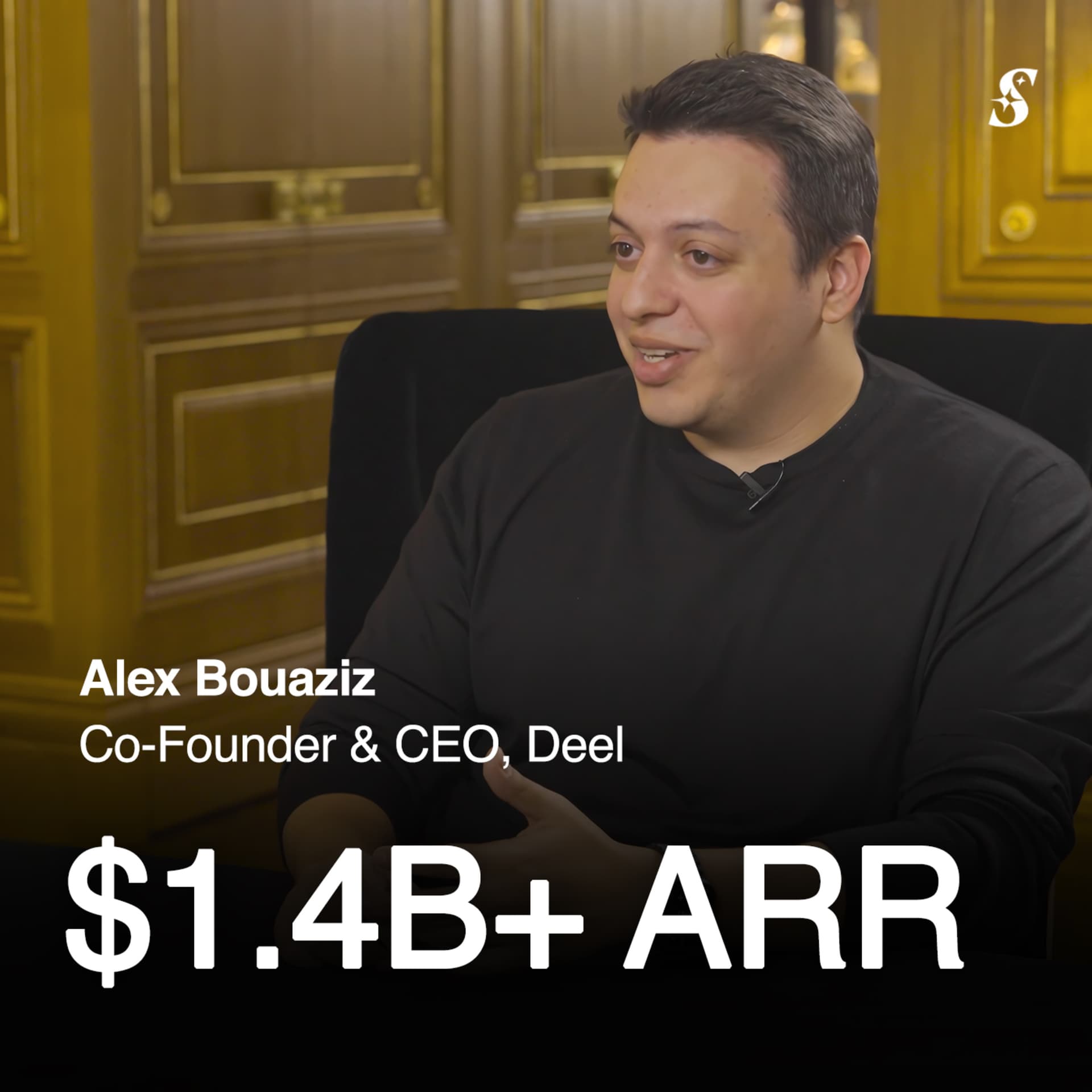
Episode Overview In this episode of the Sourcery podcast, Alex Bouaziz, co-founder and CEO of Deel, discusses the rapid growth of his company, which specializes in global payroll and workforce infrastructure. Since its inception in 2019, Deel has achieved an impressive $1.4 billion in Annual Recurring Revenue (ARR), a valuation of $17.3 billion, and serves over 40,000 customers across more than 150 countries. Bouaziz shares his insights on scaling the business, the company's unique M&A strategy, profitability during hypergrowth, and the future of global hiring in light of advancements in AI.
---
Key Topics Discussed
- Deel's Growth Journey
- Milestones:
- Company founded in 2019.
- Achieved $1.4 billion in ARR.
- Valuation of $17.3 billion.
- Over 40,000 customers globally.
- Business Model:
- Focus on providing payroll, HR, and compliance solutions for companies hiring globally.
- Transitioned from a small product to a comprehensive platform for global hiring.
- Strategic M&A Playbook
- Acquisitions:
- Implemented a strategy of over 10 acquisitions to enhance payroll, HR, and compliance capabilities.
- Aims to integrate new products and customer bases within 12 months post-acquisition.
- Cultural Integration:
- Emphasis on maintaining the morale of acquired teams and ensuring seamless cultural assimilation.
- Profitability in Hypergrowth
- Sustainable Growth:
- Deel has maintained profitability while rapidly scaling, a rarity among startups experiencing such growth.
- Focus on cash efficiency since inception, allowing for strategic fundraising without dependence on external capital.
- Future of Work and AI
- AI's Impact:
- Bouaziz believes AI and autonomous agents will fundamentally reshape the workforce.
- Discussion on the potential for AI to automate routine tasks and the role of new graduates in a tech-driven job market.
- Global Expansion Strategy
- International Hiring:
- From the start, Deel aimed to build an infrastructure that supports global hiring, catering to companies from various industries.
- Strategic focus on hiring local expertise to foster understanding of the complexities of international payroll.
- Company Culture and Leadership
- Leadership Style:
- Bouaziz emphasizes the importance of customer focus and building relationships within the company.
- Advocates for a culture of default optimism and prioritizing happiness among team members.
- Challenges and Competition
- Competitive Landscape:
- Bouaziz addresses the competitive nature of the market and the impact of external perceptions on Deel's growth.
- Emphasizes the importance of focusing on product excellence and customer satisfaction amid challenges.
---
Key Takeaways
- Resilience and Adaptation: The ability to adapt and remain resilient is crucial for leaders navigating the competitive landscape of tech startups.
- Customer-Centric Approach: Understanding and listening to customers is vital for product development and maintaining strong relationships.
- Strategic M&A: Effective integration of acquired companies can accelerate growth and bring valuable expertise to enhance service offerings.
- The Role of AI: Embracing AI as a tool for efficiency and productivity can significantly influence the future workforce dynamics.
---
Conclusion Alex Bouaziz's insights on Deel's rapid growth, strategic focus on global hiring, and the future of work provide valuable lessons for entrepreneurs and business leaders. As Deel continues to innovate and expand its offerings, its approach to integrating technology and maintaining a positive company culture will be critical to its ongoing success.
---
Follow Alex Bouaziz and Sourcery for more insights:
- [Alex Bouaziz](https://x.com/Bouazizalex)
- [Molly O’Shea](https://x.com/MollySOShea)
- [Sourcery](https://x.com/sourceryy)
Written by AI. May contain mistakes. Listen to the episode to check what was said.
Chapters
Tap a time to open that second in VODeel's Growth Journey to 1.4B ARR
0:46 to 3:02
Discussion on Deel's rapid growth from 800 to 1.4 billion in ARR and profitability.
“Having Mickey and Kua Tu and Andreessen dabbling down, I think is priceless.”
The Unique Playbook of Deel
3:03 to 5:25
Insight into Deel's unique approach to business and acquisitions.
“And I feel for them because I think it's such a big part of the journey.”
Building a Successful Team
5:26 to 7:46
The importance of leadership and team dynamics in Deel's success.
“When you're fundraising, you're basically selling a part of your business and sometimes you need it.”
Navigating Fundraising and Valuation
7:47 to 11:21
An overview of Deel's fundraising strategies and valuation journey.
“was something we were very excited about.”
The Future of Payroll and HR
11:22 to 13:12
Discussion on revolutionizing the payroll and HR industry for better employee experience.
“It's a great validation of where you are as a company too.”
Scaling Globally with Deel
13:13 to 14:00
Exploring Deel's strategy to support global companies and their needs.
“because if you don't have employees, if you're not giving them a good experience, then what do you have left in your business, right?”
Global Perspective on Business Growth
14:00 to 14:40
Learn how a global mindset shapes business strategies.
“whether you're a smaller or bigger company, because of how international we are as people.”
Building Products Based on Customer Needs
14:40 to 15:20
Discover the importance of adapting products to meet customer demands.
The Importance of Local Expertise
15:20 to 16:00
Understand how local expertise aids successful global hiring.
“have an entity in Poland because you're a small company or you just never plan to open for one person an entity in Poland.”
The Remote Work Advantage
16:00 to 16:50
Explore how fully remote work fosters company culture and scalability.
“I feel like we're still a very small start.”
Show all 38 chapters
Learning Through Product Use
16:50 to 18:00
Learn how using your own product can drive improvements.
“and suddenly you have like a thousand people behind you and you're speaking.”
Navigating Remote Team Challenges
18:00 to 19:30
Find insights on managing a remote workforce effectively.
“It's the first time I write an article on X and it didn't go too bad.”
Global Expansion Strategy
19:30 to 21:00
Understand the strategic decisions behind global growth initiatives.
“When you're a small company, there's nothing better than being all next to each other.”
Trends in Workforce and AI Tools
22:45 to 24:08
Examine current workforce trends influenced by AI technology.
“Getting into the AI side of things, you put out reports every now and again talking about workforce and trends that you see.”
Defensibility in Business Models
24:08 to 25:03
Learn about building defensibility through regulatory and operational strategies.
“A lot of companies today I talk to, they work towards how do I make my team adopt those AI products, right?”
Job Market Perspectives Amid AI Growth
25:03 to 26:04
Understand how AI might influence job creation and market dynamics.
“because sadly opening an entity in France or Germany is going to be a bit tough for cloud code to do, right?”
Diverse Industries Served
26:04 to 27:45
Learn about the range of industries that rely on payroll solutions.
“Dario might think differently, but I think you're very far away from it.”
Acquisition Strategy in Business Growth
27:45 to 28:00
Discover the role of M&A in scaling businesses effectively.
“So that's the one where I'm like, I did that yesterday.”
M&A Strategy and Insights
28:00 to 29:50
Learn how the company approaches mergers and acquisitions to scale effectively.
“The way we think about M &A is very straightforward, right?”
Onboarding Acquired Companies
29:50 to 32:40
Discover the unique playbook for integrating newly acquired companies and their products.
Navigating Acquisition Challenges
32:40 to 36:20
Understand the key challenges and learning experiences in executing M&A.
“And I think it's like, I mean, I'm pretty proud of it because it really works.”
CFO Transition and Role
36:20 to 39:40
Gain insights on the transition to a new CFO and the importance of fit and experience.
“I was born in 93, starting companies in 89.”
Preparing for an IPO
39:40 to 42:00
Learn about the preparations and considerations for taking a company public.
“So this is one of the key reasons he's here.”
Business Fundamentals and Market Corrections
42:00 to 42:40
Learn about the importance of business fundamentals and market corrections in achieving company valuation.
Navigating Competition and Media Perceptions
45:55 to 48:08
Understand how to navigate competitive markets and manage media perceptions as a CEO.
“One of them is Archer's CEO, Adam Goldstein.”
Maintaining Customer Trust During Challenges
48:08 to 50:18
Learn strategies for maintaining customer trust and communicating effectively during challenging times.
“and for yourself even as a founder, right?”
Leadership Growth and Personal Development
50:18 to 53:06
Gain insights into personal growth and skills development for effective leadership.
“I mean, there's a lot, but the one thing I would say is we're Silicon Valley outsider, quote unquote.”
Hiring Traits and Team Dynamics
53:06 to 56:00
Explore key traits to look for when hiring and how to build a cohesive team.
Hiring for Optimism and Ego Management
56:00 to 56:40
Learn about the importance of hiring individuals with a positive mindset and low ego.
“But, you know, when I look at my, across the stack, but like let's focus maybe more on my executive team.”
The Value of Default Optimism
56:40 to 57:50
Discover the concept of default optimism and how it shapes team dynamics.
“so that you can actually go into battle with them and know that they're going to be the best people to have by your side.”
Excitement About Product Development
57:50 to 58:40
Understand the passion behind product development and upcoming launches.
Leveraging Internal Products for Market Impact
58:40 to 1:00:30
Learn how internal tools can be adapted to benefit other companies.
Pricing Strategy Insights
1:00:30 to 1:03:00
Gain insights into how pricing strategies are developed based on customer feedback.
Lessons from Co-Founder Shuo
1:03:00 to 1:05:10
Explore the important lessons learned from a co-founder and the dynamics of their partnership.
Traits of Successful Salespeople
1:05:10 to 1:08:00
Identify key traits that make for effective salespeople in a business.
“And then it sure has a lot of qualities.”
Building a Global Brand Through Partnerships
1:08:00 to 1:10:01
Learn how strategic partnerships can enhance brand visibility and market growth.
“and that just shows how much like they care and I think that's a key threat for a salesperson And there's a lot more to it.”
Leveraging Premier League for Brand Growth
1:10:01 to 1:10:56
Learn how strategic partnerships in high-visibility sports can enhance brand growth.
Exciting Future Announcements
1:10:56 to 1:11:15
Discover what's on the horizon for Deel with upcoming announcements.
Transcript
Automatic transcript. May contain errors.0:00Scaling to 1.4 billion in ARR. You have the numbers we haven't disclosed yet, but that's good. Oh no! We grew from something like 800 to 1.4 plus, right, in the last year. I think at that scale, Zio has been profitable for the last three years, which is not something most startups growing at this space can say. The main idea behind Zio was there's amazing people all around the world, right? We wanted to basically build the infrastructure that helps amazing companies like yours, or larger ones, be able to hire the best talent in the world. payroll, HR, kind of like the core part of your business.
0:29What started as a small product to help some of our friends be hired by such companies, kind of became today the platform that's used by more than 40 ,000 customers to scale globally. We've always been super cash efficient. Started the company in 2019, we raised about$4 million out of Y Combinator. I think we're kind of Silicon Valley outsiders. We got to a Series A, we had actually only spent like 300K, or 350K. So why raise the money? Having Mickey and Kua Tu and Andreessen dabbling down, I think is priceless. Did they approach you? Did others hear about that and want to invest? I heard you had higher offers.
1:01I can't comment on that, but I still think the business personally is undervalued, right? But it's fine because I think the way I look at it is we don't need the money per se, right? We've been profitable for a long time. We've got quite the war chest, right? We built a pretty unique playbook. It's super unique and I think most companies should look at. The deal they are is because when we do acquisition of some of the smaller companies for product, we basically build a way to fully integrate their product and their customer base in like the span of 12 months. And one super interesting thing that came from Shuo, and I think that's what you want from those co-founders, is how excited she was about us working together, even more initially than the idea we were going to work on.
1:35We kind of ideated together, spent a lot of time together, and having someone that's just, I believe, you know you should ask him, but even six years in, has so much trust into each other and just excited to be building together is just unparalleled. How do you fit into that growth and continue up the trajectory to hit a$100 billion valuation? maybe a trillion dollars.
2:05Alex, welcome to Sorcery. Thank you for having me. Well, I'm really happy to have you here today at an undisclosed location. It's the part of the law, right? We have so much to cover today from the growth of the business, product AI funding to date congratulations on another huge round you guys have been cooking we're trying and before we go too far we do need to shout out Shwo oh yes Shwo we miss you cheers from the undisclosed location which is London undisclosed location that is London correct Shwo is amazing I think you guys have spent some time together right yeah she's my better half that's what I would say Very fashionable, too.
2:52Very fashionable, very persistent. You know, she's made a deal possible in many ways. I think I, you know, every time I meet soil funders, I think about all of the experience I've had with Shuo. And I feel for them because I think it's such a big part of the journey. And I wouldn't, you know, I wouldn't change that for anything. Scaling to 1.4 billion in ARR? Yes. Well, you have the numbers we haven't disclosed yet, but that's good. Oh, no. It's okay. and she's your chief revenue officer correct and i think that was one of the best things we've ever done like i think scanning revenue is so hard obviously everybody at a company is a salesperson everyone needs to be part of the go-to-market motion i think that's what makes a company great right from your ics and customer support all the way to your leadership um but i think having a founder taking care of sales makes them care a lot more about the details that i would say a professional hires may not care about as much.
3:51And I think it's made a significant difference for the business. Let's get into the details of the scale. Okay. So can you lay out Deel's business right now? What's the currency? You've been around for around seven years, founded in 2019. What is Deel in 2026? So as you said, we started the business in 2019. And the main idea behind deal was today we're in London, tomorrow you can be in Israel, in Dubai, in Nigeria, wherever. There's amazing people around the world, right? We wanted to basically build the infrastructure that helps amazing companies like yours or larger ones be able to hire the best talent in the world.
4:28And we really saw a huge gap in that market at the time. Now fast forward seven years, almost seven years, it's actually Dil's birthday very soon, we're going to do something fun. What we've done is we've really evolved, right? Like we've kind of built what we think of as the platform and ecosystem for companies to be able to grow global. Payroll, HR, kind of like the core part of your business, in today's world, companies have started to go global much more and there just wasn't any tools there. And what started as a small product to help some of our friends be hired by such companies kind of became today the platform that's used by more than 40 ,000 customers to scale globally.
5:06Who are some of those customers? You know, we go from small companies that are coming out of Y Combinator or Techstars and others all the way to large businesses like Coinbase, Shopify, Cloudflare or even large banks. And one of the funny parts is that we've kind of scaled out of tech, which is very fun for me, right? So you go from like KLM, like airlines, potentially oil and gas. It's such a beautiful world out there and it's really been amazing to see that as we've scaled from like the small niche of what we know right and you ensure our you know engineers like tech grads into being able to cover so many different fields uh it's really fun you say is very fashionable uh you know when we're able to support brands like Hermes or uh or on right it's just amazing to see the use cases being so different at over 17 billion dollars recently valuation can you walk me through that round how did that round come about yeah so the the story of doing when it comes to fundraising it's actually a fun one because I think a lot of founders appreciate it more than others we've always been super cash efficient right I love telling that story when when we came to our series a so we started a company in 2019 we raised about four million dollars out of Y Combinator which you know today as a seed round would probably be very small for a lot of those AI companies so we raised that seed round and we realized look it might you know we're kind of I think we're kind of Silicon Valley outsiders right we always were and that can be an advantage or a disadvantage and at the time we said maybe the last time we ever raised money so that mindset really like taught us how to build sustainable sustainably right like having growth as a mindset but still doing it the best way possible and when we got to a series A we had actually only spent like 300k or 350k and we kind of kept that culture because what we saw is it really changed the dynamics of fundraising which is something that like most founders don't realize in my opinion and it's really helped me fundraise.
7:00When you're fundraising, you're basically selling a part of your business and sometimes you need it. But in my opinion, you should always be in a position where you don't actually need it. And running your business in a way so that you don't really change the trajectory. And the reason I'm getting there is because we actually had not raised any capital for a very long time, I think since 2022, until we raised some more money this year. And there's a lot of drivers to why we raised that money, right? One is because we had grown so much as a company that I think the equity was worth more. So we've been pretty active when it comes to acquisitions, specifically in a market that I'm sure we'll talk about that, that I think is consolidating a lot.
7:38But also the dynamics of being able to work with people like the Rivet teams, like Miki, who I think is one of the most exceptional investors, being able to bring him onto the cap table was something we were very excited about. You were one of the first companies to hit 100 million in ARR. Until all of the others started doing the same. I'm so happy. But talk me through what that escape velocity feels like. And do you still feel like you have that momentum? Yeah, it was really nice to upgrade that graph the first time around. And then my friends at Wiz decided to do better. And then every single AI company is crushing that graph at the time.
8:16For us, it was never about that. I think we were a small company at the time. And we're very focused on growth. I think the early stage things, one of the things we learned pretty well through going through Y Combinator is being very focused on our customers and growth. And we kind of kept that mindset out of YC, which was, I think, a precursor to helping us build. And it's still something we do today. Very, very focused on how much are we growing month over month? How can we do better? And things like that. And I'd say that generally applying that over the first 18 months or 20 months, I think that's when we hit 100 million, really, really helped us.
8:55And, you know, I think if you look at how we've been accelerating, right, well, being profitable, I mean, now, you know, our numbers. So, you know, you can kind of say we grew from around something like 800 to 1.4 plus, right, in the last year. I think at that scale, you can definitely see that this stayed as like a core part of the culture of the company in terms of like how we perceive growth. But the one thing that's important is what I was telling you before, like, deal has been profitable for the last three years, which is not something most startups growing at this pace can say. So why raise the money?
9:24I think there's a, like, again, having Mickey and Khoatu and Andreessen doubling down, I think, is priceless. Did they approach you? Yeah. So actually, it was very interesting. So we weren't planning on raising money. And what happened is the Ribbit team, and I hope they don't mind me sharing that, they actually wanted to invest for a long time. and the problem with my fundraising style and I've learned a lot actually from that is that I was always the type of I don't like doing roadshows I don't like meeting a lot of investors and trying to get a term sheet it just never really worked for me well I haven't really tried it just doesn't fit my personality too much so what I've always tried to do is build a relationship with a few investors and then kind of let them proactively look at the business and then if they ever thought that they wanted to own a piece of it potentially offer us cash in for a new valuation.
10:12And that's what I've always done, right? If you look at our last funding rounds, every single of our rounds came from insiders because they were super close to the data, right? I didn't spend too much time with external investors because I was very, very focused on the business. So the people that were closest to the business, right? The Quattus of the world, Andresens of the world, I think saw a lot of value in the company and kept, whether it was buying secondaries or being involved in the round, right? And you can see that in the last round where Ribbit did lead the round, but Andresen and Quattu were the the two big funds that kind of collated around as well.
10:42When it comes to Rivet themselves, so what they actually had done was spend four months due diligence in the business. So they wanted to invest before, they never really had, we never really had the opportunity. Eventually, I think Nick and Miki were like, okay, let's actually have a real look at this. And the whole goal of that round, sorry, the whole goal of that due diligence was for them to buy some secondaries in the business. And I think eventually they liked the company enough that when they were starting to have some movement about potentially raising a round, and it kind of came together where they were saying, hey, you know what, we'd be happy to lead it.
11:13And I think, you know, after having not raised money for a long time, it was a good way of giving a stem to the business and having a completely external investor come and invest into the business is also a great valuation. It's a great validation of where you are as a company too. Did others hear about that and want to invest? I heard you had higher offers. I can comment on that. But no, yeah, I think, look, I think the business, I still think the business personally is undervalued, right? But it's fine because I think the way I look at it is we don't need the money per se. We've been profitable for a long time.
11:44We've got quite the war chest to be able to build a lot of different things. I think as we're looking at potentially being a public company, I think it's important to be careful when you raise money and to make sure that, especially when you look at the public markets today, that you're pricing the company at the right price. So payroll is not seen as a sexy industry. Is it not? No, apparently not. And it flies quite under the radar. So I'd love to hear how you and Shuo built up these grand ambitions to build not just a$10 billion company, now a$17 billion company, and then maybe one day$100 billion company.
12:24That's the goal, yeah. Maybe a trillion dollar company. Maybe. So how do you fit into that growth and continue up the trajectory to hit$100 billion valuation? I think there's a lot to it. Like, first of all, when you talk about payroll, HR, even IT, right, like what we've seen is generally it's an underserved market, right? I think our products are good. I think they're not even where I want them to take, right? I think the experience we can give to our customers is going to be really amazing. And the tools that are being used today are like accepted and they're not great, right? I've never seen someone say, I love my HR product or I love my payroll product.
13:01And I think we have a long way to get there, but this is really our ambition, right? kind of changing this market is one of the reasons we've been pretty successful. It's underserved for sure, but I think it's like one of the most important part of your company, right? Like you're actually building, you actually want to give the best experience to your employees because if you don't have employees, if you're not giving them a good experience, then what do you have left in your business, right? So I think it was always obvious to us that serving companies better in this market was going to be big.
13:27Now, how big is always a question, right? As you're thinking about total addressable market, how big can you build a company? And I think we've actually done a pretty good job at reinventing ourselves, right? Like when we looked at the market, the first thing that really differentiated us is we thought every single payroll and HR system, which is totally normal, first thinks monocountry, right? Like you're an entrepreneur, you're launching your company, you need payroll for your country, right? You need HR for your country. It makes sense. And I think one of our unique takes in the markets was, well, what if you were thinking about going global, right?
14:00whether you're a smaller or bigger company, because of how international we are as people. I'm a French guy that moved to Israel, London. Shuo was born in China, moved around as well. So for us, the word is global by default. So serving for global makes a lot of sense for us. So I think that unique insight, unique, I don't know, but that insight really made us build for something that was very different. And then eventually, as we built those things, one of the interesting things about Dill is we really followed our customers. I won't bore you too much with the details but you know we launched the first product and then we saw that our customers needed a second one because that one wasn't just making their needs at the time so we built a second one the third one and now I think we have over 12 different products and that's where the growth really comes from right obviously our main products which is the one where you can employ people with an infrastructure has been growing really nicely but you can see like all of our different products kind of stacking up into something that we think it's going to be pretty beautiful I can't imagine getting into all these countries is easy so what is the process for this um i think we've built a very good playbook so it depends on the product that's that you're building right like different products have different complexity in terms of how you're working i think if you were to like simplify it a lot like there's like apart from being the hr system for your for your company at a global level the two things we're really known for is you want to hire john john lives in poland but you don't have an entity in Poland because you're a small company or you just never plan to open for one person an entity in Poland.
15:27Well we have all of the entities around the world, HR, legal, payroll, finance in every single country so that we can employ this person on your behalf and give them a great experience without having you setting up structure there. And the second one that most people look up to us for is at some point it makes sense for you to open in Poland but when you do we help you open the company and we actually run payroll for you in that country. And before a deal right the way people were structured is they had like one provider for Poland one for France one for Germany one for the US like very very very messed up infrastructure right so giving them the ability to have like one vendor that understands invests right like tell me how hard is it well we're still not where I want us to be right and I think it's going to take us years to get even better but having one vendor that cares enough to go and do the work is what's very unique about the market how do you then onboard in these countries like cross cultures so like one small insights like deal is a fully remote company we have 7 000 people across 120 countries blows my mind every single time i hear about this that you're fully remote fully remote people don't understand this uh it's a huge advantage this is what most people don't understand you're a huge company and you're fully remote you you don't feel you're a huge company when you're fully remote because you don't have anybody in the room.
16:44You just feel like it's just you? I feel like we're still a very small start. For example, we have our SKO in a couple of weeks. I remember being there last year and suddenly you have like a thousand people behind you and you're speaking. I was like, you guys, you're all at Dill, right? And then like, that's just a thousand people. There's 7 ,000 of them at the company. The thing is, it's so core to our business because the reason why we have so many people in 120 countries is exactly as you said. Like going into every country is so complicated and what you want is the real local expertise and if you don't have those people, then you're just going to joke yourself like as much as i respect um some companies in the market like if you're like fully in the u.s what business do you have into understanding how to run payroll in like belize right like so i think there's no way to scale that business and have the knowledge that you need to have if you're not willing to build a company the way we have you have such a global workforce i know just the product for you do you have a payroll solution right now you know having deal on deal has been one of the biggest learning for us you know when i first built my first companies i built don't ask me why but i built like a video product consumer video product like musically at the time tiktok style and like one year later i realized i actually don't like making videos uh so i was like i just had this realization it's like building a product you don't use it's a very bad idea so one thing we do a deal is we call we call it deal on deal right like we really dog food everyone on deal is getting paid on deal every new product we build my HR hates me for because they have to be the first users on it so it's something I would recommend to every founder it's like just brute force it and use your own product if not it never works wow but yes it is the best product for ourselves do you have any tips for fully remote I actually wrote a cool article about it a couple days ago.
18:33I actually wrote, you saw it. It's the first time I write an article on X and it didn't go too bad. I think it went viral. It was fine. I mean, tons. I think, I wouldn't think we do it perfectly at all, but we've been very thoughtful about how we build a business. And I mean, I do suggest you go and read it because I did spend some time writing it. But I'd say, like I said in the article, most companies are remote. as soon as you start being on two floors three floors you don't know the people in your company whether they're sitting in the third floor or they're at home it doesn't really make a difference to you right so i think the most important part if you were to run a fully remote company is just being super mindful on like how you treat people how you onboard them how do you take care of them
19:19and honestly i think deal would not be what it is today if we didn't have the access to talent and the infrastructure that we've built. And I recommend most companies to really rethink their strategy when it comes to being all in office. When you're a small company, there's nothing better than being all next to each other. When you're a larger company, I would really challenge that aspect of it. You're in a very competitive market. Yes. Don't worry, I'll get to the competition in a second. Sure. But for going global so fast, was that a strategic decision? Yes. Did you do that because competitors were doing that?
19:54No, from the get-go. I mean, for us, the way we thought about this was we're building a product for the world, right? We want to help companies around the world be able to hire globally and set up infrastructure globally. What people don't understand is that global hiring does not just mean a U.S. company hiring in Germany, right? Sometimes it means a Peruvian company hiring in Chile, a Nigerian company hiring in Kenya. And that's really what makes this very interesting, right? It's like you're really building infrastructure for the world, and it should work for every company. So we're very intentional about this.
20:24we hired people from across the globe and to go across the globe and even sell to local companies from the first year of the business you know I have my country manager in Brazil that has been with me for five years because we've been selling to Brazilian companies since we've started I actually think it's a cheat code if you think you have product market fit to start going global very early and I actually start seeing it more and more I don't know if you've seen like that some of the AI companies like Harvey for example that's going into Europe right now or obviously the OpenAI and Tropic, they're hiring all over Europe or Latin America and APAC.
20:57I think if you have a sense that you have something great, going global early is a big differentiator. And actually even reflecting our revenue numbers, right? Like 50 % of our revenues come from American companies, but the other 50 % of our revenues come from European companies, Latin American companies, APAC-based companies. And I think that's a superpower. Sorcery is brought to you by Brex, the financial stack trusted by more than 30 ,000 companies, including one in three venture-backed startups in the U.S. Nearly 40 % of startups fail because they run out of cash. Rex is literally built to help founders avoid that.
21:31Unlike traditional banks that let your money sit idle, chipping away at it with fees, Rex's designs help you spend smarter and move faster. Their all-in-one solution combines checking, treasury, and FDIC protection into one powerful account. You can send and receive money globally at lightning speeds, Get 20 times the standard FDIC coverage through their partner banks and even high yield from day one. With same day and even same hour liquidity, access your funds anytime. Companies like Scale AI, DoorDash, Service Titan, HIMSS, Anthropic, Flexport, Robinhood, and Plaid trust and use Brex. Start today at brex.com slash sorcery.
22:13That's B-R-E-X dot com slash sorcery. Turing is training the next generation of AI with tasks that require real expertise and real world judgment. That's why companies like NVIDIA, Anthropic, Salesforce, and Gemini partner with Turing. Turing builds realistic reinforcement learning environments and data systems based on real operational traces. The kind of infrastructure Frontier Labs need to train superintelligence. Visit Turing.com slash S-O-U-R-C-E-R-Y. Getting into the AI side of things, you put out reports every now and again talking about workforce and trends that you see. What are some trends that you're seeing right now?
22:57There's a ton, right? Obviously, the one that's worrying a lot of people is both the fact that the number of junior hires, like new grads hires, is kind of declining. And I actually haven't been pretty opinionated about it. I actually think it will change. And some of the key operational role. with all of the different tools that are being built up, like the clothes of the world and others. And we've actually built, and a lot of companies do that internally, a lot of tools to help our team and give them superpowers. There's an obvious path towards a lot of those roles may not exist. If you're pressing buttons inside of a website as your main job, those jobs may not be there anymore.
23:35That said, I have very strong opinions in terms of where they're going to be going. I'll take you to the new grad one because I think it's super interesting. right like the new grad one where people are like well you know if if cloud code can do your work for you right like you don't need a new grad like they need to be trained you only want senior people i actually think most of those people most of the new grads are going to be so good at using those ai tools they're going to put all the people that are in the in the older range out of business and be able to do 10x more just by having lived through like this revolution of those tools really existing.
24:09And, you know, when I see my little sister and like how she's using, you know, an open AI into her homeworks or stuff like that, I'm like, yeah, the way they are so AI native in terms of how they see those tools and how they are such a big part of how they operate is just going to be such a disruptor, right? A lot of companies today I talk to, they work towards how do I make my team adopt those AI products, right? Like they're reluctant to adopting them and things like that. I think that new generation is going to be so AI native that they're just going to be some of the best breed. That's a good positive note.
24:43It's a great positive. The negative note is people think it's just going to wipe out lots of jobs and cause mass destruction. Look, the way I look at it is with every single industrial revolution comes new jobs, right? So I think you're still... How do you build defensibility for that? For us, it's been a bit easier, right? because sadly opening an entity in France or Germany is going to be a bit tough for cloud code to do, right? So I think actually regulatory mode is something that's very strong, right? Like in different countries, we have different licenses that are very hard to acquire. We've got entities everywhere.
25:17We've got payroll engines and all of the rules right up everywhere. I think that's like a key part of the defensibility for sure of deal. And the second part is actually completely honestly, like we've got pretty strong tailwinds in terms of how we operate, right? Like today we're a 7 ,000 people company at like 1.4 billion in run rate. Like in my mind, we could double revenue without increasing headcount, right? Because of all of the superpowers that we can give our team. So in all honesty, I feel like we've got a very strong AI tailwind type of business and we'll be very excited to see where those tools are going to bring us.
25:54And you also cover industries that are completely not related to AI, right? I mean, you know, blue color is something that's growing really fast for us, for sure. But even the white-collar workers, I'm pretty confident that when it comes to like, will all the white-collar workers be out of jobs? I don't think so. I think you're very far away from this. Dario might think differently, but I think you're very far away from it. Well, we have a special question from Mickey Malka on this topic. Oh. Are you ready? I'm ready. How will AI affect your business if companies will hire less people in the future?
26:30I think it's a great question first of all we're not seeing that trend yet so we're seeing a little bit in operations but not a big deal I think the second part is I think they'll hire less but there'll be more companies right I think there'll be more people because people need jobs so maybe they move into the blue color space if there is no more white color jobs but generally I think that I expect that like every single industrial revolution new jobs will be created and they'll be hired for those jobs as well I was fascinated by this when I learned that you cover oil and gas and some other they're kind of surprising industries no no i agree but what are some cool industries that you cover like airlines was so cool for me right like when we closed our first airline i was like hold you more you were like i didn't know we could get to this type of customers um honestly any every company in the world needs payroll right so like if you think of like any industry in the world that is allowed like we can basically cover them right so So Olingas was wild, but what's one that's pretty fun?
27:32I mean, yeah, I do think, like, that's my little, like, proud moment. Like, when I walk into, like, a store in London and I know that we do payroll for that brand. And I'm like, you're getting payroll for a deal. Like, I'm a little proud of that. So that's the one where I'm like, I did that yesterday. I went to one of the shops and I was like, oh, we run payroll here. All of those employees are hired for deals. I was pretty proud. That's really cool. um another underrated thing i learned when i was doing some research on you so you have acquisitions as a pretty big part and component of the business i was surprised with how many acquisitions you've done to date so what is the strategy there um i think mna is a core muscle i think companies that don't know how to do mna is um have problem scaling so it was always very important for us to bring that core competency inside of the business and we're lucky enough that some of our executives actually have done it multiple times in the past.
28:28The way we think about M &A is very straightforward, right? Like either we are looking specifically in our markets at companies in our space that have just not been able to scale the way we have but have really good talent and have like amazing customer base and you know the revenue is decent where it makes sense for us to bring them in and just like be able to bring the customer base and work with them so pure acquisition on that front and the other part which is kind of sad and happy at the same time but it was a big realization for me is as we get to seven years in i'm still very very hungry to build but the seven years of knowledge that i built around payroll and hr it's a little hard for me to build the depth that i have there on new products so if you think about like performance review or ATS or compensation management which are like very important key topics in HR for example it's just really hard to get the depth of knowledge that I would have had if I was starting a company just in compensation management today and the value of bringing people that have worked and thought about those problems for so long inside of your company and empower them and give them the tools the funds to build the best product that they ever had and that they would have always wanted to build basically plus the distribution into 40 ,000 plus customers is very unique and it's amazing like we've done a few acquisitions for example we recently acquired a company called assemble which build actually deal compensation in general and you know we've followed them into deal we built their full product instead of deal with the main product leader like one of the co-founders leading that and it's doing amazing and he's grown so much instead of deal that now he needs a huge part of the organization on the product side and like that's one of the beauty that I see in acquisition that as much as I want to be able to learn from ground up everything about every product that I think we're going to build bringing that skill set in-house from people that were as obsessed as I was about the problems that I that I spent a lot of time on is infinitely valuable so you're acquiring for product expansion not revenue or talent no I mean revenue again like you know if you look at deal 10 % of our revenue is inorganic right from acquisition right um so so revenue not really right like if you come to me you're in my space you know for example we're quite a company called omnipresent amazing people being competitive there for i don't know five years six years you know eventually the consolidation made a lot of sense you had some revenue great right uh but that's not really your goal right we're really very much acquiring for expertise and years of experience for example we acquired a company called payspace payspace was a company started in south africa by four brothers or three brothers and and three brothers and one brother from another mother that's what they call them and they had built payroll engines in South Africa and eventually expanded across all of the different countries in Africa because South Africa is too small and they had not realized that they had built the first like global payroll engine by just going into the other countries in in Africa and bringing them in we brought in like 15 or 20 plus years of experience in building hardcore, very boring, but very hardcore payroll knowledge and payroll engine building, which is basically like, how do you calculate your salary, gross to net, all the calculations in every country?
Read the full transcript
31:43Like, a lot of companies are trying to do this right now. I think I'm decently smart. I think my team are very smart. I would not be able to do what those guys did. So bringing that knowledge in-house and like rebuilding with them is like, it's just such an acceleration for the business. because we're in such an M &A acquisitive we're in M &A land right now and you have extra capital to do it what is your playbook and framework for onboarding them and actually getting those companies assimilated, the cultures, that kind of thing so actually one of the good things about being profitable is we can be a bit more aggressive than most companies when it comes to this actually I think it's a really great question because we built a pretty unique playbook and I think I briefly mentioned I think it's super unique and I think most companies should look at.
32:31The deal they are is because when we do acquisition of some of the smaller companies for product, we basically build a way to fully integrate their product and their customer base in like the span of 12 months. And I think it's like, I mean, I'm pretty proud of it because it really works. And most people always look at me, they're like, wow, an acquisition is going to take you so long. It's going to be so disruptive for the business. Like, what are you going to do about it? and actually fooled a lot of my competitors as well which is pretty fun because they looked at it and were like oh they're building through acquisitions and trying to like bring products together like this what we actually did which is really fun is we acquired the companies and we basically say okay for the first three months we're going to build on your back end right so you're a small product you don't have that many customers we do acquisition from like zero to five million in AR or ten million in AR so it's okay we're going to build on your back end you have your backend we're going to build within the deal using your backend and what that means in within the span of a month and a half because it's only from front end right even a month you already have the first version of the product on the product and then my learning is whenever you have a large go to market team like we do like a couple thousand people before a salesperson is comfortable with selling a product it takes like nine months to nine to twelve months and by being able to bring the zero of the product after month one even though it's using the backend of the company were acquired, you can get your salespeople trained and comfortable so that whenever, over the period of the next 11 months, you're going to rebuild the full back end of the product, when you get to that 12-month period, the team is ready to sell and is ready to show the product.
34:04Most companies, the way they work is they would rebuild their product for 12 months, then show it to their go-to-market team, and then have another lag of 9 to 12 months before the company is actually able to sell their product. So that little trick here gets us much more accelerated. And you can see it in the growth of the business, right? I think our IT business almost grew 100%. All of the different businesses we've brought in have significantly increased RIR. And it's part of our distribution strategy that gets strengthened from this as well, which is really great. What do you think the biggest mistakes are besides that most people make when they're doing acquisitions?
34:40There's a mix of both, right? I think the trick with acquisition is you cannot be over careful so you want to be super careful because like it's a very emotional moment for employees of the company they're switching they're migrating to a new one you know there's some you know what am I going to do how am I going to perform how is that going to happen so there's a lot of uncertainties for the employees of the company that you acquire and I think having a great M &A team on that front is very very important but at the same time you don't want to be too careful where it takes way too long to do it right because you're trying to like over optimize for every single detail of this happening so one thing I've always loved to do is like kind of talking to the people requiring and say hey it's gonna be a bit chaotic at the beginning but we're here for you and we're gonna make it work and this is just gonna help us get you integrated so much faster rather than trying to get everything pixel perfect in any way at the annuals crop somewhere and that I think is a huge learning for me in terms of how we can execute on M &As and how why most companies fail right like when you talk about M &As with other founders they'll tell you well it didn't really work or like one out of four worked right and i think most of it comes from the preparation either they over prepare and it kind of kills it from within because even there like the people are waiting they want to be part of your company they want to do things or they're completely underprepared and then when you integrate them it's a mess do you keep the founders long i try to i mean you know founders are fun i like working with founders i try to keep them as long as i can obviously it always needs to be appealing one thing i do which works decently well for us is I actually usually have the founders reporting to me directly for a while.
36:11So, you know, one, they have more freedom and second, they know we care, right? And it's important because they're smart people. They could go and build a new business within a year, right? And if you want some retention there, you need to show you care and you need to show they're here for the bigger picture, for that$100 billion vision and showing them how they're going to help us get there is very critical. Can you tell me more about your CFO? My new CFO? You should interview him oh yeah he's great yeah you really like him it's very funny because you know the way we looked at this so so for context um when me and shuo built uh our company actually brought in my father to help me on the finance side because with series a founder the last thing i wanted to do was finance uh and you know my father was actually he actually built a company in france that was that was public so he had very unique experiences where in france everything is about profitability and it can't grow too fast and things like that so he had a very unique like finance experience I had the luxury of seeing him start a company.
37:08I was born in 93, starting companies in 89. He was selling computers and softwares. I saw him grind through like for until 2007, I think, 7 or I need to double check that. But 2011 for when they went public. It was a small cap, small company. But such a grind to see him grow was beautiful. And so I brought him in to help us with finance because I really didn't want to deal with it. And eventually we got to a point where like, okay, like, you know, it makes sense to bring a CFO that has done American public companies, maybe from like a relationship perspective, like some Patterson CEO CFO was maybe not the best setup to be a public company.
37:46So we said, okay, let's transition and bring someone really great. And then we started like that search, which was really fun for me because, you know, it was about finding the right culture fit. It's not really that you can find someone that can run a 7 ,000 people company that's really global. And that had this type of experience. And this is one of the things I loved about Joe, right? Like, he's such, like, he's such an international guy. Like, he was in China. He's married to a Peruvian lady. And then he worked through IPOs. And then he worked as the CFO of a startup that got acquired for a decent amount of money.
38:21And then he switched from being the CFO of that company to being the CEO of the company. So seeing the business side of things. it's just like fit it so many or he crossed so many so many boxes that uh it was just so great to see right and it took me a while to find him actually so i'm very happy he's part of the team you should interview him he's much more fun than me we'll have him on we'll have shuo on oh he's he's uh he is one of the most interesting cfos i've met and uh the background is very impressive you know he speaks you don't know that but he actually speaks chinese i did know that You didn't know that.
38:57It's so cool. You see, like, you can actually speak in Chinese usual when they don't want me to understand. We'll have to get you some Mandarin lessons. It's fine. Let them have their language. You've mentioned IPO a couple of times. So how do you think about restructuring the business or getting it ready to do an event like an IPO? Yeah. Or maybe, I don't know. We'll see. Look, the way we think about this is we want the business to be as perfect as we can, be IPO ready, right? So that we can decide when is the right time if we were to be a public company. So it's part of the work, right? And actually one of the reasons Joy is even here, right?
39:34Bringing that public experience into helping us shape up into the cadence and the infrastructure of being a public company, right? So this is one of the key reasons he's here. And I think he's already done such a great job, right? So, you know, rebuilding a lot of, like, the structure, the governance. Remember, we're a six-year-old company, so a lot of the things, like, are being built as we grow as a business. But putting all of those things together that most people, you know, know take time, whether it's, like, how fast you close your accounting and SOX compliance and data governance. Like, it's been such a fun project to see kind of unfold, and I'm very happy is at the helm of getting that done.
40:14And, you know, it's kind of like growing up and maturing as a business. And even myself, maturing as a CEO, kind of seeing those things happen is like, yeah, it's at the same time very fun. And at the same time, it's my job to make sure that we do it in a way that doesn't hinder the business too. Yeah. I mean, I ask specifically because if you've seen recently, the stock market's been very volatile. Very volatile. Very volatile to a lot of new tech entrants as well. And we have a little nice little opening. And then, you know, I think it's still open. And I think there's still companies that are going to go public, but it has shown the kind of volatility that at least this market right now and this AI moment, this like mass autonomous self-improvement, AI agent chaos is bringing a lot of questions for future financing and valuations for public market companies.
41:06No, for sure. And I think it makes a lot of sense. I think the way, you know, I think the way I like to think about it is very much like business fundamentals, right? Like one is, does your business have AI tailwinds or headwinds, right? And for us, whether it's from the internal infrastructure and all of the new tools that we can build, right? Like we launched our AI workforce hub and there's a lot more we're working on right now. Like clearly we have AI tailwinds in terms of what we can offer our customers, right? And if you combine this with the regulatory work that we've done, which is really hard to reciprocate, like you can see that it's the foundations of the business are really hard to disrupt purely, right?
41:37And, you know, I would be very impressed if someone wants to vibe code payroll in Poland. that'd be and globally right that would be we love poland yeah we love poland but like do you really want to vibe co-pair in poland then well then when you're done with poland you're going to have to do it in many other countries to be able to do what we do right so like in many ways like the way i feel about it is on that front we're pretty covered and then you need to look at the fundamentals of the business right like the way we've been growing year on year the profitability profile of the company as well so look i think yeah i think your market corrects themselves in terms of the markets are beautiful they correct themselves and they eventually value the companies sometimes over time to what they should actually be valued so I look at the business fundamentals if I look at the tailwinds that we have you know I think it'd be important to price it right there's a reason why we didn't raise that the crazy valuation I think the price is gonna be very important if we were to be a public company and we're very mindful of it Well, before we go too far down, I have to bring up a very fun subject because I'm going to be called a puff peacemaker if I continue much longer.
42:44You're no puff peacemaker. To be clear, Deal is a sponsor and we love Deal, but we loved Deal even when they weren't a sponsor. we joked earlier about the location because you have been called a Dubai leading founder because of a large controversy that the company has been a part of could you share a little bit more on that yes I mean I've learned that sometimes the media are yeah they're open to running very inaccurate stories and not correcting them later which is always fun it's been a very fun learning curve for me. Yeah, I mean, you know, first of all, I'm based in Tel Aviv. I've been based in Tel Aviv for quite a while.
43:23I do think Dubai is amazing and the UAE. And if you haven't been, you should visit. Yeah, I know that that was not exactly accurate. And maybe one day the guys at TechCrunch or wherever, if you want to correct the statement, that'd be great. But beyond that, look, I mean, obviously I cannot comment on litigations. It is the first time that as a company, even me personally, have such an open and public litigation. I do think that was on purpose for a few people. But the way I kind of look at this is very transparent. As a company, we're going to grow, and we're one of the largest, if not the largest in our industry, and we've got a target on our back.
44:01It's our job to improve. It's our job to be ready. It's our job to make sure that we have the right infrastructure internally to be able to work through those things. So far, I think we've done a decent job at this, and we have a lot more to learn. VCX by Fundrise, the public ticker for private tech, allowing investors of all sizes to invest in venture capital. View the portfolio at getvcx.com. That's getvcx.com. Some of you may not have heard this yet, but our sponsor Public just launched something called Generated Assets, and it brings AI into investing in a way I've honestly never seen before.
44:37Here's how it works. You type in an idea like AI-powered supply chain companies with positive free cash flow or defense tech companies growing revenue over 25 % year over year. Publix AI then dispatches a swarm of agents that scan every single U.S. stock, evaluates them, and instantly builds a custom index around your thesis. What really stands out is how clearly it explains why each stock is included. And before you invest, you can even backtest your idea against the S &P 500 so you're making decisions with real context, not just guessing. And beyond generated assets, Public lets you invest in stocks, bonds, options, crypto, all in one place.
45:13They'll even give you an uncapped 1 % match when you transfer your investments over from another platform. If you want to build a portfolio that actually reflects your thesis, visit public.com slash sorcery. Paid for by Public Investing. Full disclosures in the description. Founders ship faster on deal. Set up payroll for any country in minutes. hire anyone anywhere, and get visas handled fast so you stay focused on scaling. Deal takes care of onboarding, HR, IT, ER, benefits, and compliance, so your team can grow without borders. It's why more than 37 ,000 fast-growing companies trust Deal to move fast.
45:47Visit D-E-E-L.com slash sorcery. That's D-E-E-L.com slash S-O-U-R-C-E-R-Y. I've interviewed a few CEOs that operate incredibly competitive markets. One of them is Archer's CEO, Adam Goldstein. I saw that interview. It was very good. Thank you. When they went public, they had three-letter agencies go after them. Their competitors file lawsuits. CalShe was a sponsor. I love CalShe. They're in the most competitive market ever right now. And it's neck and neck with Polymarket, and they just keep on fighting. On top of that, we also have Brex. And I think we all know who their competitor is. but thou shall not be named so i'm curious for you as a ceo how do you navigate leading the company through difficult situations like this and how do you let it not affect your employees the funny part is although i have more affinity with some than others in all the companies that you've talked about um a lot of it is a little bit bullshitting because if you actually put the kalshiga in the play market in a room they would get along so well and if you put the breaks guys and it's my opinion right and the company we should not be named if you want in the room they're actually great people as well um so you know i think the media bubble the x bubbles there really doesn't help in buildings like some of those competitive mindset for for no real reason when like in terms of like the people themselves they're like such great people and they're being able to build such amazing businesses and sometimes people need competition to thrive but you know i wish it was different for them right because i think they didn't all really get along So operating in a complex and competitive environment, look for us, it's always been quite interesting because we've kind of always been ahead in our market, right?
47:38So what's always been very important for me, and it's very hard to do, but as we grew and as we take back shots from a lot of different companies and little steps here and there, having the company and everybody focused on ourselves has always been the most important, right? And sometimes it's hard, right? Like news, fundraising, or things happen left and right. and you're like, oh, wow, I can't believe I'm not doing this. Or, oh, look how well they're doing. And I think having the discipline of being very focused on yourself is probably the best thing you want to have as a company for your team and for yourself even as a founder, right?
48:11Look, I think in our case, we're pretty lucky in many different ways. One, some of the competitors that are trying to make us problems, some people know them. They know their backgrounds. They know past experiences. Not specifically, but some of the others. you know they know their backgrounds etc so it makes it a little easier for me all right because you have a better understanding of like kind of what we are up against in the practices sometimes but when it comes to to competitive environment i think you just got to focus on the customer how can you build the best product for your customers and that's what happens if you look at our numbers right we actually outperform our forecast despite some of the pr that was outside we outperform our forecast we beat our numbers and our customers are happy and they're with us and they're growing with us and that's the most important point How do you keep trust with your customers through a period like this?
48:57You literally grew tremendously through this period, which I think surprised everyone. Well, first of all, I think a lot of people understood how resilient our business really is. The second is being very transparent with them. Communications, telling them what's happening. Again, we're a bit lucky where within our market, people in HR, they know our competitors, so they're not very surprised at the same time. plus I think in general it's just been very good to show them that we're resilient as well right like a lot of companies maybe would take this very differently like we just focused on ourself and focused on them and them seeing us making sure that regardless of what was happening they had the best service and they knew all the time what was going on I think that really actually buys you a lot of credibility and I think that actually is what reflects into the numbers.
49:50Do you think that that kind of competitive play is fair? No comment. I think the way I look at this is you should compete in the market, in the product. You know, you have a lot of litigations happening at different companies all the time. How often do you hear about it? How often is it framed the way it's framed? I don't know. I hear about the Elon OpenAI litigation a lot. Yeah. You know, I don't know the full story there. but yeah you talked about like one other scenario which is a big one and i actually think to some extent it's it's a big pr play as well right um so this is what i think most people see through right is the purpose of this whole thing is pr and you know the way we look at it is we'll just keep focusing on our customers and i think so far we've done a good job at that and 2026 is going to be a big year for us and that's where we want all our attention focused on what do you think the biggest misconception about dealers?
50:49I mean, there's a lot, but the one thing I would say is we're Silicon Valley outsider, quote unquote. We do have amazing investors in the Valley, but I'm not based in the US, right? And I think a weird thing that happened with us is the combination of having really good numbers on the board, plus not spending time with non-internal investors, allowed for other people in the ecosystem to try to give reason to justify our growth right like oh you know they're growing because they're doing x or y or z and devaluing a lot of the work we have because like how could a company that's who is the ceo is not based in silicon valley grow as much as we kind of did right and i think there's a lot of learnings for me there in terms of like what we could have done proactively how we could have worked on that but you know it's always a matter of like how much do you care about the noise out there right like the only thing I cared about was our customers in our product and I don't think that was the wrong move but you know there's definitely some learnings from there.
51:50Another question we had from Mickey Melka. I love Mickey. On the topic of just executive leadership and navigating through challenges like this how do you expect your executive skills to improve in the next five years? I think first of all this year my skills improved a lot in many different ways right like I was not exactly super well verse in litigation. I was definitely not super well-versed in PR and crisis PR at all. I also, you know, if you want to go and check the pure product side, like I had never built multi-product go-to-market and kind of like make all of this product work together.
52:24So I think generally we've learned a lot, right? And this year has forced me in many ways to grow as a founder, as a CEO, in terms of being much more tactical in where I spend my time. Well, I'm a very open person, as you may have seen, so I need to be a bit more mindful of that as well. And look, I think I've learned more this year than I've learned in the last six years of building the company. Is it my favorite things to do? No, I'm a geek. I'd rather code, like be an engineer and a product person. But I think it's part of the journey of an entrepreneur to just face different type of challenges that are putting you out of the comfort zone.
53:01But overall, I think, you know, scaling myself, bringing the right people at the right time, right? like uplifting the company consistently those are the things that are going to be my focus over the next five years and i think the most important part is while i do that when i grow myself on that front making sure that the company stays true to itself in terms of like the product we're building the customers we're focused on and not going to get carried away with all of the noise around it is going to be the most important part one of the questions i love to ask is a brex question because they're all about performance spending smarter moving faster intelligent af finance yes anyways so on the topic of performance i believe a huge component of performance is who you surround yourself with yeah you've already mentioned shuo you've mentioned your team you mentioned working with your dad previously who is someone that you've long admired and looked up to that keeps you motivated um there's a ton there's a ton of people i definitely look up to you mentioned karshi i think tarik is tremendous i think the the work that they have done over the years around um regulatory like it's just incredible and like the faith of building a business for so long and like kind of waiting for it to be able to take off and then figuring out the growth like outstanding i think you had sebastian on the pod at some point i love sebastian i think he's one of the sharpest person i know i think he's very underrated in the market in many different ways like he's the type of person that's at the front lines of making things happen he's one of the sharpest thinker I know uh and you know every time you know I he'll tell you like sometimes he used to call me at like 11 midnight I was working and he's like Alex I have this idea why don't we try that why don't we try and like seeing this from like I think he's like 14 years in 15 years in like the hunger to build it's beautiful right it's like something that's very inspiring um and I have to go a little French right like I still still have to be a little bit of a patriot but I don't know if you've ever talked to Fiji uh oh I haven't you should Fiji is like uh it's like the person I one of the person I look up to the most right whether it's her state at meta whether it's her leading instacart for like very rough time whether it's her not open ai and kind of like figuring out the business life um she's one of the best execs I've ever I've ever seen and like just seeing her power through those things and she's always available like I need help what do you think of that and she's very sharp in terms of like her thinking um just very strong clarity of thoughts and strong executioner and it's like the type of like I wish I'm sure perhaps she's at the she's at OpenAI but like I wish she was working with me oh my gosh and so what have you learned from all of those individuals for key traits when you're looking to hire out the team you know I think those individuals are unhirable almost like this is like the special people that you have to co-found a company with them to be able to bring them to the table similar with Shuo right like or to some extent even myself like you want me on your team it's like you can't really hire me.
55:50I mean, you know, if we raise the same way Entropic and OpenAI do, maybe we can afford them. But it's hard to compare like the type of people, those type of people with who I want to really hire. But, you know, when I look at my, across the stack, but like let's focus maybe more on my executive team. I think the common thread we, I actually always look for, but as a team we always look for, obviously you have the skills. If not, we wouldn't going to be talking to some extent but you know being able to be grounded into building a great business being focused on your customer and understanding that you can't have ego like this is going to be a battle for the next decade in terms of like what we want to build how we need to build it all of the like challenges that we're going to see as a company you need people that are grounded that are happy and that are excited for the journey and that have the lowest ego possible so that you can actually go into battle with them and know that they're going to be the best people to have by your side.
56:50I mean, you're an incredibly happy person, and so is Shwo. You know, I'll tell you a secret. When we started Dill, my HR made me change it. Really? When we started Dill, one of our principles, right? We're kind of known for deal speed and genuine care, but one of our principles was, I don't remember the exact wording. We try to hire happy people. We change it to default optimism. That's something that we look for. And the reason why it's like, the way I think about it is, if I'm going to spend so much time with you, I'd rather be a happy person so we can have good times together, right? And that's not exactly something you should filter for, but I think the default optimism actually makes a lot of sense.
57:29It's like, when you have so much shit you need to go through, do you want the person that defaults into happiness or defaults into sadness? And for me, it's kind of like a no-brainer. what about you and maybe your upbringing and your childhood instilled this level of optimism in you yeah I think I'm pretty I'm very lucky to have grown into a very loving family a very close family you know I have three sisters uh they've definitely pushed me you know being a big brother of three sisters is a very interesting thing for sure and I love them for it to be honest I wouldn't be able to point it to something very specific it's just like the way I see the word is um well actually in hebrew there's a saying which is like which is like this is for the good right like whatever happens in your life it's for something you just don't know it yet but it's always going to be for the good and i think that's very much instilled in me in a way where everything happens for a reason and you should be happy about it regardless of what happens because you're just going to make the the best out of it the most out of it as long as you're learning from those experiences you can take it forward as we look forward the next year what are you most excited about a lot of things a lot of things i'm very like there's so much cool things we have kind of cooking but like when you tell me what are you excited about i usually think product just so we're on the same page because that's what excites me the most good okay let's talk about product uh well first of all like a lot of the things we worked on over the last two years are starting to come online so the life in my opinion the life of a product is like you work on it and after like a year and a half two years it gets to the level that you want it to be obviously it's not at the level of like the products i've worked on for five years but it's like respectable as a product and a lot of our products are coming online this year right like a lot of the investments we've done over the last two years is actually starting to pay off now and you can see it in the revenue numbers you can see in the quality of the product we're giving that we can actually see it really grow and our customers being really happy and the wave of product that we've built is just going to start really paying off this year and the idea and ideal that we've kind of built into having like that full stack solution that kind of works super well all in one and like even from a data standpoint flows from like hire to retire that's how we kind of say it in hr is just very exciting to me right like being able to like actually look a leader in the eye and say like i'm gonna run your full stack HR end to end actually excited so yeah it's weird it's like actually excited and then the second thing is I think we're evolving a lot as a company we have a pretty big launch coming in the next few weeks where we we're starting to branch out in a way where on our core product and what we've built like now we want to make sure things are amazing and we're deepening our infrastructure like investing in like a hundred payroll engine and stuff like that but we're starting to see that a lot of the things that we've built internally could be very useful for other companies so you know the same way you think about like amazon and aws for example we have a couple of things coming that like we're very excited about and we think the market's gonna love data centers in space not yet not that one no but like some cool ai products that we've been working on for a while and like where we've seen that it saves internally like tens of thousands of hours and we think it can really revolutionize some of the companies that are as deep in operation as we are right because like we're very in in many ways we have a lot of operations that deal and a lot of businesses have that you know we kind of live in a world where most of the ai companies we talk to they have no real understanding of like what is real deep operations and how do you actually function across like 150 countries and like makes making things actually work the fact that we're able to make ourselves like the first customer of things that really transforms our business is something we're very excited about i don't know if you saw but these autonomous agents are now going online and hiring each other are you gonna be payroll for autonomous agents um we did build autonomous agents on deal uh and it's working pretty well actually that helps you do a lot of different tasks we actually even built a way to bring your own agents from external platform inside of the platform because the way i think about it they're like salary range that they want so we tried because like the way i was i'm still i'm still not there yet but like one interesting thing it didn't work as well as i wanted it to be but we'll iterate on pricing is like the way i was thinking about it is like we built all the different agents and I was like all right like the way to price it like all of the work this person is going to do is probably worth like five ten thousand dollars a month we'll price it like 500 bucks a month and that's the salary of this person for doing like performance improvement plans for the company end-to-end or like screening through resumes and things like that didn't pan out the way I wanted from a pricing perspective where like some customers are willing to pay a lot more some customers are not willing to pay at all but I do think there's a world where and I think we can play a huge part in this where people will be hiring, quote unquote hiring, we'll have agents doing the work for them and we'll be monitoring performance against it.
1:02:12And I do think that the one place where most people live in a company is their HR system. Every single person is there. So I don't think it's crazy to think that those agents could be living inside of your HR system from like a monitoring performance perspective and assigning them to people in order to perform tasks. This is a really interesting side tangent, but how do you think about pricing all these products? A lot of the times, like I have someone that does pricing internally. She's amazing. She's super smart. She has a lot of recommendations that we listen to sometimes. But a lot of it comes from customers.
1:02:49Like the way I kind of think about it is like early customers, you kind of talk to them and say, this is what we do. How much would you be willing to pay for that? What makes sense for you, et cetera. And it's actually quite interesting because as you grow multi-product like we do, I hate the idea of like the incremental, oh, I pay a bit more for that. pay a bit more for that up a bit more for that something i'm trying to fight a lot internally so it's like a mix of like look you're using the platform like you should be having access to x and y and z um but i think it depends it depends on like the type of product you're kind of selling the way we kind of look at it is like we are a premium company in terms of the service we offer the infrastructure we're building even the sheer amount of people we have taking care of our customers so we usually price on the premium side of the market and that has worked out pretty well for us because people see the value that we're bringing to them well as we wrap up um i want to talk about shuo a little bit more sure what are the biggest lessons that you've learned from shuo so for the quick backstory shuo and i met when we were back at m.i.t um she went on to build a great company uh in you know in air purification so i know like hardware in china i went on to do a PhD actually in London and after a year decided I wanted to build companies and not do research in LLV and when we met back post MIT and post her like being in a place where she felt like she could move on from the first business that she had built we kind of were kind of lost right like both of us you know we had made some money from previous ventures or things like that and we're like okay what what do we want to do what do we want to work on and one super interesting thing that came from shuo and i think that's what you want from most co-founders is how excited she was about us working together even more initially than like the idea we're going to work on right and we're going to like ideate it together spent a lot of time together and like having someone that's just like i believe you know you should ask her but even six years in like has so much trust into each other and just excited to be building together uh is just unparalleled and And this is like, you know, in the same way I love my wife, I think this type of like love and partnership is something that like everybody should kind of look for because it really makes for a world of difference.
1:04:58And even, you know, when you have tough times, right, like having someone that's really solid that you can turn to, that's been a key part of your life is something that's very important. At a very core for education, she values that even more than the rest, I think. It's something that I value a lot. And then it sure has a lot of qualities. the one people love the most. It's not every day that you have like a female co-founder leading like such a big organization, leading a sales team. Like I love my sales people, but sales people are hard to deal with, right? Like they're not fun to deal with sometimes.
1:05:33Tell me more. You know, they're tough. They are demanding. They, you know, sales people in general are tough to deal with. Thankfully, they're ones that are very lovely. But, you know, being able to lead such a tough organization at scale is something that most people underrate, right? And growing into this, right? Like she's an engineer. I'm an engineer. She was a mechanical engineer. She was building exoskeletons, right? Like not exactly managing salespeople and quotas and commissions and revenue operations, right? But seeing her grow over the years into developing the skills, developing the empathy, developing the mechanisms to really be able to run that org and scaling it has been very impressive, right?
1:06:17And the resilience, like it's easy to call it quits when like things go wrong, like you almost don't hit your quota. Your best sales leader is moving to an AI company that's paying way too much money and you can't compete. Like those are the moments where like the resilience is super critical and she's got more resilience than most people I know. What do you think the key traits are that make a really good salesperson? The thing is I'm a good SMB sales. Enterprise sales is a whole different art that I'm yet to master, but I'm working on. I think it's a mix of different things. I think the best salespeople are willing to listen.
1:06:49You know, when you're a founder at the very beginning, you talk a lot because you're so proud. You want to say, I do this and that. The best salespeople are the people that actually listen. Hey, what do you have? What's your problem? The ones I actually, and it's actually not obvious, but the strongest ones are the ones that truly understand the problem. A lot of salespeople are very superficial about their understanding of the product that they're selling. ideal when you're looking at like okay you have an hr stack you have different companies you have different employees you have different contractors like how do you work through that like what product makes the most sense for you etc we've kind of built and went from being like a one product you sell it's very easy into like being very much like almost external consultants that help you as a company think about your global workforce think about where you want it to head and like that's very different than like you know just selling selling something super fast right and those are the sales people I actually value the most the ones that are able to really go deep and understand the problem and actually care about understanding the problems like they can help their customers so that would be also number two like value the relationship with their customers I love it when a salesperson look at one of our products that we're still building it's like I don't want to sell this just yet because it's not good enough for my customers and that just shows how much like they care and I think that's a key threat for a salesperson And there's a lot more to it.
1:08:07I actually think we are, well, and I really hope no one that listens to this trying to push people from me, but I really do think we are an amazing go-to-market school. And I think we've, over the years, built up some of the strongest sales ICs and sales leaders in the market. And you'll see a lot of amazing sales leaders coming out of deal in the next few years. By the way, talking about go-to-market, you've recently closed some really fun partnerships. I know one is for three but can you the best one the best one can you share more about them um I mean for example Arsenal is a cool one wow yeah well I can share everything but we have some really cool stuff coming up with Arsenal um and we're going to do a lot more of them right like so there's a couple things that are happening at Zill which is kind of interesting and it's been a very interesting learning for me as we kind of scale as a company where I'm realizing more and more how important brand and marketing are which you know as a technical geeky founder maybe two three years ago I was like oh logo cool looks cool website looks cool let's go and sell right like you need aura yes we're starting to build aura it takes time it's hard it's a it's a science that I have not mastered at all yet but we're working through that but one thing I realized is building up the brand is going to be super important and I'm not talking like Silicon Valley brand like great like sure I'm talking like global brand right because when we think about deal like the vision for the company is to build the most loved hr and payroll brand in the world i want you to go and you know maybe your employee to come and say please pay me on the deal because they've got xyz but because the association is really great right and like you really love what we're doing and how we're changing things and building partnerships and brand actually really really helps and one thing we did recently is we partnered with arsenal and it's going to be a pretty big partnership we're very excited about this and the way we thought about this was it was very straightforward and simple right as we're building up our global brand we'll invest in the U.S.
1:09:57we'll invest in Latin America in APAC and everywhere but you know what better than like the best Premier League club in the world in order to be able to to scale your brand and people are going to hate me for this but I saw I don't know how accurate that is so don't catch me on the number but I saw a stat on X last week where I think the Super Bowl had like 230 million views Liverpool versus Manchester City in the Premier League on the Sunday had 750 million views uh so like oh my gosh that is where you want to be and look we're seeing it pay off right whether it's on the hospitality side where we're able to take customers and showing them like you know that we are a partner and all of the things we're building and giving like giving them a reason of like seeing why deal is going to be a great brand and that they can invest with us uh as much as just you know seeing our logo on a stadium here and there i think i think it does pay out big time and we're excited to do more of this and it's very thought through right like we spend a lot of time thinking about how do we do this right and I think you'll see a lot more of those things in the next few years from us exciting any secrets you can share not yet okay not yet but uh you know I think in June we'll have a fun announcement that's a secret that's a secret June July we'll have a fun all right I'm waiting for June I'll be ready sounds good Alex, thank you so much.
1:11:14Thank you for having me.
From the publisher
Alex Bouaziz is the co-founder and CEO of Deel, the global payroll and workforce infrastructure company that has rapidly become the #1 platform for hiring and paying employees worldwide. Founded in 2019, at only 7 years old, Deel has scaled to $1.4B+ ARR, a $17.3B valuation, and 40K+ customers across 150+ countries.
In this conversation, Alex breaks down how Deel became one of the fastest-growing software companies in the world, building the infrastructure that allows companies to hire, manage, and pay talent anywhere globally.
We discuss Deel’s unique M&A playbook, including 10+ acquisitions used to rapidly expand payroll, HR, and compliance capabilities across markets, and how the company has built its own global payroll infrastructure across countries.
Despite its rapid growth, Deel has also achieved profitability while scaling past $1B+ in revenue, an uncommon milestone for a company growing at this speed.
Alex also discusses the company’s recent $17.3B valuation & funding round backed by Ribbit Capital, Coatue, and a16z, how Deel scaled globally, and why he believes AI and autonomous agents will fundamentally reshape the future workforce.
Topics include:
• Scaling Deel to $1.4B+ ARR
• Serving 40K+ companies across 150+ countries
• Deel’s 10+ acquisition M&A strategy
• Building a profitable hypergrowth SaaS company
• The future of global hiring and distributed teams
• How AI agents will transform the workforce
Subscribe to Sourcery for conversations with the founders and investors shaping the future of technology, AI, and global business.
Alex Bouaziz: https://x.com/Bouazizalex
Molly O’Shea: https://x.com/MollySOShea
Sourcery: https://x.com/sourceryy
𝐄𝐏𝐈𝐒𝐎𝐃𝐄 𝐋𝐈𝐍𝐊𝐒
YouTube : https://youtu.be/nIQ9MSvozkU
𝐒𝐏𝐎𝐍𝐒𝐎𝐑𝐒
• Brex—The modern finance platform, combining the world’s smartest corporate card with integrated expense management, banking, bill pay, & travel. https://brex.com/sourcery
• Turing—Turing delivers top-tier talent, data, and tools to help AI labs improve model performance—and enables enterprises to turn those models into powerful, production-ready systems. https://turing.com/sourcery• VCX—VCX is the public ticker for private tech, allowing investors of all sizes to invest in venture capital. View The Portfolio at GetVCX.com
• Deel—Deel is the global people platform that helps startups hire, manage, pay, and equip anyone, anywhere. Trusted by more than 35,000 fast-growing companies, Deel is the people platform that just works, so teams can scale without the chaos. Visit: https://www.deel.com/sourcery
• Public–Investing platform Public just launched Generated Assets, which lets you turn any idea into an investable index with AI. With Generated Assets, you can build, backtest, refine, and invest in any thesis with AI. Gone are the days of one-size-fits-all ETFs. https://public.com/sourcery
Follow Sourcery for the latest updates!
Disclosure
Paid Endorsement. Brokerage services by Open to the Public Investing Inc, member FINRA & SIPC. Advisory services by Public Advisors LLC, SEC-registered adviser. Crypto trading provided by Zero Hash LLC, licensed by the NYSDFS. Generated Assets is an interactive analysis tool by Public Advisors. Output is for informational purposes only and is not an investment recommendation or advice. See disclosures at public.com/disclosures/ga. Matched funds must remain in your account for at least 5 years. Match rate and other terms are subject to change at any time.


