
In short
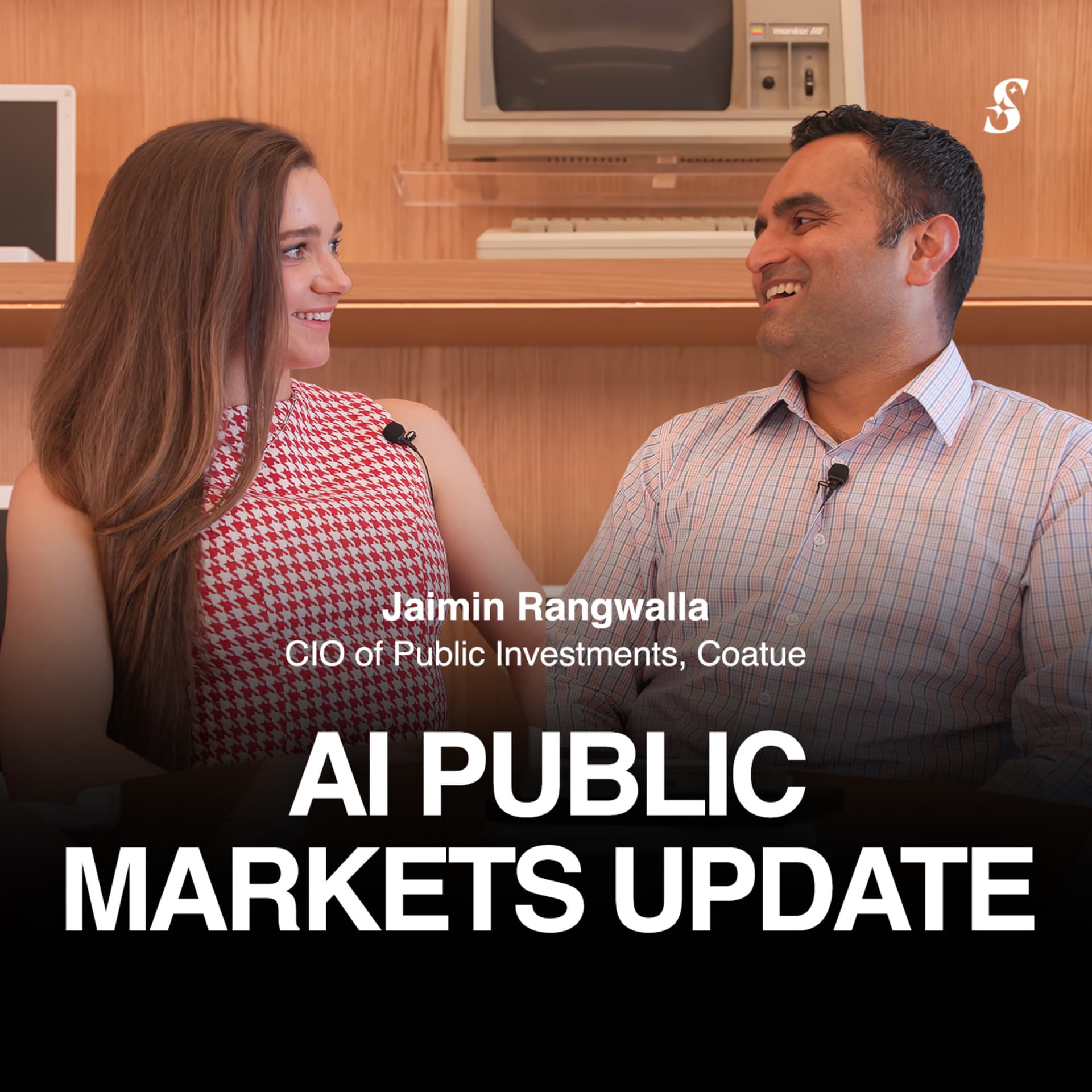
Coatue CIO Jamin Pelton discusses AI’s “biggest winners,” focusing on rapid adoption, private-company value creation, AI supply-chain bottlenecks, and why “sellers of shortage” outperform “buyers of shortage.”
Guest background
Jamin Pelton is Coatue’s CIO. He started in semiconductors in 2007 after NYU and two years of investment banking at Merrill Lynch. He later covered semis and expanded responsibilities, then ran Coatue’s public business with Philippe Dauman. He describes Coatue as sprinting “a marathon” and highlights an internal culture of collaboration (e.g., a selective early-morning soccer group).
Key claims
AI adoption curves are steeper than prior tech waves; private AI leaders are reaching massive ARR while staying private. The AI theme is shifting from “follow the GPU” to “follow the gigawatts” (power as the atomic unit). Memory tightness persists unusually long (e.g., supply agreements extending to 2030). Markets reward shortage sellers (memory, CPUs/GPUs, optical, power, labor) more than shortage buyers (hyperscalers’ rising capex compresses multiples).
Notable examples
Meta’s 2012 IPO (~$100B) vs OpenAI’s ~$800B round, Anthropic’s high-$300B round, and SpaceX/XAI’s ~$1.25T. OpenAI reaching nearly a billion users fast. OpenAI “agents”/OpenClaw controlling tasks (e.g., booking reservations, rerouting a car for magnesium). Optical’s breakout from “oversupply/undersupply” to critical infrastructure.
Written by AI. May contain mistakes. Listen to the episode to check what was said.
Chapters
Tap a time to open that second in VOThe Rise of Private Companies
0:00 to 0:57
Explore how private companies are rapidly ascending in market value before going public.
“You now have private companies that are breaking into pretty much the top 25 in the world before they even go public.”
The Shift to AI Era
1:37 to 3:07
Discussion on the tech cycles leading to the current AI revolution.
“It reminds me of my investment banking days a little bit.”
The Accelerated Pace of AI Innovation
3:07 to 4:36
Understanding the rapid growth and metrics of AI adoption.
“So we walked through internet, mobile cloud.”
Rethinking Investment Strategies
4:36 to 6:02
How investment strategies are adapting to the AI landscape.
“As CIO of the public sector, how do you map out all the different categories within this era?”
Surprises in the Semiconductor Market
6:02 to 7:03
Analysis of unexpected tightness in the semiconductor supply chain.
“What's been the biggest surprise so far?”
Jamin's Journey to CIO
7:03 to 10:07
Jamin shares his career journey and insights gained along the way.
“I started in 2007, right when the iPhone came out.”
Comparing Market Sizes: MAG7 vs AI Leaders
10:07 to 12:00
A comparison of market sizes between historic MAG7 and current AI leaders.
“And so I think that having learned that very early on in my career was a priceless lesson.”
Growth of AI Companies
12:00 to 14:00
Insights into the rapid growth of AI companies compared to traditional firms.
“And you've had to reshuffle some parts of the team to account for that too, like Frank, the claw genius.”
The Growing AI Market Opportunity
14:00 to 15:00
Explore the rapid growth and potential of companies leveraging AI technologies.
“I think it comes back to the original comment about how big the market is, right?”
Understanding Revenue Breakdown in AI
15:00 to 17:00
Learn how companies generate revenue through AI and its implications for productivity.
“with growth rates that are like nothing else in the market.”
Show all 32 chapters
The Token Economy Explained
17:00 to 18:10
Delve into the concept of tokens and their role in AI decision-making.
“I think one of the hot topics recently was around mythos and getting access to those and the tokens around there.”
Unlocking the Power of Agents in AI
19:46 to 21:52
Understand how AI agents enhance productivity and what sets them apart from traditional models.
“You've talked about how agents have become one of the biggest unlocks.”
The Evolution of AI Interaction
21:52 to 24:03
Explore how AI interaction techniques are evolving and their implications for users.
“So I think the open claw phenomenon is actually really interesting.”
The Future of Memory and AI
24:03 to 26:30
Discuss how increasing memory capabilities will transform AI functionality and user experience.
“Did you see the clip of Nat Freeman at Stripe Sessions?”
Impact of Agents on Computing Architecture
26:30 to 28:00
Examine how the rise of AI agents is reshaping computing resource demands and architecture.
“Like on our call, we had Boris Cherney, who's former Code 2 alum, but also the founder of Claude Code.”
The Shift from CPUs to GPUs
28:00 to 28:38
Explore the increasing demand for CPUs and the complexities of processing tasks with AI.
“and they're doing very complex tasks, but also simple tasks, they need offload from CPUs too.”
Market Dynamics in Semiconductor Evolution
28:38 to 29:40
Learn about the evolving ratios of CPU to GPU usage and implications for the market.
“There was a really interesting slide on that where you're showing the shift of GPUs to CPUs and it was like a four to one conversion.”
The Role of Major Players in Semiconductor
29:40 to 31:16
Understand the competitive landscape of semiconductor manufacturers and their market influence.
“there's 7 billion people or so, plus or minus.”
The Changing Perception of Semiconductors
31:16 to 32:35
Discuss the resurgence of semiconductors as a profitable sector and its implications.
“are the simple thesis and you don't want to overthink it.”
Job Creation Amidst AI Disruption
32:35 to 34:33
Examine the balance of job loss versus job creation in the wake of AI advancements.
“I never would have thought I would tell you that Samsung and Hynix together generate more cash flow than every hyperscaler.”
Understanding Market Shortages
34:33 to 36:37
Discover the framework of sellers versus buyers in markets facing shortages.
“And so I think that, you know, we're super focused on the data center companies.”
The Evolution of Job Roles in Banking
36:37 to 37:29
Learn how technological advancements have transformed job roles in the banking sector.
“because it takes two or three years for the new electrician to be trained or the new plumber to be trained or the new construction worker who's building out the distribution lines for utilities.”
The Impact of AI on Business Formation
37:29 to 39:41
Explore the surge in new business formations driven by AI technologies.
“So in talking about market dynamics, you have this framework of sellers of shortage versus buyers of shortage.”
The Contrast Between Buyers and Sellers in Tech
39:41 to 40:55
Analyze how the market rewards sellers of shortages but punishes buyers in tech.
“They're taking price, too, because they just like we have a finite amount of capacity.”
Identifying Bottlenecks in the Tech Sector
40:55 to 42:00
Examine the various bottlenecks affecting different sectors within technology.
“Yeah, I mean, you know, an area that I think has done really well is optical.”
Understanding Market Bottlenecks
42:00 to 43:02
Explore the various bottlenecks in the tech market and their implications.
“And so I think that right now, this is one of my favorite charts too.”
Market Sentiment vs. Performance
44:16 to 47:18
Analyze the disconnect between negative sentiment and market performance.
“Enterprise AI runs on Merge, the AI infra platform for integrations, agent tooling, and model orchestration.”
Navigating Market Volatility
47:18 to 49:10
Discuss strategies for managing volatility and maintaining focus on fundamentals.
“but how do you deal with this hot flash volatility and like this misguidance and sentiment and all this stuff?”
Identifying Next Market Leaders
49:10 to 51:50
Learn how to identify companies leading change in technology.
“When you're looking for new market leaders, what are the characteristics you look for?”
Risks in the Tech Sector
51:50 to 54:28
Examine the major risks facing technology investments today.
“And so it doesn't even matter whether they're public or private.”
Company Growth and Leadership
54:28 to 55:41
Reflect on company growth and the qualities of effective leadership.
“And, you know, we did another study at one of our previous calls about every 10 years, there's like a what we call a crisis or like a down 30 kind of moment for the markets.”
The Mindset of Adaptability in Changing Markets
56:00 to 56:32
Learn about the importance of staying curious and adaptable in a fast-changing industry.
“and I think it keeps him energetic, keeps him young, and he's very curious and always thinking about what's changing.”
Transcript
Automatic transcript. May contain errors.0:00You now have private companies that are breaking into pretty much the top 25 in the world before they even go public. It's an unprecedented time. The biggest of the Mag 7 was Meta in 2012. Facebook IPO. The largest IPO filing. Everybody wanted in on the most hyped up IPO in history. IPO'd around$100 billion. But today you look, OpenAI's most recent round was$800 plus billion. Anthropics last round was high$300s of billions. SpaceX was$1.25 trillion. They're reaching$25 billion in annualized revenue at a third, if not half, the speed of the hyperscalers and the mega MAG7s. They're adding$10 billion plus or minus a month, almost$2.5 billion a week.
0:40Most of the companies in the SaaS universe don't even have$2.5 billion of ARR annually. They're adding that in a week.
0:56Jamin, welcome to Sorcery. Thank you. Thanks for having me. So we're in the new, beautifully built out KOTU office. How does it feel? You know, it's almost like the first day of school again. You know, we all came in Monday morning. We didn't know what to expect. Our team here had done a great job of getting everything set up while we were all still just doing our normal jobs downstairs. And we came in. The difference is mostly we're much more of an open format, bullpen style, where everyone is sitting next to each other. We have AI folks, data scientists, analysts, all kind of sitting next to each other.
1:31So we're really trying to push the deep insights and collaboration. And it's really exciting. Now just being able to yell from one end to the other, say, what does this mean? What's happening here? It reminds me of my investment banking days a little bit. I heard Philippe has a desk in the middle of the bullpen. Is that correct? He does. He does. He has a desk. He came in the first day. He put his jacket on it and he said, wow, why am I so far from where the center of the action is? So we might have to move it back in a little bit closer to the middle. That's great. I was also walking around the office talking to some people and they mentioned to me that you have a secret soccer group that goes to the pier at 6 30 a.m twice a week yeah we uh it's not secret it's it's it's selective okay it's a selective group um but yeah we've been playing soccer for maybe eight years ago we started and it started with us playing like two on two in our gym and then we moved it out and now you know we're playing eight or nine of us uh against eight or nine of us and it's super exciting like it's we keep score we have a ranking every week we count people's goals they the grades move up and down on who's doing well and who's not.
2:40And it drives, not that we need any more competitive fuel to drive us, but it drives a little extra, a little extra of the culture. Oh, that's so fun. Okay. So we're here today to talk about your spring CO2 investor update. You just got off of it. There's lots of data. I've had a couple conversations with leaders at CO2 previously, Michael Barton, Thomas LaFont, and we've walked through all the different stages of the tech cycles. So we walked through internet, mobile cloud. We're now in the AI era. What is going on here? I feel like every six weeks we need an update at this point. It's just moving so fast.
3:18So what are you seeing? Yeah, I mean, honestly, what you said is the reality that AI is big and everyone can make these grand statements about how big it is. And we've also tried to do that a little bit in our slides about trying to size the TAM. But the most exciting part is the pace of the innovation. And you can look at that across, how quickly companies have reached$10 billion,$30 billion,$50 billion of ARR, which we talk about quite a bit, how OpenAI reached almost a billion users in the fastest time in history. All of the curves are so much steeper and faster of adoption, whether it's at the consumer level, the enterprise level, revenue level, however you think about it.
3:54And so to us, we always think about rate of change. That's how you really define technology and how quickly it's catching on and how big it can be. And a lot of times you see quick rate of change and then flattening, right? A lot of times when we look at apps that used to be popular, there was an app that might have done something, it gets to like 10 million users and then it all of a sudden flatlines. But the fact that you're hitting these metrics, whether it's, you know, top-down metrics or user metrics that just continue to go and continue to grow at such hyper rates. And sometimes they actually are seeing almost like a little bit of a slowdown.
4:24And then another level, a leg up, which just tells us One, we're still early in that adoption. And then the market is bigger than anyone is. Even the biggest bulls, I think, aren't capturing the size of the markets. As CIO of the public sector, how do you map out all the different categories within this era? Yeah. So I think that we are constantly rethinking how we're covering stocks, how we're covering themes, how we're covering subsectors within the theme. Two or three years ago, when we first started investing in NVIDIA, we thought about, oh, now we have to follow the GPU. Like if we bet on NVIDIA early, but that's usually not enough.
4:58Like what we really characterize a big theme being that there's many ideas across a theme because there's so many companies that are going to be benefiting and impacting the forward kind of future of a theme. And so we said that we had to follow the GPU. And so we were thinking about, okay, what does it mean if you're going to sell, you know, billions and billions of dollars of GPUs? What's all the infrastructure that needs to support it? And now I think we've even hit a little bit of a different slice where we're thinking about follow the gigawatts. And really, the gigawatt is almost the atomic unit of where the growth in AI is coming from.
5:29And it's one of the biggest shortages as well that's out there. And I think that we're now identifying, okay, well, what are all the inputs to the gigawatts? What are all the things that are helping reduce the lead times of gigawatts? Who are all the buyers of gigawatts? Who are all the users of the output of tokens from the gigawatts? And so we're almost slicing it very differently than we have historically, where it may have just been, okay, semiconductors and internet and aerospace and defense, you know, just kind of sector level. We're almost thinking what slice of the AI supply chain, and then who are the people we're going to have covering those slices.
6:02What's been the biggest surprise so far? I am surprised at how the tightness has persisted for this long. Historically, when you look through waves of tightness of any kind of technology, you know, memories had many periods where it's been tight. But the fact that it is tight and it almost seems like it's getting tighter every week that goes by. And now, in the case of memory, for example, you're now hearing supply agreements, like guaranteed commitments through 29, 2030. I've never seen that level of tightness and that number just keeps extending out, which to me just shows me that you have the largest companies in the world.
6:42The buyers of everything are all trillion dollar plus companies for the majority of it. They're not stupid. They are not investing hundreds and hundreds of billions of dollars growing at these high rates into something that they think is just going to kind of peak and trough. And to me, like that, the strength and the length of the strength is actually the thing that has surprised me the most. And you've started your career in semis. Yeah. I started in 2007, right when the iPhone came out. Wow. I know I aged myself a little bit, but... I mean, it's pretty cool we have this as a backdrop. And there's so many little exhibitions around the office too.
7:19Yeah. I mean, I remember when I first started, we had sent four of our IT staff to go wait in line for the iPhone. And we all got it. And it was like, what is this? And you touch it. We're all in a BlackBerry world before. And so it was just like that was my first taste. I was 25 years old. Wow, innovation happens. You don't expect it to happen. and then you see the power of what happened from that first million units of iPhones to what they're doing now. And it was really the best lesson I could have ever done. I don't think many people know about you. So I would love to get a little bit more into your background and how that scaled up to being CIO.
7:55Yeah. So I grew up outside of Philadelphia. I went to NYU for undergrad and then I did - So did I. Oh, really? Yeah. Go Violets. Yeah, I might have graduated a little earlier than you. And after that, I did two years of investment banking at Merrill Lynch, back when Merrill Lynch existed as an independent entity. And then I was thinking through what I wanted to do next. A lot of the folks that I would consider my peers were like, okay, you're going to go to private equity and then go to business school, and then figure out what you want to do after business school. I kind of went to undergraduate of business school, wasn't that excited about that idea.
8:31And so I started thinking, okay, who are people I can talk to to tell me about what my opportunities would be? And someone mentioned, oh, you should go be an investor, a public markets investor. It's different than private equity. You're not handholding a bunch of consultants and things like that. It's much more like action-based. You only need to find a couple of really big ideas a year and you can be super successful. Is that true? At an early age, it is. If you can really find one big idea and really get the firm to get behind it, that's enough to, I think, change a funds year and I think it can change an investment analyst career.
9:07And so I met with five places in 2007, in the summer of 2007, which was a nice peak in the market as well. The market had a really strong run. Four of the places did not offer me a job and Philippe offered me a job. So my decision was almost made for me because I knew I wanted to do this. I was like, okay, I'm going to go join. We were$700 million at the time, one fund, which is very different you know we had half a floor on 56th street and the first lesson I learned was that you never know what type of market you're stepping into because we all know what happened in 2008 and those other four funds all went out of business and so some of life is luck and some of life is you know what you make of that and I think I had a little bit of both because I even though the other four places didn't offer me a job and Philippe did Philippe was the one who taught me the lesson that what goes up sometimes does come down, at least for a temporary period of time, in particular in technology.
10:05But macro factors do matter. And so I think that having learned that very early on in my career was a priceless lesson. And I started covering semiconductors over time, grew to taking on more sectors, having more and more responsibility. And then two years ago, I was given the opportunity to run all of our public business with Philippe. And, you know, it's been an awesome journey. And every day I tell people that working in Code 2 is sprinting a marathon. Every day you have to sprint. There's no time to rest, but it is still thinking about the long run. And so it's been an amazing experience. Wow, amazing.
10:38Congrats. Thank you. And thanks for taking the time out of the sprint to do this. I know it might sound redundant talking about the size of the market today, but it is astronomical. It is crazy. So could you talk about the size of MAG7 when they IPO'd versus today the AI leaders and their size? It's a wild comparison. Yeah. So the biggest of the MAG7 was Meta in 2012, IPO'd around$100 billion. All of the predecessors had IPO'd in the 90s in the$10 to$50 billion range, which for that time was very large. But today, you look, OpenAI's most recent round was$800 plus billion. SpaceX's most recent, when they did the transaction with XAI, was$1.25 trillion.
11:31Anthropics last round was high 300s of billions. It's rumored to be significantly higher their next round. And so the fact that you now have private companies that are breaking into pretty much the top 25 in the world before they even go public, it's an unprecedented time. But I think that's what makes AI so exciting is that you have these private companies that are capturing so much value and so much growth while staying private. And I think that that is like nothing we've ever seen before. And you've had to reshuffle some parts of the team to account for that too, like Frank, the claw genius.
12:06Yeah. We are constantly evaluating how do we make ourselves better? How do we stay in tune with the time? And yeah, we brought in Frank. Frank joined us at the beginning of this year, and his official title might be Chief AI or whatever. I think about him as our AI mad scientist. He's the one who is trying everything out there that is new, creative, on the cutting edge, figuring out how do we implement it? How do we as an organization utilize our 20 years of data that we've been collecting to give us another leg up against the competition and allow us to succeed? Another chart that I want to mention, and this time I'm doing the Bloomberg analysis.
12:47So first, I want you to focus on the bold red line. And this is the performance of the Nasdaq since the October 31st peak. So if you look at the bold red line, it's basically been fairly flat, but you could see at one point it was down 10 percent and today it's up 10. And then what I want to do is I want to show you the performance of the Mach 7. And we actually plotted five of the companies. And what's interesting is that outside of Alphabet, so many of the Mach 7s have underperformed the NASDAQ by a lot. And in fact, three of them are down year to date. And I just thought that's interesting because to me, it's a further indication that even within the Mach 7, the reordering of the pecking order is happening quickly.
13:37One of the slides was really wild to see the annualized revenue growth that these new players have, whether it's OpenAI or Anthropic. They're reaching$25 billion in annualized revenue at a third, if not half the speed of the hyperscalers and the mega Mag7s. So how do you take that? I think it comes back to the original comment about how big the market is, right? The fact that you have these two companies today that are north of$50,$60 billion of ARR, growing just using Anthropic and what they've talked about publicly, it was$9 billion at the end of December, and that number was$30 billion. So they added$20 billion.
14:21They're adding$10 billion plus or minus a month, almost$2.5 billion a week. Most of the companies in the SaaS universe don't even have$2.5 billion of ARR annually. They're adding that in a week. And so just the size of the opportunity is so significant. And then when you think about both of them combined, let's say they're close to$60 billion. I mean, that is bigger than ServiceNow. That is bigger than Salesforce. That is bigger than any big name SaaS platform that you would think about. And these guys have done it in a matter of like handful of years versus the 15, 20 years that it took all these other companies.
14:54And so, again, what gives us like this excitement around AI is it is happening at a large scale with growth rates that are like nothing else in the market. And that gives us confidence that the market size itself is so much bigger. Because when I think about even what we're using it for, we are making new breakthroughs and we're finding new use cases. But it's nowhere near where I think the potential is. Like we're nowhere near what I see like three years down the road or five years down the road. And so I still believe we're very early in this adoption. For those who don't understand where that revenue is coming from, could you break that down?
15:28And I know some of it is promised and like future contracts and that kind of thing. But how do you break down that kind of revenue? Yeah. So I think that if you think about the pools of revenue for a company like Anthropic, it's going to be enterprises. It's going to be individuals and prosumers. And it's people that want to use their tools for efficiency. And so today, I don't think it's a straight one for one. Like, oh, if you spend$100 on Anthropic, I have to reduce my labor by$100 because I think that there's productivity gains that are achieved. And so at the end of the day, everyone works X number of hours.
15:59But even if you listen to the top coders and the top developers, they say our increase in productivity is like 2x, 3x. And so most companies, at least in the technology world, you're not limited in terms of what you're able to do based on the lack of projects. It's because you have a lack of people that can do all these projects you want to do. And so this is allowing them to work faster pace, increase productivity, run more projects. This also, AI, helps you reimagine how you're going to spend your IT budget broadly. Today, most IT budget is spent on hardware. It's spent on services. Like you have consultants that are helping you manage certain parts of your stack.
16:39And then you have software. And so there's also an element where you're rethinking. Do you need all of that? Do you need it in the same size that you have it? Do you need to increase it, decrease it? And so I think that the budget comes broadly from growing productivity, which is just a natural return on investment for any company that wants to put another dollar in their business. And then it also comes from offsetting maybe some of the expenses that you have today. So I think it's a combination of both. It's a lot about tokens. Token, token, tokens. I think one of the hot topics recently was around mythos and getting access to those and the tokens around there.
17:13So for those who don't understand tokens and the token economy, can you explain that out? Yeah. I think that basically a token is the unit of thought by any AI model. And so anytime you ask a question, if it comes back with an answer, it has generated tokens. And that is what the answer is that you see. And so the way I think about it is it's like a unit of intelligence, right? The same way that you would think about any, you know, as a human, you think about, I want to make this decision. I want to do this action. If we were an agent, each one of those would be tokens, right? And so the token economy, when people talk about it, is really the proliferation of agents and decisions made by artificial intelligence.
17:53And those decisions can actually be quantified in a number of tokens. And so it's very different than human intelligence, which is hard to quantify a unit of human intelligence. But you're able to quantify a unit of AI intelligence. It's actually very interesting because it's almost causing us to rethink how we're framing the business opportunity for a lot of companies. sorcery is brought to you by brex the financial stack trusted by more than 30 000 companies including one in three venture-backed startups in the u.s nearly 40 of startups bail because they run out of cash brex is literally built to help founders avoid that unlike traditional banks that let your money sit idle shipping away at it with fees brex's designs help you spend smarter and move faster their all-in-one solution combines checking treasury and fdic protection into one powerful account.
18:46You can send and receive money globally at lightning speeds, get 20 times the standard FDIC coverage through their partner banks, and even high yield from day one. With same day and even same hour liquidity, access your funds anytime. Companies like Scale AI, DoorDash, Service Titan, HIMSS, Anthropic, Flexport, Robinhood, and Plaid trust and use Brex. Start today at brex.com slash sorcery. That's B-R-E-X dot com slash sorcery. Turing is training the next generation of AI with tasks that require real expertise and real world judgment. That's why companies like NVIDIA, Anthropic, Salesforce and Gemini partner with Turing.
19:30Turing builds realistic reinforcement learning environments and data systems based on real operational traces. The kind of infrastructure frontier labs need to train superintelligence. Visit turing.com slash S-O-U-R-C-E-R-Y. You've talked about how agents have become one of the biggest unlocks. So what is the difference there? So if you think about your initial chat GPT interaction, you would ask it a question. It would think for some amount of time, depending on the complexity of the question, and then it would come back to it with an answer. Or not even a lot of times an answer. Maybe it comes back with an intermediate step of, okay, I searched all of X, Y, Z.
20:06I did this. Am I on the right track? Do you want me to go more in detail? Do you want me to do less? And it was a lot of human in the loop. An agent now, when you give it a problem, like the amazing part of Opus 4.5 when it launched at the end of last year was an agent can now spawn its own agents. And that can increase the depth of work, the time of work, and the quality of the work. And so all of those things, that was a huge model unlock. Agents launching agents I think is one of the most underappreciated unlocks that has happened. because you can give an agent a project now and you can just go away and you can come back and it has done, if not all of it, really, really far along.
20:47And the amazing thing is you can also, when you instruct it or prompt it initially, you can say, go do this, launch as many agents as you want, and then launch another 10 agents to check all of these agents work. So not only like it's so collaborative and iterative now where the human is almost out of the loop. And if you think about it, the human was almost a limiting factor in how much work the agents could do because before one agent or one chatbot would interact with one human, but it would always constantly stop. A third of the way it stops to check in and be like, did I do this right? Do you want me to do this again?
21:14And two thirds of the way it stops. And so the human is still limiting how much work that can be done. Now the human just has to prompt it and all of the work gets done on its own. And now what we're doing, when I use Claude2, I don't just ask it one prompt or one problem. I go and say, okay, I want this done. And I open a new one. I say, I want this done. And I open a new one and I want this done. And so they're all working concurrently. And so you're able to launch agents and then you're able to launch multiple pools of agents that also launch multiple agents below. And so to me, it's just the sheer power of exponential growth of the number of agents and the amount of work that's being done.
21:51Yeah, we definitely saw that in the open claw slide. That was crazy. So what was their growth rate? So I think the open claw phenomenon is actually really interesting. I think most people maybe don't understand and appreciate it. What OpenClaw is, it is a form of a harness. Harness is like the fancy word for how a person interacts with a model. Before you're interacting with a model with just the chat GPT interface and then even if you have a terminal maybe you're interacting in the cloud code terminal. But now a harness allows you to interact. You can be on another computer just typing to your claw and having it control a computer in a different location or a virtual computer and actually taking actions on your behalf.
22:32You can WhatsApp message it and say, you know, while I'm in the office, like we have analysts that are using it and testing it for us. He'll have his home open, he'll message it and say, oh, book me a reservation on Friday at this restaurant, send the calendar invite to Jamin, and then also make sure that we have a car service set up to take us there and back and then send him the confirmation email and make a calendar appointment and do all that stuff. It is able to do all of that in the background and it'll just come back you with a message and say, okay, I did this and here it is, right? And so it's almost like the ability to interact has changed with the Claw setup.
23:07And so now you can use a terminal to interact. You can have it in your pocket. Like the phone, we have a slide in our deck that just talks about the phone's almost like a remote now. It's a remote for your agents. Like who do you have? Which agents do you have working on what? Which agents do you have doing this for you? And you can also launch multiple agents. And so I think that OpenClaw, you're seeing the trajectory, just the number of people that are using it and programming for it and trying to figure out how to incorporate it. Even in China, like every one of the big internet companies has their own claw concept.
23:35Like ByteDance has one, Tencent has one, Baba has one. It's amazing how quick this has taken off and I don't think people fully appreciate it. But to me, it's just an intermittent state. I don't think that you're going to have it where you've got to go home, you've got to hook up all these connections to your claw because today you still have to give it access to Gmail and this and that, there's going to be a big opportunity for someone to just say, oh, here's your phone. Here's the app. This is your super app. This now allows you to connect to everything that you have and you can just ask this app questions and it is going to be the super app for you.
24:06Did you see the clip of Nat Freeman at Stripe Sessions? I did not. So he has OpenClaw deployed on his phone, I think maybe his laptop too. And so his open claw saw that he was dehydrated and so it was like oh go grab a glass of water so he went to the kitchen he grabbed a glass of water he drank it or maybe it was a bottle and open claw took a picture of him and goes nice job and then he was also driving in his car and they were like you need magnesium and so the car then rerouted to whole foods to get him magnesium it was pretty crazy. Yeah. I mean, that's just, we're just at the beginning of what's going to be possible.
24:48So you mentioned that memory per person is exploding. Can you talk through the TAM of that? Yeah. So historically, if you think about it, memory was tied to smartphones, memory is tied to computers. Everyone has a smartphone, everyone has a computer. And so you can just say like over time, as people started adding more technology devices, an individual might have, you know, eight gigs of RAM on a computer, you have eight to 16 gigs of RAM on a phone. And so you've seen like a natural growth of that just over time as you've seen penetration of phones, penetration of computers, and then the density within each device also increases over time.
Read the full transcript
25:25But now if you think about it, if you or me in a year or two, we're going to have a claw that's running hundreds of agents at all time. I'm going to have a similar impact at work. I'm going to have hundreds, maybe thousands of agents running at all the time. All of those agents require CPUs, GPUs, memory. Now it's not, it's not persistent memory because it's not running 24 hours a day. Some will run for some amount of time, some less, but you get the, you get the kind of a general direction of where this is going, which is your footprint, your like a semiconductor or technology footprint as an individual is about to expand by like 10 X because you used to have a couple of devices.
26:04Maybe you're someone as an iPad too. So you have X a little more, but like three or four devices is about to go to thousands of virtual devices on top of, and the virtual devices are the agents and each agent requires, you know, semiconductor content. So it is hard to like fathom a world where like we're all having this like big semiconductor footprint, but that's what's happening underneath the hood, right? And if we're all going to be users and we're all going to be using hundreds and thousands of agents at a time, that is where we're going. Like on our call, we had Boris Cherney, who's former Code 2 alum, but also the founder of Claude Code.
26:37And he was saying that, you know, he runs, you know, some number of agents during the day, but when he goes home, he's running or on his way out, he has a thousands of agents running to kind of do work all through the night before he comes back in the morning. So just imagine like if we're all going to be doing things like that, where we're all going to be having periods where we're running hundreds of agents and it can be simple tasks. It doesn't have to be like, you know, very complex programming tasks, but just the footprint of each individual in terms of their semiconductor content, their power content, right?
27:05It doesn't just apply to semiconductors. It applies to how much power each person consumes is all going to increase significantly. Because of those behavioral changes, how is that affecting the architecture of AI? I think that we're now moving to a world where the chatbots, you know, we joke around internally, like the chatbots have amnesia, right? Because every time you might give it some files, you give it some medical records, it does a great job of going through and analyzing it. You go back the next day and you give it the same record, or you ask a question about those records, it doesn't remember.
27:36I don't know if you ever watched that movie, 50 First Dates, where basically he has to re-explain every day what the situation is. It's very similar to that. But what's changing is now you're getting persistent memory with all of the next evolution of accelerators. And so I think that you're seeing memory content is increasing, the agent is not gonna have amnesia anymore, the agent's gonna be able to remember. And now, because the agents are launching agents and they're doing very complex tasks, but also simple tasks, they need offload from CPUs too. The historic list CPUs have done something called serial processing, which is like, you just give it a set of instructions and it does one by one by one by one, critical instructions, but one in a row.
28:16And I think that as an agent has some element, which is like, okay, make a reservation, that might just be very serial tests. That might have something which is like, okay, program something that's super complex and might require parallel tests. And so I think that that is just creating a massive need for more CPUs and more memory. And we're seeing that, we're actually just at the beginning of that. I think agents is really what is driving that. There was a really interesting slide on that where you're showing the shift of GPUs to CPUs and it was like a four to one conversion. So how did you kind of like model that out or how are you estimating it?
28:49Yeah, so for some amount of the last, the greater part of the last three or four years, it was very much a one CPU and even eight GPUs. That was kind of the, and it had gone up to 16 GPUs, which was all of the math and all of the computation is happening at the GPUs. And then they just kick it out to the CPU when it's time to like execute the final step. But now the ratio is actually moving from to one CPU to four GPUs. And so it's improved kind of by 2x already. and we think it actually has a chance to flip the opposite direction, which is one GPU to four CPUs. And some people, very aggressive, say they could go to one GPU to eight CPUs.
29:27And so I think that it's just more a function of how many of those tasks are being completed and how many of those new tasks are being done that don't require the parallel compute but require more just serial task completion. And I think that, again, it's just another way that I think about it is there's 7 billion people or so, plus or minus. Everyone has their technology needs. But if every person has 1 ,000, the 7 billion multiplies by 1 ,000. And so just think about how many more people effectively are on the earth than there are today. And I think that all of those people are going to require serial processing, parallel processing, memory, all the things that every human would have.
30:08And so I think that it's just another way to think about just almost population expansion. And if we expanded the population by 1 ,000, now this is a digital population that we're expanding, just all of the resources that are required for that digital population. Who are the main players within this stack? On the CPU side, it's Intel, AMD, and ARM. Amazon's done a great job. They actually have one of the most efficient CPUs, but they've always kind of kept it internally. They bought a private company that helped them do this, and it has helped, I think, drive AWS success, especially as we move to CPUs.
30:42I think it really helps be a tailwind of their business. But Intel for years has been almost like the forgotten child in semiconductors. They had a lot of missteps along the way, whether it was a technology issue, product issue. They've had a lot of leadership changes, but they have an amazing CEO now. Sometimes we try to keep things simple, which is you have a four to one going to one to four, which is mathematically is a 16x improvement in a market size. and then you have Elon Musk giving a stamp of approval to Intel and increasing the pace of innovation. And so I think that to me it's just some of the best thesis are the simple thesis and you don't want to overthink it.
31:22And I think that just the combination of that for a stock that, yes, it's had a big move this year, but if you think about every semiconductor company over the last four years in this heyday of AI, they're all up 5, 7, 10x. It's still a laggard over any period beyond 12 months. And so to me, there's still a lot of catch up for that company. Is that really exciting for you? Because you started your career in the semiconductor space. And now you're like, I mean, that was gaming back then. And now I will tell you the first seven or eight years of my career, all I did was work on it with shorts. Because semiconductors are viewed as the deep cyclical business.
31:58You overbuild at the top. You burn a tremendous amount of cash flow, very fragmented. Like just companies go up. They make one product, they sell it to Apple. In a year, Apple says, okay, we're going to now double source you or triple source you. And the companies go down 90%. Now, I spent almost all of my time working on shorts. We never really owned semiconductor stocks. We don't internet stocks, software stocks, other types of stocks. And so to me, it's almost just like, wow, my career has come full circle. I have a chance to make decisions at the portfolio level at a time where the sector that I started 20 years ago is now the most profitable sector, generates the most cash flow.
32:35I never would have thought I would tell you that Samsung and Hynix together generate more cash flow than every hyperscaler. It's crazy. It is crazy. But it is exactly what is warranted in this time and why you have to always be changing how you think. If I had just stuck with the view from 15 years ago that semiconductors are shorts, it would have been the most costly mistake that we would have ever made because those are the stocks that are dominating the market today? We were in the kitchen and I think the analogy was, it was like the nerdy kid who became cool. It's exactly that. I mean, they were the CEOs that no one ever wanted to sign up for meetings for at conferences.
33:14Like everyone wanted to go meet the Facebook CEO and everyone to meet the Google CEO. Everyone to meet like, you know, those were the companies of the 2010s. And now it's like the opposite. You go to, you know, one of the bank's conferences, like there's like 4 ,000 people wanting to listen to Jensen speak. It's like unreal. And GTC is like a Taylor Swift concert. It is an event. It is an event. I've been going to GTC since 2016 was my first one. And it was like a small hall at the San Jose Convention Center that like was a half of one building and like a hundred people there. Like it's amazing what it has turned into.
33:50It's crazy how he does the whole presentation without a teleprompter. Two hours. Yeah. It's so wild. Yeah. It's pretty incredible. So I'd love to talk about how data centers are fitting into this space and how you're monitoring whether or not buildouts are happening and that kind of thing. Yeah, not in space. And it helps me kind of think through how our bottlenecks easing, not easing, is something changing in the environment? At the end of the day, for me, the most important thing is what is the rate of change? And is the rate of change moving towards tighter rate of change or is it easing? And if it's easing, what is causing the easing and what is the degree of easing?
34:30And is it easing to the point where it's a problem or it's just easing to the point that it's healthy and it just facilitates the growth? And so I think that, you know, we're super focused on the data center companies. We're super focused on neoclouds, hyperscalers, on the ground where all the new buildouts are happening. Where is power available? Where is equipment available? Where is labor available? And we're trying to track all of that in real time. Yeah, it's been fun to see. I was recently down in Miami at Exowatt, and they're an energy company, a renewable energy company for data centers.
35:03And Hanan, the CEO, he was explaining out the labor that they're bringing to market because of this new industry they're pretty much facilitating. and it's down in Miami, it's manufacturing and then they build out for these facilities and it's like manufacturing all in the United States. And I think there's a lot of negative sentiment about job, obviously like there's scale to these things but there's a job replacement because of AI but there's also job accretion and like new layers of the economy that are being created. Yeah, I mean, I think that's the, we'll ultimately see where the T plus 10 years looks.
35:46We've gone back and looked at all the different innovation waves of technology, even back to like the, you know, the automobile, everything like even beyond the seven major waves of tech that we talk about. And usually there's some job loss at the jobs at risk. But then there's a whole giant section that people don't talk about, which is new job creation, new business formation, you know, like all of the different types of innovation that come off of the core innovation of new companies that are formed. Like even today, people don't talk about it, but we're actually at one of the highest new business formations that we've ever been at because everyone's now, oh, I can use AI to maybe redefine how this business works or start a new business that does this.
36:23And so I think people are very focused on the negative side of things, or at least like whatever, some people choose to focus on the negative side of things. But I think that there is a significant opportunity for new job creation. And again, it'll depend on how fast the disruption happens, because maybe there's a window where the disruption happens a little faster than the new electrician can be trained because it takes two or three years for the new electrician to be trained or the new plumber to be trained or the new construction worker who's building out the distribution lines for utilities.
36:49You can't flip overnight to those jobs, and so maybe there's a little bit of a time lag. But broadly speaking, there's a lot of companies that we look at that are massive shortages of the amount of labor that they have. And it's not one type of labor. It's a lot of different types of skilled labor, But which usually means that the salaries for those jobs are going to go up to try to lure more people to do that. And so it might just be that the next X number of years in a world of AI, like those are the jobs that are actually in the pole position versus maybe what was in the last 20 years. In our interview with Thomas, he was talking about the bank teller and how that actually evolved.
37:23It didn't really actually decrease any jobs. There were just more jobs spread out. So that's always a hot topic. So in talking about market dynamics, you have this framework of sellers of shortage versus buyers of shortage. Can you break that down? Who's winning and what's kind of the explanation? Yes. We try to simplify sellers and buyers of shortage in the concept of you have semiconductor companies, you have power, you have memory infrastructure, everything where you have a fixed amount of capacity and you have greater demand. And that greater demand is driving price increases, margin expansion.
38:04And when price is the main lever of your revenue growth and you have fixed costs, your operating profit actually go up multiples of what your price increases or your revenue is growing at. And so we've seen companies that have been able to increase their earnings 3, 4, 5, 6, 7x just in a matter of a year or two. Companies that would have been plus or minus a certain range for 10, 20 years. And so these shortages, which are critical to AI, whether it's memory, hard drives, like their shortage to kind of the development of AI, have driven significant earnings power. And the market is rewarding that set of earnings.
38:37What the market is not rewarding and not rewarding as much is the companies that are buying that shortage. And so that would be the companies that are putting the capex into the ground. And so if you look at the multiples of Microsoft, of Amazon, of Meta, they've actually all compressed in the last couple of years because their CapEx is going up. And if you just think about it, if memory pricing goes up 100 % and Microsoft has to spend two units instead of one, they're not actually getting two units of benefit. They're still getting the same benefit they would have gotten if they spent the previous price because it's not like the memory is always different.
39:13Right now, you're just seeing like-for-like price increase go up so much. And so I think that the market is, for the moment, punishing that the ROI on that dollar is a little bit less because it's just cost inflation versus actually new technology driving the higher price. And so, you know, the stocks that are working and the part of the market that everyone is really excited about, optical, power infrastructure, even labor stocks, because labor is in shortage. You're seeing rates rise in labor, memory, CPUs, GPUs, even TSMC, which is one of our largest holdings. They're taking price, too, because they just like we have a finite amount of capacity.
39:52And so we have to try to figure out how are we going to make sure that we're generating enough profits and knowing that if we're going to reinvest in more capacity that we're getting the right pricing, the right margins and the right return on investment. So those are the types of companies that are winning. Now, I don't think that, I actually think Amazon and Google are an unusual camp, and those are the two companies that we really like, because they are also a bit of a hybrid in that Google has TPUs that they sell, and Amazon has talked about selling Tranium, or at least openly discussed what the value of Tranium is.
40:24And so maybe there's room for them as well, because they would be buyers of the shortage, but they could also be sellers of the shortage. And, you know, Google has been a great stock and they have their own bottle. So there's a lot of other things that they're vertically integrated, which makes them great. But I think that that's a little bit how we're thinking about the market today. There's the buyers and then there's the sellers. The buyers are being punished because they're spending their capex is so high that their near term cash flow is gone. And that transfer is happening directly to the pockets of the sellers of the shortage.
40:52And so those are the ones that are being rewarded at the moment. Have there been any surprising breakouts? Yeah, I mean, you know, an area that I think has done really well is optical. You know, optical for years was viewed as just an area that had constant oversupply, undersupply, oversupply, undersupply. And now I think it's becoming more of a critical part of the infrastructure of the future. And I think that that is the one that probably surprised me the most. We'd been following memory. We'd been following CPUs, GPUs, accelerators, all of these. but optical is the one that I think surprised me the most.
41:27And where are the biggest bottlenecks? So some people would say memory. Some people would say power. I think there's so many bottlenecks, actually. It's like the big bottleneck is the fact that there's so many bottlenecks. It's not any individual bottleneck. It's the fact that you can talk to so many different people across different areas. It's like power generation is a bottleneck. Transmission and distribution is a bottleneck. NAND is a bottleneck. DRAM is a bottleneck. optical components are a bottleneck labor to put all the the data centers up is a bottleneck i mean it's i've never seen so many bottlenecks at the same time and i think that is what makes it so hard because if it's just one one vertical slice that's the bottleneck you can say okay well if they put enough dollars in they'll be able to solve the bottleneck but the problem is is like even if let's say memory solves their bottleneck that doesn't solve the power bottleneck that doesn't solve the optical bottleneck that doesn't solve all these so i think that the the real bottleneck is that there's so many bottlenecks.
42:20And so I think that right now, this is one of my favorite charts too. You can see that the market is really rewarding the sellers of the shortage, but it is not rewarding the buyers of the shortage because the profits are so high that the market is really focused on grabbing the short-term profits. And that's fine. But I would say that at one point, there will be a power that shifts the other way. And we need to be extremely, extremely aware and well prepared to do that. And we'll speak about what we're trying to do that. VCX by Fundrise, the public ticker for private tech, allowing investors of all sizes to invest in venture capital.
43:09View the portfolio at getvcx.com. That's getvcx.com. Some of you may not have heard this yet, but our sponsor Public just launched something called Generated Assets, and it brings AI into investing in a way I've honestly never seen before. Here's how it works. You type in an idea like AI-powered supply chain companies with positive free cash flow, or defense tech companies growing revenue over 25 % year over year. Publix AI then dispatches a swarm of agents that scan every single US stock, evaluates them, and instantly builds a custom index around your thesis. What really stands out is how clearly it explains why each stock is included.
43:47And before you invest, you can even backtest your idea against the S &P 500, so you're making decisions with real context, not just guessing. And beyond generated assets, Public lets you invest in stocks, bonds, options, crypto, all in one place. They'll even give you an uncapped 1 % match when you transfer your investments over from another platform. If you want to build a portfolio that actually reflects your thesis, visit public.com slash sorcery. Paid for by Public Investing. Full disclosures in the description. Enterprise AI runs on Merge, the AI infra platform for integrations, agent tooling, and model orchestration.
44:22so your teams ship product, not plumbing. Mistral, Dropbox, and Drada already trust Merge and production. Start building at merge.dev. Founders scale faster on Deal. Set up payroll for any country in minutes, hire anyone anywhere, get visas handled fast, and get back to building. Visit deal.com slash sorcery. That's D-E-E-L dot com slash sorcery. One of the interesting things, or I guess there's many interesting things that are going on right now. But in the news and headlines, sentiment for AI and the economy is super negative. But the public markets are performing better than I think it was, it was like a specific, it was April 2020.
45:09So if the negative sentiment is so high in the news and online, but the markets are actually better than April of 2020. How do you explain that? What is going on there? So we actually did a couple of calls ago, we did an analysis on sentiment and how indicative is sentiment of what's actually happening in the market. And it's basically a coin flip. There is no correlation between negative sentiment means the market should be down or it's contrary. And so I think that there's different moments where people are going in the news have different things that they jump on or in social media, different things that they jump on.
45:50But what is core and what is underlying is that companies are beating earnings. The S &P 500 earnings growth through 26 is like 15 % accelerating to 18%. During periods of that type of economic growth, the stock markets do well because there's drivers of that growth. The economy is strong. The consumer is strong. Even though there's been some issues with higher gas prices and things in the near term, but the consumer got a really strong tax refund. And so there's no panic in terms of consumer spending, enterprise spending, earnings are really strong. And so at the end of the day, like fundamentals do matter more so than sentiment.
46:26And I think the fundamentals are really strong. Like you look at the earnings revisions for some of these sellers of shortages, just up and to the right. Like every quarter they're beating earnings by like 30, 40%. Like I remember seeing like the SanDisk earnings or the Micron earnings, like the street would estimate like a dollar VPS and they do 250. It was just beating numbers by so much. And so to me, the fundamentals are really strong and the market is going to follow the fundamentals. And the multiples for the market actually haven't gone up that much. The multiples for the market are actually staying kind of consistent because the growth is so high.
46:57And so the market is up, whatever, 7%, 8 % this year. But earnings growth is 16%. So you're actually, the multiple by the year end, if the market stays flat, goes down from here. And so I think that we're at a period of really high growth and that's really what matters more. I think this might circle back to the beginning of the conversation. but you've been at KOTU for many cycles, especially in one like this. I talked to Thomas about this on stage, but how do you deal with this hot flash volatility and like this misguidance and sentiment and all this stuff? How do you stay focused as a firm?
47:30You know, it's funny. Philippe always says like when we do these presentations, we should do them more because it helps us ground our thinking again because we kind of re-come back to, okay, what are the five or seven things that really matter in this moment? It is hard. There is a lot of noise. The volatility in the market has been way higher than I feel like I've seen. Usually, I don't view Liberation Day as volatility. I view that as, okay, a bad thing happened, and so the market goes down when bad things happen. You kind of know. You might not know exactly how much, but you know, okay, there's bad stuff happening, so the market goes down.
48:02The volatility we're facing now is, wow, I'm still really bullish. AI is still doing great things. But wow, some days, some of our stocks are just down 5 % or 10 % for no reason. And that is the part that gets a little bit challenging. Sometimes it's because of a clawed release. And that's the part that's challenging because you're always thinking, oh, does someone know something? Is something changing and we're not at the forefront of it? Are we asleep at the wheel, which is obviously such a critical cost in this business if you're not paying attention to everything that's happening? And so we always try to reground ourselves in fundamentals.
48:38We try to reground ourselves in the big picture, in the theme, and making sure that the stocks that we own are high quality business models. We have great relationships with the management team that we can really understand what is happening and allows us to kind of deal with the volatility. And we have other tools at our disposal, hedges, puts, shorts. There's a lot of things that we can do. But I think ultimately what we've concluded at the moment is that fundamentals are really strong. The market is really resilient and AI is accelerating its pace, even though it's hard for me to say that. And maybe someone says you're crazy, like AI is all everyone's talked about for three years, but it is accelerating today than even where it was one or two years ago.
49:17When you're looking for new market leaders, what are the characteristics you look for? How are you evaluating the companies? Yeah, so I think that what we've been doing and what has worked is we're thinking about what is the leading edge change and who are the companies that are driving that leading edge change. And so NVIDIA almost sets the standard for what is like the accelerator market going to look like in terms of capabilities two years down the road. And what are the things that they're changing? Broadcom does as well. TSMC does as well. And what are areas that they're changing? because they're all trying to figure out ways that they can alleviate their own bottlenecks, that they're trying to reduce certain costs in some areas that they feel like there isn't technology advancement, but they're also trying to optimize their profitability too.
49:56And so, you know, there's a concept, let's say that people are talking about, okay, today, the way that accelerators connect is using copper wires. It's like a way that you send data. There's a scenario two, three years from now where there's going to be less copper and more optical, or at least like maybe not less copper, but more optical, right? Because it can transmit data faster, but there's limitations. It needs to be longer distance and things like that. And so I think that we're always trying to figure out, that's just one example, but there's so many, like every new version of NVIDIA's accelerators have things that they're taking out, adding, et cetera.
50:29And so we try to follow where the change is happening and what is that industry looking like today? Is it an industry with like 50 players? Well, that's not that great. Is it an industry of consolidated players where maybe they're making something for a legacy market And now all of a sudden they're in a massive windfall of demand that they weren't expecting and they can't really add supply. And so, oh, wow, maybe that's the industry that we need to go and chase down and follow. And so we're really trying to stay at the forefront. We have a big investment, OpenAI and Anthropics. So we're constantly talking to them about what are things that they're doing to optimize their models, what are technologies that they're using.
51:03So we try to do research to really stay at the forefront of where the change is happening. It is so crazy because whenever someone mentions OpenAI and Anthropic, I just assume they're a public company at this point, but they're still not. Yeah. So how are you thinking about these trillion dollar IPOs? I think that it's great for the market. I think that leadership changes in tech. We've done the studies on it. almost plus or minus every five years, a quarter of the top 25 in tech usually come out and a new four, five, six come into the top 25. It's like a very basic analysis. I'm sure if we did it more detailed, it would show even more granularity, but tech changes and leadership changes.
51:50And I think that these companies are, in my mind, again, let's just say that they're all effectively worth with over a trillion dollars, SpaceX, OpenAI, and Anthropic, they have already catapulted themselves into the top 30 companies in the world in terms of size. And so it doesn't even matter whether they're public or private. They've already reached that milestone. And so to me, when they go public, it's just going to be investors that didn't have access to it. The retail investor who had to only focus on public stocks now gets access to these stocks, and it's going to be great. I don't think that there's this concern in my mind of, oh, that means you got to sell Mag7 or this and that because the S &P is$60 or$70 trillion of market cap.
52:27We're talking about three$1 trillion companies. It's not like there's some massive flush out of all these other stocks that need to fund this. It's all in line with the size of the IPOs that probably are necessary in this market. And I think it's great that there's new names that come out there because if it's just the same names over and over, it doesn't really represent the beauty of technology. As the CIO of KOTU's public sector, I would be remiss not to ask you about risks. What are the biggest risks that you're watching? Look, the biggest risk is that there is some technology on the other side that materially changes where some of these shortages exist today.
53:10And that risk exists only in the grand scheme of, OK, the types of stocks that would be impacted by that. But if there was, let's say, let's say that the DeepSeq moment that happened last year, another moment like that happens where someone figures out a model that can do all the calculations with less power, less semiconductors, less memory, all of that. If that happens, it is probably good for the long run of AI, because that means that the adoption is going to happen faster, more people are going to use it. If AI becomes materially cheaper, there's the whole Javon's Paradox argument, which is like, yeah, the cheaper it becomes, the more people will find creative ways to use it and do other things, right?
53:45Right. Humanoids are still kind of in the back burner. But maybe if it gets cheap enough, like there'll be way more dollars that get put behind solving that problem. And all of a sudden, like other things get accelerated. And so I think that like that is a risk that I'm looking at as, you know, someone who has a mark to market portfolio every day that I'm thinking about. And then, you know, there's could there be some regulation that comes out of nowhere that maybe changes the or dampens the ability to kind of grow unconstrained the way that things are today. But generally speaking, I think that it's, you know, we're talking about a topic of national security at this point.
54:17And so I actually think that the regulatory environment is going to do what it takes to allow for as cooperative of an AI environment as possible going forward. But those are kind of the things. And, you know, we did another study at one of our previous calls about every 10 years, there's like a what we call a crisis or like a down 30 kind of moment for the markets. And every year, there's probably a down 10. I feel like last year we had our down 30 in the tariff moment, and that was kind of in between, right, crisis or correction. We had 2022 that was already like a down 30 for the markets. And so I feel like we're at a point now where there's always going to be risk, but I think that we're really set up with a great secular trend.
55:00Other than being on camera more, what are you most looking forward to this year? I think that we moved into this office, which is great. And just overall, one of the things that I say about Philippe is he's an amazing investor. He's in the Hall of Fame of risk management investing. But what people maybe don't fully appreciate is that he's an amazing CEO too, building the business. I joined when we were like 12 people,$700 million in assets. Today we're over 80 billion, 200 people, multiple offices. It's crazy when I sit back and think about the 20-year trajectory. And I think that he probably still comes to the office before I do, leaves after I do, works more than I do, and doesn't rest, right?
55:43And so to me, like the journey is still, you know, we talk about the inflection leading to another inflection. I feel like we're, as an organization, are at our second inflection, maybe probably not second, like fifth inflection. But we're at another inflection, where I think we're really on this journey to really just break out. What do you think his secret is? He plays a lot of padel tennis these days. I feel like that's his new hobby. and I think it keeps him energetic, keeps him young, and he's very curious and always thinking about what's changing. And it's almost like a mindset, right? You're just in the mindset of like what is changing, how do we capitalize?
56:15What is changing, how do we capitalize? And it's hard. A lot of people like being in an environment where like you have comfort and coziness and you're like, I know what's here, which is great for some people, but for this industry, for this sector to be successful, you always have to be thinking about what's changing and how do I catch it. Amazing place to end. Thank you so much. This was a lovely conversation. Thank you very much.
From the publisher
Coatue's Chief Investment Officer of Public Investments, Jaimin Rangwalla, joins Molly O’Shea of Sourcery to unpack the most extraordinary technology cycle of his 20-year career. Jaimin walks through Coatue's spring investor update — why OpenAI, Anthropic, and SpaceX are breaking into the world's top 25 companies before going public, how Anthropic was adding $2.5 billion in ARR every single week, and how the rise of agents launching agents is creating what he calls a "digital population explosion" that will multiply every person's semiconductor and power footprint by 1,000x.
Jaimin also breaks down Coatue's "follow the gigawatts" framework, the shift from 1 CPU : 8 GPUs to 1 GPU : 4 CPUs, why semiconductors went from career-long shorts to the most profitable sector in the market, and the "sellers of shortage vs. buyers of shortage" dynamic driving today's biggest winners. Plus: the bottlenecks no one is solving, the trillion-dollar IPOs coming, and what keeps him up at night.
Chapters below. Subscribe for more conversations with the investors and operators building the AI era.
Coatue Update Replay + Slides: https://www.coatue.com/blog/perspective/public-markets-update-2026-05-06
X: https://x.com/coatuemgmt/status/2052787367275319387?s=20
Jaimin Rangwalla: https://www.linkedin.com/in/jaimin-rangwalla-402a21/
Molly O’Shea: https://x.com/MollySOShea
Sourcery: https://x.com/sourceryy
𝐄𝐏𝐈𝐒𝐎𝐃𝐄 𝐋𝐈𝐍𝐊𝐒
YouTube:
𝐒𝐏𝐎𝐍𝐒𝐎𝐑𝐒
• Brex—The modern finance platform, combining the world’s smartest corporate card with integrated expense management, banking, bill pay, & travel. https://brex.com/sourcery
• Turing—Turing delivers top-tier talent, data, and tools to help AI labs improve model performance—and enables enterprises to turn those models into powerful, production-ready systems. https://turing.com/sourcery
• VCX—VCX is the public ticker for private tech, allowing investors of all sizes to invest in venture capital. View The Portfolio at http://GetVCX.com
• Deel—Deel is the global people platform that helps startups hire, manage, pay, and equip anyone, anywhere. Trusted by more than 35,000 fast-growing companies, Deel is the people platform that just works, so teams can scale without the chaos. Visit: https://www.deel.com/sourcery
• Public–Investing platform Public just launched Generated Assets, which lets you turn any idea into an investable index with AI. With Generated Assets, you can build, backtest, refine, and invest in any thesis with AI. Gone are the days of one-size-fits-all ETFs. https://public.com/sourcery
• Merge—The leading provider of customer-facing integrations and agentic tools for frontier LLMs, Fortune 500 organizations, and B2B SaaS companies. Visit https://merge.dev
Follow Sourcery for the latest updates!
Disclosure
Paid Endorsement. Brokerage services by Open to the Public Investing Inc, member FINRA & SIPC. Advisory services by Public Advisors LLC, SEC-registered adviser. Crypto trading provided by Zero Hash LLC, licensed by the NYSDFS. Generated Assets is an interactive analysis tool by Public Advisors. Output is for informational purposes only and is not an investment recommendation or advice. See disclosures at public.com/disclosures/ga. Matched funds must remain in your account for at least 5 years. Match rate and other terms are subject to change at any time.


