
In short
Podcast Notes: Sourcery - Full Zipline Factory Tour: How a $7.6B Company Builds Drones
Podcast Title: Sourcery Episode Title: Full Zipline Factory Tour: How a $7.6B Company Builds Drones Episode Host: Molly O'Shea Guest: Keller Rinaudo Cliffton (CEO of Zipline) Episode Description: A comprehensive tour of Zipline’s factory and operational facilities, highlighting company milestones, technology, and engineering practices.
---
Episode Summary In this episode, host Molly O'Shea interviews Keller Rinaudo Cliffton, the CEO of Zipline, during a live factory tour. The discussion covers Zipline's operations, safety records, engineering practices, and the growth dynamics of their drone delivery services.
---
Key Takeaways
Company Overview
- Valuation: Zipline recently achieved a valuation of $7.6 billion.
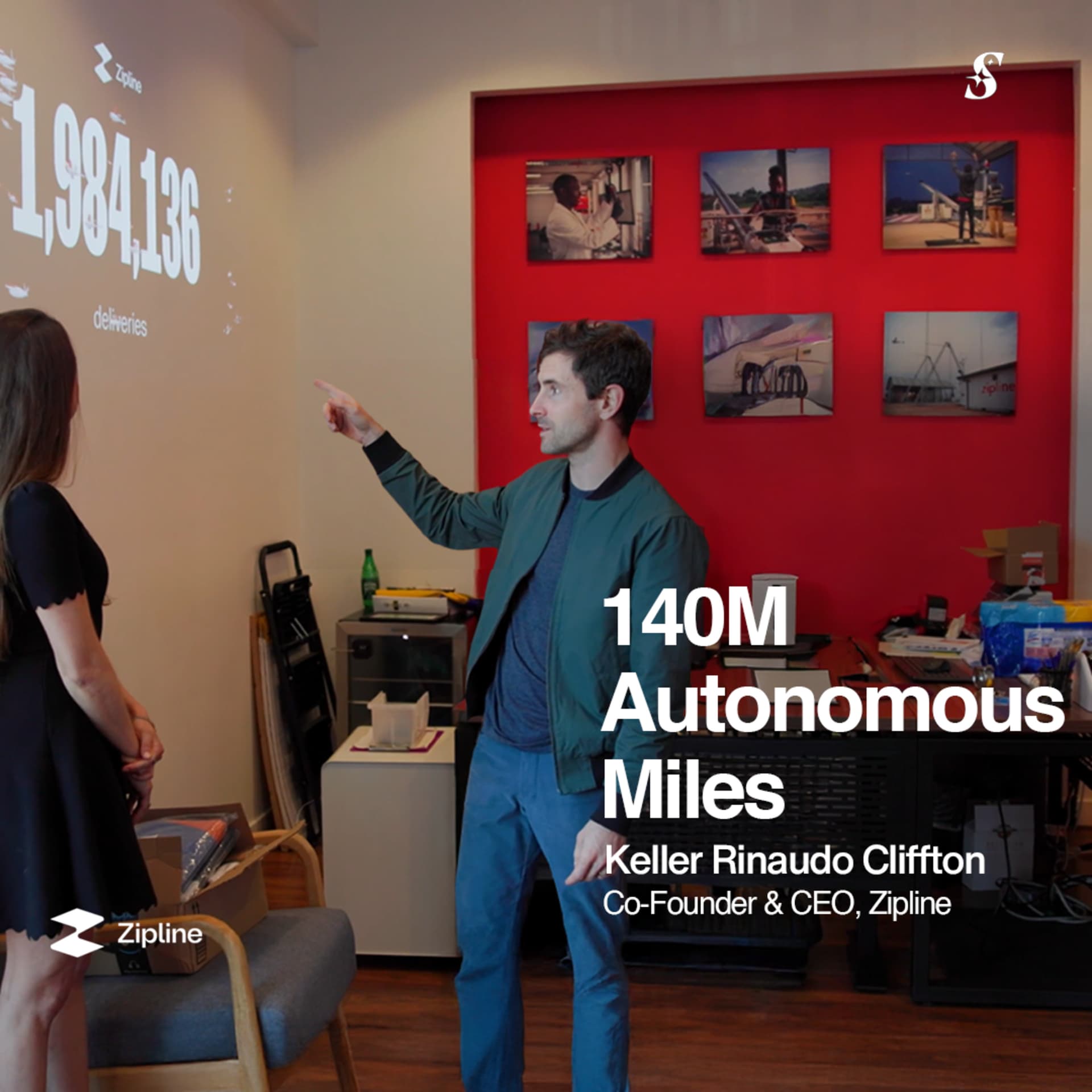
- Deliveries: Nearing 2 million total deliveries globally, with a notable focus in Africa.
- Growth Rate: Experiencing approximately 15% growth week-over-week.
- Operation Hours: Currently operating 17 hours a day and transitioning toward 24/7 operations.
Safety and Operations
- Safety Record: Achieved 125 million commercial autonomous miles with zero safety incidents.
- FAA Approval: Recently approved to operate at a ratio of one human to 30 aircraft, with plans to increase this ratio.
- Delivery Dynamics:
- First Dallas site reached 100 deliveries per day in 110 days; newer sites achieve this in as little as 2 days.
- In some cities, over 50% of homes are ordering through Zipline.
Engineering and Technology
- Team Composition: Zipline's workforce comprises approximately 1,300 employees, with more than half in engineering roles.
- Vertical Integration: Zipline follows a Tesla-like approach to vertical integration, designing core systems in-house, including motors and manufacturing software.
- Software Updates: Major software updates occur every six weeks, encompassing around 60 bug fixes and 25-30 performance improvements.
Engineering Facilities
- Remote Operating Command Center (ROCC):
- Central hub for fleet oversight.
- Employee manages multiple drones autonomously.
- Hardware-in-the-Loop (HITL) Simulator Lab:
- Tests new features in a simulated environment before real-world deployment.
- Catches 90-95% of bugs through extensive simulation testing.
Manufacturing Process
- Production Line:
- Each drone consists of 43 major sub-assemblies and about 700 unique components designed from scratch.
- The manufacturing line is tailored for efficiency and precision.
- Quality Assurance:
- Accelerated life cycle testing is performed to ensure component reliability under various conditions.
- Components undergo extreme tests for durability, including vibration and temperature tests.
---
Pivotal Moments in the Episode
- Factory Visualization: The episode showcases a bustling Zipline factory, illustrating the dynamic environment where drones are built and monitored.
- Drone Delivery in Action: Live demonstrations of drones making deliveries, emphasizing the operational efficiency and real-time tracking capabilities.
- Engineering Insights: Keller explains complex engineering concepts in a relatable manner, making the technical aspects accessible to the audience.
- Community Engagement: Keller shares anecdotes of families engaging with the Zipline service, illustrating the positive impact on communities.
---
Conclusion The episode provides a fascinating insight into Zipline's operations, showcasing how a rapidly growing company balances technological innovation and safety. With a strong commitment to vertical integration and a focus on engineering excellence, Zipline is positioned at the forefront of the drone delivery industry.
---
Additional Links
- Follow Keller Rinaudo Cliffton: [Keller on X](https://x.com/Keller)
- Follow Molly O’Shea: [Molly on X](https://x.com/MollySOShea)
- Sourcery Podcast: [Sourcery on X](https://x.com/sourceryy)
- YouTube Episode Link: [Watch Here](https://youtu.be/_qbbwichFIk?si=9KYIFVhzvFuWLX2Q)
---
Sponsors
- Brex: [Visit Brex](https://brex.com/sourcery)
- Turing: [Visit Turing](https://turing.com/sourcery)
- Deel: [Visit Deel](https://www.deel.com/sourcery)
- Public: [Visit Public](http://public.com/sourcery)
---
These notes encapsulate the essential details and engaging aspects of the podcast episode, aimed at providing readers with a clear understanding of Zipline's operations and vision.
Written by AI. May contain mistakes. Listen to the episode to check what was said.
Chapters
Tap a time to open that second in VOUnderstanding Zipline's Operations
0:45 to 2:10
Exploring Zipline's delivery operations and aircraft activity.
“You can see we're just about to cross 2 million total deliveries.”
The Rock: Remote Operations Command Center
2:10 to 3:06
Introduction to the Remote Operating Command Center and its significance.
“And then December 10th is a completely built out manufacturing facility.”
Zipline's Growth and Expansion
3:06 to 4:25
Discussion on the rapid scaling and growth of Zipline's operations.
“This building actually used to be a Harley Davidson dealership.”
Live Delivery Tracking at Zipline
6:26 to 8:00
Overview of live delivery tracking and operations at Zipline.
“So you can actually see, you know, there are there's one aircraft actually making delivery system Pea Ridge, Bentonville.”
Engineering and Testing Systems
8:00 to 12:01
Insights into Zipline's engineering processes, testing, and safety measures.
“Oh, look, a new delivery was just placed.”
Manufacturing Line for EB3 Drones
12:40 to 14:00
Exploration of the manufacturing process for Zipline's drones.
“So you're going to kind of see where we're building all of that.”
Building Drones from Scratch
14:00 to 18:00
Learn about Zipline's unique manufacturing process and software integration for drone production.
“All of these are designed from scratch by ZipLine, we have a global supply chain.”
Innovative Drone Docking Systems
18:00 to 21:40
Explore the advanced docking systems that charge and communicate with Zipline's drones.
“This dock is the piece of hardware that we're installing on the towers themselves.”
Enhancing Delivery Experience with Robots
21:40 to 23:30
Understand the design choices for Zipline's delivery robots and their impact on user experience.
“Some of you may not have heard this yet, but our sponsor Public just launched something called Generated Assets, and it brings AI into investing in a way I've honestly never seen before.”
Robotic Delivery Systems in Action
24:10 to 26:20
Learn how Zipline's robotic systems ensure accurate, reliable package delivery.
“to a lot of our healthcare partners, the AVG, obviously a subscription, a nursing home, and a super-driven, and it's a clever question of your GPS portments.”
Show all 15 chapters
Rigorous Testing for Reliability
26:20 to 28:00
Explore the extensive testing procedures Zipline uses to ensure drone reliability.
“This is testing the roll tilt mechanism, which is a really important part of the aircraft.”
Extreme Testing for Drone Durability
28:00 to 28:39
Learn how extreme conditions are used to test the durability of drone components.
“to where we're basically almost forcing the thing to break.”
Understanding Vibration Testing
28:47 to 30:02
Explore the significance of vibration testing in drone design.
“how it is, that's what I was talking about earlier, it goes from water to the body where it stirs it.”
Demonstrating RC Fan Testing
30:02 to 34:48
See how RC fans are used to simulate flight conditions during testing.
“they can get really high, I think about 80 miles indoors with the vibration.”
Accelerated Life Cycle Testing Explained
34:48 to 36:46
Understand the concept and importance of accelerated life cycle testing in engineering.
“If you go in front of them, they just sort of blow your head.”
Transcript
Automatic transcript. May contain errors.0:28Welcome to Zipline HQ. giant car factory that was right next to engineering for the first several years. We've just been approved by the FAA to now fly one human to 30 aircraft. We'll soon go well in excess of that. Humans aren't really flying the aircraft. You have a human overseeing a large fleet of autonomous vehicles. My snot. That's pretty advanced.
1:00Welcome to ZipLine HQ. You can see we're just about to cross 2 million total deliveries. Wow. Yeah, that'll probably happen in the next three or four days. All of these aircraft flying around that number, do you want to guess what those are? Active flights? Yeah, exactly. Really? Yep. So every one of those aircraft is out making deliveries somewhere in the world. Right now, most of the Africa business is slower. It's like middle of the night Africa time. But if you come in in the morning, you can like barely see that number. There's so many aircraft making deliveries. Wow. Yeah. Let's actually, speaking of seeing the aircraft making deliveries, Let's go check out the rock.
1:30What's the rock? There's a rock? The rock stands for a remote operating command center. I thought it was an actual rock this whole time. You what? I thought it was like an actual rock this whole time. No, I'm sorry. You guys are like, let's go see the rock. Okay, maybe there's like a - Are you a fan of rocks? I mean, we're in California. There's like people who love crystals. Maybe you guys love rocks. Do we seem like the type to be into energy crystals too? Definitely. Really? Yeah. We're an engineering company Molly. It's the opposite of that.
2:04Yeah, this is actually kind of a, you know, cool example by the way, you know, just getting a sense. So yeah, October 10th, that's what that space looked like where we were just standing. And then December 10th is a completely built out manufacturing facility. So this is all of Zipline HQ behind us. The zipline is about 1 ,300 people. We're about 800 people in the US, and more than half of those people are engineers. Everything from electrical engineering, firmware engineering, all different disciplines of software. So all of those teams are what you see behind us. Most of this column is actually the autonomy team.
2:38So responsible for machine learning, detect and avoid, computer vision, both on the zip as well as on the Droid. And then behind them is like a system systems test, embedded engineering, mechanical engineering, supplier industrialization engineering, and then over here is... You guys are gonna need a bigger office soon. Yes, in fact maybe you just saw something that we can't announce yet, but yeah. The zip line is soon gonna be expanding offices. This building actually used to be a Harley Davidson dealership. No way. Yeah, so they would actually do all of the maintenance of the bikes would happen downstairs and then upstairs they like had all the motorcycles this was like the showroom.
3:17What's his job?
3:21Very friendly. Emotional support. ZipLine you know it's a lot of tough days trying to build a company like ZipLine. Yeah come on in. Okay.
3:36This is my desk. This is your desk? Maggie, ZipLine's chief of staff. Hi. You're on camera? This is Molly. We have a lot of questions for you. Are you prepared? I'm just kidding. So this is mostly like powertrain, electrical engineering, more firmware engineering. This is the safety and reliability team over here. And yeah, if you want, we can go check out The Rock. Let's go check out The Rock. Yeah.
4:12So yeah, ROC stands for Remote Operating Command Center. This team is responsible for all flights happening everywhere in the US. We've just been approved by the FAA to now fly one human to 30 aircraft. We'll soon go well in excess of that. But essentially, humans aren't really flying the aircraft. You have a human overseeing a large fleet of autonomous vehicles, if that makes sense. You can see we track everything from uptime to the kind of cohort analysis of how quickly these sites scale. Zipline is now operating about 20 sites in Dallas alone. Each of those sites scales faster and faster. So it took us, I think, about 110 days to get our first site to 100 deliveries a day.
4:58We now have sites that hit 100 deliveries a day in two days. The sites are just scaling way, way faster. In some cities, we have over 50 % of homes ordering from Zipline. It's kind of insane. That's insane. More than half of all homes ordering from Zipline in some of the cities. Oh my gosh. That's crazy graph. Yeah, it's pretty cool. We're definitely in the vertical part of the curve. And then if you want to come a little closer, you can actually see these deliveries happening live. Sorcery is brought to you by Brex, the financial stack trusted by more than 30 ,000 companies, including one in three venture-backed startups in the U.S.
5:33Nearly 40 % of startups fail because they run out of cash. Rex is literally built to help founders avoid that. Unlike traditional banks that let your money sit idle, chipping away at it with fees, Rex is designed to help you spend smarter and move faster. Their all-in-one solution combines checking, treasury, and FDIC protection into one powerful account. You can send and receive money globally at lightning speeds, Get 20 times the standard FDIC coverage through their partner banks and even high yield from day one. But same day and even same hour liquidity. Access your funds anytime. Companies like Scale AI, DoorDash, Service Titan, HIMSS, Anthropic, Flexport, Robinhood, and Plaid trust and use Brex.
6:18Start today at brex.com slash sorcery. That's B-R-E-X dot com slash sorcery. So you can actually see, you know, there are there's one aircraft actually making delivery system Pea Ridge, Bentonville. So you can see all the different 20 sites are being tracked here. And we look in, you know, Pea Ridge, we can see two deliveries happening right now. So there's a zip, you know, in the northeast there. You can see a zip that's making delivery. Now it's on its way back. And it also looks like there's a zip that's outbound to make a delivery in the southwest. And then as more deliveries come in, we'll get to see packages get loaded into these aircraft, and then the aircraft take off and go make deliveries.
6:59So we might get to see that over the next two or three minutes here. You can also see all the other sites, and they almost all have deliveries that are happening right now. So yeah, that's a lot over there. Yep. A lot of these sites are, I mean, you know, we're right now, we're operating sites about 17 hours a day, we're soon I'm going to transition 24-7. It's kind of insane, you know, just getting to watch, like, the CCTV. And by the way, the system's growing 15 % week over week. So it's, you know, I'll go, like, two weeks without coming in, like, really, like, watching the rock. You come back two weeks later, it looks completely different.
7:32Like, the system is scaling so fast. Almost every two weeks, it's, like, a completely different level of scale that you can observe by watching these flights. So we'll actually get to see here probably in the next 60 seconds, you'll see a zip actually hover down and land into those docks. So all of this is controlled by this team. So one central control team for all aircraft in the U.S. Actually, sorry, there are two control centers. This is one of them. Oh, look, a new delivery was just placed. So see how the bullseye just appeared? Yeah, now down in the southeast. So that means that a zip has just been given a route.
8:10we'll probably see a zip take off here. I don't I didn't actually see it take off. So yeah, you give it maybe 30 seconds. We'll get we're probably gonna get to see a zip land here and a zip. Oh yeah, there you go. See top right that aircraft is taking off. Oh yeah. There it goes.
8:33So it's had its route automatically loaded onto it. Now you can watch it go out and make that delivery to the south to the southeast there's also a zip that is landing because we just saw it fly back right but we haven't seen it land so let's watch and we'll see we get to see a zip hover in and land but yeah i mean coming over and watching this is honestly you know it's a little bit mesmerizing because it's like these systems are just now operating for the public to watch maybe we should we don't have that today it's like a zoo camera yeah it's probably i know it's not a bad idea i wonder if there would be the googly eyes on them there there you go look there's a zip coming home after making a delivery.
9:08Cool. Yeah, we probably should do something like that. It's so fun to watch. Yeah, it's really fun. I would watch it just from home. Yeah. And keep in mind, we're watching the CCTV of one of the sites here where there are 20 other sites that are just cycling, yeah, 17 hours a day. Put the googly eyes on them, start naming them, and then all of a sudden you have a zoo. As cute as possible. Yeah. Yeah, I think it's a good idea. I feel a lot of the powertrain teams are designing everything from battery management systems to the flight computer to the power distribution boards. And we actually design the electric motors from scratch.
9:39In fact, we can pick one up in a sec. So what you're looking at is HIDL. HIDL stands for Hardware in the Loop Simulator. Zipline has 140 million commercial autonomous miles with zero safety incidents. That's hard to do when you're constantly iterating on all the different aspects of software and hardware in the system. Right now, every six weeks, we're doing a major global software update to the entire fleet. typically that'll include like 60 bug fixes, 25, 30 performance improvements, plus a lot of major new features. All of that has to be really carefully tested before we put it on an airplane, right?
10:14And you do not want to like find out for the first time that a feature is failing by putting onto an aircraft and crashing it, even at a test site. Every one of these layers is, you can kind of think of it like the brain and nervous system of an airplane. So this is the battery, battery management system, cellular antennas, Wi-Fi antennas, flight compute, power distribution board, four electric motors, which are designed from scratch by Zipline, plus the red motor controllers you can see on top, winch motor controller, mixed motor controller. So the droid brain, this is actually an NVIDIA GPU running on that small cute robot that's actually, you know, controlling its own position when it's delivering to a house, plus the dock electronics.
10:51So that larger board is what's controlling that big hockey puck dock that's the landing station for the zip. So every one of these layers is an airplane. So, and every airplane is connected to a powerful simulator that is simulating a world for that airplane to fly around in. It's kind of like, think of them all as like dreaming, right? So you're surrounded by like 30 aircraft right now. They're all flying in the matrix. And we'll download all new software onto this fleet. We can cycle through tens of thousands of flights in simulation running on the actual flight avionics itself. We can typically catch 90 to 95 % of bugs and performance software problems here.
11:29Before we then go to the final layer of testing, which is the test site itself, where we're going to deploy onto real aircraft and fly at scale. Once we do tens of thousands of flights at the test site and everything's working perfectly, then we can do an over-the-air global update to the national fleet of that new software version. Kind of makes sense? Makes sense. Yeah. So this is all kind of, I mean, it's in the weeds, but this is a huge part of Zipline's competitive advantage. Like this kind of infrastructure, this kind of investment in testing and validation is how we move at a very high engineering velocity while still deploying a product that's super safe for the neighborhoods that we fly over.
12:03I feel like I'm in a secret laboratory. Yeah, that's what this is. Turing is training the next generation of AI with tasks that require real expertise and real world judgment. That's why companies like NVIDIA, Anthropic, Salesforce, and Gemini partner with Turing. Turing builds realistic reinforcement learning environments and data systems based on real operational traces, the kind of infrastructure Frontier Labs need to train superintelligence. Visit turing.com slash S-O-U-R-C-E-R-Y.
12:40So you're going to kind of see where we're building all of that. This is the current manufacturing line for EB3. So primary structures start here. This is all the structural strength way through the air. Oh my god! It's really like... Try to pull it apart. I can pull it apart. Yeah, try to break it. You might be able to break it. You slam it. But yeah, this is a sequel carbon fiber structure that comes out of the mold. It's kind of like using a process of sort of like injection living for carbon fiber. and it's a really really hard thing to design. It has to be obviously not just strong, it also has to be very rich.
13:26One thing you worry a lot about with an aircraft is you have to worry about you know whether you're exciting different different kinds of vibration and the aircraft can actually shake the aircraft apart. It's actually like one of the main failure modes for an airplane. So anyway, those primary structures basically come onto the line and immediately start routing bus bars and through the main primary structure. We then also installed the flight computer and the power distribution board, all different avionics. There are about 43 major sub-assemblies on each aircraft and about 700 unique components.
13:59So you can see a lot of the components that get assembled onto the aircraft is being used in these bins next to each substation. All of these are designed from scratch by ZipLine, we have a global supply chain. And as I mentioned a lot of those components are actually now manufactured here. So for example we can go see the battery welding line in a second. So it's kind of cool if we stop for a second. You can see the power distribution board, flight compute board. We've now run the wiring and the buck bar roof primary structure itself. So we're ready to plug in the electric motors. Also designed to move it from scratch by ZipLine.
14:35You can also see the, we call this the winch assembly. This is both the latch, the docking bin that basically latches into the dock, as well as the winch, use the bitters and muller the droid when making flippers, or when we're loading a package into the aircraft. But yeah, as we come down, all of the software, even the software, You can actually probably see on the screen here, even the software that controls all manufacturing instructions. Oh my god! That's pretty advanced. I'll click that. So all of those manufacturing instructions, all of Zipline's manufacturing software system is also built on scratch by Zipline.
15:19That might sound weird. You would think, oh, you probably use some kind of... Because there are plenty of companies that make software, like an MRP, it's clearly called. Oh, he's on the call with him? Yeah. So it's a weird thing to do, really like any other companies that do that, like I know of our Tesla and so set, but designing your entire operating system for the company, all the software that we use on the manufacturing floor, all the software that we use on the internet site, service center, all of that. Not only are we building all the software that runs on the aircraft, not only are we We're building the communications architecture, we'll give it where we can put Shannon.
16:00Also, we're facing app because of an app that people download the orders. We also build the unmanned traffic management system that provides the FAA. But after all that, we're also designing the operating system for the company itself, which is controlling supply chain, manufacturing, maintenance, logistics, everything else. Might seem like a weird or nuanced belief, but it's a really big enabler to what we do. So the other advantage of being in control of all that software is it allows us to have full track and traceability of every single component to this aircraft. That's a big component of our figure to our suit.
16:37If ever something goes wrong in the rear goal, we need to be able to identify local bonus sales, track that goes on into a specific batch, and then you should be able to know every single pilot aircraft besides it. You can quarantine if necessary, you can put that by the supplier and create a new kind of quality process. This is super important in terms of designing systems that are not just really cost effective, but they are also extraordinary. And at the end of the day, the zipline has run 140 mAh in the amount of small. It has zero tickets. If you were to drive 113 miles per car, even in a place like the US, you would have about 600 crashes, 100 injuries, and so much means 20 to catch.
17:24So not only is the goal to save lives, like the greener lives in modern places, but the goal is also to allow them to just have to fundamentally see the remote access.
17:39This whole building, you know, it's been a huge advantage, like very sort of similar to, you know, Tesla originally had Fremont, right? They had like a giant car factory that was right next to engineering for several years. This factory has been a huge advantage, like this building has been able to expand into more and more of it. It's just a huge advantage to have all of this stuff tightly integrated together. it allows us to be lightly fast. These are actually docks. This dock is the piece of hardware that we're installing on the towers themselves. I just posted something on X six days ago. It was like a new 12 dock tower design.
18:20I don't know if you saw that. I loved how I actually posted that. People were asking Grok, because I just said XGen, people were asking Grok, what is this? How does it work? And Grok was saying, don't worry, this is a CGI rhetoric of some kind of technology. So it's like, awesome. Because that's actually, you know, Grok is incorrect. That is, you know, that is operating in its real world today. But yeah, so these docks fall on touts. These are basic, like, superchargers for aircraft. The dock, so the aircraft's function below latches into the dock. The dock tees the aircraft. It charges the aircraft.
18:57it actually it was preconditioning the battery. It's actually a project that, depending on the temperature, it also uploads data on your ground network. Every place is centered over a gigabyte and a flight data and a limit rate is super useful to make all future flights safer. You saw on your all-in interview that people would go to their patients and touch them. Yeah, yeah, it's the thing. They'll bring their kids. Young kids will ask. They'll be like, where do you want to go? Do you want to go to the park? Do you want to go to the museum? Because they'll be like, I want to go to a zip line. So they'll drive to a parking lot and they'll sit and just watch the air.
19:36You don't have to start getting an ice cream stand. I know, I know. We need to be like selling swag. That could be another component of the business, you know, selling t-shirts and food. Kind of like the Tesla diner, you know, the supercharger. Yeah, it's a thing. Yeah, lots of batteries, weight, going to aircraft. And then this is a lot of droid manufacturing. So, you know, the droid is that smaller, cute robot that's actually controlling its position on X and Y axis when we're landing. It looks like the thing doing swimming. Yeah, a little like that. Yep. We kind of designed it to go a little inspired by like me from WALL-E.
20:14Yeah. Yeah, you want it to look cute and you want and it needs to exactly like you want it to it needs to be safe but just important it has to feel safe. Actually, when you see kids and families receiving deliveries from Zipeline you can tell they feel safe because it's quiet and this robot feels friendly is safe, it looks safe, kids feel comfortable being right next to it, grabbing the packages and kids go over. This is the reason, you know, people have this, like, concept in their head of, like, because some other companies are actually doing this, you're, like, descending this massive octopopter of, you know, sounds like a lawnmower of death, who was in, like, you know, 20 feet of you, it's like, you know, you're, you're, you're, like, incredibly loud, incredibly scary.
21:04It's actually super dangerous to have an aircraft of that size from that close to your house. And that's all insane. For this to actually work, you've got to have this as a better experience. It's more magical, quieter, safer than the way that you do that. The way you do that is making the main aircraft super quiet. And keeping it 100 meters in the air at all times. It's really cute robot like the droid. Have you thought of putting Disney eyes on it? Yeah, we have. I like the idea of doing like stickers on the front of having little like two little chip hunks like holding flight controls of like, you know, aviator goggles and things like that to make it look like two little chip hunks are controlling you.
21:43Some of you may not have heard this yet, but our sponsor Public just launched something called Generated Assets, and it brings AI into investing in a way I've honestly never seen before. Here's how it works. You type in an idea like AI-powered supply chain companies with positive free cash flow or defense tech companies growing revenue over 25 % year over year. Publix AI then dispatches a swarm of agents that scan every single US stock, evaluates them, and instantly builds a custom index around your thesis. What really stands out is how clearly it explains why each stock is included. And before you invest, you can even backtest your idea against the S &P 500 so you're making decisions with real context, not just guessing.
22:22And beyond generated assets, Public lets you invest in stocks, bonds, options, crypto, all in one place. They'll even give you an uncapped 1 % match when you transfer your investments over from another platform. If you want to build a portfolio that actually reflects your thesis, visit public.com slash sorcery. Paid for by Public Investing. Full disclosures in the description. Yeah, never mind. We're not beyond making it look super cute. Actually, here's more droid testing that you can see here. Hey, how are you? So you can see this has been cycling a lot from the Wii. Literally just cycling it day after day.
23:00It's a 470. It's a thousand cycles. This might look on fancy usage. Every single component. Just a crazy life cycle. So obviously in a delivery, that would lower 100 seconds. Right now we're obviously lowering 5 seconds. We're just testing a little bit more to see what fails. Every single one is 700.
23:28We will test in all different weather conditions. We will destructive test, vibration test.
Read the full transcript
23:38If something's going to fail, we want it to fail here rather than fail in the rear. Yeah, as long as it fails here, we can then figure out what we need to change, improve it, and upgrade everything. So when people are, when you see an order, what do they, like, is that the term? Yeah, today, placing an order is super easy. I mean, you just download the Zipline app. If you're living in one of Zipline's metros, you just download the Zipline app, and then you can see all the different school friends. You can see Walmart, Poetway, Whitney, Buffalo Outwing, Sweetgreen, Bodywater, I mean, Perker to a lot of our healthcare partners, the AVG, obviously a subscription, a nursing home, and a super-driven, and it's a clever question of your GPS portments.
24:23I think I saw in one of the demos that you can, maybe, I don't know, this just happens everywhere, but you can see aerial footage of your house and choose the location you want to drop it down on. Yeah, the first time you're ordering, you just type in your address, we show you a satellite image of your house, So you get to choose exactly where you want to send it. It's a really big advantage because a lot of houses, you know, being able to have something over to your backyard is like more secure, more private, you know, worry about much higher risk. Yeah, that's great. And a lot of people really love just being able to like, you can literally tell it exactly where you want to go, like on the side of your pool or on your front doorstep or in your driveway.
25:02The other nice thing is like these kinds of robotic systems, they're really reliable. Like once you say how you want the thing delivered, we will deliver to that spot every single time without fail. We deliver in a highly accurate time go. Because you're not worrying about trap day or what human being. How many orders can someone the house? I think you should test it out. We don't necessarily want people trying to do that because as I mentioned right now we are like severely supply constrained. You know we need people only ordering what they definitely need because right now the system is struggling to keep up with demand.
25:41Yeah, but say like either one keeps on a birthday or you don't like someone. People do that. You want to break their mouths. So interestingly, you know, birthdays are huge. Tons of people are like for birthdays having birthday cakes or cupcakes and deliver like in front of all the kids. This is one of the reasons we've been able to turn off all the card today because this is viral. It makes for really good TikTok content. Good for you. A lot of people are making these TikTok videos that you can see 10 or 10 million times. So this is a lot of the, you know, we just walked by a lot of the halt chambers that like accelerated life cycle testing chambers.
26:17Every single component we will, you know, heat up, cool down, we'll vibrate it, we'll try to break it all kinds of different ways. This is testing the roll tilt mechanism, which is a really important part of the aircraft. You can see 20 of growth of my connections right there. They are running right now, but any new, basically any hardware iteration, we will do millions of hours of testing across these methods and different components to make sure that we have fully characterized the real life with the component before it goes to the outcome. This is a lot of it to you. It's a design. A lot of those end of line test jigs and light type of work used.
26:54Hey team! One more cool thing to show you is the Vive Lab. We obviously think a lot about the reliability of the system, as well as how many life cycles you get out of an aircraft. Airplanes have to think, you know, cars you already worry a lot about vibrations, airplanes have to worry even more about vibrations. Because when you're spinning motors, and especially when you're transitioning from hover into fixed-wing flight, You get something called edgewise flow across the propellers that can cause some pretty serious vibration from the, you know, through the propellers into the motors and then infilling itself.
27:32If the primary structure happens to vibrate at that same frequency, you can basically shake them apart. That's one of the reasons it's hard to build reliable vertical to take on a great aircraft. And so we do a huge amount of testing from a vibration perspective. This One of the test setups, these are like large vibration tables that we use. We also use this system over here where we can actually hit things with like liquid nitrogen and like instantly cool them down to a super cool, to a very cool temperature to where we're basically almost forcing the thing to break. We're going to like subject it to such extreme temperature and such extreme vibration that we can force the thing to break and therefore determine like what is the weakest part of the structure itself.
28:19We can go back and wait for a set-for-the-structure. So yeah, this might all seem kind of technical or in the weeds, but this level of testing and validation is required. That's how we're going to build a system that has 140 million commercial companies. Founders ship faster on deal. Set up payroll for any country in minutes, hire anyone anywhere, get visas handled fast, and get back to building. Visit deel.com slash sorcery. That's D-E-E-L dot com slash S-O-U-R-C-E-R-Y.
29:16how it is, that's what I was talking about earlier, it goes from water to the body where it stirs it. So, you can do that and you can kind of see how it is. Okay, so the goal is not to like... You can do it as possible. As possible. Alright guys, this is what we're going to do here. Try to hit it up. Hey, we're going to test this out. Yep, you can see the vibration. You can see the vibration. You can see the vibration in your eyes. If you feel this, you can see the vibration in your eyes. Yeah. Right? Yeah. Cool. Alright, to be the best. To be the best. I did best. Holly approved. Okay, we're going to film this for the morning.
30:01So we usually have these pants set up for wings, kates, air surfaces. they can get really high, I think about 80 miles indoors with the vibration. That's exactly what's happening. So we'll see the vibration of the sonic. We have an O.T. depth for you on that one. We will see if you want to try. Alright, airing directions on. Alright, do one of the other. Do the green button and then the one on the screen. She wanted to turn it off.
30:42Actually turning it off is pretty cool too. It makes a crazy noise. So hit the red button. Yeah, you hit the red button. Right now? Is it on? Not really. Okay, that's it. Now you can turn it off with the green button. So green button, I'm going to walk you. So it's green button. Once it comes on, you hit this up on us, that's sweet. and light up on this just on off button and then that's when it gets running out that's what I mean wait, like, press that button and then that one yeah, pretty much well, you know, say, oh that was so good at duck for cover
31:16okay, oh, nervous
31:27it takes a second one more time one more time oh yeah all of them
31:41alright so now we're going to run the nest here so what you hear is the band
31:51straight
31:56I'm going to get that. Oh, so. I'm going to get that. I'm going to get that. This right? This right? Oh, yeah. Okay. I'm going to get that. And then, we're going to go.
32:27Thank you.
33:01Thank you.
33:23Thank you.
34:00Thanks guys. I'm going to have a little two states. Yeah, thanks. I'm sorry to watch it. Let's keep going. The fan is good. You want to do the fan? Alright, get any prediction on? So give like a little demo of this first and then if you want to get in front of them they're wild. So these are RC playing fans for like a 7-foot model jet or whatever. And we use them to, like we were saying, for tails and wings and control surface. Under wind road can get stuck, it can cause it to get stuck. So while we do a bite test, we blow air over them to simulate that it's flying through the air while going through a really fast bite test.
34:45So, let's check them out. These are pretty loud. Oh, I just have a warning. If you go in front of them, they just sort of blow your head. Do we need somebody else to do it? Go for it. You can, like, go for the view. Yeah. You can, like, feel it in your hands. Wait, are you going to blow this way? He's going to blow this way. Yeah, yeah, yeah. I'll step out of frame. He tested that. Are you going to blow my lightning back? Yeah, yeah, it's wrong. Is it a Dyson hair dryer? Yeah, it's crazy. Do you want to try it? No, you got it. Alright, you ready? Go for it.
35:35I'm not done.
35:45Oh, what do you think you can capture that? What is this? I think it's going 80 ,000 hours. It's saliva.
36:00Oh, this goes definitely faster. Oh, you're so great! I'm so sorry!
36:19That's great! Fantastic! I feel like that'll be a really good ending of the video. That'll be a really good ending of the video. My face is like... It's crazy, right? I know! Are you just sitting there all day? More than you would probably think. It's a ton of fun. It's like when you touch an electric fence. I know. It's like it's again. That was awesome. Okay, good intro for the video. All right, should we go to headquarters real quick? Yeah, we should. Are we doing a countdown time? We're running a little bit fine. Can I just quickly explain in one sentence what accelerated life cycle testing is?
36:49Do people know what that is? Does that matter? I think so. It's just like it's simulated. Yeah, I mean, look, basically the reason all this accelerated life cycle testing is so important is for any given component, you're just going to beat the crap out of it here from a testing and validation perspective. so that if it's going to fail, it fails here rather than in the real world. It's kind of how we validate every single component up to hundreds of thousands or millions of cycles. Hey, it's Molly. If you enjoy our interviews, check out our newsletter, Sorcery.vc, where we deliver a once-a-week top deals and tech headlines email and also go deeper on our podcast interviews.
37:25Subscribe to Sorcery today. And don't forget to subscribe to the podcast on YouTube, Spotify, Apple, or wherever you listen. Link in description to sign up.
From the publisher
Zipline CEO Keller Rinaudo Cliffton gives Molly a rare full tour inside Zipline’s factory + HQ—including the ROCC (Remote Operating Command Center), live flight monitoring, the HITL hardware-in-the-loop simulator lab, reliability testing, and the production line.
DISCLAIMER: This is a LIVE factory, it is noisy, audio can be inconsistent at times. Enjoy :)
Watch our full sit-down interview with Keller for more information behind their latest $7.6B valuation & financing round.
Zipline is nearing 2,000,000 total deliveries and operates what Keller describes as a global system where “every one of those aircraft is out making delivery somewhere in the world.” The company says it has achieved 125 million commercial autonomous miles with zero safety incident, and it’s scaling fast: ~15% week-over-week growth with operations running ~17 hours/day today and moving toward 24/7.
Inside the ROCC, Keller walks through how Zipline manages fleet oversight at scale, including FAA approval to fly at ratios of “one human to 30 aircraft” (and pushing beyond that). He also shares site ramp dynamics: the first Dallas site took ~110 days to reach 100 deliveries/day, while newer sites can hit 100 deliveries/day in ~2 days—and in some cities Zipline says 50%+ of homes are ordering.
On the engineering side, Zipline’s HQ team spans autonomy, powertrain, safety/reliability, systems test, embedded, mechanical, and industrialization—part of a workforce of ~1,300 people, including ~800 in the U.S., with “more than half” in engineering. Keller also explains Zipline’s Tesla-like approach to vertical integration: designing core systems in-house (including motors) and even building internal manufacturing software—“the only other companies…that do that…Tesla.”
You’ll see how Zipline maintains high engineering velocity while prioritizing safety: a major global software update every six weeks (typically ~60 bug fixes and ~25–30 performance improvements), tested across simulation and real-world flights before rolling out over-the-air.
Keller R. Cliffton: https://x.com/Keller
Molly O’Shea: https://x.com/MollySOShea
Sourcery: https://x.com/sourceryy
𝐄𝐏𝐈𝐒𝐎𝐃𝐄 𝐋𝐈𝐍𝐊𝐒
YT: https://youtu.be/_qbbwichFIk?si=9KYIFVhzvFuWLX2Q
𝐒𝐏𝐎𝐍𝐒𝐎𝐑𝐒
• Brex—The modern finance platform, combining the world’s smartest corporate card with integrated expense management, banking, bill pay, & travel. https://brex.com/sourcery
• Turing—Turing delivers top-tier talent, data, and tools to help AI labs improve model performance—and enables enterprises to turn those models into powerful, production-ready systems. https://turing.com/sourcery
• Deel—Deel is the global people platform that helps startups hire, manage, pay, and equip anyone, anywhere. Trusted by more than 35,000 fast-growing companies, Deel is the people platform that just works, so teams can scale without the chaos. Visit: https://www.deel.com/sourcery
• Public–Investing platform Public just launched Generated Assets, which lets you turn any idea into an investable index with AI. With Generated Assets, you can build, backtest, refine, and invest in any thesis with AI. Gone are the days of one-size-fits-all ETFs. https://public.com/sourcery
Follow Sourcery for the latest updates!
Disclosure
Paid Endorsement. Brokerage services by Open to the Public Investing Inc, member FINRA & SIPC. Advisory services by Public Advisors LLC, SEC-registered adviser. Crypto trading provided by Zero Hash LLC, licensed by the NYSDFS. Generated Assets is an interactive analysis tool by Public Advisors. Output is for informational purposes only and is not an investment recommendation or advice. See disclosures at public.com/disclosures/ga. Matched funds must remain in your account for at least 5 years. Match rate and other terms are subject to change at any time.


