
In short
Podcast Notes: Sourcery - How 8VC Builds Billion-Dollar Companies
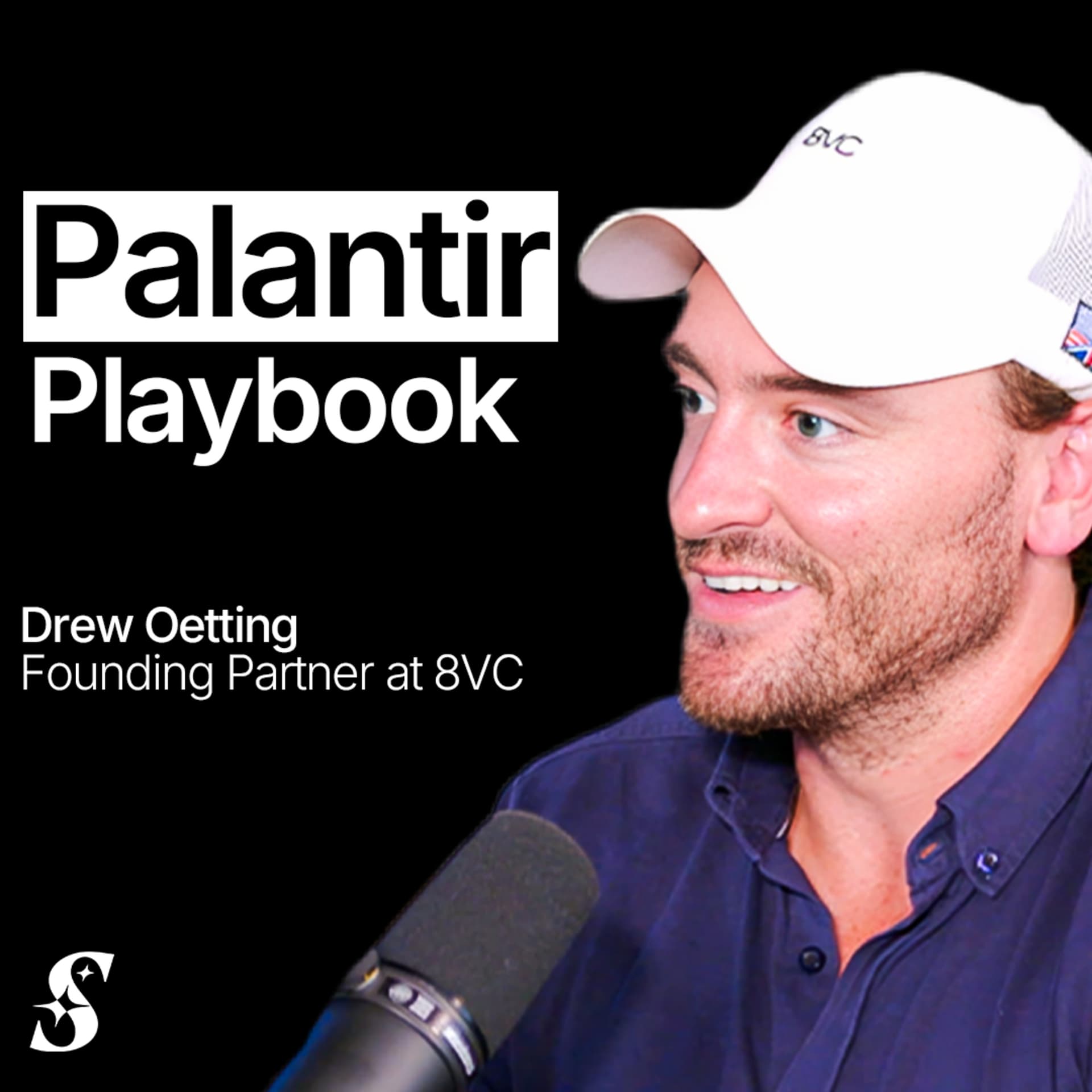
Episode Overview Podcast Title: Sourcery Episode Title: How 8VC Builds Billion-Dollar Companies Guest: Drew Oetting, Founding Partner of 8VC Description: This episode discusses 8VC's unique approach to venture capital, focusing on their "Build Program," where they co-found startups, and highlights successful companies like Palantir, Addepar, and Saronic.
---
Key Topics Discussed
- 8VC's Approach to Venture Capital
- AUM: 8VC manages over $6 billion in assets under management (AUM).
- Build Program:
- Approximately 30% of their capital is allocated to companies they co-found.
- Focus on intentional company building alongside investing.
- Outcomes:
- Successful exits and growth of companies such as Palantir ($370B), Addepar (managing $7T+), and OpenGov (acquired for $1.8B).
- 28 companies have been created, including Affinity, Saronic, and Resilience.
- Identifying Opportunities
- In-house Company Building:
- Identifying opportunities for in-house development based on unique insights and market gaps.
- The importance of structured incentives and culture in balancing venture investments with company creation.
- Case Studies
- OpenGov: Significant success with state and local government software, achieving a nearly $2 billion exit.
- Saronic: Focused on building autonomous naval vessels and shipbuilding capacity in the U.S.
- Resilience: A contract development and manufacturing organization (CDMO) focused on U.S.-based drug manufacturing.
- Industry Perspectives
- Biotech and AI:
- Discussion on the critical role of biotech in U.S. manufacturing and health resilience.
- Emphasis on the challenges of scaling biotech and pharmaceutical manufacturing in the U.S.
- Defense and Reindustrialization:
- The role of public and private collaboration in enhancing American manufacturing capabilities.
- Cultural and Policy Insights
- Federal Collaboration:
- Importance of federal government engagement with startups to support reindustrialization.
- Economic Policies:
- Need for coherent industrial policies that encourage startups and facilitate capital access for large infrastructure projects.
- Capital Allocation and Growth Strategies
- Funding Structure:
- Differentiating between initial incubation funding and follow-on investments.
- Importance of securing demand signals from customers before investing heavily in infrastructure.
- Profitability vs. Growth:
- The necessity of thoughtful capital allocation in physical infrastructure, contrasting with software startups.
- Future Trends and Innovation
- AGI and Productivity:
- Optimism about the impact of AGI on productivity and how it will redefine various industries.
- Manufacturing and Labor:
- Addressing labor shortages and the need for automation in construction and related fields.
---
Key Takeaways
- 8VC's Unique Model: The integration of venture capital with in-house company building is a distinctive approach that sets 8VC apart in the venture capital landscape.
- Intentional Design: Successful balancing of venture investments with company creation requires intentional design of organizational culture and incentives.
- Collaboration is Key: Successful reindustrialization efforts will rely on collaboration between startups and federal entities.
- Capital Allocation Challenges: Physical infrastructure startups face unique challenges regarding capital allocation and must adapt strategies accordingly.
- Future Opportunities: With advancements in biotech and AI, the future holds promising potential for reshaping the economy and addressing critical manufacturing challenges.
---
Conclusion Drew Oetting provides valuable insights into 8VC's innovative approach to venture capital, emphasizing the importance of intentionality, collaboration, and strategic capital allocation in the evolving landscape of American industry. The discussion highlights the potential for transformative change in various sectors, particularly in the face of reindustrialization efforts and emerging technologies.
Written by AI. May contain mistakes. Listen to the episode to check what was said.
Transcript
Automatic transcript. May contain errors.0:00The palance of your DNA, I think has laid the groundwork for much of what's going on here at Reindustrial. Anderil now has gotten to a size where they're going to be doing more acquisitions. OpenGov also had a nice exit. I think the thing that's underappreciated is how much your organization has to be designed intentionally to balance this dichotomy of starting companies and investing in them. But I think if you don't intentionally design the incentives, the culture, and the amount of capacity you have on your investing team, on your finance team, then it's very hard to do both well. Building the United States is insanely expensive and it takes a really long time.
0:35Part of that, I think we can address through, you know, regulatory policy and other stuff like that. But part of it is just functionally like, you know, we're not going to pay people what they pay people to work in China building facilities. They need to be paid a lot more here. So Palantir, Anderl, OpenGov, Epirus, Saronic. Which of these are your favorite? Well, I mean.
1:03Drew Oding, welcome to Sorcery. Thank you for having me. This is a big day. We're at the Reindustrialized Summit. How are you feeling? Feeling great. Feeling patriotic and pumped up about all these companies that are here. I'm working on a bunch of interesting stuff. So I love this conference. Second year being here. It's great. What's the biggest thing you've taken away from the day and the programming so far? They do a very good job here of one, having tons of startups, but then, you know, a lot of people from our government. And I think that it's probably the biggest reality of this re-industrialization concept, I think, is that it's going to require the federal government and some state governments and startup companies to interact in a way that probably hasn't happened in a long time.
1:45And I think startups are kind of a new thing for most startup founders to have to really think about. And it's definitely a new thing for a lot of folks in the government to think about because it starts a sort of a different set of challenges and playbooks that they're running than very large companies that the government's used to dealing with. So I think what's promising is that it seems like on both sides, there's a lot of collaboration starting. And you've seen this firsthand. It feels like ABC is at the center of the American mission. You're doing a lot of work, of course, down in Texas.
2:16Joe is kind of a beast at podcasting. Yeah, he's a beast at a lot of things. He's probably the highest energy, highest pain tolerance person that I know. And I think that applies to, you know, obviously building out American Optimist podcast, but also the University of Austin, a crazy project. You think about it, building a new university, it's like starting a super complex startup, but there's no like profit, you know, dream at the end of it. But, you know, working with him has been incredible. I've worked with him my entire career and he definitely is a rare individual of someone who has big ideas, you know, beyond business, but also is like willing to roll up his sleeves and actualize them himself.
2:56It does seem that building is just in your DNA. Above all that, your team has built ABC up to what it is today. And you cover many categories from biotech to manufacturing, defense, enterprise, logistics, and you've actually also built companies internally. So how did you evolve to that state and build so many billion dollar companies? It really stems, I think, from the first fund we did together. We did two funds under Formation 8, which is kind of the predecessor firm for ABC. And, you know, the first conversation I had with Joe ever, because I was right out of college, was I kind of asked him, hey, you know, you're CEO of a company, CEO of Adapar at the time, which is the second company that he co-founded after Palantir.
3:42And I'm like, and you're starting a venture fund, like, how do you do that? And he was like, well, you know, DCs are pretty lazy. So like, I'm pretty sure I can just work like, you know, just a few more hours every day and work seven days a week and then it won't be a problem. Which probably is true. Like VCs are lazier, like especially once your firm's established. Building a venture fund is hard though. It takes a ton of time. And so, you know, Joe then placed himself as CEO of Atabar and began, we began, you know, building it up. And I think it started by the fact that when we went to raise our first fund, many of the people that took a bet on us were betting on really Joe's entrepreneurial track record.
4:28And maybe he had been an incredible angel investor, but had not institutionally managed a venture fund before. And so I think that was kind of the real ticket to the dance that we had. And we kind of kept coming up with ideas for companies in addition to investing in companies. And they sometimes popped up through problems we had. Like I had to manage Joe's network as his chief of staff. And so we ended up starting Affinity, which is now a leading CRM for venture and kind of growth equity investors. we started two more companies off problems we had and when and standard metrics um you know we co-founded and so and then we also started seeing folks who were at apc that maybe were not really there to be in investors for the rest of their life and they started becoming obsessed with ideas and then starting companies so we had nate baker who had been working with us for as an intern and then as, you know, an associate.
5:37And he was just obsessed with title insurance and talks about it all the time. Eventually it's like, listen, there's not that many like, you know, technically brilliant and, you know, sort of charismatic and people who could, someone who can go recruit a bunch of their friends who is 23 or whatever and obsessed with title insurance. So you got to build a company. And so there were these early sort of data points that suggested that, you know, There was something beyond a traditional venture model for supporting entrepreneurship. And so what we called APC Build, we formalized that in 2018 and basically did that so that before we did stuff very ad hoc.
6:22So someone would start a company and if we had common equity in it or something, we would have to go raise from other investors for the seed round because it was a conflict. Or we would give all our common equity we got from founding to the fund. And it's fine for me and Joe, but we thought about proliferating the incentive around starting companies. We want to be able to incentivize our team as well in those. And so when we formalized the build program, it built the infrastructure really to be able to invest a lot of resources in build. It's now 30 % of what we do, all of our capital employees.
7:00And 30 % of it goes into companies we co-founded. And I think Joe and I and the rest of the EPC crew have probably done over two dozen at this point over the last decade or so. Wow. How do you build out the playbook for each of these companies? What are the core components you're looking for across the board? I mean, on the build side, I think there's really two major ways that they get started. The predominant way now is that we have a group of three to six EIRs at any time that are full-time employees at APC, but they're working only on sort of the process of either coming to an idea or getting it ready to kind of launch.
7:48and some people come in with like they might be like I'm either gonna do healthcare or logistics like that broad and maybe they're incredible product or engineering people and we kind of you know haven't spent a bunch of time with investing partners and and and then farther down the line potential customers and some of like the strategic partners we have who can help vet their ideas and and then other times we have an idea and we go recruit specifically against it as we've After we kind of structured ABC Build, it allowed us to have more EIRs, which I think... Then there's a natural person to then launch it.
8:27I think also top founders, they want an idea to be theirs, at least to some extent. And so if you over-refine the idea, then it can become less interesting to a founder who wants to take it... you know, put their own, kind of put their fingerprint on it. And also, frankly, like they probably are going to be better at vetting the idea because they're actually going to go dedicate their life to it. But there's still some times where we have an idea and we're obsessed with it. And so then we go recruit specifically against the idea. It seems like over the last year or so, especially when the VC market was really questionable, I feel like we've gotten to the point where we totally forgot about that, but there was a huge panic state.
9:20And then, you know, funds started to pull things back together and it looked like, oh, let's all do the roll up strategy. And so that was a trend at some point. And then there was also, you know, building things in-house. Oh, how are we ever going to make venture returns again? Let's build it in-house. What is your perspective from having that actually ingrained in the fund? Yeah. of all these other funds doing this and it kind of looking a little touristy? Well, I think that there's, I think it's, I think the thing that's underappreciated is how much your organization has to be designed intentionally to make, to balance this sort of dichotomy of, of starting companies and investing in them.
10:07There's, there's definitely some overlap, But I think if you don't intentionally design the incentives, the culture, and even like the staffing and the amount of capacity you have on your investing team, on your finance team, then it's very hard to do both well. But it is possible for sure. It's just that it almost has to be like an innate thing. Or it can be by exception. I think there always will be exceptions where a firm is an incredible talent pool and that someone either gets bored being a partner or an associate or something, or they have a really big idea and they do it by exception. I think that's actually probably the second best way to do it.
11:00If you're not going to go like all in on integrating the incentives and, and frankly, also the, the skill sets that you need to do, you know, great investing and company building. And so I think that's the, that's the underappreciated part of me. I think most of the firms that are trying it, they have good reason to try it. They have great brands, they have tons of capital. They have insight on the market. I think what sometimes they don't have is a culture and an incentive structure, which makes it symbiotic with the investing side, as opposed to either a clear afterthought or a, or frankly, a competition for resources and a, and a potential source of politics.
11:49But, you know, those are things that you, that you have to work through. and we're just lucky that we sort of worked through those a lot maybe earlier. But there's certainly, we're not the first people to do this. Sutter Hill has done this better than anyone. There's some biotech funds that have done it exceptionally well. And so it's not totally sort of an unproven path, but it does require a lot more. it requires you to run your company differently. When you talk about the 30 % you allocate towards build, how much of the allocation is in the initial incubation of it? What kind of checks are you writing into the companies and then how much of it is sectioned off for follow-on?
12:39It really varies actually. And it varies because what we're trying to do is we try to launch a company with as much unfair advantage as possible. Sometimes capital is an unfair advantage. and sometimes getting the talent or maybe even being able to win a design partnership or something requires more capital at the table from the beginning than if you just went and raised a seat around. Sometimes it doesn't though. And so the initial check size for us is like it's probably three to four million on the small side and maybe 25 to 30 or 40, the bigger side. And then there have been times where we also found these companies with other firms that put capital work, whether they're strategics or they're other investing firms.
13:29And in those cases, sometimes those first rounds are larger, but we're still... Check size for us is still usually in that range. I want to talk deeper about the portfolio because you guys just... You have so many fun names. So many fun names. We're at Reindustrialize, So I'll keep it categorically bounded. Okay. So Palantir, Andurl, OpenGov, Epirus, Saronic. Which of these are your favorite?
14:03Well, I mean, I think it's hard to have favorites, right? Because it's like what? It's not like, you know, there's a lot of different things to prioritize, right? Are you talking about in terms of name? or are you talking about in terms of? It's a trick question. Everyone hates that question, right? Yeah, yeah. I want to talk like a little bit more about them in terms of the impact that they have on the industry. Of course, they're like, they're seismic companies. They've made a real difference, especially Palantir. It's public. It's huge. Anderil now has gotten to a size where they're going to be doing more acquisitions.
14:38OpenGov also had a nice exit. So all of these, you know, they're substantial companies. so maybe just pick one or two um and kind of like break it down a little bit more well palantir really predates predates me uh so i'll put that aside and obviously it's a huge public company now so i don't i don't know much about it but it's a super important company and it and the reality is also the palantir dna i think has laid the groundwork for much of what's going on here at re-industrialize i think between palantir and spacex um they really one is that that is a talent pool that a lot of folks draw on when either they want to sell the federal government or when they want to build physical infrastructure and scale it.
15:25And so I think those companies are really important. So Palantir, the DNA from there has led to a lot of those companies and our investments, frankly. But in terms of I mean, I think OpenGov is probably the, on a relative basis, like I think having like a nearly$2 billion exit for state and local government software is like probably equivalent to like a Palantir type outcome or something. It's so impressive having watched Joe and CEO Zach Bookman build that company because I was on the first sales calls when they won Palo Alto. And it was like, whoa, that's so cool. We got the first customer. And then you start doing the math of how many customers they need to get and to make it a viable business.
16:18And you just think, wow, this is going to be really hard. And it was really hard, but they really did it. And I think, so it's now growing even faster than ever after the acquisition. So it's impressive because I think it highlights that in a place that every VC in the world, like, oh, GovTech, maybe you could do federal, role, but like, are you really going to do state and local? Um, you know, is this sort of very dismissive view of it? Uh, and yeah, it's probably harder than building like the average vertical software company. But, um, but I think it just, it goes to, I think, you know, like I mentioned, Joe's pain tolerance is vision for things that other people, you know, might just not ever want to touch.
17:03And so I think I just, it, it holds like a special place for me because I think it's just, it's such a testament to, I think, that determination and that drive, even if it's not the biggest company. I think Ceranx also just, it's a more recent one. Probably it's one of the first companies we did from build in Austin after we moved there in late 2019. And the founders are just amazing. um you know do you know the ceo um you know navy seal and you always kind of you know know that you can be great leaders and um come under pressure but you know have huge ambition but you see it up close and like see how it's manifested in the company culture and the way they operate it just like confirms that and i think it's something that you know you can intellectualize you know oh yeah of course navy seal is gonna be a great leader but like you know you see it and you're like, whoa, this is like really special.
17:59Uh, and, and Viv, you know, he actually, the CTO, he was, he was an ABC fellow back in the day. Um, and then worked at standard metrics and at Andrel and then, you know, was ready to build his company and came and joined us. So it's, it's cool also because it comes full circle. Um, where, you know, I think first met him when he was, I don't know, 19 or 20 or something. And now he's like, an incredible CTO. So that one's a cool one. Plus it's in Austin, which is fun to go see them. And they also work six days a week in person, which is pretty cool. Saronic is like a rocket ship. Yeah. Yeah, it's an incredible company.
18:37It's crazy the amount of progress that they've made in such a short period of time. Is that a testament to build? Were you able to unlock a bunch of doors for them? Sorcery is brought to you by Brex, the financial stack trusted by more than 30 ,000 companies, including one in three venture-backed startups in the U.S. Nearly 40 % of startups fail because they run out of cash. Rex is literally built to help founders avoid that. Unlike traditional banks that let your money sit idle, chipping away at it with fees, Rex's designs help you spend smarter and move faster. Their all-in-one solution combines checking, treasury, and FDIC protection into one powerful account.
19:16You can send and receive money globally at lightning speeds, Get 20 times the standard FDIC coverage through their partner banks and even high yield from day one. With same day and even same hour liquidity, access your funds anytime. Companies like Scale AI, DoorDash, Service Titan, HIMSS, Anthropic, Flexport, Robinhood, and Plaid trust and use Brex. Start today at brex.com slash sorcery. That's B-R-E-X dot com slash sorcery. I think we were helpful on the upfront, but frankly, I think it's a testament mostly to Dino and Viv and the other co-founders. They're very mature, super present and patient, but also intense, which is kind of rare in founders.
20:07tend to usually see founders that are really intense, are very extroverted, very manic almost. And then you have also the founders, especially on the technical side, that are maybe more really deep thinkers, but much more introverted. And they all have this mix between the best of both worlds, which I think just means there's a lot less noise. It's incredibly impressive to see it. For those that don't know what Sironic is, Could you share a little bit on? Yes. I mean, Sironic is building basically the autonomous future of the Navy. So they're building autonomous surface vessels for naval reconnaissance, logistics, payload, delivery, ranging from much smaller form factors all the way up through much larger ones.
21:04and a big part of that, which has been a big topic here is shipbuilding capacity and so I think not only is Theronics' ambition to deliver these autonomous boats and there's a huge amount of work that goes into the software and the communication protocols and material science and stuff to make a naval vessel autonomous but the other thing is figuring out how to build ships in the United States again which is an area that we probably have, you know, the, the fallen behind the most in terms of our capacity. And that's on the defense side, but also on the commercial side as well. So in order for, you know, in order for Serenica to succeed, they also have to become, you know, a leader of U.S.
21:52shipbuilding, which is, which is really cool. And they've, they've already made their first, you know, they kind of, they bought a, an old shipyard, you know, know, and they're retrofitting that, but then they're, they have much bigger plans too. I know the portfolio also extends itself into like biotech, life sciences, healthcare that can also, you know, shift into American resiliency and reindustrialization. What are you seeing in that world that's becoming more exciting and, and maybe unlocking with this new administration and technology? Yeah. I mean, I think that the same way that a lot of the, you know, that in order for AI to realize, you know, so its potential for our economy, but yet is blocked by the rate at which we can scale physical infrastructure, you know, genomic medicine and sort of advanced biologics is similar.
22:51Right. So the manufacturing of pharmaceutical drugs is another place where the United States owns the innovation end of it and thinks a lot about manufacturing before something is, you know, when something is still being proven out. But there's not a lot of thought about scalability when it comes to the way you develop a drug. Part of that's because if you're successful, it's, you know, like a 99 % margin business. So if you can do it, if you're really bad and it's an 89 % margin, who cares, which is different than a lot of other industries. But also there's just, there has been a, there's, there's been a, a big outsourcing push, especially in more sort of standardized traditional modalities.
23:41And I think it became pretty obvious during the pandemic that the production of, you know, pharmaceutical drugs is probably something that we want to have domestically controlled, at least to some extent. And so I think, you know, in some ways it's the hardest place to innovate from a manufacturing perspective because there are such stringent regulations. And the FDA and the way that they sort of monitor and evaluate quality of manufacturing is a very static process sort of evaluation. They don't like lots of, you know, sort of continuously improving systems necessarily. But I think that's changing.
24:29And I think the other big thing is just that in life science, these facilities are incredibly expensive. They require huge amounts of labor that needs to be there, whether there is a commercial project or not. Because you're a GMP manufacturing facility, you can't have, you know, mold accumulating. If you don't run the machines, they may either get dirty or they stop performing as well. You need to keep the lights on. You need to keep the HVAC going. You got to keep paying the insurance. You got to keep doing the property tax. So they have very high fixed cost. And I think that has been a barrier for sure that I think this administration is prioritizing.
25:18and then the other part that I think they will prioritize as well which is it's gonna be an interesting one to kind of to grapple with is some of the production of this of pharmaceutical products is a pretty dirty chemical process at least at least in the sort of the way it can be done at scale today so that's why a lot of you know chemistry-based drug manufacturing processes have been moved to places with lower environmental standards. So if you can dump all your chemicals into the water, you know, some river, when you're done with three agents, it's a lot cheaper than if they need to go into a bomb-proof, you know, detention tank and then transported to some biohazard, you know, thing in a mountain somewhere.
26:09And so I think that's going to be a decision we need to make. Either we're comfortable, figuring out ways to reduce that burden from frankly just environmental regulation and deal with frankly the trade off of that which is that there may be some sort of cost to it or we have to invest really aggressively in new technologies that right now are not necessarily commercially viable, even if they're technically viable, because pharma companies are rationally incredibly averse to switching their process because they've already, you know, they make tons of investments or acquisitions across all these different sort of binary bets.
27:01You get one that works, you don't want to have to go deal with changing the way you're going to manufacture that because, you know, and, and there's, there's so much money that was invested in so much money at risk. Once you have something that's commercially viable, that the current way that the, both the regulatory and the sort of market dynamics are, it's really tough to get a new technology into an existing set of programs. And I think that's one way that could accelerate these things would be if you want these sort of cleaner, more innovative, like enzymatic approaches to making certain drugs, I think you're going to have to ration with that.
27:43And I think there's a role for the government on that. There's also probably a role, frankly, for the pharmaceutical industry to, you know, do they really care about making stuff in the U.S. or not? So crazy. Yeah, it's tough. I mean, the good news is that I think in the pharma world, many of our allies have capabilities. You know, there's, you know, Europe has significant capabilities. Japan, you know, I mean, India has a huge amount of manufacturing and I think India will be hopefully a really important ally for the United States going forward. But, you know, we do want some capabilities here.
28:21Especially, you know, at least enough that we can, you know, use them in the event of another pandemic or frankly just because these are pretty good jobs. They pay relatively, they pay actually really high for manufacturing jobs. And there's a ton of downstream economic sort of activity that happens with these. These are like huge multi-hundred million or billion dollar projects. So the construction, the electrical, the HVAC, the logistics, these are all downstream of that. And again, there's a real argument that Americans should be doing that. In today's high-speed business world, staying ahead means using the smartest tools possible, including the powerful capabilities of artificial intelligence.
29:13Meet Turing Intelligence. Turing builds customizable AI systems designed to solve your mission-critical challenges, no matter your industry. From expert guidance to tailored projects, Turing helps top companies realize AI that's more capable, more adaptable, and more effective. With Turing, discover how AI can accelerate your business growth. To learn more, visit Turing.com slash sorcery, spelt S-O-U-R-C-E-R-Y. That's Turing.com slash sorcery. Are there any particular companies you're watching in this space? So we co-founded a company called Resilience, which is a, basically we started it in summer of 2020.
29:52So kind of right as the pandemic was, was underway. And it's a US-based CDMO. So we are a manufacturer of third party, you know, of other people's drugs here in the US. We have about over a thousand folks in our big flagship plant in Ohio. and and so that's like you know that's a that's been a really big company we co-founded it with Arch Bob Nelson at Arch who brings like you know 40 plus years of biotech investing experience and so it was it was a build company that I think is a good example of when we partner and he's he's got more knows more about biotech and has more connectivity than we ever will and we kind of brought I think this sort of national security and and also just kind of like operational view of these types of businesses.
Read the full transcript
30:47I also think there's some problem with biotech right now is just that the sentiment is very low. Is it weird? Kind of despite actual outcomes, both clinical outcomes, but also M &A. I think that's because it's very hard to understand. Companies go public way too early. and so the stocks go up and if everyone's happy and interest rates are zero and then they are the first thing people sell when they're like i have no idea what this actually is i bought it because it sounded cool um and there's not that many people who can understand you know who can understand it uh who also can invest in like a 500 million dollar market cap company so you know you see the stock fall and then people just you know sentiment sort of turns um and i think that's I think that's too bad.
31:36I mean, I think we're sort of obsessed with this idea right now of lean biotech, which is really the idea of how do you get as much done with as little money as possible, which seems obvious. That's what startups are always trying to do. So, biotechs, by and large, don't necessarily think that way all that much. And there's ways that now that, I think, under the new administration, the FDA is encouraging even more to reduce the cost of getting human data, which is really where value is created in life science. And so, I think that, unfortunately, the sentiment really does drive how much innovation you can do on the manufacturing side of things just because the manufacturing companies and also just bioprocessing and new tools for developing life science companies, their customer base is biotech and so and then their source of capital is VCs so sentiment does matter a lot but I'm incredibly bullish on I mean I think there's going to be almost as much a change in like the way that our economy and our lives work from genomic medicines as from AI.
32:58But I think it may be a bit of a bumpier ride than with AI where, you know, you can get 2 billion of revenue in a couple of years or something. Yeah. And you can push stuff and yeah, there's less regulation and things like that. But I, but I'm very bullish over the next 10 years. We are in a kind of wonderful period of progress and the new administration is definitely helping with that. What other initiatives are you optimistic about right now? I think, I think the biggest, well, what I would say is like being a re-industrial is like one thing is just, I think that patriotism is no longer like some four letter word among like, um, maybe, maybe among like coastal elites.
33:42I mean, I don't think it really ever like, Regardless of political affiliation, I grew up in Iowa. I think everyone flies American flags, regardless of what party you voted for. But I think it became a weird thing. I mean, it's always one of our core values on our website. So to us, it never felt weird. But I think it's good to have people be patriotic. If I could have people either be irrationally patriotic or irrationally unpatriotic, it's like, I want patriotic because we live in this country. We can't really do much about it. So I'd rather have, you know, the same way I'd rather have people be irrationally optimistic than pessimistic.
34:19So I'd rather fall on that. I think it's just good for the country, right? I think it's just, it creates like sort of a levity. People feel, you know, excited and ambitious. They want to do things. And so that's great to see from, I think, a really important set of people, which is people who are funding things and people who are, you know, deciding where they're going to work and stuff like that. and it's also good that they get a little bit more on board with probably where the rest of the rest of the country is again like kind of regardless of political affiliation um i think the big question as it relates to um federal policy from from here on is is the industrial policy side so um you know tariffs are effective in some ways they cause issues in other ways but regardless of that if we want to scale our manufacturing base really quickly there's just fundamental limiting factors that can only be removed by the government and so if we've decided that we want to move at that rate which i think really i think that's another bipartisan issue i think you know you have you have both sides wanting to do that, you have to actually remove the real barriers.
35:38And what I'm most focused on is ones for startups, because startups are kind of unique, right? Bonus depreciation is awesome. If you're Boeing, it's awesome if you're a real estate developer. And that's great. But it doesn't do anything for a startup because they're C-Corp. So it doesn't pass through their investors. They have plenty of net operating losses already. So the fact that they can write that off doesn't mean anything because they don't have any profits to write it off against. And so, you know, I think the traditional tools that the government uses for incentivizing things probably don't, most of them don't work super well for closing the gap that this wave of sort of companies being built right now, you know, the real gap that exists from a capital perspective on what they need to do for scale.
36:34Venture capital can fund hundreds of millions of dollars of stuff. If you're, you know, one of the very top companies, you can raise billions. But there's many projects out there that maybe don't even meet the threshold for return potential from a VC that would be really important for the country. And so VCs are ignoring them. There's not much less capital, capital-wise for them. And then there's certain projects that even the biggest VC funds can't fund because, and don't really make sense to, right? So, you know, shipbuilding in the United States is a great example. Talking about many billions of dollars to even kind of make a dent.
37:21Or if you talk about nuclear power, you're talking about, you know, billions or tens of billions of dollars, you know? And so in places where startups are the real sort of growth factor, I think the way that – what I'm very hopeful for is that this administration marries some of the other sort of trade-based policies they have with economic policies that make sense for startups as it relates to industrial stuff. because startups are 100 % in on building in the U.S. So a large company, they're excited about it now. They're excited about it now because they got to talk to their board about it or they got called in front of the president and he made fun of them or something or they just want to put a press release out or they were planning on already spending$5 billion.
38:13So who cares? We'll just say we're spending it here. But the second that Ireland changes their tax policy or that there's a new administration that changes the tariffs, we already have 30 years of track record that they're gonna go and they're gonna move their manufacturing wherever it is cheapest. And as a shareholder of that company, maybe I'm okay with that, but as a citizen of our country, I'm not. And so when our industrial policy is designed, it needs to take that into account and build for, and be built for the companies that are all in on the United States and have no other choice. You know?
38:53We're not going to build our, you know, our fill finish facility in any other country at Resilience. We are 100%. We're more than 100 % all in in that facility, right? Cerronex is not going to go build ports in, you know, some random tax haven place just because something changed after they've gone all in on building a, you know, shipbuilding in the US. So, and I'm very hopeful about that, but I do think it's an important thing for both for policymakers, but also for startups to realize they need to advocate for themselves. Technology is moving super fast. The industry is moving super fast, especially like in VC.
39:35Like these companies all of a sudden are printing lots of dollars overnight. And AI is a factor of that. we're getting to AGI pretty quickly or super intelligence, whatever you want to call it. A company I recently discovered is a company called Turing that develops and deploys next generation AGI systems for real world problems across industries. I'm curious from your perspective, how does AGI fit into this piece? And like, what do you think the biggest effects will be? Yeah, I think, I mean, I think part of it obviously depends a bit on like what we mean by AGI, right? So like, I will assume that what we mean by AGI is not like truly an omnipotent, like sort of digital being, because I frankly think that's a religious conversation.
40:23Like, I just think there's not really any distinction between the types of basically between theology and a discussion about something that is truly like a, you know, like a superior intelligence. um and and so i don't really worry about it much like you know either either it will delete me or like you know i mean me and my fiance's german shepherd has a great life so i'm happy to be the pet to some you know incredible superhuman as long as i get to i guess play i don't play golf all day or something whatever whatever it would have me do so i kind of don't worry about that instead i think about AGI more as like where you could have a system which could go into a variety of different application areas and very quickly effectively process mine them and understand them without lots of human or any human sort of direction.
41:20And so I think, you know, what that looks like is, I think it is a pretty big leap forward. I think what you see right now is basically people building tons of vertically specific intelligences that I still think have a fair way to go, but are like rapidly progressing. And so I think once you see an AI product that can rapidly change what it's capable of doing and without needing to be directed by the person, I think that's like where you know that's to me what like AGI would be functionally and I think it's going to have pretty profound impacts on some places I think the way it touches the physical world is actually going to be take much longer like I think that a lot of these systems are going to be really good at basically like internet people stuff because that's what they're trained on and that's who's training them like you know so obsessively now so like software engineering like for sure I think Excel work and you know some legal a lot of legal things a lot of accounting those are probably the things and then obviously you know call centers and other stuff like that I think it's gonna be a massive productivity gain at least for the next 20 years if you're like you run a construction company or you have an HVAC business because right now you're paying some person 50 grand to make your website like that's done that's not happening more you're paying some BPO to like, you know, handle your call center while you're on the job, that's going away.
43:01If you're hiring some property manager to basically move around paper, that's going away. And you need five people to manage the coordination of your scheduling of your people. I think that's going away. So I think for small business owners who do something in the physical world, it's going to make them so much more productive and profitable. And that's the place where I already see it. Like my YPO forum, I have, you know, people that don't run tech companies, they run huge construction companies, industrial companies, and like they're using it themselves, like just making stuff all the time. Um, and it's pretty impressive stuff.
43:38So I think, I think that that's like going to be a huge, um, you know, huge boom and maybe robotics will get there and there'll be, you know, a real sort of conflict between, you know, whatever robot can do electrical work and electricians. But I think that's, I think that's much farther off than, you know, automating low level web design, which I think is already done. Well, you guys just announced Bedrock Robotics recent round of$80 million to help automate construction vehicles. That's pretty, that's a pretty good real world. It is. I mean, I think the interesting thing about capital equipment, right, is like the amount of labor relative to the capital equipment already is very, very small.
44:24And a lot of, I think it's a place also where you're increasing functionality and speed more so than just like ripping cost out. So I think it will be largely an enabler and allow the left folks working in construction to be, to frankly, like just do less things that or they don't want to do and do more of the important stuff. We also have a massive labor shortage in construction. So unlike maybe in, I don't know, legal or BC or whatever, like maybe we're over, maybe we need to cut some jobs there. But I think that, listen, like building the United States is insanely expensive and it takes a really long time.
45:08And part of that, I think we can address through, you know, regulatory policy and other stuff like that. But part of it is just functionally like, you know, we're not going to pay people, but they pay people to work in China building facilities. So people need to get rightfully so. They need to be paid a lot more here. So we're going to have to have, we're going to have to invest heavily in, in, you know, systems and hardware that make people way more efficient. It's the only way to, to actually do it without just, you know, spending 50 % of our GDP on construction each year, which probably is where it would have to be if you were extrapolating on our current cost structure.
45:51Love premium merch just as much as we do? That's why Sorcery uses 4th Wall. Everyone from creators like Marcus Brownlee to podcasts like Acquired2Orgs like the Smithsonian Institute are using 4th Wall. They let you create and sell premium products without having to stress the details. They handle everything from production, shipping, customer support, taxes, even giveaways. When it's time to level up and make gear that people are actually proud to wear, that's when it's time to use 4th Wall. And that's why we've trusted 4th Wall for all of our brand wear at Sorcery since day one. Use my link in the description to get free credits for your first order.
46:27And for any VCs, DM me on X and I can get all your portfolio companies set up with a free samples credit deal. One of our partners is Brex and they help companies of all sizes from startups to enterprises spend smarter, move faster, be super capital efficient. As you think about these companies scaling over time, what are the levers that you pull on for whether you want to go for growth or go for profitability? What are you looking at? I think that it's hard to... Well, I'll use the example because we're here at Reindustrialize. So I think capital allocation is probably something that's been under-talked about in startups for a generation because software largely had pretty obvious capital allocation frameworks.
47:07And it became much more obvious. So even if it wasn't obvious in 2012 that you should think about your Cacto TV or whatever, it became very obvious very quickly. And so there was kind of these playbooks. And I think part of the other reason that it wasn't thought about all that much is because your biggest source of spend was on engineering, and then it switched to sales. And during the engineering time, you're just building quickly, and shipping product and that's sort of the productivity. And then you get to sales and salespeople are really managed based off how much money they bring in. So it's kind of easy to do.
47:41And so it's not the most complicated capital allocation. When you're building physical infrastructure, it's totally different. Because the check sizes you have to write without any feedback or huge to build a facility, you can't build like one one thousandth of it and be like, ooh, it's working. Let's do more. I mean, you might be able to modularize some, but there's really long lead times on equipment. There's lead times on labor. So if you're too incremental, then you just built a facility that's uneconomic. Whereas if you're a software company or an e-commerce company, you can change your capital allocation to your different sales and marketing channels.
48:26You can do that algorithmically at the most atomic unit you want. so you now have a whole set of of companies where a huge part of being the founder is thinking about capital allocation because you may be betting the farm when you make you know you build your first facility um and so it definitely changes the way that i think about the way startups should manage growth and profitability because um they get fewer shots on goal in making these big bets with way i think with less data and so it's about de-risking that so how do you do that well like with resilience one thing we learned which is going to sound very obvious but um you know early on we took a little bit of like if we build it they'll come strategy that's a bad idea um it's much better to buy or invest in a facility alongside a customer who has you know either already signed or who has given so much demand signal that they need what you are about to build and has clarified the economics.
49:27So you can do the analysis. Similar with, I think in defense, you're not going to get perfect demand signal early on, but paying attention to what people who run various parts of the DoD are saying that they want and the processes that have been defined and is their budget allocated, those things become really, really important because if you build something, you know, before there's any demand signal and then there's no demand, you've sunk hundreds of millions of dollars that you're not going to ever be able to recover. So I think it changes it a lot for startups. I think they're very aware of it.
50:09You hear so much more conversations around capital allocation, around cost of capital, around, you know, I think one thing that we're very, you know, excited by and trying to do in various ways is to create new financing structures for these companies when they need to go build a shipbuilding port or they need to go build a bunch of manufacturing space because there's a big gap between using venture capital and the private credit markets that are more traditional and sort of profit oriented. And there really needs to be basically infrastructure financing or project financing for growth stage businesses.
50:52that's a little bit more willing to take risk. And so I think it's a huge part. And frankly, you just have a lot less margin for error. Now, that being said, you also, once you have it built and successfully, you usually can get tons of operating leverage on it. Because you might be able to do$2 billion of annual revenue in a facility that costs you$200 or$300 million. But the fixed cost of it might be$50 or$75 million a year. So at 0%, you're burning tons of money. And at 100%, you're printing cash. It's just like a different philosophy of business than most startups are used to. That's a great answer.
51:34That was probably one of the best answers I've gotten for a while. Oh, it's good. It was long, so I'm glad it was good. It was super helpful. Yeah, no, I think that's going to be great. As we wrap up, we have to do the very fun segment. Okay, you ready for this? I'm ready. This is going to be a rapid fire, hot, spicy question answer round. Okay. I might throw in a curve ball. Who knows? Okay. So currently there's an 18 % chance on Calci that Trump brings back manufacturing. What's your take on this? How are they defining the resolution of that? That is a really good point. It's important these days.
52:16You have to read the fine print. Let's see. If the value added by manufacturing to GDP in Q4, 2028 is at least 13.1%, then the market resolves to yes. What is it today? The first quarter of 2025, manufacturing accounted for 9.7 % of total U.S. GDP. I think that the Trump administration will bring, will make a big dent on that. That will improve, but I don't think it'll hit 13.1%. When will the next U.S. recession start? We could be in one now. for all I know, like I would say in two years or three years would be when probably the, like as per the, whoever comes up with the Fed or whatever says that we're in a recession.
53:01I think we, I think we are in a reckoning right now that's like kind of being held in stasis, but it's gonna, there's gonna be some resolution, but I think. Right now the market has 20 % on Q3 2025. That is like the highest percentage of all of them. Yeah. I think they just need to come up with a new definition for a lot of this stuff. Because last time we had a recession, it was two days. And then we just turned the money printer on. And then the stock market went up. But it still felt like we were in a recession because no one had a job. Except U.S. debt is at a crazy peak. Okay, so today, U.S.
53:40debt, I'm looking at a live tracker right now. It's about$36 trillion. 36.65161 keeps on changing. What do you think the peak U.S. national debt will be this year? 38 to 40. Okay. That's not bad. I guess by the end of the next budget. I mean, that's bad. That's bad to say. You are close. You are close to what the market is saying. I think we're going to add to the debt. Yeah, seems likely. I mean, if we want to do all this industrial policy stuff, there's going to be some short term adding to the debt because it's either going to come through reduction in tax revenue. It's going to come through government outlay and stuff.
54:19So what is your take on this? Because, of course, there's a lot of backlash with Elon and Doge and that sort of thing. Some other people are saying, oh, this is going to happen, but AI is going to unlock so much productivity and capital gains, profit, that it'll help wipe it away. Do you think that that will actually help mitigate the amount of debt that we've racked up? or are we just going to say, all right, let's move on? I believe over the next 20 or 30 years, it will make a huge difference, yes. I just think in the short run, there's investments that need to be made to realize that. And I think that, you know, the way that our system deals with that is by adding to the debt.
54:57There's other ways to deal with it, but I don't think there's the political will to take the type of measures we'd need to take to both make those investments and reduce the debt in the short run. Do you think humans are going to colonize Mars by 2050? I would say we'll be on Mars by 2050. I don't think we will. I mean, colonized maybe is like, depends what that means. But I think there will be a human on Mars by 2050. So maybe that's a no. I don't know. But I think they'll be there. There's an 11 % chance right now. I think they're, I don't know if it'll be humans. It might be humanoids. Oh, yeah.
55:38Definitely. That's probably even higher, yeah. I'm going to save the best for last. Will the U.S. say that aliens exist this year? Yes. Yes? Yeah. What do they have it at? 5%. 5 %? Good. It's a contrarian bet. You have a lot of upside. I got tons of upside. I'm just, I'm not convinced that the U.S. government hasn't already said that and that it just, it just was buried somewhere and we just didn't notice. you guys I feel like you have more UAP sightings like Austin in that area too I think there's tons of sightings of stuff so I don't know it's also just fun fun to imagine yeah I have a good friend in Austin and the only he goes to a lot of political you know kind of fundraiser people trying to raise money and the only question he asked them is what is your opinion on aliens and I think it's actually the best question to ask a person running for office because one, if they are like, I'm going to get back to talking about abortion policy.
56:39You're like, dude, you're not fun at all. I want to hear about the aliens. But two, it's like one of the things everyone imagines when they're going if they were a kid and they're like, if I was president one day, first thing I'd figure out is if there's aliens. If they have energy around it, you're like, okay, this person's a real person. They're not like some NPC political drone. A real one. Look, if we're not going to get the Epstein files this year, at least give us the aliens. That's what I think. They need to release something. Release something. So I'll take the bet. I got a lot of upside on that.
57:11Okay. Well, Drew, this was so much fun. Yeah, this was great. Thank you for taking the time and being a huge supporter of reindustrialization. Yeah. Thank you so much for having me on here. Hey, it's Molly. If you enjoy our interviews, check out our newsletter, Sorcery.bc, where we deliver a once a week top deals and tech headlines email and also go deeper on our podcast interviews. Subscribe to Sorcery today. And don't forget to subscribe to the podcast on YouTube, Spotify, Apple, or wherever you listen. Link in description to sign up.
From the publisher
With $6B+ in AUM, 8VC has taken a different approach to venture capital: instead of just funding startups, they also build them.
Founding Partner Drew Oetting joins Sourcery to unpack 8VC’s infamous “Build” Program, where nearly 30% of the fund’s capital goes into companies they co-found. With a track record of creating 28 companies—including Affinity, Saronic, Epirus, and Resilience—alongside massive outcomes like Palantir ($370B), Addepar (Managing $7T+), and OpenGov ($1.8B acquisition), 8VC’s DNA is centered around building (*ehem Joe Lonsdale*).
In this episode, we dive into:
• How 8VC identifies opportunities worth building in-house
• Why structuring incentives and culture is key to balancing venture + company creation
• Case studies from OpenGov, Saronic, and Resilience
• 8VC’s perspective on biotech, AI, defense, and reindustrialization
• The role of public & private collaboration, startups, and capital in rebuilding America
Connect with us:
1. Drew Oetting: https://x.com/andrewoetting
2. Molly O’Shea: https://x.com/MollySOShea
3. Sourcery: https://x.com/sourceryvc
Brought to you by:
• Brex—The modern finance platform, combining the world’s smartest corporate card with integrated expense management, banking, bill pay, and travel.
As a Sourcery Listener you get: 75,000 points after spending $3,000 on Brex card(s), white-glove onboarding, $5,000 in AWS credits, $2,500 in OpenAI credits, & access to $180k+ in SaaS discounts. On top of $500 toward Brex travel, $300 in cashback, plus exclusive perks (like billboards..) visit → https://brex.com/sourcery
• Turing—Turing delivers top-tier talent, data, and tools to help AI labs improve model performance—and enables enterprises to turn those models into powerful, production-ready systems. Visit: https://turing.com/sourcery
• Kalshi—The largest prediction market and the only legal platform in the US where people can trade directly on the outcomes of future events: https://kalshi.com/sourcery
• Fourthwall—The #1 way to sell merch online — Fourthwall is the easiest way to launch a fully branded merch store—used by big brands like MKBHD, Acquired, & even the Smithsonian. 100+ products. No upfront cost. Visit Fourthwall to start today: https://fourthwall.com/
Follow Sourcery for the latest updates!
(00:00) Intro: Drew Oetting, Founding Partner 8VC
(03:33) Origins Of 8VC & Lessons From Joe Lonsdale’s Founder DNA
(05:48) Early Experiments In Building Companies Inside 8VC
(07:03) Formalizing The Build Program (30% Of Capital)
(08:33) How 8VC Works With EIRs To Co-Found Startups
(10:33) Why Most VC Firms Fail At In-House Company Building
(13:03) Portfolio Highlights: OpenGov, Saronic, Epirus, Affinity
(17:03) Case Study: Resilience & Biotech Manufacturing
(27:03) American Reindustrialization, Policy, & Capital Allocation
(39:03) The Future Of AGI & Its Real-World Impacts
(45:33) Rapid-Fire Round: Recession Odds, National Debt, Aliens
(54:03) Closing Thoughts On Building America’s Future


