
In short
Podcast Notes: Sourcery - How AI is Reaching the Most Extreme Parts of the World
Episode Overview
- Host: Molly O'Shea
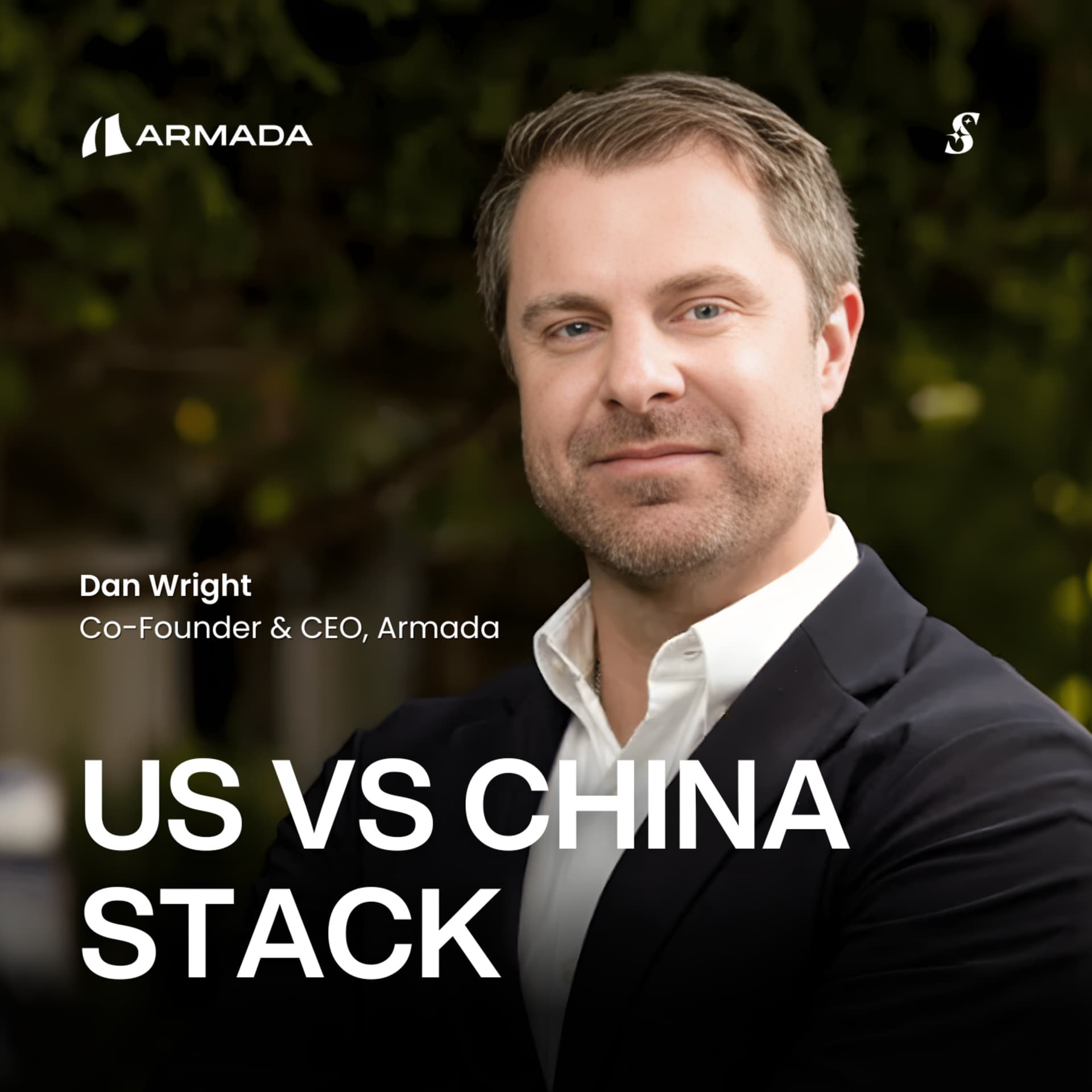
- Guest: Dan Wright, CEO of Armada
- Event Location: Reagan National Defense Forum, Reagan National Library
- Main Topics: AI infrastructure, modular AI factories, partnerships, geopolitical implications of AI, space data centers, and disaster response.
---
Key Concepts
- Armada: Hyperscaler for the Edge
- Definition: Armada builds modular AI factories that provide compute, connectivity, and storage in environments where latency and reliability are critical.
- Aim: To bridge the digital divide; currently, 70% of the world lacks access to AI.
- Partnerships and Collaborations
- Key Partners: SpaceX, Microsoft, OpenAI, Skydio.
- Significance: Partnerships enhance connectivity and infrastructure, making powerful AI models accessible in extreme environments.
- Deployment in Extreme Environments
- Examples:
- First modular data center in Saudi Arabia (with Aramco).
- Deployment with the U.S. Navy for the UNITAS exercise at sea.
- Real-time disaster response in Alaska for avalanches and floods.
- Geopolitical Stakes
- AI Stack Competition: Wright emphasizes the need for the U.S. to establish its AI stack globally to counter the influence of the Chinese AI stack.
- Exporting Infrastructure: Vital to support allies and maintain leadership in AI.
- Future of AI in Space
- Discusses the inevitability of data centers in space, especially with future plans for lunar and Martian bases.
- SpaceX's Starship as a catalyzing factor for lunar and planetary industry development.
---
Key Discussions
Modular AI Factories vs. Large Data Centers
- Speed and Flexibility: Modular factories can be deployed in months vs. years for traditional data centers.
- Mobility: Factories can be moved as needs change.
Role of Starlink
- Connectivity: Expanding rapidly to remote areas, facilitating AI applications in various industries.
- Recent Growth: Mention of Starlink's expansion into countries like South Korea.
Military and Emergency Response Applications
- Importance of Edge Computing: Reduces latency and costs associated with data transfer over long distances.
- Emergency Scenarios: Practical examples of how Armada has helped in real-world emergencies.
Vision for the Future
- Scaling AI: Plans to expand deployment capabilities across various industries.
- Global Expansion: Armada's commitment to becoming a globally recognized name in AI infrastructure.
Challenges and Needs
- Talent Acquisition: Wright calls for skilled individuals to join Armada.
- Partnership Development: Emphasis on finding additional partners in various industries.
---
Conclusion
- Summary of Goals: Armada aims to transform the way AI is delivered globally, ensuring access to critical AI technologies in underserved areas, while positioning itself strategically in the geopolitical landscape.
- Future Outlook: Excitement about the upcoming developments in AI infrastructure and partnerships.
---
Additional Resources
- Dan Wright's Profile: [Twitter](https://x.com/danwrightSF)
- Molly O'Shea's Profile: [Twitter](https://x.com/MollySOShea)
- Sourcery Podcast: [Listen on YouTube](https://youtu.be/8mRvaiOuydY)
---
Sponsors
- Brex: Modern finance platform for startups.
- Turing: AI talent and tools for improving model performance.
- Deel: Global people platform for hiring and managing remote teams.
- Public: Investing platform with AI-driven investment options.
Disclosure The episode contains paid endorsements, and listeners should review the relevant disclosures for each sponsor.
Written by AI. May contain mistakes. Listen to the episode to check what was said.
Chapters
Tap a time to open that second in VOThe Mission of Armada
0:45 to 2:24
Discussion about Armada's mission to bridge the AI access gap globally.
“And I don't want to live in a world where the world's running on the Chinese AI stack, causing all that information to go back to China.”
Partnerships and Strategies
2:24 to 4:32
Overview of key partnerships with SpaceX, Microsoft, and others.
“It's a trillion dollar question now with AI spend.”
AI Factories at the Edge
4:32 to 6:28
Insights into the deployment and advantages of modular AI data centers.
“You have pretty much ascended quite quickly with your partnerships and strategic investors.”
Extreme Environments and Innovations
6:28 to 8:03
Examples of AI applications in extreme environments, including the Navy and Arctic.
“And then another example is the hottest temperatures in the world.”
Future of Data Centers in Space
8:03 to 11:25
Exploring the potential for modular data centers in space and their implications.
“And so you're going to see data centers in space, and I'm sure we're definitely going to be a part of it.”
AI Dominance and Government Relations
12:10 to 14:03
Discussion on the AI Action Plan and Armada's role in U.S. AI strategy.
“You were at the signing of the AI Action Plan, in which President Trump signed three different executive orders on AI dominance.”
The Global AI Stack Debate
14:03 to 14:50
Explore the competition between American and Chinese AI technologies.
“We're working with Aramco, we're working with other key companies with allies in different parts of the world.”
Strategic Data Center Locations
14:53 to 16:04
Understanding the importance of data centers in critical regions.
“So I kind of want to talk a little bit more on like the positioning of Armada and how important it is to be close to the data centers.”
AI in Emergency Response
16:08 to 17:42
Learn how AI technologies are utilized in disaster response scenarios.
“It's about twice as expensive to do that running the latest large AI models in the cloud versus at the edge.”
Looking Ahead to 2026
17:43 to 18:46
Insights into future developments and expansion plans for Armada.
“Man, 2026 is going to be a massive year.”
Show all 12 chapters
Partnerships and Recruitment Needs
20:17 to 21:09
Discussing the need for great talent and strategic partnerships.
“So, you know, great people send them our way.”
Reflections on Reagan's Leadership
21:10 to 22:10
Insights into the leadership qualities admired in Ronald Reagan.
“I would just say if this is your first Reagan National Defense Forum, enjoy it.”
Transcript
Automatic transcript. May contain errors.0:00Armada is the hyperscaler for the edge. We are taking the most powerful AI models and we're moving them to the edge faster, better, cheaper, and more flexibly than anybody else. And we do that with modular AI factories that can be deployed literally anywhere in the world. 70 % of the world does not have access to AI. And so the mission of Armada is to bridge the digital divide and fill that gap. We started the company working with SpaceX. We are the first mover when it comes to the infrastructure. And that partnership works really well because we complement the connectivity with the infrastructure and the AI.
0:29We announced recently a partnership with Skydio. We announced another one with OpenAI, taking their models to the edge for the first time. So partnerships are a key part of our strategy. We were the first modular data center ever to be deployed in the middle of the desert in Saudi Arabia with Aramco, working with Microsoft. In a few years, what's going to happen is either the world is going to be running on the USAI stack or it's going to be running on the Chinese AI stack. And I don't want to live in a world where the world's running on the Chinese AI stack, causing all that information to go back to China.
0:56Data centers in space is coming, and it makes sense. SpaceX is talking about with Starship going to the moon. You're going to need compute, especially as you start to think about optimist robots building bases on the moon. So you're going to see data centers in space, and I'm sure we're definitely going to be a part of it.
1:19Dan Wright, welcome to Sorcery. Great to be here. Thanks, Molly. Well, we're at the Reagan National Library. Here we are. Is this your first time here? No, this is actually probably my fifth time, fifth straight year at RNDF. Okay. And what's it like? This is my first time. It is always crazy, but it's inspiring. You hear from some of the top minds in the DOW and some of the top entrepreneurs, and it's a great place to meet a lot of people in a very short amount of time. Just over really a day and a half, you can meet tons and tons of people that are working on critical problems for the country.
1:53I know I was walking in, ran into Palmer Luckey, saw this huge event, huge breakfast right under Air Force One. It's pretty special. So for people that don't know what Armada is, obviously I know we've had many interviews together. What is Armada? So Armada is the hyperscaler for the edge. We are taking the most powerful AI models and we're moving them to the edge faster, better, cheaper, and more flexibly than anybody else. And we do that with modular AI factories that can be deployed literally anywhere in the world. AI factories have become a hot topic. It's a trillion dollar question now with AI spend.
2:31What do you think the state of the market is for AI infrastructure? I mean, we are going through a generational boom with AI. We're seeing that with these big AI labs, the foundation model companies. To this point, that's really impacted consumers with ChatGPT and Grok and now knowledge workers. but what we're really seeing now at Armada is that those really powerful models are starting to be applied to operations on the ground at the edge and I think that's the next big shift that we're going to have to see is that these models which are doing wonders for you know consumers and for knowledge workers they need to be put in the hands of the people who really need them when you have to make split second decisions that sometimes impact life and death or billions of dollars.
3:14And how does your view of modular, on-demand AI data centers differ from these huge, large-scale data centers? So when you think about the huge, large data centers, it's sort of like an extension of what we've been doing, the cloud, right? To this point, we've had these big, hyperscale data centers. Today, they cover about 30 % of the world. That means 70 % of the world does not have access to AI. And so the mission of Armada is to bridge the digital divide and fill that gap. We're going to continue to need these big hyperscale data centers for the cloud and extending that, but those take a long time.
3:51It's construction, it's permitting, it's years, there's supply chain issues, there's all sorts of issues. With us, what is really nice is rather than taking years, you can put these anywhere in a matter of a small number of months. And they're mobile and so if needs change you can move them around and so where we see our role is to rapidly extend the benefit of all these models that have been trained in the cloud because the cloud is going to continue to be really important but then allowing them to reach these locations that have never been able to be reached before through these modular AI factories that can be deployed again faster cheaper more flexibly than any other way so you've raised over 200 million dollars to date.
4:32You have pretty much ascended quite quickly with your partnerships and strategic investors. Who are some of the people that you work with? Yeah, so we started the company working with SpaceX, and they've continued to be a great partner for us. And what that means is that as SpaceX rolls out throughout the world, and most people don't know, five years ago, they hadn't even launched Starlink. Now it's in 150 countries, and it's continuing to grow every week, we are the first mover when it comes to the infrastructure. And that partnership works really well because we complement the connectivity with the infrastructure and the AI.
5:09On the other hand, we also partner with the big cloud providers like Microsoft, extending all of these really powerful models to the edge, even Azure Stack, which is a piece of hardware that Microsoft has developed. It can go in the galleon. So we've given it a home and we've extended all the benefits of that to the edge. And then there's lots of others. We announced recently a partnership with Skydio. We announced another one with OpenAI, taking their models to the edge for the first time. So partnerships are a key part of our strategy. And it's, again, taking these capabilities, bringing them all together at the edge in a way that is turnkey for the people that are really just trying to solve the most important problems on the ground.
5:48I think those are awesome. But one of the most, I think, like interesting things about Armada is just the extreme environments that you work in. Can you lay out as many as possible? Yeah, when we say the edge, we really mean it. And I'll just give a few recent examples. So just this week, we announced that we did the first offshore edge computing that the Navy's ever done. We did that as part of the UNITAS exercise this year, running cutting-edge applications like Minotaur, Maven. There was an Azure stack in there. Bringing that all together at the edge in the belly of an aircraft carrier. You can run these things in the middle of the ocean.
6:21And then if you want to deploy it, you can put it in the C-17, C-130. So this edge is really being redefined. And then another example is the hottest temperatures in the world. We were the first modular data center ever to be deployed in the middle of the summer in the desert in Saudi Arabia with Aramco working with Microsoft. And then also on the flip side, we were deployed in basically the Arctic with the state of Alaska, the first modular data center ever in Alaska, helping to cut the time to process large amounts of data from drones from 30 hours to real time in order to better respond to avalanches and floods and other types of natural disasters.
6:59And you go on site for all of these, right? We always are at the edge. It's funny. I get messages from our team all the time, and it's like the most crazy places you can imagine. And the edge is going to continue to get, you know, redefined. I get calls, literally I was on the call with somebody and they're like, hey, can we get one of these in Antarctica. I'm like, well, yeah, Starlink's live in Antarctica. No reason why we can't do that. Obviously, data center in space is the new hotness. Everybody's talking about it. Yeah, what's the deal with that? So are you going to get these in space? They are modular.
7:26I mean, the edge is continuing to expand. Are you the first person that's going to go? I mean, this is actually a debate that we have in terms of how soon it's going to happen, but it's definitely going to happen. Data centers in space is coming, and it makes sense, right? If you think about, and a lot of this is public, but what SpaceX is talking about with Starship going to the moon. You're going to need compute, especially as you start to think about optimist robots building bases on the moon, later Mars. You're going to need large amounts of compute. Not to mention a lot of the things that we do here on Earth, you're going to want to do there in space, and it's a lot more efficient to do it, especially in hostile environments, if you can automate more of that.
8:04Things like mining, for example. And so you're going to see data centers in space, and I'm sure we're definitely going to be a part of it. What do you think about SpaceX's Vermeer IPO for 2026? I mean I think SpaceX is an incredible company and they have a ton of value so I don't have any insider information here but I would say hey if the world can get access to you know SpaceX I think that's a good thing. And I know that was one of your first partners you talked about that a little bit so can you just talk about how SpaceX has been expanding Starlink and the ways in which you work together? Yeah, I mean, so Starlink is really amazing in the sense that it just continues to get better so fast.
8:45And I mean that in a few ways. So one is, as I mentioned, they're expanding really fast. They're rolling out in new countries every week in major markets, right? So just as a real recent example, just this last week, they launched in South Korea, right? Big market and an important ally for the US. So that's a big deal. The second thing is they are also expanding the types of services that are available. It started that Starlink was just a consumer product. Then they brought it to Enterprise. And, you know, initially that was used by Enterprise as more as a backup. And now it's being used more as a primary.
9:18And that is because the service keeps getting better and better and better as more birds, more satellites go up into the sky. And then each generation of satellite is also better. Not to mention the terminals on the ground. and there's now multiple types of terminals, including the more recent minis that people really like. Hey, I can put it in a backpack if I go on a hike. If I'm traveling, I can put it on the ski rack of my car. Perfect internet all the time. And so all that does for us is it gives us more use cases that we can unlock where we say, okay, now that you have connectivity on the oil rig or even on a farm or a ranch, wherever you are, we can actually then apply the AI to those situations on the ground without any latency and then send the metadata back to some other location that they want it.
10:03Part of your full stack approach. Part of the full stack approach. And also with Star Shield, I mean, that's a huge advantage that we have when you think about, you know, some of the conflicts that are going on. And people talk to me a lot about this race that we're in with China and, you know, the geopolitical conflicts that are going on around the world. Yeah. I am very grateful that SpaceX is an American company. I feel like it's an unfair advantage that we have with now Star Shield with, you know, that available to the DOW. And we, again, want to be the first mover with the infrastructure and the AI to help with different problems at the edge.
10:36And then the work we're doing with the Navy is a good example of that. Sorcery is brought to you by Brex, the financial stack trusted by more than 30 ,000 companies, including one in three venture backed startups in the U.S. Nearly 40 % of startups bail because they run out of cash. Rex is literally built to help founders avoid that. Unlike traditional banks that let your money sit idle, chipping away at it with fees, Rex's designs help you spend smarter and move faster. Their all-in-one solution combines checking, treasury, and FDIC protection into one powerful account. You can send and receive money globally at lightning speeds, get 20 times the standard FDIC coverage through their partner banks, and even high yield from day one.
11:20With same day and even same hour liquidity, access your funds anytime. Companies like Scale AI, DoorDash, Service Titan, HIMSS, Anthropic, Flexport, Robinhood, and Plaid trust and use Brex. Start today at brex.com slash sorcery. That's B-R-E-X dot com slash sorcery. Turing is training the next generation of AI with tasks that require real expertise and real-world judgment. That's why companies like NVIDIA, Anthropic, Salesforce, and Gemini partner with Turing. Turing builds realistic reinforcement learning environments and data systems based on real operational traces, the kind of infrastructure Frontier Labs need to train superintelligence.
12:06Visit turing.com slash S-O-U-R-C-E-R-Y. You were at the signing of the AI Action Plan, in which President Trump signed three different executive orders on AI dominance. And then you guys wrote a white paper on AI dominance. Yes. So could you share more about that? Yes. So I've been in D.C. a lot this year. I was actually there earlier this week at the Pentagon and doing some other meetings on the Hill. And I was telling people I've been there more this year than the rest of my life combined. And it's funny, there's more entrepreneurs here at Reagan National Defense Forum than I've ever seen in the five years I've been here.
12:43and I say that's a good leading indicator for the country. I really believe that because if tech is working with the government, good things are going to happen. That's our competitive advantage versus China. As far as that specific event, it was actually fortuitous. We had been working with the government, but we didn't know that they were going to announce the AI action plan that day. That happened to be the same day that we did our white paper at this event. We thought maybe, but it ended up being directly aligned. And basically what we're saying is, you know, pillar one of the AI action plan, which we talk a lot in our white paper is we need to deploy infrastructure fast.
13:16This goes to the point about what's the role of these modular AI factories. We can't wait years for construction and permits. We need to deploy these wherever we have available land and energy. And the nice thing about modular AI factories, if you have a lot of stranded natural gas, you can use that to power them. Or if you have nuclear, you can use that. So we're very flexible on the power. We just need power and land of any kind. And then the third pillar of the AI action plan, which we also talk about in our white paper, is taking that technology as we continue to rapidly iterate and improve on it, which we're doing with every generation now of our galleons, and we've had many generations now, and then exporting that to our allies.
13:58And we're doing this, I was just actually back in DC for the US Saudi Business Council. We're working with Aramco, we're working with other key companies with allies in different parts of the world. And that's how we win. Because in a few years, what's going to happen is one of two things, either the world is going to be running on the USAI stack, or it's going to be running on the Chinese AI stack. And I don't want to live in a world where the world's running on the Chinese AI stack, that AI is teaching our kids, it's causing all that information to go back to China. That's not a good scenario for us.
14:30And so we need to make sure that we win. And that's really what we're all about, taking the six gigawatts of stranded energy in the country, putting it to work for AI and then exporting it faster than China can by a Huawei and other state backed companies. And then also with Starlink, one of the reasons why it's such a great partnership is that we can be the first mover as the connectivity goes around the globe. And again, front run Huawei and box them out. Box them out. So I kind of want to talk a little bit more on like the positioning of Armada and how important it is to be close to the data centers.
15:02So could you just share why globally it's so important for us to have these strategic positions around the world? Yeah, I'll just I'll use like a military example and then I'll give some other examples. But if you think about a military example, if you look at where a lot of these conflicts happen now, it's in the Pacific. it's you know in the arctic obviously i think there was a recent wall street journal article about what russia and china are doing in the arctic um it's it's a real problem that right now we have all of these drones and you know cutting edge ai models that we want to use but we don't have any infrastructure in any of those locations basically nowhere in the pacific theater um and also nowhere in the arctic um and other you know contested locations around the world.
15:49And so what happens is you're faced with this really bad dilemma, which is either we just don't use those technologies if something happens in those places, or we do, but we have to send it to some data center that's thousands of miles away. And when we do that, there's security issues. The number one time when data is hacked is when it's in motion. There's massive cost. It's about twice as expensive to do that running the latest large AI models in the cloud versus at the edge. And then on top of that, there's massive latency. And if you think about taking large amounts of data from drones or if we're using robots or, you know, Sironic ships or sail drones or whatever to respond to these things, you can't have any latency.
16:30Because by definition, this all has to be done in real time in the moment when you're, you know, addressing a threat. Another good example is emergency response. You know, we work with the state of Alaska. they're using us for responding to avalanches and also to floods and other natural disasters we were also very involved with the response to the fires that happened here uh in socal last year can you share more about that that's that was insane that was like amazing by the way yeah basically what happened and this happens a lot with armada and this is one reason why i love building our company is we you know saw what was happening and we just started to call up all of the first responders and say we just want to help and we we actually called up spacex or i think they have called us and we said hey let's just jump in and like help with this thing and then we'll figure out if they're these people become customers later and uh that's literally that's literally what we did we hadn't figured out contracts hadn't figured out anything we just went in and helped and what's amazing what has come out of that we have so many customers throughout the state and i think that's something that i try to always talk to our team about if we we have a value with the company which is live the mission you know if you help people in these critical life and death scenarios, they'll never forget it and they'll want to work with you for the long haul.
17:42So what are you most looking forward to in this next year? 2025 is pretty much over. What's coming on? Man, 2026 is going to be a massive year. I think that this is the year that you really see us taking these models at scale to critical industries. I mean, one of the things that we've done is we've already deployed now in some of the most austere environments in the world. This is not like a theoretical. This is proven, hardened technology, and it's very high value use cases. And so now what we're seeing is, you know, maybe we started at one site with a customer and then they say, hey, by the way, I've got 300 oil rigs where I want this.
18:21By the way, I don't have one aircraft carrier. I've got, you know, hundreds of them. So I'm excited to scale real world AI. And then I think the other thing that you're going to see is that we're going to continue to expand our work with the DOW, one reason why I'm here, and then also expanding our partners geographically. I mean, we're already a global company. We're in a lot of countries and we're expanding. I'm on a plane a lot and I expect more of that, but that's, you know, the company that we want to build. We want to build a global company, just like SpaceX, just like a lot of the companies that we admire that can solve the biggest problems at the edge.
18:57Some of you may not have heard this yet, but our sponsor, Public, just launched something called generated assets, and it brings AI into investing in a way I've honestly never seen before. Here's how it works. You type in an idea like AI-powered supply chain companies with positive free cash flow or defense tech companies growing revenue over 25 % year over year. Publix AI then dispatches a swarm of agents that scan every single US stock, evaluates them, and instantly builds a custom index around your thesis. What really stands out is how clearly it explains why each stock is included. And before you invest, you can even backtest your idea against the S &P 500.
19:33So you're making decisions with real context, not just guessing. And beyond generated assets, Public lets you invest in stocks, bonds, options, crypto, all in one place. They'll even give you an uncapped 1 % match when you transfer your investments over from another platform. If you want to build a portfolio that actually reflects your thesis, visit public.com slash sorcery, paid for by Public Investing. Full disclosures in the description. Founders ship faster on deal. Set up payroll for any country in minutes. Hire anyone anywhere. Get visas handled fast and get back to building. Visit D-E-E-L dot com slash sorcery.
20:09That's D-E-E-L dot com slash S-O-U-R-C-E-R-Y. And what are the biggest bottlenecks for you and Armada? We need great people. So, you know, great people send them our way. We're hiring across all functions. I'd say, you know, also we are always trying to find new partners, especially ones that have cutting edge AI capabilities that we can then bring to the edge. Whether that is a big company like Microsoft, or it's a smaller, more up and company, up and coming foundation model company. I think now we're on a lot of people's radar. So we're getting more and more people coming to us, but we want that.
20:45Also partners in different specific industries that we're focused on. We're very focused on American AI and energy dominance. And so all of the energy companies that are already working with oil and gas companies, mining companies, we've been doing a lot of work on the issue with critical minerals with China, working with key companies there. So more of those companies that we can work with, the more we can just speed up that mission. Amazing. Any last remarks from you, Dan? I would just say if this is your first Reagan National Defense Forum, enjoy it. We got a great day out here. I mean, it's amazing how many friends, entrepreneurs I've run into, as well as people in the government.
21:23So it's going to be a good day. What do you admire most about Reagan? Oh, man. Well, I'm from California, right? So it's near and dear to my heart. I admire that he was able to unify a lot of people, both in my home state, you know, born and raised in California, inspire a lot of people. He was able to actually, you know, obviously change his career and he chose to serve the country and then obviously took it to the presidency and made a huge impact there. So I think I really admire his way to bringing together both my home state and the country and then just how he led as a leader. and the fact that he wasn't afraid to stick up his hand when he really didn't need to and say, I'm going to serve my country and I'm going to do whatever it takes to make sure that the U.S.
22:10becomes and remains the world's foremost superpower. That's a wonderful place to end. Dan Wright, CEO of Armada, thank you very much. Thanks, Molly. Hey, it's Molly. If you enjoy our interviews, check out our newsletter, Sorcery.VC, where we deliver a once-a-week top deals and tech headlines email and also go deeper on our podcast interviews. subscribe to sorcery today and don't forget to subscribe to the podcast on youtube spotify apple or wherever you listen link in description to sign up
From the publisher
Filmed at the Reagan National Defense Forum at the Reagan National Library, Molly walks with Dan Wright, CEO of Armada, to unpack why the next era of AI infrastructure will not live only in hyperscale cloud campuses – it will move into the physical world.
Armada calls itself the hyperscaler for the edge. The company builds modular AI factories that bring compute, connectivity, storage, and real world AI into environments where latency, security, and reliability are mission critical. Dan shares how Armada started with SpaceX as an early point of entry, why Starlink fundamentally changed what is deployable around the globe, and how Armada is pairing connectivity with infrastructure to bring the most powerful AI models to places that have never had access before.
The conversation spans Armada’s partnerships with Microsoft, OpenAI, and Skydio, plus what it takes to deploy in extreme environments, from U.S. Navy operations at sea to the Saudi desert with Aramco Digital, and all the way to Alaska for real time disaster response. Dan also lays out the geopolitics of AI infrastructure, why he believes the world will run on either the U.S. AI stack or the Chinese AI stack, and why exporting infrastructure to allies is central to winning that race.
We also go long on space. Dan explains why data centers in space are coming, why Starship is a prerequisite for lunar and planetary industry, and why compute becomes unavoidable once you imagine robots building bases on the Moon and later Mars. He also reacts to the ongoing SpaceX IPO speculation for 2026 and why broader access to SpaceX would matter if it happens.
Armada has raised $200M+ to date, backed by investors including Founders Fund, Dragon Global, Lux Capital, Shield Capital, 8090 Industries, Microsoft’s M12, Overmatch, Silent Ventures, Felicis, and Marlinspike, with later strategic participation including Pinegrove, Veriten, and Glade Brook.
Dan Wright: https://x.com/danwrightSF
Molly O’Shea: https://x.com/MollySOShea
Sourcery: https://x.com/sourceryy
𝐄𝐏𝐈𝐒𝐎𝐃𝐄 𝐋𝐈𝐍𝐊
YT: https://youtu.be/8mRvaiOuydY
𝐒𝐏𝐎𝐍𝐒𝐎𝐑𝐒
• Brex—The modern finance platform, combining the world’s smartest corporate card with integrated expense management, banking, bill pay, & travel. https://brex.com/sourcery
• Turing—Turing delivers top-tier talent, data, and tools to help AI labs improve model performance—and enables enterprises to turn those models into powerful, production-ready systems. https://turing.com/sourcery
• Deel—Deel is the global people platform that helps startups hire, manage, pay, and equip anyone, anywhere. Trusted by more than 35,000 fast-growing companies, Deel is the people platform that just works, so teams can scale without the chaos. Visit: https://www.deel.com/sourcery
• Public–Investing platform Public just launched Generated Assets, which lets you turn any idea into an investable index with AI. With Generated Assets, you can build, backtest, refine, and invest in any thesis with AI. Gone are the days of one-size-fits-all ETFs. https://public.com/sourcery
Follow Sourcery for the latest updates!
Disclosure
Paid Endorsement. Brokerage services by Open to the Public Investing Inc, member FINRA & SIPC. Advisory services by Public Advisors LLC, SEC-registered adviser. Crypto trading provided by Zero Hash LLC, licensed by the NYSDFS. Generated Assets is an interactive analysis tool by Public Advisors. Output is for informational purposes only and is not an investment recommendation or advice. See disclosures at public.com/disclosures/ga. Matched funds must remain in your account for at least 5 years. Match rate and other terms are subject to change at any time.


