
In short
Podcast Episode Notes: Inside General Catalyst’s $1.5B AI Roll-Up Machine
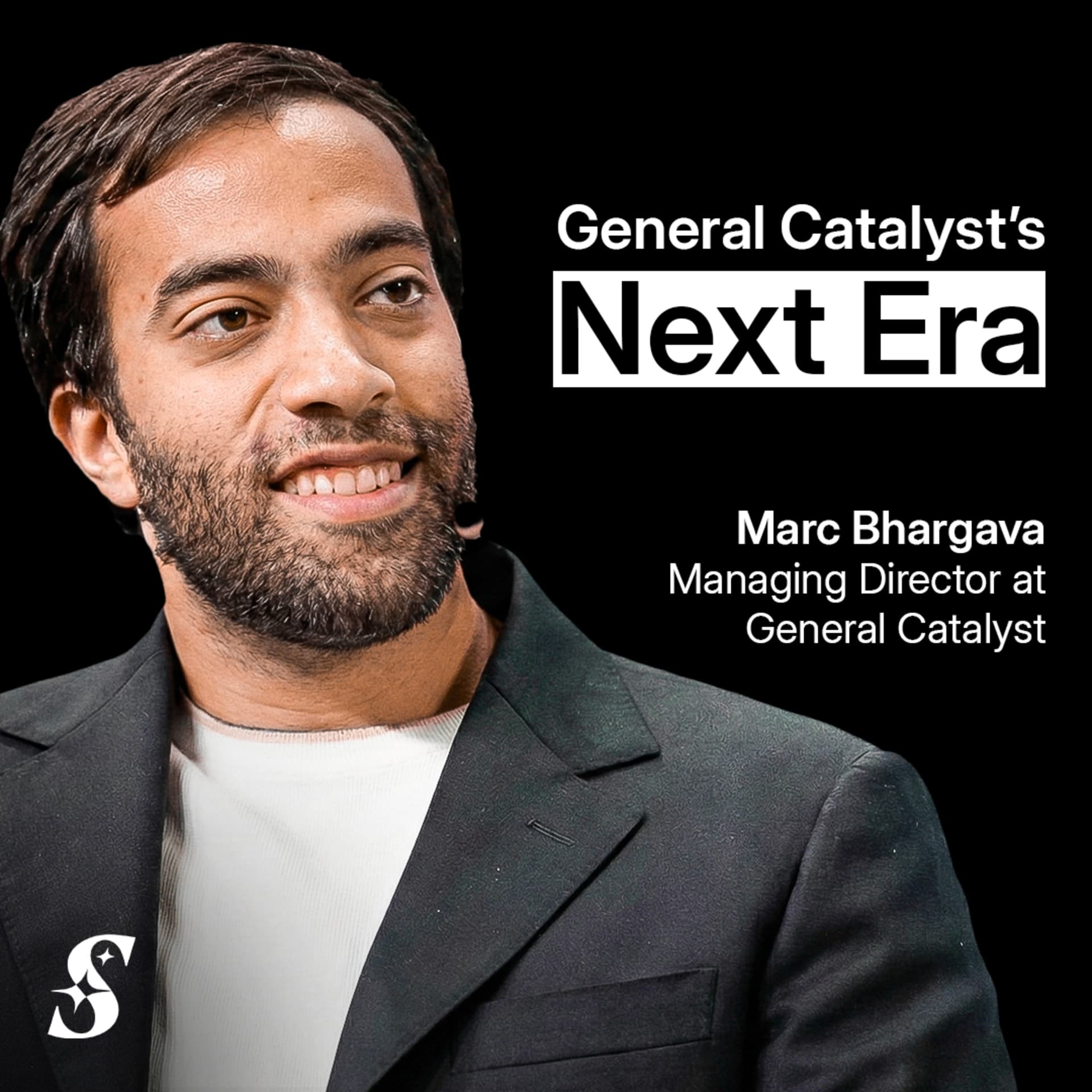
Podcast Overview Title: Sourcery Description: Interviews with the top Investors, CEOs, & Founders Episode Title: Inside General Catalyst’s $1.5B AI Roll-Up Machine Episode Description: Marc Bhargava, Managing Director at General Catalyst, discusses the significant transformation in venture and private markets driven by AI roll-ups.
---
Key Highlights
General Catalyst Overview
- Current Position: One of the three largest venture capital firms with approximately $40 billion in assets under management.
- Core Strategy: Focus on incubating AI-native companies and acquiring fragmented services businesses to transform them.
AI Roll-Ups
- Definition: The AI roll-up strategy combines operational transformation with venture creation and is distinct from traditional private equity.
- Market Opportunity: The global services economy, valued at around $16 trillion, is poised for disruption through AI technology, which can improve EBITDA margins by 20-30% through automation.
Selection of Industries
- Industry Mapping: General Catalyst identified 70 service categories and narrowed them down to 10 where AI can have an immediate impact.
- Key Work Categories for AI Automation:
- Customer service and support
- Data entry and evaluation
- Content generation and marketing
- Basic logic and reasoning tasks
Portfolio Companies
- Notable companies under General Catalyst's roll-up strategy include:
- Crescendo: Focuses on call center automation.
- Long Lake: Involved in HOA management and PEO services.
- Titan MSP: Targets the outsourced IT services market.
Investment Approach
- Funding Strategy: General Catalyst typically allocates between $100 million and $150 million over three to four funding rounds, aiming to lead at least the first two rounds.
- Long-Term Vision: Aims to hold investments for 7-10 years with the goal of going public rather than applying pressure for quick exits often seen in private equity.
Differentiation from Traditional PE
- Operational Focus: Unlike traditional private equity, which often emphasizes cost-cutting, General Catalyst emphasizes transformation through technology investment.
- Long-Term Growth: The aim is to build "AI-native compounders," similar to successful public companies like Transdime, focused on long-term operational improvements via AI.
---
Insights and Takeaways
The Role of AI in Industry Transformation
- AI is not just a tool for efficiency but a catalyst for creating substantial economic value across traditional sectors that have historically low margins.
- The adoption of AI changes the operational landscape, allowing companies to take on more clients and increase revenue without proportionately increasing costs.
Market Potential
- The services industry presents a massive, untapped opportunity for venture capital investment, potentially yielding software-like margins as operational efficiencies increase.
Talent and Global Expansion
- Most of the roll-up companies are based in the U.S., particularly in San Francisco and New York, but General Catalyst is exploring opportunities in Europe and Asia, recognizing the rise of talent outside Silicon Valley.
Conclusion
- Marc Bhargava emphasizes that the AI roll-up strategy is still underrated in the market, suggesting a future where these companies could outperform traditional software firms in terms of growth and profitability.
- The focus on AI implementation in fragmented industries opens avenues for significant innovation and value creation.
---
Sponsorships
- Brex: Modern finance platform for startups.
- Turing: Provides AI talent and solutions for enhancing model performance.
- Carta: Software bridging founders, investors, and limited partners.
- Public: Investing platform offering AI-driven investment tools.
For more details, visit [Sourcery's website](https://www.sourcery.vc).
Written by AI. May contain mistakes. Listen to the episode to check what was said.
Transcript
Automatic transcript. May contain errors.0:00GC is one of the three largest venture players. We put up to work about a billion and a half on the creation strategy. And first and foremost, it's really around incubating companies. There's a ton of potential right now, especially to incubate applied AI companies. So as the models get better, whether it's OpenAI or Anthropic or Google or XAI or others, we really do think there'll be a lot of new companies that can be built on top of this technology. There's a huge opportunity on creation to incubate applied AI companies. When we do that, we go one of two ways. Either we incubate the applied AI company and we have it scale organically, and then we give them capital for marketing and growth.
0:33Or that second part has begun to be called the AI-enabled roll-up. And obviously, we are extremely involved in companies like Long Lake, Udia, Titan MSP, Beacon, Crescendo, and others who are kind of the leaders now in this field. At GC, we've been investing between$100 and$150 million, but over three or four rounds of funding. We like to lead at least the first two, and then we start bringing in other investors in the third or the fourth. We think in this much larger TAM than software, you can have software-like margins. Because once you take out 30, 40, 50 percent of what people do and free them up to do the hard stuff, you can double the revenue.
1:07Unlike private equity, we screen really hard for does this company want to change? Do they want to implement AI? And then, of course, we want to hold them for seven to 10 years and go public and not necessarily add debt and cut costs. Some of the companies in the roll up will hit 100 million of EBITDA and they're like less than two years old. Oh, my God.
1:32Mark Bhargava, welcome to Sorcery. Thanks for having me. Well, this is fun. This is great. I've been waiting to do this for a while now. You are the managing director at General Catalyst. You are a managing director at General Catalyst. I don't think many people know the breadth of General Catalyst's asset management function. So could you just break down how it's structured? Yeah, sure. I can talk a little bit about GC and how we're set up, what we're all working on. So we were a venture capital firm, but we're evolving to be really a company. And people ask me, well, what does that mean? There are two big parts to it.
2:12As a company, one, we're actually building companies for the long term. So folks have seen the announcement about us buying a hospital system in Ohio, for example. We did that through an organization called Hack Co, which we incubated and then bought a hospital. And we plan to hold that for a really long period of time. We have a wealth management business that we've set up to help founders manage their money. That's another company we've built in-house that we plan to hold for a very long time. And then finally, we have now an AI consulting business called Percepta that really comes in and changes Fortune 100 companies, helps implement AI, really leverages everything we've learned from AI investing.
2:46And that's another company we've built in-house that we will hold for a very long time, maybe forever in these cases. So GC as a company is building in-house what we call transformation companies. with these three being examples of businesses we think should exist, are good for society. We're not planning on taking them public. We want to hold them for a really long time. In addition to these three transformation companies, we have another bucket where we're probably better known for, which is our funds. And so there we have the traditional venture funds, ignition on the early stage, endurance for later stage.
3:18We also have a customer value fund for helping companies scale really quickly, which we can talk about. And then lastly, where I'm focused is on the creation, which is part of our funds business. And creation has been a very fast-growing fund for us because it's all about manufacturing outliers. So while our venture funds are always looking for the next great company or person, we on the creation side are incubating companies, but ones that we would want to take public in seven to 10 years. So they're not necessarily companies we majority own or we would hold forever, but they're businesses we think really should exist that we're creating through creation that we want to go and take public in seven to 10 years.
3:54And most of the time, they don't exist because there's not enough capital for it, or it's multidisciplinary. So it really requires a lot of different expertise, or it's a bit more traditional or outside the box. Things like the AI roll-ups that we're working on these new thesis spaces that just haven't really happened yet. So creation is where I spend most of my time. But GC as an organization, we truly are a company now, building companies for the long term, creating and incubating companies that we want to take public in the future. So how large is this? And with the company as a new structure, will you be weighing it with AUM?
4:27Like, how does this differentiate? So we're kind of one of the three largest venture players. The way we really view it is on the returns for our investors. So our venture funds have to outperform and do really well to attract more LPs and obviously to attract more founders. The nice thing is that all of these pieces do tie together with really one question, which is what are the best ways to work with the most founders and help them the most? And the answer to that question, we try to plug and match both the companies and the venture funds. So for example, if you're a founder and you have a tech business and you're growing quickly, maybe you use our wealth management transformation company to manage your money.
5:03Maybe use Percepta to help you create your own mini model or inference or kind of improve your technology stack. Percepta can come in and really help with that. Maybe if you're in healthcare, you decide to sell into our hospital system in Ohio and be able to test out your technology. So the transformation companies that we build in-house in GC are ultimately also helping our founders while delivering value for the investors in GC. And same on the venture side. You know, not every founder has the perfect idea and they're scaling. Some founders are second-time founders thinking about their next thing.
5:36So with creation, we help give them the idea. We introduce them to their co-founder. We help them even before the capital formation. And on the other hand, if you're already growing really quickly and you want a way to scale without as much dilution, our customer value fund helps with that. So GC is doing a lot of things at once. We've hired incredible people for each transformation company, for each fund product. But ultimately, we now feel like if you're successfully growing and running a company, there are more ways to partner with GC than any other firm out there. And because of that, we're really seeing our brand rise.
6:06We're seeing the founders we back be extremely high quality and their companies do well because there are just so many more ways to plug in and work with GC than with an individual solo kind of venture fund. With your focus on the creation side of things, how much have you allocated to creation? In our last fund cycle, we put up to work about a billion and a half on the creation strategy. And first and foremost, it's really around incubating companies. So we think there's a ton of potential right now, especially to incubate applied AI companies. So as the models get better, whether it's OpenAI or Anthropic or Google or XAI or others, we really do think there'll be a lot of new companies that can be built on top of this technology.
6:46And every three to six months, the models are getting better and better, especially recently at things like reasoning, logic, coding, math. And so we think there's a huge opportunity on creation to incubate applied AI companies. And when we do that, we go one of two ways. Either we incubate the applied AI company and we have it scale organically, and then we give them capital for marketing and growth. Or in about half the cases, after incubating an applied AI company, we actually give them capital to go by their distribution, by their client list and the data that comes there. And so that second part has begun to be called the AI-enabled roll-up.
7:20And obviously, we are extremely involved in companies like Long Lake, Udia, Titan MSP, Beacon, Crescendo, and others who are kind of the leaders now in this field. Wow. I think what would be really interesting would be to take a step back because General Catalyst really leaned into this moment. People have forgotten about this, but there was an existential moment for SaaS in early 2023 or something like that. And everyone thought venture was dead. SaaS was dead. It was the end of everything. No more venture capital. It's over. That was the whole idea. But then some people thought, oh, no, this is an opportunity.
8:01This is an opportunity to roll up companies, to apply AI, to use these efficiencies. And one of those people or one of those funds was General Catalyst. And so you guys actually really leaned in hard for this. What was the decision making process for it? Yeah, for us, it was a both strategy. So we actually think three approaches can win. One, some folks view it as the model companies will end up being the winners. They're going to keep iterating. They make better and better models. They'll go direct to the consumer. And we're obviously investors in Anthropic, large investors from the last round, from this current round.
8:33We absolutely think companies like Anthropic and OpenAI and Google can benefit and the model layer can benefit. So we agree with that. We also agree with folks who say, well, it's been overestimated. SaaS is not dead. If you look at public market comps, they've continued to grow, do well. There are all kinds of new, interesting SaaS companies that are being started and growing. But we also think there is this third bucket. So we're kind of an all of the above. We think there'll be winners in each category. We obviously want to be part of them. But that third bucket is for really fragmented industries where it's very hard to sell into AI native services and products.
9:07Can we actually build the AI native service platform and software and then go buy our distribution? So a few examples. One that was very early on was Crescendo, where we led several rounds of funding to build AI native software for call centers. And we teamed up Andy Lee, who ran Alorica for over 30 years, a call center chain with two amazing CTOs. Someone from GC went and joined full time. And we built out this software that automates 50 to 70 % now of what a call center does. So after proving that out in a year and having 10 or so pilot clients, we gave them the money to actually go buy a call center.
9:40And they're well on their way now of taking 10 % EBITDA margins and turning them into 40 % EBITDA margins. And that's because when half the tasks can be automated, people can start to focus on cross-selling, revenue opportunities, and the harder tasks. So Crescendo is just one example. With Long Lake, a second example, they've gone after the HOA management space, PEO services, and others. And they're also scaling quickly, doubling the EBITDA margins of the companies they've been buying. And they have the benefit of having all of the data and the ability to do change management and change practices.
10:11And then, of course, third and fourth, we have companies like Titan MSP and the MSP space. Then went out, got six pilot clients, showed us they could automate 38 % of what MSP does, which is an outsourced IT services firm. And now they've bought RFA, which is a well-known MSP in New York. And they also are well on their way to kind of doubling EBITDA margins. And so we definitely think that there's an opportunity for software. But there are a lot of industries that are highly fragmented. They're split across the country. They don't really buy technology products. When they do buy tech products, they call it IT and they cap it at 2 % or 3 % of revenue.
10:44And at the same time, there's this ability with AI to go in and automate 20, 30, even 50 % of the tasks at those businesses. So to really make the most out of AI technology, you want to buy of these companies and be able to free up people to perform the higher earning tasks and really grow the company and grow the margin story. And that's what we're starting to see proven out across all of these case studies and examples. And we've been getting a lot of interest from crossover funds and others as we've been doing this and we've really been proving the model. sorcery is brought to you by brex the financial stack trusted by more than 30 000 companies including one in three venture-backed startups in the u.s nearly 40 percent of startups bail because they run out of cash brex is literally built to help founders avoid that unlike traditional banks that let your money sit idle chipping away at it with fees brex's designs help you spend smarter and move faster their all-in-one solution combines checking treasury and fdic protection into one powerful account.
11:44You can send and receive money globally at lightning speeds, get 20 times the standard FDIC coverage through their partner banks, and even high yield from day one. But same day and even same hour liquidity. Access your funds anytime. Companies like Scale AI, DoorDash, Service Titan, HIMSS, Anthropic, Flexport, Robinhood, and Plaid trust and use Brex. Start today at brex.com slash sorcery. That's B-R-E-X dot com slash sorcery. In today's high-speed business world, staying ahead means using the smartest tools possible, including the powerful capabilities of artificial intelligence. Meet Turing Intelligence.
12:24Turing builds customizable AI systems designed to solve your mission-critical challenges, no matter your industry. From expert guidance to tailored projects, Turing helps top companies realize AI that's more capable, more adaptable, and more effective. With Turing, discover how AI can accelerate your business growth. To learn more, visit turing.com slash sorcery, spelt S-O-U-R-C-E-R-Y. That's turing.com slash sorcery. Sorcery is proudly sponsored by Carta. Carta is transforming the private marketplace, connecting founders, investors, and limited partners through software purpose-built for private capital.
13:02Trusted by more than 65 ,000 companies in over 160 countries. Carta's platform of software and services lays the groundwork so you can build, invest, and scale with confidence. Carta's fund administration platform supports over 9 ,000 funds and SPVs, representing nearly$185 billion in assets under management, with tools designed to enhance the strategic impact of fund CFOs. For more information, visit carta.com slash sorcery. That's C-A-R-T-A dot com slash S-O-U-R-C-E-R-Y. Some of you may not have heard this yet, but our sponsor Public just launched something called Generated Assets, and it brings AI into investing in a way I've honestly never seen before.
13:46Here's how it works. You type in an idea like AI-powered supply chain companies with positive free cash flow, or defense tech companies growing revenue over 25 % year over year. Public's AI then dispatches a swarm of agents that scan every single US stock, evaluates them, and instantly builds a custom index around your thesis. What really stands out is how clearly it explains why each stock is included. And before you invest, you can even backtest your idea against the S &P 500 so you're making decisions with real context, not just guessing. And beyond generated assets, Public lets you invest in stocks, bonds, options, crypto, all in one place.
14:22They'll even give you an uncapped 1 % match when you transfer your investments over from another platform. If you want to build a portfolio that actually reflects your thesis, visit public.com slash sorcery, paid for by Public Investing. Full disclosures in the description. So these are traditionally not sexy industries at all. Definitely not. They're very boring. They're boring. But you came from a really fun industry. You came from crypto and everything. And from my understanding and research, you looked at 70 different industries and you landed on 10 of them for this fund. What was your process for that?
14:57And how did you evaluate the opportunity set for those 10 industries? Well, I'm still very bullish on crypto and got into space in 2016. was an early investor in amazing companies, started to go me with Jen and Greg. We built it, sold it to Coinbase. Today, it's the heart of Coinbase Prime, which Greg Tussar, my co-founder, still runs. And after the Coinbase exit, I found myself doing a lot of angel investing, a lot of it in great fintech companies like Ramp and Zip and others. But I was also looking at NFTs and other things, honestly, in crypto that didn't really play out. And at the same time, I started meeting these really smart AI founders.
15:32And I felt like if I was giving money to people putting monkeys on the internet, probably I should support these like PhDs in AI from Stanford who are working really hard on their companies and play it forward. So I got to be in the angel round of Harvey and Together and Windsurf and a lot of these names. And so seeing kind of their progress was really what inspired me then at General Catalyst to say, I still want to invest in crypto, which is obviously growing really well in terms of Bitcoin and stable coin adoption and things being built on Ethereum. But I also want to be part of this AI movement.
16:03And then as I started to think about how do I want to be part of this AI transformation, I started talking to a lot of second-time founders like myself. And most of them were identifying that the hard part was go-to-market. I can build AI software to automate a lot of what a call center does, or a lot of what a law firm does, or an accounting firm, or an IT firm. But it's going to be really, or HOA management or property management, like with Dwelly out in the UK. But it's going to be really hard for me to go-to-market in these unsexy industries where I don't have a network, where it's really fragmented, where they don't really trust tech.
16:33It's not the same as a ramp or Brex selling into all the hot startups. And so it was really brainstorming with those second-time founders, thinking about how do we take this AI technology and really scale and grow that we together really conceived of this AI roll-up concept very early on with especially folks like Long Lake being a great example or Crescendo. Those are really two of the first in this space and got very lucky to work with them. As we started seeing their success, we stepped back and said, we should double down here. We also were obviously getting a ton of interest from other investors and LPs and others.
17:03And so that's when we became more systematic about a year and a half, two years ago, where we said, okay, we have these success stories. Maybe they're a bit more one-off. It was about these amazing founders we wanted back and about applied AI. But let's actually look at 70 services-based industries and let's try to figure out which of those 70s we could automate 30 % of the tasks happening there. And we were able to kind of figure that out by first saying, well, what can AI automate? Like, what's it good at? And they were four pretty clear buckets. One was customer success and support and service.
17:33Basically, AI agents can do that task pretty well. A second was a data entry and evaluation. If you're filling out the same forms, you're adding the same tables. That was a second bucket. It really could do well. A third was creating content and copy and marketing. So like an FAQ or an investor presentation or a list of do's and do nots. Like that sort of content it was really good at. Or responding to email or doing translation or creating an NDA contract. And then a fourth bucket, which has only happened the last nine months, is basic logic and reasoning, including like an insurance. Should I underwrite this person?
18:05They're a super risky driver. Here's their background. It's not so clear, but you can do almost as good a job as a human saying, yeah, here are the risks, here are the rewards, here's my recommendation. So this fourth bucket of kind of basic logic and reasoning, which has really been pushed forward by all the automation and things like code and other areas, were the four buckets we identified. So then we mapped those forms of automation against these 70 industries. And we came up with 10 where we thought we have really high conviction that at least 20 % to 30 % of tasks, again, not people, but tasks can be automated.
18:36And then if you work at an HOA management company, or if you work at a call center, or if you work in legal, with the 30 % free time you have, we now ask you to do more work, like take on more clients, cross-sell them, do harder tasks. And so with the same cost basis, but adding all these AI tools for automation in these four buckets, folks can now take on 20, 50, and over three or four years, even 100 % more tasks with the same cost basis. So we're already seeing in many of the case studies that if you look at the first couple companies they acquired, even if they've only grown revenue 20%, if they've kept the cost basis flat using AI, but then bringing up people to kind of do 20 % more tasks, around 10 % or 15 % EBITDA margin businesses can become 30 % EBITDA margin businesses.
19:19You can roughly double the free cash flow. And we're seeing that happen in many of our businesses in a one-year period. So for us, though, at the heart of that is, is the AI automation enough? And obviously, we decided not to go forward with 60 of the 70s. So we held a really high bar to, is this an industry where AI automation actually can make a meaningful difference? Then can we actually go and buy and roll up these companies, get their data, improve the models, improve our software, automate 20 plus percent of tasks, free people up to cross-sell, get more revenue? And the result is a higher revenue base with a very similar cost basis, which generally translates to a really large improvement in EBITDA margin.
19:57This market, some could estimate, is between$20 to$30 trillion. How do you view this type of private company in the grand scheme of knowledge work? Yeah, we have a slightly more conservative sort of$16 trillion, we think, services industries globally, which is really massive, to your point. And on the software side, software globally is like a$1 trillion opportunity. So it is 16 times larger. Well, why hasn't everyone in VC rushed to invest in services businesses like accounting, legal, IT, insurance? Well, they historically have not been that profitable. So they sort of break even generally in many cases.
20:37Well, obviously, as you get to scale in that$1 trillion of revenue in software, the marginal cost is really low and they can become very profitable and have amazing cash flow. And companies like CrowdStrike or ServiceNow or others, you know, kind of show this model. And of course, the hyperscalers like Amazon and Google and Microsoft. So there are all these amazing proven examples in the software field of having very strong free cash flow and on high margins. Our thesis somewhat is, well, these unsexy services industries that were breakeven or 15 to 20 % EBITDA margins, net income obviously much lower.
21:09They can look like software from a margin profile. Because once you take out the repetitive tasks and you take out 30, 40, 50 % of what people do and free them up to do the hard stuff with the same cost basis, You can 50 % grow the revenue or double the revenue. Your margin profile now looks much, much more similar to software. So we think in this much larger TAM than software, you can have software-like margins. And that's only happening now because of AI, both in the form of LLMs and basically creating software to automate tasks, but also in the form of AI agents that can actually handle from soup to nuts tasks.
21:43So we think there'll be a mix of kind of AI-native software, agentic workforces, people working for agents, agents working for people, kind of mixing all of that up, a totally different margin profile for some of these companies. I'm so curious how you assemble the team to do this, because it's fairly novel. I mean, you're doing it within a traditionally venture capital fund, but you're bringing in traditional private equity into it as well. And also tech, like you need operations. So how did you assemble the team and what's the composition? Yeah, so the creation strategy at GC has really existed since the beginning.
22:19So we've really focused on backing second-time founders and operators and stories like Kayak and Livongo were built out of our offices. And so we've had this sort of incubation muscle for a long time at GC. In 2021, we formalized it a little more and had a dedicated sleeve around it and said, we're going to commit this much capital. And then we obviously doubled that and grew it last year as well. But the mantra at GC of how do we get amazing ideas and co-founders, put them together, build companies, leverage our network, many times is multidisciplinary. Like one's in healthcare, one knows technology.
22:52That's been for a long time. So we are building off of a great foundation at GC. But we've really changed it now where we're also adding in a lot of the applied AI piece. And so at our heart, we kind of have three things. One, we definitely want second-time founders like myself or Haman who built out Livongo or others. Folks on the team like Chris Kaufman had operational roles. He kind of was an interim CFO at a rug company marketplace. So we definitely want people who have founder or operating roles. Then we also want people who have some VC or angel investing experience. And lastly, we've been mixing it in with people who have private equity experience.
Read the full transcript
23:25And I started my career at McKinsey and then worked in private equity. So have a lot of folks on our team like Kate, Chris, Sarah, Mark Crane. And so we are looking for kind of this, maybe it's more difficult to hire for, but people who have the PE experience, operational experience, and VC experience. And we've kind of connected this motley crew. And now what's been really helpful to us is really our founders selling us. And so we've made about nine offers in this AI-enabled software roll-up idea or AI-enabled software that turns into roll-ups. We've kind of made nine offers and we've won eight out of the nine.
23:58And so GC has certainly created a brand around, if this is a strategy that resonates with you and you're a founder, there are a lot of ways we can help you in terms of setting up the team, looking at targets, looking at industries together, thinking about how you should be using debt funding, thinking about does CVF make sense for your business? So we have really created a flywheel and playbook around this that what I'm most proud of is how it's resonated with founders. We're clearly the top choice in this space. That's so fascinating. Can you talk through the funding mechanism part of it? Like, how do you structure it?
24:28Yeah, so we normally do one or two rounds to build the software piece. Like with the Titan MSP, for example, we gave them kind of a traditional seed Series A to build out AI automation for IT services for MSPs. and they went out and they got six pilot clients in over three or four months. They sort of showed us, hey, look at all the tickets that happened in MSP. We can now automate 38 % of them. So when that happens, then we start talking to them about a second round of funding. We say, well, let's actually go look for targets because if we can buy one of these companies and automate 38%, we're certainly going to increase the margin and be able to reinvest a lot of that free cashflow into growth and create a really successful company.
25:06And so we look at especially the pilot clients that they're working with and who really wants this AI technology. And unlike private equity, we screen really hard for, does this company want to change? Do they want to implement AI? And then of course, we want to hold them for seven to 10 years and go public and not necessarily add debt and cut costs. That's a really different model than private equity. But in their case, then we gave them a second round of funding when they found their target RFA. And now that they've found that target and are doing really well on the AI transformation, then they say, okay, now we want a third round of funding to go and do a lot of small tuck-ins or buy another platform.
25:40So at GC, we've been investing between 100 and 150 million in each of these projects. But over, you know, three or four rounds of funding, we like to lead at least the first two. And then we start bringing in other investors in the third or the fourth. And we get to work with some really great crossover funds and other VCs as well on these projects. Some like Elad, you've had on the podcast as a great collaborator of ours and others. So we've definitely been seeing kind of a lot of success with that. You said you plan on holding these for seven to 10 years and hopefully go public or that sort of thing, some sort of exit scenario.
26:15That's a little bit different than the fast turnaround of a traditional private equity fund and everything that goes on with that, call it bad practices. But I'm curious around that philosophy. Why hold it for that long? Yeah, a lot of it is because we want these to be compounders. So the end vision for most of the founders is, I want to be the next generation Transdime or Danaher or Constellation Software. There are these companies in the public markets with over$100 billion in market cap that have outperformed NASDAQ, outperformed the S &P. And what they do is they go buy companies, improve their operations, generate more free cash flow from the company they bought.
26:54And with that extra free cash flow, they go and they buy even more companies and they wash and repeat. And so they've been termed by public investors as compounders. And they've done really well. It's a great model. Our view is that they're going to be these AI native compounders. That they go buy companies, they improve them, they generate more free cash flow, then they reinvest that to continue to grow quickly. But the driving improvement is more AI. So historically, it's been things like pricing or sourcing materials better, or maybe improvement on some of the go-to-market. Here, a lot of the improvement is on this AI automation piece.
27:27And so we think there'll be plenty of these$100 billion AI native compounders in the public markets 10 years from now. And the founders who are starting these companies generally have very strong tech backgrounds. And they want to build a business that's VC-backed. They want to take it public. And many of them want to run it in the public market for 10 years. So they really want ownership on this for the next 20 years. Very different than private equity, where there's a management team that works for a private equity firm that's highly incentivized to get this company to be sold in three to five years, maybe to another PE, maybe to a strategic.
27:58And so the focus is adding debt, cutting costs, improving margin that way. And it's not really an investing in technology for the long run. Some of this AI technology, you add costs, right? So you can't go in, add debt, cut costs. We're actually going in and we're adding costs. We're saying hire engineers, we're subscribing to LLM-based softwares. We're going in and investing in adding costs. But we think it's worth it because we're adding a lot less costs than the amount of revenue we're adding as we're freeing up people to do more and more revenue producing tasks. So our mindset is longer term and the founders who actually own these companies, majority owners, their mindset is longer term.
28:33So it's just a different strategy. PE has obviously done really well. There are a lot of efficiencies in many markets. There's also not enough automation in many markets to do what the strategy we are. So we have a lot of respect for private equity and the work folks like Tomo Bravo and Blackstone and others have done. They've been incredibly successful. We're kind of playing our own game around, hey, how do we help these founders get AI-native compounders that will be in the public market with a much longer-term view and a view that we should take these companies and go public. And maybe even GC holds the stock after they go public and keeps compounding.
29:06Efficiencies, synergies, change management, all the good buzzwords. Exactly. We pull some of those and then leave others out. Like on the change management side, we tend to really screen for the right founders. So our view is when our founders create these holdcos and then want to buy companies, They generally don't do the change management part. We just screen really hard for people who want AI change in the businesses from the get-go. This is something I've noticed. And I mean, there's data around it too, but the private markets are swelling. And it extends from private equity to private credit.
29:37I mean, this, I think, would be part of it. It's a new pool. Carta has seen this as well. And they've extended their products into private credit, private equity. They're now doing LP management. How do you think those markets have actually changed operationally with AI, with what's going on, with competition? Like, even when you're looking at buying companies for some of these, is there competition between all? Like, how does that work? We haven't seen a lot of people implement AI effectively to date. And we're generally in the view, along with that MIT study, that maybe 95 % of these Fortune 100s have tried.
30:15and they said it's kind of a waste and it didn't really work and it was janky and that kind of stuff. So we are of a view that it is really hard to actually turn AI native. And so our worldview is let's create an AI native team. Maybe they were head of applied AI at Rippling or Scale or Stripe or they worked at these places or Figma and they've really seen kind of AI applied within the enterprise setting. Let's put together these teams. Let's incubate AI native teams, AI native software, and then let's go out and buy these companies. because we've found when traditional companies are trying to implement AI, they get some benefits for sure, but there's a lot left to be desired basically in terms of the amount of automation they can achieve.
30:57So at least for us, we think that it's pretty difficult to just take models out of the box and implement them. You need a lot of context, you need a native team, you need a team that knows how to build software around the models. All of that is kind of difficult, which model to use. And so we kind of agree with the MIT study that says, yeah, AI is kind of a buzzword that's hard to implement right now. And we don't necessarily think that the world is going straight to AGI, where AI agents will immediately be able to do everything. So I think we sit, at least in the creation strategy, somewhere in the middle, where if you have an AI-native team, but you also have the traditional clients, customer base, services folks, and you mix it together, that's where you can have kind of the best outcome, the best revenue growth, the best margin profile.
31:39So we really believe in this hybrid approach where AI in the right hands will be able to automate a good deal of work in many industries. But you'll also need people for tasks. And kind of this mix of people, software, agents is going to be unique to each industry. And we can create the category defining company in each industry to go after that opportunity with the full tool set in the toolkit. I recently had Michael Barton, who's a sector head at Code2 on the podcast. And he framed this out as there's two camps. There's AI will drive, and this has to do with layoffs. AI will drive efficiencies for teams and teams will be smaller.
32:19Then there's another camp that says, no, this will make your teams much more powerful and you'll be able to build bigger teams that are just much more effective. Where do you sit between these two camps? We're pretty squarely in the second camp. I'll give you an example, but we incubated a company, Hippocratic AI. which is an AI nurse. It's AI nurse software. And, you know, there's just such a massive shortage of nurses in this country and in the hospital systems. And so our view is AI is not coming in to replace nurses, but now one nurse could manage a team of five AIs that can do a lot of the basic tasks, like checking in on a patient or getting information.
32:55So for us, we kind of think that AI will create a lot of volume in the economy. There'll be a lot more new jobs. And so every time this happens in technology, Is the internet coming in and replacing jobs? Or is locomotives coming in and replacing jobs? The truth is, it's very granular. Sadly, yes, some jobs might not be there anymore. But at the same time, it's creating a lot of economic opportunity and new types of jobs, or even letting one person now do a lot more work. So that's what we see the most in the services industry, is if someone can now do three times the amount of work because they have orchestrated AI agents and they use LLM software, are you getting rid of someone who's now three times as efficient, who only needs a slight salary increase, you're probably not.
33:35You probably are hiring three or four more of them. And so that's kind of what we see on the ground, which is in many of these spaces, there's a huge shortage of nurses, accountants, and yes, even lawyers. It'd be nice if everyone could have a lawyer in their phone, right? So many of these industries, more and more people would love to have it. We believe in this idea of abundance and abundance is gonna come from that mix of people and AI services. It won't be purely AI. It won't necessarily be purely replacing people. We do think that there'll be a transition part, but there's some happy medium.
34:05And then the second nuance is kind of the first things to go is a lot of the outsourcing businesses. So there's a lot of outsourcing in legal. There was a lot of outsourcing in call centers. There's a lot of outsourcing in insurance, like looking over claims. What we're seeing a lot of is you add AI technology to American companies. They're now much more efficient. They don't need to outsource a lot of these more repetitive tasks. So I think the area that will be hit the hardest is probably abroad in places like India, Philippines. places like that, even Mexico. So here at GC, we are committed to trying to figure out ways to how do you retrain and reskill?
34:38And can we invest in companies that are training people in new fields? And we think it'll be most felt actually outside of the United States. After surveying all these different shifts and this transition period that you talk about, I think there's definitely going to be one too. You don't know what the future of jobs will be. Calci had a market that it hit up to like 86%. I haven't checked it recently on layoffs in tech. And that there's going to be an 86 % chance that there's going to be more layoffs this year than in 2024. But I do think, I don't know if that one's true or not. So you'd have to check the data.
35:18But you would think that because of all this mix, new industries might pop up. What are you thinking might like, what could come next? Yeah, I think it'll be a lot more of things that right now are really limited to people with resources. So I think there'll be a lot more legal use cases and way more representation and legal, I think, like a real time understanding of your company, your balance sheets, accounting. It'll be a lot more there. So I think there'll be industries that already exist, but much more abundance. On the nursing side right now, if you're dispatched from a hospital, maybe they follow up with you for three months or six months, but it just doesn't make economic sense to follow up with patients nine months a year out.
35:58But if you were truly doing the best thing for your patient, you would follow up with them in nine months and in 12 months. So I think a lot of these industries like healthcare, insurance, legal, where people have resources but then are tapped out, there'll be just a lot more around that. And so I think you'll have way more sophisticated markets in all of these places. So to be as unbiased as possible and objective, do you think AI roll-ups are underrated or overrated? I think they're underrated right now. I mean, most people you talk to haven't really heard of them. So we're just getting started on this part.
36:32I think right now people think, oh, it's a way to maybe put more money to work or something. Because obviously, as you buy companies, you can move quickly, you can put more money to work. But I think folks don't fundamentally understand that in a$16 trillion services industry, we could have companies growing faster than software companies and at higher margin than software companies. And so this pool of$1 trillion that VC has been fishing in has actually expanded now, maybe not to the full$16 trillion, but to multiple trillion. I think very few folks really grasp that. And so I definitely think that for now they're underrated.
37:07Yeah, I brought that up because I'm just like thinking about all the numbers that you've been mentioning throughout this and like increasing EBITDA and the growth and the KED count, all of it. It seems much more lucrative. And so I'm happy that we're diving deep into it. So when we look at this industry and like the different players that go into it, how much of a role do consulting services play in this? And what do you think happens to the McKinsey where you used to work or like Accenture and how effective are they in this process? Because it's really difficult. Totally. Our view is, you know, at least on the AI roll-up side, we're more getting these smaller, fragmented style businesses and putting them together and doing this AI transformation.
37:51McKinsey and Accenture's and others really focus more on the Fortune 100. And I think they'll have some success in embedding AI there. But at GC, we created a company called Percepta, one of our transformation companies that we want to hold for the long term. And the thesis there is that maybe traditional consulting isn't really designed for a lot of the AI implementation piece. So they can give more strategy advice, but not necessarily the same kind of, hey, here's what we're seeing. It's a fast-moving industry. Here are the companies we've invested in. Let's actually go and implement kind of fast-moving AI changing technology in the Fortune 100.
38:25So I do think there's a huge opportunity for companies like Percepta. You probably will also see McKinsey and Accenture and others benefit. and the Fortune 100 also will have to evolve. Our focus more though on creation is incubating these companies in more fragmented industries where you don't necessarily even have the resources to go to a McKinsey or an Accenture if you want to add AI implementation. Because of General Catalyst's very large platform that you have, how do the private market investments help determine or inform these companies? Are you partnering with any of them for them? How does Anthropic fit in here?
39:05And what are you learning from them? Yeah. So with Anthropic, we're kind of learning where are the models going. So there's always a new release every three months, six months. We're better understanding what are the tasks that these models can do, especially as logic and reasoning is better. And then we have portfolio companies like Rocks, which is taking on Salesforce, for example, and it's more AI native. Or Udia, which is focused in the legal space, also more AI native. Serval, which came out of Stealth last week. which is taking on ServiceNow in a more AI-enabled way. So we're working closely with Percepta to let them know about the companies in the portfolio, what they're seeing both in terms of model improvements and also product improvements.
39:43And then Percepta is getting this real-life view of everything going on as much as it can in AI and then is able to help its Fortune 100 clients implement all this new technology, a lot of which our team is helping identify and pass up to them. This was a good question from Kyle Harrison, but he wanted to ask, How do you decide when to choose from building an AI roll-up or investing in another SaaS company? Yeah, it's a really good question. One answer to that is percent automation. So if we think a space is going to be 90 or 100 % automated, then probably software is the best solution. And honestly, an incumbent like Microsoft or Amazon or Google that has the distribution can just push the software.
40:24It can be part of your Google Workplace or your Prime subscription. So if something's 100 % automatable, it probably should be a software or agentic solution. And then most likely the winner there could be a fast growing company, but also it's very likely someone who just already has the distribution. So if coding gets fully automated, maybe it can just be pushed through by Google or Microsoft or someone else. So one thing we're careful about in the AI-enabled rollups is we target 30 % automation at least, but we actually don't want more than 70 % automation. Because if something's approaching 80, 90, or 100 % automation, and there's really not the people services part of it.
41:00So that's one important part. The second thing is fragmentation. Like when the industry is really hard to sell into, imagine creating AI native software for homeowner association, HOA management, like that's just extremely hard to sell into. So you could create an amazing product, I'm sure, but your sales process would be very, very slow. So the second thing we look for is, hey, it's very fragmented and it's hard to sell in a SaaS product to these businesses. And then the third thing we look for is, it has to be really sticky. Like with HOA management, it's a two-year contract. So it's important that, you know, it's a low-churn business where we can go in, we can do all this AI implementation, and there will be some hiccups along the way, but we can kind of smooth those over and we have these kind of loyal clients.
41:41Accounting is another really good space where there's very low churn that we're in, or insurance or MSPs. And so those are the things we look for. We do think that software services will win out in areas that are, you know, more than 80 % automatable, or it's easy to sell into your client base, We have a few large tech customers. There are plenty of areas where it really makes sense to be more of a software solution. That said, we think there's also this really big market for AI-enabled roll-ups, especially in things like services. Well, to shift a little bit, Sorcery is sponsored by Brex. Amazing.
42:12We love Brex. They're all about spending smarter, moving faster, and performance. When you're working and you're building on these companies, what are the metrics that you use to determine their performance? I would assume some of it's a little abstract because it's like team and that sort of thing. But how do you measure performance? Yeah. And the first tranche of funding, what we're targeting is this 30 % automation. So go out and get 10 clients or get five private clients, but really show us the software you can build or the agentic workforce you can build. And then come back to us and map out.
42:44If you look at all the man hours in a company, our 30 % could you automate with the products that you have built or stitched together. And so that's the first really key metric. Then the second key metric is when we go and actually buy companies, we're looking for how are you improving the margin? So you've automated 30 % or more. How's that flowing through the margin? And we want a really detailed plan of how to double your EBITDA margin, generally from the 15 to 20 range to 30 to 40%. So that's kind of the second really key metric. Once you start showing us you're there or you're on track to get there, that's the second really important metric.
43:17And then the third is now you're growing and you're scaling and you're moving quickly. Well, what multiples are you buying these businesses at? And how quickly do you get those multiples down as you improve the margin profile and the EBITDA profile as well? And so then we get a bit more sensitive to entry multiples and doing things like smaller tuck-in acquisitions and using debt. And then the final one is just dilution. Like we want the founders of these companies to still own at least 10 % of their business when they go public, ideally 20 or even 30. And so, you know, that's also a really important metric.
43:47Are you compounding now with your own free cash flow and with debt financing towards the later rounds so that you can still own a big chunk of your company when you go public? And of course, we at GC can own a big chunk, ideally also 20 to 25 percent when these companies go public. So a really large concentrated position and things that we think can be really massive outcomes. So along the way, we have these different metrics sort of for each stage of the AI-enabled roll-up. Wow, that's highly concentrated. Yeah, for sure. This is a really difficult question. Yeah. Yeah. Where are these businesses located?
44:19Where have you traveled to? Right. Well, the holding companies that we help incubate and fund are pretty much exclusively in San Francisco and New York. So out of the eight or nine deals that we've done, I think six are here and two or three are in New York. So we have seen that talent has come back for sure to the Bay Area. It's like the center of applied AI, research AI, and then New York too for financial services, especially, and some of the really great M &A specialists or people who have built and sold companies are out there. So we're primarily working with really experienced entrepreneurs, second-time founders, amazing operators, and they tend to be between SF and New York.
44:56Then the companies, once we create the hold codes and they create the software, we show the automation. Now we're actually buying businesses. Those are almost never in San Francisco or New York. They're all across the country. Increasingly, it's getting more global. We invested two rounds in a company called Dwelly, which is out in London, which is rolling up property management and scaling really well and also doubling the EBITDA margin of the property managers they're buying. And we've also done a deal in Germany in the accounting space. And so increasingly now, well, my answer was at first US, we also have bets in like UK and Germany.
45:28And we're looking at this strategy really closely in India too. And Europe has much lower entry multiples. People sometimes rat on Europe that it's hard to build a big company because there's so many markets. In some ways, the AI-enabled roll-up is really perfect for that because we can buy our way into new markets and iterate. And it's the same back-end technology to automate accounting, for example. And so increasingly, this will be a more global strategy. But to date, it's been New York, SF, London, and Berlin. When you go global, do you keep the teams here in the U.S. and then the operations?
46:00How does that work with telepise? We normally invest in a separate company to do HOA, property management roll-up, for example, in the UK, which is Dwelly, and they'll expand to broader Europe, for example. So we, right now, none of our roll-ups are really working internationally, with the exception of one that's rolling up software companies. And they're based in Canada, but are between Canada and the US. I mean, more on like the talent side, like is the talent in those geographies as I'd say like AI native as they could be in the US? Like how does that quality wise compare? I think it's less US versus international and sort of SF Bay Area versus everyone else.
46:40I think SF just has a much higher density of talent and quality of talent than really anywhere else in the world. But I think it is exciting that there's a lot more homegrown, great companies in New York and in London and Berlin. And the quality of talent is rising in all of these other places. So much so that we definitely are investing more in Europe and investing more in India. But in terms of where's the absolute top tier talent in the world, I think it's still here in the Bay Area. There's nothing special about the Bay Area except for it attracts all the really great people to, you know, leave wherever they are and come work here.
47:12So that's been the draw. So you've been at General Catalyst for a couple of years now. What is the biggest lesson that you've learned from him on? Definitely advocating on team and paying up when you have to. Like I got to learn from HT some epic stories about how GC got involved in Stripe. And, you know, I won't repeat all of the details there. But there are some companies you just really want to be in. And it's less about the terms. It's more about catch them early. Like you can buy 10 or 20 % of an iconic company at seed or at A or at B. So a lot of people have the mentality of, oh, this is$100 million check.
47:49Let's spend all our time. This is more important than like a 1 million seed check. But the reality is normally your 100 million check is buying you 10 % of a company. Your seed check for 1 million is also buying you 10 % of the company. So it's really important to kind of what are going to be the next 50 iconic companies and ideally try to catch them early and pay just as much attention to buying 10 % of some seed business as 10 % of an established business. So we have really at GC shifted a lot our focus on seed with the acquisition of La Familia and bringing in Jeanette and who's running our Europe practice and is a very prolific seed investor from La Familia, Venture Highway, the India seed firm that we also acquired.
48:28We brought in recently and then Yuri to come lead our US seed practice. He had a successful seed firm. So I think that mentality we're really pushing through, which is can we buy 10 to 20 % of companies early rather than certain types of investments are more important than others? It's really how do we get those iconic companies, 10 or 20 % of them? So intense. Yeah, there's a lot going on there. There's a lot going on. So what are you most looking forward to in the next 12 months? In the next 12 months, I think becoming much more public about our thesis. Some of our best roll-ups have decided not to do any press.
49:03whatsoever, which I think is, I can understand where they're coming from. They're cash flow positive. Like, you know, some of the companies in the roll-up will hit 100 million of EBITDA, and they're like less than two years old. We have companies like that who say, if we're generating hundreds of millions of free cash flow, we don't need to be out fundraising every three to six months and doing the press tour and promising people AGIs around the corner. And like, you don't, if you have a good business, and you're making a lot of money, and you're seeing AI implementation really working, a lot of our companies have remained really quiet or more stealthy despite doing amazing.
49:36But I am excited to hear these stories come out much more publicly. And obviously, we'll send them your way as well. But in the next six months or a year, as we have these amazing proof points that I get to see being on the board of many of these companies, we're going to start telling our story much more to the world with an angle of working now with more crossover firms, starting to prepare them to go public. It's really an amazing journey. For me, it feels a lot like in 2016 in crypto, there were a few people who thought it was legit, like USV and A16Z. But most of the market was just trying to be polite because they didn't want to offend USV and A16Z and Founders Fund, which was obviously really involved directly in Bitcoin.
50:13They were just trying to be polite, but they didn't really believe in it. And there were a few. I think we're kind of there in the AI rollup right now where ourselves and Elod and Thrive and a few others, AVC have embraced it. But I think most of the market is still pretty skeptical, similar to kind of the crypto evolution and where Bitcoin and stablecoins are today. You see very few people who say, hey, there's not value there. It's not interesting. I think that'll be us in a few years, too. So it's been really fun, again, being on what I think is like a journey that will most definitely be proven true.
50:41Oh, so fascinating and really cool to capture it at this point in time. Absolutely. I'm really excited to do a rapid fire interview with every single one of the companies. No, I think they should definitely do more press. And we have a few that are starting to do more, including Titan MSP and Yudia and Crescendo. But we're excited for the rest too as well. Okay. Well, Mark, it was a pleasure to have you on. Thank you so much for sharing more on the creation. Yeah, thanks so much for having me. It was a real pleasure. Hey, it's Molly. If you enjoy our interviews, check out our newsletter, Sorcery.bc, where we deliver a once a week top deals and tech headlines email and also go deeper on our podcast interviews.
51:19Subscribe to Sorcery today. And don't forget to subscribe to the podcast on YouTube, Spotify, Apple, or wherever you listen. Link in description to sign up.
From the publisher
Marc Bhargava, Managing Director at General Catalyst and head of the firm’s Creation Strategy, breaks down one of the most significant shifts happening inside venture and private markets today: AI Roll-Ups.
One of the 3 largest venture players with ~$40B AUM, General Catalyst has quietly built a $1.5B AI roll-up engine dedicated to incubating AI-native companies & acquiring the fragmented services businesses they can transform — a model that sits directly at the intersection of venture creation, operational transformation, & what has traditionally been the realm of private equity.
Marc explains why the firm believes the global services economy (a $16 trillion market historically defined by low margins and slow modernization) is now on the verge of being reshaped. Not by traditional software, and not by classic PE rollups, but by AI-enabled companies that combine in-house automation software with the acquisition of real distribution. These companies, built initially inside GC’s Creation Strategy, have already begun doubling EBITDA margins within 12 months, demonstrating what becomes possible when AI automation frees 20–30% of repetitive tasks and allows teams to handle significantly greater throughput.
The conversation goes deep into how GC selects industries for this strategy, mapping 70 services categories down to the 10 where AI can have the most immediate impact. Marc outlines the 4 categories of work AI now reliably automates, from customer service and data entry to content generation and early-stage reasoning, and how those capabilities form the backbone of portfolio companies like Crescendo, Long Lake, Titan MSP, Eudia, & others.
Marc Bhargava: https://x.com/marcbhargava
Molly O’Shea: https://x.com/MollySOShea
Sourcery: https://x.com/sourceryvc
𝐒𝐏𝐎𝐍𝐒𝐎𝐑𝐒
• Brex—The modern finance platform, combining the world’s smartest corporate card with integrated expense management, banking, bill pay, & travel. https://brex.com/sourcery
• Turing—Turing delivers top-tier talent, data, and tools to help AI labs improve model performance—and enables enterprises to turn those models into powerful, production-ready systems. https://turing.com/sourcery
• Carta—Carta connects founders, investors, and limited partners through software purpose-built for private capital. Trusted by 65,000+ companies in 160+ countries, Carta’s platform of software & services lays the groundwork so you can build, invest, and scale with confidence. https://carta.com/sourcery/?utm_medium=newsletter&utm_source=sourcery&utm_campaign=20250923-amer-carta_sourcery_data_insights
• Public–Investing platform Public just launched Generated Assets, which lets you turn any idea into an investable index with AI. With Generated Assets, you can build, backtest, refine, and invest in any thesis with AI. Gone are the days of one-size-fits-all ETFs. public.com/sourcery
Follow Sourcery for the latest updates!
Disclosure
Paid Endorsement. Brokerage services by Open to the Public Investing Inc, member FINRA & SIPC. Advisory services by Public Advisors LLC, SEC-registered adviser. Crypto trading provided by Zero Hash LLC, licensed by the NYSDFS. Generated Assets is an interactive analysis tool by Public Advisors. Output is for informational purposes only and is not an investment recommendation or advice. See disclosures at public.com/disclosures/ga. Matched funds must remain in your account for at least 5 years. Match rate and other terms are subject to change at any time.


