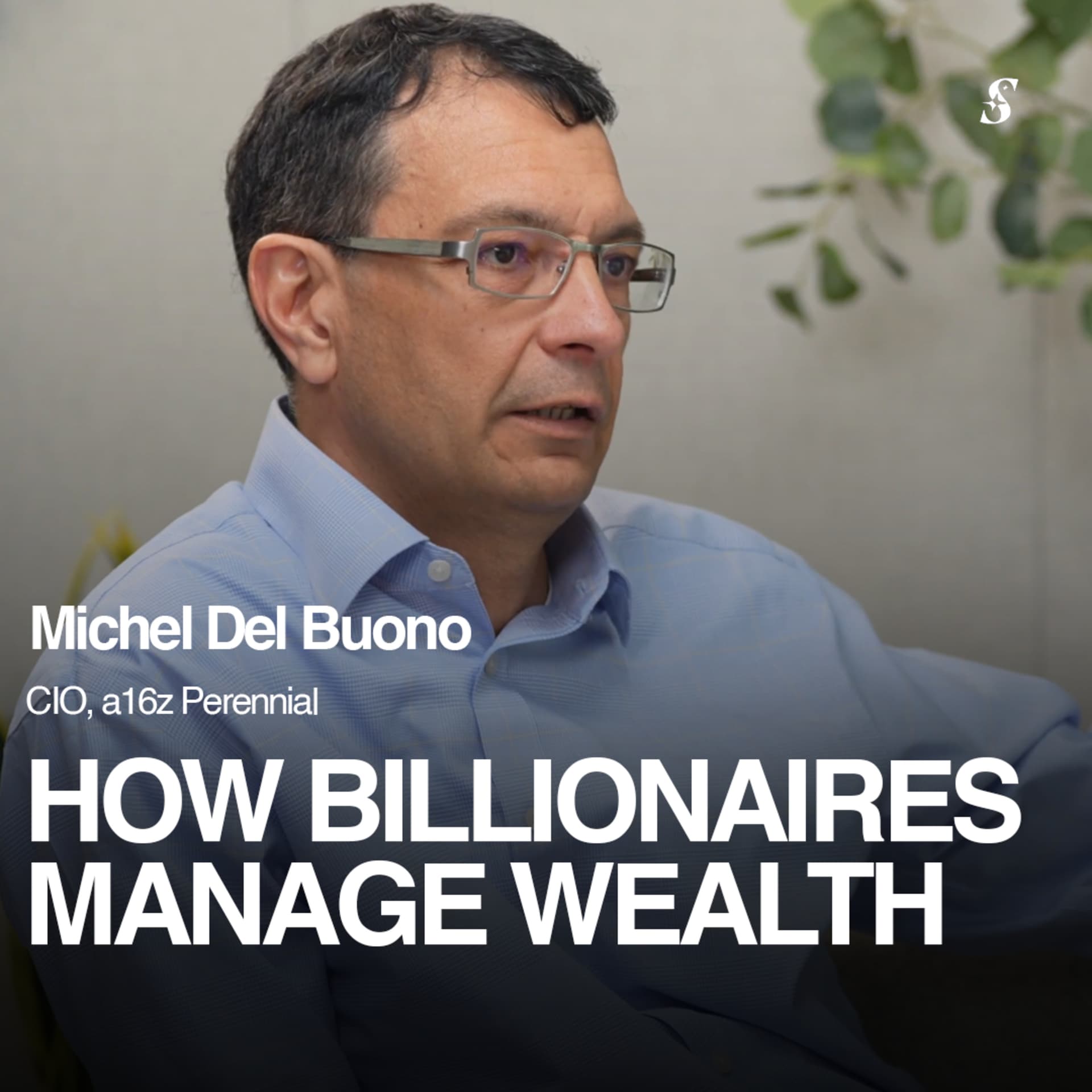

In short
A16 Perennial CIO Michelle discusses Marc Andreessen & Ben Horowitz’s multi-family office model, why wealth management fails taxable, institutional-sized clients, and how to prepare for major liquidity events (e.g., SpaceX IPO rumors).
Guest backgrounds
Michelle is CIO of A16 Perennial, a multi-family office serving a small number of high-net-worth/billionaire families with professional investment teams and customized portfolios.
Key claims
- Traditional wealth management is “retail product” with high service but weak investment acumen; bank wealth managers are trained as service providers, not professional investors.
- Flat AUM/relationship-fee incentives lead to simple portfolios and discourage building alternative-investment teams; fund-of-funds adds “dual layer” fees.
- Institutional asset managers often optimize for non-taxable clients, leaving taxable individuals in a “no-man’s land.”
- Single-family offices are hard to execute (need many specialized investors; talent retention issues; often collapse after patriarch/matriarch death).
Notable examples
- SpaceX: discusses pre-IPO structuring, gradual diversification, and options programs to monetize volatility without immediately selling.
- Warns about secondary/SPV vehicles: employees can control entities holding stock and may sell without investor approval; recommends cap-table/direct ownership when possible and doing background checks/legal diligence.
Written by AI. May contain mistakes. Listen to the episode to check what was said.
Chapters
Tap a time to open that second in VOUnderstanding Perennial's Structure
1:24 to 3:41
Exploration of the structure and purpose of Perennial, the multifamily office.
“podcasts in a very long time yep first modern podcast first modern podcast and so you're the CIO of A16 Perennial.”
Wealth Management Challenges Today
3:41 to 5:49
Discussion on the major issues faced in the wealth management industry.
“it would be great to just dive even deeper into the state of wealth management today.”
Institutional vs. Traditional Wealth Management
5:49 to 8:13
Comparison between institutional asset managers and traditional wealth management firms.
“By the way, there are also fee structure misalignments.”
Generational Wealth Management Trends
8:13 to 10:40
Examination of how wealth management has evolved across different generations.
“They're not even attempting to optimize after-tax return.”
Performance vs. Service in Wealth Management
10:40 to 14:00
Analysis of the balance between customer service and investment performance in wealth management.
“And so they're often facing the choice of either creating a single family office, which I think is very difficult.”
Understanding Professional Investors
14:00 to 15:30
Learn the importance of hiring professional investors and the impact on fees.
“So very important for me from the get go here to sort of hire people that were professional investors by trade first.”
Challenges of Single Family Offices
15:30 to 17:20
Explore the complexities and challenges of managing a single family office.
“And all these things are specialties that require people.”
Wealth Management vs. Family Office
19:18 to 21:30
Understand when to consider wealth management as an alternative to a family office.
“with tasks that require real expertise and real world judgment.”
Preparing for IPO and Liquidity Events
21:30 to 24:00
Learn how to prepare for large liquidity events like IPOs in terms of investment.
“the broader theme of these Silicon Valley oriented firms?”
Choosing the Right Wealth Manager
24:00 to 26:21
Gain insights on how to select a wealth manager and the importance of due diligence.
“I talked to Sean McGuire of Sequoia, who they've invested billions into SpaceX and Elon companies.”
Show all 25 chapters
Challenges of Switching Wealth Managers
26:21 to 28:00
Discuss the difficulties clients face when switching wealth management firms.
“And you ask, well, why did you pick that?”
Portfolio Construction and Client Relationships
28:00 to 29:10
Learn how to build a diversified portfolio that adapts to client needs over time.
“Like for these typical portfolios, how do you set them up initially?”
Navigating Market Volatility
29:10 to 31:30
Understand how to leverage market volatility to create investment opportunities.
“So we're not focused simply on exiting that position on day one, the concentrated, let's say it's SpaceX.”
The Importance of Real Estate in Wealth Portfolios
31:30 to 34:20
Discover the benefits of including real estate in investment portfolios and tax strategies.
“So one, we have AI disrupting public markets, but we also have wars and GL politics and, I don't know, oil.”
Tax Strategies and Wealth Management
34:20 to 38:10
Explore effective tax strategies to enhance wealth management without relocating.
“to liquidate that and go into something else very fast i remember during the global financial crisis you know i worked at a hedge fund the only thing we could sell was treasuries to raise money.”
Using Capital Losses Effectively
40:31 to 42:00
Understand how to utilize capital losses strategically for tax benefits in investments.
“Set up payroll for any country in minutes.”
Navigating the Secondary Market
42:00 to 44:22
Learn about the complexities and risks of secondary transactions and investment structures.
“And then the total you get at the end has been tax mitigated, right?”
Venture Capital Returns and Risks
44:22 to 46:23
Discover the dispersion of returns in venture capital and the importance of manager selection.
“Whatever's written in the contract is what matters when you go into private.”
Creating Entity Value in Firms
46:23 to 48:46
Understand the significance of building entity value for long-term investment viability.
“What's your view on venture capital as an industry?”
Wealth Management for Founders
48:46 to 53:16
Explore common mistakes founders make with their wealth and how to manage portfolios effectively.
“The firm's not going to disappear when someone decides to hang up the cleats, right?”
Private Credit Market Insights
53:16 to 55:44
Analyze the dynamics and potential bubble risks in the private credit market.
“And so if that's the goal, we try to keep the portfolio actually more liquid because their hope is that they can finance more of it themselves, right?”
Current IPO Landscape
55:44 to 56:00
Get insights into the current IPO landscape and expectations for companies like SpaceX and OpenAI.
Current Economic Landscape and IPOs
56:00 to 56:59
Explore the current economic growth and the dynamics affecting IPO opportunities.
“And that right now, there's no indication of a slowdown in the economy, really.”
Investment Research and Diligence
57:00 to 59:26
Learn about effective research methods and the importance of diligence in private investing.
“So the pressure to go public is not as high as it would be if they weren't able to.”
Future Aspirations in Wealth Management
59:27 to 1:00:26
Hear about the shift towards transparency in wealth management and educational goals.
“I'm lucky enough to be up here, which is not going to complain.”
Transcript
Automatic transcript. May contain errors.0:00Is it true this is the multifamily office of Marc and Ben? It's a multifamily office for the principals here and a number of founders, but many in fact backed by the company. SpaceX is rumored and reported to have nearly a$2 trillion IPO incoming. How do you prepare early employees and founders for these large liquidity events? It'll be an interesting test of the markets if they can sort of, I mean that would be the largest IPO ever for the markets to digest that. to be really interesting to watch. Most of the independent firms have spun out of banks. Banks themselves don't train people to be professional investors.
0:36These people are trained to be service providers. They're trained to be responsive, helpful. But actual investment acumen when you're at a large bank sits in a separate group. You're rewarded as a wealth manager by how much you grow your book of business. You're never trained to be an investment person per se. So I'll see someone with their very, very first liquidity. They take it and instead of doing something a little bit safe in case there's a rainy day, they turn around and you put it in a bunch of very early stage startups. You just sort of sit there and you're like, listen, if you're going to do venture, at least try to do it in a systematic way.
1:07Do not take 80 % of what you just got and hand it to your three friends. Almost always this ends in two years.
1:23michelle welcome to sorcery thank you i think this is one of your first podcasts in a very long time yep first modern podcast first modern podcast and so you're the CIO of A16 Perennial. Is it true this is the family office or multifamily office of Mark and Ben? It's a multifamily office for the principals here and a number of founders, not necessarily been backed by the company, but many, in fact, backed by the company. So what's the structure of Perennial? Okay. So I think the reason why we built Perennial or why we're building Perennial, it's about four years in now, was a reflection on what's happening in the wealth management industry.
2:06I think for starters, the principals here, Mark and Ben included, had been served by more traditional wealth management firms. And they looked to the LPs of the A16Z and saw, you know, the big sovereign wealth funds, the big pensions have very high-end professional investment teams come. And then they'd look at the wealth management side, how they were being served personally. And frankly, I think most folks would agree they felt sort of underwhelmed with the quality of the investment advice and investment acumen, not the whole service provision and everything, but specifically on the investment front.
2:46I think that was one issue. Another issue or another point, obviously, is to build a community around A16Z. A16Z is all about its community. And so this is another way to help founders in a different dimension of their personal life, right? So if you can take that burden off their hands, you know, ostensibly, they can focus even more on the business. And so it becomes much more of a lengthier relationship with the founders, because obviously, you start when you invest with them and their startup. But even post liquidity, instead of having sort of an artificial end point of your relationship with them, you can continue helping them think about life after liquidity event, right, in terms of philanthropy, asset management, legacy, all those kinds of things.
3:36I want to get more into the perennial strategy and structure. But I think before that, it would be great to just dive even deeper into the state of wealth management today. What have been the biggest problems drilling down further into the issues that you've seen? How wealth is managed, maybe the different types of wealth over time, but structurally, like what are the biggest problems there? It's very interesting. So they're basically, there are two approaches you can use to have your wealth managed if you're a wealthy individual. One is you can go to the traditional RIA or wealth management channel.
4:08And I'll talk about that in a second. The other one is you can go to traditional asset managers. Think, you know, large asset management firms, you know of hedge funds, PE shops, things like that. And both those approaches, I think, have their own sort of problems when you're dealing with an individual that has an institutional amount of wealth or will and are taxable. Right. These two these two the confluence of these two effects means that the sort of the two standard approaches I just described aren't really great. So wealth management, traditional wealth management. Most of these firms, the independent firms have spun out of banks and the banks themselves don't train people to be professional investors.
4:52Right. These people are trained to be service providers. They're trained to be responsive. They're trained to be helpful. But the actual investment acumen when you're at a large bank sits in a separate group. And you're rewarded as a wealth manager by how much you grow your book of business. So you're never trained to be an investment person per se. And then when you spin out, therefore, you create your own large independent firm. It's, again, not a focus, right? And so if you are, so the way I would characterize a lot of that product or that offering, I I would call it mostly retail product, but with a veneer of very high-end service when it comes to the investing side.
5:30Of course, there's all the ancillary services around household staffing and buying dog walkers and nannies and things like that. But by and large, the investment side of the function, I think, is just not of the quality that someone with an institutional balance sheet should expect or deserves. So there's that side. By the way, there are also fee structure misalignments. So this is a tangent, but I think it's an important one, which is most of these firms rely on a relationship fee, which is a flat fee that you pay no matter what you do. And let me ask you the question, if you're paid the same to do something easy or something difficult, I think human nature is such that you'll do the easy thing, right?
6:15And so you look at a lot of these firms that have the flat fee structure and you look at the at the portfolios that come to us we we see a lot of them coming in and i would characterize those portfolios as very simple not very sophisticated um very very focused on just standard market beta stocks and bonds and things like that not a lot of focus on uh on um alternatives and the reason being is for you to build an alternative offering you're going to have to go hire professional investors and professional investors are paid well. They have growth ambitions. It's very difficult for them to fit into an organization that's not focused around investment too.
6:58So I think there's a lot of challenges, even if you wanted to grow an asset management or investment function in SINRA, I think it'd be very difficult. So the flat fee arrangement, you know, means that people do not invest in building out these alternative teams. It's a lot of work. It's a lot of effort and it's a lot of expense. And if you make the same 40, 50, 60 bips doing that, or just buying stocks and bonds, you're going to buy stocks and bonds. So by and large, so that industry I think is not teed up for, you know, a sophisticated portfolio that is deserving of someone that's got 50, 100, 200 million, let alone a billion dollars, right so that's one route and then the other route is the traditional institutional asset management route and those guys um their biggest clients are non-profits right so their pensions endowments foundations some wealth funds all these people don't pay tax so they are not at all focused on the taxable element and if you're an individual uh you're paying especially in this state you're paying 50 plus percent tax so the easiest alpha to use a you know investment term to get is a tax alpha, right?
8:09And they are not these institutional asset managers because most of their clients are non-taxable. They're not even attempting to optimize after-tax return. In fact, you could even argue that from a fiduciary perspective, they're not allowed to optimize after-tax return because the vast majority of their clients care about pre-tax return. So they're structurally not able to serve you. So there's this weird no-man's land where you have taxable individuals that have and deserve in sort of an institutional quality portfolio build and asset allocation. And yet neither of the two standard channels really deliver that.
8:47And I would add in sort of subscale endowments and foundations also in the mix because while they can probably access the institutional, they may be too small and they may be cut out of certain elements. So having sort of a different approach could also be useful for them. Dave who connected us and thank you to Dave for the connection he wanted to hear what you've seen throughout the different generations of wealth I mean we've come a long way it was a lot of industrial a lot of like big bank big kind of industry types of wealth built over long periods of time to now what we're seeing and what is the bread and butter of A16Z very fast wealth billionaires billion dollar exits very quickly and uh part of that is of course these different cycles of innovation and ai and the pluriferation around there but what have you seen throughout your career through these different types and how has management changed alongside that no it's super interesting and i think um i can tell when i meet a family what region they're from because these waves affected different areas right so the industrial wave was the midwest so if i meet a Chicago family, and these are gross generalizations, but nonetheless, if I meet a Chicago family, very often they've sold their business maybe one or two generations ago, and the family business has become managing the family's assets.
10:13So they're very well versed in all the terminology, they understand the asset classes, and they ask pretty sophisticated questions around that. And they're very focused on the performance and so on and so forth. So I would put that as one of those earlier waves you're talking about right and then you come to the west coast and your point it's more recent wealth person who generated the wealth is the person you're interacting with and so that person is going to have a lot of business savvy intellectual insight into how things work so you can be very curious about this industry and about how to do things but they won't necessarily per se have an interest in having studied it the way a multi-generational family that had an industrial exit two generations ago would have done because it's not their full time job.
10:58It's not their passion. Right. And so they're often facing the choice of either creating a single family office, which I think is very difficult. And I can get into that or joining, you know, a multifamily office. And then when they join the multifamily office, they're facing a number of questions that I think are not obvious to answer, which is, What am I paying for? What am I getting? What do I want? And because they're not necessarily knowledgeable about the industry, they focus on, they fall back on things they understand. How quickly does someone answer my email? How helpful are they when I'm in a pinch?
11:33Which are important things, but not the only thing, right? Assessing the investment performance is very important because just a couple of hundred basis points of extra performance over the lifetime someone could mean hundreds of millions of dollars more that they could then go create a charity to do something with or something like that. So that part I think is lost sometimes in the translation. I want to get to the family office point, but I do remember when we were first talking, there is a big difference between these other wealth managers that do allure you with all the customer service that kind of takes part and takes you away from the actual performance of the portfolio.
12:11So what have you seen there? Yeah. So this goes back to sort of that flat fee relationship fee kind of arrangement, which in that flat fee is an AUM based fee. So if I'm selling you a bunch of services, why am I charging you an AUM fee? And, you know, I sort of, I like to make funny analogies. One, one analogy is let's say you brought your car to get your car fixed and the mechanic comes out and says, well, to repair a car, it's 10 base points of your, of your balance sheet. Like, I mean, I think we'd all react like, what are you talking about? right there's an hourly wage you work three hours multiply it by three that's what you should pay me so these services in my opinion should be fee for service right but because that's of course less profitable than having an AUM based fee on someone's entire balance sheet you charge that fee you go through the motions of the investment management but you view that as a cost center and like you do the services right and so that's why the portfolios often end up being sort of simpler and less sophisticated because you're not incented to invest in building out the alternatives team, as I mentioned.
13:15These are people who are hard to find. You have to manage them in a different way than you would a more junior resource. And, you know, constructing these portfolios, the proof points take time. You're building a VC portfolio. You're not going to find out in two years whether it's done well, right? You're going to find out in 10 years. I don't know that a lot of these firms have the patience for that, right? So for me, what was very important, and by the way, if you don't build a professional investment team, then you are, you by default have to invest in other people's investment firms, right?
13:49So it becomes a pure fund-to-fund approach. And so there's dual layer of fees, so it's very expensive to do, right? So there are fallout implications from not building an investment team in-house. It forces you to become a fund of funds if you are going to do alternatives. And so that's a high fee kind of setup. So very important for me from the get go here to sort of hire people that were professional investors by trade first. And professional investor is a very specific definition in my mind. It's someone who at some point in their career was paid purely based on the performance of their investments.
14:23Right. Your investments were up 20 percent this year. Here's your money. Thank you very much. right? If you have those kinds of people on your team, you now can underwrite your investments yourself, or you can go hire a third-party manager, but you're not forced to just go down the third-party route. And so you can save a lot of embedded fees for the things you decide to do yourself. And I'm not suggesting you should do everything yourself because it's too hard, too many things, but there are certainly some things you can do yourself and therefore really reduce the fee load. So you increase the alpha to the client because you're not passing through these fees.
14:59Like a standard sort of endowment style approach, 50, 60, 70 % alternatives. On a look through basis, your fees are going to be three or 4 % a year. So it's a huge headwind. If you can get rid of some of that by having a professional team in house and not always just hiring third party managers, that can, you know, maybe you cut that in half. it's a couple hundred base points of alpha right there so the structuring is very important in my opinion how to do this right and then on the family offices point family offices are taking off they're becoming a new hype wave they're they're all over the place but you're saying single family offices are very difficult why is that and why should people avoid doing that as a first step um i mean the allure is cool i have my own family office but you know what are you trying to accomplish so if what you're trying to accomplish is have someone help you a little bit with your sort of financial reporting and all that's you can call that a family office i guess the definition of family office is very broad so it could include all sorts of things but if you're trying to build a multi-asset class portfolio global multi-asset class portfolio you're going to hire a bunch of these sort of professional investors i mentioned i don't know you need five six seven of them different asset classes you've got you know you've got fixed income obviously stocks, which are, you know, more straightforward, I'd say, but then you've got venture capital, private equity, real estate and real assets, credit.
16:20And all these things are specialties that require people. So how are you going to do that and pay these people if your balance sheet isn't very big? And I mean billions, right? Otherwise, the compensation you're paying to this team is eating up whatever benefit you might be getting, right? The other challenge I found is that family offices have real trouble retaining the talent because you hire someone, they're ambitious, they have a career path. The principal of the family is signing up really to be a manager of an asset management company. That's really what they're signing up for. I don't think many of them actually realize that's what they're signing up for.
16:57And I don't think they want to do that. So they don't want to manage me, meet me daily or twice a week, let alone a broader team. And so it's very difficult to attract the high-end professionals because they're just going to be sort of in a vacuum, often not meeting the principle. So it's a very difficult thing to execute. Some people do execute, of course, but they have very large balance sheets. They have a long-term horizon, and they're committed to building a proper bench on their team. So I think that's one issue. The other issue is a lot of single-family offices, you hear that the motivation is they build it to keep the family together.
17:37and then you witness the statistics at least show that when the patriarch or matriarch passes away very often the family office falls apart either the investments are completely turned around and that things are liquidated in a hurry that results in large losses by the way we're the beneficiaries that sometimes we buy those things uh or or the kids or the heirs take their money and go their own way, right? So the very sort of conceptual underpinning of why to create a single family office seems to fall apart a lot too. So there's multiple challenges with trying to do a single family office, I think.
18:12Again, it depends on what you want to execute with the single family office. Sorcery is brought to you by Brex, the financial stack trusted by more than 30 ,000 companies, including one in three venture-backed startups in the US. Nearly 40 % of startups bail because they run out of cash. Rex is literally built to help founders avoid that. Unlike traditional banks that let your money sit idle, chipping away at it with fees, Rex's designs help you spend smarter and move faster. Their all-in-one solution combines checking, treasury, and FDIC protection into one powerful account. You can send and receive money globally at lightning speeds, get 20 times the standard FDIC coverage through their partner banks, and even high yield from day one, with same day and even same hour liquidity.
18:59Access your funds anytime. Companies like Scale AI, DoorDash, Service Titan, HIMSS, Anthropic, Flexport, Robinhood, and Plaid trust and use Brex. Start today at brex.com slash sorcery. That's B-R-E-X dot com slash sorcery. Turing is training the next generation of AI with tasks that require real expertise and real world judgment. That's why companies like NVIDIA Anthropic, Salesforce, and Gemini partner with Turing. Turing builds realistic reinforcement learning environments and data systems based on real operational traces, the kind of infrastructure frontier labs need to train superintelligence.
19:41Visit turing.com slash S-O-U-R-C-E-R-Y. At what level of wealth should people start thinking about going the wealth management direction? Wealth management as opposed to single family office? Yeah. Well, I mean, for wealth management of course there are firms that cater you know from small amounts all the way to large amounts but for a type of wealth management firm that i'm talking about the type we're building here perennial that has a lot of investment expertise 25 50 million dollars would kind of be the minimum really but but i would say it's really more for the centi millionaires and billionaires who have again you know an institutional time multi-generational time horizon so they're they're more like an endowment than they are like an individual how many families are you working with right now uh well we're purposely keeping it small because another thing is we really want to be customized uh and focused on the individual needs of the families what you'll find again in the industry there's a lot of folks go by playbooks so they'll categorize you as a certain type of family in terms of your risk profile or your liquidity or a balance sheet.
20:52And then there's a standard program that's put into place. I'd say that's very common, right? We don't want to do that. We feel like the people we work with are people who have multi-generational wealth anyway. So they should have a custom built asset allocation, custom built investment program, a lot of work around their concentrated stock because often they come with a lot of concentrated stock. And so we've built a team around that. And so we only have a couple dozen families we work with in that sort of overarching quarterback of everything. Is that the main difference between A16Z Perennial and let's say an iconic?
21:29How does it fit within the broader theme of these Silicon Valley oriented firms? I think the Silicon Valley oriented firms for the most part, again, are trying to be a full stack offering of all the services. um and so you know with a certain amount of revenue there's only so much you can build in-house right so a lot of these firms do not have professional investors so i i often ask people as a quiz um how many professional investors do you think are in you know ria xyz and uh and people answer i'm in percent right people answer me 20 percent 50 percent 30 percent but the number often is zero or one or two people.
22:15And so that's the big difference between us and many of these other firms. With so many large wealth creation events coming up, SpaceX is rumored and reported too to have nearly a$2 trillion IPO incoming. Yep. One, what do you make of that? And two, how do you prepare early employees and founders for these large liquidity events? Well, look, I think it'll be an interesting test of the markets if they can sort of, I mean, that would be the largest IPO ever, right? And so for the markets to digest that, it'd be really interesting to watch. And I think there's a lot of other very large startups waiting in the wings who will be watching this super carefully, right?
22:57Because if it works for SpaceX, maybe it works for me. in terms of preparing I think you know again if you're an individual with you know taxes structuring your estate structuring your trust is very important pre-IPO and then post-IPO it's all about how do I diversify gradually and I would not purport or claim to know more about SpaceX than someone that's worked there 20 years so I would work with that person and ask them you know What do you think the prospects of SpaceX are? I would not go and suggest they dump SpaceX 100 % immediately and go buy stocks and bonds, right? Sure, part of their strategy should be to diversify, but part of it should be to hold on to that stock long term and think about how to maybe even monetize the volatility.
23:44So we've built some options programs and things like that for people here to monetize. These stocks are volatile by nature, and so you can monetize that volatility without necessarily exiting the stock. So there's lots of interesting strategies you can do with someone that has a concentrated stock position. It's just so interesting because I think I've talked to several people in L.A. pertaining to this IPO. I talked to Sean McGuire of Sequoia, who they've invested billions into SpaceX and Elon companies. And then I've also talked to engineers and I've talked to people that have been at SpaceX.
24:19One of the themes that I've seen throughout this is that there are not enough wealth managers. And there's not enough wealth managers with this family office type of expertise either. And so there's a little bit of like an incoming drought for a lot of demand. And I know SpaceX is not only LA, but it's also Texas. There are definitely differences there. But in terms of that, what do you make up of like, where should they go? So because a lot of these engineers and other professionals there are not in this world, they're ill-equipped to assess the options. And so often they end up in places they shouldn't, in my opinion.
24:59And so the challenge for them is to, even if this is not your passion, please invest time enough to understand the space. One of the things I always suggest to people is look at the pedigrees, the education, the employment history of the people you're hiring, right? Right. If they've never really done, you know, been professional investors, then don't look to that firm for professional investing advice. Look to that firm for services. Right. So I think just doing educating yourself enough about the industry is a really important first step to even try to attempt to, you know, often people say they get a referral.
25:33Oh, my buddy uses so and so and they're a nice person. OK, well, I'll go with that. And, you know, I always like to make medical analogies here because it sort of highlights how sort of, I guess, ridiculous that decision-making process. Let's say you needed a, you have a horrible cancer and you need a big surgery. Are you simply going to ask your neighbor, hey, do you know some, a good brain surgeon? And they'll go, yeah, you know, so-and-so down the road is a great brain. No, right? You're going to go read the hospital reports and find out which surgeons have done the surgery the most. And, you know, do the same thing here.
26:06I mean, your wealth is the product of your life's work. This is not some, it's a very important thing. So invest the time, please, to sort of understand what you're buying before buying. Because I'm at the receiving end of that a lot. I see people, they go somewhere and then they come to us. And they say, I don't like this. And you ask, well, why did you pick that? And the answer always is, almost always is, well, my neighbor or my friend or a colleague. Right? So if you have any influence on this, tell people, do just a little homework. How easy is it or how hard is it to switch over to different firms?
26:42Super hard. Really? And this is part of the game. So you're with a firm. They know all your accountant numbers. They know all your wiring instructions. They know all your different trusts, your trustees, your accountants. so when you are doing something they'll report back to the accountant they'll you need to send money they'll do the wire instructions for you the industry is set up to sort of trap you right even the large um uh the large custodian firms i don't know if you it's hard for people to realize this but if you're an individual in these custodian firms uh you know the brand names i won't name any names, which you know who they are, you can sort of do a lot of stuff yourself, self-initiate self-service.
27:27When you move under the RA platform, those, those features are disabled to sort of keep you more locked into that ecosystem. So it's very hard. It's daunting. And this is why there's such a race to be the first firm that someone that recently had liquidity, this is where the fight is. Like, I heard you had a liquid, you're about to have a liquidity event. Me, me, me, pick me. because once you've picked the person, the odds of them moving again are extremely low, right? And so that's where all the competition happens. When they essentially onboard, I'm just so curious about this. What products do you show them?
28:07And where are their barriers? Like, for instance, do you go into art? Like for these typical portfolios, how do you set them up initially? you said it's kind of like a gradual process but like what are all the offerings and how do you balance it it is a gradual process so you know i think we're a very open book and so we'll tell people frankly that they don't need to necessarily put all of their assets with us right which again is not what most people in the industry will say most people in the industry will say hey you should put everything with me because otherwise i won't have an insight on what you're doing elsewhere and therefore I won't be able to manage your things optimally.
Read the full transcript
28:48But that's not true. You can have the firms communicate with each other and I do this regularly, right? And so, again, if you went to a traditional firm, they would start with more of the stock and bond mix. They might add a little bit of some sort of credit. We sort of tend to work with people more in a linear fashion, acknowledging that their portfolio is going to change over time, right? So we're not focused simply on exiting that position on day one, the concentrated, let's say it's SpaceX. We're not just simply going to be like, you've got to sell all of SpaceX. It's okay, SpaceX, if you hold on to it for 20 years, here's what the outcome might look like.
29:26By the way, we built a lot of tools to help forecast these kinds of things, which is, again, empowered by the fact we have professional investors who know how to do that. I mean, a lot of it, I'm sorry to be repetitive, a lot of it falls back to that. and then we we will do we will um customize based on their needs like so yeah strange alternate strange unusual alternative asset classes are definitely part of the mix we have some clients who do a lot in the art space um i'm not an art specialist but i know art specialists that can help you right so so we're very very flexible um but the point is the whole mix of things has to make sense right and so i'm not simply going to be and this is where um giving advice is an important part a lot of again firms will present you alternatives will say you can do this or you could do that you tell me what you want and they're doing this for various reasons one they may not actually have a strong opinion two uh it's liability if i tell you do this and you do it and then you're not happy well i told you to do that if instead i gave you three options and you pick B, I didn't pick B, you pick B, right?
30:32So we're very much into giving advice. We'll tell you, look, if you're going to put a lot of art, you might want to counterbalance that with this and that to make the whole portfolio work, right? So we sort of put ourselves out there. But I think a lot of people have desire and hunger for that. They don't want to sort of have to learn all these things and make the decision. They want someone who tells them, you should do this. Again, let's use a medical analogy. you know i have cancer you know okay you need to do a surgery right not well you know maybe you could do a surgery maybe you can drink some herbal teas you tell me that you wouldn't be satisfied with that with the physician why is that okay here right so you want to get a i think you want a professional telling you no no herbal tea for you like the tumor is big herbal tea is not going to work, right?
31:23You need a surgery, right? So that's one of the things we pride ourselves in. I'm so curious about your stance on the current markets and the current market volatility. So one, we have AI disrupting public markets, but we also have wars and GL politics and, I don't know, oil. And so how do you manage throughout all this? How do you provide assistance to the families, to your clients? And one, are you actively managing their portfolios? Two, are you helping them navigate through this? Because I'm sure they're seeing their wealth go up and down in different directions. Yeah, I mean, I always tell people, one of my favorite saying is, volatility is not the enemy, right?
32:04A lot of people fret. Volatility, I'm scared. But if you have a deep balance sheet and you've kept your portfolio at least somewhat liquid, volatility is a huge opportunity. It's like a fat pitch, right? And so you get assets that go on sale. You know, big equities, you know, stock markets every four or five years. There's like a 40 % drawdown, right? Blue light sale. You should have flexibility in your portfolio to take advantage of the blue light sale. And you should have your advisor call you up and go, hey, these things are 40 % off. It's time to back up the truck. So yes, we do do very active interaction with clients on the front.
32:44How much do you like to put in cash and real estate and all these other kinds? Real estate's actually for taxable individuals is a really very cool asset class because it's uncorrelated. So if you're, again, you're a SpaceX person, right? You have a lot of stock market risk factor, right? So if you take real estate, real estate's pretty uncorrelated to that. So it diversifies you. And then a lot of wealth in this country, a lot of wealthy families made their fortunes with real estate, right, including the present. And why is that? Because the entire banking system and taxation system was built around real assets.
33:27When banks and law and law, all these laws were built in the 20s, 30s, 40s, all there was was real assets, right? People weren't, there were no Internet companies. They were buying buildings, factories. So the tax code is very beneficial to real assets. And you can therefore get a solid teens return on a tax adjusted basis out of real assets and real estate. So to me, it's a very, again, if you've got the ability to stomach the illiquidity, because buildings don't trade like stocks, you should be holding a lot of those in your portfolio. So, yes, it's an important part. And then cash or very liquid bonds.
34:07people don't like bonds for the return profile they say well why would i own this thing it returns three or four percent and my answer to that is you're not owning it for the three or four percent you're owning it because it gives you that flexibility gives you that option value to liquidate that and go into something else very fast i remember during the global financial crisis you know i worked at a hedge fund the only thing we could sell was treasuries to raise money. Nothing else was trading. So having a treasury kind of liquidity buffer, super important. You can go sell those treasuries even when there's a horrible war or something.
34:44Someone will pay you cash for that. In fact, they might pay you more than they would have before because bonds is a safe haven asset. You take that cash, you go buy the distressed asset, right? We should talk about taxes. Yes. Taxes are probably one of the biggest talks around town, especially in California. Some people are like, oh, well, you made so much money, like you get to choose where you live. And if you want to live in California, that's the purpose of making a lot of money. Some people will say, oh, I've made a lot of money. I need to go somewhere else so I can save, you know, a couple percentage points.
35:17And I don't know, live somewhere for three, four years, something like that. But what is your main stance on taxes and where you live? Because we can also get into this afterwards. But the billionaire tax bill, that definitely, I mean, I don't know if this was based on principle or like a little bit of a protest, but I think it was over a trillion dollars left the state of California. So how do you feel about taxes? Well, I mean, no one loves paying taxes unless they feel they're getting value for it. Right. And I think when you hear people complain about it, it's I don't get value. Right. You know, my schools aren't great.
35:54The roads are in disrepair, whatever you hear these complaints. right so i don't think anyone's necessarily averse to paying tax if they feel they're getting value for and a lot of people who leave field are not getting that right so that's one um two there's a sense that the the revenues are mismanaged and i'm you know i'm not going to get into all the waste and fraud that happens but we all know a lot of that happens right but there's a lot of and moving is a very draconian move right because your family your your friends and all that So some people can do that and want to do that. And by the way, it's not easy.
36:27You have to sort of really move. So leaving your house here, your main house, and moving to Texas or Florida for a year or two with the intent of coming back doesn't qualify, right? If you do come back after a couple of years, the tax authorities here will say, look, you never sold your house. You never had the intent of leaving the state, so you owe us tax. So you really have to sever ties. You have to, of course, buy your principal residence, sell your principal residence here. You've got to register to vote. You've got to have all your physicians there, all that stuff to really prove to this state that you've left and that you have no intention of coming back.
37:03So the move isn't easy and it's a draconian change. Some people, though, if you have a really big balance sheet, it's worth it, right? But there's a lot of things you can do with your portfolio to mitigate tax too. So before jumping to, you know, I'm going to move to Puerto Rico or whatever. First, think about how you structure your investments, your portfolio. So there's all sorts of very clever ways to use the qualified business tax exemptions, QSBS. So you can create several trusts. Each of those trusts gets the now$15 million exemption before it was 10. So you can do that. Married couples now can get both exemptions.
37:41So there's a lot of things that if you do on that, remember we were talking about the pre-IPO, on the pre-IPO prep, you can do things to already mitigate tax a lot. Then you can use the proceeds and invest them in tax-advantaged things like real estate, if it's managed the right way, that is. A lot of real estate, unfortunately, is managed in a way where the buildings are sold a lot and that generates tax. But if you hold the buildings for a long time, you can use the depreciation credits and never pay tax on the income you're getting. So there's a lot of things you can do like that before you move.
38:13And we spend a lot of time, obviously, thinking about that pre-liquidity event and post-liquidity event. There's also a number of strategies you can use that generate losses, whether the market is up or down. There's some sophisticated strategies that use leverage. Using leverage is not always easy because leverage can be dangerous on a portfolio. Luckily, we have a couple of people on our team that worked at hedge funds and are used to leverage. So there are things like that you can do before the pull the plug on moving somewhere else. But I see a lot of people moving, though, to your point. Really?
38:47A lot of people moving. In fact, there's been a bit of a boomerang. Some people have moved and then come back. Because in their minds, they thought that saving several percentage points of tax was worth the move. And then when they move, they, for personal reasons, they're like, look, I saved money, but it wasn't. The savings weren't worth the cost to me personally. Right. And these are, you can't, it's very hard to predict how you're going to feel when you move somewhere else because you don't, you've never lived there. Right. So I think it's very hard. It's a valid point. Yeah. VCX by Fundrise, the public ticker for private tech, allowing investors of all sizes to invest in venture capital.
39:25View the portfolio at getvcx.com. That's getvcx.com. Some of you may not have heard this yet, but our sponsor Public just launched something called Generated Assets. And it brings AI into investing in a way I've honestly never seen before. Here's how it works. You type in an idea like AI-powered supply chain companies with positive free cash flow or defense tech companies growing revenue over 25 % year over year. Publix AI then dispatches a swarm of agents that scan every single US stock, evaluates them, and instantly builds a custom index around your thesis. What really stands out is how clearly it explains why each stock is included.
40:02And before you invest, you can even backtest your idea against the S &P 500. So you're making decisions with real context, not just guessing. And beyond generated assets, Public lets you invest in stocks, bonds, options, crypto, all in one place. They'll even give you an uncapped 1 % match when you transfer your investments over from another platform. If you want to build a portfolio that actually reflects your thesis, visit public.com slash sorcery. Paid for by Public Investing. Full disclosures in the description. Founders ship faster on deal. Set up payroll for any country in minutes. Hire anyone anywhere.
40:37Get visas handled fast and get back to building. Visit D-E-E-L dot com slash sorcery. That's D-E-E-L dot com slash S-O-U-R-C-E-R-Y. Hi. Chamath recently went viral for a tweet about capital losses because of the destruction his SPACs have incurred on people. What is your viewpoint on capital losses and how do you use them to your point of offset? So we use them a lot, right? Capital losses are the core behind all those sort of liquid strategies I mentioned to you before, the leverage strategies and whatnot. there's some nuances in the tax code like you can't use a loss that comes to you personally unless you happen to be a professional in that industry so you can only use a small part of them so the way to use a loss is inside a fund vehicle that generates its own gains that can be offset by its own losses then you don't have to worry about extracting the losses and putting them on your personal balance sheet and not being a user.
41:42So if you owned a SPAC or something like that, and it went to zero, you may not be able to write that off, right? But if it's sitting in a portfolio in a fund structure, usually a partnership, you're going to have other things inside that fund. They're going to be offsets naturally so that you can shield the total result of that fund from tax. And that's exactly, I think, the right strategy for real assets and real estates where you're generating these capital losses, you're generating depreciation losses, and you use those to offset the income inside that fund. And then the total you get at the end has been tax mitigated, right?
42:19SPACs were a huge trend. Secondaries have taken storm. And so with secondaries, we're seeing not only lots of volume in secondary transactions, which is good, I guess, for growth investors, because that was really quiet for a while. But we're also seeing these multi-layered SPVs proliferate and cause sometimes scams. But in terms of secondaries, what are you seeing and what are you advising your clients on with these? So it's a fascinating space, to your point. It's a little bit like the comment I made before, where if you don't have professional investors on your team, you have to build a fund of funds to invest.
42:58It's the same idea with these secondary vehicles. I'd say be very, very careful what you're doing. Attorneys love to use this term, perfect your ownership interest. So let's say we're going to use SpaceX again since we've been on SpaceX. Let's say you've been working at SpaceX years and you create your own MOLLE Corp and you put your SpaceX stock in that. SpaceX doesn't want you, or most companies, I don't know the pictures of SpaceX, don't want you to transfer your stock to an external person, right? So what you do is you transfer it to your own entity and then you sell shares in that entity to other people right and it's not very clear and you often charge fees right so a lot i mean it's sometimes quite egregious to your point you've been paying two three five percent for the right to buy something um but the problem is the stocks are sitting in that entity and you are the manager of the entity the employee is the manager of the entity um and so they're the ones who ultimately even though they've written the promise saying when there's a liquidity event, we'll sell the shares and hand you the money.
44:01I've seen personally in cases where the stocks that are in the entity are sold by the individual managing the entity, and they don't need to seek approval from the people who invest in it, right? So be really careful when you go into these private entities. Any private company has its own set of rules. You can't sort of use intuition, well, that's fair or not. Whatever's written in the contract is what matters when you go into private. And the vast majority of the volume goes through these sort of questionable SPDs. Directly going on the cap table is what you should be trying to do, but that's extremely difficult, right?
44:38Obviously, right? And so that's where I would caution people really be very careful. So we spend a lot of time when we see these things doing legal diligence, which is expensive. You're going to pay an attorney$20 ,000 to review this thing and make sure it's bulletproof. do you really want to do that if you're going to be putting you know 500 ,000 into this so um be aware will your clients take these spvs to you to manage for them or do they just kind of do them on their own we've helped a couple clients try to build some um but most of the time we're actually trying to build one for our clients to get into a particular company yeah right it's been interesting to see.
45:19I did an interview series at Anduril and one of the questions I asked Macrim and Brian Schimpf, the CEO, is there is like a dark pool of fake SPVs going around for Anduril. And so with those, are you just going into deep legal matters and paperwork to backtrack and see if that is a viable vehicle? Have you seen any if you've run into a full on fraud before? but you know the first thing we do is we pay a background check company to see again using you as an example does she actually work at SpaceX what do you know so that's step one a lot of people don't even do that right ask your friends and clients how many of them have done run a background check on the on the person running the the answer is going to be no one right so just to get it's back to my just do some basic homework if you're going to do these kinds of things, right?
46:10Or get someone to do it for you. Venture capital has gotten some heat for not having the best returns, not being the best asset class. How do you manage that kind of alternative within these portfolios? What's your view on venture capital as an industry? No, that's a great, great, great question. No bias, of course. Zero bias. Zero bias. Look, if you look at the different asset classes and the dispersion of returns, right? Like the worst manager to the best manager, venture is the biggest dispersion of all the asset classes, like compared to private equity, credit, or hedge funds or whatever. And so to your point, that means that who you pick is super important, right?
46:57If the dispersion was this narrow, it kind of wouldn't matter, right? You kind of know what you're going to get out of that asset class. When the dispersion is this wide, and the stock market performs, by the way, somewhere in the middle of that, if you pick the bottom half, to your point, well, that's a problem. You should have just avoided the illiquidity, avoided the fees, and bought QQQ or something. And so I think picking the right managers and being exposed to the right people there is more critical than any other asset class. There's a couple of other interesting observations. I'd say, by and large, the industry has not tried to create entity value, right?
47:39What do I mean by that? They're often focused around one individual. And if that individual leaves, the firm is gone, right? Or the firm will have to reinvent itself, right? So because the person has their name on it, they're the only one there, and they've not built sort of an institution around it, right? And so the longevity of that entity is questionable and therefore it doesn't have entity value in and of itself right of course the funds have value but the entity itself doesn't what's really interesting about a16z personally for me and one of the things that attracted me here this firm has entity value right there's a lot of people who own this firm it's building you know a comprehensive set of products and services across different asset class sub-asset classes right be it crypto ai apps ai whatever.
48:27And it also has expertise around fundraising, HR systems, go to market. And so the whole thing is highly valuable. It doesn't just revolve around, it's not 10 or 15 people with one person, right? So I would say if you're going to, you know, invest for the long term, try and invest in firms that are trying to create entity value, because that's a sign of longevity, right? The firm's not going to disappear when someone decides to hang up the cleats, right? I think the other interesting thing is as the check sizes to participate have gotten bigger, scale has become more important, right? All asset management industries have some scale benefits to them.
49:10Venture traditionally had less and now has a lot, right? So if you're going to back a new AI startup, you can't show up with a million-dollar check or a$2 million check. It's useless. Or let alone, you're going to build an AI chip where the tape out for one chip is$100 million. And how are you going to participate in that? So you need to have large funds. So that's another thing. I think all of a sudden, it's become very clear that you need to have, there's been this dispersion. And you need to have a bigger fund. What's the biggest lesson that you've learned from Mark and Ben?
49:47The biggest lesson I learned from Mark and Ben.
49:53actually I have an interesting one so one of the biggest lessons I've learned from Mark and Ben it's really interesting it's about how to build a team and how to work with people and they said something when I first got here that was interesting they said we don't hire people for lack of flaws we hire people for their their sort of their skills and it was really interesting to me at first I didn't know what to make of this but for a long time i worked um you know in a large management consulting company and my reviews were all about addressing my flaws right so it's like well they would gloss over the things i did well it was not even worth mentioning and it's just a list of things i had to fix all the time and it's actually an incredibly demoralizing kind of thing because you the things you did well no one seems to care mention and then you're always being told every year after year these are the 18 things you got a fix to make it to the next level, right?
50:47Here, it's completely turned on its head. Like, if you are great at something, let's celebrate that. And we're all people, so there'll be things we might not like with that, but that's fine. We'll learn to live with that. And hopefully the balance is good. So there's this real embrace of, you know, the talents that people have. And so as a result, everyone here at the firm, what stunned me is every function I meet, people are really excellent at their function. The amount of talent in this firm is mind-blowing. And so it makes you really proud to be part of this place. So that's the lesson I want for MarketBag.
51:22That's a great answer. Hopefully. Yeah. Okay. What's the biggest mistake people make with their wealth? So I'll restrict my answer to the biggest mistake people make with their wealth to sort of founders of startups. I think because they grew up in the venture industry and in the private asset industry, they automatically gravitate to that. And so I'll see someone with their very first liquidity, their very, very first liquidity, they take it, and instead of doing something a little bit safe in case there's a rainy day, they turn around and they go put in a bunch of very early-stage startups, often referred to by their friends.
52:01And you just sort of sit there and you're like, listen, if you're going to do venture, at least try to do it in a systematic way, and not take, you know, 80 % of what you just got and hand it to your three friends. And almost always this ends in tears. Maybe I'm being exaggerating, but very rarely do those outcomes happen the same. And of course, because that individual who made it, their experience was one of success. It's hard for them to sort of visualize the statistics of the industry as a whole, right? So they're expecting that if they do two or three of these things, at least one of them will work and often none of them.
52:39Right. So that's the biggest mistake I see. It's like you finally got some liquidity, your hard work paid off. And what do you do? You go put it back in another sort of highly uncertain, highly liquid thing. Right. For those founders that come to you, they're post exit, they're liquid. Do some of them want to start on their second or their third company? and how do you manage their portfolios to do that? Many do want to start a second and third company, especially nowadays, you're young. Are you going to retire when you're 35 or 40 and not do anything? I mean, I don't think anyone wants to do that.
53:14So a lot of people want to do. And so if that's the goal, we try to keep the portfolio actually more liquid because their hope is that they can finance more of it themselves, right? The idea is, well, I did my first company and by IPO, I owned 15 % of it. the next time I want to own 30 % of it, right? And so I'm going to bootstrap it and use my own capital more. So we try to, yes, is a short answer. We change how we would suggest the portfolio based on those desires. A lot of founders, though, I think want to stick with their company very, very long term. They're not necessarily thinking, you know, two years out, I'm done.
53:51They want to stay along. I mean, this is their baby. They know it. They've grown it. so it's not necessarily i'm going to completely detach it's maybe my level in intensity will decrease maybe i won't be ceo anymore maybe i'll be chair or something like that but flat out leaving i'd say it's kind of the exception you do see it i want to do a quick fire on some macro okay okay is private credit in a bubble there's several flavors of private credit one is sort of direct lending so the idea is fico scores and things like that aren't the best indicators of credit quality maybe we can develop a different way to assess credit quality and we'll lend directly to an individual often okay that stuff has been fairly resilient and in part because it's So they sort of take the equity tranche, sometimes called the first loss piece, and they keep that on the balance sheet, the issuer does, and then the other pieces are sold.
54:54So there's like a buffer, right? If there's a few defaults, you're okay. Right? But there's more the sort of the private credit lending to companies, mainly sponsor-backed companies. And when people say sponsor-backed, they mean PE-backed companies. um and remember the pe companies how do you pe company private equity their equity investments right so how do you maximize return on equity well you use as little equity as you can right so you you buy a company and you lever it as much as you can so that your equity piece is small so that if the company improves the the return on equity is magnified right and so you're purposely levering these companies quite highly and you're putting that into a vehicle and people are investing into that leverage.
55:39So if there's an economic headwind and those companies start not being able to manage their debt, that's a problem, right? So at the end of the day, the question of whether or not private credit is in a bubble is really a question of, are we facing some sort of long-term slowdown or recession whereby these companies can't service their debt the way they were before. And that right now, there's no indication of a slowdown in the economy, really. There's a few, you know, there was a bit of a surprise on the employment report. But by and large, the economy is growing, you know, the long term trend for growth is not even 2%.
56:17And the economy grows above that pretty regularly. So right now, and the huge CapEx boom around AI is propulsing the economy. So I don't know that there's an immediate sort of macro event that causes these companies to not be able to support their debt. But it's a levered, high-risk strategy. Is the IPO window open? We're going to find out with SpaceX. What about OpenAI? Whoever goes first. Who's going first? I think SpaceX. But it depends if Anthropik and OpenAI are going to have a heated competition even more. Because I feel like they're in a battle right now. And so that's a race. But look, I mean, companies are still able to raise large amounts of money in the private markets, as we've seen with OpenAI and others.
57:03So the pressure to go public is not as high as it would be if they weren't able to. Right. And then, as I mentioned before, VC funds, growth equity funds have raised large funds. So there's capital available to do these things. um yeah i mean it's surprising how large fundraisers 10 20 50 billion dollar fundraisers happen overnight oversubscribe so until that stops happening there's you know less urged ipo unless you get to a size where the private market can't accommodate you anymore so it's in some paradoxical way right if there's like a slowdown in the economy and less excitement about these companies that's when they're going to be maybe more forced to IPO because the private capital then won't be available.
57:50I feel like OpenAI already pushed the limits on how much private capital they can extract with$110 billion around. I can't imagine how many more pockets you can go to. But no one thought before that that it would be easy to raise that sum and it was easy to raise it. Okay. What is your information and research diet? What do you watch out for? I'm kind of old school. I like to read source materials. I know nowadays, you know, people watch podcasts and things like that. I like to read Fed data. I like to read FRED, the Federal Reserve Economic Database that you can get free. I like to read quarterly reports from companies, transcripts of the analyst calls and those kinds of things.
58:39So that's what I spend a lot of time looking at reading and then of course listening to my clients who are in the know on the private private market side you do have a very good advantage i have a great great advantage there right right so you know i think of private investing there's like this two by two matrix which is like it's access and it's diligence right and so you know we're in a real sweet spot here right because i have access or we have access or clients therefore have access to all sorts of things because of the incredible network we have here. And then the diligence, it's a large firm.
59:12I can always find someone here that's worked with someone or knows someone that's worked with or been on a board or in a startup. So it's the amount of diligence I can do. It's very quickly, I can sort of assert whether or not this is a quality investment. So on that two by two matrix, I like to think, you know, I'm lucky enough to be up here, which is not going to complain. Very lucky. As we close out, what are you most looking forward to this year? so there's been a big effort at the firm to be more um outgoing with media and uh and this is part of that amazing so i'm very excited to uh to be out there speaking a bit more i mean traditionally a lot of wealth management firms tried to operate uh and multifamacies under a little bit under the radar um but i think for me personally at least i find that the way we set things up is so compelling and differentiated that i'm very excited to sort presented to the world more broadly.
1:00:07So that's... Also from what you've mentioned, it's clear that there needs to be more real information on these industries out there because there's a lot of traps. Yep. A lot of traps. So my goal is to educate. A long time ago, I wanted to be an academic. I spent way too many years at Stanford. I still enjoy teaching and educating people. So to me, that's the biggest excitement of this job. Amazing. Well, I'm looking forward to that as well. Thank you so much, Michelle. Thank you. Appreciate it. Hey, it's Molly. If you enjoy our interviews, check out our newsletter, sorcery.bc, where we deliver a once a week top deals and tech headlines email, and also go deeper on our podcast interviews.
1:00:46Subscribe to Sorcery today. And don't forget to subscribe to the podcast on YouTube, Spotify, Apple, or wherever you listen. Link in description to sign up.
From the publisher
Michel Del Buono, CIO of Andreessen Horowitz’s multi-family office Perennial, breaks down how Silicon Valley’s top founders and investors manage wealth after massive liquidity events.
Perennial was built after Marc Andreessen and Ben Horowitz saw a major gap: traditional wealth managers weren’t delivering institutional-quality investment advice, while institutional asset managers weren’t built for taxable individuals.
In this episode, we go deep on how portfolios should be constructed when you’re managing $50M to $1B+, including how to prepare for potential mega-events like a SpaceX IPO — which could be one of the largest in history.
We cover:
Why most wealth management portfolios are misaligned
The structural flaws of RIAs vs institutional asset managers
How to manage concentrated stock positions pre- and post-IPO
Why venture capital returns are driven by extreme dispersion
How taxes, fees, and structure can drive hundreds of basis points of alpha
Why volatility is one of the biggest opportunities for long-term investors
The rise of multi-family offices in Silicon Valley
Michel also explains why many founders make critical mistakes immediately after their first liquidity event — and how to avoid them.
If you’re building, investing, or approaching a major liquidity event, this is a masterclass in how wealth is actually managed at scale.
Michel Del Buono: https://www.linkedin.com/in/mdelbuono/
Molly O’Shea: https://x.com/MollySOShea
Sourcery: https://x.com/sourceryy
𝐄𝐏𝐈𝐒𝐎𝐃𝐄 𝐋𝐈𝐍𝐊𝐒
YouTube : https://youtu.be/eiu81s0iyj8
𝐒𝐏𝐎𝐍𝐒𝐎𝐑𝐒
• Brex—The modern finance platform, combining the world’s smartest corporate card with integrated expense management, banking, bill pay, & travel. https://brex.com/sourcery
• Turing—Turing delivers top-tier talent, data, and tools to help AI labs improve model performance—and enables enterprises to turn those models into powerful, production-ready systems. https://turing.com/sourcery• VCX—VCX is the public ticker for private tech, allowing investors of all sizes to invest in venture capital. View The Portfolio at GetVCX.com
• Deel—Deel is the global people platform that helps startups hire, manage, pay, and equip anyone, anywhere. Trusted by more than 35,000 fast-growing companies, Deel is the people platform that just works, so teams can scale without the chaos. Visit: https://www.deel.com/sourcery
• Public–Investing platform Public just launched Generated Assets, which lets you turn any idea into an investable index with AI. With Generated Assets, you can build, backtest, refine, and invest in any thesis with AI. Gone are the days of one-size-fits-all ETFs. https://public.com/sourcery
Follow Sourcery for the latest updates!
Disclosure
Paid Endorsement. Brokerage services by Open to the Public Investing Inc, member FINRA & SIPC. Advisory services by Public Advisors LLC, SEC-registered adviser. Crypto trading provided by Zero Hash LLC, licensed by the NYSDFS. Generated Assets is an interactive analysis tool by Public Advisors. Output is for informational purposes only and is not an investment recommendation or advice. See disclosures at public.com/disclosures/ga. Matched funds must remain in your account for at least 5 years. Match rate and other terms are subject to change at any time.


