
In short
Sourcery Podcast Episode Notes: Inside OpenAI’s $500B Valuation | Altimeter’s Largest Bet
Episode Overview
- Podcast Title: Sourcery
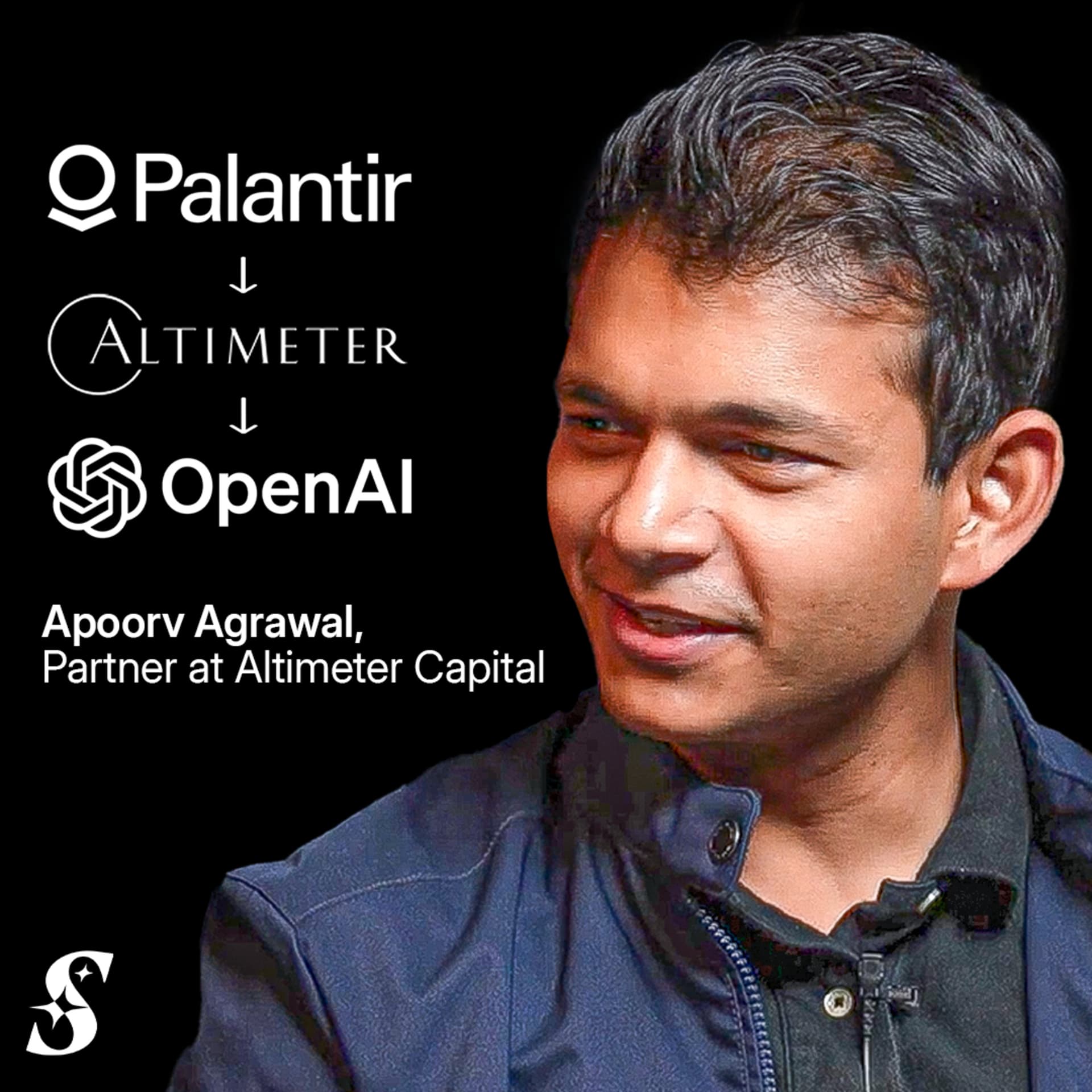
- Episode Title: Inside OpenAI’s $500B Valuation | Altimeter’s Largest Bet
- Hosts: Apoorv Agrawal (Partner at Altimeter) and Molly O’Shea
- Description: This episode dives into Altimeter's strategic investment in OpenAI, discussing the implications of AI in the investment landscape, the dynamics of the AI supercycle, and insights from Apoorv’s time at Palantir.
Key Themes and Discussions
Altimeter’s Investment Strategy
- Largest Investment: Altimeter has made its largest bet in history on OpenAI, investing over $10 billion.
- Disciplined Bets: The firm is known for concentrating on generational companies (e.g., Snowflake, SpaceX).
- Power Laws in Investing:
- Acknowledgment that 0.3% of companies drive 99% of returns.
- Focus on investing in companies that show potential to be in the top tier.
OpenAI’s Growth and Valuation
- Consumer AI Supercycle:
- ChatGPT has evolved into a mainstream product, becoming impactful in daily life.
- OpenAI's valuation exceeds $500 billion based on its growing user base and revenue.
- User Metrics:
- Estimated 700 million weekly active users.
- Projected revenue of $10 billion, which could grow significantly with user base expansion.
- Defensibility in AI:
- Speed is highlighted as a critical competitive advantage in AI development.
Adoption and Market Dynamics
- AI Talent Wars:
- The competition for AI talent is fierce, with companies like Meta leveraging their financial strength to attract top talent.
- Parasocial Relationships:
- Users form emotional connections with AI products like ChatGPT, leading to high retention and engagement.
Technical Insights and Future Predictions
- GPT-5 Release:
- Transition from model-based to system-based releases, emphasizing a move towards more sophisticated AI operations.
- Adoption Curve:
- Discussion on how technology raises the ceiling (early adopters) versus raising the floor (mainstream users).
Lessons from Palantir and Founding Team Insights
- Forward Deployed Engineers:
- Emphasis on customer intimacy and understanding industry-specific challenges.
- Cultural Insights:
- The importance of mission-driven work and high talent standards at Palantir.
- How experiences at Palantir shaped Apoorv's investment philosophy.
Key Takeaways for Investors
- Evaluating Founders:
- Assessing founder performance is crucial, focusing on their ability to create generational businesses.
- Market Volatility:
- The narrative around companies like OpenAI is volatile, moving rapidly based on market sentiment and product releases.
Major Quotes
- "Speed is the only defensible moat in AI."
- "ChatGPT is no longer a product; it’s a relationship."
- "Every time we study a business, there will be two or three questions that will define the business at that given time."
Conclusion This episode provides valuable insights into the strategic decisions and evaluations driving investment in AI. Apoorv Agrawal’s deep understanding of market dynamics and his experiences at Palantir offer a unique perspective on navigating the complexities of the AI landscape. The conversation underscores the significance of speed, user engagement, and the evolving nature of technology in shaping the future of investments.
---
For more information and updates, connect with the hosts
- [Apoorv Agrawal](https://x.com/apoorv03)
- [Molly O’Shea](https://x.com/MollySOShea)
- [Sourcery](https://x.com/sourceryvc)
Written by AI. May contain mistakes. Listen to the episode to check what was said.
Transcript
Automatic transcript. May contain errors.0:00Do you think that the winner of the AI super cycle is going to be worth more than$150 billion at the time? It is clear that chat GPT has become a verb. OpenAI is on its path to being a winner of the consumer AI super cycle. And, you know, OpenAI is our largest investment in the history of Altimeter. Talent, this is where the war is now. You mentioned Meta, like they're generating about$100 billion of operating cash flow. To put that in perspective, OpenAI just raised this massive round,$40 billion. So they got the text moment, they got the voice moment, they got the image moment. Just this year alone, you've had Operator and Deep Research and chat GPT agents and Codex and GP5 now.
0:33This was an interesting release because I don't think it went the way many had expected. There was a lot of hype around it. It didn't go so well. We're halfway through the year and they've had such big releases. I feel like that is the secret sauce. That is the defensibility. Speed is the only note. Boundtour was actually a very misunderstood business for majority of its existence. And in large part because of how customer obsessed Boundtour is. Give us the rundown on Expo. How did you get into this investment? What do they do? Well, the punchline is the number one hacker in the world is no longer a human.
1:11Apoorv, welcome to Sorcery. Delighted to be here. Thanks for having me. Thanks for having me. We're at Altimeter's office. That's right. Welcome to Altimeter. Thanks. We have a lot to discuss today. We're going to go deep into OpenAI, the$500 billion valuation, the philosophy around ChatGPT's parasocial relationship that's formed with its users. We're also going to talk about the talent wars, all the money flowing into that, some of your recent investments. And then we'll go into your time at Palantir, how that cemented your career and how you think about things as a forward deployed engineer.
1:49So to start, let's get into the$500 billion valuation. When did you first invest into OpenAI? We've tracked OpenAI for a bit. Obviously, a very important company. We first invested last year. And ultimately, what gave us the confidence was it is clear that chat GPT has become a verb. OpenAI has been on its path to being a winner of the consumer AI super cycle. And if you study the past super cycles, let's start with the internet. One of the biggest technology super cycles produced a large winner in Google, two and a half trillion in market cap. The next one, mobile, created a large winner in Apple, three and a half trillion in market cap.
2:39Social, meta, 1.8 trillion in market cap. Enter Gen AI. Do you think that the winner of the AI super cycle is going to be worth more than 150 billion at the time? Definitely, right? And so the real question was, is OpenAI that winner? And while it's not a layup, we got increasing comfort that OpenAI with ChatGPT had caught magic in a bottle. It was a brand, not a technology, not a product. It was a brand, something that was impacting our day-to-day lives. And that's what ultimately gave us the confidence. I'm happy to dig into the numbers. Let's dig into the numbers. You know, I'll start with the consumer side of things.
3:21Consumer markets tend to be winner-take-most, if not winner-take-all sometimes, right? You look at search. Google has 90 % plus market share. If you and I were internet investors in the year 2001, and we had the hard job of deciding which search engine to back, you could have backed Lycos and Alta Vista and Ask Jeeves. And the truth is, you'd be right, because the numbers are all going top and top and right. All you had to do was wait until 2004, Google's IPO, and you'd have gotten 99 % of all gross profits generated in search. That's a little bit of how I feel about what's happening with ChatGPT right now.
4:02They've publicly disclosed they've got 700 million weekly active users. They recently crossed a big revenue milestone. I believe they announced$10 billion revenue run rate in June. and a similar dynamic is going on in AI where if you took the user count of ChatGPT on one side and all the other AI apps on the other side, let's do Perplexity and Cloud and Crock and Gemini and long tail of apps that people use, add them all up, multiply it by 10, it's probably still less than ChatGPT's user base. Same on revenue. And so we saw this, This is the sign of a power law playing out, the same power law that played out in the internet, the same that played out in mobile, the same that played out in social.
4:50And so the rough math as we see it is, they've announced 700 million weekly active users, let's say on a monthly active user basis, it's somewhere between one and two billion. Revenue was announced at 10 billion. So roughly 1 billion users, 10 billion revenue, earning about$10 per user per year, round numbers. we think over time the number of users could go up to three to four billion users we think on the monetization side over time it could go from 10 today to 60 70 dollars per user per year which is where meta and google and other large consumer platforms are and together you know p times q um three to four billion users multiplied by 60 70 dollars a user gets you to about $200 billion of a revenue opportunity over some medium amount of time frame.
5:41That is the consumer AI opportunity. That is what we're playing for. The other parts of the business, you know, the enterprise business, the API business, we'll have a shot as good as any other. And enterprise markets tend to be more fragmented, not as concentrated. and that's where we are, ChadGPT Enterprise is doing really well. We use it. So those are the numbers on OpenAI. That's how we think about it. And how much did you invest at the time? What was their valuation? We entered last year at the$150 billion round. What's unique with you and Altimeter is that you've only invested into OpenAI, whereas other funds have spread their bets amongst other LLMs.
6:28So how do you think about that concentration and what is your investment strategy? Our business is defined by power laws. The rough math of our business is there's 5 ,000 companies that raise every year that we track. 500 of those, so 10 % of those, will raise from tier one investors. 15 of the 5 ,000 will return over 90 % of the gross profits for a given vintage. You might have heard of the Pareto, certainly the 80-20 or the 90-10. 15 of 5 ,000 is 0.3%. This is not 80-20. This is not 90-10. This is 99.7 % and 0.3%. The power law is so sharp that very few companies actually return majority of the gross profits.
7:14And so when we think we found one that is on that power law, we think OpenAI is definitely on that power law. There's a couple others on that power law in our business. We try to concentrate into them. We had a similar experience with Snowflake. And OpenAI is our largest investment in the history of Altimeter. What sets OpenAI apart from Anthropic and even Google? It's a great question. All of those are formidable, formidable teams with incredible products. Obviously, Anthropic's crushing it with their API. Probably one of the most loved developer products out there, both with the API, but also the Cloud Code product.
7:56and so I would say they're winning in their own right in the enterprise segment with developers on the coding use case and doing a great job at it Google, same thing I mean, there's a lot of great products they've built I would say that a lot is yet to be seen from them I feel like the best of Google is ahead of them so a lot more to come there but at least that's how we see it I think those are the two most formidable players, as you mentioned. Going back, like circling back a little bit more. So 700 million weekly active users, they've developed a very strong consumer brand. They have a cult.
8:38They have a cult brand. They've achieved this. It's actually insane the rate they did this. I think you published a chart on this. And then also the other charts from East Mies West. Those are great. We'll add all these in. I'm curious from your standpoint as an investor and a user and understanding their commercial efforts. How does the consumer adoption bleed into enterprise? Look, I think ultimately there's three legs to the stool on the usage numbers that you highlighted. It's obviously the number of users. It's how much time they spend per day and what is the retention of those users. I would say those are the three legs of the stool that we measure to have a sense of the health of a consumer app.
9:25And on the first one, as I mentioned, I think they are far and above larger than any standalone AI app today. In terms of time spent, you know, we've published this analysis. They are far and above time spent per user per day compared to any of the other AI apps today. Actually, not just AI apps. one of the analysis we did is they're now larger than some of the mainstream consumer apps like X. Yeah. And retention, it's pretty wild, actually. So what we call smile curves are starting to show up in retention, meaning that in a chart where you see the number of users that stay on an app after they started the journey, typically you would expect an exponential decay of the users on this app.
10:13for very few apps, the curve actually goes up. So it looks like a smile. And chat GPT exhibits a smile curve. The other apps that exhibit smile curves are Instagram and TikTok. And the implication is users are finding so much value on this app that they want to come back to it. And how this bleeds into habit formation is I have this beautiful thing at my personal phone that I use for my personal life, and I want that at work. And so your question about how this bleeds into enterprise motion is similar to the effect that good software has or good devices have is you want to use at work what you have at home.
11:02And that's the success of ChadGPT Enterprise. Sorcery is brought to you by Brex, the financial stack trusted by more than 30 ,000 companies, including one in three venture-backed startups in the U.S. Nearly 40 % of startups fail because they run out of cash. Rex is literally built to help founders avoid that. Unlike traditional banks that let your money sit idle, chipping away at it with fees, Rex is designed to help you spend smarter and move faster. Their all-in-one solution combines checking, treasury, and FDIC protection into one powerful account. You can send and receive money globally at lightning speeds, Get 20 times the standard FDIC coverage through their partner banks and even high yield from day one.
11:45With same day and even same hour liquidity, access your funds anytime. Companies like Scale AI, DoorDash, Service Titan, HIMSS, Anthropic, Flexport, Robinhood, and Plaid trust and use Brex. Start today at brex.com slash sorcery. That's B-R-E-X dot com slash sorcery. How did this momentum start? I know that they have this crazy strategy, but I'd love to hear it from you. We've talked about this before, but could you just go deeper into the momentum that they build and how this is like, what's the formula? Look, I think it all starts with going back to November 2022. I actually have vivid memories of it.
12:31It was the same month that my wife and I got married. And so we were at our honeymoon playing with Chad GPT, just obsessed with it. and I think they caught magic in a bottle. That moment is so precious. There is no amount of launch prep you could do for what happened in November 2022, magic in a bottle. They had incredible viral adoption, hundreds of millions of users within a bunch of weeks and over time, if you look at the charts, the user growth has been a steady climb. And you can see the kinks when they've launched significant milestones. So for example, you know, in 2020, 2023 was like a steady climb.
13:16At some point, they took off the sign-in page and that you didn't have to log on to use ChatGPT and you saw like a kink. Then you saw the next big one in 2024 with advanced voice mode, right? Then you saw another one with Studio Ghibli, the image gen, you know, so they got the text moment, they got the voice moment, They got the image moment. And so it's, I think the strategy is as much as it is, like it's like the grind of the feature velocity is so high. Keeping up with OpenAI product updates is a full-time job. And that's the strategy, is ship fast. And I feel like that done at a consistent pace, I mean, just this year alone, you've had Operator and Deep Research and ChatGPT agents and Codex.
14:05And these are in GPT-5 now. I mean, we're halfway through the year and they've had such big releases. I feel like that is the secret sauce. That is the defensibility. Speed is the only mode. This is where the story gets funny, right? What we saw with GPT-5 was they turned off GPT-4. And that caused a lot of unrest with users. And there was a story that really came to surface. And Sam wrote a tweet about this. But it was really clear people had parasocial relationships with the chat itself. And so how do you think about this? It's probably a little bit more philosophical. But how do you think about that connection with the product?
14:48ChatGPT is no longer a website. It is no longer a product. It is a relationship. that users have with technology similar to the way, the relationship that I have with this phone. I use this for half a dozen hours a day. If I forget this at home, I will know within minutes. And I think ChadGPT is starting to get to a point where it is such a steady stream of a companion, a shop. I mean, I don't buy anything above$100 without consulting ChadGPT. Really? Like a lot of research. Spent so much time doing research. so much travel, so much learning, language learning, planning. And I think what happened over the weekend was, you know, the hashtag for forever was a reminder that like most important technology releases, this is changing the human experience.
15:46The same thing happened with desktop and PC. Gaming, you know, people got addicted to gaming. The same happened with mobile. the same happened with you know social networks and if i was to construct two axes molly on call it dopamine factor how much sugar is there in the product and and social call it network effects i would say chat gpt is actually quite safe and quite healthy because you know on the on the dopamine factor there's no doom scrolling there's no cat videos there's the amount of dopamine that you have on chat gpt versus i don't know pick your favorite twitter or instagram is a lot lower x the level of sugar is a lot lower whereas and then the other one which is network effects like if my friend um molly brad jammin or eric are on instagram i'm more likely to be there if they're on x i'm more likely to be there but if they're on chat gpt you know i don't have an incremental reason to be there.
16:47So the network effects are not as sharp right now. Despite that, this has become a dominant experience for relationship with people. And I think that's what the biggest takeaway I had over the weekend was, wow, this is becoming technology that people have a relationship with in a way that makes it incredibly sticky. Memory in particular, I think, adds so much context for your life that switching out of it would be so hard. And so I think those were some of the takeaways that I had as that weekend unfolded. In today's high-speed business world, staying ahead means using the smartest tools possible, including the powerful capabilities of artificial intelligence.
17:33Meet Turing Intelligence. Turing builds customizable AI systems designed to solve your mission-critical challenges, no matter your industry. From expert guidance to tailored projects, Turing helps top companies realize AI that's more capable, more adaptable, and more effective. With Turing, discover how AI can accelerate your business growth. To learn more, visit Turing.com slash Sorcery. Spelt S-O-U-R-C-E-R-Y. That's Turing.com slash Sorcery. I use CalShoe markets within these conversations. And one of my favorite ones to ask is, what do you think the best AI will be this month? Usually it's whatever their favorite is.
18:11Time and time again, mostly, unless it's a CTO, it's ChatGBT. And it's because of the context and the memory. And when you feel it over and over and over again. Not everyone is having a parasocial relationship. Some people are extreme doomers. And David Sachs tweeted not too long after this, exposing the doomers, talking about the doomers. Guess what? We're not there yet. And what we've seen with these model releases over and over again, that the world is not ending. We're not going to get destroyed quite yet. It's going to take longer to build. Where do you think we are in the AI adoption curve?
18:48Yeah. Jeffrey Moore wrote this book called Crossing the Chasm. I'll refer to some of the concepts that he describes in that book. But I think David's not wrong. Look, there's, with any sufficiently advanced technology, you've got the tech enthusiasts or call it the developers or the super users who will adopt it first. And so I think of it as like technology that raises the ceiling and technology that raises the floor. And on the ceiling, you've got super users, tech enthusiasts, typically 10 to 15 % of the population. And then at the ceiling, you've got the vast majority of the population. The majority, even the skeptics.
19:29And so I think the way adoption plays out for really any technology is I evaluated on, hey, is this new product release raising the ceiling or is it raising the floor? So, for example, let's talk about raising the floor. What people who are the vast majority in laggards need is remove friction. Look, they don't wake up to use AI. They wake up to live their lives. and AI has got to find a job, find a way to be a part of their life. Advanced voice mode reduces the friction. I've got an action button dedicated to voice mode. Incredibly useful. 1-800-CHAT-GPT. WhatsApp with chat GPT or Meta AI. Those are, I would say, ceiling feature releases that will accelerate the adoption over the 6, 12, 18 months.
20:23Sorry, raising the floor. The reason the ceiling would be, you know, these are users who are vibe coding. They're coding their own daily software. They're experimenting with chat agents. They're playing with codecs. They're playing with cloud code. And there's a set of features that are targeted to them this year. This would be deep research. This would be the computer use operator. And I think both of these will go up over time. And ultimately, the biggest, I would say, experience will ultimately transcend beyond chat. Maybe we'll have wearables. Maybe what Johnny Ives is working on is a wearable.
21:04I don't know what it is, but it could be a pair of glasses, could be a phone, could be a device, could be a watch. and how you engage with that could really remove friction of communicating with a future interface. So I think those are some of the big things that I'm looking forward to. What a time to be alive. Maybe we've reached AGI. Maybe we're going to reach it soon. I don't know. The definition is unclear. But with AGI and superintelligence, we are approaching a lot of really fun, philosophical, evolutionary, existential questions. How do you think about humans' relation with technology and where this might go?
21:49AGI. And I think if I start with start at the start, like, you know, I started my career, I was an intern at a firm called Rocket Fuel, and we were using AI to target ads to maximize some reward function. And that predictive machine learning or AI felt magical to me. Two years later, in 2012, the team at AlexNet beat the ImageNet benchmark identifying cats and dogs better than humans. I thought that was magic. A couple of years later, I was at Palantra. I was a software engineer. I started using this tool called Kite. It was a coding copilot that would help you code faster. I thought that was magic.
22:29I thought that was great AI. Self-driving cars, GPT-3, voice mode. I mean, every two years or so, there's been a moment where I was like, wow, that's magical AI. Isn't that AGI? And so I guess my point is that the bar for what AGI is, is going up fast. And what we define to be, I guess, a lot of great intelligence is going up. And so now to actually answer your question, how that changes society, I think, you know, I wasn't around, but I'm told that there was a time when there was teams at banks whose job was to calculate the interest rates. And then the calculator came through. I, you know, I remember this.
23:13As a child, somebody gifted me an encyclopedia. I remember reading it cover to cover, but it's completely not really needed anymore. You could just look it up pretty quickly. You could look up really any fact pretty quickly. I feel the same way about most forms of intelligence, I suspect, in five to ten years, we wouldn't have to work to earn a living anymore. And what do you do in a world where you don't have to work to live? I suspect relationships would matter a lot. I suspect, as Victor Frankel talks about in his book, Man's Search for Meaning, creation would matter a lot. You would get a lot of joy in doing things that you enjoy and, you know, finding meaning.
24:04But it's certainly going to look like a brave new world. It's a great book. As we talk about the new releases, we have to talk about GPT-5. This was an interesting release because I don't think it went the way many had expected. There was a lot of hype around it. It didn't go so well. But my biggest observation, what I thought was pretty interesting out of this was Sam actually took action really fast. He immediately went back to work and was iterating off of the feedback. What do you think that means today for what it takes to be competitive as a founder, as a CEO? You know, I think one of the things that strikes me about Sam and the OpenAI team in general is the single word to define them is anti-fragile.
24:55I've seen this for years now. Remember the time the blip happened when Sam was for a hot second not at OpenAI? And it felt like, oh, what's going to happen to this org? You know, this is obviously a pretty big, big deal. But I feel like they've gotten stronger. very few orgs get faster over time i feel like open air has gotten stronger over time faster over time and the gpt5 release is not not anything different i feel like for an org that is antifragile they took they're taking incredible amounts of feedback they're working with all the teams and they're gathering feedback and fast the doors are open the lines are open and again a sign of uh evolving fast ultimately being the mode speed is the mode um and so that's what i think about the GPT-5 release, you know, I think it was a complicated release.
25:44It was the first time they released a system, not a single model. It has a model router. It makes, bakes in a lot of thinking of how much compute resources to allocate to a query coming in. And so, again, a sign of anti-fragility. Why was it so significant, technically speaking? Yeah. You know, I think each of our, each of the OpenAI prior releases have been typically a model or a set of models. This was the first time they released a system, a unified system that makes the decision of how much compute to allocate. Should I give you a quick response to a simple query like what's the capital of United Kingdom, which could just be a lookup?
26:21You don't even need to scramble the jets for that one, as opposed to a more complicated query like you're an investment analyst, help me analyze, gather feedback for, summarize the feedback on all the users of Neuralink so far. That would employ an orchestrator agent, it would go scrape the web, it would gather all the data, it would summarize it, it would probably package it together in a table, and that's probably like a three or four minute query. That delineation, which was previously something that the user would have to make in a model selector, is now made for you. That's a pretty significant change because remember the framework of raising the ceiling versus raising the floor.
27:00This is raising both. For a user who is, the majority of users who don't really want to select a model, this is great. This is simple, clean UX, a Google-like bar. You just start. And the same for on the ceiling. If you wanted to ask complicated questions, you don't have to think about, hey, what is the best model for me to do this? Is it 03? Is it 04 mini? Is it 03 pro? And I think that was one part of significance, called the consumer experience. The second part was, you know, obviously they focused very heavily on a couple of domains, coding and design and healthcare and so on. And so the feedback for those focused domains has been pretty good.
27:45Given they are a consumer product, do you think the structure of having these demos, these releases, is the most effective way for them to communicate? Or do you think they should adopt other things? I mean, they do go on podcasts. Like Sam definitely did a podcast tour beforehand, but how do you think about that and talking to who their real customer is? Because then people bring up benchmarking and how they perform and all of this sort of like stuff that, you know, is not what, you know, I don't know, Sally is doing on the couch before homework, you know? Yeah. You know, Ben Thompson wrote a great note on it.
28:23I'll share something he wrote about, which is that once you have a large enough user base, it's really hard for you to satisfy everybody. You just have to make choices. And not every upgrade, model upgrade, new product will please everybody. And I think that's kind of what happened here. Ben, on your question on benchmarks, I think the benchmarks are the starting line, but they're by no means the finish line. The benchmarks are kind of saturated, right? Do we need them? Like, what is the point? What do they even mean? I feel like they're all arbitrary. They're a starting line. Exactly. They're not the finish line.
29:03You typically start with, you know, a bunch of models that are at some zip code of a performance metric. And what you actually need is more proprietary evals. Let's say for Sorcery, you had 100 or 200 custom evals that work for your use case that you know work well. And then, hey, is the model doing better than a human on those evals? Or you might have particular features or just making sure there's no better tool user or inner debugging. So there's like a long tail of custom evals that I think do a better job now. than benchmarks? It was interesting to watch. I obviously love Calci, but I was watching the Calci chart on this for the essay of the month.
Read the full transcript
29:50And during that, it was live. And so during that release, they had a couple of different demos. After the second demo, ChachiPT had the top spot and then it completely did a reverse Uno and switched. it actually switched I think with the Gemini I believe and so so it was really interesting to see but like my observation off of that is of course like retail sentiment if they were public this is how volatile this would be it's like the most competitive market ever and then you have twitter chatter but then you have like okay you actually went to CEOs you did market research that's the reality so there's a disconnect there but it was an interesting observation into you.
30:33Okay, how volatile would this be if it was public? Very volatile. It would be very volatile. I mean, there's been multiple moments like the blip, like the time last summer when there was, you know, a couple of departures, like the GPT-5 release. There's all these moments where I feel like the narrative, as Kelsey and tracks appropriately, completely flips up and down. would be a very volatile start. So Brad Lightcap, he captured some of the momentum from their customers with GPT-5. I want to go through some of these and then get something that you've heard from your portfolio. So he heard some really good momentum and I'll show the tweet from Cursor, Lovable, Harvey, Amgen, Uber, and Notion.
31:20I know you have a particular instance. Do you want to share this? Absolutely. This is another example of What you said, which is the Twitter narrative was so volatile. But if you actually call the experts, the actual customers, and so we called a series of customers. We called all of the coding AI companies we know from a bunch of their customers of the two or three largest labs to customer service and cybersecurity. And, you know, early, right, two weeks in. But good so far, working with the team, as we said, it's a product in motion. But one particular one stands out is our company Expo. On their benchmarks, they saw a significant step up with GPT-5, much better than any other coding or design or math startup saw in their ability to find cyber exploits.
32:16And, you know, summarizing, basically, the jump was from just under 60 % to 81%, switching from Anthropik's latest model to OpenAI's latest model, GPT-5. And the jump was so significant, I think it was higher than what the team had expected, but certainly the Expo team had expected by quite a bit, but maybe even the OpenAI team. And so they've published the results. And it's becoming pretty clear that AI is much better than humans at this thing called hacking. We need to talk about Expo. Let's do it. So give us the rundown on Expo. How did you get into this investment? What do they do? Well, the punchline is the number one hacker in the world is no longer a human.
33:03It's a set of AI agents that work together and break through perimeters and find vulnerabilities, sometimes even exploit them. And so there's this platform called HackerOne, which is a marketplace where corporations could find ethical hackers to help them red team or penetration test their perimeter. Expo has been let loose on this platform. And a couple of weeks in, they became the number one player in the United States. But two weeks ago, right at Black Hat, they achieved the number one spot globally. and so it's a pretty big milestone and for, you know, there's a lot of things that AI has gotten better than humans at obviously image recognition, a bunch of games hacking is now there and so that's the significance of Expo and, you know, the one thing I will say is while Expo will be a great business it is a business that must be built for the safety of the Western world.
34:09And ultimately, cybersecurity ends up being a game of cat and mouse. And you've got the good guys who will make some progress and the bad guys. And the chat GPT moment of cyber hacking hasn't happened yet. It'll happen. And offensive actors will use AI to do so. And we need Expo and players like Expo to help keep the world safe. What are the applications? You know, typically what, so the way Expo, you would have done this previously, is let's say you're a developer team and you would write software, you would ship software, and then you would have a red team or penetration testing team analyze all the vulnerabilities in your code.
34:52You might do this test once a year or twice a year, and you're typically rate limited by the number of penetration testers there are in the world. is not that many of them. It's expensive. It's ultimately a manual exercise.
35:07Today, a lot more code is being shipped, right? You're writing a lot of code using AI. And by the way, that code is being written by models that were trained on the open source code base with a lot more vulnerabilities. And so it's a lot more vulnerable. So the biggest application is going from this really analog red team penetration testing process that happens once a year to continuous testing that happens as you're writing code, as you're shipping faster, continuously, why be rate limited on the testing? And so that's the biggest application used by companies small and large across the spectrum.
35:46This must have been incredibly competitive to win. How did you meet Uhe and how did you win this? The team at Expo is incredibly, incredibly talented. Uhud Demur, founder and CEO of Expo, taught computer science at Oxford for a couple of decades, then built GitHub Copilot with Matt Friedman and team at Microsoft. and this is sort of his yin to his yang as he was building GitHub Copilot and saw the vulnerable code that was being written started Expo last year. You know, we're obviously incredibly lucky to be working with them and we haven't won anything. The work has just begun. We've just started partnering with them but I would say it was a...
36:39I think they were looking for missionaries And I feel like our first meeting, my first meeting with Uhe felt like our fifth meeting. We'd done quite a bit of work even before I met them. And I would say ultimately, as a former software engineer, I could intrinsically understand the problem. And how I reached out to them was also because it makes so much sense. I understand the root cause. I see how they were going to fix it and how you build a large company doing it. And so our first meeting felt like our fifth meeting. I think we met on a Friday morning and we decided to work together by the Saturday evening afterwards.
37:10Wow. Yeah, fast and furious. That is quick. Yeah, yeah, yeah. The shape of Expo is so unique. As you said, it's a small team, less than 50 people, all across the world. Uje lives in Malta. Nico, the CTO, lives in Argentina. They've won thousands and thousands of dollars, which are awards that are publicly available for anybody to win, but also ultimately to create training data and focus on our target segment, which is large enterprise. I think large financial services customers, large insurance customers, large healthcare, large technology businesses on one end. And so that's our customer base.
37:56And on the other end, it's small to medium sized businesses who want to just have faster compliance. And so that's where we spend the tokens. And it is true. We spend more on tokens than we spend on humans. and it is, I guess, the shape of an AI native firm. Okay. Well, we need to talk about where is spend today in AI and where will this be in the future? I know you have some great charts about this. They're not pyramids. It is probably the biggest question in AI right now. Where will the value accrue? And we've been studying this now for a couple of years And, you know, I'm sure the audience sees the large CapEx announcements that the hyperscalers are making.
38:45They add up to hundreds of billions of dollars that are going into the ground, building data centers, acquiring chips and the infrastructure to enable all that. And so we decided to study the same with the build of prior super cycles with the internet, cloud, mobile, AI. And we put it together to see where does value accrue over time. And I'll summarize it for the audience here, which is in the cloud super cycle, you have about$400 billion of revenue that is being earned by the applications. Let's call it the layer one. You've got about$200 billion spent on infrastructure. This is AWS and GCP and Azure, et cetera.
39:29And you've got about$50 billion on semis. This is Intel, AMD, et cetera, the CPU layer. The shape of this is 400, 250. Enter AI. NVIDIA alone at the chip layer earned roughly$40 billion in data center revenue in Q1 last quarter. So analyze, that's about 160. Let's say the total industry is 170, 180, maybe let's say 200. The infra layer is 20, 30 billion. This is inference revenue that's being earned by the hyperscalers and neoclouds and so on. So a fraction of this, right? A fraction of the 200. And then the revenue being earned by the application layer, this is players like OpenAI and Anthropic and Perplexity and Glead and so on.
40:20is on the order of, you know, 30,$40 billion. The shape is this way. Cloud is this way. And it is so different from cloud that it begs the question, when will, and if this will invert, and that's the biggest question we've been analyzing. And so, you know, we walked through a bunch of analogs that have written about this publicly as, it takes a while for this to invert. You know, the canonical example is AWS. started in the year 2000. In 2012, sorry, it started in the year 2004. Eight years later in 2012, they got their first outside customer in Netflix. Eight years. And for eight years, it was a lot of the build laying down the railroads until you started to monetize it.
41:07And so, you know, that's the thing that's going on right now. It's, you know, 90 % of all AI dollars are actually in the semis layer. Love premium merch just as much as we do? That's why Sorcery uses 4th Wall. Everyone from creators like Marcus Brownlee to podcasts like Acquired2Orgs like the Smithsonian Institute are using 4th Wall. They let you create and sell premium products without having to stress the details. They handle everything from production, shipping, customer support, taxes, even giveaways. When it's time to level up and make gear that people are actually proud to wear, that's when it's time to use 4th Wall.
41:43And that's why we've trusted Fourth Wall for all of our brandware at Sorcery since day one. Use my link in the description to get free credits for your first order. And for any VCs, DM me on X and I can get all your portfolio companies set up with a free samples credit deal. There's one important line item that you missed. It's the talent. The talent. The billion dollar talent. The most important piece of it. I mean, who knew that if you went to college for being an AI researcher, you'd become a billionaire? That is creating an entirely new class of graduates. That's right. That's right. I want to get into this because I think it's so interesting, and we're seeing it from multiple sides.
42:23You'll see it from the open AI side, but also the meta superintelligence team. Can you break, like, what is going on here? The ingredients of, call it being on the frontier, are compute. CapEx, we spoke about it. data, which is sort of accessible to everybody. We are saturated on the training data that exists. Talent, this is where the war is now. And if you look at, you know, you mentioned Meta, like Meta has an incredibly large balance sheet, right? They've got, I want to say like 70 to$80 billion on the balance sheet of cash. Every quarter, they're printing $25 to$30 billion of operating cash flow, which they might use to invest in CapEx or buy their stock or distribute dividends or whatever.
43:25But on an analyzed basis, they're generating about$100 billion of operating cash flow. To put that in perspective, OpenAI just raised this massive round, $40 billion, and Meta is producing more than twice that in a year. So if I was Zuck and, you know, got to give it to him, founder-led organization, incredibly bold, not afraid to make tough decisions, big decisions, is acquiring the most important ingredient, talent, leading indicator of all value. And, you know, they've got plenty of cash to do it. So a bold move by a bold leader. And what a time to be watching this. What a time to be alive.
44:10What a time. You were part of one of the most intensive, one of the most impactful, one of the most well-branded teams that came out of technology. And this is Palantir's Forward Deployed Engineers. I want to break this one down because it's insane. I was just looking at an Instagram post. This is where I get some of my news. Groundbreaking. Right, right. So I'll read this out. Palantir X employees. This is one of the best cultures ever. They've raised over$30 billion total, averaging$800 million per company. And more than 6 % have founded billion-dollar startups. These are companies like Kalshi.
44:57Yes. Tarek. Tarek was a forward-deployed engineer. Sourcegraph. Quinn. Quinn. Yeah. Yep. Ironclad Adipar Joe Wansale Does that count? Yeah It counts And we have 11 labs 11 labs Mati Andril Obviously Legendary firm Chapter I mean the list is long And I promise you it's getting longer It's getting longer There's going to be 10x more of those So the world watch out So what is it? How does this create 30 billion dollars in raised capital. What are the principles of being a forward deployed engineer? Yeah, it's a good place to start. Look, I think for the two decades or so that Panitra has been around, for a majority of it, nobody understood forward deployed engineering.
45:50Panitra was actually a very misunderstood business for majority of its existence. And in large part, because of how customer obsessed Panitra is, The shape of the business is like no other software business. Our median ACV is over$5 million. The reason forward deployed engineering came to be is anytime there's a sufficiently advanced technology that cuts across horizontally through a bunch of different industries from defense, oil and gas, finance, consumer packaged goods, automotive, airlines, etc. What you need is experts who are really good at the technology. which was a lot of people at Poundra, but we knew nothing about those industries.
46:32You know, as somebody who worked in a bunch of these commercial industries, I did not know much about oil and gas or finance or CPG. And so we would spend a lot of time with our customers learning about their industries to deliver an experience that was soup to nuts, controlled by us, because the industry was so used to buying software that while it might be good on paper, would not actually move the needle. The same is true right now. Why is forward deployed engineering all the vogue? It's because you have advanced technology in AI that cuts horizontally across a lot of different industries, software engineering, customer service, legal, healthcare, finance, and so on.
47:16And applying it appropriately to those industries requires a lot of context. And, you know, I think that was the principle behind creating forward deployed engineers. basically engineers who would go and obsess about the customer problem. And oftentimes the customer problem was not a sexy problem. It was building a data pipeline. Sometimes it was dealing with org change. Sometimes it was figuring out processes. Other times it was figuring out permissions and all sorts of things. And I think that's why forward deployed engineering came to be. They've reached over a billion dollars in quarterly revenue.
47:51They have forward deployed engineers. they just keep on going on a tear what is it about their culture that primes their employees for success you know palantra is a very very special place obviously a special place for me i'm biased um i think it's a it's a it's again a very important mission it is a it is a firm that while a great business as you said uh must exist um for for for for the western world and allies and I would say the there's a lot of great things and I've written a whole article about it is it all starts with a mission the single thing that unites folks at Palantir and and and what we do and and what we did while we I was there is that there is something that is larger than your own existence that you're there for it could be helping the the the U.S.
48:42government the the allied governments it could be a mission And for that same reason, in a lot of the Palantra language, mission language was overused. Everything was a win or a loss. And that brought people together. And you need that in wartime. You need something to unite the troops in a wartime. The second was an uncompromising bar on talent. I mean, for all the time that I was there, every single candidate we hired was interviewed by the founders. Imagine the operational complexity that creates, but that was required to keep the bar really high. And I felt like we got, as Karp would say, a colony of artists that Pounder kept together.
49:32And finally, I would say, it's really deep obsession with customer outcomes. Not sexy problems, not the shiny problems, not vanity metrics, but like really moving the needle for the customer in a way that you can only do when you own the entire process soup to nuts. And so now it shows up in the metrics at Poundra, as you said, the latest quarterly earnings, incredible quarterly earnings. And I think revenue and revenue growth are lagging indicators. The leading indicators are what I described to you is what Poundra excels at. They have an incredible company. They have a cult brand. Software that dominates Alex Karp, Sham Sankar.
50:17What was the biggest lesson that you learned from Sham? Wow. Too many. Honestly, Sham's a great leader. Sham's a great systems thinker. And, you know, I'll share one anecdote that I learned with him. I remember this was, we were in London working on a customer deployment. And as a young engineer and engineering leader at the time, I remember feeling how the entire mental model for Shum and his focus was around winning. It was not around a great plan. It was not around a great team or a roadmap or a set of features that we were going to build. It was around winning. he actually wrote a lot of this in his article called The Primacy of Winning in Pirate Wires I recommend folks to check it out but it is the single unifying orientation that Sean has always had and he would say that winning takes care of everything if you're winning you don't have to worry about the other stuff but just to highlight the trade-offs the trade-offs of that if you're oriented around winning is you will have to deal with a lot of chaos.
51:38You might not have a beautiful roadmap in wartime because the fact that you... I mean, I feel the same way about a lot of what's happening in AI right now. Things are moving so fast that if you have a beautiful product roadmap, something's not right. You're probably not moving fast enough. And I'd say that was the biggest thing that I learned from Sean and I think it's particularly relevant now. one of the other things he used to say is forward deployed engineers ingest pain and excrete product and you know it's one of those shramisms that is so true basically to remind you that no task is beneath you even if that includes plumbing of data pipelines to change management it's ultimately all pain for a bigger more important mission so many many things I could speak at length about all the great great things I learned from Shaman and his leadership what's the biggest lesson you learned from Alex Karp another legend too many you know one of the things that counter does even to this day I believe is before you start they ship you a set of five books a book on obviously getting things done and user experiences which you would expect, a book on counterterrorism, which you would expect, but a book on improv comedy.
53:03Okay. But a book on, you know, but basically the biggest lesson I took away from Alex Karp is, you know, he thought a lot about keeping this artist, the colony of artists at Palantra together. He thought a lot about what is the appropriate way for Palantra to be represented in the world. So, for example, you know, Karp really led all our go-to-market efforts. Well, the time I was there, it was a very small go-to-market team led by Alex. And he had some very particular thoughts on how we approach our customers.
53:43But an incredible CEO and obviously crushing it at Palantra. A true lesson in performance. That's right. That's right. Well, speaking of performance, Sorcery is sponsored by Brex. They're all about spending smarter, moving faster for over 30 ,000 companies, 200 public ones. And I'm curious from your perspective, as we think about companies today in this super cycle, moving super fast, becoming really competitive. What are the key characteristics that you look for in founder performance? Ultimately, we invest across venture growth, pre-IPO and public markets, I would say. There's really two questions that I'm trying to assess when looking at businesses.
54:31Is this a great business? Is this a generational business that will go create a large company, maybe a public company? Question number one. Question number two, is this a great price? Is this a great structure? Does the math pencil out, et cetera? And I spend 99 % of my time answering the first question. Is this a generational business led by incredible leaders, inspired by a great mission? And while every business is unique, it's hard for me to give you a template for all of them. I think the thing that I obsess about the most is asking the right questions. Every time we study a business, there'll be two or three or four questions that'll define the business at that given time.
55:13And knowing the right questions to ask, actually, that's probably the process that takes a little bit of time. The answers will typically either be knowable or not, and we can get to them. But that's where I spend a lot of time. That's pretty good. That's a good answer. I appreciate it. As we wrap up, we're going to do a quickfire round. Fun. Okay? Fun, fun. First, I want to know if you're bullish or bearish on these companies. and then I'll ask a secondary question. So these are all based on Calci's recent IPO charts. You can go there and see, you know, place your trade on who you think is going to IPO first.
55:52But I want to know if you're bullish or bearish on these companies. Sure. All right. It's five of them, okay? Are you ready for this? Let's go. Ready, ready. Klarna, Discord, Databricks, Cerebris, and Errol. Bullish, bullish, bullish, bullish. Wait for it. Bullish. Bullish on all of them. Those are really good companies. Those are all really good companies. I mean, four of them are ultimate portfolio companies. Four. Four out of five. So those are all really good companies. Sorry, I'm not bearish on any of them. What do you think the odds are that any of those will go public this year? I think at least one of them will go public this year.
56:33I'm a big fan of the public markets, building the public. You can still have a lot of innovation in the public markets. as some of the greats have shown. Any particular name? Ooh, tough. Are we going to trip compliance? That's right. Well, we can always remove this, but as you saw, Databricks just announced a big round this morning. So had that not happened, I would have said Databricks, but that's probably not the number one leader right now. I guess I think a more interesting question, I want to ask is, do you think companies even need to go public anymore? I mean, we've seen through secondary markets, through these massive private rounds over and over again, that there's just so much capital.
57:22Do they still need to go public? I'm a big proponent of companies going public. It has an incredible amount of alignment with shareholders, great hygiene, not to mention, gives you a pretty good feedback on the company's priorities. I suspect there's a class of companies now like SpaceX, like Stripe, that have found a way to have repeatable liquidity for their employees at a regular cadence, let's say 12 to 18 months. but I'm personally a huge fan of companies going public and I think it'll always be a great way to build companies at scale, durably
58:10while admitting that some of the best businesses are now being built while they're private the private, late stage private call it asset class is just full of so many great gems SpaceX, Stripe, Android, OpenAI, Anthropic some greats there. So not to be discounted, but companies are staying private longer, building with access to capital, both primary and secondary. Okay. We'll have to check back in about six months. Six months. Okay. Right, right. Well, Porv, this was fantastic. Thank you so much. We covered so much ground. This was fun. Thanks for having me. Yeah, thank you so much for coming on.
58:51Hey, it's Molly. If you enjoy our interviews, check out our newsletter sorcery.vc where we deliver a once a week top deals and tech headlines email and also go deeper on our podcast interviews subscribe to sorcery today and don't forget to subscribe to the podcast on youtube spotify apple or wherever you listen link in description to sign up
From the publisher
With $10B+ in AUM, Altimeter has made their largest bet in its history on OpenAI. Known for disciplined bets in generational companies like Snowflake, SpaceX, Anduril — and now OpenAI, the firm is now fully committed to the AI supercycle.
In this episode, Apoorv Agrawal, Partner at Altimeter focused on AI and software, joins Molly O’Shea to break down how the firm evaluates opportunities in the AI supercycle. Apoorv explains why power laws govern venture returns, how Altimeter evaluated the $500B+ OpenAI opportunity, and why speed is the only defensible moat in AI.
We also explore the AI talent wars reshaping Silicon Valley, the rise of XBOW (where AI agents are already outperforming humans), and lessons from Apoorv’s formative years as a forward deployed engineer at Palantir — a culture that has produced billions in founder-led value creation.
For institutional investors, allocators, and operators, this conversation offers a rare inside look at how one of the sharpest minds in venture is positioning around AI — from infrastructure and chips to applications and talent.
Connect with us:
1. Apoorv Agrawal: https://x.com/apoorv03
2. Molly O’Shea: https://x.com/MollySOShea
3. Sourcery: https://x.com/sourceryvc
Brought to you by:
• Brex—The modern finance platform, combining the world’s smartest corporate card with integrated expense management, banking, bill pay, & travel.
As a Sourcery Listener you get: 75,000 points after spending $3,000 on Brex card(s), white-glove onboarding, $5,000 in AWS credits, $2,500 in OpenAI credits, & access to $180k+ in SaaS discounts. On top of $500 toward Brex travel, $300 in cashback, plus exclusive perks (like billboards..) visit → https://brex.com/sourcery
• Turing—Turing delivers top-tier talent, data, and tools to help AI labs improve model performance—and enables enterprises to turn those models into powerful, production-ready systems. Visit: https://turing.com/sourcery
• Kalshi—The largest prediction market and the only legal platform in the US where people can trade directly on the outcomes of future events: https://kalshi.com/sourcery
• Fourthwall—The #1 way to sell merch online — Fourthwall is the easiest way to launch a fully branded merch store—used by big brands like MKBHD, Acquired, & even the Smithsonian. 100+ products. No upfront cost. Visit Fourthwall to start today: https://fourthwall.com/
Follow Sourcery for the latest updates!
https://www.sourcery.vc/
Chapters:
(00:00) Welcome & Altimeter’s $10B+ AUM strategy
(01:57) Why Altimeter concentrated its largest investment ever in OpenAI
(04:45) The power law in venture capital: why 0.3% of companies drive 99% of returns
(09:25) Consumer adoption of ChatGPT & enterprise spillover
(12:08) Velocity: Why speed is the ultimate moat in AI
(14:18) Parasocial relationships with ChatGPT
(19:29) Adoption curves: raising the ceiling vs. raising the floor
(23:30) Defining AGI & DOOM
(25:40) GPT-5 release: volatility, iteration, & anti-fragility
(32:00) XBOW AI: When AI becomes the world’s top hacker
(38:22) Where AI value accrues — chips, infrastructure, or applications
(42:50) The billion-dollar talent wars & Meta’s AI strategy
(44:12) Palantir’s billion-dollar FDE culture
(50:10) Lessons from Shyam Sankar & Alex Karp
(53:52) Evaluating founder performance & IPO readiness in today’s market
(55:36) IPO Predictions: Klarna, Discord, Databricks, Cerebras, Anduril


