
In short
Podcast Episode Notes: Inside Sequoia’s Strategy with Alfred Lin
Episode Overview
- Podcast Title: Sourcery
- Episode Title: Inside Sequoia’s Strategy: Alfred Lin on Company Building & Partnering Long-term
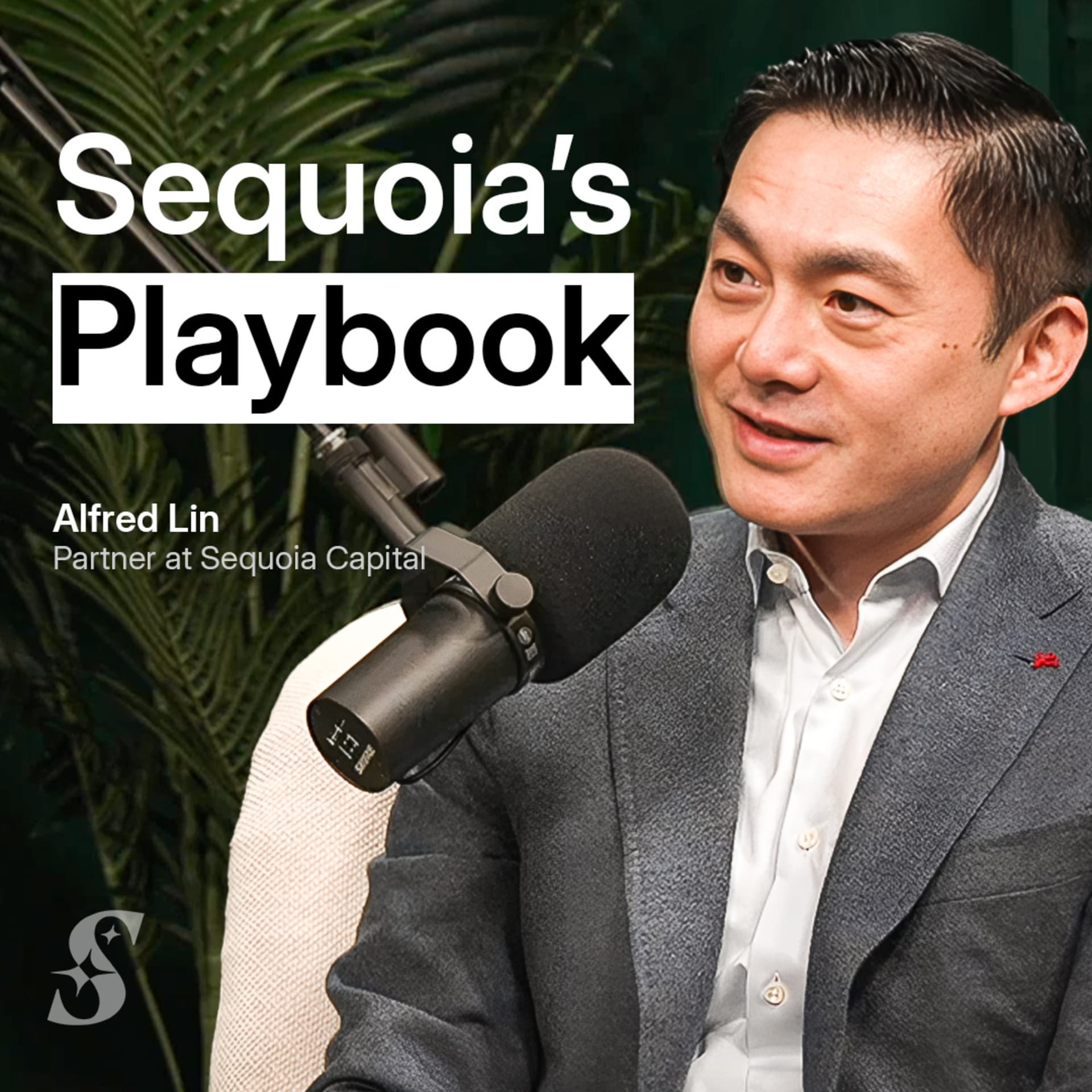
- Guest: Alfred Lin, Partner at Sequoia
- Release Date: [Date Not Specified in Transcript]
- Description: Alfred Lin discusses Sequoia Capital’s approach to investing in and supporting outlier founders, the importance of company building, and the strategic decisions behind successful startups such as DoorDash and Zipline.
Key Themes and Discussions
- Sequoia's Investment Philosophy
- Founder-First Approach: Emphasis on investing in "outlier founders," defined as those who are significantly above the average in terms of capability and vision.
- Statistical Definition: Founders four standard deviations above the mean are considered outliers.
- Company Building Insights
- Bespoke Support: Sequoia tailors its support to the unique needs of each founder.
- Examples of tailored strategies for founders like Brian Chesky (Airbnb) and Tony Hsu (DoorDash).
- Navigating Challenges
- Long-Term Commitment: Lin discusses helping companies like Kalshi through regulatory hurdles and the various pivots they needed to make.
- Pivots Defined:
- Little “p” Pivots: Minor adjustments or changes in strategy.
- Big “P” Pivots: Major shifts in business model or product focus, as exemplified by Zipline's transition to drone deliveries.
- Revenue Quality vs. Quantity
- Understanding Revenue Types: Lin emphasizes the importance of distinguishing between:
- Pilot/Experimental Revenue: Revenue from initial, non-recurring contracts that may not represent sustainable income.
- Quality Revenue: Consistent, predictable income streams, particularly from subscriptions.
- Efficiency Over Capital
- Strategic Efficiency: Lin argues that operational efficiency should be prioritized over simply raising capital.
- Growth Metrics: Companies need to focus on sustainable growth and product-market fit rather than solely on revenue milestones.
- The State of Startup Competition
- Accelerating Change: The current startup landscape is more competitive than ever, particularly with the rise of AI technologies.
- Expectations for Founders: Lin notes that today's founders face higher expectations due to easier access to technology and market opportunities.
Key Takeaways
- Support During Hard Times: Sequoia partners with founders as "shock absorbers" during difficult periods and as strategic advisors during successful times.
- Revenue Metrics: The race to reach $100 million in revenue should not overshadow the importance of measuring both the health of the business and the quality of revenue.
- Intellectual Honesty: Founders must be realistic about their product-market fit and avoid using capital to mask underlying issues.
Notable Quotes
- "The best thing you can do is roll up your sleeves, pick up the pieces and help the company get through that hardship."
- "We want people who are just off the charts, really good at something."
- "Quality of the revenue really, really matters."
Episode Breakdown by Time Stamps
- 00:00 - Introduction of Alfred Lin
- 02:37 - Definition of an outlier founder
- 04:15 - Support for founders: lessons from Airbnb & DoorDash
- 07:10 - Kalshi's regulatory navigation
- 14:00 - Differences between little and big pivots
- 18:00 - Efficiency strategies in DoorDash vs. Uber Eats
- 19:49 - When to invest capital for growth
- 22:19 - The metric of reaching $100 million revenue
- 25:55 - Differentiating between pilot and real revenue
- 29:00 - Insights on the AI hype cycle
- 31:36 - Expectations for the newer generation of founders
- 34:21 - Concluding thoughts on measuring company velocity beyond revenue
Additional Resources
- Alfred Lin's Social Media: [Twitter Link](https://x.com/Alfred_Lin)
- Sourcery Podcast: [Website Link](https://www.sourcery.vc/)
---
This structured summary provides a comprehensive overview of the podcast episode, highlighting key discussions and insights from Alfred Lin regarding Sequoia's investment strategies and the current startup landscape.
Written by AI. May contain mistakes. Listen to the episode to check what was said.
Transcript
Automatic transcript. May contain errors.0:00When the company is down, there is no point to beat someone when they're down. The best thing you can do is roll up your sleeves, pick up the pieces and help the company get through that hardship. And that's what we do at Sequoia. Both Tanay and Tariq said throughout the time you've been very supportive, but now it seems the relationship is much more focused and a little bit more intense. This is a very Sequoia characteristic of board members. We partner with the founders and we know to be shock observers during bad times and to be sparring partners during good times. You back a wide range of companies, but what is that through line for you?
0:35At Sequoia, we're focused on outlier founders, and that's pretty consistent to how many companies and how many founders we have to see before we make one investment. Those two companies, Othellis, Kimura, and then Kalshi, the stories are very, very different, even though it took a long time. The sort of natural tendency that every founder or investor thinks is like, oh, all these successes are overnight successes. It's just not true. Every founder has their journey and it's taken longer than they want. Even if when things go fast, it takes longer than they want. This idea that we have, we can just get to$100 million in revenue.
1:09That's the goal. I think quality of the revenue matters. That's why one-time revenue is not seen as good as subscription revenue. In technology, we live in a world of accelerating change. Things are moving faster today than 10 years ago. 10 years ago, things were moving faster than 10 years before that. And part of that means that founders today have a harder job than founders a decade ago.
1:40All right. Wow. Alfred Lin, welcome to Sorcery. Well, thank you for having me on the show. This is so fun. It feels like a long time coming. Well, I've been listening to what you've been producing in the last few months, and the shows have been great. Well, I have had a highlight reel of Alfred Lin's portfolio. I'm going to get more on too. So I've gotten to know Kalshi really well. I've gotten to know Nominal really well, helped break their funding announcement. I recently, just yesterday, was at Camille's office, was meeting with Tanay. I got a nice tour of physical intelligence with Brian and they all have the same through line and it's Alfred Lin.
2:25I'm curious, you back a wide range of companies and this also includes Citadel Securities. And I want to go deep into this later because I find it fascinating. But what is that through line for you? I don't really think about the through line per se, but maybe there's a through line of my taste in founders. We always start with the founders. And I think the companies that you named and many more at Sequoia were focused on outlier founders. And you can ask the question, what makes someone an outlier? And you can express it in maybe in statistical terms. One standard deviation above the mean is good.
3:06Two is great. Three is exceptional. And four standard deviations above the mean would be an outlier. and that's pretty consistent to how many companies and how many founders we have to see before we make one investment. Typically, we see about a thousand companies before we make one investment. And on top of that, being an outlier, I love founders that have a unique and novel insight into the world. And they mostly see a problem in the world that the world has solved incorrectly in their view and they want to change it. And they have the daringness and the purpose and the desire to go change the world.
3:50And that's what makes this job so fun. You can think of this as buying low, selling high, being an investor. But I really just think about it as partnering with these great founders who want to go change the world. One of the notes that I learned from multiple founders about you, it comes from your operator builder DNA. How do you help these companies build? I think it's very bespoke for each and every one of these founders. And in certain cases, Brian Chesky doesn't need to be told how to tell a story. He's such a great storyteller. But international expansion, setting up operations, he may need more help on recruiting, what to look for, et cetera, in the early days.
4:39with Tony Hsu. He's so good at looking at things from the highest level of detail all the way to the lowest level of detail. And I'll teach him that, but maybe certain things around how to think about breaking down a problem into smaller and smaller problems and tell the story behind the data. Every single founder comes at this problem of company building in a slightly different way because they have a certain set of skills. And I hopefully help them think about all the other skills that they want to learn and will improve themselves as a founder by evening out all of the things that they want to learn along the way.
5:22With Kaoshi, I don't have to teach them anything about regulatory. They're just experts at that. But, you know, sort of product and then they're great engineers, but building the product, making the UI come to life, that took a bit of time because that wasn't something that they were used to. So for every founder, it's a little different. And that's what makes this job so much fun. Have you been to Caltech's new headquarters? I have not been to their new office. It was at their old office where they had this big celebratory thing during elections of last year. And it was just so fun for them to call the elections last year.
5:59It was definitely exciting in their office. They call it before all of the other national media outlets. So that was a ton of fun. They keep on doing that over and over and over again. Yeah, but that was the start. That was the start. You always remember the start of things. You know, the second or the third or the fourth is fun, but not as interesting as the first. So between Kalshi and Kameer, I want to talk about both of those ones because they took a while to bake, but recently they both hit inflection points. And for you as an investor and an operator, I'm curious how you helped navigate those really, really long periods of time.
6:45Like when I had Tarek on the podcast, he said it was brutal. Like he wouldn't wish it upon his worst enemy. Like it was just a excruciating, brutal process. But you were always supportive and pushing them along. So what was it like to get them to this point? And how do you support them now? How is it different? So I think the sort of natural tendency that every founder or investor thinks is like, oh, all these successes are overnight successes. It's just not true. Every founder has their journey and it's taken longer than they want. Even when things go fast, it takes longer than they want. For those two companies, Othellis, Camura, and then Kaoshi, the stories are very, very different, even though it took a long time.
7:35On Kaoshi, the thing that they wanted to do was to be the first regulated events marketplace for an exchange. And that took a long time just to get the regulatory side, to work with the CFTC to get regulated. And once they did that, we invested in, I think, December of 2020 when that happened. but even then it took a bunch of time working that with the CFTC to launch these events to sort of figure out how to sort of systematize it and so that they can launch more and more events over and over again in a more repeatable way and so when they first started it probably took 18 months to launch their first event and now it takes a matter of hours that work is something that just takes effort yeah and you have to take this big problem and break it down and figure out how to make it repeatable it's it's the first one is do things that don't scale but over time you have to figure out how to scale the process and that's what we we did there and then we did it from and then we did small little p pivots along the way so we started with current events then with economic indicators and then the election which we had to sort of work very very hard to get including deciding whether we would sue a regulator or regulators generally not a great idea to sue your regulator unless you have a really strong case and there was a lot of thinking and back and forth about exactly what the calculus was on how we would win and we thought we had a really strong case and Tariq and Luana were fearless and that's why they were able to propose that we sue a regulator of ours and to open up elections.
9:30And we won and then we pivoted, small little P pivot to elections, which was a big deal. Then politics, other events along the way. And now there's a small little P pivot to sports. And along the way, we are going to go event by event And the word Kaoshi means everything. So eventually they want to offer all sorts of event contracts where you can, if you have an insight, you can trade up. I hope I don't get in trouble by saying this. Both Tane and Tariq said throughout the time you've been very supportive, but now it seems like you understand, okay, we caught something and we have to go hard on it.
10:16And so the relationship is much more focused and a little bit more intense. How do you think about that? I think I've been pretty intense with them the whole time. They just don't realize it. I think this is a very secure characteristic of board members. We partner with the founders and we know to be shock observers during bad times and to be sparring partners during good times. And so there's no point when the company is down. If something goes wrong, there is no point to beat someone when they're down. You actually, the best thing you can do is roll up your sleeves, pick up the pieces and help the company get through that hardship.
10:56And that's what we do at Sequoia. And then when things are going well, you want to be a sparring partner. You want to take things to the next level. You want to take, you have something that's working. Well, it can work even better. and one of the things I always reflect on is companies when things are going well they get a little arrogant and the first sign of why companies fail is the hubris of much success that Jim Collins wrote a book it was a small book about why the mighty fall and the first sign is the hubris of much success and the second is the undisciplined pursuit of more those things when I see that I try to nip it in the bud sorcery is brought to you by brex the financial stack trusted by more than 30 000 companies including one in three venture-backed startups in the u.s nearly 40 percent of startups fail because they run out of cash brex is literally built to help founders avoid that unlike traditional banks that let your money sit idle chipping away at it with fees brex is designed to help you spend smarter and move faster their all-in-one solution combines checking treasury and fdic protection into one powerful account.
12:10You can send and receive money globally at lightning speeds, get 20 times the standard FDIC coverage through their partner banks, and even high yield from day one. With same day and even same hour liquidity, access your funds anytime. Companies like Scale AI, DoorDash, Service Titan, HIMSS, Anthropic, Flexport, Robinhood, and Plaid trust and use Brex. Start today at brex.com slash sorcery. That's B-R-E-X dot com slash sorcery. What are the key characteristics you look for in founders? We talked a little bit about being an outlier and having a spike. And for me, that's like number one. You just, we want people who are just off the charts, really good at something.
12:57And they have this like dream of building something that they have never, that the world has never seen before. One of the things I really love doing is riffing with founders. And so I love to hear the unique and novel insights. I love to hear how deeply they've studied the market or the industry, even though they're an outsider. and I think their founders, they fall into three different buckets. There's the person who's a dreamer. They just can paint this beautiful vision of the future and you just get enticed by that. And there are people who solve their own, they have a, they see a problem and they want to solve that problem.
13:39And I love riffing with them on that particular problem. And then there are founders who are very technical and they can describe the technology, but they're less good with explaining what the business is. And I try to help each of those three in different ways. You had mentioned lowercase p pivots. Is that what you call it? Lowercase p pivots? But in my notes and research, you also have capital P pivots. And for one of those, it was with Zipline. So what happened with Zipline? And so this concept of little pivots and capital pivots is like, you know, when Amazon went from books to music, that's category expansion.
14:28You can kind of imagine that that would be all of e-commerce. Big pivots is like you're completely going out of e-commerce. And so Zipline, they started out with this idea of building a mobile platform for robotics where the iPhone was going to be the brains. and what they ended up with was what Keller would say was kind of like a toy and people would play with it they had fun with it and then after a few days or a few weeks they would put it back on the shelf and it wasn't it wasn't a very sticky product and Keller went back to the drawing board and came back and said you know what I think we want to build drones and I'm like what you were building this mobile platform for robotics now you want to build drones You don't know anything about drones.
15:17You don't have anybody on the team that knows anything about how to make a drone. How are we going to do that? And by the way, we don't have any ability to fly drones beyond visual line of sight in the United States. What are we going to do? It's like, oh, well, I guess we need to fly outside the United States. I'm like, what? Okay. And by the way, why would anybody pay you? The system is going to be expensive to sort of get started. So why would anybody pay you to deliver anything? It's like, yeah. I think medical deliveries are really valuable. So we're going to start there. But we're going to start in Africa.
15:57We're going to start in Rwanda because the infrastructure there is pretty poor. The road infrastructure is just bad. But we're going to be able to take blood from the central of Rwanda and fly it out to all all these sort of remote places to save lives. I'm like, hmm, that's very interesting. That's a very big pivot from where you were before. But we talked through it and we tried to sort of reason through from first principles why this would work. But the whole idea was we're going to go out to Rwanda. We're going to prove out that we can do this. and then we can bring back all of the safety records to the U.S.
16:41and eventually be allowed to fly in the U.S., which is what has happened now. And we're going to do a lot of deliveries in the U.S. now. Did they relocate the business when they did that? Like the headquarters and everything? They didn't relocate the business, but Keller, I think, spent a lot of time in Rwanda setting things up. I think he lived there for like three to six months, just for the first three to six months. Seems necessary. It definitely was necessary. There are a lot of power landings too. It wasn't perfect on day one. Did you go? Did you visit? I have not visited Rwanda yet. Okay, so we need to get you to Kalshi's headquarters and also to Rwanda.
17:21Kalshi's headquarters, I'm going to see, flying to New York this week, so I'll see them. We're leading a bunch of students from Harvard and MIT to their offices. this week. So I'll see their offices soon. Some quants? I don't know if you can count them as quants quite yet. They haven't graduated. It's a little sort of college recruiting for both Kaoshi and Clay. Good. They've got a big office they should fill up. So one of your earlier investments is DoorDash. There is something that you mentioned about DoorDash, and this has to do with capital. It's not a strategic weapon, but efficiency is the weapon.
18:09So how do you think about when businesses are growing, what levers to pull? One of the things that we had to deal with at DoorDash was capital was plentiful and a lot of companies were funded during that time. And a lot of competitors in the food delivery space was funded. And you can either take this view that capital is a strategic weapon, which some people have said, or you can take the view that your business model is your strategic weapon, your product is your strategic weapon, your efficiency or unit economics is your strategic weapon. And I've always taken that view, which is why I've always told them, hey, we're not going to be able to raise as much money as Uber, but we're still going to win because we're going to be twice as efficient.
19:02And for every$100 that we spend acquiring customers, we're going to get twice as many customers. If we can do that, then you should really pour the capital into the engine and let it fire. One of the things I've always sort of thought about was that capital and marketing dollars are really fuel. But do you have a fire burning? And if you have a fire burning really, really hot, you want to pour fuel on it. If you don't have a fire burning, pouring fuel on the ground, it's not going to burn. So I always tell founders, let's get the fire going first. Let's get your flywheel going first, then pour fuel onto the fire, fuel into your jet engine.
19:49How do you know when it's the right time? I feel like from some of the conversations I've had on this podcast, marketing and marketing success can often mask actual product market fit. So how do you think about that when applying capital towards it? The saying goes, growth covers all sins. But the problem is as soon as you stop growing or you stop pouring money or marketing into the engine, you see all the things that are wrong with the company. And at some level, you have to be intellectually honest about what's going on. Do you actually have product market fit to your question or are you just throwing money to get users?
20:36And to me, you need to prime the pump. Let's get real. Sometimes you just need to get some users and test it. And so then you learn how to get better and better at building the product. And that feeds back into product market fit. But when you don't have product market fit and you're hiding that fact with capital, that's kind of a defeatist way of building a company. You need to sort of be intellectually honest with yourself. Often the data is very simple. You just have to look at the engagement of your product. And we often think about things of the sort of output metrics. And Amazon taught us to think about the input metrics.
21:16The input metrics is engagement, then retention, then monetization. And DoorDash did an extremely good job of being focused on how many orders does the user actually order? How did they retain over time? And then we can figure out how much we want to monetize. And if we monetize them all, we can spend more capital to acquire them. There were a number of metrics that DoorDash tracked that were all about retention. They were very, very focused on making the retention curves, the cohort curves smile. And I think that was the reason for much of their success. One of the things that I think we forget is that startups are great at figuring out how to deliver value.
22:07And then after you deliver value, then you want to capture the value. And so the same is true with revenue. Let's figure out whether we deliver value first before we monetize it. We should talk about revenue. Revenue is a hot topic right now. The race to$100 million in revenue has become somewhat of a standard metric. It's now the benchmark and whoever can get there the fastest apparently gets a gold star. So I'm curious from your standpoint, how do you think about this overall concept of getting to$100 million in revenue? And I guess the through line or underneath that, there are categorically companies that are pushing that.
22:50So maybe we can break that down a bit too. But how do you think about race to revenue and getting these benchmarks for early stage companies? In today's high speed business world. Staying ahead means using the smartest tools possible, including the powerful capabilities of artificial intelligence. Meet Turing Intelligence. Turing builds customizable AI systems designed to solve your mission-critical challenges, no matter your industry. From expert guidance to tailored projects, Turing helps top companies realize AI that's more capable, more adaptable, and more effective. With Turing, discover how AI can accelerate your business growth.
23:25To learn more, visit Turing.com slash sorcery, spelt S-O-U-R-C-E-R-Y. That's Turing.com slash sorcery. It is a very important topic because again, I think financial metrics, revenue is a financial metric, is an output metric. And the health of the business is not just the output metric, but it's a bunch of input metrics. And I, you know, as a board member, a way to summarize how well the company is doing is just to show you the financials and not show you any of the input metrics. And I think they go hand in hand. And if you think about there's inputs, there's the company, and then there's output.
24:10And how efficiently you're taking the inputs to produce outputs, that's the throughput of the company. And that's what the founders make sure that there's high throughput, the management team, the employees make sure there's high throughput. I think you need to measure all three of those. This idea that we have, we can just get to$100 million in revenue, relies on the fact that that's the goal. And yet I think quality of the revenue matters. That's why one-time revenue is not seen as good as subscription revenue. And that's why SaaS companies trade differently than software companies because software companies is one-time license.
24:53And yet they're not valued as well as a subscription company like a SaaS company. And so the quality of revenue really, really matters. And so I prefer to have slower growth, quality revenue than fast growth, non-quality revenue. And today, I think there are a lot of revenue that is experimental revenue. People are willing to experiment because they don't want to be left behind in AI. And that's good and bad. It's great for founders. They get to finance some of their R &D with revenue. It's bad because it's pilot revenue. It may go away. So you need to figure out with that revenue, are you going to retain that customer?
25:37Retention is so important. And so you can get to$100 million. And then if you churn all of it, you're going to go back to zero pretty quickly. Can you explain experimental revenue a little bit more? Like, are teams aware it's experimental or is it just we're going to try out different business lines? I think the teams are aware. They hide the fact that it's experimental. Pilot revenue is experimental, right? So would you like to sign up for this pilot? If the pilot goes well, we'll sign a larger contract. that's very standard thing that has happened in enterprise sales. You go in, it's like, this is a new product.
26:15You've never used this before. Why don't you try it? And if we can hit a bunch of ROI metrics, then the customer will say, okay, well, you hit a bunch of ROI metrics. I'm going to extend. And so the counting pilot revenue and counting it as ARR and annualizing it is kind of a joke, which I think a lot of founders know it's a joke, but they don't have any problems just taking whatever month's revenue is, that's all pilot revenue and multiplying by 12. But you're laughing. You know it's a good joke, but they do it anyway and they call it ARR, like as if it was recurring. What are the other types of revenue that people claim to be revenue?
27:03I think it would be good. But it would be clarifying to just list out all the different ways in which people claim they have revenue. I'm not saying this is like a getcha for anybody, but like I think it would be helpful for founders and even some maybe younger investors to understand the difference between like actual revenue versus these different kinds of pilot revenue, etc. that people are calling. Yeah. So there's pilot revenue. There is. And so that isn't really long term revenue. You got to be honest with yourself. There's revenue where you get a revenue share and you tell people your gross revenue, not your net revenue.
27:42And, you know, in the marketplace business, the quote GMV versus your take. Your take is like five to 10 percent and you're talking about GMV. That was done a lot in the marketplace's companies. There are plenty of examples where customers, you have a high churn rate. So 30 % of your customers churn and you want to just count this month as ARR when you know that 30 % of them are going to churn. So the quality of the revenue is not very good. There's professional services revenue. You are getting paid to do professional services, but it's not product revenue. It's one time. And it is revenue. You get paid.
28:25but it will disappear. There's the subscription and hardware revenue. People, if you buy Peloton, there's the Peloton machine and then there's the subscription revenue. We value the subscription revenue way more than the hardware revenue because the hardware revenue is one time and it's low gross margin. Whereas the subscription revenue of Peloton is higher gross margin. So there are all these little things and little tricks and I think it's not trying to be devious or anything, but we don't sort of break out all these different revenue into these different parts. And if you want to be intellectually honest, you would want to break out all these different parts to be intellectually honest about the health of your business.
29:13And my partner, Pat, always talks about what are the numbers behind the numbers? And the better the founder is, the better the management team on understanding the numbers behind the numbers, the more leverage they're going to have, the more understanding they're going to have in the business. One of the undercurrents for all of this is the increased competition within startups, with AI, this hype cycle, if you want to call it that. Things are moving so much faster than anyone could have ever expected. and there is pressure to perform and to keep up with everyone else. More recently, I don't know if you saw this, but there was, and this was really interesting because there was a lot of backlash on it, but Hamant was on 20VC and they were talking about the standard triple, triple, double, double.
30:05And Hamant was saying like, no, it's, we actually expect more than that now because of what they're seeing at General Catalyst. And on Twitter, founders didn't like to hear that. Other people didn't like to hear that. I would assume you don't like to hear that based on what you mentioned earlier. You'd rather have sustainable quality growth than something really, really fast. But what do you think that means for the overall context of where we are right now in the technology cycle of companies feeling the pressure to grow as fast as possible? And then also these really, really large VCs now expecting that.
Read the full transcript
30:44So let me separate two parts of your question, because I think it's a very, very important question. Sorcery is proudly sponsored by Carta. Carta is transforming the private marketplace, connecting founders, investors, and limited partners through software purpose-built for private capital. Trusted by more than 65 ,000 companies in over 160 countries, Carta's platform of software and services lays the groundwork so you can build, invest, and scale with confidence. Carta's fund administration platform supports over 9 ,000 funds and SPVs, representing nearly$185 billion in assets under management, with tools designed to enhance the strategic impact of fund CFOs.
31:27For more information, visit carta.com slash sorcery. That's C-A-R-T-A dot com slash S-O-U-R-C-E-R-Y. In technology, we live in a world of accelerating change. Things are moving faster today than 10 years ago. 10 years ago, things were moving faster than 10 years before that. And part of that means that founders today have a harder job than founders a decade ago. That's just the price of progress. And so there is an element of truth that we expect more of this generation. And by the way, why? Well, 10 years ago, we didn't have all of these customers on mobile, on every single device connected to broadband everywhere around the world.
32:16Your ability to reach customers today is just a lot easier than 10 years ago or 10 years before that. When I started, I was still building PCs and computers in junior high school and high school because IBM PCs were expensive. So people wanted to buy clone PCs and you put them together. You don't need to do that today. You buy like full service. Oh no, you don't need to put servers into a rack. You just go on AWS or GCP or Azure and you just provision a server. And you don't have to set it up anymore with foundation models. They're bundled in. And so things are just a lot easier today in some respects, which means it's a lot harder in other respects.
33:06And it's a lot harder to get above the fray because once you launch and you have any success, 15 competitors show up. And that was true 15 years ago, but it's way worse now. When DoorDash launched, there was a lot of competitors. But today, if you launch an AI company and it has some semblance of success, there's going to be a lot of competitors. At the same time, I think revenue as the metric is a lazy way of looking at the problem. You have to look at the underlying metrics. And don't forget, some of the best companies in the world over time have taken time to build before they reach revenue.
33:49Part of it is to become feature parity. Figma just went public recently. It took a long time for them to be on the same feature parity with Photoshop. but it was collaborative. It's obviously going to be the next generation on how you sort of collaborate with designers. You can do it on the web instead of like walking over to a designer's desktop and seeing what they design. But at the same time, it took time to build the product in the product surface area. And so the measurements should be about the velocity of the company, not just revenue growth.
From the publisher
Sequoia Partner Alfred Lin joins Sourcery to share how one of the world’s most iconic venture funds, which has distributed over $43B to investors since 2020, continues to back outlier founders at the earliest stages. Sequoia just launched its latest early stage funds: Seed Fund VI: $200M and Venture Fund XIX: $750M, to continue partnering with the next generation of outlier founders at the start of their journey.
Sitting at Number 1 on the Midas list two years in a row, Alfred goes deep to share Sequoia’s company-building philosophy with stories from OpenAI, DoorDash, Kalshi, Commure, Zipline, and more.
Alfred explains how Sequoia thinks about partnering with founders four standard deviations above the mean, why efficiency matters more than capital, the role of pivots in scaling, and how to distinguish quality revenue from experimental revenue in today’s AI-driven market.
Topics include:
- Sequoia’s founder-first investing philosophy
- How Alfred helped Kalshi navigate regulatory battles
- DoorDash’s efficiency playbook vs. Uber Eats
- Zipline’s “Big P” pivot to medical drone delivery
- Revenue quality, AI hype cycles, and Sequoia’s outlook
Alfred Lin: https://x.com/Alfred_Lin
Molly O’Shea: https://x.com/MollySOShea
Sourcery: https://x.com/sourceryvc
𝐒𝐏𝐎𝐍𝐒𝐎𝐑𝐒
• Brex—The modern finance platform, combining the world’s smartest corporate card with integrated expense management, banking, bill pay, & travel. https://brex.com/sourcery
• Turing—Turing delivers top-tier talent, data, and tools to help AI labs improve model performance—and enables enterprises to turn those models into powerful, production-ready systems. https://turing.com/sourcery
• Carta—Carta connects founders, investors, and limited partners through software purpose-built for private capital. Trusted by 65,000+ companies in 160+ countries, Carta’s platform of software & services lays the groundwork so you can build, invest, and scale with confidence. https://carta.com/sourcery
• Kalshi—The largest prediction market and the only legal platform in the US where people can trade directly on the outcomes of future events: https://kalshi.com/sourcery
Follow Sourcery for the latest updates!
(00:00) Alfred Lin, Sequoia
(02:37) What makes an “outlier founder”
(04:15) Bespoke founder support: lessons from Airbnb & DoorDash
(07:10) Stories from Kalshi: regulation, elections & more markets
(14:00) Little “p” pivots vs. Big “P” pivots
(14:17) Zipline’s dramatic pivot to medical drones
(18:00) DoorDash vs. Uber: efficiency as a weapon
(19:49) When to pour capital into growth
(20:07) Growth vs. true product-market fit
(22:19) The race to $100M revenue – healthy or not?
(25:55) Pilot/experimental revenue vs. real ARR
(27:26) Breaking down revenue quality: SaaS vs. hardware vs. services
(29:00) AI cycle, hype, and founder pressure
(31:36) Why Sequoia expects more from this generation of founders
(34:21) Closing thoughts: measuring company velocity, not just revenue


