
In short
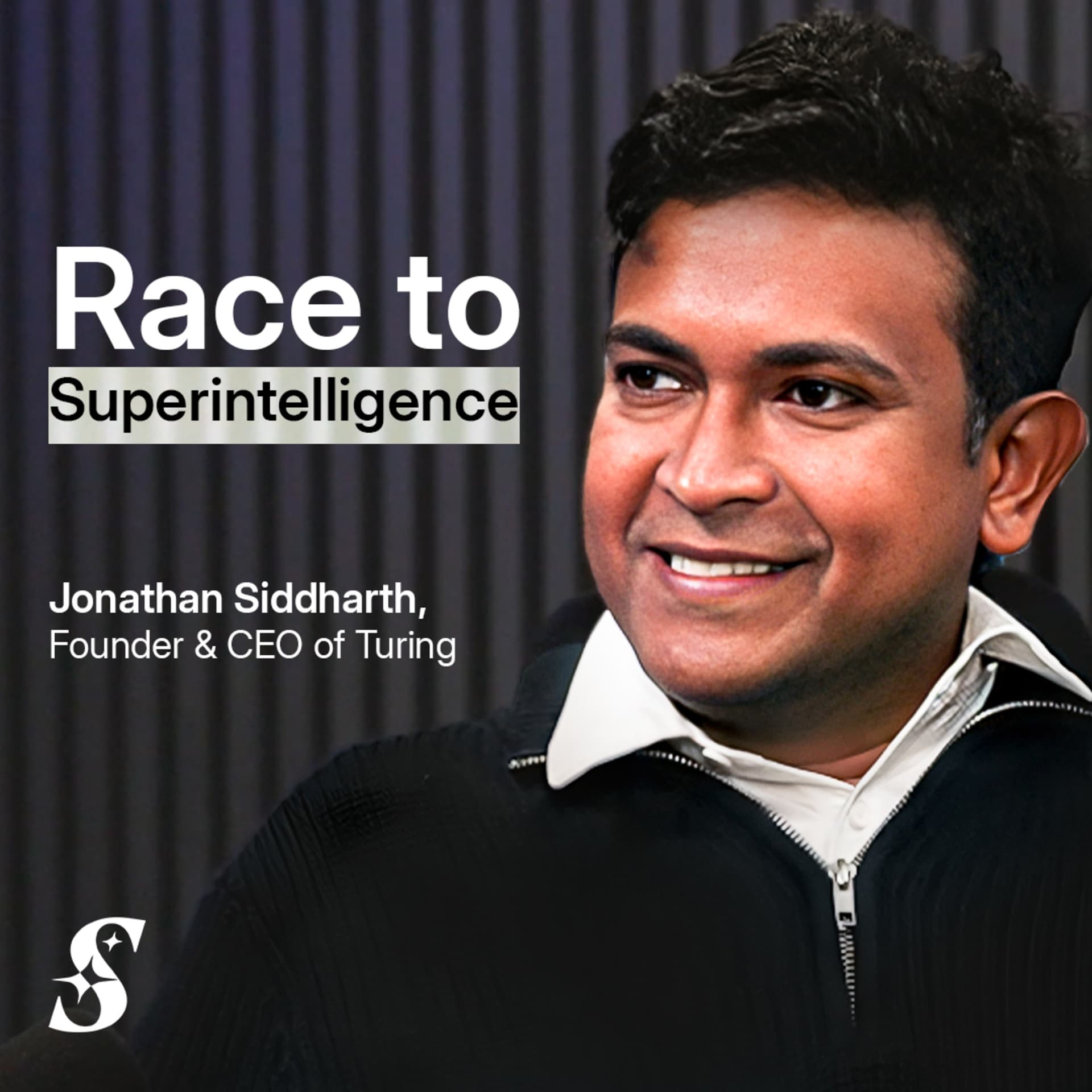
Podcast Episode Summary: Inside The $2.2B AI Research Accelerator | Turing
Podcast Information
- Podcast Title: Sourcery
- Episode Title: Inside The $2.2B AI Research Accelerator | Turing
- Guests: Jonathan Siddharth, Founder & CEO of Turing
- Host: Molly O'Shea
Episode Overview In this episode, Jonathan Siddharth discusses Turing, a rapidly growing AI research accelerator that has hit remarkable milestones in terms of revenue and valuation. The conversation dives deep into the transformation of AI training, the evolution of Turing's business model, and the competitive landscape of AI data providers.
Key Points Discussed
- The Evolution of AI Training
- Shift from Data Labeling to Research:
- Turing represents a move away from conventional data labeling towards a model focused on strategic research.
- The demand is now for complex, expert-generated data rather than simple labeled datasets.
- Turing's Growth and Success
- Achieved $300M in ARR and raised $111M at a $2.2B valuation.
- Positioned as a key player among major AI labs like OpenAI, Google, and Anthropic.
- Turing is instrumental in enabling these labs to advance AI across four pillars of superintelligence:
- Multimodality
- Reasoning
- Tool use
- Coding
- Understanding the AI Landscape
- The episode discusses the $30 trillion knowledge work economy that is set for automation.
- Emphasis on how Turing is filling the gap for Fortune 500 companies in sectors like finance, insurance, and pharma seeking proprietary intelligence.
- AI Model Training Process
- Pre-training and Post-training:
- Pre-training involves unsupervised learning using filtered internet data to create a base model.
- Post-training includes supervised fine-tuning and reinforcement learning to align models with human preferences.
- Turing's data from a network of 4M+ engineers helps train models and identify gaps in AI capabilities.
- Safety and Ethical Considerations in AI
- Discusses the importance of human-in-the-loop systems for safety.
- The conversation touches on the shifting narrative around AI safety and how effective engineering can mitigate many risks.
- Closing the Enterprise Gap
- Turing aids enterprises in custom AI model development, emphasizing the necessity of fine-tuning models on proprietary data for competitive advantage.
- The importance of turning unstructured data into usable formats for AI training is highlighted.
Key Takeaways
- Turing's Positioning:
- Turing is not just another data provider; it is a research-first accelerator that collaborates closely with AI labs to enhance model performance.
- The Future of AI:
- Siddharth expresses optimism about AI's potential to solve significant global challenges such as diseases and aging through advancements in superintelligence.
- Competitive Landscape:
- The demand for high-quality data is immense, and Turing sets itself apart from its competitors (like Scale AI and Mercor) by providing a strategic partnership rather than just data.
- Enterprise Intelligence:
- Companies need to leverage their proprietary data for building tailored AI systems to gain a competitive edge in their respective markets.
Conclusion This episode provides valuable insights into the evolving landscape of AI training and the pivotal role Turing plays in shaping the future of artificial intelligence. As companies navigate the complexities of AI integration, understanding the importance of strategic data utilization and customized solutions will be crucial for competing in the rapidly advancing knowledge economy.
Written by AI. May contain mistakes. Listen to the episode to check what was said.
Transcript
Automatic transcript. May contain errors.0:00300 million plus in revenue and profitable, 225 million in funding, at a last valuation of$2.2 billion, and customers that include OpenAI, NVIDIA, Anthropik, Google, Microsoft, Meta, Salesforce, Amazon, and I'm sure a lot more. Jonathan, what is touring? The era of sweatshop data labeling is over. Now what the labs needed is a strategic research accelerator, a Turing's the world's leading research accelerator, working with all of these frontier labs to advance them along the four pillars of superintelligence. multi-modality, reasoning, tool use, and coding. That's$30 trillion of knowledge work that is going to be automated.
0:39Ever since the scale AI acquisition, investment, whatever you want to call it, there's essentially a billion dollars up for grabs. This market is massive and growing. There's unlimited demand for high quality data. What does the inside of OpenAI look like? What does it take to get to GPT-5? First, I think GPT-5 is fucking awesome. The AI doomers talk about this concept of rapid takeoff. I don't think rapid takeoff is how things will unfold. We will get to ASI and it's honestly the most important problem humanity could be working on because if we solve intelligence, we can solve diseases, we can solve aging, we can solve perhaps interstellar travel.
1:24Jonathan, welcome to Sorcery. Thank you for having me. Well, Well, we met just a few months ago in Paris at the RAISE Summit. This was actually at Apoorv from Altimeter. Thank you, Apoorv. His event outside of the summit, and you were one of the speakers on stage. What were you guys talking about? We were talking about training superintelligence. The race to AGI is on, and the data needs of these models have shifted. These models need incredibly complex data for training them to get better at coding, advanced reasoning, STEM, etc. And we were chatting about how the world looks so different today than it did like a few years back.
2:09So I remembered that speech. It wasn't a speech. I remember that panel. And I was really taken back because I've heard of Scale. I've heard of Mercore. I've heard of all these different companies in the AI research space. it's definitely evolved from just where it was before with data labeling to something a little bit more advanced as AI continues to evolve but there was one thing that I thought was quite interesting and I didn't know this but like the scale at which these companies are running specifically yours and I tweeted this out and it kind of went viral but I tweeted out just got back from Ray's Summit in Paris where AI's top names like Grock, Cerebris, Eric Schmidt, Lovable and Windsurf this was like right before the Windsurf thing by the way I don't know if you remember that All took the stage.
2:55Yeah, one unexpected player stood out as the next breakout AGI leader. Some stats. $300 million plus in revenue and profitable. $225 million in funding at a last valuation of$2.2 billion. A network of 4 million engineers and customers that include OpenAI, NVIDIA, Anthropic, Google, Microsoft, Meta, Salesforce, Amazon, and I'm sure a lot more. So Jonathan, what is Turing? So at Turing, we train superintelligence. We work with seven out of the eight Frontier Labs. We work with OpenAI, Anthropic, Meta, Google, Microsoft, NVIDIA, Amazon. Anybody that's building a Frontier Foundation model, we are probably working with them already.
3:46And what's happening is as these models have become smarter and smarter, the data needed to improve them has become increasingly harder to generate. The earlier era was almost like commodity data labeling. That era is over. Now it's all about frontier data. These models need expert human data in every domain imaginable. They need data to train these models in reinforcement learning. and sometimes they need synthetic data. What we are doing is scaling up our data infrastructure at gigantic scale. So for these models, the cool thing is everybody's aware of all the research breakthroughs that are needed to move these models forward and all the labs do an amazing job at advancing the research frontier.
4:35You need tons and tons of compute and we have NVIDIA, Cerebrus, Grok, like all these companies to thank for that. but they need a ginormous amount of data. And what's happened, Molly, is these models ate the internet when they were pre-trained, but the internet data is used up. It was used up like three years ago, right? Where's the data gonna come from to keep the scaling laws going? You need to have expert humans from every domain imaginable to work on a platform like Turing to break the models and figure out what type of incremental data will move them forward. The era of sweatshop data labeling is over.
5:19Now what the labs need is a strategic research accelerator, and Turing's the world's leading research accelerator, working with all of these frontier labs to advance them along, I would say, the four pillars of superintelligence, which is multimodality, reasoning, tool use, and coding. If you solve these four things, you will get to ASI. What's ASI? Artificial superintelligence. I think of ASI, and different people have like different definitions, right? I mean, AGI was also very ambiguously defined. And I think of ASI as us having automated 90 % of the tasks that 90 % of humans do today in front of a computer, right?
6:05If you look at most types of knowledge work, like my job, your job, you're looking in front of a computer, analyzing what's on the screen, using different tools, and taking decisions. And this is the job of a CEO. It's the job of a head of engineering, a director of performance marketing, an SDR. These types of tasks are going to be automated. The only constraint, the reason this hasn't happened yet, is the data that has to improve these models hasn't gone into them yet. And we are scaling like crazy. I think of this like a four-dimensional matrix. Think of every industry you can imagine. Financial services, retail, healthcare, life sciences.
6:47That's dimension one. Next dimension, think of every function in that industry. Software engineering, sales, marketing, etc. Third dimension, think of every role in the org chart in that function. Let's pick marketing. There's a CMO, there's a director of performance marketing, there's an SEO analyst. And fourth dimension, think of the workflow that a human performing that role goes through. Let's say we pick a director of performance marketing, and they have to figure out how to allocate marketing budget across different channels, solving for CAC, LTV, yield of the efficiency of the channel, scalability of the channel, etc.
7:24This requires that human to do data analysis, to do A-B tests, use tools like Facebook's performance marketing dashboard, LinkedIn's performance marketing dashboard, analyze which campaigns do well, and based on that, like update the website funnel, right? All of this is going to be automated, right? This is like, if you look at those four-dimensional, if you look at that four-dimensional matrix, that's$30 trillion of knowledge work that is going to be automated. And these models will improve to automate all of this as long as we scale up compute and we scale up data. There is this joke among AI researchers.
8:01Researcher one says, hey, is it true that LLMs cannot reason well out of distribution? Meaning are LLMs just interpolating based on data in the training set? How will they generalize? And researcher two says, then you bring all data into distribution. like all of humanity's human knowledge, bring it into distribution. Seven billion humans on the planet doing all sorts of interesting things. I think most of them should be on platforms like Turing generating data to train these models. So humans are a lot more leveraged in what they do. Sorcery is brought to you by Brex, the financial stack trusted by more than 30 ,000 companies, including one in three venture-backed startups in the U.S.
8:44Nearly 40 % of startups fail because they run out of cash. Rex is literally built to help founders avoid that. Unlike traditional banks that let your money sit idle, chipping away at it with fees, Rex's designs help you spend smarter and move faster. Their all-in-one solution combines checking, treasury, and FDIC protection into one powerful account. You can send and receive money globally at lightning speeds, get 20 times the standard FDIC coverage through their partner banks, and even high yield from day one. with same day and even same hour liquidity. Access your funds anytime. Companies like Scale AI, DoorDash, Service Titan, HIMSS, Anthropic, Flexport, Robinhood, and Plaid trust and use Brex.
9:29Start today at brex.com slash sorcery. That's B-R-E-X dot com slash sorcery. I kind of think that's why Nat Friedman started to, he started to translate all those scrolls. he's starting that was one of his projects he's translating scrolls because we ran out of data we ran out of human knowledge and now we have to go back in time and decipher these things so right now there's a lot of competition in the space and it seems like the hottest thing to look at ever since the scale ai acquisition investment whatever you want to call it there's essentially a billion dollars up for grabs. And I want to know, between the three leaders, of which you are one of them, how do you differentiate?
10:21This market is massive and growing. There's unlimited demand for high quality data, unlimited demand. I see two axes that you have to be really good at to win in this market. One axis is finding really smart humans really, really fast. And there are a few companies that do a good job at that, Turing being one of them. There's another axis, which is you have to be at the forefront of data research. You have to know what type of data is likely to be helpful to the model for it to advance encoding, STEM, advanced reasoning, et cetera. Turing's great at that. We are the one company in this category that's not just good at finding people and generating data, but being proactive about figuring out what type of data these models are likely to need.
11:10And as the models get getting smarter and smarter every quarter, you have to innovate on the research side too. So on that two by two, I would say Turing's the one company up and to the right. There are plenty of companies that are good at, okay, we have a large talent network, we work with university students, or we're good at finding people. We think that's necessary, that's not sufficient. You have to ensure that the quality of the data is good and that it can improve the model's performance. Taking a step back, can you explain the evolution of this industry and models? You gave a really good explanation on This Week in Startups with Alex and I think this was like phenomenal, like it was clipped and everything.
11:58Could you explain the evolution of that? this industry had a huge shift after the reasoning models came out late last year or one being the first the shift is before the reasoning models this industry needed simple data gobs and gobs of simple data you needed a data factory or this industry needed somebody to find people really fast after the reasoning models came out the game completely changed this is like after O1 and DeepSeek. Now what the labs need is not a data factory. It's not a talent marketplace. The labs need a strategic research partner, somebody who can collaborate directly with their researchers to understand where the models are weakened today and strategically custom engineer data to improve the model's performance.
12:49They need a research accelerator. In-house researchers collaborate with teams in coding, multimodality, STEM, RL gyms, etc., to generate data that will improve these models. And the data that the models need now needs to be hard, that is model breaking. It has to literally break the model, so you need humans who are smarter than the models. It has to be realistic, that reflects how real humans use these models to do real work. Only then AI will actually move the GDP of the world. It has to mirror real world use, not esoteric academic use cases that test whether you've hit the singularity or not.
13:28And third, the data needs to be diverse to cover every single type of knowledge work imaginable. So you need hard data, realistic data, and diverse data. That's how it's shifted. Because research has become such an important part of this next era of AI. it would be wrong not to bring up the fact that this is your background. So you were in research and in AI development before this. So how did that lead to founding Turing? Turing's founding DNA is AI research. My co-founder and I met at Stanford. I worked at the Stanford AI lab and the Stanford info lab. My co-founder worked at the Stanford NLP lab.
14:13And in an alternate universe, Both of us would have gotten our PhD in computer science and AI. And at Stanford, there's this radioactive spider that tends to bite people and makes them start companies instead. And that's what happened to me and my co-founder. And so we saw the power of AI early. And when Turing was started, it was all about using AI to find the world's smartest software engineers at scale, use AI to vet them, match them to companies, use AI to manage them. So when the AGI wave hit, I remember that fateful meeting with OpenAI when they were training GPT-3, and OpenAI wanted to teach GPT-3 to code and to do function calling and tool use, which are building blocks for training agents.
15:03When we saw it, it was obvious what this was going to become. This was the future. And we were perfectly positioned. We had the world's largest platform of software engineers, where we could build the ability to generate high quality data from. And it was clear that the models needed not just coding data, but data in every advanced domain in STEM, in healthcare, legal, finance, etc. And that really helped us, the fact that our DNA was AI research. And now we are publishing papers on what type of data is most likely to help these models advance in coding, in chip design, in multimodality, and coming up with really hard evals for these models.
15:51On the research side, how are you evaluating researchers and how are you recruiting them? On the research side, our focus is on two things. Number one, ensuring that our data is the highest quality in advancing the models along the four pillars of superintelligence, multimodality, reasoning, tool use, and coding. And number two, we do research on what type of data the models might likely need in the future. That's why we were on RL gyms very, very early. We built thousands of these reinforcement learning gyms to train agents. We were able to do that, again, because we have an internal R &D team that's constantly going to AI conferences, understanding where the frontier is, publishing papers.
16:43That's been really key. So the focus is on ensuring that the data that we generate is high quality. I think of that as horizon one. That's the here and now. and horizon two is what type of data will these models need three months in the future. That's horizon two. And today, a lot of that work is on embodied AI and robotics and coming up with benchmarks that the models would struggle at today. Like we are creating data for coding now, for agentic coding, that would stump all of today's models and agents built on top of those models. It gives us a little bit of a sadistic pleasure in flunking all of the models today and a little bit of like demonstrating where the human intelligence frontier is.
17:27But I would give that maybe six months before the models climb that hill and then we'll generate data that's even harder for the models. Could you just explain like maybe step-by-step for people that don't understand how models are created, the partners in which they work with and then also the teams they have internally that make all these processes run? Because I don't think many people know like what does the inside of OpenAI look like? What does it take to get to GPT-5? What is that process? Yeah. Let me talk the general recipe of training a frontier model, right? And a frontier model is a trillion parameter model, like let's say a GPT-4 class model, like the general recipe.
18:10This is roughly what all the labs follow, right? So there are two main steps. There's pre-training and post-training. Pre-training is a form of unsupervised learning, meaning humans are not involved. It's like lots and lots of compute. In pre-training, you build what's called a base model. And all the base model knows is how to autocomplete stuff. Pre-training is done completely inside the frontier labs. And during pre-training, you feed the models a subset of the internet. It's a filtered subset of the internet. There are these datasets like Common Crawl, C4, GitHub, Archive. You also feed a lot of books.
18:53You might feed videos. You feed all these, let's call it humanity's knowledge corpus. You feed it to these models. And the model is basically doing the task of language modeling, which is learning how to predict the next token. This is a model that just knows how to auto-complete stuff. An example of a pre-trained model is something like GPT-3. We haven't yet built chat GPT. This is just GPT-3, right, as the result of pre-training. To this model, if you say something like, Molly runs Sorcery, it'll then respond by saying, Molly is interviewing Jonathan for the next episode. That's how the model will respond.
19:37It's just auto-completing. It's not an assistant yet. But the magical thing about pre-training is in the quest to autocomplete stuff, the model has learned a lot of internal representations about the world. It's like raw brain mass. It's like an artificial brain that hasn't been molded yet. But the intelligence is there, right? The next step is post-training. And OpenAI came up with this paper called Instruct GPT, which lays out this process in more detail. I encourage your readers to listen to it, to read the paper. In post-training, this is when GPT-3 becomes chat GPT. You teach this base model to become a helpful, honest, harmless assistant.
20:23And post-training has two main steps, supervised fine-tuning and reinforcement learning. In supervised fine-tuning, you hire lots and lots of human experts to create prompts and completions that teach the model how to answer questions. The task is still language modeling. You're still predicting the next token, but you feed it question-answer pairs that could either be single-turn, meaning question and answer, or multi-turn, where you're having a dialogue with the model. At this step, if you ask the model, let's say a human contractor has the question, Molly runs sorcery, the next completion for it might be, what would you like to know about Molly?
21:05might be an appropriate response that you teach the model to do. You teach the model how to respond. In the case of coding, a contractor might create a question like, hey, give me some Python code to train a text classifier to detect X posts into positive sentiment, neutral sentiment, negative sentiment. And then the contractor actually writes code. And let's imagine the code had some type of exception or some type of bug. the contractor would give the model a demonstration of what the right answer is. It's humans showing the model question-answer pairs, so the model learns. Again, this is still language modeling.
21:46The model is still learning how to predict, but now you've aligned the model. If you ask the model a dangerous question, and there are these areas in the community, it's called CBRN, Chemical, Biological, Radioactive, Nuclear. There are categories of things that for safety, you might want to train the model to decline to answer. That gets done in this step too, this supervised fine-tuning step. The step after that is reinforcement learning with human feedback, where when the model has gotten slightly better at responses, you'd have the model output two responses, two completions, and you'd have human contractors pick what is a completion that a human tends to prefer.
22:28For example, if the question is, tell me more about Maliché and Sorcery, and there's one set of responses that is maybe super verbose and is not easy to consume, whereas there's another response that's like in crisp bullet points, and maybe that links to the conversation we are having. Maybe a human contractor maybe picks that. Oh, that response is better. This RLHF step is used to train a reward model. and the reward model basically scores responses based on what's a response that a human tends to prefer. And this is used to update the model that has been trained so far to output completions that humans tend to prefer.
23:18For example, in coding, humans may tend to prefer code that's commented really well, that's structured in a way that is easy to maintain and is more modular. But those preferences are learned in RLHF. And once you've done RLHF, you would then do another round of evals where you're evaluating the model's performance to see if the model improved. And as the model improves, you'll figure out where the model breaks next and then generate data to improve the model there again. It's a loop between you first do pre-training. Pre-training is done relatively infrequently. And then post-training is a highly iterative process.
24:03You start first with SFT. Then you would do reinforcement learning with human feedback. You'd evaluate the model again, figure out where it's breaking, where it's doing well, and then generate data in the areas where the model is weakened. Now, what I just described is how things used to largely work until last year. Now, for these verifiable domains like coding and math, instead of doing reinforcement learning with human feedback, you can do reinforcement learning because you can automatically check when you got the correct answer or not in these verifiable domains. And with reinforcement learning, the way you teach the model is not through imitation learning, where you're learning from humans, but it's through experiential learning, where you create this environment with prompts and verifiers, and you create basically a mini world model, where as long as the agent gets the right result, that particular trajectory that the agent took to come to the right answer gets reinforced.
25:07And when the agent got to a result that didn't get the right answer, that doesn't get reinforced. So the model kind of learns from its own experience. It's a form of self-play, which I think is really, really cool. If you remember from the Alpha Zero days when DeepMind was teaching their Go playing algorithm, the first version of Google's AlphaGo system learned from expert humans, which was quite good. The next generation, which was even better, just played against itself and figured out which paths tended to it winning and which paths tended to it losing and learned from that. And there is this Move 37 in one of the games where the model came up with a move that felt alien to the best Go players in the world because the model had figured out a trajectory to win that beat sort of the best human experts.
26:06And I'm super excited for AI in the enterprise when an agent takes a path that is so novel and so interesting and so different that really exceeds superintelligence. And for me, that's a big part of artificial superintelligence. Why should human intelligence be the bound for what we do? These models could exceed us in many interesting ways. In today's high-speed business world, staying ahead means using the smartest tools possible, including the powerful capabilities of artificial intelligence. Meet Turing Intelligence. Turing builds customizable AI systems designed to solve your mission-critical challenges, no matter your industry.
26:45From expert guidance to tailored projects, Turing helps top companies realize AI that's more capable, more adaptable, and more effective. With Turing, discover how AI can accelerate your business growth. To learn more, visit Turing.com slash sorcery, spelt S-O-U-R-C-E-R-Y. That's Turing.com slash sorcery. I think that's a really interesting point, and it's also a point that scares people a lot. It's created a culture of doomers because they're afraid of AI and technology rapidly advancing so fast or so quickly out of our control that it puts safety at a risk. um I'm gonna put that to the side like quite like a little bit but it brings it brings into light this tweet that David Sachs had not too long ago like right after the GPT-5 release and there was a lot of pushback on this release it didn't go as expected many um were actually like quite disappointed they were expecting like something crazy to happen and turns out it was just a little bit of an incremental, seemingly incremental, I don't want to offend anyone, seemingly incremental improvement to the model.
28:02But I'm curious from your standpoint, what did you make of that moment in that tweet that David Sachs had put out that was, you know, it was addressing the doomers of, okay, actually, like, AI is not moving that fast, we actually might have more time before, where we have real crazy moves happening. Yeah. Let me unpack this. I think there are two parts to your question. There's one part, which is, are we slowing down? Like, are things going to be more incremental going on? That's one part to your question. And then there's another part, which is, how should we think about safety in these AI systems?
28:43So let me take that separately. first I think GPT-5 is fucking awesome I think it's awesome I think we've just gotten used to magic that maybe we are not fully seeing the impact of of what's just out there and I'm not just saying that because we we work with the company that built it I think GPT-5 is awesome I think one thing is real though which is the AI doomers talk about this concept of rapid takeoff it's sort of the I mean if you've seen the matrix or the terminator movies like somehow we'll hit a singularity and there's just this rapid takeoff where humanity gets left behind I don't think rapid takeoff is how things will unfold I think it's going to be steady continuous progress every step of the way we're going to keep moving forward and it's going to be great and it's great for a few reasons the reason I think rapid takeoff will not happen and I know why the doomers believed in rapid takeoff is because GPT-3 felt like magic, right?
29:47It was like fucking magic. It was magic because there were a lot of one-time jumps in there. Jump number one on the data front, we ate the internet. We ate the internet. There is only one internet and we ate it in GPT-3, right? And GPT-4, again, in all of these, and all the models like GPT-4, like Gemini 2.5 Pro, Grob 2, Grob 3, Claude. It's the same formula. We all ate the internet, and that was a huge one-time jump. And we put in all of humanity's knowledge. All the books that you own the licenses off were fed into the models, right? So humanity's collective intelligence was eaten in the GPT-3, GPT-4 era.
30:33And we scaled up compute. Some of the early gains in compute where we also got that, right? And computers takes time to build. You got to solve energy and you got to build data centers and you see what Elon's doing with his projects. You see what Sam Altman and OpenAI are doing. You see what Meta's doing. Compute also takes time to build, right? So we got a huge jump by eating the internet and using all the easily accessible compute. But the scaling laws, which is an empirical law, is continuing to hold, meaning you take a big model with lots of parameters, you dial up compute, you dial up data, and the models smoothly keep improving, right?
Read the full transcript
31:15I'm a huge optimist in humans and human potential. I think we humans will solve bigger, more interesting problems instead of the more mundane stuff that we do today. I believe I will be 100x more productive. If I'm 100x more productive, maybe I'll run 100 companies in parallel. Elon might run 600 companies in parallel, right? So I think the solution is simple. Keep hiring the best researchers on the planet. Keep scaling up compute. Keep scaling up data. We will get to ASI. And it's honestly the most important problem humanity could be working on. Because if we solve intelligence, we can solve diseases.
31:53We can solve aging. We can solve perhaps interstellar travel. It's going to be awesome. On the safety side, I think the narrative has changed a little bit. Cal, she actually has a market out on this of will models pause research for safety reasons. And this goes until 2027. And so right now it's at about 9 % chance. But it was trending upwards of like 40, not too long ago. It's really shifted and it's taken a nosedive in the last week or so. So why do you think that is? Why do you think the narrative on safety is changing? People have realized that the best way to deploy these systems is with humans in the loop.
32:42And with humans in the loop, a lot of the safety issues go away. You have to design these systems for partial autonomy. People's mental models when they think about AI is self-driving cars. I feel like the self-driving car industry did a lot of damage to AI in one particular way, because with self-driving cars, 99 % accuracy is not enough. That last 1 % really matters. But with a lot of AI systems, if you're automating the job of an investment analyst, or if you're automating the job of a CEO or a CFO, you don't have to be 100 % accurate, as long as there is a human overseeing the results of the model.
33:28So I think we know how to build good safety harnesses around these systems with a human verifying the results of the model. So I think a lot of the risks, many of the risks were somewhat exaggerated. And we have good techniques to address safety in the post-training phase. You can teach the models to decline to answer questions that could be dangerous in the CBRN side of the space, chemical, biological, radioactive, nuclear. So we have some good techniques to contain the negative behaviors of these models. Safety is important, but I think it was, some of the risks were over-exaggerated and they could be solved with really good engineering.
34:19I think what's the bigger risk is we don't deploy these systems quickly enough. I mean, there was that MIT study that showed how 95 % of Gen AI pilots fail. I'm not surprised by that result at all. They fail because oftentimes, Firstly, there is a big data gap. To solve real-world enterprise workflows, you need real-world enterprise data, and that data doesn't exist on the internet. To have that data, you have to hire people doing those workflows and train the models the right way, which is what we're doing. So there's an enterprise data gap, and there's also an enterprise expertise gap. There's a lot of first mile schlep and last mile schlep to make these systems actually work well.
35:08And there's work to do. And the bigger risk is an insurance company or a company in financial services doesn't adopt or make the best use of these models quickly enough. And if you don't do it quickly, their competitors will and whoever does it really well will win. Okay, but how are you helping close the enterprise gap? With enterprises, the biggest gap is making sure that you are building custom models, which could be an off-the-shelf model that you take, but you fine-tune it on your proprietary data. This is what you're doing with enterprises? That's right. Okay. That's right. With enterprises, the old way of thinking was you would take this off-the-shelf model or you give everybody access to ChatGPT or Claude and call it a day.
35:55Right? That's the SaaS era thinking, right? Yeah. Plug and play. But the best enterprises know that it's not about integrating general intelligence. It's about building proprietary intelligence. You'd want to take a model, maybe from built by one of the frontier labs, but you'd want to fine tune that model on your proprietary enterprise data. Your data is your moat and fine tune it on your proprietary human intelligence. You might automate your proprietary internal workflows. It'll probably be a custom model that's on-prem. It'll probably be a smaller model. Oftentimes, we see a half a billion to a 10 billion parameter model.
36:37That's the regime, not a trillion parameter model. And this will be faster, more accurate. You'll have full control over governance, confidentiality. You don't want your model to help your competitors. So that's what you want to build. But the constraint for these models is step one, you first have to prepare your data. Enterprises have lots and lots of unstructured data, but you want to convert it into structured data into a format to fine-tune these LLMs. You'd want a platform to make sure you can distill your human expertise into the models and suck up like your proprietary data into a way to fine-tune these models.
37:15And you'd want to build the right workflows designed for partial autonomy. You'd want to have good evals for your specific workflows. You'd want to solve safety. And the enterprises need a neutral evaluator to help them pick the right models, pick the right systems to build this. And that's where we come in. The same technology that we built to help the frontier labs get to AGI, we are building a version of this for enterprises to build proprietary intelligence to build their own internal chat GPT or systems built on top of chat GPT. And that's going to transform. And I'm very bullish for Fortune 500 companies that have good data collection practices.
38:03As long as you, at the very least maintained good unstructured data from your prior business interactions with your customers, you have an opportunity to win because your proprietary data is your moat. As long as you distill it into, as long as you fine tune LLMs based on that knowledge and you, most companies have really amazing human expertise inside their organizations. They just have to transfer that expertise from those human minds into those machine minds. and that will give them an edge. It'll actually give them an edge over a startup starting from scratch. If you're GEICO, as long as you do a good job, if you're GEICO Progressive or any of these insurance companies, as long as you do a good job of fine-tuning your custom models on your underwriting data, on your claims processing data, and building systems around it to automate underwriting and claims processing, you can win.
39:03But if you don't do that, there could be an upstart AI company that starts today, that does this from scratch, that has a good data collection feedback loop, that company could jump you. But that company will still need time to acquire that data. If you're Geico or Progressive, you have access to that data. So it's your battle to lose. But to do that, you have to act fast to make sure that you own your proprietary intelligence and you don't outsource it away. With over$300 million in revenue, I'm sure this number has changed because that was a couple of months ago. But who are your customers? You can talk categorically.
39:47You don't have to tell me their names. I know some of these things are sensitive, but what ways in which are you helping these different industries deploy their own models? So we are working with almost everybody that's building a foundation model. We are working with eight out of the nine frontier foundation labs. And now we've expanded to start to work with enterprises in financial services, in insurance, in pharma. and we are rapidly expanding into more verticals. So this is like investment banks. This is maybe private equity funds. These are like real financial institutions. That's pretty interesting.
40:32That's right. And if the job involves analyzing data and making relatively quantifiable decisions, like verifiable decisions, it's a great use case. And for investment banks, private wealth management, firms, these other companies in capital markets, if the job is to like figure out good investment opportunities and you're looking to find alpha, this is AI is sort of, is like, it would be an existential risk to ignore. Because now with this technology, you can ask a question like, hey, how many times did the CEO of this public company talk about this particular topic in the last 12 months? And how has that changed, right?
41:28In the pre-LLM world, this question would have been a very sad piece of work for an intern or like some analyst to do for like many, many hours. But for LLMs, this is like nothing, right? So LLMs are really good at synthesizing gobs and gobs of information to come up with useful signal, especially if they are fine-tuned on the right data sets. So if you're an investment firm and you have a history of evaluating investment opportunities and making decisions, and maybe you decided to buy a stake in a company at a certain price, or maybe you decided to pass on a company, and you probably wrote an investment memo outlining your decisions, that's incredibly valuable data to fine tune an LLM, right?
42:17And you own that data. That's your edge. Your data is your moat. And I think like the best firms are already doing this to help an investment analyst make better decisions faster and eventually with significantly fewer people. Sorcery is proudly sponsored by Carta. Carta is transforming the private marketplace, connecting founders, investors, and limited partners through software purpose-built for private capital. Trusted by more than 65 ,000 companies in over 160 countries, Carta's platform of software and services lays the groundwork so you can build, invest, and scale with confidence. Carta's fund administration platform supports over 9 ,000 funds and SPVs, representing nearly$185 billion in assets under management, with tools designed to
43:19How do you give conviction in your investors, in outside entities, that this is sustainable, durable revenue? The whole image of Mercor, Surge, Scale AI is that this is service-based revenue and it's not long-term. And we all know the VC world investors, they love long, sticky revenue. But how do you position this to investors and how do you think about revenue yourself? So, Turing's an interesting company in that we are a lot like NVIDIA in one sense, in that we are a picks and shovels into the AGI industry, right? These, as AGI continues to advance, they're going to need lots and lots of compute and lots and lots of data.
44:17So, that's going to continue to grow for the foreseeable future. I think we're still a significant distance away from automating everything. If I asked you how much of enterprise workflows have we automated today, you'd probably say next to nothing. If I think of a zero to 10 point scale, on the consumer side, we are maybe at a three. On the enterprise side, we are maybe at a 0.25 at best. So there's a huge market ahead that's massive and growing on the data side. So we're very excited about that. The thing that we've discovered, and this is one way in which we are different from like the traditional data labeling companies like the ones that you mentioned, is we also work with enterprises to help them take advantage of AGI.
45:11And for enterprises, they don't need just data. They need somebody to help them build end-to-end AI systems. in the first mile and the last mile. I think that's going to be an even bigger market potentially that we are perfectly positioned to. I think of it a little bit like we are working with the Formula One teams in the Frontier AI labs, but there's the car companies where there's a trickle-down effect of some of this technology. We are now building RL gyms for giant financial institutions as well. And that's a massive market. Like, if you look at the services market, it's a trillion-dollar market, right?
45:53And we are talking about$30 trillion of knowledge work that's about to be automated. And enterprises need all the help they can get to not just build the right models, but to build the right systems around these models to automate workflows. So I think, like, Turing will probably replace companies like McKinsey, Bain, BCG, and every services company, like Accenture, TCS, Wipro, Infosys, like all of these companies doing vanilla services, that's going to be automated with these agentic systems. And we are perfectly positioned as the company that's helping the frontier labs build smarter and smarter superintelligence.
46:31We are simultaneously helping enterprises take advantage of these superintelligent systems, and one helps the other. If you're just a pure data vendor, you're not touching reality. You're just selling data to labs. but because we also try to build stuff on top of these models, we touch reality. We know where the models break when you try to solve underwriting. One of the use cases that you told me was after you record an interview, you try to pick the right clips from those interviews that are likely to go viral. In the future, you'll probably use a Turing model that is fine-tuned for your own use case to do that.
47:09That's an example of something that actually touches a real-world use case. So the fact that we are also helping enterprises helps us do a better job serving the Frontier AI labs. So talking about revenue, revenue has become really public because all of a sudden there's a billion dollars up for grabs with the scale AI acquisition, acqui-hire, whatever you want to call it, investment round. How do you think about revenue and your competitors? So this is a massive market that's growing super fast. right and the interesting thing is and there are a few companies in the space there's companies like surge more core scale ii of course being the company that started in the space early this unlimited demand for really high quality data if you look at the competitive landscape i see three categories of companies there is the pure play data labeling companies There are recruiting talent marketplaces.
48:17We are none of them. We are a research-first data accelerator. That sets us apart. Of course, we are really good at finding really smart people, and we built a platform that helps us generate data really efficiently. But what sets us apart is our research-first posture. Old-school data labeling is over, and the era of recruiting or a talent marketplace is also over. These labs need more than just data thrown over a wall. They need more than just higher 50 PhDs in physics, chemistry, math, biology. They don't need just that. What they need is a true partner that can understand their research objectives in improving their models for coding, for math, for STEM, for reasoning, for agentic workflows.
49:07And they need a partner that can go, that can help them figure out what type of data is likely to be helpful and do things before being asked. That sets Turing apart. I would say most of the other companies in the space fall into either being a data labeler or a people finder. And Turing is a research first accelerator. We are a research accelerator for the Frontier Labs. Hey, it's Molly. if you enjoy our interviews, check out our newsletter, sorcery.bc, where we deliver a once a week top deals and tech headlines email, and also go deeper on our podcast interviews. Subscribe to Sorcery today. And don't forget to subscribe to the podcast on YouTube, Spotify, Apple, or wherever you listen.
49:52Link in description to sign up.
From the publisher
AI has eaten the internet, data labeling is so over, and $30 trillion of human work is on the verge of automation. Jonathan Siddharth, Founder & CEO of Turing, joins Sourcery to break down the power shift in AI training — from commodity data labeling to expert research — positioning Turing apart from AI data providers like Scale AI, Mercor, & Surge.
Turing has become a hidden force in the AI race, hitting $300M in ARR in 2024 (~3x YoY), achieving profitability, and raising $111M at a $2.2B valuation in March. That growth cements its position as one of the fastest-growing AGI infrastructure companies.
Today, frontier labs like OpenAI, Anthropic, Meta, Google, Microsoft, Nvidia, & Amazon rely on Turing for the frontier data that pushes AI forward across the four pillars of superintelligence:
• Multimodality
• Reasoning
• Tool use
• Coding
We explore Turing’s expansion into the enterprise, closing the “gap” – where Fortune 500s in finance, insurance, and pharma are racing to build proprietary intelligence on their own data, creating durable moats in the $30T knowledge work economy.
PS Jonathan also explains how labs like OpenAI train models:
• Pre-training on filtered internet corpora (Common Crawl, GitHub, books, video)
• Post-training with supervised fine-tuning (human Q&A datasets)
• Reinforcement learning (RLHF + verifiable domains) to align models with human preferences
• Model-breaking data from Turing’s 4M+ engineers to close gaps and advance systems like GPT-5
1. Jonathan Siddharth: https://www.linkedin.com/in/jonsid/
2. Molly O’Shea: https://x.com/MollySOShea
3. Sourcery: https://x.com/sourceryvc
Brought to you by:
• Brex—The modern finance platform, combining the world’s smartest corporate card with integrated expense management, banking, bill pay, & travel.
As a Sourcery Listener you get: 75,000 points after spending $3,000 on Brex card(s), white-glove onboarding, $5,000 in AWS credits, $2,500 in OpenAI credits, & access to $180k+ in SaaS discounts. On top of $500 toward Brex travel, $300 in cashback, plus exclusive perks (like billboards..) visit → https://brex.com/sourcery
• Turing—Turing delivers top-tier talent, data, and tools to help AI labs improve model performance—and enables enterprises to turn those models into powerful, production-ready systems. Visit: https://turing.com/sourcery
• Carta—Carta connects founders, investors, and limited partners through software purpose-built for private capital. Trusted by 65,000+ companies in 160+ countries, Carta’s platform of software & services lays the groundwork so you can build, invest, and scale with confidence. Visit: https://carta.com/sourcery
• Kalshi—The largest prediction market and the only legal platform in the US where people can trade directly on the outcomes of future events: https://kalshi.com/sourcery
Follow Sourcery for the latest updates!
(00:00) AI Ate The Internet
(00:49) Training superintelligence: the race to AGI
(02:31) Viral tweet
(03:24) What Turing actually does
(04:43) The internet data is “used up” — where will new data come from?
(05:34) Four pillars of superintelligence: multimodality, reasoning, tool use, coding
(06:07) Automating $30T of global knowledge work
(09:18) The $1B revenue opportunity
(10:59) Why Turing is a research-first accelerator, not a data labeler
(13:45) Jonathan’s Stanford AI Lab roots and founding DNA
(17:57) How models are built: pre-training vs. post-training
(20:14) RLHF, reinforcement learning, and “breaking the models”
(25:19) GPT-5 and the myth of rapid takeoff
(30:46) Safety debates and human-in-the-loop systems
(34:53) Closing Enterprise Gap: finance, insurance, & pharma
(39:23) Why proprietary enterprise data is the next moat in AI


