
In short
Merge’s AI-focused platform and security/cost “fix” for agent-driven integrations in the GenAI era, including governance, guardrails, and routing to manage spend and risk.
Guests (backgrounds)
Shensi and Gil, CTO/CEO of Merge (a Merge special). They describe building and scaling Merge’s products, using AI internally (Cloud Code/Codex), and serving large AI companies and enterprise customers.
Key claims
- “Everything goes wrong” when agents connect to tools; non-deterministic actions can leak sensitive data without hard guardrails.
- Cybersecurity threats are accelerating via AI-generated code and supply-chain attacks; humans can’t review the volume of agent-produced changes.
- Token-maxxing is CFO-brutal: productivity gains don’t automatically translate to budget gains; cost savings and routing are essential.
- Agent governance needs identity integration, visibility, and granular access controls.
Notable examples
- Customers named: OpenAI, Perplexity, Netflix, Uber, Mistral, Dropbox, Freshworks.
- Security incidents referenced: MergeCore/GitHub supply-chain PR surge; Wiz “single Git push” repo access; Axios attack; “Mythos” discussed hypothetically.
- Use case: connecting Whoop to Asana to correlate stress with tasks.
Written by AI. May contain mistakes. Listen to the episode to check what was said.
Chapters
Tap a time to open that second in VOIntroduction to Critical Business Functions
0:00 to 1:05
Learn about the importance of uptime and reliability in business operations.
“We power critical functions for a lot of businesses.”
Merge's AI-Pivot Strategy
1:32 to 2:06
Discover how Merge shifted focus towards AI solutions and product launches.
“Yeah, honestly, it's been really exciting for us.”
Exploring Merge's Product Suite
2:06 to 3:21
An overview of Merge's three key products for AI integration and data synchronization.
“We have Merge Unified, which is our original product.”
Internal Transformation with AI
3:21 to 3:36
Learn how facing challenges led Merge to innovate and embrace AI technology.
“you can see when companies don't really make a concerted effort to pivot or rebuild or embrace AI.”
Navigating Resource Limitations
3:36 to 5:15
Discuss the challenge of allocating resources for future developments amidst current demands.
“And you can tell either by what they're posting about online, who they're engaging with, like how their products are developing, but you guys did make that concerted effort.”
Cultural Embrace of AI at Merge
5:15 to 6:33
Explore how Merge fosters a culture of AI adoption across all departments.
“We knew we had to be able to build new products and adapt our existing products with just a couple of people.”
Evolution of Hiring Practices
6:33 to 8:07
Understand how AI influences hiring and the qualities sought in candidates.
“Everyone is generating things as then making it automated as much as possible.”
Leveraging AI for Business Growth
8:07 to 8:31
See how AI has accelerated revenue growth without a significant increase in headcount.
“Are you seeing the direct correlation there?”
The Role of Tools in Development
8:31 to 9:10
Discuss the tools like Codex and Cloud Code that support Merge's engineering process.
“And it used to be that, you know, a team that had a barrel of a PM or a manager and a bunch of ammunition could get a lot done.”
Understanding Customer Segments
9:10 to 10:35
Learn about the diverse categories of customers and their specific needs.
“So yeah, like Brax, Ramp, and like a few others as well.”
Show all 33 chapters
Sales Experience in the AI Market
10:35 to 12:51
Explore the distinct experiences and challenges of selling to AI companies.
“powering their AI search functionality and also connectivity in their products.”
Navigating Security Concerns
12:51 to 14:01
Discuss the growing importance of cybersecurity in API integrations.
The Evolving Trust in AI and Cloud Security
14:01 to 17:28
Explore how trust in AI and cloud infrastructure is changing, especially in security contexts.
“And a lot of times it's through integrations and different APIs connecting things together, whether it's like someone's using, I don't know, like Vercel was talking about theirs openly.”
Cybersecurity Challenges in AI-Driven Environments
17:29 to 21:03
Discuss the rising cybersecurity threats linked to AI integrations and open-source vulnerabilities.
Cybersecurity Challenges in AI-Driven Environments
21:10 to 22:06
Discuss the rising cybersecurity threats linked to AI integrations and open-source vulnerabilities.
“including one in three venture-backed startups in the US.”
Cybersecurity Challenges in AI-Driven Environments
22:07 to 22:30
Discuss the rising cybersecurity threats linked to AI integrations and open-source vulnerabilities.
“That's why companies like NVIDIA, Anthropic, Salesforce, and Gemini partner with Turing.”
Internal Security Challenges and Data Management
22:35 to 25:43
Understand the internal security risks and the importance of managing sensitive data in organizations.
“You have a bot detector, all these other things internally.”
Managing AI Integrations and Employee Access
25:44 to 28:00
Learn about the challenges of employee access to AI tools and the need for governance in AI integrations.
“i think i think cost is another one that's been that's been you know really crazy to follow along You know, you see everyone saying token max, token max.”
Granular Access Management Solutions
28:00 to 29:19
Learn about innovative solutions for managing granular access to multiple platforms and tools.
“And if they ever leave, they immediately get access revoked.”
Popular Connections in Productivity Tools
29:20 to 30:39
Discover the most common tools and platforms employees are using in today's companies.
“So the CTO is able to see all the activity, if there's any security violations, and also if they want to revoke any access or add more access.”
Trends and Insights in SaaS Platforms
30:40 to 31:54
Explore the shifting trends in SaaS platforms and how companies plan for the future.
“Do you guys watch these trends, keep track of them for marketing purposes and for sales purposes?”
Salesforce's Headless Approach
31:55 to 33:22
Understand the implications of Salesforce's headless announcement and its potential impact.
The Necessity of Adapting to Market Changes
33:23 to 34:51
Learn how companies need to adapt to changing market conditions and customer needs.
“It just kind of does everything without actually going into the platform, headless being almost UI-less.”
The Role of Headless Integrations
34:52 to 36:39
Discover how headless integrations can streamline business processes and improve efficiency.
“So I guess because you guys are so close to the metal and you understand everything that's been evolving with APIs, can you explain how that market has evolved?”
Hiring for a Startup Culture
36:40 to 38:26
Explore the key traits to look for when hiring in a fast-paced startup environment.
“to tell an agent, you know, locally, like go build this thing.”
Challenges in Recruiting and Talent Acquisition
38:27 to 40:29
Understand the challenges in recruiting top talent and how to identify genuine interest.
“and you were saying some of your best hires came like off cycle, not through like fundraisers and that kind of thing.”
The Future of SaaS in a Volatile Market
40:30 to 42:00
Learn how the SaaS market is evolving and the implications for enterprise companies.
“The risk in high risk, high reward is the equity and lower cash.”
The Evolution of AI in Automation
42:00 to 43:18
Learn how AI is changing the landscape of software automation and user expectations.
Valuations and Market Realities
45:03 to 46:40
Explore the contrasting valuations in public and private markets for AI companies.
Scaling Through Customer Success
46:40 to 48:19
Understand the importance of adapting to customer needs and scaling up operations.
“So I think you guys have been a little bit humble.”
Key Metrics for Success
48:19 to 49:49
Learn about critical metrics that drive success for tech companies and startups.
“Was it intimidating getting bigger and bigger logos?”
Misconceptions in Tech Development
49:49 to 51:47
Discuss common misconceptions about ML usage and the importance of product focus.
“If we receive any negative feedback, we action it immediately.”
The Future of AI Agents
51:47 to 54:35
Discover the anticipated rise of AI agents and their impact on businesses this year.
“I do ask everyone what their horoscope is, and I actually did not believe in horoscopes until when we started this company.”
Transcript
Automatic transcript. May contain errors.0:00Shensi Ding:We power critical functions for a lot of businesses. Their core could be powered and heavily driven by merge. So these sort of things we cannot break. We cannot go down. Everything's four, five, six nines of uptime. And if you lose that, you can lose all your customers overnight.
0:13Gil Feig:Some of your customers are names like OpenAI, Perplexity, Netflix, Uber, Mistral, Dropbox, Freshworks, and more. So we do serve some of the largest AI companies in the world, powering their AI search functionality and also connectivity in their products. Consumer expectations are higher now. You just expect significantly more automation. And so the SaaS platform cannot keep up. with the expected automation. It's just hard to compete. What is the state of cybersecurity in this layer of AI?
0:36Shensi Ding:They now speak English perfectly. They now write code perfectly. And they now have unlimited manpower all driven by AI. The second you connect it to tools, which is what everyone is trying to do right now, that's where everything goes wrong. It's so hard to block them because they're coming from IPs all around the world and all it takes is one and it could mean the end of your company.
1:04Gil Feig:All right, Shensi, Gil, welcome to Sorcery. Thanks for having us. Thanks so much. This is a Merge special. We have a CTO and a CEO on.
1:13Shensi Ding:We're happy to be here.
1:15Gil Feig:So what's going on? Hopefully you don't get canceled. I don't think you're going to get canceled. Although we did have some spicy pre-podcast talk. Yeah, we won't talk about Stables High School gossip. No.
1:27Gil Feig:So you guys are on a tear. You have a lot of big announcements that keep on rolling out. What's the latest? What's going on? Yeah, honestly, it's been really exciting for us. Around like a year and a half ago, we made a pretty concerted effort to do like three efforts in order to really move ourselves into the AI space. One of them was using AI really aggressively internally, pivoting our existing product to sell or not pivoting, but like adjusting our current product to sell to AI companies and then also launching our own AI products. And those beds have really paid off, especially in the past year and a half.
1:56Gil Feig:So it's been really exciting seeing like all the hard work that we put in finally coming to fruition. So what are those products today?
2:03Shensi Ding:Yeah, so we have now a suite of three products. We have Merge Unified, which is our original product. It helps companies sync data. So basically, you want to bring that in, power something like enterprise search, do RAG. You take that, you ingest all the data, we normalize it, and it's there for your customers. Helps build a really good search experience. Since then, we've also launched Merge Agent Handler, which is essentially one sort of MCP server you can connect to to help your customers offer or to offer hundreds of integrations to your customers inside of agents. And this can be used for internal agents within a company when you're building your own.
2:38Shensi Ding:It can be used for external agents. So if you're building a customer support bot, for example, and then it also can be used to power just internal use cases. Your whole team is using Cloud Code. Your team is using, you know, Claude or ChatGPT or whatever it is. The connectors all just appear in there and work with whatever AI tools you're using. And then lastly, we launched Merge Gateway. And Merge Gateway is infrastructure that just makes it really easy for you to switch between hundreds of different AI models and route them based on a ton of different policies. It has security layer built in, and it has a lot of smart routing policies, cost-saving policies, and dashboards that make it easy for your whole company to really optimize your AI spend and usage?
3:20Gil Feig:One of the observations that I've had over the last two, three years was you can see when companies don't really make a concerted effort to pivot or rebuild or embrace AI. And you can tell either by what they're posting about online, who they're engaging with, like how their products are developing, but you guys did make that concerted effort. what was that process for you internally especially with your customers too i mean it was really hard um there were a lot there was specifically one really really big deal that we wanted to close and it was going to take up like 90 of our resources um and it was really hard to figure out like okay how do we end up like taking how do we end up finding resources to start building for the future instead of just building for right now and thankfully even though it was honestly at the time really hard, the deal paused for a month.
4:13Gil Feig:And during that time, we actually got a lot done. We finalized the idea that for our second product, which was the Merge Agent Handler, we also started really aggressively leading into AI coding. So Gil and I paused back on the keyboard, using Cloud Code really aggressively, using Windsurf really aggressively, so we could also learn how to code with AI. And that month actually really transformed the business because with us having firsthand knowledge of how powerful AI is from zero to one, it allowed us to see what was possible with our existing products as well. Did you also notice when you were doing that, the vulnerability of your business before?
4:47Shensi Ding:I mean, I think absolutely. I think we realized in that moment, it was the classic innovators dilemma where we had this product, it was growing really fast. It continues to grow really fast, but we also knew where the space was going and we wanted to put as many resources as possible in our newer products. And so during that month, Shensi was talking about, we also realized we do not have this ability to just put unlimited resources on this new thing? How can we get more with less? And that was why we knew we had to invest in AI. We knew we had to be able to build new products and adapt our existing products with just a couple of people.
5:20Shensi Ding:So honestly, actually building our next product, Agent Handler, we had one engineer and me and Shensi, and we were helping on nights, weekends. We did whatever we could, half because we needed to contribute, we needed to help. And the other half was, if we are the leaders of this company, we have to know everything there is to know about how AI works how you build with ai so that one we are more effective and two we're building for where
5:42Gil Feig:the puck is going yeah and i back then like mostly our engineers were like oh like i'm gonna input this code snippet into chat gbt and like ask a few questions about like how to fix something but after that it was like we saw what was possible everything was different we were like you need to be building completely zero to one with ai how do you keep your team up to date on everything obviously like that is an example but um some founders have really pushed their teams to actually use and embrace ai and then also with your new hires like do you test them like what is the experience it's cultural like our whole team is really encouraged to do it and if you don't do it it does it is a part of your performance um so everyone will share like tricks that they learned um we'll also feature people who are really ai forward and it's not just r d so like our accounting team is really AI forward.
6:29Gil Feig:Same with our recruiting and finance teams and our marketing team too. So everyone is in cloud code. Everyone is generating things as then making it automated as much as possible. And we just really try to highlight it as like a positive part of like the merge experience.
6:42Shensi Ding:We also have, yeah, we have brown bag lunches, training sessions. We just started a recurring session on merge skills. So just skills that you've built and how to use them. We ask about it in the interview process. So what we're not looking for is I use the latest cutting edge, but we're looking for, you know, hey, I use it to code sometimes. My company doesn't let me use it to do all these things, but I really want to. That's what we're looking for is just the desire. And I think we've brought in the right people for it now.
7:08Gil Feig:Yeah, but I think it has to just be cultural. Yeah, it's so interesting. More of the conversations I've had recently when I'm talking with either public company CEOs or really high growth companies, when they're hiring out, they're trying to hire for founders or previous founders people that went through yc like that kind of thing that like high agency self um uh what's it called self-development it's an autodidact type of dna within talent and i've just been seeing this over and over again where there is like a clear bifurcation and people who just like think you can still just like apply to get a job By the way, the bar is always very low or high.
7:50Gil Feig:I don't know what it is. It's one of those heights where it's as you've taken on and you've used adoption with AI more and more internally and the models are developing faster and they're more, they're just more efficient. Have you noticed the company build faster? Are you seeing the direct correlation there? Yeah, I mean, last year we didn't increase headcount that much, but our revenue accelerated pretty significantly. And so it's had like meaningful leverage on our business.
8:17Shensi Ding:And yeah, I think one thing Shunsi actually brings up a lot of the company is Keith Raboy's barrels versus ammunition, you know, sort of sort of view where you have some employees that are ammunition. They're really good at specific tasks and just knocking that out. And then you have barrels who basically just knock down doors and will do anything to get things done. And it used to be that, you know, a team that had a barrel of a PM or a manager and a bunch of ammunition could get a lot done. But now that you kind of can have one person just go use, you know, codex, cloud code, whatever to go build something you really just need a lot of barrels to just go get things done
8:49Gil Feig:so that also has shifted how we're hiring how do you do you like codex how's that going we we love
8:55Shensi Ding:it yeah we like we like codex and cloud code we use both um we're big fans of them yeah we we allow
9:00Gil Feig:just like a budget so you can choose whatever tools you prefer some of our team members prefer codex some of our team members prefer cloud it's really just dependent on like some people prefer like other things it's really just up to their preference yeah the only we just have security
9:11Shensi Ding:reviews obviously we can't have people going wild on every tool but otherwise yeah yeah so let's
9:15Gil Feig:talk about the growth so what are the current metrics of the company how many customers you have now yes so we have over i think over like 20 000 um self-serve organizations on the platform might be 25 now i probably need to check um in over 400 enterprise customers on the platform too i think brex is one of your customers they are we love brex yeah michael tannenbaum um actually helped bring us in like a long time ago oh my gosh i know i know i love him i really love him yeah he's yeah he's like the goat what are the main categories of customers that you bring in and what are their use cases yeah so there's a couple different categories like traditional sass platforms um which can include some like ai so like our first customer ever was drada and we of course sell to a lot of the stock to platforms like drada vanta um yeah you name it And then also, you know, sadly, they didn't, sadly, they didn't onboard onto Merge.
10:12Gil Feig:Next topic on this one. And then Expense Management Platforms. So yeah, like Brax, Ramp, and like a few others as well. And then also large financial services. We have customers like JP Morgan, US Bank. Yeah. And that's been really awesome for us. And then, of course, like the large AI companies. And that's been like a newer segment that we actively invested in early last year. as we do serve some of the largest AI companies in the world, powering their AI search functionality and also connectivity in their products.
10:38Shensi Ding:Yeah, that would be large LLMs as well as some of the largest, you know, AI, I'm not going to say rapper, but, you know, AI, SaaS-ish platforms.
10:45Gil Feig:What is the difference in selling to these different, because that's a lot of different categories there and also stages of company. The types of products that they're probably purchasing differ a little bit. And so we're able to have like a guess on like what products they'll be mostly interested in. um so for like large financial services usually it's probably like our unified api for deterministic use cases um or if they're building some kind of like agentic product then they'll need our agent handler um products as well and maybe merge gateway uh for like large ai companies it's usually like the connectivity that we're really really a part of um yeah and then for sass platforms to be
11:22Shensi Ding:honest like it could be all three i think one other interesting difference that we've started to see is when people are buying us for ai use cases they actually don't really know what they're looking for as much as it was in the past right like we would yeah you know two three years ago we go to sell our unified platform to you know a classic sas company they have seven people who are api experts on the call asking detailed questions around rate limits and how it handles this and that and now we go on the call and they're like sorry we need a chart of how this works because we don't know the mcp protocol so like we just need to understand here's our software just like tell us is this going to work with it or not um so we're a big part of that is like it's forcing us to evolve now adapt our product to what people think that they want when no one
12:03Gil Feig:really even knows what they want right now that's so interesting so what is i mean i guess to distill that down further what is the sales experience in the ai world like people just don't like they don't really know what they want or we have to say like oh we've seen this from other customers like this these are like best practices are um a lot of times they don't have experience like partnerships for these different integrations they're not sure like what the best end user experiences so we'll just we have to use our experience to kind of guide them through the best way to build but also a lot of these ai companies they purchase much faster like large financial services like the deal cycles are definitely just longer um for sass platforms shorter because sometimes we're selling to an existing product that already has product market fit and this is a newer product they're also like a little bit unsure of what adoption might look like and for these large ai companies it's it's really fast because the competition is just so
12:50Shensi Ding:fierce you'll even a lot of times they come into calls and we're like okay this is what a poc would look like they're like oh no we already had our agent built into it we know it works we just want
12:58Gil Feig:to make sure you know yeah really yeah they do the proactive approach a lot of times yeah and so what are their biggest use cases for that what are they dying to have asap a lot of times it's like specific uh deployment options um so they'll have like specific security requirements um they might want something custom they might want specific connectors that we don't currently offer um but they've already done the diligence where we are the best partner but yeah usually the deployment options are like the big the big part that we end up having to work with them on
13:27Shensi Ding:a lot of our product and adding new connectors and really supporting what our customers need for connectivity and for security and all that like that's that's great um but a lot of times now i think i think we kind of had this almost move back in time with trusting cloud and trusting other services and and you saw it when ai first when gen ai started to take off everyone was like no i don't want you to train on my data and i don't want this and that and all these custom clauses got inserted into every contract that was like no use of ai no doing this um and i think there was just fear of uncertainty kind of like we have on these sales calls in general with people who just don't know what they're looking for but now i think over the past year you've seen people use the models trust them more and now everyone's backing away from that language but there's still a lot of reservations now around using anything ai in the cloud and so still demands for no we want this running in our own infrastructure we don't trust a multi-tenant uh but it is kind of again moving back towards okay we trust the cloud again yeah there's also especially with the players that
14:23Gil Feig:we're working with there's already pre-existing partnerships or requirements where they can only use certain cloud providers and so then we have to like oblige by those requirements as well which is our pain but you know it's something it's worth it yeah i'm curious you you spoke a little bit about this uh in the explanation but like cyber security has become a hot topic and we're seeing prevalent breaches over and over and over again. And a lot of times it's through integrations and different APIs connecting things together, whether it's like someone's using, I don't know, like Vercel was talking about theirs openly.
14:56Gil Feig:Like we saw the Mercore one. We've seen so many. Okay. So what is the state of cybersecurity in this layer of AI?
15:04Shensi Ding:Yeah. I mean, I think one of the biggest problems, so what caused, you know, Mercore and a bunch of others is the supply chain attacks where everyone's using these same open source packages, but now the number of pull requests or code change requests that are being sent to GitHub, I haven't seen the chart in a little bit, but it's like massively soaring to the point where it's, you can tell it's all agentic, right? Agents are pushing a ton of code. You don't have enough humans to read all that code. And so things are slipping by, things are getting in. And one of them was a vulnerability that gets injected into an open source package that everybody relies on and uses.
15:36Shensi Ding:And so all of a sudden that, that little, you know virus or that file goes into all the code bases and people are just getting really screwed over by that so i think there is a need for for seriously like slowing down especially with these core packages being incredibly careful um yeah i think that's that's one of the the big ones we're seeing we're only going to see more of that as more ai generated code continues to get pushed out so what's your solution so that so that one is a tougher problem but i think i think the The problem that we fall into and what we're doing is really this problem around integrations empowering data to be sent anywhere.
16:11Shensi Ding:So if you think about the world before Gen.AI writing code, before agents actually sending data to places, what you had was you had an engineer who explicitly said, pull this data, these exact fields from this platform, and then take it, transform it in this way, and send it to this platform exactly in this way. And then a second engineer had to go and approve that code and make sure that that looked right. Now, instead, you're saying, hey, AI agent that is non-deterministic and can do whatever you want, whenever you want. Take the data from here and send it here. And please don't send the social security across with it.
16:44Shensi Ding:And then next thing you know, that gets sent across. So that's where we are. We're blocking that type of thing from ever happening. We don't trust agents. We say, hey, we can try. We can try to set rules, but there need to be hard guardrails and blocks for things like sensitive data being sent across. And so we've doubled down there. we continue to double down around other things like jailbreak detection and all of that as well that's crazy i know it is i know we built a lot it's really cool because i think honestly like
17:12Gil Feig:a lot of the issues with agents is like data leaving the system um yeah that's what we really
Read the full transcript
17:16Shensi Ding:help patrol yeah and then you know i've written about this and we'll write more about it but you know it's kind of like if you have this sort of evil genius who's a mass murderer but they're locked in a jail cell like they can't do anything right and it's the same it actually is the same thing as an agent though right like what what do you care if the agent is so smart it could do any cyber tech it knows how to do everything but it has no tools and you're just it's sitting there just talking to you like who cares it can't do anything the second you connect it to tools which is what everyone is trying to do right now that's where everything goes wrong well i heard with
17:46Gil Feig:slack too there's like major there's like a major leak there just as you deploy it you can get all this sensitive data just through onboarding onto slack yeah company information and i'll probably
18:00Shensi Ding:take that part out but yeah i don't know about that one i've talked to a couple people about
18:05Gil Feig:this one of our interviews was with gilly ronan from cybersarts and he had a crazy like doomer viewpoint but he's also being realistic he's like look if you are multiplying the amount of instances that you could be hacked and there are breaches it's obviously going to happen yeah so we were like talking about he thinks like really dark days are about also it's getting easier to find breaches too i think you can just tell there's a lot more like automated like ways to try to find bugs and like security issues um so yeah it's both sides easier to like create issues and also
18:37Shensi Ding:easier to find them all yeah to be honest like i i'm on call this week for our team i like to go back into the on-call rotations just to kind of see what's going on um and yesterday i had to manually go in and intervene because we all of a sudden had over a thousand bot signups in like an hour and we could see them actively scanning all the endpoints across our back end and it was called like scanner a scanner b scanner c and it's so hard to block them because they're coming from ips all around the world fortunately we have some good tooling with bot detection and we were able to to block them um but those are just getting really prevalent and all it takes is one and it could we know this from some recent instances like it could mean the end of your company um so yeah what
19:16Gil Feig:else are you saying i mean you probably read oh yeah he's so good at this research he does his And security reviews, too, for different vendors that we end up onboarding on, too. Oh, wow. Yeah.
19:24Shensi Ding:Yeah, I mean, I see a lot. We've just been seeing just repeated attacks. We've been seeing people just, you know, like, I'm sure you saw the GitHub one recently. I think that was not that long ago, where basically Wiz found that they were able to do a single Git push of a file and gain access to every single repository hosted on the platform. And fortunately, they responsibly disclosed it. But I'm sure Wiz did not find that manually. They're using AI. They're finding these things. Everyone's hearing about Mythos. Who knows? how true the whole secrecy and whatever story is but the point is like good models are going to be really good at finding these things so we need to get ahead of that so what is your view on mythos i mean my i guess i guess my take is like it's hypothetically or you know realistically i don't know which one it is i mean i think it's realistic that if we have an incredibly smart model it's going to be able to find a lot of things that have existed in these packages that we've been using for 20 30 years i think it's also good that we're letting it loose uh you know for for kind of like security and researchers up front to find those things and patch them because we saw how bad the Axios attack was where they just I'm sure they use an agent to find you know a sort of like some problems and find patterns of how they could easily inject uh something into the package without getting caught um but it worked and and so I think it's it's also the other problem here is you know a lot of these attacks don't come from Americans or from from people who who live a really great quality of life and are not you know not like looking for ways to make a quick book.
20:49Shensi Ding:It's people who necessarily need to do other things to find money in the world. They now speak English perfectly. They now write code perfectly. And they now have unlimited manpower all driven by AI. And so I think we're just going to see more and more of it.
21:04Gil Feig:Sorcery is brought to you by Brex, the financial stack trusted by more than 30 ,000 companies, including one in three venture-backed startups in the US. Nearly 40 % of startups fail because they run out of cash. Rex is literally built to help founders avoid that. Unlike traditional banks that let your money sit idle, chipping away at it with fees, Rex's designs help you spend smarter and move faster. Their all-in-one solution combines checking, treasury, and FDIC protection into one powerful account. You can send and receive money globally at lightning speeds, get 20 times the standard FDIC coverage through their partner banks, and even high yield from day one with same day and even same hour liquidity.
21:47Gil Feig:Access your funds anytime. Companies like Scale AI, DoorDash, Service Titan, HIMSS, Anthropic, Flexport, Robinhood, and Plaid trust and use Brex. Start today at brex.com slash sorcery. That's B-R-E-X dot com slash sorcery. Turing is training the next generation of AI with tasks that require real expertise and real world judgment. That's why companies like NVIDIA, Anthropic, Salesforce, and Gemini partner with Turing. Turing builds realistic reinforcement learning environments and data systems based on real operational traces, the kind of infrastructure Frontier Labs need to train superintelligence.
22:30Gil Feig:Visit turing.com slash S-O-U-R-C-E-R-Y. So as CTO, what are the precautions that you take? You have a bot detector, all these other things internally. How do you go about it?
22:41Shensi Ding:Yeah, so bot detection is one of them. You also, you know, I think in security in general, I think this is not commonly known, but your biggest threat is always internal, right? So we're less afraid of someone scanning our ports and finding issues as we are someone compromising someone internally and phishing an account and then using their account to do things or, you know, hiring the wrong person, hiring someone who's secretly a spy. Like that stuff sounds farfetched, but it happens. And that's why we're crazy about background checks and doing reference calls and making sure that we really are only bringing in trustworthy people.
23:13Shensi Ding:So again, I'm actually more afraid of that, of us bringing in someone, someone, you know, bad than I am of anything else. Oh, that's a good point. Yeah.
23:22Gil Feig:I'm so curious. This might be a little off topic, but when, because most of these are organizations that try to hack into companies, breach, and then sell the data for millions of dollars. what do they do with that data what happens what do you when they sell it to someone what
23:38Shensi Ding:what do they do with the data i think it depends on how does it impact you yeah i mean it depends on what the data is right so imagine someone steals all of uh i'm not gonna use i don't want to use merge as an example it's bad karma yeah our data is unstealable you know our data is unstealable but let's say like someone hacked plaid i'm just gonna pick them oh my god no their finance data. We can't. Those are not the data.
24:00Gil Feig:Cut all this. Cut all this. Make up a company. Yeah, yeah. All right, all right.
24:03Shensi Ding:Let's say someone hacked a financial data company that has, you know, a bunch of, I don't know. Bank account information. We need to roll this back. Yeah, yeah, yeah.
24:13Gil Feig:Okay, let's say there's a scenario. What would the scenario be?
24:17Shensi Ding:Okay, so let's say that there is a scenario where data got hacked, and this could be people's financial data and potentially their social security numbers, right? There's a few different things that they'll do. So first, they'll reach out to the company and say, hey, we have all this data, pay us for it. And the company has a lot to think about. They immediately engage crisis management and their thoughts like candidly going through their head is, you know, one, if we pay for this data from this company, are they truly going to then wipe all the data and get rid of it? You know, we still have to notify everybody because technically once a second copy of that data is out there, it's out there.
24:51Shensi Ding:So that's kind of the next piece. So people are thinking about how much it's going to cost to get them back. They're thinking about damage control. They're thinking about their brand, thinking about all of it. But the attackers know that. They know that actually this data might be useless to us. It might not be worth anything. But we know that to the company, it's their reputation on the line. And so that's who they're going to blackmail. They're going to go after that company and say, if you do not pay us for this data, we're going to leak it. And we know that means that you're going to lose all of your customers.
25:17Shensi Ding:There's other instances where they genuinely hacked credit card numbers and the data itself can just be immediately sold on a black market. um so that's another instance in either case the company that got breached technically has to notify everyone about it though they often tend not to do it um but that's why i think companies really care about it you know morally you should care about good security but business is business companies are thinking about their own reputation and how much any breach is going to cost them at
25:42Gil Feig:the end of the day okay so what else is the state of the ai infrastructure market what's going on
25:47Shensi Ding:i think i think cost is another one that's been that's been you know really crazy to follow along You know, you see everyone saying token max, token max. Yeah. And that's really great in theory. It actually is great in practice, too. You're seeing a lot being built, but then the bill comes to the CFO and it's actually really brutal and way worse than they expected. And even if they got double the productivity, they might not have had double the budget for headcount and they, you know, spent unreasonably. And so we've invested really heavily in cost savings using our gateway product, which has been been really cool to see as well.
26:18Gil Feig:Yeah. yeah and i think a lot more margin focus is also starting to increase like obviously we saw cursor increase their margins which is very very hard to do um but it is really important and there are a lot of really great open source providers out there too that are very cheap and maybe that's like the best platform to route to if you're doing like what's one plus one or like hello or like hi or like thanks um but it's really hard to automate that yeah yeah what else are you guys
26:41Shensi Ding:seeing i could share another this is not quite gateway um yeah another another problem that we've really seen actually is internal use of AI. So when we talk about our agent handler product, which helps you add integrations to your products, one of the things that we heard in a lot of customer conversations was, hey, actually internally, we want our employees using and automating everything. And I actually had the CTO of a really large financial firm say to me, my employees have been coming to me and saying, all my friends are using agents to automate this and do that and do that. And why aren't we?
27:16Shensi Ding:And he was like, because we're regulated, because we can't let you just connect all of our internal services to all of your external services. But really, they should be able to do that, right? And just security is a big problem there. So one of the big things that we've invested in and that we just see people with a lot more demand for is the governance and control over the agents and full visibility into what your employees are actually doing with them. So let my employees actually go and connect Salesforce and read all the data out of it and send it to other places, but also do it in a way that I'm going to detect if, you know, again, like bank numbers are being sent places or if proprietary data is being moved out of company boundaries.
27:55Shensi Ding:So that's another big. And for that, you see companies being like, this has to tightly couple with our identity providers and keep up with all of our employees. And if they ever leave, they immediately get access revoked. Just been seeing a lot of demand for that sort of thing.
28:09Gil Feig:Yeah. Another thing is also granular access. So for example, if you hire a PR intern and you want them to have access to like your account, so you want them to be able to see the accounts in Salesforce, right now it's either you give them full access to Salesforce or you can't get them access at all. And there isn't really a great solution for the in-between, but we were able to make it so that like IT manager or that CTO can make it so that PR intern can only like see accounts and nothing else. Like as hard as they try to like write data to Salesforce and they try to delete any data, it's just not possible.
28:35Gil Feig:So we're able to help you do that. Yeah.
28:37Shensi Ding:And one of the problems there too is like people aren't just using one platform for all of this, right? People at companies are constantly saying, I want to try this new platform, this new platform, this, and security can't govern that. They can't keep track of what's being connected, where. And so part of what we built was basically that central hub. So, you know, you built, you connect to all the software in one place on Merge Agent Handler, and then Merge Agent Handler connects to any platform you're using. So if you have some intern who's like, I want to try this new AI tool, you say, okay, you can use that.
29:05Shensi Ding:But the only tool you're allowed to connect it to is Merge Agent Handler. That connects to all the tools in a more governed.
29:11Gil Feig:What's also cool about that is it's kind of like the employees, like central node for all connectivity. So whether they're using codex or cloud or, you know, perplexity or whatever you're using, all the connectivity and the actions go through that node. So the CTO is able to see all the activity, if there's any security violations, and also if they want to revoke any access or add more access. Can I ask this? What are the most popular connections? Yeah, I mean, it's just like general, like productivity tools, like ticketing systems. like file storage systems like Google Drive, Box, Dropbox. Also, people are really obviously like messaging systems are very common just for like automation of communication.
29:44Gil Feig:Email is very popular. Also, like code repositories are very popular. But yeah, just like general, general like productivity tools. There are more specific connectors that are very popular for specific functions. So like obviously for accounting, it's like the most common accounting systems like QuickBooks, NetSuite, Xero. Marketing teams also are starting to use a lot of different platforms too, like hubspot um like a hr i don't even know how to say this one but yeah like all these like different like um geo different platforms too um but yeah just overall like it it everything is getting connected and even if there isn't even if there isn't a public mcp server we'll generally we specifically create our own tools so that's not like a blocker for anyone yeah we've also
30:24Shensi Ding:seen a lot of like customs systems of record for specific industries like credit healthcare And then actually just more of a fun one that we've done as well is, you know, we have a bunch of consumer connectors that we've built. So like Whoop and Aura, for example. One fun use case was we saw an employee at a different company connect their Whoop to their Asana task tracker so they could see how their stress correlated with the tasks on their board. Oh, my God.
30:50Gil Feig:Oh, my God. That's hilarious. Wow. Do you guys watch these trends, keep track of them for marketing purposes and for sales purposes? What have you seen over time? So I think we're just naturally really interested in it. So we just follow a lot, obviously, on Twitter. But then also... No, internally. Oh, internally. From all of your customer use, are you watching the trends of what people are shifting to? Because obviously, a lot of these code platforms are new. And some of the old SaaS platforms, they're boring and people don't want them anymore. We get a lot of heads up on roadmap plans, where people are planning on going, where they think things are going.
31:27Gil Feig:and also honestly on the partner side because we have so many different partners and gill and i are also meeting with them a lot we hear a lot of industry gossip about like future plans for like what they're doing with their api partnerships that they're going to establish um so we hear a lot naturally just because we are in the middle of all this activity um so yeah i don't know yeah
31:45Shensi Ding:gossip just like naturally comes to us yeah a lot of the giants that that seem stuck right now are planning big moves we'll see how fast they move on them but there's some exciting stuff coming
31:53Gil Feig:yeah speaking of one of those and your favorite person uh salesforce and their headless announcement yeah yeah i fucking love benioff you do i do i know i'm long i'm long benioff she's read all his podcasts yeah i listen to all of it yeah and you had a story that you guys were about to meet him and he didn't show up yes yeah so one of our team members her husband works at salesforce and he was like oh like i can get you guys invited to benioff's holiday party like where do you guys want to go and we actually had like our board meeting we were like oh like you know what like we should go like we like we wouldn't work we've been trying to like work with salesforce for a while let's let's try to go and so gill flew out um for one day for one day on economy um so he's a holiday party in new york um and so we go to this holiday party we're like ready we're prepped i've read all i've read his books i've listened to every podcast he's been on i deeply researched all their products things they were buying new tech they have yes um and then we're sitting there and then he just never shows up no and then like four hours later dj's cleaning up gill's still like let's just sit here and just hope he comes back but but i think what was really helpful from that time actually was that we i did do a lot of research on salesforce and like as a gill and um we talked a lot about it and one thing that's really remarkable is it's very hard to have a dominant product and company for 30 years through multiple tech shifts and so i just would not count benny off out um i think like he's able to adjust really well to whatever market dynamics are coming and i think it's partially because of his philosophy of like the beginner's mind that he always talks about in his book like if i started the company today what would it look like and so i think that if if salesforce can do a headless um could make like it could do headless like anyone else can um it's really really impressive what they've been able to do because it probably is very hard for them to accomplish that yeah and salesforce i i especially think
33:37Shensi Ding:they'll succeed with headless just because throughout throughout the past like they've
33:40Gil Feig:always had people who don't know what headless is also explain that yeah so essentially like
33:44Shensi Ding:you never need to go to salesforce you can have your agent it can it can you know go sign up through the API or through a CLI tool, like a command line tool. It can, you know, create accounts. It just kind of does everything without actually going into the platform, headless being almost UI-less. And in the past, they've already shown that they're open to this for 20 years because they have an open API and a lot of people have built on top of them. They've built a great ecosystem around them. It's their moat. It's their moat. You're using other tools. They actually, you know, maybe they do, but like on the surface, they appear to not care if you really go into the app.
34:17Shensi Ding:They just care that your whole stack is built on top of the data that's stored inside of there. So this is actually nothing new, right? It's just saying, okay, now agents are capable of using APIs to a whole additional level. We're going to facilitate so that they can do everything via API or MCP or whatever you want to refer to it as. So I think they've shown that that was a moat. That was something that was very successful for them. And this is only going to continue that.
34:40Gil Feig:Yeah, we've taken a lot of inspiration from what he said about Beginner's Mind for our company too. All the time. I would not cut him out.
34:47Shensi Ding:Every day. If we started the company today, what would we do?
34:50Gil Feig:What would you do? We did it. We're doing it.
34:54Shensi Ding:We did it. We fucking did it. We did it.
34:57Gil Feig:That's a good answer. Yeah. Wow. How'd you come up with that? So I guess because you guys are so close to the metal and you understand everything that's been evolving with APIs, can you explain how that market has evolved? And do you think more companies are going to take the headless approach? I think you have to because I think a lot of times um not for all software but for some software like you're not going to have time to make a decision for what vendor to use we notice this with packages a lot also in cloud code scarily but like you know it'll just decide which is the best package to for your product um and so they you'll probably end up picking vendors based off of that as well um and so I think you have to do that in order to compete so you need to make it easy for people to sign up create accounts pay um as much as possible because not everyone's going to want to meet with someone there are exceptions of course like infrastructure security products like someone will want to it's still a trust-based business where you want to meet with someone you want to you want to gauge like how trustworthy someone is and if you can really rely on them um but for a lot of like very simple use cases yeah you don't you get an agent an agent can make the choice
35:59Shensi Ding:and also headless really removes a lot of the the barrier of learning any new platform like even salesforce which isn't you know necessarily a technical platform like you i can remember the first time going in and being like what is an opportunity i just don't grasp this concept It makes no sense to me. Yeah, but like technically, let's say you want to have this whole business that you're running. You know, you are the one person company that's the next, you know, unicorn or whatever. You can't be knowing the intricacies of your hosting platform and of Salesforce and of everything, but you need all that stuff and you need those functions going.
36:30Shensi Ding:But, you know, and Lovable is a great example, right? Like you have your site, Lovable deploys it. It gets it running in the cloud. Maybe it's not like infinitely scalable, but it works. There's no reason that you shouldn't be able to tell an agent, you know, locally, like go build this thing. and it deploys it to AWS in a very scalable way or to Cloudflare in a very scalable way. Like everything can just be built and done by a local agent without you needing to know how any of it functions, just using sort of headless integrations all from one central agent.
36:59Gil Feig:Shanti, you mentioned like a really interesting thing when you were describing Salesforce. And I don't know, maybe it changes with this wave of companies, but in the AI world, like everyone is so ai pilled but it is evolving so fast you guys made a concerted effort again to like rebuild and pivot towards these new opportunities but how do you see that playing out especially because you've you've been founding companies for a while like how do you see this next generation evolve like do you think people will be able to adapt like that i i just think i think it'll be hard like i think right now it's very much easy mode for a lot of these companies and But every year from what we've seen, like we started a company in 2020 and I hear like everyone says like the year they started is the hardest year.
37:41Gil Feig:But like when we started in 2020, it was like peak COVID and we fundraised when people weren't even used to doing Zoom meetings. And that was like very hard. And then the year after, like then like everyone was fundraising crazy. The year after everyone died. And then after that, like then it became just like a crazy again. And so, yeah, I just think you need to really learn how to adjust regardless of what happens with the market. And I think Benioff's really good at it. And I think a lot of these people are not going to be used to that. Can you tell when you're looking at companies or you're like seeing them online, like which ones are big or not?
38:12Gil Feig:I think I think the best way to succeed is to just do things. And I think if you over intellectualize your company building instead of actually doing anything, you're too high on Maslow's hierarchy. And that means that you're not actually able to suffer later. So we talked about this a little bit off camera, but we were talking about talent and recruiting. and you were saying some of your best hires came like off cycle, not through like fundraisers and that kind of thing. What do you look for in talent? And what are those kinds of traits? I mean, you have to actually be interested in what we're building.
38:44Gil Feig:Like if you're only joining because like, you know, like you think you're really hot, it's going to be easy. Or like, you think you're just going to like only make a lot of money and you can just coast. That's just not the company that we are, that we are. And for most companies, that's just not a great fit. so it's really just like hiring missionaries versus mercenaries and filtering for that and it is hard like i think during like the period like the more upfront you are about how hard it is to do company building the more you're able to weed out the people that are just trying to coast and just like ride on your coattails and not do anything um but yeah i mean it is hard and like it's interesting to see like all these like people joining bouncing from company to company to company where they think will be really easy because once something gets hard they're just gonna abandon you it's a common i know christina cordova had a really great tweet about this but i i totally agree like you just you see those people and like they have really great resumes but they're just not on your they're not in the boat what was her tweet i forget what that exactly was but it was basically just like it was after one really hot company was going through a tough time um and like a lot of they were people were starting to leave and it was basically just like yeah when like when you like hire these people just because you're really hot like they're just i forget the exact I don't know.
39:52Gil Feig:I don't remember what it was, but I don't know if it really resonated with me. I don't know if you find it. It's shiny object syndrome. Yeah. Yeah.
39:58Shensi Ding:You find it, you see it a lot too in interview processes where you're talking to someone who's just like, I'm, I, you know, I'm interviewing currently only with top hyper growth companies and I want to de-risk with every single question I ask. I want to understand how I basically have this like high risk, high, or sorry, low risk, high reward situation, which just doesn't come often. So those, those are the people that we try to weed out pretty quickly too.
40:20Gil Feig:yeah also interestingly like some um some candidates will be like oh like what is your cash burn like you're not spending a lot but i also want like a real one percentile um salary oh my god how are you to get that oh my god what are the craziest asks that you've had
40:34Shensi Ding:i mean we we've had oh so we had someone we were like okay yeah so like people want to just like
40:40Gil Feig:join the exec team with like no experience really yeah they're like oh i'll just be coo or i'll be co-CEO and you're like what I was like who are you yeah no that does that does happen too um but yeah obviously or like someone will just be like oh yeah like I I want you to pay like public company salaries and it's like well then why are you here like you like the way it's supposed to work when you go to a smaller startup is like you're taking a bet on the equity you can't make more when you're going to smaller startup and maybe you can there are some companies where you can do that but like I think the rule like also like in order to find people who are really there for the company, yeah, you have to take a little bit.
41:16Shensi Ding:The risk in high risk, high reward is the equity and lower cash. That's what you're doing. If you're getting the same amount of cash, there is no risk trade-off.
41:24Gil Feig:Okay, so I want to go back into the SaaS-pocalypse a lot. I don't think we uncovered that enough. So what are you seeing in the SaaS world? I mean, the public markets, they've become so volatile off of all of this, but whether it's enterprise sales or other kinds of trends that are going on. yeah i mean i think enterprise sales for these large companies is much harder because the time to build the same exact product in-house is just significantly lower um there's also just less leverage like when you're doing a negotiation against the customer for why they should renew um yeah like you can always just like oh i could just build this and before that that meant a very different cost but now the cost for doing that is very very cheap yeah and i think people push back
42:04Shensi Ding:on that a lot at the beginning and they still do a bit but as models get better and better like we actively vibe code we we do this every day and now it's not just like hey go build this thing and now let me correct it a lot no ai is coming back to you asking clarifying questions and it's going and building a pretty robust system it gets to the point where english becomes your programming language like yeah at some point are you going to need to buy sass or are you going to be able to say duplicate this best in class platform also i think like consumer expectations are higher now
42:34Gil Feig:like you just expect significantly more automation and so the sass platform cannot keep up with the expected automation it's just hard to compete like you don't want to have to buy a platform and then build your agents on top you just want it to come out of the box does that make you nervous
42:48Shensi Ding:i mean i think we're good at this motion you know and and we also have a sort of like in some ways forward deployed team and the idea is you know a sort of if you can take off the shelf software that does most of what you need and then have someone customize it to exactly what you need at a relatively low cost which is what ai facilitates then i think there's still a lot of value in sort of platforms powering or buying sort of ready-made software off the shelf, because there's still a lot of nuance and a lot of detail that you avoid having to figure out that falls outside the time it takes to code in general.
43:18Gil Feig:Today's episode is sponsored by VCX by Fundrise, the public ticker for private tech, allowing investors of all sizes to invest in venture capital. Learn more at getvcx.com. Some of you may not have heard this yet, but our sponsor Public just launched something called Generated Assets, and it brings AI into investing in a way I've honestly never seen before. Here's how it works. You type in an idea like AI-powered supply chain companies with positive free cash flow or defense tech companies growing revenue over 25 % year over year. Publix AI then dispatches a swarm of agents that scan every single US stock, evaluates them, and instantly builds a custom index around your thesis.
44:00Gil Feig:What really stands out is how clearly it explains why each stock is included. And before you invest, you can even backtest your idea against the S &P 500, so you're making decisions with real context, not just guessing. And beyond generated assets, Publix lets you invest in stocks, bonds, options, crypto, all in one place. They'll even give you an uncapped 1 % match when you transfer your investments over from another platform. If you want to build a portfolio that actually reflects your thesis, visit public.com slash sorcery. Paid for by public investing. Full disclosures in the description. Enterprise AI runs on Merge, the AI infra platform for integrations, agent tooling, and model orchestration.
44:38Gil Feig:So your teams ship product, not plumbing. Mistral, Dropbox, and Drada already trust Merge in production. Start building at Merge.dev. founders scale faster on deal set up payroll for any country in minutes hire anyone anywhere get visas handled fast and get back to building visit deal.com slash sorcery that's d-e-e-l.com slash sorcery i think we've become like a little desensitized to the valuations for ai companies or ai enabled companies yeah do you think they're rational what do you what do you see with silicon valley and maybe even the broader market could be upper market yeah i i think it's it's it's crazy because the public markets are has just such a different story versus the private markets obviously so i think it'll be interesting to see when like opening in anthropic go public because then it'll become like a kind of like a merging of the two um yeah i don't yeah i don't really want to like talk shit get hit so oh my god but yeah like i mean obviously i have a lot
45:41Shensi Ding:for like private thoughts yeah to not to not name any companies like i remember when when we first started merge we were like candidly it was it was really frustrating to see some companies where we knew what their revenue was and we knew they were raising it like a 3 000 x multiple on that revenue we were seeing insane valuations and like you can't help but be a little jealous or a little just like come on like why is this happening and you have vcs telling you you don't want that that's not the thing but in the moment you do it of course you want that um and we're really glad we didn't because obviously a lot of those companies ended up falling and some of them ended up doing really well but but most didn't and we're seeing it now a lot of the numbers that are coming out some of them are really really successful companies and are obviously going to continue to grow um but we know specifically like we know the numbers we know sales figures for some of these companies raising at hundreds of millions to billions and again we're looking at thousand x to you know hundred to thousand x multipliers like a lot of these companies are going to fail um or they're going to be doing well but just not be able to raise their next round and and they're going to be forced to massively lay off and slow down how do you stay focused through
46:44Gil Feig:all that there's just so much noise i think yeah we just have to think long term and also like i think we just have you just have to focus on like your wins for like your customers and the type of customers you're onboarding and like what your actual business metrics are um but yeah like obviously like it's it's a it's competitive market with when it comes to recruiting talent like it definitely makes it a lot harder especially for people who are optimizing just for like what has like the biggest valuation what has the flashiest like numbers um and so that's where you really filter for missionary versus mercenaries.
47:11Gil Feig:So I think you guys have been a little bit humble. I know. And I think these are some of your customers. So some of your customers are names like OpenAI, Perplexity, Netflix, Uber, Mistral, Dropbox, Freshworks, and more. So how did that happen? Yeah, a lot of work. Like it was very a lot of work. Yeah. When we first got started, especially because we were infrastructure, a lot of startups like were very scared to use us. I remember talking to Ram and they were, I think like a hundred employees at the time. And we were really scared to onboard them because our product was so like early. And yeah, it's, it's, we've obviously gone like a long way since then.
47:48Gil Feig:Obviously they've grown a lot on us as well. And yeah, we just, we've had to adapt the company a lot. Like I think after our series B, we made a really concerted effort to move up market segment, our team, have a more mature sales motion and also just make sure our product was really enterprise ready. And that was really hard. But like last year was really when it all started kicking in.
48:06Shensi Ding:Yeah, it really took climbing a logo ladder, riding off the reputations of each successive company size growth to be able to close that next level and prove that we could handle that.
48:16Gil Feig:Yeah, and then once you close up, not fucking up.
48:19Shensi Ding:Oh, yeah. Yeah.
48:21Gil Feig:Was it intimidating getting bigger and bigger logos? Oh, my God. Yeah. It is. Yeah.
48:25Shensi Ding:It's intimidating every day. We power critical functions for a lot of these businesses. We're talking their core. You log in. That could be powered and heavily driven by Merge. You go and you use some core AI model and it looks up any data from anywhere. That's us as well. So these sort of things like we cannot break. We cannot go down. Everything's like four or five, six nines of uptime. Absolutely essential. And if you lose that, you can lose all your customers overnight like some companies have recently.
48:54Gil Feig:Wow. Yeah. No pressure.
48:56Shensi Ding:No pressure. None.
48:57Gil Feig:Yeah. You guys are so chill. Oh, yeah. Yeah. Speaking of that. So one of our sponsors is Brex and they're all about performance, spending smarter, we love faster, love Brex. And so this is a question I usually like to ask as it regards to performance, but like, how do you think about the metrics you use to measure success? What are the next milestones that you want to go after as a company? So yeah, revenue obviously matters the most, but also how much money we spent to get that revenue. That's really important. So we're always looking at like our gross margins, our cash burn, yeah, our cash burn multiple, what our runway looks like.
49:33Gil Feig:Those are just really important for us. And we're always looking at that every week.
49:36Shensi Ding:Yep. And then the metrics that we believe obviously heavily lead to that, the quality of our product. We think our reputation and how people view us in the market is the driver of that. And so for us, it's never been okay to be in second place. We want to be the leading platform always. If we receive any negative feedback, we action it immediately. It's critical. We are the number one product on the market. we will not let that change.
49:58Gil Feig:What are the biggest misconceptions that you think are happening in tech right now? Girl. This is a program.
50:04Shensi Ding:I need to know that. Like, they told us it would be easy. I know. We need some hot takes.
50:10Gil Feig:Dale, come on.
50:12Shensi Ding:Hey, Rose, this is the SAT store.
50:14Gil Feig:The biggest misconceptions.
50:17Shensi Ding:The biggest misconceptions, what about, what was it about?
50:19Gil Feig:In tech right now, yeah. Everybody's tied to their screens looking for the next, like, model release, but, like, what's the higher picture? like oh yeah okay so i mean one hot take i want a hot take that i have is that i've noticed a lot of companies like kind of over engineering their like ml usage like they'll have like they'll build their own custom models they'll try to um train their own models when really like you should you could probably just use the generic model and then focus more on making your product better that's good that's my i mean when should you build versus buy i mean yeah there are some specific situations where you like obviously you have to and maybe i don't know but i i've noticed there are some companies that i was very surprised to hear how advanced they were when it came to training their own models when their product was lagging and i and i don't think that their customers end up actually seeing the benefit of all that work and sometimes you need to just focus on like what everyone could publicly see more i actually want to second that you see a lot
51:12Shensi Ding:of people trying to build like a custom harness or you know um use something like a workflow builder to build agents that are that are repeatable and all of that and i just ultimately think none of it matters because we're almost at the point now where English is the language that you use to tell an agent it will be deterministic very soon we already see it you just say hey go do x thing that hey go do x thing is your artifact from then on out that gets repeated by the agent infinitely so I think all these platforms that are around like build agents that are more reliable and that do things more repeatedly and none of that really matters all that's going to matter is just can you type it in English somewhere have that run on a periodic cadence for your background agents um and then do you have auditability for and observability for security okay all right well
51:57Gil Feig:this is an easy closing question what are you most looking forward to this year it's not easy what's your favorite color i don't know oh yeah this year i mean there's a lot we put a lot of hard work into the past few years um and like it's all really coming together so i'm this i'm really excited for it to just like finally come through i actually bought a spell early this year oh she's really into spells i bought like an etsy spell away like you bought i'm sorry you bought a spell yeah you never bought a spell is that why you're on sorcery you know like this started as a witch podcast oh really yeah i love witches no i i'm just kidding oh i have a girl only ten dollars for three wishes i know that's it i know and one of them already came true and then they email you Yeah, the other one's like on its way.
52:47Gil Feig:Are you sure you're not from LA?
52:53Gil Feig:Do you have crystals? No, I don't. No? No, I don't. I do ask everyone what their horoscope is, and I actually did not believe in horoscopes until when we started this company. Like 80 % of our early team members were Tauruses and Libras because they can endure abuse really well. I know. What are you? I'm an Aquarius. What are you? Taurus. Yeah, he's very abusable. Damn. I know. It's very abusable. That's great. it's great i'm a leo oh you know you are a podcast host what is it what does it mean though i just like i actually don't really know other than you're just like flashy i think that's the only thing i don't really know anything about i'm quite an introvert oh really yeah my family was making fun of me at dinner last night because they're like everything that you've been afraid of since you were a child you're now doing it's like facts face your fears yeah um yeah i have i
53:42Shensi Ding:I have one other one that I just forgot. Okay. So, wait a second. Oh, okay. So, yeah.
53:49Gil Feig:This just in. This just in.
53:50Shensi Ding:What I'm really excited about for this year. No, what I am really excited about for this year is that companies are going to actually start using AI agents. So, we built Agent Handler and a lot of our products Gateway because we saw all these problems with us trying to use AI. And we were like, oh, yeah, this is clearly a problem. Everyone's going to hit it. And then we start getting on calls with customers to sell it. And they're like, yeah, bro, like we just gave our employees access to chat GPT in the browser. They're not allowed to use anything. And that was painful because we were like, we have all this stuff ready and like no one is ready for it.
54:22Shensi Ding:And this year we're now starting to see companies being like, we need this, we need this. And we now not only have those products, but we've been able to run cycles with a lot of the early adopters. So they're built out and they are ready to sell as companies start to like kind of come online this year.
54:35Gil Feig:It's a great way to end it. You're ready to go. We're ready. Thank you guys so much. Thank you. Awesome. Hey, it's Molly. If you enjoy our interviews, check out our newsletter, Sorcery.bc, where we deliver a once a week top deals and tech headlines email and also go deeper on our podcast interviews. Subscribe to Sorcery today. And don't forget to subscribe to the podcast on YouTube, Spotify, Apple, or wherever you listen. Link in description to sign up.
From the publisher
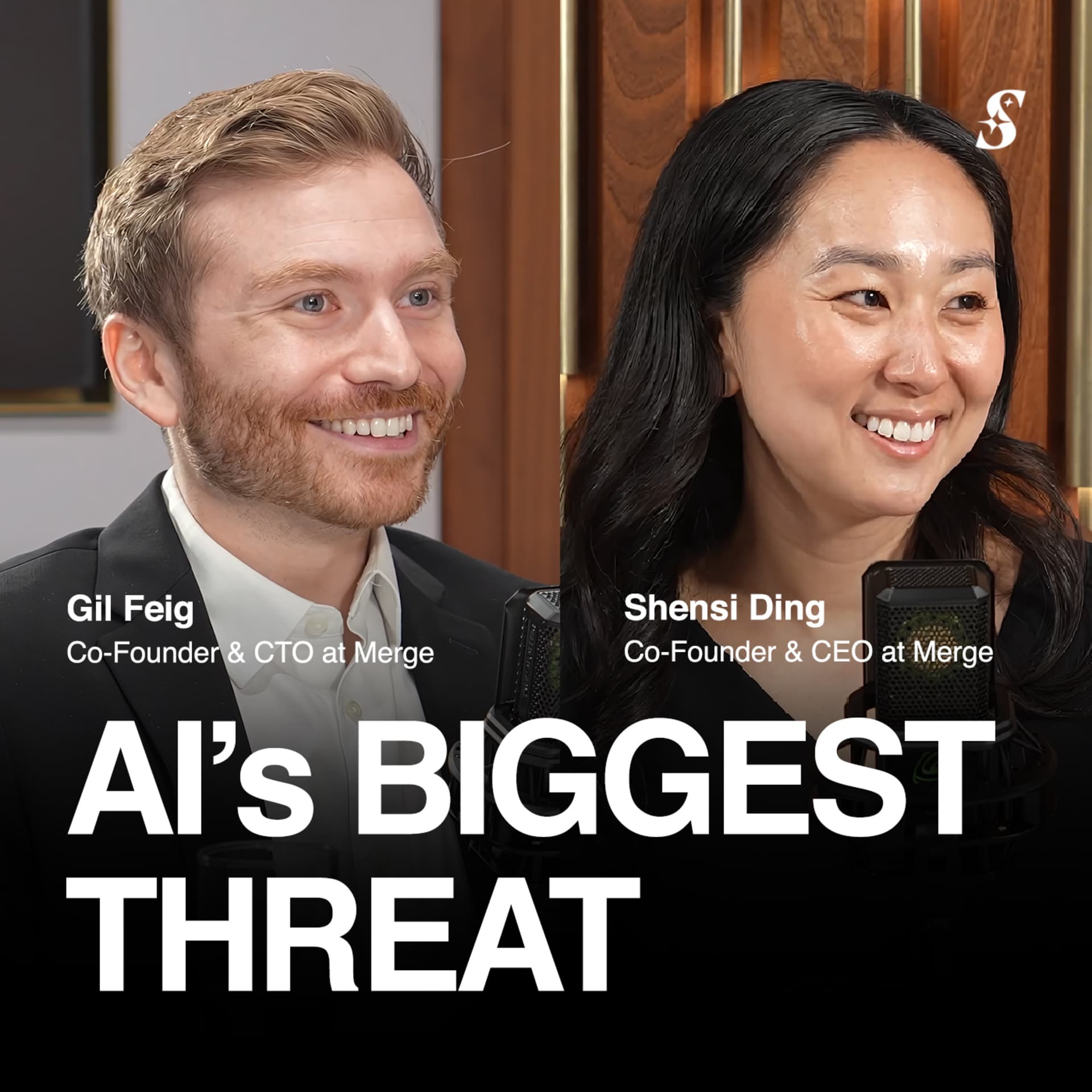
Merge co-founders Shensi Ding (CEO) and Gil Feig (CTO) join Sourcery for a wide-ranging conversation on building AI infrastructure that quietly powers some of the biggest companies in tech — including OpenAI, Perplexity, Netflix, Uber, Mistral, and Dropbox.
They break down Merge's three-product suite (Unified, Agent Handler, and Gateway), the make-or-break month that pushed them to rebuild around AI, and why they now believe "English is your programming language." Gil gets candid on the state of AI security — supply chain attacks, agentic code flooding GitHub, and why the scariest threat is always internal. Shensi shares hard-won hiring philosophy (missionaries vs. mercenaries), her admiration for Benioff and the "beginner's mind," and a hot take on companies over-engineering their own models.
Plus: the SaaSpocalypse, the brutal reality of token-maxxing bills, governing employee AI access, headless Salesforce, and whether today's AI valuations make any sense at all.
Shensi Ding: https://x.com/shensi
Gil Feig: https://x.com/GilFeig
Molly O’Shea: https://x.com/MollySOShea
Sourcery: https://x.com/sourceryy
𝐄𝐏𝐈𝐒𝐎𝐃𝐄 𝐋𝐈𝐍𝐊𝐒
YouTube: https://youtu.be/SjrejHEAdeg
𝐒𝐏𝐎𝐍𝐒𝐎𝐑𝐒
• Brex—The modern finance platform, combining the world’s smartest corporate card with integrated expense management, banking, bill pay, & travel. https://brex.com/sourcery
• Turing—Turing delivers top-tier talent, data, and tools to help AI labs improve model performance—and enables enterprises to turn those models into powerful, production-ready systems. https://turing.com/sourcery
• VCX—VCX is the public ticker for private tech, allowing investors of all sizes to invest in venture capital. View The Portfolio at http://GetVCX.com
• Deel—Deel is the global people platform that helps startups hire, manage, pay, and equip anyone, anywhere. Trusted by more than 35,000 fast-growing companies, Deel is the people platform that just works, so teams can scale without the chaos. Visit: https://www.deel.com/sourcery
• Public–Investing platform Public just launched Generated Assets, which lets you turn any idea into an investable index with AI. With Generated Assets, you can build, backtest, refine, and invest in any thesis with AI. Gone are the days of one-size-fits-all ETFs. https://public.com/sourcery
• Merge—The leading provider of customer-facing integrations and agentic tools for frontier LLMs, Fortune 500 organizations, and B2B SaaS companies. Visit https://merge.dev
Follow Sourcery for the latest updates!
Disclosure
Paid Endorsement. Brokerage services by Open to the Public Investing Inc, member FINRA & SIPC. Advisory services by Public Advisors LLC, SEC-registered adviser. Crypto trading provided by Zero Hash LLC, licensed by the NYSDFS. Generated Assets is an interactive analysis tool by Public Advisors. Output is for informational purposes only and is not an investment recommendation or advice. See disclosures at public.com/disclosures/ga. Matched funds must remain in your account for at least 5 years. Match rate and other terms are subject to change at any time.
𝐓𝐈𝐌𝐄𝐒𝐓𝐀𝐌𝐏𝐒
(00:00) Shensi Ding & Gil Feig, Co-Founders at Merge
(01:04) Three products. One big bet
(03:20) How Merge made the AI pivot
(04:42) The Classic Innovator’s Dilemma
(05:58) Building culture around AI
(07:10) The leverage nobody’s talking about
(08:52) Codex vs Claude Code
(09:15) The scale nobody knew about
(09:47) SaaS, Finance, and the Biggest AI Labs
(10:46) Why AI companies buy differently
(12:04) What AI sales actually looks like
(13:04) The Fastest sales cycles in the market
(14:35) Why is Cybersecurity broken
(15:59) Merge's solution to agent security
(19:16) Mythos, Wiz, and the GitHub Hack
(22:34) 1,000 Bot signups in one hour
(23:23) Real reason companies pay ransom to hackers
(25:43) The State of AI Infrastructure Costs
(26:41) Internal AI Governance is the next big problem


