
In short
Sourcery Podcast Episode Summary
Episode Title
What Travis Kalanick Taught Bradley Tusk, & Why He Closed His VC Fund
Episode Description In this episode, Bradley Tusk shares insights gained from his time working with Travis Kalanick during Uber's formative regulatory challenges. He discusses Kalanick's innovative mindset, the implications of the AI wave on the economy, and Tusk's decision to shut down his venture capital fund in favor of an equity-for-services model.
Key Themes and Discussions
- Lessons from Travis Kalanick
- Innovative Thinking: Tusk describes Kalanick as exceptionally fast and analytical, challenging existing institutions.
- Travis's Law: The concept of turning customers into political advocates for a business, which Uber successfully utilized during regulatory battles.
- The Impact of AI on the Economy
- AI Infrastructure Spending: Tusk discusses the projected $2 trillion investment in AI and questions whether it's driven by genuine market needs or short-term valuation boosts.
- Valuation Discrepancies: There’s a stark difference in how AI companies and non-AI companies are valued today, with AI startups receiving inflated valuations despite limited earnings.
- Venture Capital Fund Economics
- Struggles of Mid-Sized Funds: Tusk highlights the difficulty mid-sized VC funds face in terms of profitability and operational complexity.
- Closing the Fund: Tusk's decision to halt the traditional VC model was influenced by realizing that founders didn’t need capital as much as they needed strategic guidance.
Timestamps of Key Topics
- (00:00) Intro
- (01:25) AI infrastructure spending influenced by market narratives
- (03:55) Capital flow in AI data-center and energy spending
- (16:30) Zero-sum vs. abundance mentality in tech and politics
- (32:00) Influence of Kalanick on Tusk's view of founders
- (37:05) Reason for stopping traditional VC fund raising
- (44:30) Economics of mid-sized funds
- (59:40) Discussion on AI and unemployment risk, advocating for Universal Basic Income (UBI)
- (01:05:50) Major lessons learned from Kalanick
Insights Gained from the Episode
- Founders and Regulation: Tusk argues that understanding regulation is crucial for modern startups, emphasizing its role in shaping long-term strategy.
- Equity-for-Services Model: Tusk’s shift from traditional VC funding to an equity-for-services approach allows him to leverage his expertise more effectively without the pressure of managing LPs.
- Future of Jobs: Tusk raises concerns about potential job losses due to AI and advocates for the implementation of UBI as a solution to maintain economic stability amidst technological advancements.
Conclusion Bradley Tusk's experience with Travis Kalanick has provided him with unique insights into the intersection of technology, politics, and regulatory environments. His decision to close his VC fund and move towards an equity-for-services model illustrates a nuanced understanding of the current economic landscape marked by AI's rapid evolution. The episode delves into the complexities of venture capital, the importance of regulatory knowledge, and the potential socioeconomic impacts of technological innovations.
Written by AI. May contain mistakes. Listen to the episode to check what was said.
Transcript
Automatic transcript. May contain errors.0:00The two smartest people that I've ever worked with closely are Mike Bloomberg and Travis Kalan. bar none. I'm sitting in a Walmart meeting and a friend of mine called and said, hey, there's a guy with a small transportation startup. He's having some regulatory problems. Would you mind talking to him? I become Uber's first political advisor that day. I get really lucky when Travis calls back and says, listen, I can't afford your fee. Would you take equity? And thank God I said, yes. What is the biggest lesson you learned from working with Travis Kalanick? I am an unapologetic Travis enthusiast.
0:31Did he make mistakes? Absolutely not. Travis fans will hear this and be angry about it. I don't care.
0:46Riley Tusk, welcome to Sorcery. Hey Molly, thanks for having me. We have so much to talk about today. I know. So just to tell the audience, we were chatting and then Molly looks at the producer, told me your name again. Lance. Lance, right. And said, we got that right. And he's like, no, you didn't tell me to press record. So we're going to have to do it all over again. We're going to have to do it all over again. Let's talk about that. Let's talk about the substack you're putting out right now. Yeah. So what we were just talking about is I've got a substack about to come out that says that I at least have a suspicion that all of this massive AI infrastructure investment, so it's 1.5 trillion in 2025, projected to be 2 trillion in 2026 is really about the short-term share price and valuation of the big AI companies, the generative companies, or the companies that supply CPUs that's disguised as long-term thinking.
1:39So, you know, investors like two things, and you know this better than I do at this point, but like A would be the fundamentals of a company itself, but B oftentimes even more so is the narrative, right? Tesla should not be worth a fraction of what it's worth today, if not for the narrative and the belief by investors that Elon, and he is a genius, but like that Elon will just figure things out that no one can predict, including Elon right now. And therefore the value is worth it. Right. And then occasionally someone short stock, they look at it for a little while, that's all narrative, right?
2:10I mean, Toyota should be an infinitely more valuable company than Tesla. And yet, yeah, I haven't checked in Mark Kapp in a while, but last I checked, it was like less than a quarter. So oftentimes, if you can sell investors on, hey, we're doing something really brilliant for the long term future, people are like, great, here's my money. And they double down and they triple down. And in reality, it may be that the way that we think AI will happen in the next 10, 20 years is the way that it is today. Right. So right now, what we assume is you need massive amounts of compute. So the chips from NVIDIA and everyone else are incredibly valuable.
2:48You need mass amounts of energy to power that compute. So all the ancillary businesses are valuable. And therefore, you need to produce as much capacity as possible for the future. That might be true, but it might not be true, right? So for example, we know that when DeepSeek came out with their model, it was an inference model, right? That basically said, instead of having to sort of generate everything from scratch every time, we'll say that if A leads to B and B leads to C, we'll assume C is correct and just give you D. Now, is it as accurate? No. But is it possibly 90 % as accurate? Yes. Now, it's Chinese companies.
3:24So for all we know, it's all bullshit, right? It might not be true at all. We don't know. But let's just take the off chance that they're not lying, right? And it's true. At least for the way that I use AI, 90 % is more than good enough, Right. I'm basically using it in lieu of Google these days. And so ultimately, if you said to me, this thing costs$10 and this thing costs a dollar and the thing costs a dollar is 90 percent as good. I'm taking the thing that costs a dollar. If that's true, you probably didn't need the two trillion dollars in infrastructure spending, which means these companies are going to be crippled by debt.
3:59Right. It's fine to take out the debt and everyone to be excited while you're doing so and boost the share price. And by the way, if you are the executives of any of these companies, your net worth is the current share price and whatever you can sell, right? Not what it's going to be in 20 years. If anyone knows to get out, it's probably you. So I do worry a little bit that a lot of the investment that's happening is really about driving the narrative and therefore the valuation, if it's private or the share price, if it's public today, as opposed to what the economy will actually need in a decade or two from now.
4:31Can you break down where that capital is going within the$2 trillion? Yeah. I mean, a lot of it are things like data centers. So a data center ultimately, I don't invest in them because there's no real regulatory issue. We'll get into it. I mean, a little bit of permitting and zoning, but not that much. But I see deals, right? Occasionally, I'll take a look at them. Some of it is physical capacity, servers, land. And you can't really put a giant data center in the middle of Manhattan because it would cost 10 times as much. So one is where are you going to put it? So where Lance lives in New Jersey, it's a better location for a data center than where I live in Soho.
5:11That's one. Two would be actual chips from NVIDIA or whoever the maker might be, Intel, whoever it is, because you need very, very advanced GPUs, processing units, in order to be able to generate that level of AGI. and therefore those are really, really expensive. And because the demand is so high, basic economics, if there's massive demand for GPUs, guess what costs more money? GPUs. And especially if there are trade restrictions around it, that further shapes the market, right? So that's, and then energy, right? So it's interesting, I was talking, I won't name them, but I was talking to a guy who went for governor of Vermont the other day and he was, you know, basically when you are a political donor like me, They pretend to ask you for sort of strategy and policy ideas before they ask you for the money.
5:59And so we were doing that. Given my background, I have a little bit to add on the campaign side, I guess. And I was saying to him, because Vermont is a state that has great hydroelectric power, if I were you, I would really build a campaign platform around building data centers in Vermont, generate economic development, generate tax revenue, generate jobs. and the play is, hey, we can provide this energy for an incredibly low cost and it's clean energy, which voters in Vermont care about, right? Some states that wouldn't matter, but it does there. And I said, I don't even know if it's absolutely right or not, but it's no more wrong than the narrative right now driving the market.
6:39And if investors are buying it with their money, my guess is it'll more than stand up to some political reporter, take a quick look at it. We'll see if he does it or not. We'll see if he runs or not. But nonetheless, Nevertheless, you know, energy is obviously a really big component. And in fact, if there's one larger societal externality that's positive around this, even if it turns out the money is a little bit of a waste and stop me when this gets too wonky, but is we really do need to return to nuclear energy in this country. And if microgrid nuclear becomes a thing because of the need for energy to power the compute, that's a worthwhile outcome.
7:23It's interesting. You know, I'm a lot older than you. And yet I'm still young enough that Three Mile Island happened before my level of consciousness. Right. And what I have noticed, try this out going forward as an experiment. Okay. If you talk to anyone who's probably, so I'm 52, right? So anyone who's my age or younger, yeah, we should have nuclear power. Absolutely. It is plentiful. It's expensive to generate. But then once you do, it's a lot cheaper and it's totally environmentally clean. It makes total sense. Yes, there's some risk. But the tradeoff is we're destroying the climate right now, which has all kinds of risk, right?
8:00Massive hurricanes and earthquakes and tornadoes. So, like, there's risk either way. um anyone for whom they were kind of aware enough maybe i don't know 10 or 12 and older when three mile island happened totally different perspective for them they're like no no no that's crazy way too risky we got it we can't do nuclear and so i think that as that group ages out of power um there will be a lot more acceptance of nuclear again because i'm pretty old at this point and I'm still on the young side for this particular issue. So one good thing that might come out of all this, even if it turns out that a lot of the spend ends up being unnecessary, and therefore, by the way, a loss for the shareholders of those companies eventually, right, is maybe we will get a much better clean energy system out of it.
8:50And for whatever reason, Trump, who is wildly opposed to wind and solar for reasons that still don't make that much sense to me, doesn't seem to have a problem in the clear. There's like many different points in there that we can unpack. It's really interesting seeing how many data center deals are coming through. I see endless because it's a new gold rush. As a gold rush, it's causing all these different picks and shovels. Infrastructure is definitely a part of that. We have like training, we have nuclear, we've got energy, we've got the power bottlenecks. And then we also have the data center bottlenecks.
9:21And then we also don't know like what is actually going to be the moonshot unlock here. Like we don't, because there are lots of things going on under the surface that we're just we're betting on incrementalism for most of these valuations we're betting on incrementalism with these companies and how they're going to compound we're not taking into effect like what what's going to be the moonshot unlock what if deep seek was the moonshot yeah right what if the inference model was the thing that's like oh we only need 10 of the energy in the compute and it turns out that this other 90 % is basically wasteful.
9:54I mean, I don't know. And in a weird way for the American economy, I guess I hope that DeepSeek is wrong. But putting that aside, yeah, we don't know. And by the way, the most ironic thing is the underlying thing we're talking about here is AI. And if anything can figure out the moonshot, it's AI, right? So that's the most ironic part of all of it. Or for example, if you start taking this as like third and fourth kind of gradient thinking, like, okay so maybe most of the ai infrastructure spent turns out to be wasteful but maybe the upside is that nuclear happens as a result yeah and maybe because of that um we have so much ai processing power that then the ai exists to figure out decarbonization overall right like it seems to me like i'm you know i'll recycle something today i'm sure but as someone who worked in new york city government for a long time it all goes in the same way it does it does I don't know why people do this.
10:51I do it just because it's like literally two bins. I put it in the right one. My sister gets fined at her apartment. I'm like, I don't care. And I'm not washing it because it's all going to the same place. But so to me, that's not going to solve climate change. If we solve climate change, if it's because we eventually figure out how to effectively remove carbon from the atmosphere and things like that, whether it's sucking it out or trees that can absorb more CO2 or whatever it might be. and that probably is a challenge for AI because there are carbon capture plants and startups right now. You've probably even talked to some of them and they're really interesting, but it's like very nascent, right?
11:29It's still a pretty big risk if you were an investor because it's an incredible amount of CapEx for something that still may or may not work. But if we do solve climate change, I have this general view and now I'm probably getting way off. You'll have to add a landscape to edit this out because it's going way off course. But I like to look at humanity sometimes as we are in a race to save ourselves before we destroy ourselves. Because we are doing both things simultaneously all the time. So think about climate change. When they invented the car, when they invented hairspray, whatever it is, right?
12:05Things that ended up in one way or another being bad for the environment. No one said, my goal is to destroy the ozone layer. What I really want to do is make the earth uninhabitable in 100 years. That's why I'm inventing this product. It was, I have something that has value to consumers, right? That has value to society. The car fundamentally transformed the economy, right? You know, hairspray, aerosol as a product is before my time, but obviously became at time a more convenient, cost-effective way for people to be able to do their hair. Fine, right? There's nothing really wrong with that. I mean, if you think about every startup founder that I talk to about investing or you talk to, you know, in an interview, it's fundamentally, they believe they have a product or service that has some utility because otherwise they wouldn't be doing it, right?
12:53So in all these cases, and then it turns out that in these good things that happen like economic transformation, because now we have a car instead of a horse and buggy, there's also fossil fuels that are being burned and polluted, which then leads to other things. So then we have new technology ultimately, you know, hopefully through AI to like, okay, now we're going to find a way to take the fuel and take the toxins that came from the fuel out of the atmosphere, right? So, or vaccines, right? So like putting aside the whole crazy anti-vaxxer thing right now, like vaccines were a scientific development to figure out how to take diseases that occurred typically in nature and protect people from them, right?
13:38A lot of that same learning leads to advancement of bioweapons, right? Which could be incredibly dangerous and wipe us all out. And then at the same time, they're working on more vaccines to be able to contradict the potential risk of bioweapons, right? Or even nuclear. You know, when Truman dropped the bombs on Nagasaki and Hiroshima, you can debate today whether or not it was a good idea. But, like, there was a clear purpose to it, right? Which was we were at war. We had been at war at that point for five or six years. 38th or now, wherever we got in. anyway so and it needed to end right and that was the way to end the war like I don't know that if I were president I would have reached any different conclusion than Truman did right however it's also the thing that is the easiest way for us to sort of destroy humanity and arguably the greatest achievement of human history is that no one in the last 80 years has used nuclear weapons even even though it's proliferated now to, I think, nine countries plus whatever Iran does or doesn't have.
14:47So, and then the question becomes, in that case, there might not be a technology that can counteract nuclear, but can we advance enough as human beings to remove them as a threat, right? So it's just, it's always like by definition, because human beings are so unevolved, right? We're only like, at most, we've been a species in this form for a couple of hundred thousand years. And most of the stuff that I read is more like 60 ,000 years. I mean, the universe is 14.8 billion years old. The Earth is something like four and a half billion years old. So, you know, like the average human lifetime, even with a hundred years, is like 0.0.
15:30And you have like 10 zeros before you even get to a one of the entirety of the universe. so like we're so new and so unevolved that we're like this fascinating like in some ways like you could almost see humanity as like the ultimate shakespearean play that the gods created to be like let's entertain ourselves let's create these beings that are in some ways amazing in some ways horrible in some ways brilliant in some ways moronic right and let's just throw it all fucking together and see what happens. It's reality TV, right? But like in some ways, you know, imagine it from a macro standpoint, you know, and we're so perfectly imperfect that we're just in this constant race to sort of both advance ourselves and save ourselves without destroying ourselves.
16:20And then that gets to, and this is anything, a far more philosophical podcast than you meant to have. I love it. Arguably, I would say the central question of our time is zero sum versus abundance. There are really two fundamental ways to view the world. One would be the everyone's for themselves. It's everyone versus everyone. You just have to get as much as you can in the time that you have without the cost to you being so severe that it outweighs the benefit, which in some cases means people literally just figure out ways to not get indicted for things or whatever it is. And whoever has the most toys wins, right?
16:58And I think Trump in many ways is the ultimate manifestation of a zero sum mentality, right? You know, he views success in life as who has the most money, who has the most power, who has the most influence, who has the most beautiful woman, who has the most luxurious airplane, the most gold plating, literally whatever it is. He doesn't ever seem particularly happy to me, even though he accumulates more of that at this point combined maybe than anyone, right? And the other way would be sort of an abundance mentality, which is we are happier when we are doing things that give us some sense of purpose and meaning.
17:35So I've studied like a ton of happiness science and behavioral economics. Like I studied behavioral economics when I was in school and then in my 40s, started studying happiness science in part because my own life wasn't that happy at the time. And as I was realizing I needed to get a divorce, at the same time, I was sort of trying to really understand what is it that makes human beings happy. And there's really just two things, right? It's relationships where there are people in your life who love and support you unconditionally and you love and support them unconditionally. Doesn't mean you can't have disagreements with them or disapprove of something, but fundamentally that's there.
18:10And the things that give you meaning and purpose, right? So for example, you've been to my bookstore. I own a bookstore on the Lower East Side of Manhattan. It is a bookstore it is a podcast studio that anyone in new york can use or anyone wherever it can use for free um an event space and a cafe it loses so much money it is the worst business in all of new york um however uh the way i look at it is i look at how much money do i lose on the bookstore and it's it's a funny other day i came up at lunch with some friends and they like literally gasped What is it? I mean, I lose around a million bucks a year.
18:45Oh my gosh. Yeah, all in. But so here's what I did. I don't fly private. Yesterday, I had a disaster trip over San Francisco and probably wish that I had. But like most of the time, it's fine, right? 98 % of the time, it's fine. And I looked at, okay, let's say that over the course of a year, I travel a lot, right? Domestically, if I just flew private instead of flying commercial, what would I spend? And it ended up being about the same amount of money that I lose on the bookstore. So I was like, okay, this is a great A-B test. Forget about whatever the bookstore does for anybody else. And, you know, sure, create some jobs, people put their podcast, put all that aside, right?
19:24Just fundamentally for me, for Bradley, which of these two things will make me happier? Because it's the ultimate sort of zero stone versus abundance sort of A-B test, right? So if I spent that money on flying private, what do I get? A little more convenience, can avoid the TSA line, which usually with clear and pre-check is like a minute, right? But sometimes maybe it's 10. And I would find ways to brag to people sort of like, you know, in a nuanced way that I flew private, right? And then they'd probably think I'm a douchebag anyway, right? But nonetheless, that's sort of the upside of flying private.
19:59And upside of the bookstore. I record my podcast there twice a week. I should plug it. It's called Firewall. If you like this, you'll like that. If you don't like this, you definitely want that. We have events there all the time. I take meetings there on Fridays usually. But most of all, do you know what I like about it? People pat me on the head constantly and tell me how wonderful I am because I own a money-losing indie bookstore in New York City. And people like bookstores, and I get a lot of validation and affirmation. So the meaning and purpose I got from the bookstore, not because it does anything for anyone else, but simply because if you just said, which of these two things will make me feel better?
20:38People admiring me and praising me because I flew private or people admiring me and praising me because I own a money-losing bookstore. It is like the ROI is significantly greater on the bookstore, right? Just from a pure selfish standpoint. So I would argue that for happiness generation, the two things that are proven to be the most effective are cultivating and really investing in relationships with people who you really care about and really care about you. So like, for example, I keep a running list of the 50 people at any given moment who I kind of matter to me the most. And it involves a little bit over time.
21:12And then usually once a week on the weekend, I'll just run through it. I'm like, okay, I haven't talked to so-and-so in a week or two weeks or three weeks or whatever it is. And I'll text or I'll call. And you know what no one has ever done? Text it back saying, why are you bothering me? It's always like, hey, great to hear from you, right? And then you have a pleasant exchange that might lead to some sort of plan or it might just be a nice check-in or whatever it is. but either way. And then I try to really look at almost, and look, I am lucky to be a point in life where I have enough money to do what I want to do.
21:41But I also choose not to do certain. I don't have a big house in the Hamptons, right? I don't have a plane or boat or anything like that because I invested in stuff that I care about instead. And I truly believe that I have figured out kind of the formula in many ways to happiness because I effectively just prioritize relationships and purpose ahead of everything else. I still make money. I still need to make money to do the things that I care about and to further them. But, and I also just like making money. I like being a business. But nonetheless, I truly believe that if you can adopt that mentality, your odds of long-term sustained happiness are significantly greater.
22:19And I think whether or not humanity realizes that, especially in the first world where you don't have to worry about, you know, some people do, but the vast majority of Americans don't have to worry about being homeless or don't have to worry about not having any access to healthcare of any kind, right? At least there's an emergency room or something. Assuming that you have the very basics covered, at that point, it becomes really a question of maximizing happiness, becomes a math question. And that ultimately gets to zero sum versus abundance. And I really think that it is both on an individual level, the most important question that we can answer for ourselves and on a societal level, if we want to sort of bring ourselves to extinction in the next 50 or 100 years, zero-sump's a great way to do that.
23:03If we want to see our children's children's children's children live and thrive, then it's got to be an abundance approach. And like ultimately to me, like that's what life comes down to. Sorcery is brought to you by Brex, the financial stack trusted by more than 30 ,000 companies, including one in three venture-backed startups in the U.S. Nearly 40 % of startups fail because they run out of cash. Rex is literally built to help founders avoid that. Unlike traditional banks that let your money sit idle, chipping away at it with fees, Rex is designed to help you spend smarter and move faster. Their all-in-one solution combines checking, treasury, and FDIC protection into one powerful account.
23:44You can send and receive money globally at lightning speeds, get 20 times the standard FDIC coverage through their partner banks, and even high yield from day one. With same day and even same hour liquidity, access your funds anytime. Companies like Scale AI, DoorDash, Service Titan, HIMS, Anthropic, Flexport, Robinhood, and Plaid trust and use Brex. Start today at brex.com slash sorcery. That's B-R-E-X dot com slash sorcery. In today's high-speed business world, staying ahead means using the smartest tools possible, including the powerful capabilities of artificial intelligence. Meet Turing Intelligence.
24:24Turing builds customizable AI systems designed to solve your mission-critical challenges, no matter your industry. From expert guidance to tailored projects, Turing helps top companies realize AI that's more capable, more adaptable, and more effective. With Turing, discover how AI can accelerate your business growth. To learn more, visit Turing.com slash Sorcery, spelt S-O-U-R-C-E-R-Y. That's Turing.com slash Sorcery. Sorcery is proudly sponsored by Carta. Carta is transforming the private marketplace, connecting founders, investors, and limited partners through software purpose-built for private capital.
25:02trusted by more than 65 ,000 companies in over 160 countries. Carta's platform of software and services lays the groundwork so you can build, invest, and scale with confidence. Carta's fund administration platform supports over 9 ,000 funds and SPVs, representing nearly$185 billion in assets under management, with tools designed to enhance the strategic impact of fund CFOs. For more information, visit carta.com slash sorcery. That's C-A-R-T-A dot com slash S-O-U-R-C-E-R-Y. Wow. Yeah, it's really interesting. I'm thinking about a couple of the past conversations I've had and how this relates to job and purpose and meaning.
25:45And there are some people I interviewed, Naveen Shada from Mayfield, and he says, oh, well, with AI, we'll be able to do as much as we want. We'll be able to work from Hawaii. We can have five jobs because it'll all be running and we'll have just more time to ourselves. same with jonathan from turing he says the same thing like why can't i run like 10 companies like elon like i could do multiple things if i wanted to or maybe not but it does present an opportunity because i i mean i've seen in my day-to-day like i now have like so many projects all the time because i can get so much more done but for some people like there are other constraints much of that though let me just challenge it for a second right which is yes but you choosing to do that is it ultimately your ability to do it successfully, which you do?
Read the full transcript
26:31Is it the product of, oh, here's this technology that before just wasn't available to me and therefore it made impossible, or you make choices, right? And the choices you make, which by the way, include all kinds of sacrifices, right? You know, we were talking before the podcast about like, you live in LA, I hope you're secure or anything like that. And like, it's a pain in the ass street because you're working in New York and San Francisco, right? But like, at the end of the day, we make choices and the choices facilitate what you can then do, right? Like for example, I spent a ton of money on my team because everything that I don't want to do and don't have to do, I don't do.
27:09Yeah. And that frees me up to do all the things that I do want to do. And that's why I have like multiple companies and a foundation and all kinds of other stuff, because in part, I pay other people to do a lot of things for me. What does that mean? I have less money at the end of the day, right but i made that choice so do you buy the notion that it's technology or is it really fundamentally just about your choices no i think it's absolutely choices like i choose to work really hard because i like working really hard and i also have this like moment in time where there's so much momentum that i am taking opportunity right i do know that i'm making so many sacrifices i'm making sacrifices to friends i'm constantly letting them down because i have to work i'm making sacrifices to my family i'm not going to certain events like they're very close.
27:53They all live in Connecticut. I don't do that much. I have sacrifices for my own personal life, like different decisions, not to go on dates. So just cancel things because I just want to work. And like, I'm constantly traveling between cities. I have a selfish reason of like having my apartment in LA because between all this chaos, I like to go back to there and like have a weekend. And then I like to go run around and like do all my interviews. But I know that's a choice. Like I know for a fact, there are some people that do have access to this technology and they don't care. Like they just they just use it for the day to day and then they, you know, have their leisurely activities.
28:25But unfortunately, I'm competitive and I want to succeed. So I'm like, how can I maximize my opportunities right now in this window? Yeah. You at least I will say how old are you? You have vastly more self-awareness than I had. And so I the same in some ways still do have the same mentality that you have right now. but I think where you're probably way advanced than me, and that probably gender is part of that too, is not only do I think what you thought, but I thought the people who didn't make the choice I was making, there was something wrong with them. Like they were leading a lesser life if they chose to live a more subdued, you know, work eight hours a day.
29:06It's just part of your life and spend a lot more time doing leisure activities. And then I've come to realize that like, you're you for reasons good and bad. Adam Schertz, some of it is, you know, genetic and some of it's trauma or whatever else it has shaped you. Just like the same thing for me. And therefore, that's how we need to act. But ultimately, if someone else can have fulfillment and contentment with half of the effort, because that's better for them, that's fine. But it took me much later in life to have the wisdom to understand that. Whereas everything you just said was basically almost an acknowledgement of like, hey, this is what I choose.
29:45It's right for me, but there's no judgment on someone who chooses something else. So you should feel pretty good because it definitely took me like several decades to get to where you are. Sometimes I feel good. Sometimes I need to go to the spa and get a massage. Sure. This will be a shift into investing because I think this does package itself well into how you chose to lead Tusk Ventures and how you're now going into services for equity. So can you talk about that shift? Yeah, sure. Sure. So I, you know, unlike most people you talk to, like I didn't start off in business or technology. Right.
30:21I worked in politics and government for years and years and years. You know, I made government salaries or campaign salaries for years and years. And then I kind of fell into tech totally by accident. Right. So my last like real job was in 2009. I was Mike Bloomberg's campaign manager and ran for mayor of New York City. we won. And I decided that I thought there was sort of in the kind of political consulting business, a hole in the model where typically people did one of two things. Either they ran comprehensive campaigns for companies or institutions or candidates, whoever it was, but in one place, or they would work nationally, but they would offer one skill set.
31:04They were a pollster. They made ads, whatever it was. And my view was that the world had changed enough that the way to get things done in government and politics was no longer like a guy knows a guy and you know the right guy. It's really multifaceted, right? So yes, it's the inside game of lobbying, but it is also earned media and paid media and social media and grassroots and all these other tools. And I felt like the amalgamation experiences I had had, both in terms of the things I've done and the different places that I've lived and worked, said to me, I think someone could do everything everywhere.
31:38And that was sort of the genesis of my first company, Test Strategies, which I don't run it anymore, but still exists as a consulting firm. And so about a year into that, I'm sitting in a Walmart meeting and a friend of mine called and said, hey, there's a guy with a small transportation startup. He's having some regulatory problems. Would you mind talking to him? I become Uber's first political advisor that day. I get really lucky when Travis calls back and says, listen, I can't afford your fee. Would you take equity? And thank God I said yes. And that became very lucrative for a lot of other stuff that I do today.
32:13But the experience that I had was effectively running campaigns all over the US to legalize ride sharing. And what we figured out that was really both transformative for Uber, but really informed a lot of the investing I've done ever since is in certain cases, you can turn your customers into political advocates and you can use the very technology that they, you engage them on for business politically. So for Uber, the taxi industry was a very, very big, it's hard for like someone your age now to sort of imagine this, but like was this incredibly powerful industry. Right. And we were a tiny, tiny, you know, seed series, He's a startup, right?
32:57And Travis, you know, is a genius and has transformed society, but he didn't have this great track record. He had a couple of failed startups before that. It wasn't like someone had like, it wasn't Elon Musk doing his next company, right? And, but the experience of Taxi was so bad for so many people and Travis figured out a way to do it that was so fundamentally better that he had this belief and he was right that But ultimately, people would fight to keep that opportunity. And as taxi would then use their lobbyists and their political muscle to try to put us out of business, which they tried to do in every single market in America.
33:37We saved ourselves by going to our customers and saying, look, if you like this Uber thing, we need you to let people know. And we built functionality directly into the app that let people tell their city councilman, their state senator, whoever the relevant person was, leave this thing alone. I like it. And so many people did that ultimately became more powerful than the donations and lobbies the taxi had. And we won. And so as that's all emerging, I'm like, okay, this equity thing, I remember literally the first time, I took the equity mainly just because I liked Travis and thought it was interesting and I kind of wanted to work on it.
34:12That was it. I literally didn't even know what the phrase equity meant from that, from a business context when I said yes. And then I remember one day, it was nighttime. time we were on the phone about some ish regulatory issue somewhere and he says like how many shares do you have like i didn't even know and then like he helped me figure out how many i had and he said oh we just closed around uh your shares worth 12 million dollars i was fucking i well you know sometimes you remember like literally exactly where you were and what you like i remember where i was in my apartment what i was looking at because i was floored because i'm a first generation american i didn't grow up with that much money i worked in government for years i mean after law school, I turned down all these jobs at law firms offering 150 grand or whatever it was at the time to make$28 ,000 at the Parks Department of New York City.
34:59Right. So like, to me, money wasn't like a thing. And it's not that I didn't want it. It just didn't, I didn't really understand like how much money you needed. It never had literally occurred to me that I would ever have $12 million. Like it just had never once crossed my mind. I remember me so fucking blown away by that I was like, oh my God. So this equity for services thing is pretty good. So I did it again with Clear to get them to airports and it worked out really well, not anywhere near Uber well, but it was really good. And then I made, I wouldn't call it a mistake because we made a lot of money and it was a good learning experience, but I made the sort of view of like, oh, well, the really rich people have funds.
35:40So I should have a fund. And so I went out and raised my first venture fund, Started in 2015. We started making our first investments in late 2016. FanDuel was our first investment. My thesis was, look, there's no fund out there that is regulatory first. So many startups have regulatory issues, and Uber in some ways was the perfect example of that. I had gotten credit for being the person that did it. That I can find more of these, and I can invest in them, and they'll want me to invest because they're going to want my help from a political standpoint. and we'll make a lot of money. And so we did.
36:18So we did three funds. Fund one was so hard to do, but we raised it finally. It was$35 million, but it's sitting at like about a 5X right now. We'll see where we're in circles. We'll see where circle exits in a few weeks when the lockup's done, but really well. And fund two was 70 million. Fund three was 140.
36:42And the funds I'll have to start closing the first round, circling the sub docs for fund four. It kind of hit me that like, it was the wrong business model because what I realized was founders who took our investment did so, not because they needed my money, but because they wanted our help politically. And ultimately I started talking to them like, let's say I just asked you what I did with Travis. Just, hey, just give me equity. I don't, but I'm not gonna give you a check. Like, yeah, we don't care. Fine, like we didn't need your money. Like any really great startup to get into typically doesn't need your money in the first place, right?
37:16Anyone who desperately needs your money, there might be a reason why. I mean, occasionally there's a diamond in the rough that no one believed in. But generally speaking, that's not the case. And I was like, why am I, A, giving 80 % of my profits back to my LPs, right? I don't actually need them. B, I have a great partner named Jordan Noff who's a brilliant, brilliant investor. but he's a traditional venture capitalist and we split the equity and the carry and everything else, which was reasonable. But I didn't really need all that stuff. I didn't need to worry about portfolio construction. I didn't need to worry about fund administration.
37:50I didn't need to worry about compliance. I didn't need to deal with taking board seats. And so I pulled the plug. I said, we're not going to raise fund four, and I'm going to do a hybrid of the first two models. So I announced this back in February, I think, of 25. And it's equity for services. So what I did with Uber and with Clear, but now also pro rata. And then as our investor rights come up, I'll either invest off my own balance sheet. So there are companies since that I've said, you know what? I love this company. And it's an amount of money that I can afford to deploy out of my own capital.
38:25And I'll do so. Or I have all these investors that made a lot of money with us. and I'll just go to them and say, hey, here's a company that I really like. The round is bigger than I can take myself. Do you want a partner and do SPVs? And for me, from a financial kind of time standpoint, it's better because one, I own 100 % of the risk, but I also want 100 % of the upside. Now I do every year now because I have a team of people who work at the company to both source deals and then more importantly, help all of our portfolio companies solve their regulatory problems. I have to pay those people every two weeks, whether it's a liquidity event or not, right?
39:02So it costs me a couple million dollars a year on the front end. But I then also own all. I mean, I gave the employees about 20, 25 % of it, but I own all of the rest. And that's a lot greater ultimately than the carry that I had at my fund in terms of upside leverage. And A, B, I don't have to deal with fundraising anymore. It's a pain in the ass, right? It's a huge pain in the ass. And the reality is I'm not good at it. And a lot of the things that have allowed me to succeed professionally are the same things that were hindrances for me for fundraising in that like, I'm a misfit, right? Like I don't fit in well.
39:44I wasn't popular when I was a kid. I, you know, like I'm not comfortable like in big social settings. Like I like my friends and I like to work, but like, I don't go to like, you probably have to go to all these like networking things. Like I don't go to fucking any of that. Right. I mean, even like conferences, I show up, someone meets me, they put me in the green room. I have a cup of coffee. They mic me. I go speak. I take a few pictures with people and then I'm out at the side door. Right. Like I don't want to socialize. Like even like the other day I was in San Francisco and did an event for tech week.
40:19I was very happy to do the event. The 30 people that came out to me afterwards and I had to like hear every one of their pitches and everything. I was like, oh my God, like there are people who feed off of that. That's not me. Right. So as a result, I was not a good institutional fundraiser because I don't play golf and I don't like hang out in a country club or any of that kind of stuff. And like, yeah, I go to lots of Mets and Knicks games, but I don't take clients. I take my friends or my kids. And so, and also what it turns out that institutional investors want to hear. They think they want a different, they say they want, they think they want a differentiated strategy.
40:57They don't. What they want is, this is exactly what you already know and are comfortable with, with this tiny twist that could deliver some alpha, but at the same time isn't too risky, right? And like, it took me years to even understand that. And then even when I knew how to say the right things, like it wasn't genuine, right? And so I think people can feel that. So I don't have to fundraise anymore. I don't have to manage LP relationships anymore. I hate sitting on boards because I don't add any value. I am only good at one thing, solving your regulatory problems, right? Or creating regulatory opportunity, arbitrage.
41:33And I'm going to do that anyway because I'm an investor in the company. Me sitting on the board and hearing about the CAC or hearing about the burn or the next race, like I don't fucking care. And I don't add any value to that conversation, right? So, but when we were investors, we're taking lead positions. We took board seats, right? So I had to sit on boards. Like I don't have a couple that I'm left on, but other than that, I don't do that anymore. Portfolio construction, all that shit. Like I don't have any of that anymore. And I own all the economic upsides. You put all that together. So for me, this is a much better model.
42:07And I would say for the people listening to this, look, most people in order to gain access to highly disruptive, highly promising startups have to write a check to get equity because that's how the model works. But if you have a particular skill set, so there are lawyers that can do this, there are marketing people that could do this, you could do this with media, right? Where you're like, hey, I have this thing you really need. I believe in you and I'm going to bet on you, right? I'm not asking you for cash. I'm just betting on the upside that you're going to succeed. Give me equity. You can make that sale.
42:39And if you can make that sale, it is a much better model. Does that answer your question? That does. Okay. Did I just change your worldview and what your career is going to go? No, I mean, I've been getting some advisory shares from people. They offer it to me, which is amazing. Were you ever thinking of raising a fund? Similar to you, like I know what it takes to raise a fund. I've worked at a couple emerging managers, emerging partners and funds. I don't like that. That is like adding another job on top of the job and it clouds your judgment and it makes you orient the practice and everything that you probably find is like your superpowers and what you enjoy out of investing.
43:16And it like, you have to like come in with the mindset of knowing that it is like a multi-dimensional practice and that like, that is just one component of it, but it is a very large component. And you always have to be fundraising. You always have to be like networking with LPs when you're on the road meeting founders, because it's like a cycle that just continues. So like in the beginning, like there are so many people that have reached out to me about starting a fund or like having me as like a co-GP, like something like that. And I just like, I'm focused on this. Like I need the power law for this to win.
43:48And then maybe other stuff will come across. But like it is, it would be a huge distraction. And even then, if you get to that point, I would still say having now done both the advisory share model. Now, ideally you get to a place like where I'm in, where I can then either have the capital or raise the capital to sort of continue on. It's just much better. I don't even really think it's a... Now, here's where that's not true. I'm, for the same reason, not a great fundraiser. My biggest fund was 140 and fund four would have been roughly the same size. If you can raise billions and billions and billions of dollars and effectively your business model is your management fees and not the carry.
44:31And a lot of people raise mega funds. Their superpower isn't investing. It's raising institutional capital, right? If that's your superpower, then yes, then that's the right approach. Because if you have$10 billion under management, you're getting$150 to$250 million a year in management fees, and your only business doesn't cost nearly that much to run, so you're pocketing the rest. Like, sure, that's great for as long as you can keep raising the money. But if you're not in that position, it seems to me that if you have the opportunity to do equity for services, it is just unquestionably a far better approach.
45:08Yeah. It's interesting. Carta had just put out their recent VC fund performance report. And so you're seeing this in the data of the VC market itself. There is a huge bifurcation in this barbell effect that Marc Andreessen talks about too. There's always going to be the small emerging class of managers. It's healthy. It's doing well. There's this huge gap in the middle of medium medium sized managers. And then like the large, the large funds just keep compounding because they've got the superpower law dynamics within them. Totally. Right. Yeah. And that's right. So I think the question is, if you're an emerging manager, and let's say you don't have the thing that you or I could do where you could just get the equity elsewise, if you can run your fund, it's a sub 50.
45:55My advice is to do that. Right. Because the challenge is like when we went to one from 35 to 140. The upside was we had more management fees. It made life easier. It was a little less of a scramble, right? But at the same time, we still ended up basically spending all the management fees on the operations of the fund. It wasn't like we were taking home lots of cash at the end of the day, but now the hurdle is 140. So for fund one, we won the money so fast because the hurdle was 35 and some of that was like SPVs. So the actual hurdle was like 22 or something. And we got there quickly and we were in carry and then we were in super, you know, we got like a trigger to get 25%, like all of that really quickly.
46:38Whereas with fund three, the investors are based on just me looking at the fund. If the investors are going to make money, like it's going to work out for them, but I don't know how much carry I'm going to make. And I also didn't make that much of the management fees. And so 140 is like the worst possible size, right? If you can do sub 50, get a couple of great hits and really ride those great. If you could do billions of dollars and make a ton of money in management fees, great. But that in-between number, like at least for me, it didn't make sense. Yeah. It doesn't make sense. It's interesting.
47:10Cause I don't think like many people think about VC and it's like a very sexy, it's attractive industry, but they don't understand the actual dynamics of structuring it out that you're actually probably not going to take in that much money. And most managers are poor for a very long time. Yeah. And even like, it's funny, there's this sort of view of like, well, if you're early stage, as long as you have a couple of home runs, you're in great shape. So that's true if it's a$35 million fund. But my second fund is$70 million. It's sitting at a three and a half X right now, but has no DPI, a couple of minor secondary things, but no real DPI yet.
47:49Again, the investors are going to do really well. I don't know that we're going to do that well on it, right? Because you got to return the 70 and the management fees and then we'll make money. But the truth is you probably need, like we have one absolute grand slam in that fund, right? That we led the series A, like a 30, which is a mental health startup that does kind of the back office. And I think we led the A at 32 and a half and, you know, valuation now it's at least 50X, right?
48:20But everything else is like, there's a couple of probably five to 10Xs and then a bunch of oneXs or zeros. It will work out well for the LPs. When I kind of look at over a 10 year period between the management fees from that and the carry, how much I'm going to make, like, again, not a great use of my time. Like I still own my consulting firm. I don't work there anymore, but I still own it. And like, I look at the profits that that generates and that takes me a couple of hours a week of management and maybe some pitching. And then in comparison to that, like a lot of the venture math isn't there at all.
48:55Yeah, the math isn't mathing. Yes, exactly. So there's that component of the macro of the venture capital world right now. And then there's also the AI component, which we talked about a little bit before. But before we started recording, We were talking about valuations and how that's impacting whether you're an AI company or a non-AI company. There's also data in Carta that series A companies get a 30 % premium on them compared to if they're AI versus non-AI. And I think it's probably more than that because if you reduce it down to good companies, the delta is going to be much, much greater.
49:37Yeah, for sure. I mean, look, we see this all the time, which is there is a mass. So when I started investing capital, so that's 2016, we were in this sort of a golden era venture where all that mattered was growth, right? No one's like, oh, we'll figure out the business model later. We'll worry about profitability later. And that worked for a while. Like we had some, you know, FanDuel and Coinbase, some great successes out of that. Some of them became really profitable companies. Some did not. But fundamentally, it was ultimately bad economics. It was a rational exuberance where everything was just sort of based on this incredible enthusiasm about the future.
50:19And by the way, at least with AI, there's like this concept of some sort of breakthrough that we can't totally understand. Back then, there wasn't even really that, right? A lot of the tech was like a marketplace. It's not that complicated, right? Like you, me, and Lance could build a marketplace this afternoon if we really wanted to, right? So, and then the bottom fell out. in like 21, right? And then everyone's like, oh, right. This is a business. We need to worry about unit economics. We need to worry about EBITDA. We need to worry about CAC and like all these things. Like, okay, fine. Makes sense.
50:52Now we're in a world where we're living in both realities at the same time. So when it's a non-AI company, the post kind of drop-off mentality still typically applies. You really are looking at like the fundamentals of the business itself and ultimately will PB greater than L and will PB so much greater than L that this is going to become a really valuable company. When it comes to AI, we're back to this like, oh, would the law just kind of work out? When I was telling you about a company, I won't name the company or the firm that won the deal, but it was a deep fake prevention space. They had about a million dollars in ARR and I offered three and a half on 35, which I actually thought was kind of generous.
51:33right? The winning bid was 14 on 140. I have no idea how that investor is going to make back their money on that deal. If you were an employee now coming in at the A or beyond at 140, I'm not really sure how much, like if someone came to me to try to work at this company, if your only goal is to maximize the upside of the equity, like probably not, right? Um, and yet because it was just AI, somehow all normal rules went out the window. Right. And so for us, you know, like the other day I saw a company in the mental health chat bot space that is heavily regulated, definitely could use our help, um, has an insanely high valuation.
52:21Maybe it'll grow into it. Maybe it'll be worth it. Maybe it won't. I don't know. But ultimately realized that from an equity for service standpoint, like didn't make sense for me because there's no point in me taking a bet on a company that could, there's a million reasons why I could still fail, but hope that it'll be a five or a 10 or a 20X if the starting point is so incredibly high that I just don't see any world if you just look at the market where this could possibly be the case. It's kind of like I didn't do any cannabis deals. And the reason I didn't do any cannabis deals was not more alongside, it was just that when I looked at the valuation of the deals that I was seeing, and I looked at the comps on the Canadian market, which does allow cannabis trading, it was like, I don't really understand why these American private companies are so highly valued because when there eventually is a liquidity, if you look at the market that in Canada is a capitalist country, right, that has trading, like the multiples aren't nearly what you would need to succeed.
53:16And so like, other than some equity for services with ease. Like we never did any deployment of capital into cannabis simply because it just didn't make sense to me from an economic standpoint. And by the way, one or two maybe have disproved that, but not many, right? Like I don't really regret that decision at all. I'm not saying AI is cannabis. AI obviously has a hell of a lot more potential than cannabis, but I kind of still am applying that mentality to it. So a lot of the deals that I'm doing are in AI, but they're all really companies where the Series A is still sub$100 million, right? Or right at$100 million, which is still kind of high, but nonetheless, not totally insane.
54:02And if there are companies where it's well north of that, I'm just like, you know what? It might be, maybe I'll regret this. Maybe it'll be a great company. if you really want a regulatory help, I have a consulting firm that would gladly take your money, you know, but I'm not taking that quick. There's something about regulation that I find really curious. And I think it's become more apparent this year, particularly with the new administration and all their efforts and advancing different sectors. Like we talked about nuclear, like we talked about AI, like there are so many different areas where you're getting the connection between Silicon Valley and DC that it seems pretty amicable and it seems like it's actually progressing growth?
54:45Huh, so that's a really good question. I don't agree with you. You don't? No. Okay. I would say that there is a narrative that supports what you're talking about and reporters really like that narrative. Okay. And there are half a dozen people, Marc Andreessen, David Sachs, Chamath, others who are big Trump supporters, Peter Thiel, Elon in a way. And they've done really well, right? They've invested in a person who has a zero-sum mentality to the world. And in that person's worldview, if you are helpful to them, you can really do well along the way. Look at all the people who are investing in TikTok at a$14 billion valuation, right?
55:29If you're Larry or Allison or whoever it is, amazing, right? But But I would say that's sort of individual companies getting contracts or government favors, but it's not the market, right? So if you were China and you had the ability to install an American and control an American president, there's like an old movie called The Venture Incandidate that's about that. I think it's Russia. And you said, I really want to hurt America long term. Here's what I would do. I would go after what makes our economy great. So what is that? It is intellectual property. It is research and development. It is higher education.
56:12It is immigration because we can get the best and the brightest from all over the world to want to come here and then become part of our economy. It is free trade. It is independent Fed, an independent, you know, somewhere independent BLS. It is sort of, you know, an independent market, right? So there are all these fundamentals. Trump has undermined every single one of those things. So I would argue everything that makes the American economy great, that venture capital totally relies upon at the end of the day, is being undermined significantly. And so if you said to me, are you as bullish about VC in 10 years, if the trends don't reverse, now hopefully we'll have a new president, whoever it is in 2028, because hopefully we won't have sort of martial law or whatever.
57:01Um, and maybe that person from either party will reverse some of the policies, but at this current rate, I would say the American economy is far weaker long-term, um, than it's ever been. And I would be far less bullish on it. So, um, yeah, if you are, and by the way, because of what I do for a living, like, do I know how to get a startup into DOD or HHS or whatever it is, the FDA? Like, yeah, you know, there's a skill set that we have that, you know, we figure out the right ways into things. So it's not that we don't even take advantage of it. We do. But from a long-term American standpoint, I actually think that we're going to, VCs and sector for those who participated in this, unless they just made so much money and only just care about how much money they have and nothing else, are going to really regret it.
57:58So I'm curious on your perspective on this part in particular. So the US has over$37 trillion in debt. And so a lot of people are counting on AI and the technological innovation that is going on that's in these narratives to unlock that and offset it. How? By creating economic prosperity. Sure. Look, by the way, again, the title capitalist is literally in my job, right? adventure capitalist. I believe strongly in capitalism. I would say everything that I just, all those points I just made to you are what capitalism is, right? And what we're doing now, especially with the U.S. government just taking 10 % of Intel or whatever, that's socialism.
58:40I'm not a socialist. Like, yes, what you just said is right, but that's based on fundamental capitalist principles and theory of which we are not advancing right now. So like if you take the big, beautiful bill, for example, we took on a couple of trillion dollars more in debt. And I'm not really sure what the upside is, right? It might benefit me as someone at the very top of the tax curve, but what am I going to do with it, right? Fundamentally, people at the bottom of the ladder spend a lot more money. If you actually want to juice the economy, you want to give tax cuts or benefits to the lowest income people because they're going to spend every penny of it, right?
59:25You know, if I put it in treasuries or whatever it is, like that doesn't really do any long-term good, right? Other than just a lot more borrowing. So like in many ways to me, the unlocked AI is UBI, universal basic income. It's like Andrew Yang, I think was absolutely right about this. In fact, the reason why I ran him for mayor in 2021 in New York, we lost, but the one of the main reasons that I was, put my support behind it is because I truly believe that he's right about this, which is you can't have a world with 32 trillionaires and 18 % unemployment. That literally is not, that's the French revolution coming our way.
1:00:06And by the way, deservedly so. So if you want to have an economy where people can prosper, people have to have income. And if it turns out that AI does in the short term displace lots and lots of jobs. So I do believe that in a 25-year span, we'll be able to look at and say, oh, AI unlocked all these new industries that we can't conceive of today and all of these jobs, just like the internet did, just like the automobile did, just like the steam engine did and everything else. But there's going to be this 20, 25 year period, probably with massive amounts of uncertainty and job loss while other entrepreneurs are figuring out some of this stuff.
1:00:49Right. But as we know, like every startup that I invest in at sea, like I have no expectation of ever seeing liquidity for a decade. Right. The seven year, I don't know where the seven year thing came from. It's all arbitrary. Right. I mean, I've had a couple of lemonade was really fast. I've had a couple that were fast, but by and large, which a decade is the norm. So if someone in seven years creates something really exceptional, like the US economic output isn't going to really probably be impacted for 17 years, right? So what happens in that 17-year interim? People are going to really struggle.
1:01:24And if people are really struggling because they don't have enough money, if they don't have enough money, they're not spending money, right? I can't invest in companies that are going to make a lot of money if no one's buying the product. At the end of the day, every single thing I invest in is predicated on the notion of selling someone a product or a service for more money than it costs us to produce said product or service. Otherwise, it's not a business. It's a hobby like my bookstore. Fundamentally, people have to have money to spend. If businesses are so wildly efficient that their spend is radically less because they don't need it, and if consumers have so much less money because unemployment is 18 % or wherever it is, and people are really struggling, they're not deploying capital.
1:02:06That's called a depression, right? And so to me, fundamentally, if you took AI and then combined it with how do we keep money in people's pockets, you could have this tremendous boom. I would argue that the bill that we just passed is literally the opposite of that. That's interesting. It's also interesting bringing up the Intel investment. So that one happened. And then also MP Materials, which by the way, like manufacturers a lot of their magnets through China. So I don't really understand that one. Well, I think it's because you're still assuming some level of policy and consistency. And I would argue it's just about individual gain in every case.
1:02:47So if working with China helps a particular company that now all of a sudden benefits certain people, makes them more money, they'll work with China. Even the U.S. government? Yeah. I mean, not generally, no. In this U.S. government, what should happen with the TikTok deal? Is that not a deal with China? Fair. Fair. So then I guess, what is your opinion on all these U.S. government deals? I'm not a socialist. I don't support it. I believe in free enterprise, which means free markets, intellectual property, rule of law, investment research development investment in higher education as much immigration as possible that is how you unlock growth and we're not doing that this is just crony capitalism designed to benefit a handful of people at the expense of everyone else and we are going to pay a massive price for that scary yeah really fucking by the way i am in the process of getting portuguese citizenship right now.
1:03:46Less because I don't see myself living here, but as a Jew, we have never had a period in the world where we have lived in one country for hundreds of years safely. And I hope the U.S. is the exception to that, but I don't know that it is. And there's a lot to argue that antisemitism, especially on the left, is rising so significantly that I'm not sure that's really true. And I would like my kids to have another option, right? And it might be that the Portuguese passports should sit in a drawer and say for two decades and we never touch them. Great. That's actually a really good outcome. But ultimately, what I want to happen is Kristallnacht, which was the night, kind of the beginning of the Holocaust effectively, where all of a sudden it was like open season on Jews.
1:04:32That's not the time that you start figuring it out. Right. You figure it out now. Now, I am lucky enough that Portugal is still a country where effectively you can purchase citizenship. And that's what I'm doing. Right. because I have the ability to do that, luckily. But I would argue that if you can do that, you should because if you just take everything that I just said, if you disagree with everything I've said for the last hour or whatever it is, then sure, no need. But if you take the fundamental things I've talked about in terms of a zero-sum mentality, the underlying long-term damage to the U.S.
1:05:07economy and capitalist system, and then arguably not even investing in the things that allow, if you take the beginning of our conversation, humanity and the race to outpace saving over destroying. All of that does not argue for the long-term future of this country. And I'd like to have another option. Okay. Wow, this is a really depressing podcast. No, we'll amp it up. All right. Let's not... Some music, Lance. What can you do to make this better? Play some rave music. I don't know. Okay, so maybe a positive question. What is the biggest lesson you learned from working with Travis Kalanick? A lot.
1:05:52And I understand that he took a beating in terms of his reputation at the end of Uber. I am an unapologetic Travis enthusiast. Did he make mistakes? Absolutely. But they were generally mistakes of omission where he was so focused on growth and investment and things like that, that he really didn't pay enough attention to the underlying management of the company itself. And he paid a massive price for that. But I think he's one of the smartest. The two smartest people that I've ever worked with closely are Mike Bloomberg and Travis Kellanick, bar none. I remember one time, this was before we were going to have a New York office.
1:06:34So he was hanging out of my office and I was, we were in a conference room together, but I was on another call while he was working or whatever. So he only heard while he was doing his own work, 50 % of the conversation. And it was some potential campaign around like gas importation. It was really complicated, right? I barely knew what I was talking about. He only heard half of it. And when the call was over, just hearing my half, then explain to me everything that I got right and wrong and where this thing needs to go and how their business should work. And he was fucking right. Like the dude is a genius, number one.
1:07:11Two, he is relentless. And I think in some ways, his relentlessness actually has become a little bit of a mistake in the sense that other people say, oh, I need a Travis Callender-like founder with his relentlessness. His relentlessness is unquestionably a superpower. It works for him. There are other times where I've met founders who are almost trying to imitate him, and they're hyper-aggressive without the underlying substance being there behind it. And it's actually, that's really bad. That's actually worse than not being hyper-aggressive. But when you combine his substance, his work ethic, and his relentlessness, it's an exceptional combination.
1:07:56He saw the future, man, like the very first time I met him in person, I remember he said to me, one day, no one will own a car, they'll all drive themselves, and you'll get it by pressing a button. And he said that long before anyone else did, or at least long before anyone was like a futurist that just writes things, but doesn't actually do anything. And did more to make that happen than probably anyone in the world, maybe him and Elon, you know? And so he saw it so much well before. And even politically, you know, and I, my first book, I called this Travis's Law, which was the notion of, we talked about, if you have a product that people are really passionate about and you have the right means to mobilize them, you can turn your customers into political advocates and be big, powerful entrenched interests, right?
1:08:43Like I might've deployed that really well. And I might have taken that thought to other startups I've invested in. But that was his insight, not mine. And that's, to me, one of the biggest political innovations we've seen in decades. So he is one of the most unique people that I know. I'm biased. I am in Cloud Kitchen, so I'm not objective. And I also just think that there is a humanity to Travis because he's a shy, even awkward guy. he's not someone that's social he has his friends whatever but he's not out there on like the social scene all that much and so people don't really know so all they know are the stereotypes of him and what media does in general is they build you up and they tear you down and then as i've been arguing to him hey we're due for the build-up again although he's like i'm good you know i have a lot of disagreements about that.
1:09:38But so he got built up. Was he ever as absolutely heroic and superhuman as all those profiles in 2013, 2014, where you walk into an airport and there'd be like, you know, a hundred magazines displayed outward and his face is on the cover of every one of them. No, he's a human being. Was he in any way what he was made out to be when he left Uber? not even in the slightest, right? He's a human being. But I think with that said, he is one of the most remarkable human beings I've ever met. That was a really good answer. By the way, I'm sure a lot of people who are not Travis fans will hear this and be angry about it.
1:10:16I don't care. I've known the guy now for almost 15 years. I've worked with him for 15 years. I stand by every word of it. Wow. Well, that answers my Brex question. No, that's great. I usually ask a Brex question on like founder performance. And I think that really answers it all. But the problem is, and I have this problem too, he is not a good comp for anyone or anything else. I had the same thing in government, right? Where like, if you only ever worked in government politics for Mike Bloomberg, you're actually useless to everybody else. Because he was so different and so incredible. And so unlike the norm that it almost ruins you for like any other normal performance or situation.
1:11:02And Travis in a lot of ways was like that too. So when I try, I really try to not let my experience with Travis influence too much my thinking about other founders and companies because it's a terrible cop. Like for better and for worse, whatever it is, like you're not gonna have another one of him or like, I've met a lot of investments since Uber and some of them have been really successful, none of them are Uber. And I'm never going to make as much money as I did on Uber and anything again. You know, like that's just one of one. Yeah, total one of one. That's insane. Okay, well, Bradley, we are over time.
1:11:43All right, well, thank you for giving me all this time. I could talk to you forever, honestly. Yeah, we should keep going after the podcast. Let's get a live stream going. Yeah, we'll just keep recording forever. Well, thank you so much for coming on. Yeah, thanks for having me. I really appreciate it. Hey, it's Molly. If you enjoy our interviews, check out our newsletter, sorcery.vc, where we deliver a once a week top deals and tech headlines email and also go deeper on our podcast interviews. Subscribe to Sorcery today. And don't forget to subscribe to the podcast on YouTube, Spotify, Apple or wherever you listen.
1:12:13Link in description to sign up.
From the publisher
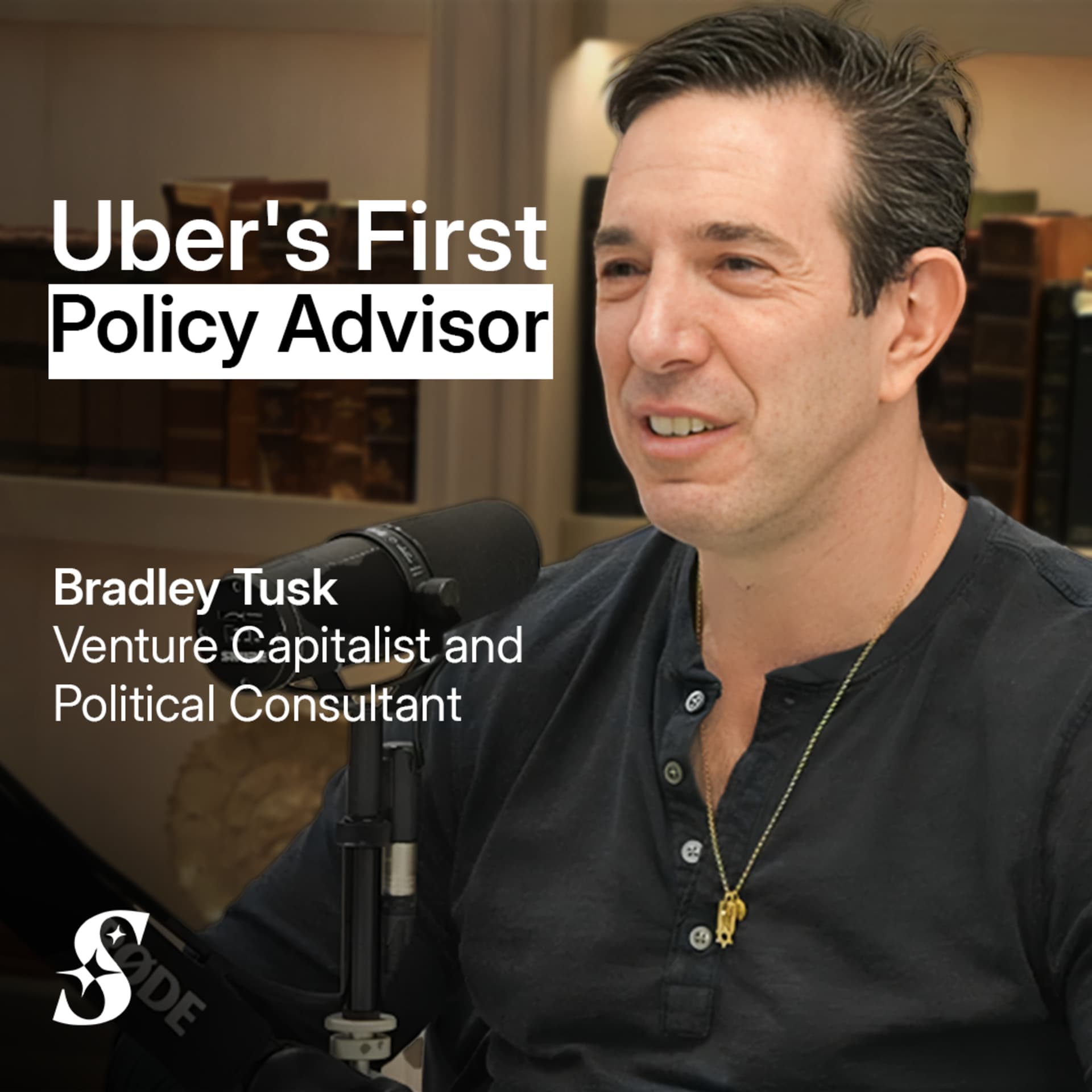
Bradley Tusk joins Sourcery to discuss what he learned working closely with Travis Kalanick during Uber’s early regulatory battles, and how those experiences shaped his decision to shut down his venture fund and return to an equity-for-services model.
Bradley explains why Travis was unusually fast, analytical, and willing to challenge institutions, and how that mindset influenced the way Uber approached politics and growth. He also breaks down how the current AI wave is affecting valuations, capital formation, data-center spending, and the broader regulatory environment.
The conversation covers the real economics of running a VC fund, why mid-sized funds struggle, how AI is reshaping startup incentives, and what founders should understand about regulation, policy, and long-term strategy. It’s a practical, grounded discussion from someone who has worked at the intersection of tech and government for over a decade.
Bradley Tusk: https://www.linkedin.com/in/btusk/
Molly O’Shea: https://x.com/MollySOShea
Sourcery: https://x.com/sourceryvc
𝐒𝐏𝐎𝐍𝐒𝐎𝐑𝐒
• Brex—The modern finance platform, combining the world’s smartest corporate card with integrated expense management, banking, bill pay, & travel. https://brex.com/sourcery
• Turing—Turing delivers top-tier talent, data, and tools to help AI labs improve model performance—and enables enterprises to turn those models into powerful, production-ready systems. https://turing.com/sourcery
• Carta—Carta connects founders, investors, and limited partners through software purpose-built for private capital. Trusted by 65,000+ companies in 160+ countries, Carta’s platform of software & services lays the groundwork so you can build, invest, and scale with confidence. https://carta.com/sourcery/?utm_medium=newsletter&utm_source=sourcery&utm_campaign=20250923-amer-carta_sourcery_data_insights
Follow Sourcery for the latest updates!
𝐓𝐈𝐌𝐄𝐒𝐓𝐀𝐌𝐏𝐒
(00:00) Intro
(01:25) How AI infrastructure spending is being driven by market narratives
(03:10) DeepSeek, inference models, and compute efficiency
(03:55) Where the $2T in AI data-center and energy capital is flowing
(07:10) Nuclear energy and the broader implications of AI’s power demand
(16:30) Zero-sum vs abundance thinking in tech and politics
(17:35) How people find meaning, purpose, and balance in high-pressure work
(27:00) Why Bradley invests heavily in his team and removes non-essential tasks
(32:00) How Bradley’s experience with Travis Kalanick shaped his view of founders
(32:35) “Travis’s Law” and turning users into political advocates
(37:05) Why Bradley decided to stop raising traditional VC funds
(44:30) The economics of mid-sized funds and why they’re so difficult to run
(49:20) How AI valuations differ from non-AI valuations
(54:40) What people misunderstand about Silicon Valley and DC
(59:40) AI, unemployment risk, and why Bradley believes UBI will be necessary
(01:05:50) The biggest lessons Bradley learned from Travis Kalanick


