
In short
```markdown
Podcast Summary
Sourcery Episode with Michael Mignano
Episode Overview Title: Why Lightspeed Bet on xAI, Neuralink, Suno, Granola, & Pika Guest: Michael Mignano, Partner at Lightspeed Release Date: [Date Placeholder] Podcast Description: Interviews with top Investors, CEOs, & Founders.
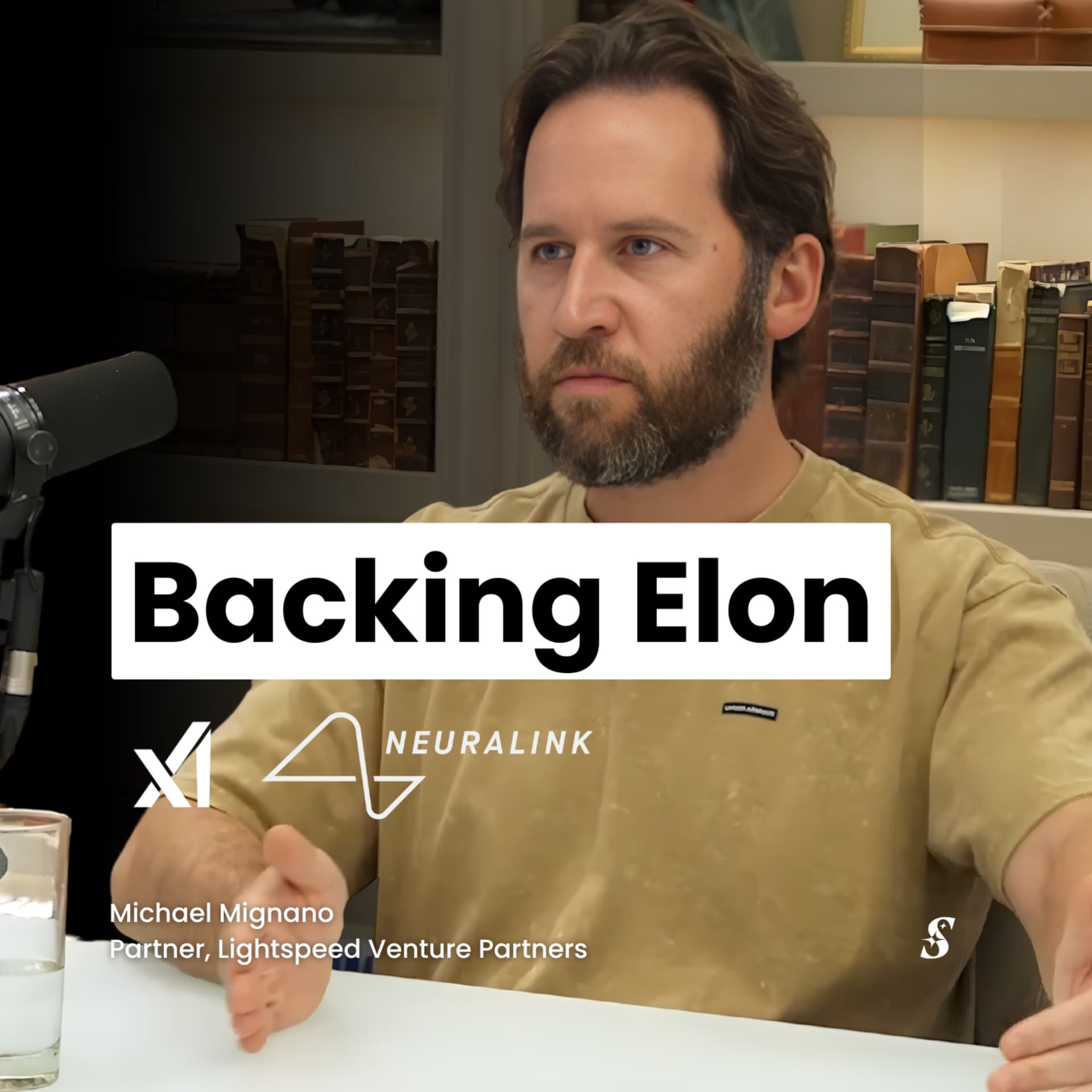
In this episode, Michael Mignano discusses his transition from building consumer media products to investing in technology companies with a focus on AI and creativity-driven startups. He shares insights on his portfolio—including notable investments in companies like xAI, Neuralink, and Granola—and his unique approach to evaluating AI businesses in a rapidly evolving landscape.
Key Topics Discussed
- Background and Transition to Lightspeed
- Michael's Background: Co-founder of Anchor, a podcasting platform acquired by Spotify.
- Joining Lightspeed: Transitioned to the $30 billion venture capital firm to focus on early-stage investments in AI and creative technologies.
- Investment Thesis
- Focus on Creativity: Michael emphasizes the importance of creativity as a competitive advantage or "moat" in business, especially for AI startups.
- Evaluation Criteria: He evaluates companies based on:
- Retention metrics: How sticky and valuable the product is over time.
- Organic growth: The ability to grow through word-of-mouth rather than just viral marketing.
- Insights on AI Firms
- Investments in AI: Discussed Lightspeed's investments in xAI and Neuralink, emphasizing the need to back innovative thinkers like Elon Musk.
- Defensibility in AI: Identifies retention-driven moats as essential for AI startups to maintain competitiveness against incumbents like OpenAI.
- The Sora Launch
- Impact on Creators: Discussed the implications of Sora’s launch for content creators, indicating it may signal a shift away from individual creators towards platforms controlling content narratives.
- Future of Media: Michael predicts that as AI evolves, the nature of content creation will change, potentially diminishing the role of individual creators in favor of algorithmically generated content.
- Challenges and Opportunities in AI Investment
- Changing Check Sizes: Note on evolving check sizes in seed and Series A rounds, reflecting increased competition and valuation premiums for AI startups.
- ARR Metrics: Critique of the reliance on Annual Recurring Revenue (ARR) metrics, arguing they may not accurately reflect the health of a business.
- Predictions and Future Trends
- IPO Candidates: Discussed potential IPO candidates in the tech space, including OpenAI and Discord, highlighting the demand for public AI investment opportunities.
Key Takeaways
- Creative Moats: In an AI-driven world, the ability to innovate within business models will separate successful companies from the rest.
- Importance of Retention: High user retention is crucial for startups aiming to build lasting businesses in a competitive landscape.
- Evolution Beyond Creators: The emergence of platforms like Sora suggests a transformative shift in how content is created and consumed, potentially sidelining traditional creators.
Final Thoughts Michael Mignano provides a compelling perspective on how AI is reshaping creativity and investment strategies in tech. His emphasis on retention and creativity as key indicators of a startup's potential success reflects the changing dynamics of the venture capital landscape, particularly in the AI sector.
Follow Michael Mignano: [Twitter](https://x.com/mignano) Follow Molly O’Shea: [Twitter](https://x.com/MollySOShea) Follow Sourcery: [Twitter](https://x.com/sourceryy)
Episode Links
- [Watch on YouTube](https://youtu.be/m0lZ3JdZw7s)
- [Sourcery Website](https://www.sourcery.vc/)
Sponsors
- [Brex](https://brex.com/sourcery): Modern finance platform.
- [Turing](https://turing.com/sourcery): Customizable AI solutions.
- [Deel](https://www.deel.com/sourcery): Global hiring and payroll solutions.
- [Public](https://public.com/sourcery): Investment platform with AI-generated assets.
---
This summary encapsulates the key discussions and insights from the Sourcery podcast episode with Michael Mignano, providing a comprehensive overview for those interested in venture capital, AI, and the future of content creation. ```
Written by AI. May contain mistakes. Listen to the episode to check what was said.
Transcript
Automatic transcript. May contain errors.0:00This is like a very hot topic. I'm sure you have a lot of opinions. What did you think about the Sora launch? I think Sora is the next phase. It's a whole new chapter for the internet. You know, I hate to say it, it's almost like the end of the creator. Okay, so you joined Lightspeed,$30 billion fund. You've invested in XAI, Neuralink, Suno, Granola, Pika. So I'm curious, how do you see creativity as a moat? When you think about moats, I think what's really important right now, given how fast OpenAI can move, is getting to a behavior that is sticky and durable extremely early. So one lesson for me is Suno.
0:35It's producing the best AI-generated music in the world. They have a shockingly high amount of revenue that I will let them reveal on your podcast. I won't do it. But the thesis has been extremely validated. And I think you only get there by being creative and having the courage to go do it. What do you think the world's going to look like once we have super intelligence? Uh, well...
1:06All right. All right. Michael, welcome to Sorcery. Thank you, Molly. Happy to be here. As the godfather of podcasting, how does it feel? It feels good to be recording a podcast. I like podcasts. Did you expect it to be this crazy? No, absolutely not. When we started Anchor, it was a very niche thing, I would say, in the Apple Podcast Store, which Spotify wasn't even really a podcast platform at that point. It was just music. There were like maybe a couple hundred thousand podcasts in the store. And then, you know, we didn't even think it was going to be big. So we were actually trying to build a social network for audio.
1:44Like we imagined like really short form stuff, kind of like Clubhouse. But then eventually after a bunch of pivots, we just realized that, oh, wait, podcasts actually are a thing. We actually have to attach ourselves to this. We need to make this really, really easy. And then the whole thing just took off and ran away. And, you know, then there are tens of millions or maybe hundreds of millions of people that have now made podcasts. So it's crazy. We did not expect it. And you were head of Talk. That was the title? At Spotify, yeah. I think that was my title because Talk Audio encompassed podcasts.
2:17We were also doing video. This was the start of Spotify getting into video podcasts. And then back then, this was a few years ago, of course, we were also dabbling in live Talk Audio as well because after Clubhouse, everyone had to have a live play. The problem with all these live formats on the internet is that synchronous content is really, really hard because the beauty of the internet is that everything is actually asynchronous, so you can consume it on your own schedule, right? Like this podcast or all the podcasts you've done, anyone can consume them on demand. But if you have a synchronous platform, you're sort of forcing everyone to say, you must consume this at this exact moment, and that's just really inconvenient.
2:58So fast forward in 2022, you joined Lightspeed? Yes. Okay, so you joined Lightspeed,$30 billion fund, a mega fund. We had Bucky on, it was great. Oh, nice. Bucky's the best. He's the best. Yeah, we went into the economics of what it takes to return a$30 billion fund, which was really interesting. And I think we could relate this to some of your portfolio companies. So for you, you've invested in XAI, Neuralink, Suno, Granola, Macroscope, Pika. So you've done all of those. And then I've also read on you that creativity is your moat that you like to go after. So what is your investment thesis? My investment thesis, when I started, candidly, I thought it was going to be really focused on things that matched my own experiences and my background.
3:44You noted that I built Anchor. I spent a lot of time building consumer products for lots and lots of people. And I love those types of companies. I love founders that are super drawn to consumer and products for everyone. But the reality is after I joined, AI became a thing. And I think with each day that passes, I think we're realizing that AI makes it so that we know less and less about the future. And so I think, you know, every investor out there has some thing they're good at or, you know, some way they see the world that's different than other people. But I also think in many ways, we're all having to forget kind of everything we know and dream a little bit bigger because things are moving so, so fast.
4:26But for me, yes, I am drawn towards media. I'm drawn towards creativity. And at the end of the day, as like a product builder and a product designer myself, I'm drawn towards founders who just have amazing product taste and sensibility. You know, you mentioned Granola, the founder and CEO of that company, Chris Pedregal, with his co-founder Sam. I had known Chris for a really long time and I watched him build this company, Socratic, and I just knew that this guy had incredible product intuition. Just like I knew whatever he chose to build, something really great would come out of it because he had shown me that through his previous company.
5:03And so when he told me he was building something new with Sam, it was like, doesn't even matter what you're building. Sure, we will invest. And so I find more often than not, especially as AI, again, kind of makes you have to forget everything you know, it's really becoming more and more about people, great people. And for me, it's like product-oriented CEOs. How does XAI and Neuralink, those size investments, fit into this? Yeah, it's a good question. So maybe taking a step back, Lightspeed, as you mentioned, it's a large platform. Mega. 30-ish billion under management. The current fund generation we're investing out of is in the ballpark of about 7 billion.
5:43To do that, we're basically investing across stages. And I generally focus on early stage, but, you know, we're a firm that really prides itself on collaboration, working with our partners across different stages and sectors. And so if somebody has a great relationship or if somebody has a very specific point of view on the world. We're not a firm that lets sort of the borders of those sectors or stages be a barrier that prevents a deal from getting done. And so I generally focus earlier, but as a fund, we absolutely have a strategy to bet on the biggest and best companies in the world. And in the case of companies like XAI and Neuralink, it's like you got to back Elon Musk if you have the opportunity to.
6:26And so that's the idea behind those investments. But for me, I am more and more drawn towards the earliest stages. Again, as AI is making it such that you kind of have to forget what you believe. And when you're living in that kind of world and operating in a world that moves so fast, the best bet you can make is on people. And so right now I'm doing a lot of seed, a lot of like inception stage. This person's amazing. Let's give them a couple million bucks type of investing. I'm really interested to know how you think about this environment because Because OpenAI just had their Dev Day. Some would call this a Sherlocking event.
7:05That's what it's called, right? It feels like every one of their Dev Days or every one of their live streams is a Sherlocking event. I mean, good for them. Yeah, totally. Good for them. But I'm really curious how you even can get yourself to write a check and commit to something because there will be a funding. And this one generative AI company, I'm not going to name it, they had a big announcement the week before and funding and blah, blah, blah. and then Sora comes out. 800 million weekly active users, like insane amounts of like power law dynamics there. Like what, like how would the other one win?
7:40Yeah, I mean, look, this is, I think this is the thing that every investor is thinking about right now. And I think the best you can really do is invest in great people who are hopefully getting a way ahead of the curve before OpenAI or other incumbents are gonna be building something. And in the process, they're building some sort of moats and we can talk about what those moats might be. I mean, I think, yes, it's scary, but I should also point out that this is kind of always how venture has been. There have always been incumbents that can, you know, with one flip of a switch, send a team to go work in your space.
8:13I think the difference of what we're seeing here is kind of the ambition of Sam Altman and the speed and the kind of ruthlessness, and that's a compliment, to which his organization can move and can move fast. But, you know, when you think about moats, I think what's really important right now given how fast OpenAI can move, is getting to a behavior that is sticky and is durable extremely early. And so, you know, to bring it back to something like Granola, you know, Granola is doing incredible meeting notes for anyone that uses the product. Have you used Granola? Okay, you gotta use Granola. It's really, really good.
8:49Maybe. So Granola does these meeting notes and it's really, really good. And we find that when somebody uses the product, it's incredibly sticky, right? Like the retention is insane. I've never seen retention like this before for a product, because each time you use it, it just becomes more and more valuable for you. It has more and more of your context and history. And so at a time where all these companies are spending a lot of money for the latest and greatest AI tools, what you want to do is you want to get them to buy as quickly and as early as possible and get them as retained as early as possible.
9:21And the hope is that if you can do that, then even if somebody comes along and they build a better granola, you're not going to switch because it has all of your context. And so I think when you hear investors talk about like moats and data moats and things like that, it's that kind of thing that we're talking about. Okay, so is that the primary moat you look for? Like how are you evaluating these companies? So one of the things that I take a little bit of an issue with right now in venture is there's so much of a focus on this ARR number. Oh my God, it's fake. Yeah, and it's not even defined properly half the time, right?
9:57Like, you might just take, some of these companies are literally just taking, like, yesterday's subscription rate and, like, multiplying it by 365, whatever. I think it doesn't say anything about the durability or the quality of the revenue. One of my partners says this thing, that there's, like, high caloric revenue and low caloric revenue. And it's like, you want the healthy revenue, right? So I think a lot of rounds are getting done right now based on this revenue. But what I'm really looking at and what all my partners are really looking at is the same stuff we've always looked at, which is retention.
10:31You know, how sticky is the product? How often are people coming back? In addition to retention, is it growing organically? Is it growing word of mouth? Or have they just figured out a way to go viral on TikTok a few times? Because if you do that, if you can figure out how to go viral on TikTok and you have a very well optimized conversion funnel, you can quickly run up your revenue rate. Like it's actually like not that hard. That's how good TikTok is. But it doesn't really say anything about the durability or the quality of the product or business. And so for me, it all comes back to the fundamentals.
11:04Is the product retaining users? Is it growing organically? Like those are the two most important questions in my mind. And when you're looking at the early stages, what kind of check sizes are you writing? Yeah. So this is another thing that's changing as a result of AI. I think, you know, when we're doing really early stage inception type investing, it could be anywhere from a couple million dollars, maybe, you know, two million dollars to in some cases some founders are raising, call it five or six. I think when you're getting more into like a proper seed, you know, it's anywhere from four or maybe on, you know, maybe on the higher end, we're seeing some of these larger seeds come in at like 10, again, as a result of AI and the momentum.
11:46And then Series A's are sort of also getting bigger, right? A Series A, when I built my company, we raised a$10 million Series A and it was like a big round. It was like, wow, that's a big Series A that can last us a long time. You know, Macroscope, a Series A that I led a few months ago, we led that Series A with a$25 million check. So they're getting bigger. They're getting bigger. Carta just put out recent data in their fund performance report and Series A's are getting a 30 % premium. Wow. What do they attribute that to? AI. So AI companies get a 30 % premium versus non-AI companies. And it's just like the biggest difference in this new cycle.
12:28And I would say you can imagine that power law dynamics will seek in there and the delta is probably much greater between like the good teams and like, you know, the average teams. Because once you get into competitive land and you're going after, let's say, like another like huge megafund and there's competition, like you're going to run the price up. Totally. Yeah, that's actually the dynamic we're seeing a lot. And definitely one of the things that's making us want to go earlier and earlier. Some of these companies, you know, they're growing revenue so quickly that the rounds are happening in such quick succession.
13:02And oftentimes, if you're the seed investor and things are going kind of well, you might quickly do the Series A. And then by the time a new investor has an opportunity to come in, it's the Series B. It's priced really expensively, but nothing has been de-risked yet. So you're paying this really premium price. You're having to write this gigantic check. And you don't know anything more about the business, whether or not it'll fail or succeed. And so I think the natural fallout of that is you have to go earlier and earlier. And I think to do that is a new muscle for a lot of big funds. And I also think it's why you're seeing more and more of these accelerators pop up and do so well.
13:41Sorcery is brought to you by Brex, the financial stack trusted by more than 30 ,000 companies, including one in three venture-backed startups in the U.S. Nearly 40 % of startups fail because they run out of cash. Brex is literally built to help founders avoid that. Unlike traditional banks that let your money sit idle, shipping away at it with fees, Brex is designed to help you spend smarter and move faster. Their all-in-one solution combines checking, treasury, and FDIC protection into one powerful account. You can send and receive money globally at lightning speeds, get 20 times the standard FDIC coverage through their partner banks, and even high yield from day one.
14:22With same day and even same hour liquidity, access your funds anytime. companies like scale ai doordash service titan hymns anthropic flexport robin hood and plaid trust and use brex start today at brex.com slash sorcery that's b-r-e-x.com slash sorcery in today's high-speed business world staying ahead means using the smartest tools possible including the powerful capabilities of artificial intelligence meet turing intelligence turing builds customizable AI systems designed to solve your mission-critical challenges, no matter your industry. From expert guidance to tailored projects, Turing helps top companies realize AI that's more capable, more adaptable, and more effective.
15:06With Turing, discover how AI can accelerate your business growth. To learn more, visit Turing.com slash sorcery, spelt S-O-U-R-C-E-R-Y. That's Turing.com slash sorcery. Are you concerned at all with that rapid deployment? Going back to this report, like, There was a slump in VC, but now we're seeing dry powder deplete within these funds. Like people are really allocating capital and fast because it's so competitive. Are you concerned at all with that? I think it's definitely probably a concern for broader venture capital. I think at Lightspeed, we have always maintained a very, very high bar. You know, even in this environment, even at this pace, you know, investing partners are still making the same amount of investments on average per year as a partner as we would a few years ago.
15:58And I think the only way you can do that is if you hold a really, really high bar. And again, don't get caught up in some of these kind of vanity metrics that we talked about and you go back to the fundamentals. So I think it's really just about keeping the bar high. Yeah, I want to go back to your point on moats because I'd also read some tweets like you've written about moats a bunch and one of them was on creativity. How do you see creativity as a moat? Yeah, the way I think about creativity as a moat, so I've written a lot about creativity in terms of making stuff and tools and art and music and that form of creativity.
16:35I think when I talk about creativity as a moat, I'm talking about creativity in a business sense, right? If you look at every business, every great company, whether it's Apple or Nike or Amazon, and you really study the story of these founders and how these companies came to be, there's something really creative about what they did. There's an ingenuity. It's not something that can just be written by ChatGPT in an AI-generated business plan. And so I think as it becomes easier and easier to make businesses, which it will because of AI, right? We keep hearing about, you know, the one person billion dollar company.
17:15I'm sure everyone tweets about that. Sure, it's going to be easier and easier to execute on business. But I think the thing that will remain rare and special is creativity in business, right? Who is the person or company or set of people that is coming up with something really, really new and novel in terms of a business model or an approach to go to market or an approach to how they do their product development? I think the best companies are still going to have that quality. And so at the end of the day, maybe the only thing that's durable at this point is creativity when everything else can be automated.
17:52What's a lesson you've learned from one of your founders on this? So one lesson for me is actually Suno. I think something really creative and genius about what they've done. They have a ton of subscribers and a shockingly high amount of revenue that I will let them reveal on your podcast. I will do it. But, you know, I think when you're looking at that business early on, what you're saying to yourself is, okay, they really need to mirror the consumption businesses of the past, like a Spotify, like a YouTube, like a TikTok. They need to get a bunch of people creating on one side, and then they need to get a bunch of people creating on the other side.
18:32And to be clear, that is happening. But what the founders of this company, Mikey and Martin and Georg, a belief they had very, very early on, which I would characterize as super creative to both believe this and then pursue it, was that actually in the future, AI is going to make it so easy to create and such a personal experience to create that these people that are creating, they're going to listen to their own music. and that's a business right there. We're going to, yes, we're going to get these other consumers over here and we're going to monetize them just like Spotify does. But we think there's also an opportunity to monetize consumption behaviors over here and not just for creation.
19:10And I think that early on, I was skeptical. Some of us around the table were skeptical. But it was a really creative and sort of bold bet on the future and a creative business model to pursue. And the thesis has been extremely validated. And I think you only get there by being creative and having the courage to go do it. Mm-hmm. I've had so much fun using Sino. It's a blast. It's so much fun. In the world of generative AI, I want to go into Sora. This is like a very hot topic. I'm sure you have a lot of opinions. I have some, too. But I want to hear your stance on this. What did you think about the Sora launch?
19:46Yeah, I thought it was incredible. I thought, first of all, they did a really good job on the product. Just even the onboarding experience of scanning your face was really seamless and fast. And I think they're able to discern a very, very high quality of you just from a very, very brief scan. I think the other thing they did that it stuck with me was when you first onboard, you encounter a screen. And a bunch of people I've talked to don't remember this screen because I think everyone just clicked past it. I'm curious to know if you remember it. There's a screen that says everything you're about to experience is not real or something like that.
20:23It says, you know, like, the feed, nothing in the feed is real. And my guess is they introduced that as a sort of disclaimer, right? Like, hey, reminder, that's not your friend actually stealing that TV from Walmart. It's not real. But to me, it almost came off like a mission statement. Like, this feed, you're stepping into an alternate universe. You're stepping into another galaxy. You know, it's, Ben Thompson, I think, made an interesting comment about Meta's Vibes app, where he said something along the lines of, this feels like Meta's first real step into the metaverse. It's a completely different universe, right?
21:03Nothing is real, but it's people we know and we identify with, or we may even know personally. So I think that alone just kind of blew me away. And then I also think, obviously, the Cameos thing was just incredibly smart for a lot of different reasons. I think it's the first time we've seen a new type of social dynamic built on AI. We've seen a lot of these platforms out there try to make the new AI-first social network, where they just basically replace humans with AI bots or avatars. And I think that's boring, and it doesn't really tap into kind of some of the new and native and interesting things that you can only do with AI.
21:42But avatars is like, it's a purely new social dynamic. So I think that's really interesting. I think the biggest takeaway for me, though, is what it means for media and the business of media and the economics of media. Do you remember a few years ago when Adam Masseri, CEO of Instagram, put out this video and he said, starting now, we're going to be leaning into recommendations. We're going to move away from your friend graph and we're going to start doing recommendations. and everyone was up in arms. All the users, especially the influencers. I remember Kylie Jenner put out this huge thing about how she was so upset.
22:23And you could understand it, right? Because she had something like 900 million followers. It was a business, right? If she could put out a piece of content, tap a button, and it reached 900 million followers, that is immense pricing power and the ability to advertise. So for her to learn, And actually, those 900 million followers, they matter a little bit less. That's a big hit to her business. And so I wrote this piece, which I called The End of Social Media, and it was all about this new form of media, which I had called Recommendation Media. And it was really just kind of the TikTok algorithm and how the TikTok algorithm was sort of the next phase of media.
23:02The follower graph was going away, and now the platforms were going to get to decide what somebody saw. far more efficient way of content distribution. I think Sora is kind of the next phase. It's kind of, you know, I hate to say it, it's almost like the end of the creator. Like if you play this out and think about where this goes, platforms want to amass a huge catalog of content, and then they want to program each piece of content such that when you're in the platform and you're swiping, your attention is captured for as long as possible. And that's why the TikTok algorithm is so powerful. But it still requires that human beings make the content.
23:42And there's a cost to that. And so I think where we're inevitably headed is now when you're swiping TikTok or Reels or Sora, we're eventually going to end up in a place where most of that content is generated on the fly, specifically to target you and to capture your attention as long as possible. And unfortunately, like the individual creator just becomes far, far, far less valuable in that dynamic. And so to me, that is the biggest impact of Sora. It marks the end of the creator, unfortunately, which obviously I find devastating in many ways. You know, I spent my career, the first part of my career, building tools for creators.
24:21And it's a whole new chapter for the internet. Yeah, I think I read a couple posts on different creators saying like, this is a cataclysmic event. Like you should like really come up with a good strategy going forward because it is a doomer standpoint for like creators for sure. But like, I think like with all of these things, you do need reinvention. I was talking to PJ who creates all those like extremely viral AI videos. They did one for Kalshi. It reached like over a hundred million people. Like it's truly insane. Like he's very talented. And when he did that, I was like, okay, I got to learn how to do that.
24:58And this was when like Gemini's model was taking off. And so I like spent the weekend like, okay, I'm gonna learn how to do this. Like, you kind of have to, like, mix-match on all these different platforms and make something in the end. It was, like, the, okay, defensibility for sure there. Like, I did not want to do it at the end of the day. Like, and then with Sora coming out, I DM'd him and I was like, hey, what do you think? Like, are you still, like, hiring and training people to, like, do this and create these viral videos for your huge, by the way, like, corporate customers? He was like, no, the game's changed.
Read the full transcript
25:33It's completely changed. I'm only hiring comedians. I'm only hiring comedy writers. Yeah, I think this is really smart. So, you know, I mentioned that this is obviously really bad for creators, but I think the flip side is it will probably reward uniqueness. Going back to your point or your question to me about creativity as a moat for business, I think now what you're going to see is creativity as a moat for creators. Creativity for creativity, right? In fact, I think Sora, the Avatar model, is a perfect example of this. Sam actually even hinted to this in his blog post, sort of hinted that there's gonna be a new model where they're compensating creators for their likeness, their name and likeness.
26:16That's cool. Yeah, maybe we move from a world in which we're compensating people for however many views they can get, because now, views for a platform are unlimited. They can just get as many views as they want. But what they can't get is uniqueness, right? And so if you're a person or a brand or an avatar and you can do something or appear a certain way that is truly unique, maybe that's what's going to be compensated. And it's scary in a way to think that the incentives are shifting for creators. But maybe, I don't know, maybe there's something, maybe there's a positive sort of silver lining to this as well.
26:52Well, I was excited about that because I don't want to make talking head videos. I don't care, but I know that's like one of the viral hacks for like at least women on Instagram. Like, it just works. A couple points on the avatars and, like, the cameos point is, I thought it was absolutely genius for Sam to make him one of the stamped cameos. Because guess what? Now he's gonna have more videos on the internet of himself than anyone else. Like, the distribution on that is gonna be truly insane. And then going back to, like, understanding monetization on that, I was thinking, okay, like, I don't know if I wanna make my cameo public because what are people getting, Like, I don't want them to misuse this or make me do something crazy." And I was like generating...
27:33But you might for a price. Maybe for a price. You might. Not saying you. I'm just saying that's probably the calculation they're making right now, right? Yeah, it could be. And like, I was thinking about his because I was trying to recreate, you know, I had this viral clip of me pretending I didn't know, like, Jack and Sam were related. So I wanted to make a clip of me talking to Sam and being like, the results are in. You're related to Jack Altman. But the problem I had was like every time I did that, I was prompting it to make Sam like anxious and like scared and worried and then happy. But like he was only happy the whole time.
28:11And I was like, what did you engineer in here that you're only happy? That's funny. Yeah. Yeah. I mean, look, I think people are going to find ways to capitalize on this. There was a tweet going around today or yesterday about Jake Paul in six days or seven days. has generated a billion views of his face by doing the same thing, by, you know, making his cameo public and then I guess tweeting that people should go use it. And so people, there's going to be a business around this for name and likeness. And, you know, again, at the end of the day, I guess my hope would be that maybe if nothing else, we can reward creativity and uniqueness and people doing something different.
28:55So as you said, we don't all just have a bunch of talking head clips floating around because that seems to be the hack that works today. Some of you may not have heard this yet, but our sponsor Public just launched something called Generated Assets, and it brings AI into investing in a way I've honestly never seen before. Here's how it works. You type in an idea like AI-powered supply chain companies with positive free cash flow or defense tech companies growing revenue over 25 % year over year. Publix AI then dispatches a swarm of agents that scan every single US stock, evaluates them, and instantly builds a custom index around your thesis.
29:30What really stands out is how clearly it explains why each stock is included. And before you invest, you can even backtest your idea against the S &P 500, so you're making decisions with real context, not just guessing. And beyond generated assets, Publix lets you invest in stocks, bonds, options, crypto, all in one place. They'll even give you an uncapped 1 % match when you transfer your investments over from another platform. If you want to build a portfolio that actually reflects your thesis, visit public.com slash sorcery. Paid for by public investing. Full disclosures in the description. Maybe this actually like just cannibalizes the cameo.
30:06Cameo business is business. Yeah, maybe. Because do you need cameo anymore if like you have this? Right. Yeah, exactly. Yes, that's true. That's, yeah. Yeah, so it's really fascinating. I'm interested to see where it goes. So I have an interesting question on Lightspeed's strategy, investing into AI, because you guys have invested into like several LLM competitors. What informs your decision there? And I can go through the list unless you have them on top of your head, but you've invested into XAI, Anthropic, Mistral, Stability AI. You've also done Pika and some more. So I'm curious, how do you think about investing in these direct competitors?
30:43Yeah, I think Lightspeed from very early on in sort of the AI kind of revolution took this position that actually AI and foundation models are more akin to software and code than they are to business lines and strategies. And, you know, I think now it would be silly to say X random software company is competitive with Y unrelated software company. It's all just code. And I think that was the position we took internally early on. And so as we made these different investments, the way we thought about them was actually we believe these things are actually quite different, right? XAI has decidedly taken a very direct step into things like consumer through obviously the X platform and potentially embodied AI and robotics through potential partnerships with companies like Tesla, et cetera, and Optimus and things like that.
31:36Whereas Anthropic is like, we're very, very focused on the enterprise. We're very focused on code, right? And where Mistral is like, we're very focused on European sovereignty and open source. And so I actually think we view these businesses as quite different. And we don't just view kind of AI as being competitive with AI, just in the same way as we don't view software being competitive with software. Yeah, that makes total sense. I think now we're seeing a lot more of the bifurcation between all of them. Exactly, yeah. And I think that was, you know, when we talked to these companies early on, that's how they were talking about it too.
32:14It's like, this is our mission, this is our vision. We view a world in which we do this part of the world and this company does this part of the world. And so, yeah, maybe on the surface early on, it may have looked like from the outside, maybe it looked like that was competitive, but we didn't believe that early on and we don't think the founders did either. Where do you think the value accrues in the AI stack? I think it's such a hard question. I feel like this is the question everyone has. Where does the value accrue? I mean, clearly it's accruing right now to the model layer for companies like Anthropic and OpenAI and X.
32:51But there are also amazing application layer businesses generating a lot of value as well. I mean, we're not in this company, but there are many reports out there about how much cursor is generating at the application layer. And there are lots of other companies that are generating an accruing value at the application layer. And so I know it's sort of a cop-out answer, but the simple answer is it's at whatever layer somebody is willing to spend money. And if you're a huge foundation model and you can kind of hit every layer of the stack, there's probably more revenue for you to take advantage of than if you're just at the application layer.
33:27But we're seeing now that every different layer of the stack is able to generate an interesting type of business. What about your AI education startup? Yes, Oboe. So my anchor co-founder, Nir Zuckerman, for a long time has been thinking about education and about how we as humans, we are spending however many billions of dollars on making machines extremely intelligent. But one thing that we're not doing is we're not doing the same thing for human intelligence. And so he and I have a belief that AI can actually be used to make human beings smarter. And people are obviously using AI and foundation models to teach themselves.
34:16But what no one has really done yet is focused on the products, right? Like, how do we make great products to help people learn? Everyone talks about, hey, it'll be amazing one day when you have a tutor that knows everything about you, knows everything you've ever learned, knows everything about how you like to learn, what the most efficient way is to teach you and then actually teaches you things that makes you smarter. And so that's what we're thinking about with Oboe. We want to build the products that leverage AI to actually teach people things. And so we launched the first product a few weeks ago.
34:48It's called Oboe. The whole idea of it is that it creates these magical educational courses for you on the fly about anything and in a way that's customized and personalized to you and what you like to learn. and it enables you to learn them in whatever format best suits, again, the way that you like to learn. So we can teach you through audio, we can teach you through text. That's the basic premise of the company. And yeah, it's been really exciting to work again with my anchor co-founder. He's taken the lead on this one. He's CEO. I'm just riding his coattails as a glorified advisor and board member and co-founder.
35:28Education has always been like a really, really hard space to get returns out of, build companies, get adoption. Why do you think now is the right time? We think about this less as ed tech, and we think about this more as a horizontal need for every person on the planet. We're all learning every day, right? When you go to Google something, you're learning. When you go to ChatGPT, you're learning. But today, what you also do is you go to Google, you end up on some website, then you realize you didn't get what you wanted. So you go over to YouTube, you search for a video, you watch the video, you bounce around the timeline.
36:03You're kind of like piecing together the educational journey. And yeah, you might come out of it a little bit smarter, but you wasted a bunch of time and it didn't actually teach you in the way that's best for you. But with AI, we can effectively generate that entire experience for you in real time based on anything we've already learned about what you like to learn or what's effective for teaching you. And so we don't view it as like, hey, we're going to reinvent the school. We view it as more every single person on the planet can be learning far more efficiently than what the horizontal tools offer them today.
36:37And that's the hole we're going to try to fill. What do you think the world's going to look like once we have super intelligence? Well, I think the key is to, you know, I'm going to channel my inner Ilya Satskavar here, but I think the key is aligning intelligence with the needs of humans. And I think that that's a really tough thing to do. Fortunately, we have a lot of great minds thinking about it, but I think superintelligence is going to be able to do things in a far more capable way than we're going to be able to do and think however many steps ahead of us. And so the most important thing is making sure that we can be aligned with it from the beginning.
37:20Founders ship faster on deal, set up payroll for any country in minutes, hire anyone anywhere and get visas handled fast. So you stay focused on scaling deal takes care of onboarding, HR, it, or benefits and compliance. So your team can grow without borders. It's why more than 37 ,000 fast growing companies trust deal to move fast. Visit D E E L.com slash sorcery. That's D-E-E-L dot com slash S-O-U-R-C-E-R-Y. Coming from the podcast world, how big do you think this will get? Podcasting? Yeah. Yeah, so I've frequently underestimated, I think, how big podcasts can get. We thought it was this niche little thing.
38:01Then we saw that it was becoming a big thing, and all the biggest companies in the world wanted a piece of it. And then, you know, I think around the time that I left Spotify in 2022, I sort of personally felt like, okay, the work is done and it's great and I'm happy with where it is. And then I think once again, I was proven wrong because in 2024, 2025, as we saw, we had the podcast election, right? And now I just think that podcasts are basically the new television, right? Yeah. In the same way that you and I grew up watching TV, I think now people watch podcasts. And yeah, today most of them are maybe people sitting around a table having a conversation like this.
38:42But remember that just a few short years ago, podcasts weren't even associated with video. Video is a new format for podcasts. And so I think as people get more and more used to video being the medium, people are going to be more and more creative and fill the space in new ways. I mean, look at your show. You're doing it from all these different interesting locations. You're not just sitting behind a mic at your computer and using, you know, an amazing tool like Riverside. You're like out there in the real world. And I think we're going to see more and more people push the boundaries of the format.
39:15I think when it's all said and done, again, I think it's television. It's television that anyone can broadcast, right? And I think if you view it through that lens, we've got a long ways to go before it reaches its peak. From working at Spotify, what is the biggest lesson you learned from Daniel Ek? I think one of the amazing things about Spotify and Daniel is there's really like no ceiling to the ambition. He started Spotify in a world where because of piracy, music was effectively free. It was illegal to be free, but it was effectively free. And he built a platform and a company that was effectively better than free.
39:55right and that was the scope of the ambition and you've obviously seen that um with some of the other companies he's he started uh companies like like neko which lightspeed is fortunate to be an investor in but also with sort of his business strategy uh and ambition inside of these companies so so spotify i think really smartly um took their position in music built up over the course of you know, 10, 12 years and said, we're going to take this position of strength where we have, you know, hundreds of millions of people listening to music. And now we're going to ladder into a new format that sits adjacent to music and has, and has all the same interface, right?
40:36Like if you think about music, it's largely the same interface as podcasts. So we can ladder into podcasts, right? And then once you do that and you do it successfully, it's like, okay, what's the next thing we can ladder in that leverages off everything else we've built. So they go into audiobooks. And so I think the biggest thing that I've taken from that experience was just how smart and strategic you can be as a big company when you've sort of like won a position in something to be able to leverage that to go into the next thing. That's been, that was a really, really big learning from being there.
41:09And I think Spotify in general is a very, very strategic company. They take a long time to make decisions. I don't mean that in a bad way. I think I know every company wants to be fast, but you know, they're thinking about the future five, 10 years in advance. And I think most of us don't have the attention span to do that. Yeah, that's a really good segue into my Brex question. So Brex is all about performance, spending smarter, moving faster, the modern intelligence finance platform. But I'm curious from your standpoint, like how do you view performance as an investor as you handle all of these portfolio companies of like when to lean in, when to, you know, let someone bake a little bit more.
41:49How are you thinking about that in terms of like, okay, like talk about the Spotify strategy of like turning the dials at certain times. Yeah. I think of, especially because I'm so focused on early stage investment these days, you know, I think performance can easily be measured by the standard things, revenue, Dow, now. But the way I like to think about it, the earliest stages is speed of iteration, speed of shipping, speed of learning. Like how quickly are you getting stuff out there into the world and getting signal back and learning and then making the next decision just a little bit smarter.
42:22This has always been a thing I've cared about and it's obviously always been important for startups. But again, with AI, everything is moving so fast, you have to be willing to go faster and you have to be willing to take more and more risks. So I think about performance as speed. And so then as we close out, I love to end on predictions. So which companies do you think will officially announce an IPO this year? Give me like three. Which companies will go public? Boring answer, but OpenAI. You think OpenAI is going to go public this year? I mean, they're the biggest private company, right? I'll throw out another one just for fun.
43:03Calci. I saw they raised a big round, so maybe they'll go public next year too. Polymarket. I know a competitor, but also raised a very big round, partnered with New York Stock Exchange, ICE. Maybe they'll go public. Cerebris seems like a candidate. I know they were going to go public. I think they actually just withdrew their plans to go public, or at least I read that. So that seems like another one that could happen. Discord, I feel like has been baking for a really long time, large successful platform. That seems like a good candidate. And then, yeah, I mean, I feel like any of the AI incumbents or hyperscalers like OpenAI seems like they have a great shot as well.
43:39Do you think that might be the next strategic like momentum milestone? I feel like they're always trying to outpace each other with different kinds of partnerships and announcements and growth and blah, blah, blah. Do you think IPOs might be the next layer? Maybe. I mean, one of the things that i've been thinking about a friend of mine really smart friend said you know what maybe um maybe more ai companies should be going public because there's clearly a lot of demand for it uh and if you're a public mark you know if you're a public investor a public market investor a retail investor you don't really have a lot of choices right you've got google you've got meta um you've got nvidia and and so maybe some ai companies maybe who were even earlier on their trajectory and maybe have less revenue than we've been seeing from typical companies that are going public.
44:29Maybe they should consider going public because there's probably just so much pent up demand from retail investors. So I thought that was an interesting take. That is really interesting. Okay. Well, Michael, it was a pleasure to have you on. Pleasure is all mine. Thank you so much, Molly. Thank you. Hey, it's Molly. If you enjoy our interviews, check out our newsletter, sorcery.bc where we deliver a once a week top deals and tech headlines email and also go deeper on our podcast interviews subscribe to sorcery today and don't forget to subscribe to the podcast on youtube spotify apple or wherever you listen link in description to sign up
From the publisher
Michael Mignano, Partner at $30B VC firm Lightspeed, and the co-founder of Anchor, a podcast creation, hosting, and monetization platform acquired by Spotify in 2019, joins Sourcery to discuss the next era of creation & technology investing.
In this episode, Michael shares how his background building consumer media products informs the way he invests today, with a focus on AI and creativity-driven companies. We discuss his portfolio, including investments in xAI, Neuralink, Suno, Pika, Granola, and Macroscope, and how he evaluates AI businesses when incumbents can move quickly.
The conversation digs into what makes AI companies defensible today, from retention-driven moats to why ARR metrics can be misleading. Michael shares his reaction to the Sora launch and avatars, and what these changes could mean for creators.
We also touch on evolving early-stage check sizes, lessons from Spotify’s Daniel Ek, his work on Obo, and thoughts on potential IPO candidates.
Michael Mignano: https://x.com/mignano
Molly O’Shea: https://x.com/MollySOShea
Sourcery: https://x.com/sourceryy
𝐄𝐏𝐈𝐒𝐎𝐃𝐄 𝐋𝐈𝐍𝐊𝐒
YouTube : https://youtu.be/m0lZ3JdZw7s
𝐒𝐏𝐎𝐍𝐒𝐎𝐑𝐒
• Brex—The modern finance platform, combining the world’s smartest corporate card with integrated expense management, banking, bill pay, & travel. https://brex.com/sourcery
• Turing—Turing delivers top-tier talent, data, and tools to help AI labs improve model performance—and enables enterprises to turn those models into powerful, production-ready systems. https://turing.com/sourcery
• Deel—Deel is the global people platform that helps startups hire, manage, pay, and equip anyone, anywhere. Trusted by more than 35,000 fast-growing companies, Deel is the people platform that just works, so teams can scale without the chaos. Visit: https://www.deel.com/sourcery
• Public–Investing platform Public just launched Generated Assets, which lets you turn any idea into an investable index with AI. With Generated Assets, you can build, backtest, refine, and invest in any thesis with AI. Gone are the days of one-size-fits-all ETFs. https://public.com/sourcery
Follow Sourcery for the latest updates!
Disclosure
Paid Endorsement. Brokerage services by Open to the Public Investing Inc, member FINRA & SIPC. Advisory services by Public Advisors LLC, SEC-registered adviser. Crypto trading provided by Zero Hash LLC, licensed by the NYSDFS. Generated Assets is an interactive analysis tool by Public Advisors. Output is for informational purposes only and is not an investment recommendation or advice. See disclosures at public.com/disclosures/ga. Matched funds must remain in your account for at least 5 years. Match rate and other terms are subject to change at any time.
𝐓𝐈𝐌𝐄𝐒𝐓𝐀𝐌𝐏𝐒
(00:00) Michael Mignano
(01:06) Anchor’s pivot & podcasting’s breakout moment
(02:32) Spotify’s Talk org: podcasts, video, and live audio
(02:55) Why synchronous (live) formats fail online
(03:27) Joining Lightspeed & portfolio overview
(03:47) Investment thesis: creativity, product taste, founders
(05:24) How xAI & Neuralink fit Lightspeed’s strategy
(06:56) Is OpenAI “Sherlocking” ?
(08:37) Granola & retention as the real AI moat
(09:52) Why ARR can be FAKE in AI startups
(11:20) Seed vs Series A check sizes & AI valuation premiums
(19:34) Sora, avatars, recommendation media, & creator economics
(33:37) Oboe: AI education & human intelligence
(40:01) Lessons from Daniel Ek & Spotify’s long-term strategy
(42:55) IPO predictions & what comes next


