
 Ask ChatGPT

 State of the World from NPR
23 Oct 2026 · 7m · 4 chapters
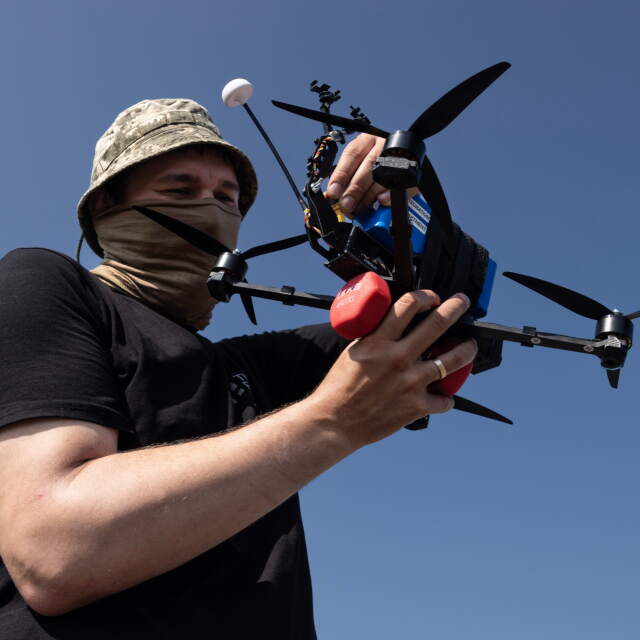
The episode explains how drones have transformed the Russia-Ukraine war front into a “kill zone,” a 10–20 mile-wide belt of territory packed with Russian drones, mines, and artillery where even small movements can be detected and attacked. It contrasts earlier trench-style deadlock with modern drone-saturated warfare across a 700+ mile front.
Taurus Mishak, a Ukrainian senior lieutenant describing four-hour advances of a kilometer, constant hiding/waiting, and increased night danger from thermal cameras; Rob Lieb, a U.S. Marine veteran living in Ukraine who monitors the war and says Ukrainian troops act as spotters for drone operators and that vehicles/tanks are rare due to detection; Dima Putyata, a former Ukrainian soldier who went from knowing nothing about drones to commanding 26 drone crews, emphasizing rapid adaptation; Luba Shipovich, a Ukrainian-American who trains drone users and argues operators and combat medics must be trained together. Key claims/examples include drone-driven casualties (at least 80%), nets over roads not guaranteeing safety, and Ukraine’s plan for 10 million drones vs Russia’s 7+ million.
Written by AI. May contain mistakes.
Exploration of the kill zone created by drone warfare in Ukraine.
“It's sometimes compared to World War I with its static, deadlocked trench warfare.”
Discussion on the infantry's strategic adjustments due to drone prevalence.
“it advanced rapidly in conventional fashion with large columns of troops.”
Insights into how both sides of the conflict are adapting to drone warfare.
“Ukraine had no real drone industry at the start of the war.”
Examination of how drone warfare might shape future conflicts globally.
“Luba Shipovich is a Ukrainian-American who heads a private group, Dignitas, that trains troops on drones.”

Get the gist, explore an idea or ask about something said.
 Claude
On State of the World from NPR, what are the key points of this episode?
Searching your listeningAutomatic transcript. May contain errors.
0:00This message comes from Thumbtack. Avoiding your unfinished home projects because you're not sure where to start? Thumbtack knows homes so you don't have to. Don't know the difference between matte paint finish and satin? Or what that clunking sound from your dryer is? With Thumbtack, you don't have to be a home pro. You just have to hire one. You can hire top-rated pros, see price estimates, and read reviews all on the app. Download today. Today on State of the World. Drones make the Russia-Ukraine war frontline a kill zone. You're listening to State of the World from NPR, a human perspective on global events.
0:40I'm Greg Dixon. In some ways, the war Russia is waging in Ukraine is similar to conflicts of an earlier era. It's sometimes compared to World War I with its static, deadlocked trench warfare. Yet it's also a decidedly modern war. That static front line is dominated by deadly drones that have created what is called a kill zone on either side of the front. NPR's Greg Myrie tells us what it's like in the kill zone and what it means about the future of warfare. Ukraine's senior lieutenant, Taurus Mishak, is just a few short miles from the front line in eastern Ukraine. This kill zone is like a belt of territory, which is full of Russian drones, Russian mines, also artillery.
1:28It's like almost nonstop reconnaissance surveillance. Ukraine has a similar arsenal threatening Russian forces dug in on the other side of the line. In the kill zone, any sign of movement, just sticking your head out of a foxhole for fresh air, can get you noticed and attacked by the drones constantly buzzing overhead. Mishak, who's speaking to me on Zoom, says even routine movements like rotating troops in and out of this space is a nightmare. Not far from what we are talking today, we have a group that moved through this kill zone and they walk like four hours just for one kilometer. They hear the drone and they have to hide and wait.
2:12And then drone passes, then they can move. And it's not safe at night because drones have thermal cameras that detect body heat. So in the night, it's even more dangerous. When Russia launched its full-scale invasion in 2022, it advanced rapidly in conventional fashion with large columns of troops. Later that fall, Ukraine's counteroffensive drove the Russians back in some places. Since then, the two armies have settled in and the front line has moved only incrementally. It stretches more than 700 miles from north to south. On either side of this line, the Killzone is a band roughly 10 to 20 miles wide and dominated by drones.
2:54The Killzone is basically a product of drone warfare. Rob Lieb is a U.S. Marine veteran who now lives in Ukraine and monitors the war for the Foreign Policy Research Institute of Philadelphia. Because Ukraine has far fewer troops and relies heavily on drones, it has a remarkably small presence on the front line. In many places, it's fewer than 10 soldiers per mile, in small groups spaced out hundreds of yards apart. Those infantrymen are maybe two positions where it's two to four people, and they're underground for the most part. They're trying to remain hidden. These troops are not really trying to hold back advancing Russian soldiers.
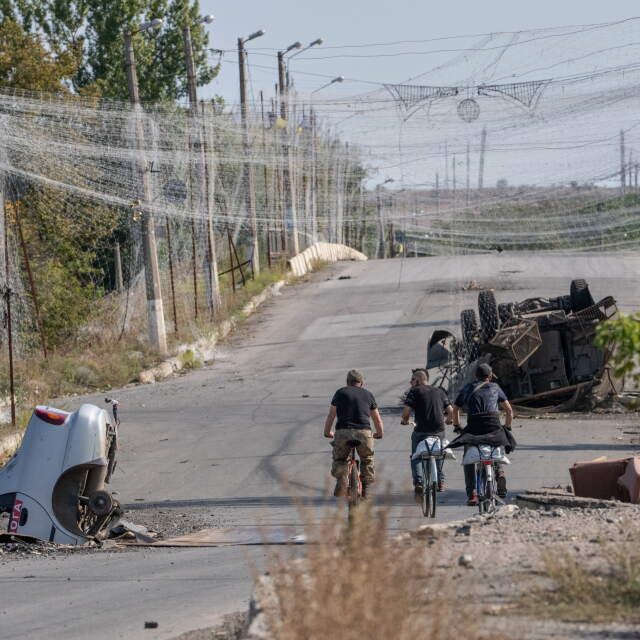
3:34They act more as spotters, relaying Russian movements to Ukrainian drone operators behind the front lines, who then tracked down Russian intruders. Lee says this zone is so saturated with drones that it's virtually impossible for either side to pull together a large ground force without being detected and drawing fire. Both sides have installed huge nets over the roads to protect military vehicles from drones. This still doesn't guarantee safety. Tanks and armored personnel carriers are now rare on the roads. Because of such a high density of drones, it became very difficult to bring vehicles near the front line at all.
4:14Neither army planned to fight this way. Ukraine had no real drone industry at the start of the war. This year, President Volodymyr Zelensky says the country will make 10 million drones. Russia has also ramped up drone production. It expects to make more than 7 million this year. When Dima Putyata joined Ukraine's military four years ago, he knew nothing about drones and didn't think it was a manly way to wage war. When I saw that we have drones, I was not smart enough. I said, no, we don't need to have it. Let's fight like men. I was a little bit maybe romantic in this way. There was another issue as well.
4:54At the time, few Ukrainian troops knew how to fly drones. No one had any drone operator. It's just, oh, you're a driver. You can use a drone. Oh, can I use a drone? You can try. When he left the military this May, Putyata was commanding 26 drone crews in and around the kill zone in northeastern Ukraine. Both sides have rapidly embraced the technology, but it keeps changing. They understand how to use it here and right now. Maybe not really understand how to use it in the future because everything is developing. And my point is that you just need to keep going and adapting to that. Two years ago, Ukraine became the first country to establish drones as its own separate branch of the military.
5:39The military has also introduced the widespread use of ground drones, which look like trolleys and perform a wide range of tasks that would endanger soldiers. They deliver food, medicine, and ammunition to the front line. They can be loaded with machine guns to carry out attacks. The ground robots also evacuate wounded soldiers. But drone operators and combat medics have different skills. And it turns out you need both. Luba Shipovich is a Ukrainian-American who heads a private group, Dignitas, that trains troops on drones. Operator doesn't know how to properly evacuate wounded soldiers, and medic doesn't know how to operate ground robots.
6:25So now we are trying to create a combined program that will train both medic and robot operators. Media coverage tends to focus on the long-range airstrikes Russia and Ukraine are inflicting deep inside each other's territory. But the vast majority of the fighting is in the kill zone, where Rob Lee says drones account for at least 80 percent of the casualties. Dima Putiata, the former soldier, says what started in this war has already spread to other conflicts. Right now, with drones, this is the cheapest flying munition that can be massively produced. You can destroy a lot of stuff like that.
7:08And it's much cheaper than it used to be to have a war, unfortunately. a kind of war, he predicts, the world will see much more often. Greg Myrie, NPR News, Kiev.
7:24That's the State of the World from NPR. Thanks for listening. Stay tuned for the following announcements and messages from our sponsors. Support for this podcast and the following message come from Made in Cookware. President and co-founder Jake Kalick shares the key ingredients that go into Maiden products. We try to design products that are going to last you an incredibly long time. And to know that we're making this in places that take the raw material seriously, take the manufacturing processes seriously, that's ultimately what's going to allow us to sleep better at night selling this product to you.
8:01Learn more about Maiden Cookware at m-a-d-e-i-n cookware.com. This message comes from Rula. Celebrate World Mental Health Day this October with Rula, who makes accessing quality mental health care easy and affordable. Head to RULA.com to find a therapist the easy way.


