Ask ChatGPT


 State of the World from NPR
23 Nov 2026 · 8m · 9 chapters
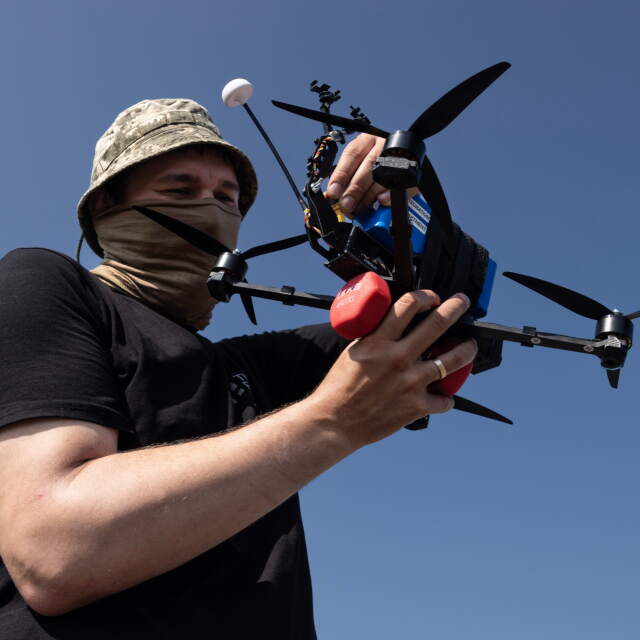
The episode asks whether Ukraine should use AI in battlefield weapons amid fears that AI could start making battlefield decisions. It visits Ukraine’s defense tech sector, focusing on an AI-powered FPV drone company, Fourth Law in Odd Systems, led by computer scientist and serial entrepreneur Yaroslav Ažnuk (formerly co-founder of PetCube, smartphone pet cameras). Background: Ažnuk shifted from consumer tech to defense after Russia’s 2022 full-scale invasion.
Ukraine needs AI for an edge and to respond as fast as Russia; their drones use image recognition and onboard “simple tools” (deep learning trained on combat footage) to lock onto and guide targets, with pilots selecting targets and safeguards to prevent “rogue” behavior.
the Lupinys 10 TFL-1 strike drone; a test where the system locks onto and flies to a moving car after pilot selection.
Yaroslav Ažnuk; “STAB” (call sign) and “Professor” (drone pilot) from the company’s testing team.
Written by AI. May contain mistakes.
Discussing the transformation of weapons in the Ukraine conflict.
“Should Ukraine use AI in its battlefield weapons?”
Addressing fears around AI making battlefield decisions soon.
“And as the conflict has gone on, the weapons on the battlefield have transformed rapidly.”
Exploring a company in Ukraine that produces AI-powered drones.
“Advocates for AI say Ukraine cannot say no to a technology that could give them an edge over a much bigger enemy.”
Introducing Yaroslav Ažnuk, a tech entrepreneur turned defense innovator.
“He's 37, a computer scientist and serial entrepreneur who spent years in Silicon Valley.”
Details on the development of autonomous drones and their capabilities.
“And so now we're making not cameras that fling trees, but cameras that fling explosives to people who came to occupy our land.”
Understanding how AI technology is integrated into modern warfare.
“His team has developed a widely used strike drone called the Lupinys 10 TFL-1.”
A firsthand look at the testing of AI-powered drones on the battlefield.
“The fourth law has named all of its weapons after Ukrainian intellectuals and artists killed or persecuted by Russians in the last century.”
Discussing public concerns and ethical implications of AI in warfare.
“The company asked NPR not to reveal this location or the identities of those who work here for security reasons.”
Emphasizing the need for Ukraine to adopt AI to keep pace with threats.
“Like, they're no more likely for a Terminator uprising than a warehouse with artillery shells.”

Get the gist, explore an idea or ask about something said.
 Claude
On State of the World from NPR, what are the key points of this episode?
Searching your listeningAutomatic transcript. May contain errors.
0:00Unregulated merchant cash advances are trapping small businesses in crushing debt. One business owner learned the hard way. This plan only works on naive and honest people. On the Sunday Story, inside the unregulated world of merchant cash advances. The Sunday Story from the Up First podcast. Listen now on the NPR app.
0:24Today on State of the World. Should Ukraine use AI in its battlefield weapons?
0:33You're listening to State of the World from NPR, a human perspective on global events. I'm Greg Dixon. We're approaching five years since Russia's full-scale invasion of Ukraine. And as the conflict has gone on, the weapons on the battlefield have transformed rapidly. Russia invaded Ukraine with tanks. Now drones and hypersonic missiles are used. And so it's no surprise both sides are now using weapons powered by AI, a fact which has many people worried, including Ukrainian President Volodymyr Zelensky. He's warned that AI could start leading decisions on the battlefield as early as next year.
1:12Advocates for AI say Ukraine cannot say no to a technology that could give them an edge over a much bigger enemy. NPR's Joanna Kakisos takes us to Ukraine to visit a company that makes AI-powered drones and learn how these weapons work. It's a good microphone. It's almost like a weapon. We meet Yaroslav Ažnuk in a conference room, and for security reasons, he asked us not to reveal much else about the location. He's 37, a computer scientist and serial entrepreneur who spent years in Silicon Valley. Before the war, he was known for co-founding a successful company called PetCube,
1:55which makes smartphone-powered cameras that watch and even entertain your pets. These cameras allow pet parents to watch their pets when they're not at home and fling treats to them and shine a laser toy for them. Then, in 2022, Russia launched its full-scale invasion of Ukraine and Ajnouk, like many Ukrainian tech leaders, turned his focus to the defense space. I was like, OK, I got to move on from my role as the CEO of PetCube and do something to protect my country. And so now we're making not cameras that fling trees, but cameras that fling explosives to people who came to occupy our land. The cameras he's talking about are part of an image recognition system incorporated into first-person view or FPV drones.
2:39This year alone, Ukraine will produce over 7 million of FPV drones, those small drones. They've fully transformed the battlefield and they have become, for our era, what the tank or machine gun have become for World War I. Ajnuk runs the defense tech firms, the fourth law in odd systems. We are the leaders in autonomous drones and thermal cameras. We're number one in Ukraine, maybe to some extent close to the top globally. His team has developed a widely used strike drone called the Lupinys 10 TFL-1. It combines a small, affordable FPV drone with an autonomous terminal guidance system. That means the drone has an onboard computer and AI technology that takes control during the final phase of the flight.
3:32But it's very different from, say, the kind of AI that sits on those data centers that power Claude, or even the kind of AI that does self-driving for your Tesla. Ajnouk says the AI technology in his company's drones uses simple tools to recognize images and make smart software. Which then allows you either to navigate autonomously without a human, or to choose a target autonomously or to fly towards a target autonomously. Dozens of Ukrainian military units already use the fourth law's autonomous drone, which is named after the 20th century Ukrainian poet Anatoly Lupinis. He endured decades of Soviet imprisonment and torture.
4:19The fourth law has named all of its weapons after Ukrainian intellectuals and artists killed or persecuted by Russians in the last century. It is important for us to help to resurrect those people. They're still with us. Their ideas are still with us. And they're now fighting back.
4:42The company's teams test the drones every day. We meet one team in an overgrown field outside Kiev. They've set up a fold-out table near a copse of trees and a hornet's nest. A slight, sandy-haired man greets us.
5:14He uses the military call sign STAB. The company asked NPR not to reveal this location or the identities of those who work here for security reasons. Stab points to a drone. So you see here is our camera plus a microcomputer inside. Oh, there it is. Oh, there it is. And all of the mind is here. The microcomputer inside the drone runs on a deep learning neural network that's been fed hours of combat footage. That's how it recognizes targets. A target is like vehicle, light armored vehicle, tank, and flying object, etc.
5:59The drone begins its flight guided by a pilot. He also asked us to use his call sign, Professor. The pilot is the one who selects the target. He guides the drone with a control stick. Professor checks a video monitor. There's a red flash. Is it locking there? Yeah, it's locked, and if you see, the system is working by itself. The drone has locked onto the target.
6:28A dilapidated car that a company employee is driving along a dirt road. Professor puts down the control stick, and the drone flies itself to the car. The microcomputer inside constantly runs algorithms to keep it on course.
6:47Stab says AI drones are useful because they're hard to jam, and he insists there are safeguards in place so the drones don't go rogue. It's very obvious for the public to be concerned about... Back at the conference room, Gatoslav Ashnuk says it's obvious the public is concerned about the dangers of AI. Any kind of tool can be used for good or for bad, and in the end it's the human that decides how to use that tool. And he says his company's AI-powered drones are not economist killer robots. They're very far from a Terminator kind of scenario, right? These are just sort of calculators. Like, they're no more likely for a Terminator uprising than a warehouse with artillery shells.
7:36He does, however, acknowledge that AI warfare is developing quickly. It's not unthinkable to imagine that some years in the future there will be drones that will be able to make their own decisions about designating something as a target or not. And Ukraine must keep up, he says, because Russia is also using AI-powered drones to attack. If we're not able to react just as fast, we have lost. And obviously after we've lost, there is no way for us to argue about the ethics of AI. The most important thing he says is, don't die. Joanna Kikisis, NPR News, Cave.
8:27That's the State of the World from NPR. Thanks for listening. Stay tuned for the following announcements and messages from our sponsors. This message comes from Thumbtack. Avoiding your unfinished home projects because you're not sure where to start? Thumbtack knows homes so you don't have to. Don't know the difference between matte paint finish and satin? Or what that clunking sound from your dryer is? With Thumbtack, you don't have to be a home pro. You just have to hire one. You can hire top-rated pros, see price estimates, and read reviews all on the app. Download today. You are the public in public radio and we want you to see behind the scenes.
9:08One lucky winner and their guest will come and tour NPR headquarters, watch a live taping of All Things Considered, and have lunch with an NPR journalist. Enter at npr.org slash giveaway. No purchase or donation required for entry. You must be 18 years or older to enter. Links to the entry page and official rules can be found at npr.org slash giveaway. This message comes from IXL. IXL provides personalized learning and powerful insights that help teachers boost achievement and understand student progress in real time. Learn more at IXL.com slash NPR.