 State of the World from NPR
30 Jun 2025 · 6m


 Add vo to ChatGPT or Claude to ask about everything you hear
vo listened to this episode to put together the overview and transcript, so there may be the odd mistake.
Russia’s largest weekend bombardment of Ukraine, involving over 500 drones and missiles, and how Ukraine is responding.
Joanna Kakissis (NPR Ukraine correspondent), interviewed by Scott Tong (NPR).
Kakissis is NPR’s Ukraine correspondent; Tong is an NPR journalist who conducts the on-air interview.
at least six civilians killed and at least a dozen injured; Ukraine lost an F-16 and pilot Maksim Ustimenko, who shot down seven targets; Russia is using mass drone/missile waves to overwhelm air defenses and deplete ammunition, including decoys.
Odessa speedboat air-defense team against Iranian-designed Shahid drones; Ukraine’s drone attacks on Russian airfields and heavy bomber jets; Kherson residents using FPV drone alert devices; Zelensky says Russia targeted cities with nearly 2,500 drones/missiles/guided bombs in a week.
0:00Today on State of the World, Russia's largest bombardment of Ukraine.
0:08You're listening to State of the World from NPR. We bring you the day's most vital international stories up close where they're happening. It's Monday, June 30th. I'm Greg Dixon. Over the weekend, Russia attacked Ukraine with over 500 drones and missiles. The Ukrainian Air Force said it was the largest air assault since Russia's full-scale invasion began over three years ago. Russian bombing of Ukraine has increased over the last few months. For an update on this most recent attack and on where things stand in the war, we're going to hear from NPR's Ukraine correspondent, Joanna Kakissis. She spoke to Scott Tong.
0:46What casualties do we know about? Well, Scott, at least six civilians were killed in these strikes, and at least a dozen were injured. Ukraine also lost an F-16 fighter jet and its pilot, 32-year-old Maksim Ustimenko, who shot down seven aerial targets before his plane went down. Now, despite the scale of this weekend's attacks, fewer people were killed or wounded compared to previous attacks, including ones here in Kiev. There was one earlier this month, for example, where 28 people were killed just in the city and more than 100 were wounded. However, President Volodymyr Zelensky has said that in the last week alone, Russia has targeted Ukrainian cities with nearly 2 ,500 drones, missiles, and guided bombs.
1:29So that's a lot of airstrikes per day. It is a lot. And I'm reading Russia is sending a lot of drones not just to attack, but to be decoys to try to confuse Ukrainian air defense. Why is Russia launching so many air assaults these days? Well, military analysts have said that Russia is also trying to overwhelm Ukrainian air defense by trying to get them to deplete their munition stockpiles, like to use as many as possible. Now, I should explain that in most Ukrainian cities, the military tries to protect the skies using anti-aircraft missiles and these guys with machine guns moving around on trucks.
2:05We also went to the southern city of Odessa recently. It's Ukraine's main port on the Black Sea. And there the Navy has an air defense team on speedboats, and they patrol the Black Sea and try to shoot down these Iranian-designed Shahid drones using machine guns mounted on the speedboat. We joined the speedboat air defense unit on a patrol recently and spoke to the commander Ilya. We are using only his first name at the request of the Ukrainian military, which cites security reasons.
2:38He's telling us that Odessa does not have enough air defense on land, so it's really up to the speedboat unit to intercept Shahid drones. And he said the Russians are now sending the drones in such big groups, he says, that it's impossible to shoot them all down. Well, all these drone strikes and defend itself. You know, I'm reading Ukraine is seeking to buy patriot air defense technology from the United States. But more broadly, how can Ukraine defend itself from all of these drone attacks? Well, in addition to, you know, these air defense units that I mentioned earlier, Ukraine is using drones to strike at Russia's war machine, drones that they've developed themselves.
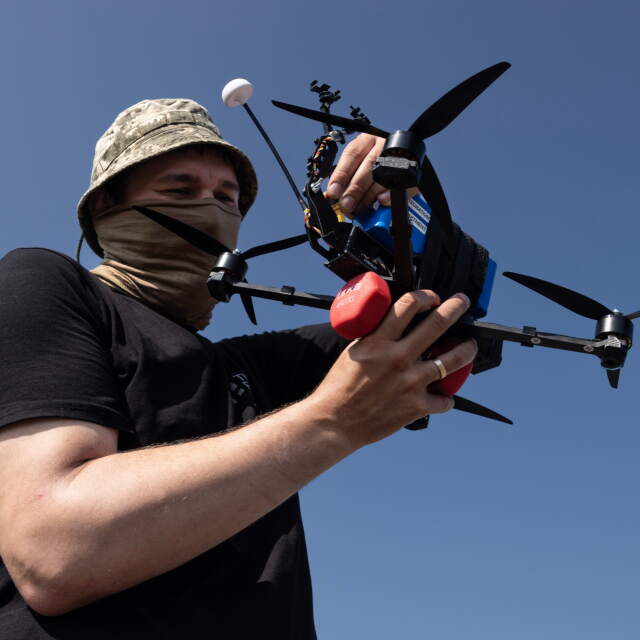
3:17Earlier this month, Ukraine actually pulled off a very bold operation that involved using very cheap drones on Russian airfields, and they targeted Russian heavy bomber jets that are used to launch missiles at Ukraine, and they damaged some of these jets. The Ukrainians have also attacked Russian oil depots and ammunition sites, and also the Crimean Bridge, which is a supply route for Russian troops. And on a very personal level, Ukrainians are also investing in gadgets to protect themselves against drones, for example. We recently visited the southern city of Kherson, and this is perhaps the most dangerous city in Ukraine.
3:52So it's going to be bang again. Don't be afraid. That's Anastasia Kravitz. She actually runs a Cirque du Soleil style circus in Ukraine and she lives in Kherson. Oh my goodness. Yeah, a bunch of little kids apparently are enrolled. And she and other residents of the city, they carry around these devices that alert them when a Russian FPV drone is near. Now these drones hunt down residents in the city and it's absolutely terrifying. So these devices help them seek shelter. Kravitz told me about one of her students who is in grade school and who has learned how to manage these attacks. She's 10 years old, but she knows where it flies, what is flying, which missile is going, how to hide from drone.
4:36So people in her zone carry these devices with them in their purses. They clip them on their vests, in their cars. And these devices beep whenever a drone is near and lets people know how far away that drone is so they can seek hard cover immediately. Oh, my goodness. And, Joanna, just briefly, peace talks. President Trump had been pushing them between Ukraine and Russia. Where is that conversation now? Well, you know, Russian President Vladimir Putin says he's ready for a new round of peace talks, but it's not clear when they're going to resume. Now, representatives of Ukraine and Russia have already met for two rounds of ceasefire talks in Istanbul and agreed to prisoner exchanges, but there's no sign that a ceasefire is near.
5:20That's NPR's Ukraine correspondent, Joanna Kakisos. Joanna, take good care. Thanks very much. Thanks for having me on the show.
5:31That's the State of the World from NPR. Thanks for listening.
Scan the code with your iPhone camera
Listen in the app.