 Ask ChatGPT

People-powered, proactive healthcare—how businesses (not just healthcare firms) can help individuals take agency over health using wearables, AI guidance, and better trust/data practices.
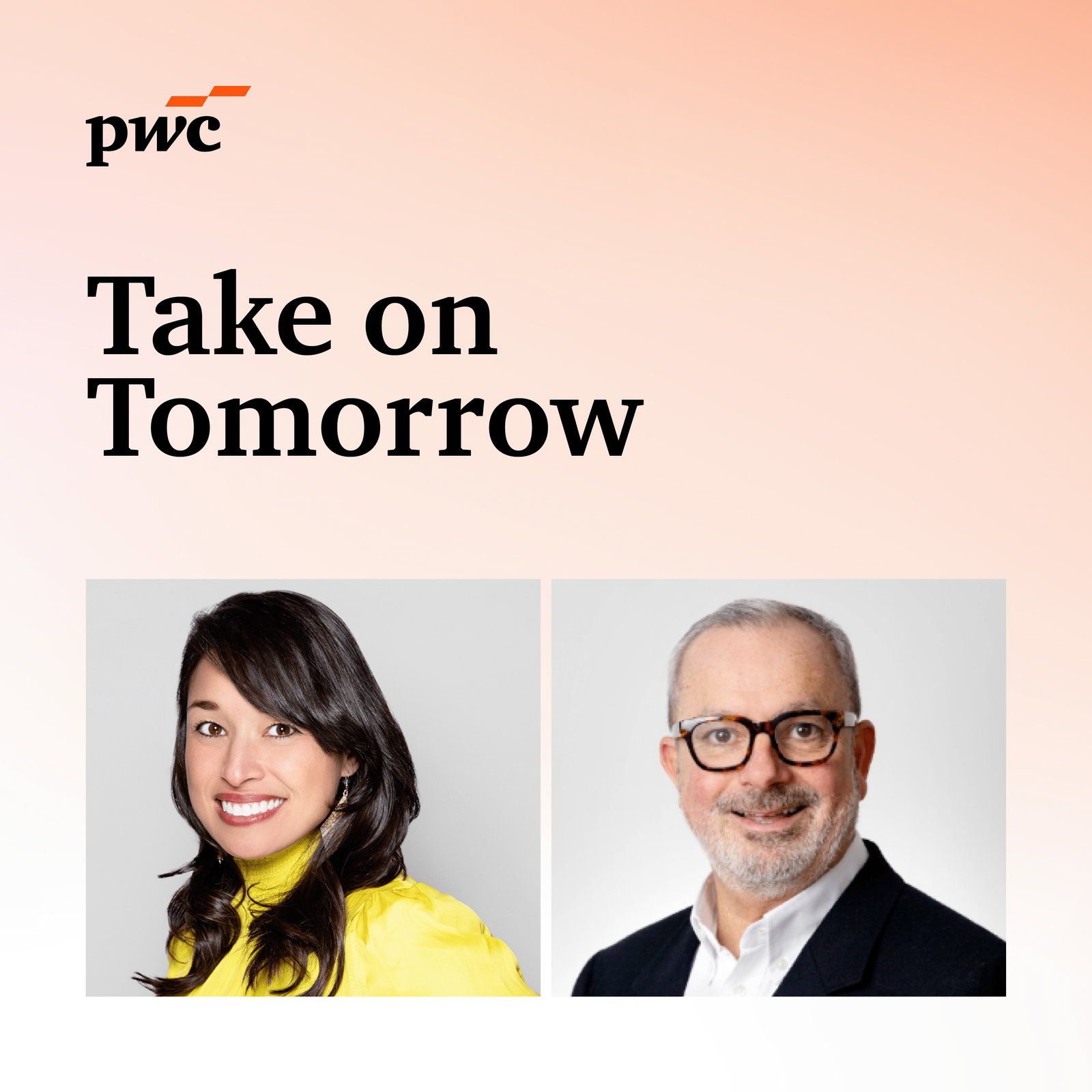
Anthony Bruce, PwC UK Global Health Industries Leader; Dorothy Kilroy, Aura Smart Ring chief commercial officer (Aura); hosts Femi O’K and Lizzie O’Leary (broadcaster/journalist; podcaster/journalist).
Most people lack a personal health baseline; technology (AI, wearables) enables 24/7 tracking and earlier detection; consumerization can improve access and outcomes without replacing clinicians; trust, education, and secure, transparent data handling are essential.
Aura tracks 50+ metrics; NBA partnership (2020) boosted cultural adoption; “cardiovascular age” (arterial stiffness) shifted one user from +5 to -7; women’s health longitudinal data; AI care layer for on-demand clinical questions; members report ~20% alcohol reduction; wearable insights can prompt clinician validation (e.g., cancer detection).
Written by AI. May contain mistakes.
Discussion on the evolving healthcare landscape and the role of technology.
“And this is Take On Tomorrow, the podcast from PwC.”
Exploration of how wearable technology has changed personal health tracking.
“Anthony, we're going to come back to you for more on what all businesses can learn from this shift.”
Insights from the Aura Smart Ring's CCO on market challenges and strategies.
“There was many moments, sort of a series of signals that compounded.”
The importance of consumer data in proactive health management.
“And it's been kind of the sustainable path for our growth.”
Discussion on how personal health data impacts individual choices.
“You know, a traditional sort of doctor's visit, you think about once a year if you're lucky, and it's often sort of a five to 10 minute appointment.”
The challenges of interpreting health data and its emotional impact.
“And so I think it's always interesting to assume that there's sort of this worried well group, but actually our data just does not suggest that at all.”
Learn about the necessity of recovery for overall performance in various areas of life.
“We're always trying to improve ourselves, better ourselves in whatever area of our career we're in.”
Discover how consumer involvement is changing healthcare dynamics.
“Dorothy Kilroy, thank you so much for your time.”
Understand the importance of trust in health data management and technology adoption.
“What lessons are there in the health industry for leaders in other industries who are also looking for new ideas and new ways of creating value?”
Explore the advancements in healthcare technology and their real-world impacts.
“If you look into the future, where do you see the next wave of momentum building in health?”
Learn key lessons from the healthcare sector that apply to other industries.
“You are a business leader in the healthcare sector.”
Reflect on how discussions around health can inspire personal shifts in mindset.
“Anthony Brees, thank you so much for joining us.”

Get the gist, explore an idea or ask about something said.
 Claude
On Take on Tomorrow, what are the key points of this episode?
Searching your listeningAutomatic transcript. May contain errors.
0:01Health care has been historically something that happens to you, not something you participate in, and people really want that agency. It's businesses large and small, all engaged in this endeavour really to drive up population health and access to health care. The average person really doesn't have a good baseline understanding of their health. From werewolves to home testing, the way we take care of ourselves is changing. Tracking your health is no longer something you only do during a doctor's visit. It's part of our daily lives. Are businesses ready for this revolution, even those beyond the healthcare industry?
0:41I'm Femi O 'K, a broadcaster and journalist. And I'm Lizzie O 'Leary, a podcaster and journalist. And this is Take On Tomorrow, the podcast from PwC. This season, we're looking at how business can build momentum around bold ideas. Today, the healthcare industry is going through a major shift. There's more power in the hands of everyday people.
1:10Later, we will hear how the Aura Smart Ring has created a new way of monitoring our health from the company's chief commercial officer. But first, to get a finger on the pulse of the current healthcare landscape, here's Anthony Bruce, Global Health Industries Leader from PwC UK. Anthony, so good to have you. Welcome. Thank you. Anthony, what has changed in the last few years that's making a people-powered health system possible now? I think a bunch of things have changed and are coming together. Technology is becoming much more personal. It's with us every day, it's 24-7, and it's much more pervasive than it was.
1:52You don't need to open a newspaper or look at the internet without seeing the emergence of new AI capabilities. A third thing I would say is consumer expectations, patient expectations are shifting dramatically. What does this mean for all types of businesses, though, not just those that happen to work in health? retailers are getting much more engaged in the health agenda whether it's through over-the-counter drugs whether it's through a much more engaged consumer who comes into a store with a very specific set of questions and and or requests technology businesses are moving capital into healthcare also new platforms are emerging large language models for example with a healthcare spin are being launched.
2:40So I think it's businesses, large and small, all engaged in this endeavour really to drive up population health and access to healthcare. Anthony, we're going to come back to you for more on what all businesses can learn from this shift. But now let's look at the tech driving it. Today, it's wearables. And I'm thinking of things like smart rings or watches, for example, allow us to track our sleep, our heart rate, even predicted if we're getting ill. And these tools are really popular. You cannot miss them on fingers and wrists, but they weren't always so common. So what moved wearable healthcare tech from the margins to so many of us taking part?
3:22To find out, I spoke to Dorothy Kilroy, the chief commercial officer at Aura, the company behind the Aura smart ring. The Aura ring is a smart ring that tracks more than 50 health metrics, from daily step counts and heart rate to how you're sleeping each night. We began by talking about what it took to build momentum around their ring.
3:45It took many years to prove two things simultaneously. One, that the science was rigorous, and two, that you'd actually want to wear it every day. The NBA partnership in 2020, that was sort of a pivotal cultural moment for Aura. People seeing them on players? Yeah, exactly. You know, it wasn't just because of the athletes, but because it showed that Aura could perform under pressure in a real-world setting, right? This was sort of COVID, and it was a really pivotal cultural moment for Aura. We've had over 80 peer-reviewed studies now that feature Aura's technology, and it matters when you're asking people to wear something that they're going to base their health decisions on the data.
4:27Was there a moment that the company realized, oh, this is more than sort of a niche thing, that you are building real momentum, and not just in terms of the device, but also in terms of thinking about health, thinking about those metrics that you're talking about. There was many moments, sort of a series of signals that compounded. I mentioned sort of the NBA bubble and the pandemic. That was a big change fundamentally in how people relate to health. People realized they almost had no baseline of their health, no way to know what normal looked like for them personally, which made it impossible to know when stuff was off.
5:08Women's health was another one of those big aha moments for us. So we created products around her cycle, pregnancy mode, and then researched back understanding how physiology changes with the biometrics. We've had other big moments where we've had breakthroughs in science of the types of features that we're measuring. I'll give you a good example. We have a cardiovascular age feature, which is measuring the arterial stiffness. Your arteries have a lot of elasticity and as you age, they get more rigid. And so giving people an understanding of where that is against their baseline. And then when they start to see their habits change and how that moves.
5:47Personally, I'll tell you my story on this. I started with a plus five cardiovascular age. So my arterial stiffness was five years older than my biological age versus my sort of peer set. And I really focused on cardio fitness. I had kind of neglected it, you know, with the struggles of sort of job responsibilities and raising a young family and aging parents. And I was able to move that to a minus seven. And it was really empowering and motivating to see that it was actually that sensitive that it could move. I'd like to hear a little bit about, honestly, some of the bumps along the way. One of the things that our listeners really take from this is like, okay, how does a company face challenges and then learn from them?
6:33So are there, I guess, big challenges that you think about in terms of bringing Aura to the market? And what did you learn from them? You can't just sell a better product when nobody knows that the category exists. You actually have to educate people on what they need, something before you can tell them why yours is the best. And what we learned was form and function cannot be trade-offs. Health technology only changes behavior if people trust it enough to act on it. And people only trust it if it feels as good as it works. We also learned that the market education is a long game. The bet on scientific credibility felt slow at the time.
7:11And in retrospect, I think it's given us sort of this distinct advantage versus our competitors. And it's been kind of the sustainable path for our growth. I want to talk a little bit about how Aura fits into the healthcare system. The traditional healthcare model is reactive. We get sick, we seek treatment. What have you all seen from consumers about why people are looking for more data about their bodies, more kind of proactive insights. Yeah, I think that this is the really interesting insight that has been an accelerant to our business, people taking health literally into their own hands. It's made what has been invisible health risks suddenly visible and personal.
7:55And people realize the traditional health system wasn't built to catch those problems. It serves you when you are sick. We call it sick care, but it really doesn't bring proactive health care and empower the actual user with their data. There's just a deep frustration in this. Healthcare has been historically something that happens to you, not something you participate in. And people really want that agency. For women, this is even more charged. Women have been chronically underrepresented in clinical research. And many foundational health studies have been conducted primarily on men. Wearables have this really great opportunity to close that gap.
8:31You know, we have longitudinal data across millions of women now across a broad spectrum of time. And when you start to get that population data on scale on the female physiology that's never existed before, it gives you this other unique advantage that isn't just sort of a snapshot of a doctor's visit, but actually over time. We don't believe that consumerization of health is about replacing doctors. We think it's about giving the individuals actually better tools themselves so that when they do spend time with clinicians, they're more informed, they're more targeted, they're more useful. You know, a traditional sort of doctor's visit, you think about once a year if you're lucky, and it's often sort of a five to 10 minute appointment.
9:12And the doctor's not with you 24-7, helping guide your decisions every day, whether that's, you know, taking a walk after a meal, when you open the fridge, what you choose to eat, how you manage stress, all of those lifestyle habits that stack up. I think that's what's different about Aura. It's with you 24-7. I want to learn a little bit more about the sort of anticipatory predictive features. Like how does that work if you are tracking your data and then what the AI tells you, here's what I see in that pattern? What we have found is that you also want to go further and ask not just sort of wellness type questions, but you also want to ask clinical questions.
9:56So one of the steps that we took is we integrated an AI-powered care layer into our advisor product. And that actually gives our members right there and then, whether it's, you know, I always think about nine o 'clock on a Saturday evening when your doctor's office is not open, but you have a ton of clinical questions, whether that is about your blood pressure, whether that is about your sleep, whether that's managing some other ailment or disease that you may have. and you have that sort of on-demand medical guidance. And when you need to go further, you can actually take that clinical evaluation or medical treatment and Aura will connect you then with a licensed physician in this partnership.
10:37I think for anyone who is looking to understand their health, there is a fine balance, right? Between like, get as much information as you can about yourself, but also don't go overboard into crazy rabbit holes that turn you into a paranoid person. How do you thread that needle as a company to serve your members but not overload them? What is always surprising is how many of our members are actually managing a chronic condition and they're anything but the worried well from diabetes or battling cancer or challenged with other sort of ailments in their life, whether that's a fertility journey or some sort of phase of life like perimenopause.
11:18And so I think it's always interesting to assume that there's sort of this worried well group, but actually our data just does not suggest that at all. I think that actually most people, the average person really doesn't have a good baseline understanding of their health, right? Many people struggle with their relationship with alcohol. And although we have plenty of data to suggest that this is not good for our health, it's still a hard thing socially and culturally to understand how it impacts us individually. Our members, we find, have a 20 % reduction in their alcohol and some even completely abstain from it because they start to see what actually impacts their health.
11:59And I'll give you an example. I'm somebody who, when I have an alcoholic drink, my heart rate goes up by about 10 beats, which is a huge difference. My husband, as an alternative, he doesn't have that reaction, and actually it doesn't impact him so profoundly. And so it's very individual. And so I think without that data, you can't fully understand, you know, what is the impact of that on your life. There is concern, though, that I have heard from doctors, for example, and this is a different example, but I'll give it to you. I have had cancer. I'm fine. But when I go and get my CAT scan, my doctor likes to say, don't open the chart before I'm with you because this is complicated because the emotional and physical possibilities of you processing that information alone is a lot.
12:46Do you worry about that at all of people kind of being flustered by their own health data? We certainly think about it. And I think this comes to the kind of the tone on and the rigor that we put into how we communicate with our members. We have found, Lizzie, though, some of our members who have discovered based on sort of a disparate set of symptoms with their aura data that they actually have cancer. and they've taken that data into their clinicians and said, hey, look at this. And so I think about those people who can use that data to say something doesn't feel right and have some kind of like independent validation of that and then be able to use that.
13:28Before I let you go, I'm really curious. Are there things you have learned about yourself that have surprised you or that you never really thought about before until you started tracking yourself? Yeah, you know, I was an avid marathon runner in my 30s, and I thought health meant doing more. And when I started to wear an aura ring, I learned about recovery and stress was really a way to sort of manage my actual performance in every part of my life, whether that was my, I sort of think of all of us probably listening on this are like corporate athletes, right? We're always trying to improve ourselves, better ourselves in whatever area of our career we're in.
14:14And then your home, your connections at home, your connections to your family. And in my mind, I always thought do more, work yourself to your brink. But actually, what I learned was recovery was just as an important part of any sort of performance, whether that was athletic performance, career performance, wherever that was happening. So I just learned I needed to spend more time recovering and to actually schedule that and to not feel guilty about it in a culture where we're sort of so go, go, go. I think you just described like the constant dilemma of the type A mother. Right, right. The juggle is real.
14:50Dorothy Kilroy, thank you so much for your time. Real pleasure. Thank you, Lizzie.
14:56Anthony Brice, welcome back. Dorothy talked about healthcare moving from something that happens to us to something that we actively participate in. This ability to keep a check on how we're doing physically, it's become known as the consumerisation of health. What does that mean for the kind of work that you do and also for the health industry in general? I think what we're seeing is a real drive and engagement with people in their own health. So for me, it's significant change for pharmaceutical companies, for healthcare companies, etc, etc. But I also have a huge degree of optimism that it can help make care more accessible, lower the price point and make it more pervasive.
15:43And what that's going to do over time, if we can reconfigure health systems around it, it's going to improve health outcomes and longevity and take some of those societal ills away. So I'm hugely optimistic about it. What lessons are there in the health industry for leaders in other industries who are also looking for new ideas and new ways of creating value? I guess a few things. The winners in this area and the generalizable point that you're asking about is about being really centered around, in this case, the patient or the consumer. Where is demand shifting to? Because it's shifting fast, staying really close to how people want to consume their health, where they want to engage with it, and what technology devices might they want to.
16:33That applies to banking and it applies to other sectors. The second thing is trust. If we can build trust and health is so personal, in some cases very confidential and very sensitive and governed by a number of regulations and so forth. But if we can build trust around health data and the sharing of it, we'll be better able to drive adoption. Actually, we are told as consumers to protect our data, to be sceptical, to be wary about where we leave our information online. So how does a company build trust with users who are told, be careful what information you give out about yourself? We did a consumer health survey recently, and that came out as one of the number one barriers to innovation here.
17:22So we can create the technology, we can create the platforms and organizations are doing that. But unless they can show that they are treating people with respect, that the data is securely held, that they're transparent about that, and that they are very open about what they're doing with the data and not doing with the data, because that is the key thing that organizations need to do. need to be focused on. If you lose that, it's very hard to build and very easy to lose. If you look into the future, where do you see the next wave of momentum building in health? Which ideas maybe feel really specialized today, but could be mainstream tomorrow?
18:02I think there's a couple of things. The use of technology in drug discovery, taking the process and cost and effort and time involved in pharmaceutical companies is taking sort of 10 years if you can do that using technology people are seeing that time scale coming down low years and months now we're some way off doing that at scale but think about the access to life-saving life-changing medicines if we can do that at scale across a number of different therapeutic areas. And then actually kind of going all the way the other way, I was talking to my mum and dad earlier about them being able to do a consultation with their GP from home because my mum wasn't feeling well, couldn't get to the doctors.
18:54A simple thing, a video interview with a GP, these things can mean somebody can get an opinion that's reassuring, get a prescription without having to wait three weeks or six weeks or get a bus to the GP surgery. So I think both high tech at that end of the spectrum, the drug discovery end, but real world impact in terms of real life, real people today. You are a business leader in the healthcare sector. So you know what is possible, what the innovations are. But for other business leaders outside of health, what are the two or three lessons that you could share or point to that we can learn from?
19:37I think the first would be obsess about your patients, your consumers and your customers. You look at the uptake of GLP-1s, which has been faster than mobile phones. People didn't see that coming. Two or three big players got really close to their customers and followed them fast and made something available to them and are generating significant return. So in that case, stay close to the consumer and really obsess about what they care about, what they want and what they're prepared to trade. Move fast and follow that. That's about experimentation in a targeted way around what's the problem we're trying to solve.
20:15And then thirdly, the piece around trust and safety. So I think for leaders, it's got to be keeping close to your customers and moving at pace and sustaining and building trust in your brand and in the way you work. Anthony Brees, thank you so much for joining us. Thanks, Femi. That was a great conversation.
20:36Femi, I think listening to this episode, it makes me think about whether I need to take on an internal shift about how I regard my own health, as well as kind of thinking about this external shift of the products we use and the way we track our own lives. You know, I'm so used to sort of you make your annual visit and that's what you do. This is a very, very different mindset. And Lizzie, what my takeaway was, was that we often ask business leaders, how does that apply to all of us and all society? And with health, we're all involved. We don't have to look for an application that impacts society.
21:20And also it helps our awareness and our education as well. So that link between how is this important to us is a very short link. It's very obvious to see how AI and this kind of smart technology is impacting us already and will impact us more in the future.
21:45That is it for this episode. If we inspired you to think about your business in a new way, please follow Take On Tomorrow wherever you listen to podcasts. For more, you can visit pwc.com slash takeontomorrow. Next time.
22:01Dorothy Kilroy: In-space manufacturing is going to create a fundamental shift in the way that we think about almost all of our technologies. What happens when the space economy moves from frontier to foundation? And what are the industries that should be ready for takeoff? Take on Tomorrow is brought to you by PwC. PwC refers to the PwC network and or one or more of its member firms, each of which is a separate legal entity.
Most people only think about healthcare when something goes wrong. But wearables, AI, and other new technologies are giving us access to more information about our bodies and delivering it more frequently than ever before — putting more control over our health in our own hands.
In this episode of Take on Tomorrow we explore the momentum behind a people-powered health system. And we consider what happens as technology moves healthcare beyond the clinic and into our everyday lives.
Dorothy Kilroy, Chief Commercial Officer at Oura, shares how the company built a business model around a new category of wearable technology, and why providing a better understanding of personal health could change the way people interact with the wider healthcare system.
PwC's Global Health Industries Leader, Anthony Bruce, looks at some broader shifts taking place: how evolving consumer expectations and new technologies are reshaping healthcare, why businesses well outside the health industry have a role to play, and what it will take to turn innovation into better, more accessible care.
Take on Tomorrow is brought to you by PwC. PwC refers to the PwC network and/or one or more of its member firms, each of which is a separate legal entity. Please see www.pwc.com/structure for further details. © 2026 PwC.