 Ask ChatGPT



How AI is changing the “career ladder” by automating tasks, reshaping early-career learning, and increasing demand for human skills; culture and experimentation matter more than tool adoption.
Pete Brown, PwC global workforce leader; Melanie Rosenwasser, Chief People Officer at Dropbox (AI-powered collaboration platform).
AI is replacing tasks more than entire jobs; it accelerates getting to the “interesting bit,” but employees must still do the thinking. Adaptability becomes “new job security.” Early-career development should shift from learning via mundane work to earlier customer exposure, judgment practice, and feedback loops. AI-capable employees feel empowered, but trust in management can decline if intent isn’t clear.
Dropbox’s AI use case library; “AI Applied” competition (120+ submissions); “career compass” app generating career plans/mentor recommendations; Dropbox internship/new-grad expansion (~25%) and reported performance/promotion/retention advantages.
Written by AI. May contain mistakes.
Discussion on how AI is changing expectations around entry-level roles.
“Shortly, we'll hear from Melanie Rosenwasser, Chief People Officer at Dropbox, a collaboration platform for AI-powered work on how AI is redefining careers inside her own company.”
Exploration of how AI alters skills required and learning pathways for new employees.
“we're delighted to be joined by Pete Brown, PwC's global workforce leader.”
Pete Brown discusses AI's influence on job roles and employee confidence.
“sort of traditionally handled by people early in their careers, what happens to those first few rungs of the career ladder?”
Interview with Melanie Rosenwasser on AI's role in job market transformations.
“So there are a lot of headlines about AI replacing jobs.”
Discussion on the importance of adaptability and skills in the evolving job market.
“And they also demonstrate higher retention rates and higher engagement.”
Melanie shares lessons learned from AI adoption and fostering a culture of experimentation.
“And we're kind of starting to see roles converge as a result.”
Discussion on the balance between AI productivity and employee mental health.
“As you're experimenting with AI, how do you bring all the workforce along with that experimentation and that progress?”
Exploration of what the future work landscape may look like alongside AI.
“So as a remote-first company, we've redesigned gathering around this notion of analog, device-free experiences.”
Learn why staying rooted in the physical world is crucial in an AI-driven landscape.
“So building things, making things, playing sports, gardening, spending time in nature.”
Discover the human skills that companies like Dropbox are seeking in new hires.
“It was such a pleasure speaking with you.”
Understand how daily AI usage influences workers' confidence and job security.
“Is that approach being seen anywhere else?”
Examine the relationship between AI adoption, employee trust, and management.
“Well, first, Lizzie, I found that really encouraging.”
Learn how to engage skilled workers in an AI-focused environment.
“So I think people do need confidence and trust in the technology, but they also need that trust and confidence in the intent behind it.”
Find out how to empower employees to identify and solve work inefficiencies using AI.
“I love how you're challenging us to think about the momentum that AI is creating.”
Discover three key strategies for integrating AI and engaging employees effectively.
“Give them the tools, give them sensible guardrails and skills, and then ask them, what wastes your time?”
Explore how leadership can help employees thrive in an AI-enhanced workspace.
“Femi, when I listen to Pete and then also Melanie, one of the things that I'm thinking about is just sort of like what builds a good employee, an employee who wants to stay?”

Get the gist, explore an idea or ask about something said.
 Claude
On Take on Tomorrow, what are the key points of this episode?
Searching your listeningAutomatic transcript. May contain errors.
0:00AI is changing everyone's expectations around talent in general, and that includes early career talent. But it's not necessarily by eliminating those roles.
0:11Melanie Rosenwasser: AI can get people to the interesting bit faster, but they still have to do the thinking and organizations have to create an environment where they're able to develop those skills. Culture actually matters more than technology. So a lot of companies focus on tool adoption, but the biggest challenge is actually creating a culture where your employees can experiment. In many careers, progression is obvious. You start with an entry-level job, then work your way up the ladder to senior positions. But as AI automates simple tasks, the types of skills needed for these jobs are changing, with human skills like creativity and judgment in high demand.
0:52So are workers ready for the new types of roles AI is creating? I'm Lizzie O 'Leary, a podcaster and journalist. And I'm Femi Oke, a broadcaster and journalist. And this is Take On Tomorrow, the podcast from PwC. Today, how is AI reinventing the career ladder?
1:20Shortly, we'll hear from Melanie Rosenwasser, Chief People Officer at Dropbox, a collaboration platform for AI-powered work on how AI is redefining careers inside her own company. But before we get there, to help us understand what's happening across the wider workforce, we're delighted to be joined by Pete Brown, PwC's global workforce leader. Pete, welcome back.
1:46Melanie Rosenwasser: Thank you, Femi. Lovely to see you. So, Pete, there's a lot of worry that AI is going to eliminate jobs, especially at the entry level. When you look at the data around the world, what is actually happening? I think some of the data here is actually really quite encouraging. People that are using AI regularly aren't telling us that they feel less relevant. It's actually quite the opposite. it they're saying they feel more empowered and actually they have more confidence around their own job security now that doesn't mean that jobs won't disappear or change they absolutely will and we can't duck that but what we're seeing is much more immediately is that ai is changing the content of people's jobs so take something that perhaps used to take half a day pulling some research creating a first cut of a document.
2:39Melanie Rosenwasser: If AI can get me to that in 20 minutes, the job hasn't changed, but what I do with my time and what's expected of me has changed. So if AI is taking over some of these tasks, these routines that you're describing that are sort of traditionally handled by people early in their careers, what happens to those first few rungs of the career ladder? How do you learn how to be an employee? I think there's a very real and genuine issue here. And I see this firsthand actually at home. My 21-year-old daughter is going through exactly that, trying to work out how does she get onto the first rung of the career as she leaves university.
3:20Melanie Rosenwasser: and I think if I reflect back on how many of us learned we sat in lots of meetings we saw more experienced colleagues and a lot of that actually was pretty mundane and I wouldn't preserve that mundane work simply because we had to do it we were learning whilst we were doing that so if AI takes away some of the work people used to learn through what do we replace that experience with Can I get them in front of the customer faster into the discussion earlier? I'm able to ask them what do they think? Do they agree with what's being produced by AI? What's missing? And what would they recommend? Let them see how somebody with experience approaches the same problem.
4:02Melanie Rosenwasser: I think that creates a fantastic learning opportunity for colleagues as they join in the lower rungs of the ladder. It sounds like roles are being designed at rapid speed. To understand what that looks like day to day, I spoke to someone who's thinking about this in real time, Lizzie. Melanie Rossenwasser is the chief people officer at Dropbox. And we began by looking at how AI is actually impacting the job market, both at the tech company and beyond. Her answer might surprise you.
4:38So there are a lot of headlines about AI replacing jobs. I recently read something like there's been, you know, 175 ,000 AI-related layoffs in the last few years. But if you actually look at the labor market data, the percentage of actual jobs fully replaced by AI is like closer to zero. And it is true that AI is replacing tasks today, right, but not necessarily entire jobs. And as AI takes on more of the tasks within a role, jobs, teams, and organizational structures will change. And so because of this, I think about adaptability as the new job security. So as AI is automating routine work, I think the employees that thrive will continuously evolve and use AI to amplify things like judgment and creativity.
5:25There's definitely anxiety from young people going into the workforce about what will happen to their early career jobs. What would you say to anxious young people trying to get their first step on the job ladder? You know, AI is changing everyone's expectations around talent in general, and that includes early career talent. But it's not necessarily by eliminating those roles. So many of our interns and new graduates arrive already using AI to code and research and prototype. And this actually significantly accelerates their ramp time. So we're expanding our internship and new grad program by about 25 % because we see this cohort as a source of innovation and a pipeline for leadership.
6:13And actually our data reinforces this investment. So our emerging talent hires actually outperform external hires by their second year at Dropbox. 65 % are promoted by their second year, 87 % by their third. And they also demonstrate higher retention rates and higher engagement. And just in terms of engineering, a lot of our interns and new grads are in engineering. They actually commit two times more code and do so two times faster than comparable external hires. That's really impressive. Why do you think that anxiety still exists when in reality, young people, graduates coming into employment are more qualified to handle AI than perhaps older people who are already in the companies?
6:58We're all learning and we're all kind of making assumptions before we actually see it play out in real life. And so the assumption is sort of, oh, lower level work will all be automated by AI. And so therefore, you don't need entry level. Therefore, you don't need roles that perform more administrative tasks. But I think the real value is how do we then apply their talent differently from entry level tasks or admin type functions? And the capability is there. So education, it's doing its job by preparing students in the AI age. And then as employers, it's our job to then embrace that talent and basically enable it to thrive.
7:35I'm thinking about a career ladder and how people used to approach their careers and how they would plot it out. I'm going to do this and I'm going to have this milestone and I'm going to do this milestone. Has that career ladder changed now that AI is very much part of the picture? I think really what's happening is that AI is blurring the boundaries between job families. So this is making breadth increasingly as valuable or potentially even more valuable than depth, right, or specialty. And we're kind of starting to see roles converge as a result. One of the trends in the tech industry is this notion of a full stack builder.
8:15This is effectively an AI native like product creator that combines product management, design, engineering, customer insight to take ideas from concept to customer impact just on their own. So I think the future will be less about functional ladders and more about expanding capability where expertise will still matter, but you'll have to have some working knowledge across disciplines. But I think something that's really important is this notion of also testing for these innately human durable skills alongside AI skills. So it's things like awareness and judgment and adaptability and connection.
8:53Can you share some of the lessons that you've learned at Dropbox from experimenting with AI, experimenting with the workforce? What are the lessons that other companies could learn from the experimentation that you've been doing? I would say probably two things. So first, there's a lot of hype, whether it's headlines about AI replacing jobs or this sort of fallacy that AI immediately creates measurable ROI. We found that it's actually much more useful to just start from first principles. So what are the problems we're solving? What work are we trying to improve? And how do we actually redesign the work, not just layer AI on top of what's existing?
9:33So that's probably the first lesson. And the second is that culture actually matters more than technology. So a lot of companies focus on tool adoption, but the biggest challenge is actually creating a culture where your employees can experiment. They can share what works. They can redesign their own workflows, right? And there's this continuous learning loop that we all participate in together. And that's ultimately what determines whether AI is becoming just another productivity tool or whether it's truly transformational. As you're experimenting with AI, how do you bring all the workforce along with that experimentation and that progress?
10:08So I'll give you just a couple of examples of what we've done. We make it easier to apply AI in everyday work. So we have what we call an AI use case library. So this includes all of the workflows we've automated and all of the tools we've used to do it. And this gives employees practical examples that they can build on, right, rather than having every team start from scratch. We have this culture of experimentation. So we ran a competition called AI Applied, where folks would submit their workflows that they've automated with an AI tool. We had over 120 submissions, and the winning project was basically like a homegrown version of Mythos, which is like a security software, which handled hundreds of vulnerabilities in just a couple of months at a fraction of the cost.
10:54We also built something called a career compass. So this is an application, an AI app that puts employees in the driver's seat of designing their own jobs. So it helps them identify what to automate, which AI tool to use, what new responsibilities to take on, and which skills they need to develop. It even generates like a personalized career growth plan and mentor recommendations and even an updated job description. So instead of waiting for HR or your manager to redesign your role, employees have the agency to proactively shape it on their own. If we're looking at AI being more than just creating more efficiency, more productivity, that there's new services, new products, more money is coming into the company, that's AI.
11:39But what about the people part of that, the workforce? Yes. Do they have a role to play as well or is the AI doing the heavy lifting in this instance? I think the employees often are the architects of what AI is doing. But I think the other thing to really think about is the impact on well-being. There are things like cognitive atrophy where the fear is that we'll stop thinking for ourselves. But the opposite of that spectrum is brain fry, right, where humans never stop thinking. So we've added AI-specific well-being questions to our employee engagement survey to understand its impact on mental load and energy.
12:18The results showed that while employees feel that AI is improving their productivity, their work is becoming more cognitively demanding as routine work disappears. And lastly, we try to create intentional space for human connection. So as a remote-first company, we've redesigned gathering around this notion of analog, device-free experiences. So at a recent executive offsite, we actually replaced screens with reflection and visioning and relationship building. We even brought in a breathwork specialist. And the impact was actually significant. So feeling cared about by other executive team members went from 44 % to 100%.
12:58And we also looked at our communication pattern. So it shifted from scheduled meetings towards more spontaneous texts and phone calls, right, which is generally a measure of increased trust. Let's look into the future, 10 years from now. How will that balance between the workforce working alongside AI? How would that have changed? What will it look like? There's the technology dimension, which is, can AI do it? There's kind of this governance angle, like should AI do it? And then there's this humanity angle, like if AI can do it, then what should remain uniquely human? So I think there are probably a few things that we can do today to sort of protect our humanity as this transformation unfolds so that we have, you know, a future that's worth looking forward to, right?
13:45So the first is protecting our attention. So this notion of deep thinking is not just a competitive advantage. It's actually good for your mental health. I think the second thing is strengthening human relationships, right? So purpose often comes from being needed by other people, not just being productive. And then finally, and this seems very anti-technology, but staying rooted in the physical world, right? So building things, making things, playing sports, gardening, spending time in nature. I think the more AI pulls us into the digital world, the more intentional we need to be about staying connected to the real one.
14:18Melanie Rossenwasa, thanks for joining us. Thank you so much. It was such a pleasure speaking with you.
14:28Pete, when we listen to Melanie talk about how Dropbox is looking for more human skills, judgment, creativity, decision-making in their early career hires, how do workers develop those skills if they had not had the chance to learn them in a traditional entry-level role?
14:46Melanie Rosenwasser: Yeah, I actually agree with Melanie. I don't think judgment comes simply from doing repetitive work for for 10 years it comes from being exposed where you can create a view have it challenged watch how experienced people approach different situations and occasionally getting things wrong and learning from that and i think ai can actually help younger people get that learning much earlier in their careers if ai can produce the analysis great but then you're able to ask, well, so what? Do you agree with that analysis? What's missing? What would you do? That's where I think the judgment muscle is developed and nurtured.
15:25So Dropbox has found that because new hires are performing so well, they're actually expanding the internship and the recruitment programs that they have for young people because they're more likely to be familiar with AI and embracing it. Is that approach being seen anywhere else? Have you seen that in other companies, Pete?
15:48Melanie Rosenwasser: Femi, I think it's too early to say that there's one pattern across all employers. But I really like the Dropbox example because I think it challenges an assumption that AI, because it can do junior tasks, we therefore need fewer junior people. we spend a lot of time asking about how we prepare young people for an AI enabled workplace but some of those people are joining the workforce already comfortable using AI experimenting with AI and arguably they're more capable than many of the people in the organization they're joining so I think there's a question for leaders and for organizations to actually ask what can they learn from this talented workforce that's joining them.
16:32Following on that a little bit, PwC just released the Hopes and Fears report, which surveys 50 ,000 workers around the world. And it showed that workers who use AI daily feel more empowered and have higher confidence in their job security. What does that tell you?
16:48Melanie Rosenwasser: Well, first, Lizzie, I found that really encouraging. I'd be really careful to say that AI causes confidence. It may also be that confident and adaptable people are more likely to use AI regularly. But I think there's a very clear lesson for employers around the world that giving somebody access to AI and making them capable with AI are two very different things. You can buy 50 ,000 licences and give everybody that licence. That doesn't mean you've suddenly got an AI-capable workforce. PwC's Hopes and Fears Workers Survey also noted that trust in management was going down. What does that mean for upper management?
17:34Melanie Rosenwasser: I think this is one of the findings that all leaders around the world need to pay a lot of attention to. Of course, people need to trust the technology. Is it safe? Is it reliable? Is it secure? But I think there's another question, which is, what is my employer actually going to do with it? if you put yourself in the shoes of an employee you tell me that ai is going to make me 20 % more productive and i'm thinking well great what am i going to do with that 20 % does my job get better am i going to do more interesting work or i might also be thinking ah you need 20 % less of me does that apply to the whole workforce and i don't think that's a resistance to ai i think it's a totally rational response from a human being.
18:24Melanie Rosenwasser: And I think that's what makes the hopes and fears findings really interesting together, that people can be positive around using AI, which is what they tell us they are, whilst at the same time becoming less trusting of management. So I think people do need confidence and trust in the technology, but they also need that trust and confidence in the intent behind it. Your research also suggests that workers who have strong AI skills are among the most ambitious, but also the most likely to leave. So if you are an organization, how do you hold on to the people who have these skills, who are more likely to lead the transformation and have them motivate other colleagues?
19:05Melanie Rosenwasser: Lizzie, I think you get to part of the answer there in your question, actually, because I don't think retention is quite the right lens to put onto this. These are people who are naturally curious. They are often very ambitious. They learn quickly and they can see where things are heading. And they know that those capabilities have value. So rather than starting with a how do I retain them question, I'd ask what am I actually going to do and what am I going to focus them on to keep them engaged, give them real business problems, let them change how work gets done, give them opportunity to help other people in the organization.
19:43Melanie Rosenwasser: I really liked Melanie's example. I think more than 120 employees submitted workflows they'd automated using AI. And I think if somebody's worked out how to remove four hours from a process, I wouldn't just congratulate them and say, well, get back to your day job. I'd actually ask, how can I use that capability to actually help another hundred people in my organisation. And I think that's the opportunity and it's how the capability starts to spread across the organisation. I love how you're challenging us to think about the momentum that AI is creating. The momentum is with the workforce. So what's the bold idea that makes sure that leaders keep the momentum up?
20:29Melanie Rosenwasser: It's interesting, Femi, because I think there is a danger that the workforce is actually outpacing the ability of an organization to change and i think for me it people tend to adopt what they've helped to create i think far too often small groups disappear away they design an answer they build everything and then they you know near the end they suddenly say ah we need to get everybody to adopt this and they're surprised actually when that doesn't happen with ai the people doing the work are often those that know exactly where the frustrations and wasted effort are. Give them the tools, give them sensible guardrails and skills, and then ask them, what wastes your time?
21:09Melanie Rosenwasser: What frustrates your customers? What could get better? And where could AI help? So the people who are listening to this show are business leaders. And if you had to leave them with a few tips for building real momentum about how AI is shifting careers and shifting the career ladder, what tips would you leave them with? I think probably three pretty simple things. First, I would start with the work. What business problem am I trying to solve for here? What's not working? What's taking too long? And then I'd work out where the technology can help me on that journey. Secondly, invest in people as seriously as you're investing in the technology itself.
21:51Melanie Rosenwasser: Skills, experience, coaching, time to learn and experiment. And don't just invest in the enthusiasts, make sure that the core workforce is getting the opportunity as well. Third, involve people. Be straight about what's changing, including the difficult bits, and give people a genuine role in working out how AI can improve their work. For me, the opportunity is getting the technology, the organisation and its people moving together. Pete Brown, thanks for joining us. Thank you.
22:28Femi, when I listen to Pete and then also Melanie, one of the things that I'm thinking about is just sort of like what builds a good employee, an employee who wants to stay? Is it skills? Is it getting honest feedback from management and some sort of leadership and direction? And listening to both of them, they're talking about using these new tools, giving employees confidence, but then also, I would say, maybe guiding them in a way where they don't feel like they've just had a new tool thrown at them and their job is going to get harder and more complicated. And my takeaway was that the common narrative that AI is going to take your job is a fallacy in many respects because AI is creating more space for jobs and people to flourish and to thrive.
23:29If you get into it and experiment and play with it and then define how you would like your job to be. But that does need fabulous leadership for those two things to happen.
23:49If this episode had you thinking about your business differently, please follow Take On Tomorrow wherever you listen to podcasts. For more, go to pwc.com slash takeontomorrow. Next time. Imagine a future where your tasks get automated. Maybe fresh produce shows up on your doorsteps, where roads maintain themselves at night, where garbage bins take themselves out. What does our world look like with more robots in it? Take On Tomorrow is brought to you by PwC. PwC refers to the PwC network and or one or more of its member firms, each of which is a separate legal entity.
AI is redefining work. It’s changing the jobs people are expected to do, how they learn, and what it takes for them to move forward in their careers.
In this episode of Take on Tomorrow, we explore the ways in which AI is transforming the career ladder—and what happens as routine tasks disappear; as human skills like judgement, creativity, and adaptability become more valuable; and as early-career workers are asked to contribute at a higher level, sooner.
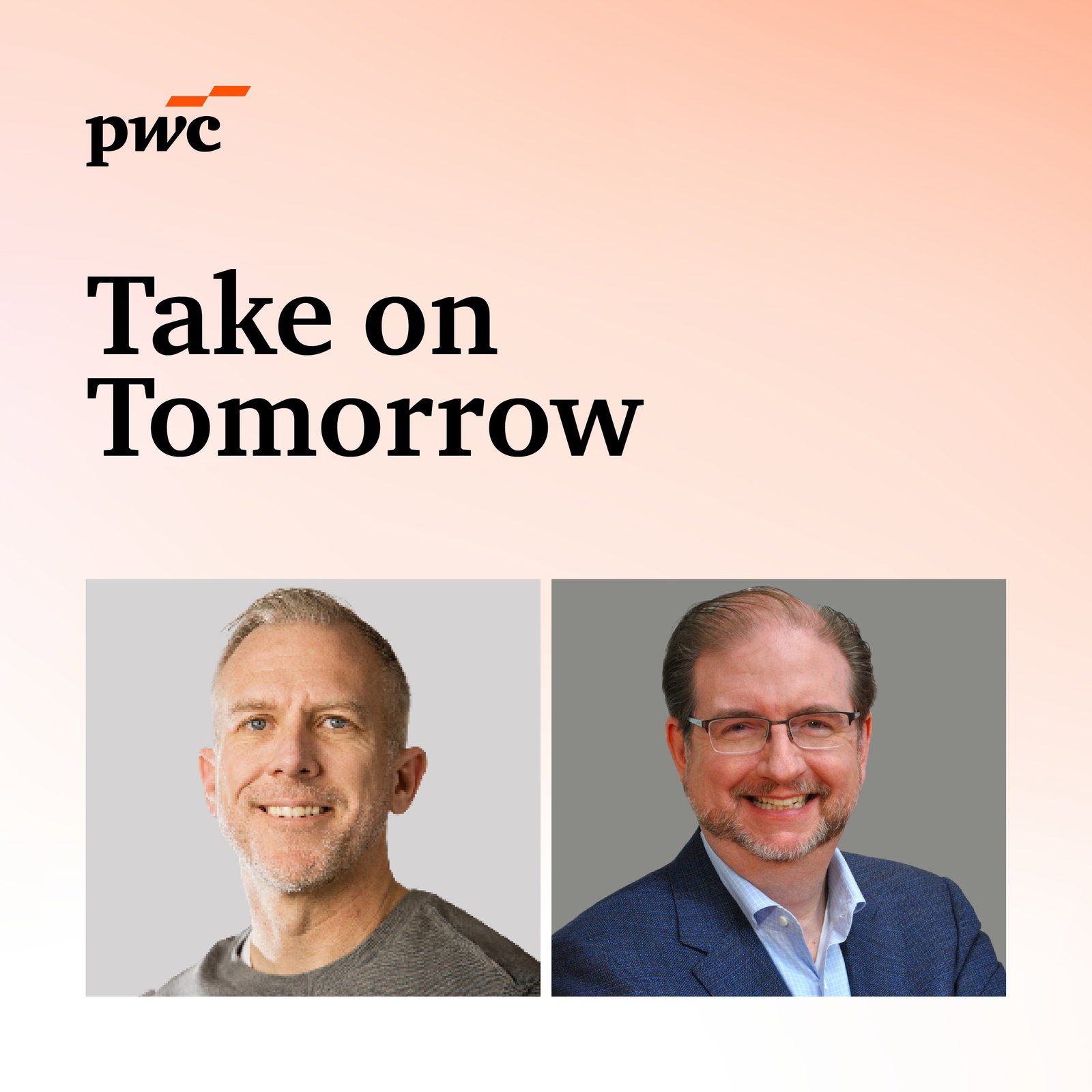
Melanie Rosenwasser, Chief People Officer at Dropbox, a collaboration platform for AI-powered work, shares what the company is doing to redesign roles around AI, invest more in early-career talent, and give employees greater agency to shape their own jobs and development.
PwC’s Global Workforce Leader, Pete Brown, looks at wider workforce shifts: how AI could help people advance to the more interesting parts of work faster, and why trust between employers and employees will be critical as work changes.
As workers experiment and adapt—sometimes faster than the organisations around them—we ask: What will it take to get people, technology, and organisations moving forward together?
Take on Tomorrow is brought to you by PwC. PwC refers to the PwC network and/or one or more of its member firms, each of which is a separate legal entity. Please see www.pwc.com/structure for further details. © 2026 PwC.