
In short
Talking AI Podcast - Episode Summary
Episode Title
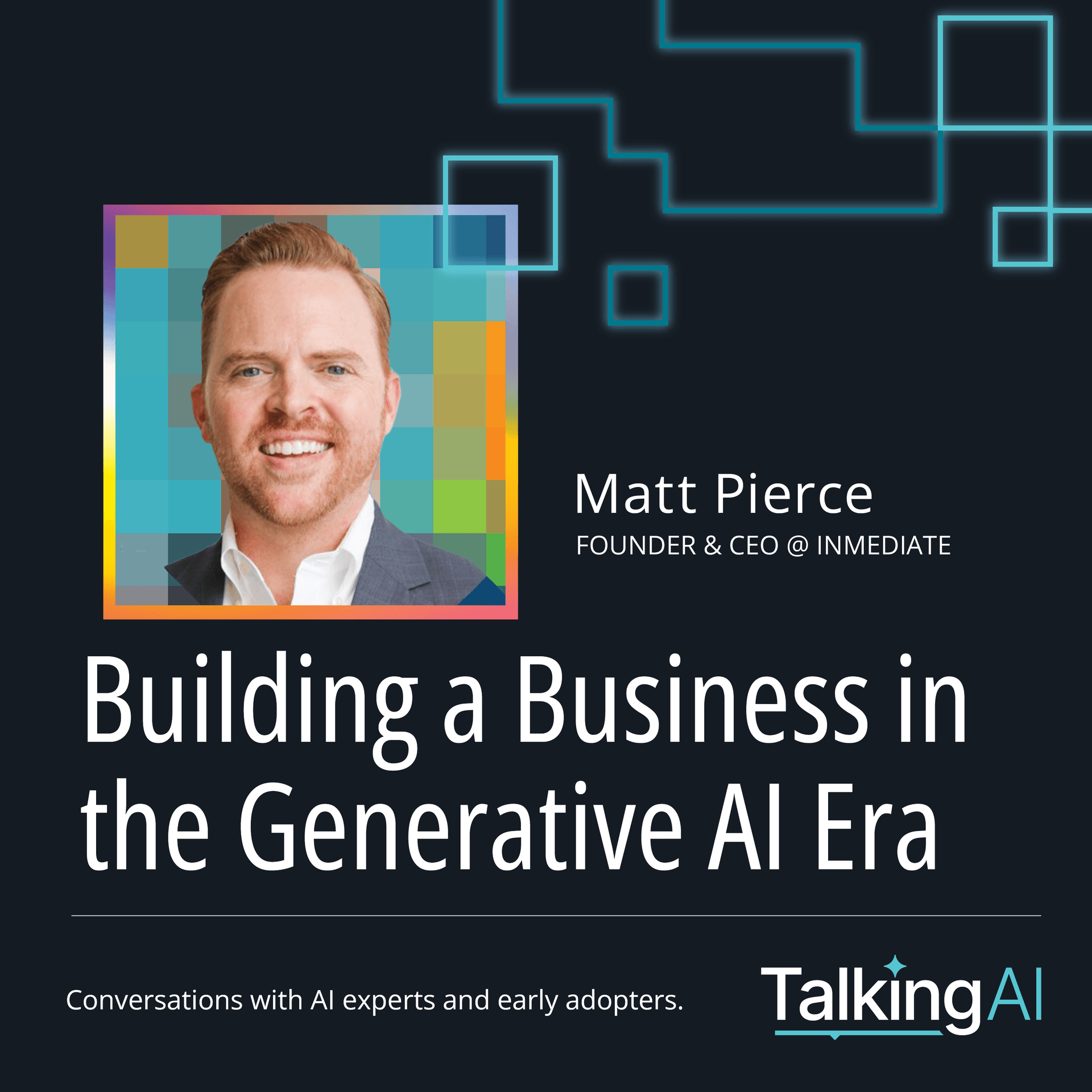
Building a Business in the Generative AI Era Host: Matt Paige Guest: Matt Pierce, Founder and CEO of Immediate
Episode Overview In this episode, Matt Paige kicks off the second season of the Talking AI podcast with Matt Pierce, who discusses the inception and growth of Immediate, a company focused on providing financial wellness benefits through ImmediatePay. This service allows employees to access a portion of their earned pay before payday, aimed at helping businesses with talent recruitment and retention.
Key Themes and Discussions
Matt Pierce's Background
- Career Path:
- Started in sales at a healthcare technology company.
- Progressed through various roles leading to an IPO and acquisition by Vista Equity Partners.
- Gained experience in navigating the balance between company culture and operational processes.
Immediate's Mission and Product
- ImmediatePay:
- A financial wellness benefit that allows employees to access their earned pay before payday, reducing reliance on credit and other high-interest alternatives.
- Targeted primarily at industries like healthcare and fast food, where many employees earn less than $30 an hour.
- Product-Market Fit:
- Defined by the ability to sell to customers outside of the founder's immediate network, indicating a broader market interest and demand.
- Achieved after approximately 7-8 months post-launch.
Early Days and Challenges
- Sales Strategy:
- Emphasized grassroots marketing and engaging with potential users directly.
- Utilized personal interactions (e.g., handing out cards at drive-thrus) to gather feedback and create demand.
- Scrappy Beginnings:
- Faced challenges due to limited references and credibility in the early stages.
- Developed creative outreach strategies and utilized tenacity to secure initial clients.
AI and Business Operations Utilization of AI
- Operational Efficiency:
- Implemented AI to detect and prevent fraudulent activities related to early wage access.
- Developed a system that flags unusual clock-in/out patterns, significantly reducing fraud incidents.
- Sales and Marketing:
- Leveraged AI tools like ChatGPT to streamline content creation for marketing materials, significantly reducing the time and effort involved in producing high-quality outreach communications.
Future of AI in Business
- Growth and Adaptation:
- Companies that embrace AI will likely see greater efficiencies and competitive advantages.
- Importance of integrating AI into existing processes rather than fearing job displacement; AI can enhance productivity and profitability.
- Mindset Shift:
- Encouragement for companies to empower employees to experiment with AI tools without overcomplicating governance structures initially.
Key Takeaways
- Focus on Niche Markets: Prioritizing specific customer segments can yield greater success than attempting to appeal broadly.
- Tenacity in Sales: Persistence and grassroots engagement can lead to significant business growth, especially for startups.
- AI as a Partner: Leveraging AI is crucial for operational efficiency and can help businesses adapt to changing market demands.
- Cultural Integration: Organizations should maintain balance between culture and process as they scale, enhancing employee engagement alongside operational efficiency.
Relevant Links
- Immediate Website: [Join Immediate](https://joinimmediate.com/)
- Matt Pierce on LinkedIn: [LinkedIn Profile](https://www.linkedin.com/in/piercmb/)
Conclusion The episode provides valuable insights into the journey of building a business in the generative AI era, emphasizing the importance of adaptability, technology integration, and understanding market needs.
Written by AI. May contain mistakes. Listen to the episode to check what was said.
Transcript
Automatic transcript. May contain errors.0:00Season three of the Built Right Podcast is right around the corner, but we've got one big change coming your way. The Built Right Podcast is now the Talking AI Podcast, and we've got a lot to talk about in AI. In the Talking AI Podcast, we'll be having in-depth conversations with both AI experts and early adopters of AI. That way you can understand how the technology works and how early adopters are beginning to implement and, more importantly, get value from AI. Our guests range from AI research scientists to founders of AI products to industry leaders putting AI to work in their business. While you're waiting for Season 3, go ahead and subscribe on your favorite podcast platform so you don't miss an episode.
0:41And make sure to leave us a comment about the AI topics that you want to hear about. So get ready to talk some AI in the new Talking AI Podcast, coming your way August 6th.
0:53Welcome to Built Right, a podcast by Hatchworks where we help you learn how to build the right digital product the right way. In this season, we're going all in on generative AI with guests ranging from international AI speakers, founders of Gen AI products, experts in specific domains of Gen AI, and leaders across industries. We're here to help you figure out how to take advantage of this new emerging technology so you can win in the market. So whether you're an AI techie or just AI curious, we got you covered. Let's get into it. Today, we're joined by Matt Pierce, founder and CEO of Immediate, who delivers responsible on-demand pay through early wage access.
1:32Really interesting product and solution we'll get into here in a bit. But Matt has two decades of experience in high-growth businesses, including early-stage startups, all the way through IPO. Welcome to the show, Matt. Thanks so much for having me. Excited about the conversation. Yeah. And today we're going to be getting into Matt's story of finding product market fit by focusing on a very specific niche. And this is a lesson anyone really can apply to your business, no matter the size or scale. It's one of those like lifelong first principle kind of lessons you really got to lean into. And his story is one of the better ones I've heard of how they focused and then use that to scale.
2:11And plus, as always, we're going to get into how AI is impacting Matt's business, how they're taking advantage of it and where he sees the future going. But before we jump in, give us a bit of a background on you, Matt, your experience and kind of what's led you to where you are today. And then we'll get into the fun part of the story of how you got started with immediate. It is it is funny when you hear almost 20 years ago, wait, has it been almost 20 years? like, goodness gracious, time flies, you know, it really does. So I tell people a lot. I've, I've been in sales all my life and, and started as an intern in grad school, working for a healthcare technology company.
2:55I was able to kind of take that and enroll it into a full-time job out of school and ended up being at this company for right at a decade and was fortunate enough to was Employee 55. I was fortunate enough to get in. I got a nice seat on a rocket ship. We built it up and took it public. I worked my way up in the partnerships world. When I first came in, I was building a reseller program. I took it from four to 25 partners. Then they let me hire somebody to manage it. Then I moved on to build a national lead gen program, which I built up from essentially nothing. I added 44 partners in the first year.
3:32We did 5 million in revenue in the first year there. And then they let me hire somebody to manage that. And so I kind of kept just working my way out of jobs, right? I'd build something up and then I'd go, all right, I need somebody to manage what, you know, like essentially I need somebody to farm what I've, what I've gone out and gotten ready for us. And so I ended up, I guess they kind of at a certain point said, well, he's done, he's done every job in the, in this, in this division, let's just make him the head of it. And so I got a promotion to run in the business development team. And it was about the time that we were going public.
4:05And so we had a nice IPO in early 2012. And then Vista Equity Partners came along and acquired the business for about$650 million a year and a half later. And I got to hang around for about a year after that and really learned a lot about private equity-backed companies. And it was interesting. I'll share a little bit about this because it really helped frame and shape a lot of who I am and the way that we've been building this business here is when I started there, very little process, right? Super heavy on the culture. We I mean, still some of my best friends are from there. I actually met my wife at this company.
4:41I mean, it was just like a really good culture of people who were waking up every day, rowing in the same direction. and you build and build and build. I think we were 850 employees when we sold and learned a ton along the way. But what happens when private equity comes in and especially for us, they took us back private and then merged us with two of our competitors. And so you blink and wake up and it's, oh, hey, we're 1800 employees and we're in five different cities and trying to build relationships with a finance team and a legal team. and a field sales team and take all that and then bundle it into a private equity playbook where there's very detailed structure.
5:27And so that culture shifted very quickly to process, right? And so I always kind of took that as a really solid lesson for blending culture and process, right? You don't want to be overly processed because then you kind of lose your culture. You want to be overly focused on culture because then you kind of lose the process. And I think as a company and organization grows, that's really the thing that you have to go through that's going to help you get to that next level is how do I keep culture intact? How do we make sure that things are still fun and exciting? But as we grow in scale and you go from, you know, like here at a media, go from me being the only salesperson to now we have eight.
6:11How do we make sure that they're all falling in line and working the right process? And so that's something that I learned early on that I think has carried me through my career. Quick break in the pod. If you're listening to this podcast, chances are you've been thinking about how to actually use AI inside your business. And that's exactly why we built the AI Opportunity Finder. It's a free tool that helps you uncover high impact, tailored AI use cases based on your business, your goals, your pain points, and your industry. No fluff, no generic use cases, just real ideas that fit your business and the ranked by ROI potential.
6:46It takes about three minutes to run and it's like having your own personal AI strategist for free. If you want to try it for free, check out the link in the show notes or go to hatchworks.com backslash AI dash opportunity dash finder. yeah and you hit on an interesting point i've been through some of this too with the first thing for listeners like step back and if you're if you're early in your career uh i think it's marissa meyer it's like it doesn't matter what seats you get on the rocket ship just go get a seat like that's a great way to accelerate your career um great to have experience in both small and big companies but like what matt just went through like you basically probably accelerated 20 years worth of a career, probably in a five-year period.
7:28100%. Absolutely. But the one piece you had on process and culture, that was really interesting there. We've had similar things with Hatchworks. When you're a startup and you're small and everybody knows everybody, it's easy. You don't need all the process, but you start to hit these plateaus. As you were talking through that, I'm like, man, we've gone through these same things of getting to... I've heard of it in people numbers or revenue numbers. It's like you hit the million in revenue, kind of hits a plateau, hit about 10 million, 100 million. And there's these different pain points as you go and grow.
8:02But it's kind of interesting to hear that story as you go there. And the process piece, that'll be interesting. We'll get your take on that later as we start to get into AI and where does that fit in with automating some of these pieces? And And, you know, maybe it accelerates things even further. 100%. It really does. And I don't want to skip ahead, but there's definitely some things that AI is bringing to the table that is helping organizations as they scale and kind of go and do those processes. But just to round that out, after I left there, I spent a few years, I spent two years at a company up in Boston and a year out a company out in L.A.
8:44And really, I think that there's, I guess, like this, the mindset that comes from an entrepreneur is I knew in college that this is what I wanted to do. I obviously had no clue what kind of company I was going to start. I felt like I was a natural born leader. And I felt like I, in some cases, I thought I might be unemployable. I've got opinions. And you know what I mean? And so there's this piece. It's a great track for entrepreneurship. leadership. Exactly. I just remember sitting in a class in college and being like, I just don't know if I want to work for somebody. And we all work for somebody.
9:20But it's also, I knew that that's where I wanted to get. And so I was like, what are the steps and process that I could take? And so when I had that opportunity to join that company right out of college, or when I was still in grad school and then joined right out of college, I'm like, this is a time for me to go in and lean in and learn. And so I was very deliberate about the selection that I made. I could have gone to work. Matter of fact, I had a job offer right out of grad school to move to LA and get into the entertainment industry from an agent perspective, like be an agent in training, which I think now about, goodness gracious, how different would my life be.
10:01I went out there and did a two-week interview process and got the job offer. And it was going to be an agent in training for celebrity voiceover work. We're talking like 03, 04, when that was just getting going. Now you hear celebrities on all the advertisements. Back then, that was kind of unheard of. And so it was just a different path. But I remember when I was going through the checklist, the pros and cons on that decision of, is this going to help me get closer to starting a company and being my own boss? Or is this going to take me way out of my comfort zone and put me into a place where, what if I really love this and I'm here the rest of my life?
10:38I'm like a West Coaster the rest of my life. And I just didn't know if that's what I wanted. And obviously, for me, at least, I made the right decision. And so I kind of was seeking that when I left. I went and worked for this company in Boston, learned a good bit there, got to really rebuild a growth organization, which is an important piece of the puzzle. And then I got picked up by a pre-series A company out on the West Coast. And in my mind, it was, all right, I'm going to go do this again. This is a pre-series A. I was employed like 25, good equity slug. And let me go build this thing. And this is going to be a big West Coast pop.
11:14And I just got burned out. I was traveling out there every three weeks. I was traveling all the country. It's kind of like a team of one. And I just got burned out. And about a year into it, we parted ways. And I kind of sat down and go, all right, now's the time. And I started doing growth, like growth consulting, just to see if I could find a place that I wanted to go really sink my teeth into starting a business, which led to starting immediate. So I know that's kind of like a little abbreviated, a little extended, but it just kind of shows that my mindset from the early 2000s when I was in college was, I'm going to start a business, period.
11:58And even when we had that exit, I didn't go out and buy a flashy new car and do all the things that sometimes people do when they make money. And it wasn't like it wasn't retire money, but it was, you know, it was pay off your house money. And and it was, you know, with some leftover. And as opposed to me doing that, what I did was I put that money, set it aside, said, this is the money I'm going to use to start a company one day. And and so it was it was a lot of build up to where we are today to foundationalize and make sure that I was in the best place to succeed. Yeah, it's funny how serendipity plays into things in your career.
12:38I love hearing people's career journeys, but it's also putting yourself out there for the at-bats. I look back when I first started, I got my first job, somebody put out on Facebook. And this was back in the day when Facebook was still the new thing with just in college. And they said, hey, our company needs some interns. And I was like, I don't have a job yet. So that led me down this like meandering path to where I am. But it's just, you know, it's so random how things kind of work out. But in the end, it makes perfect sense. So love hearing those journeys. I prescribe to the mindset that life doesn't happen to you.
13:16It happens for you. And I think if you take that into everything you're doing, and look, sometimes it's hard to believe that. And sometimes it's hard to get on board. And there may be people that are listening like, crap, I'm in a tough spot. I don't feel like this has happened for me. I can look back on some of some of the darkest days, some of the toughest times, some of the times when I wasn't really sure if this was ever going to work out. And even here, there have been times where I've laid awake at night staring at the ceiling fan, just going like, what have I done? Is this going to work?
13:54And I think everybody goes through that in some phase of their life. But I think when you can kind of take that as like, all right, hey, I'm here, right? What am I going to do about it and how am I going to use what I've learned and where I am to spring forward. And if I can, if I can leverage this, then I'm going to be in a really good spot coming out of it. And, and Hey, if I'm not, I'm going to take that same mindset. Your mindset can really, can really play with you, you know? And, um, and I just think that there's, there's so much power in being able to, to shift your thinking. And I know that that's, uh, I can, I can, I can sit here and say this because I've been practicing it and doing it for a long time.
14:35And, you know, my wife and I have this discussion sometimes where she'll be worried about something, upset about something. I go, just don't think about it. And she'll go, just don't think about it. Like, that's just not an option. You know what I mean? And I do think that there's probably some like man versus woman in that where the compartmentalization, like guys by and large do a really good job of that. And women have a tougher time to compartmentalize things. Um, but I'm, I'm thinking less about compartmentalizing and more about like, what is me worrying about this going to do to make it better versus me like going into action.
15:11Right. Like, so as opposed to thinking about all the things that are going bad, I think a lot about like, you got to think about solutions, like think about the solution to the problem, not just fester on the problem. And, and I think that that's one of the things that just like through my career has helped me and guided me to where I am and still use pretty frequently. Yeah, it's what's in the span of your control to a certain extent. And then it's that unlock you mentioned there. When you're going through the pain, just realize that that's going to be something that's making you stronger, you're going to look back on.
15:44I look back when we went through COVID, it just seemed crazy specifically for our company at Hatchworks, but we learned so much through that experience as a company that now when we hit a speed bump or a roadblock, it's like, okay, we've done this before. We've been through this. And it's like building muscle to a certain extent. But I want to ask you, get to kind of a philosophical question here. What's your definition of product market fit? And then let's get into kind of the early days of immediate and how you found that. Yeah, to define it is hard, to me at least, because I think every company, every platform, every product are going to have a little bit of different way of looking at it.
16:40For us as an organization, I felt like we got to product market fit when we started selling to people that we didn't know. And, you know, the first the first few customers was like, oh, you know, well, hey, my brother runs my brother runs a company and he's got 25 employees. Like, let's go get them like, oh, hey, family stage. Right. Right. Exactly. I mean, I was the one of our first customers was the coffee shop that I was working out of because I was working there every day. My wife tells me I'm too loud and I can't work from home. And so so I would go I would go to one coffee shop in the morning.
17:13I'd come home and have lunch with her and then I go to another coffee shop in the afternoon. And so at this one, they got in there and they were like, you're here like every day. What are you doing? And I was just like, hey, sales pitch time, you know? And so I still knew them, right? There was that. So I felt like when we kind of got over that hump, and I would say probably more so not even just the one time because lightning can strike. When we got to a place where we could sell people that we didn't know in a repeatable way, right? And that was when it started to click. And it took us post first customer, I'd say it probably took us seven or eight months to get to a place where we were really selling people we didn't know.
17:59And that's so that for us, at least that's where I felt product market fit kind of started coming into play where we felt really like, all right, we've built something that works and that people will buy and that people will use. So now we're good. Let's see how we can pour gas in the fire and repeat what we've been doing. Yeah, I like that definition. I've never heard of it told in that way, but it's almost like a test, a litmus test of, okay, are there people outside of my immediate circle interested in and buying this? That's a great test. I like that. I've never heard of it referred to in that way.
18:31Yeah, and the flip side of it, if you can't sell your friends and families, you're probably going to have a tough time selling strangers, you know what I mean? And so that felt like a pretty good place for us. Cool. So take us down like any kind of early, like what was that journey like in the early days to start getting to scale? Any kind of anecdotes or interesting stories along the way? Yeah, my early sales stories are some of my favorite. Just because you've got to be scrappy, right? You don't have referenceability. We used to laugh, our CTO and I, because people would ask for references early on.
19:15and they'd say, can we talk to a senior living company that's on ADP that's over 1 ,000 employees? And I would go, let me see if I can pull together a reference for you. And I'd go back and I'd look at my spreadsheet and I'd go, we have seven customers and the largest is 140 employees and none of them are on ADP. And so I would go, I would, I would send an email and I would say, still working on the ref, the ADP specific reference, but I found you one that senior living and I'd like for you to talk to so-and-so. Right. And then I would just keep my fingers crossed that that would go well enough that they would come back and say, you know, I don't need the ADP specific reference, you know?
19:55And so, so you do have to do things that are a little, a little scrappy early on. And for us, we really made a decision that we were going to focus in health care initially and then also try to focus on kind of quick service and fast food restaurants. Largely because the solution that we offer, it's a voluntary financial wellness benefit. You mentioned at the beginning, but it essentially allows employees the ability to get there to access their pay in between paydays. So something unexpected happens. I don't have to turn to run a credit card debt, write a bad check, title, payday loan, etc. Right.
20:33I can go and say, hey, I've already earned money. I can access a portion of that. And we do it for free to an immediate card or a three dollar transaction fee to to their own bank issue debit card or bank account. And so all this to say, we looked and said, we believe that. Primary users of this will be making less than call it thirty dollars an hour. So where are companies with a high volume of people making less than$30 an hour? And that's typically like healthcare as in senior living and in like home health, home care and physician practices. And then obviously fast food. We see it all the time, right?
21:13You'll drive down the road and you'll see a billboard that says, you know, now hiring starting at 16 bucks an hour, 18 bucks an hour. And so we're like, all right, let's go do that. And so I actually had these little cards made. I might have one in my desk here. I do with this under a pile of stuff and I don't want to shuffle around, but I had these little cards made that, that said I had a QR code on the back that went straight to our website. And on the front, it said, you worked today. Why wait to get paid? And there you go. I got the marketing copy going. I like it. Right. Yep. And this was when I was, I was the only marketing guy and I'm going like, I think this goes well, you know?
21:55And so I came up with this tagline that was like our first tagline. It was your pay, your way. And there was a QR code on the back. And so I would hand those out. I would go through the drive-thru and I would say, hey, do you mind me asking you a really personal question? And people hear that and they think like, what is a really personal question? And I go, you know, sometimes people be like, I don't think so. But by and large, people go, yeah, you know, they're handing me my food. And I go, how often do you get paid? and they say, oh, oh, you know, and then, then they're like a little, the defensive nature goes away.
22:28Cause like, that's not that personal, personal. They didn't ask me how much I get paid. They just said, how, how often. And so most of the time I get paid every other Friday or every Friday or whatever. And I go, do you have the ability to get paid in between paydays? And, and most of the time they would say, no, we don't. And I go, wouldn't it be cool if you could access your own money there? Yeah. And I go, I got a solution for that. And I give them like, Like, you know, it helped me to tighten up this like 20 second elevator pitch. Right. Like, hey, we got a platform that allows you that connects to your time tracking system and lets you get paid in between paydays for a nominal transaction fee.
23:00Would you give that to your boss? And we use that. We kept doing that. We were doing that over and over and over and over again. And then I would start, you know, I'd find out if it was a franchise operator or if it was there's one group. So we're headquartered in Birmingham. There's one group that's headquartered here and got like 25 locations and all corporate owned. And so I found, you know, I found the CEO's contact info. And so then I'd send them an email. Every time I do that, I'd send an email and I go, I go, hey, went to the location over on over in Wildwood. And they said they'd love this.
23:32This is the this is the 12th time I've had somebody say this. Like we should get together. Like, let me share something with you. And and so finally, he gave me a call. We go in the call and he goes, I've been hearing about this from all the managers at the stores, that there's some guy who's dropping cards off in the drive-thru. And so I was like, well, tell you what? Right? You got to stick with it. And I said, tell you what, give me an opportunity to share this whole presentation with you. And if it doesn't work out, I won't drop off any more cards at your location. She goes, all right, cool.
24:01Let's do it. And so they end up becoming a customer. They've got about 1 ,000 employees. They have 44 % enrollment. Our average enrollment is anywhere from 15 % to 25%. They're at 44 % enrollment. And the reason for that is because there's so many people that are kind of in that target market. Like, right, they're in that pay band where we see a lot of success. And so that was that one of the core values of our company is, which at the time we didn't have them. You know, I kind of came up with them as we went and then formalized. And one of our core values is tenacity, right? Like, we're going to keep doing it.
24:32We're going to keep chipping away. We're going to work hard. And because I believe that in the long in the long run, just being tenacious is is what's going to get you over the hump. And and so we did that with groups like like that fast food chain. We've done some we've done some other pretty creative things. But I really it's funny because when you're in those days, you can't savor it as much as you'd like because you're kind of sitting there going like, you know, it's a little bit of like kill or be killed. You've got to get some deals done because you've got a finite amount of money. I think at that point, we had raised maybe a million, million and a half dollars or something.
Read the full transcript
25:10And we were burning a decent bit of cash. And I'm just out there going like, oh, we got to win. Like, all right, you small micro celebration. And then you move on to the next one. And I don't feel like I got to savor that as much in those days, how pivotal those early wins were and still are to the company. Um, and so I think now as you continue to grow and scale and you start putting a team in place, it, it helps me to remember that like, Hey, you know, later today, me and one of our, uh, our sales guys have a meeting with a, with a 9 ,000 employee company and they sign up. It's going to be a big win.
25:45Like let's pause and celebrate that, you know? Um, so those are some good learnings along the way. Yeah. So for the listeners, two key pieces to take away from what Matt just walked through. The first one is focusing on a specific niche in customer base. He mentioned healthcare and then fast food. He had a very specific target versus 15 different targets, spray and pray and not get anywhere. And then second, I love this approach is kind of the bottoms up user led growth, starting with the people. You see companies like Slack and others, very similar approach. If you just went to the CEO directly, kept pounding on his door, you probably wouldn't have got anywhere.
26:29So you almost got this like social proof from the bottom. So two really key things to think about and apply to whatever you're doing there. But let's shift now to the AI conversation. So a couple of places we could take this. I'd love to hear how this is either impacting your business or how you're looking to take advantage of it, the first two pieces. And then we'll get into kind of where you think this is going to go into the future as this starts to evolve because things are evolving rapidly right now. Right. It's it's interesting. There's a couple of different ways it's it's helping us. And I'll focus on two.
27:16So one is one is kind of just the administration and in the the operational aspect of how our platform works. And then secondarily is more on like the sales marketing aspect of it. So from an operational perspective, one of the things that we learned early on was that from time to time, people may try to take advantage of a system, right? Right. For us, the way that we allow people to access money is you clock in and clock out. Right. So whatever system you're using at work, when you clock in and clock out, we look at it, we go, all right. Matt just clocked out. I'm going to use easy math because it's early in the morning.
28:03Matt just clocked out a 10 hour shift and he makes 20 bucks an hour. You just earn 200 bucks. Right. We give you typically up to 50 percent. of that. You can access up to 50 % of that. So, um, so what we found was we would have people sometimes that go in and go, you know what, I'm kind of over this job and I'm going to quit on Friday. So I'm going to go in, I'm going to clock in at 6 AM and then I'm going to either have my buddy clock me out or I'm going to clock out at like midnight and I'm going to get 18 hours of work, 18 times 20. Now I'm testing myself three,$360. And I'm just going to pull out that 180 before they know.
28:43And then I got$180. And so we had some, for lack of better terms, some fraud early on. And we had to figure out how to fix that. When you're small, while it hurt, I'd be like, oh, we had to give up$225. Now we're processing millions and millions and millions of dollars every month. And so it's a lot bigger. We got to figure out those things when it's small. And so what we did was our CTO and his team went in and said, what if we started to leverage AI to create a running 60-day average for every employee based off of their employee ID on what their average workday looks like? And then let's create this matrix inside the system that says, if Matt typically works a six-hour shift, and all of a sudden one day he comes in and clocks out a 15 hour shift.
29:39Well, that's greater than whatever the, the, um, the Delta is right. I think we would usually put like a 20 or 25 % cap. And so if, if it's typically a six hour shift and you clock out a 15 hour shift, what we would do is leverage that AI to go, Hey, we, we recognize this is out of the ordinary. We're going to flag that and not give you access to that money until it's either approved by your manager or cleaned up in the system. What we would always default to is, hey, this is well beyond your average work day. We assume this is a mistake. If it's not, can you get your manager to approve it? And so what do we do?
30:15We saw fraud drop. I mean, it was like, it dropped like a lead balloon. It was beautiful. And so we leveraged it. And we started doing that three years ago. And so we started leveraging AI for operational things like that pretty early on. So now you kind of fast forward to where we are today and chat GPT. And I mean, you know, everybody's got their, I say everybody, most companies now have some former aspect of AI that they can leverage. And what we've started really doing is using it in sales, marketing, outreach, et cetera, where it can kind of help you form that, to form the outline of what you're trying to do.
30:58I'll give you an example. We had a webinar that we just hosted earlier this week. And one of the ladies on our marketing team was on maternity leave. She's back now. But while she was out, she does most of our copy. And I was just like, who's going to do this? This is a big webinar. We're going to big companies. Let's make sure that we've got something that really pops. And so what we did was kind of by committee, we were like, we're going to go through this thing and tweak it and make it sound really good. But let's start with ChatGPT. And so we just gave it some props, right? Like, hey, this is a webinar for earned wage access.
31:34Here's the title of it. Here's who's going to be participating. Here's the tone. Here's some of the details we want to get across. And here's the reason that people should join. And it, you know, in minutes, seconds, it outputs like a really good framework that we could then go in. And so as opposed to us spending an hour, 90 minutes kind of formulating all this, we took the framework and then we tweaked it and adjusted it and made it like really tight and added in some of our own stats and things like that. And in less than 20 minutes, we had a really good invitation kind of outreach email for that.
32:08And so those are things that I think the really clear win is to find the way you can use that and associate it. I mean, I would assume that I don't know for a fact, but I would assume that some of our salespeople are probably using something similar when they're doing outreach. Like, hey, I'm going to outreach to this 30 ,000 employee fast food chain. And I could sit here and toil for two hours over all the right things I'm going to say and not say. And I don't want it to be longer than six sentences because people zone out and all those things. Right. And you could drop it in and go here. Now I've got now I've got a formula and I'm going to go in and kind of kind of tweak it.
32:47So those are the places that we're really using it today and where we're seeing pretty impactful value from it. Yeah. And you're doing it the right way. And we talk to clients. It's identify of your existing processes. You know, where are the most mundane, the most repetitive or the most painful? It's like those three things start there because it is with any change, it takes time for people to process and adapt to it. But if you can get a quick win and that fraud example is amazing, you almost unlock a piece in your team's brain of like, wow, this thing actually is pretty powerful, pretty capable.
33:28And then they start thinking of other use cases that may be other existing processes or it may be something wholly new altogether. So that's such a great place to start. And we're doing something similar at Hatchworks. We call it our generative driven development. And the unique thing, like your copy example is great, but what is code? You know, it is a language as well. So it works the same way. So we're building, you know, within the framework, ways to get to code quicker, testing, regression testing. You can start to apply these same pieces to software development. So we're starting to find a lot of interesting and unique use cases there.
34:12So, you know, to that point, one of the things that I've, the way I've, I've kind of thought of AI is like a really bright, really smart intern. Yeah. Right. So think about this thing. Like Hatchworks goes in the summer, you go, hey, we got this intern from Harvard and they come in and, and your CFO goes, hey, we're starting to plan for 2025. can you put together a pro forma? I'm going to give you our historicals. You put together a pro forma of what you think it's going to look like. I can tell you Harvard, if it's a Harvard MBA and they're interning, it's going to be a good looking spreadsheet.
34:49It's going to have a lot of tabs and there's going to be some real, but it's not going to be a hundred percent accurate, right? There's going to be some things that because they haven't been at that company long enough, they haven't been in this field long enough in the space, whatever it is, there's going to be a gap. And that gap may be 10%. It may be 40%. But the idea that CFO is not going to go, I'm going to let this Harvard intern go build this pro forma that I'm going to slide in front of the board. They're going to go, I'm going to let him do the heavy lifting. And then I'm going to pull it in and I'm going to go, all right, let me take this and tweak it and adjust it.
35:21And that's the way I kind of think of AI with a lot of these processes like that, like what you just talked about and what I talked about from a sales perspective is let's allow our team to leverage AI to give us the framework. And then let's take that and then let's make it, let's, let's, let's make the tone us. Let's make the, let's add the data points in there. Let's get it the rest of the way. And, and if we do that, that, that becomes operating with more efficiency, which means we can touch more people. We can touch more companies. We can get more, more content out, things of that nature.
35:55Yeah. Yeah. So there's two points I completely agree with you on. There's one I disagree with you on there. So I think it's more than an intern. I would almost equate it to, you know, based on the persona you give it, right? PhD, multiple degrees, whatever. But the piece I agree with though, whether it's an intern or somebody highly skilled, if you put them in your organization, they're not going to add a ton of value if they don't have the context. And the third point you mentioned that is critical, and this is where I think some people get stuck, is they'll start with something generic and they get something generic out.
36:31The data, whether it's how you're prompting or whether it's like, if you're getting more advanced, the data you're leveraging within the GPT or whatever tool you're using, that's where it starts to really unlock some things. It's almost like you're giving it that central brain that's unique to your organization, your situation, whatever it is. But that's where it starts to get really interesting. But if you're not applying that core piece of it, the context, the data, you know, it's cool. It's kind of like a magic trick, but is it adding real value? So there's an interesting piece there. So in the future, last point I'll ask you, where do you think this goes?
37:13Like, I mean, if you look back to like 2022 to where we are now, there's been so much advancement. Where do you see this going, whether it's how it impacts the labor market or just broader economy or smaller use case, anything that sticks out in your head with where this potentially goes? It's hard for me to put a thought out there about where it goes. But what I can say is that if you're not leveraging it, you're missing out. Right. And I think every company is going to find ways that you can, you can tighten up processes, you can create more efficiencies. You know, of course, like when, when we started, when we started leveraging AI for our, our time tracking validation, like there were some people here that were kind of like, wait, it did that?
38:01Like, how's, is my job safe? Like, you know, are you going to, now are you going to take those, you know, like support for instance, they go, are you going to take our top 10 support tickets and then replace me with that? And the answer was, no, we're not. But hey, you know what? We are going to, if we do have our top 10 support tickets and some of ours, our number one support ticket is, I need a new activation code. Our activation codes time out after like 30 days. And so if you don't enroll in the first 30 days and then you decide, whatever, six weeks later, you have an unexpected event. Well, that's a really easy one to leverage AI on.
38:36And quite frankly, if I'm a support rep, I'm going to go, I don't want to log into the system, click, generate new activation code. And so that's just a mundane task, like you said. Right. And so to me, it's as it continues to grow and evolve, it's not necessarily that we're going to go in and go, at least for us. Right. We're not going to go in and go, all right, well, now we can take our support team of whatever, eight people down to down to six because we've replaced all this. We're going to go, hey, we're going to keep growing. And so now, as opposed to having to have a new support rep for every 30 ,000 employees, we can do it for every 50 ,000 employees.
39:13What does that do to the company? It creates a more profitable business. Right. It enhances our gross profit margins. And so I think that that's the way that as a business owner, not even a business owner, as a person in the business world, if you can figure out ways that you can leverage AI to create broad efficiencies for what you do in your day in and day out responsibilities, if you can do that, you're going to get ahead. Right. And so I think that's what's going to happen in the future is you're going to see the companies and individuals who leverage it move forward more quickly. And you're going to see the laggards just kind of starting to fall behind.
39:53And so I do think it's obviously it's here to stay. I do think that there's a ton of value that comes from it. And I think the people that are thinking about like, oh, gosh, it's going to take over the world like that stuff is so that stuff is so like far off, in my opinion. but what it is is and any and hey maybe you're right but if that happens 30 years from now let's try to make the most of it for the next 30 years because it's here and it's not going anywhere you know what i mean um so i do feel like that's that's kind of the the best i can give you on that i'm i'm not smart enough to tell you where i think it's going to go but i am smart enough to tell you that i think that the people who are leveraging it are going to get ahead yeah but the most important piece you hit on it ties into where we started right it's kind of that entrepreneurship piece of it.
40:36Just start playing around with these tools. I can't stress that enough. So many individuals and even companies are like, oh, we got to figure out our governance. We got to go hire the fancy data scientist person to lead this. It's like, no, just empower your people to start, empower and get them excited about it to just start using it. That's the key piece. and then let just the natural learning start to evolve from there. One quote I've heard, it was from a friend. He doesn't know where it came from. I got to find out so I can properly attribute it. But he said, AI will change your life whether you embrace it or reject it.
41:17So it's kind of your which side are you going to be on? Are you kind of riding this train in a positive way or is it impacting you in a negative way? I think to your point, we'll see how far it goes. Been a really good insight there. But Matt, this has been awesome having you on the Built Right podcast. Where can people find either you or more details about Immediate? So learn more about Immediate on our website. It's joinimmediate.com. There's tons of content on there and we've got it broken down for employees and for employers. We are a benefit. So you have to go through your employer if you want to offer this, but joinimmediate.com is a great place to find.
42:02And then I'm pretty active on LinkedIn. So you can search me on there, just throw a Matt Pearson immediate and I'll pop up. And so I'm happy to connect with anybody who listens and wants to follow along on the journey. Great. Thanks, Matt. Absolutely. Thanks for having me.
42:22Thanks for listening to Built Right. If you enjoy the show, give us a follow or subscribe on your favorite podcast platform. And don't forget to leave us a review. For more info on Built Right, visit us at HatchworksBiltRight.com. The single biggest mistake we see companies make with AI is they don't properly train their teams. We see it all the time. Companies roll out AI tools and expect people to just figure it out. But using AI effectively requires a totally different mindset and skill set. And that's exactly why we built training for every level of your org, from AI training for teams and executives to training engineering teams on our generative driven development methodology.
43:03Or if you've already identified your AI use cases and want to just prioritize where to start, we offer an AI roadmap and ROI workshop to help you build a clear plan. It's all about going from we should use AI to actually driving real value with it. Head over to Hatchworks.com to learn more.
From the publisher
We’re back with season two of the Built Right podcast! Following on from our first season where we featured some brilliant and insightful guests from the product design world, we’re kicking off this season with Matt Pierce, Founder and CEO of Immediate.
Immediate helps businesses recruit and retain talent by offering ImmediatePay, a financial wellness benefit that lets employees gain access to their pay in between paydays.
In this episode of the Built Right podcast, we hear the story behind how it all got started. Matt takes us through his career background and how he came to start Immediate. He explains how he defines product-market fit and his process for building the company and ImmediatePay. We also hear Matt’s take on AI in the product world, why he thinks it’s here to stay, and why everyone should find ways to use it or get left behind.
Explore the potential use cases of generative AI for your business and gain valuable insights into AI-driven innovation and strategies to elevate your business. Listen to the podcast now and subscribe to our newsletter for the latest updates and exclusive content!
Key moments:
- How Matt realized his dreams of starting a business
- Matt’s unique approach to career acceleration
- How Matt’s mindset changed while keeping his end goals in mind
- Beating business worries
- How Matt defines product-market fit
- What the early days of Immediate looked like
- How Immediate began utilizing AI
- Predictions for the future of business in an AI world
Key links:
- Immediate: https://joinimmediate.com/
- Follow Matt on LinkedIn: https://www.linkedin.com/in/piercmb/
Mentioned in this episode:
AI Opportunity Finder
Feeling overwhelmed by all the AI noise out there? The AI Opportunity Finder from HatchWorks cuts through the hype and gives you a clear starting point. In less than 5 minutes, you’ll get tailored, high-impact AI use cases specific to your business—scored by ROI so you know exactly where to start. Whether you're looking to cut costs, automate tasks, or grow faster, this free tool gives you a personalized roadmap built for action. 👉 Try it now at https://hatchworks.com/ai-opportunity-finder/
Talking AI - Conversations with AI experts and early adopters
Welcome to the Talking AI podcast, where we dive deep into the world of artificial intelligence with host Matt Paige. Formerly known as the Built Right podcast, Talking AI brings you insightful conversations with AI experts, founders of AI products, and industry leaders who are leveraging AI in their businesses. Whether you're an AI expert or a beginner, our episodes will help you understand how AI technology works and how early adopters are deriving value from it. New episodes drop starting August 6th.