
In short
Talking AI Podcast Episode Summary
Episode Title
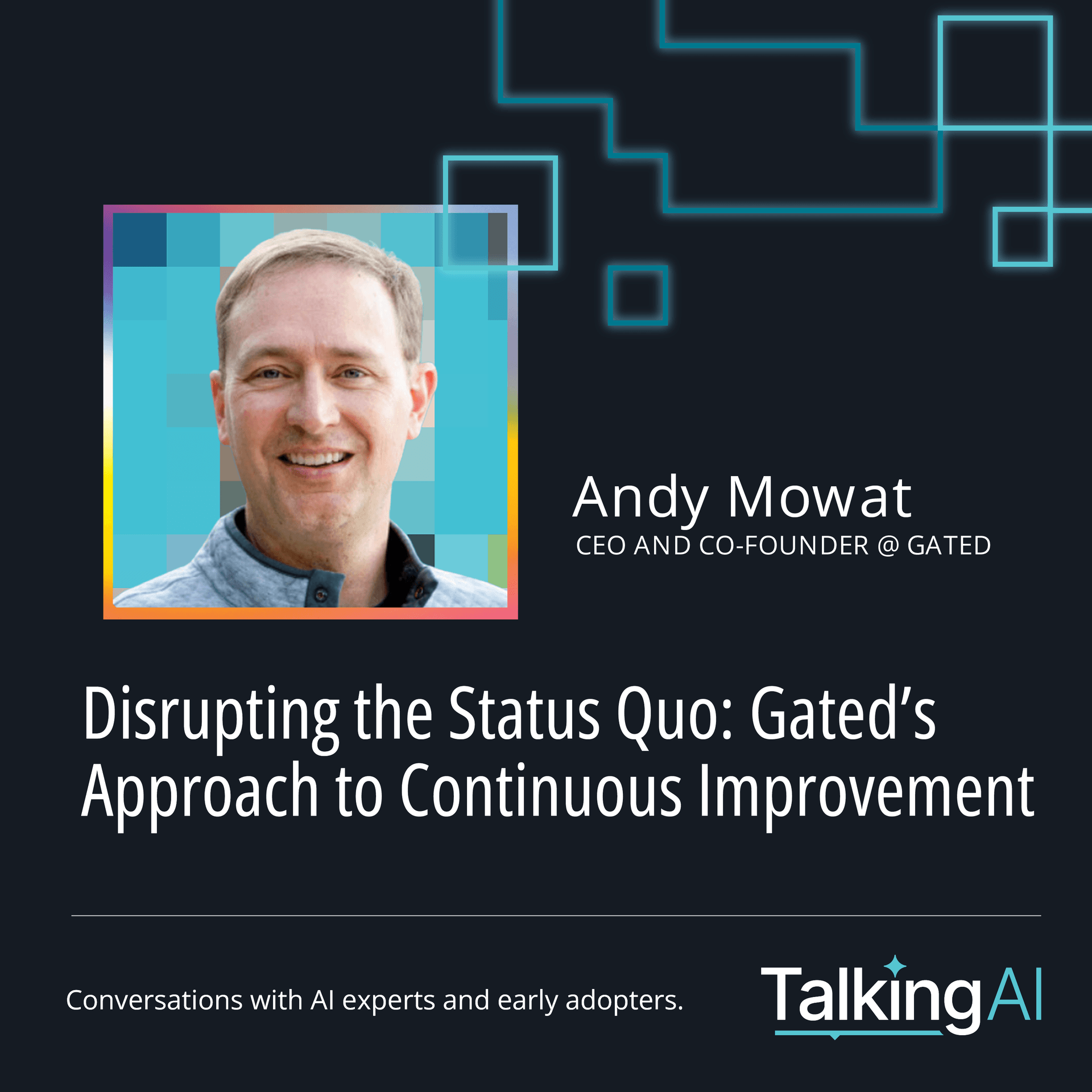
Disrupting the Status Quo: Gated's Approach to Continuous Improvement with CEO Andy Mowat
Host
Matt Paige
Guest
Andy Mowat (CEO of Gated)
---
Episode Overview
In this episode of the Talking AI podcast, Matt Paige engages with Andy Mowat, the CEO of Gated, a product designed to help users manage and filter their email communications effectively. They discuss the evolution of Gated, strategies for product development, and the importance of user-centric approaches in modern communication.
---
Key Topics & Discussions
Introduction to Gated
- Origin of Gated:
- Andy Mowat faced frustration with the overwhelming amount of irrelevant emails.
- He created a unique solution that allowed senders to pay a small fee to get his attention, leading to the development of Gated.
Defining Strategy
- Mowat's Definition:
- Strategy involves focusing on solving a specific problem rather than just listing features.
- Emphasizes understanding user behavior to create meaningful solutions.
The Gated Mission
- Changing Communication:
- Gated aims to reduce noise in communication and promote valuable interactions.
- The company is focusing on a broader scope of communication platforms beyond just email.
User Engagement and Product Development
- Continuous Improvement:
- Importance of engaging customers to iterate and improve the product.
- Mowat emphasizes the balance between product development and user feedback.
Pivots and Market Changes
- Recognizing the Need for Change:
- Mowat discusses recognizing friction points in growth as a signal to pivot or enhance product offerings.
- Reinforces the importance of making hard strategic decisions to innovate and improve.
Challenges of Market Adoption
- Overcoming Status Quo:
- Addressing the difficulties of changing user habits and fostering a willingness to adopt new communication methods.
- Importance of creating a cultural moment to stimulate interest and excitement around the product.
Market Trends and Strategy
- Proliferation of Channels:
- Discussion of the overwhelming number of communication channels and the impact of generative AI on outreach.
- Mowat highlights the need to adapt strategies to evolving market conditions and user needs.
Monetization Philosophy
- Focus on User Experience First:
- Emphasis on creating a product that users love before prioritizing monetization strategies.
- Advocates for a balance between providing value and exploring revenue options as the user base grows.
Customer Advocacy and Engagement
- Building Relationships:
- Mowat shares strategies for engaging customers and turning them into advocates.
- Discusses the importance of using product interactions as a means for initiating conversations and gathering feedback.
---
Key Takeaways
- User-Centric Approach:
- Successful products are built with a deep understanding of user needs and behaviors.
- Iterative Development:
- Continuous feedback from users is vital for product evolution.
- Strategic Decision-Making:
- Entrepreneurs must be willing to make tough decisions to pivot or refine their offerings based on market needs.
- Changing Communication Dynamics:
- As communication channels expand and evolve, products must adapt to help users manage their digital interactions effectively.
- Engagement is Key:
- Building a community around the product fosters loyalty and advocacy among users.
---
Conclusion
The episode provides deep insights into the philosophy and operational strategies behind Gated, illustrating how the company aims to disrupt traditional communication methods. Andy Mowat's experiences and reflections offer valuable lessons for entrepreneurs and product developers in today's digital landscape.
Additional Resources
- Connect with Andy Mowat: [LinkedIn](https://www.linkedin.com/in/amowat/)
- Explore Gated: [Gated Website](https://www.gated.com/)
- Customer Advocacy Playbook: [Read here](https://www.linkedin.com/pulse/customer-advocacy-playbook-andy-mowat/)
For more episodes, subscribe to the Talking AI podcast on your preferred platform!
Written by AI. May contain mistakes. Listen to the episode to check what was said.
Transcript
Automatic transcript. May contain errors.0:00Season three of the Built Right Podcast is right around the corner, but we've got one big change coming your way. The Built Right Podcast is now the Talking AI Podcast, and we've got a lot to talk about in AI. In the Talking AI Podcast, we'll be having in-depth conversations with both AI experts and early adopters of AI. That way you can understand how the technology works and how early adopters are beginning to implement and, more importantly, get value from AI. Our guests range from AI research scientists to founders of AI products to industry leaders putting AI to work in their business. While you're waiting for season three, go ahead and subscribe on your favorite podcast platform so you don't miss an episode.
0:41And make sure to leave us a comment about the AI topics that you want to hear about. So get ready to talk some AI in the new Talking AI Podcast, coming your way August 6th.
0:58Welcome to Built Right, a podcast by Hatchworks where we help you learn to build the right digital product the right way. In each episode, we'll deconstruct the layers of successful product development, break down popular trends, and offer real advice to help make sure your product is built right. We may not have all the answers, but we've built a lot of digital products across a lot of industries, and we've seen a thing or two. Let's get into it.
1:33Today, we're chatting with my friend, Andy Mowat, CEO of Gated, and we're going to go deep into the land of product strategy today through the lens of Andy's experience in building Gated, as well us some past experience at big name companies that you all will recognize. But before we jump in, Andy, we'd love for you to provide a brief intro, who you are, what do you do, some of your past experience to kick us off. Yeah, absolutely. I historically have scaled companies up to large scales, taking Upwork, Box, and most recently CultureAmp, kind of to unicorn status. Periodically, I start something from scratch and I'm doing that right now.
2:15I'm running Gated. Gated, the original product takes unknown email out of your inbox and challenges people to think like, hey, is your attention worthwhile? And as we talked about, we're launching in a couple of weeks, which probably is launched by the time we talk here, our new platform, which is helping people take control of their attention on all platforms. So we'll dive into that. Yeah, so excited to get into this. And there's some nice kind of meaty pivots along the way throughout the journey, kind of leading to this new gated 2.0 here. But I want to start with, you know, a meaty kind of meta question here.
2:54And how would you define strategy? This is such a, I think, a nebulous question sometimes. And feel free to kind of jump into examples from past experience. But how, in your mind, what is strategy? I think it's being as clearly focused on a single problem or opportunity as possible. For us, when we're building a tool that anybody can use, it's understanding user behavior really well and then figuring out how to do that. And this kind of goes counter to my approach, but our CTO, Alan, is very passionate about it, which is it's understanding what's the problem you're trying to solve versus the features.
3:33and then figuring out how do you deliver the right solution to that problem. Yeah, it's perfect. It's that element of choice, right? And making a decision and being deliberate about where you're going. That's missed so many times, I think, in strategy. That's what I love about Gated. You're very focused in who you serve and what you're doing there. Another element, though, that I love about Gated is this element of the manifesto and kind of your view of the market. and it kind of encapsulates your strategy in a sense in this kind of narrative format. But I would love to kind of give your overview, your take on leveraging something like that to help kind of convey your strategy.
4:14Yeah, I mean, I think we spent a couple months iterating on the manifesto. I mean, if people haven't seen it, it's a good.com slash manifesto. I think it helps people understand what the company's trying to accomplish. And I think, I mean, you probably, I don't know when you encounter a manifesto versus when you first learned about gated, but I think if you're like, okay, it's just a tool. You're kind of like, do I need the tool or not? But I think a lot of people have also really gravitated towards the change we're trying to bring in the world, which is like communications, less noisy, more personal, and all of those things.
4:50So for me, I think the original manifesto came from the concept of not everyone can use our original email product, but everyone should believe in the mission we're trying to accomplish. I think as we launched this new platform, literally anyone can use it, which is fun. And so we're rethinking the manifesto, which is small tweaks. It doesn't fundamentally change, but it guides the decisions we make on the product. And so we take it very seriously. And it's not a here's three bullet points on a web page. It's like it's an interactive kind of flowing manifesto. Yeah, that's what I love about it.
5:27It puts your stance, your viewpoint in the market. And you mentioned like how I found out about a great user gated now. I love it. I remember I saw, you know, put something out there on noise canceling headphones for your email. And that kind of just clicked for me. It's actually how we kind of first engaged and interacted. quick break in the pod. If you're listening to this podcast, chances are you've been thinking about how to actually use AI inside your business. And that's exactly why we built the AI Opportunity Finder. It's a free tool that helps you uncover high impact, tailored AI use cases based on your business, your goals, your pain points, and your industry.
6:05No fluff, no generic use cases, just real ideas that fit your business and the ranked by ROI potential. It takes about three minutes to run and it's like having your own personal AI strategist for free. If you want to try it for free, check out the link in the show notes or go to hatchworks.com backslash AI dash opportunity dash finder. But it just clicked, which is awesome. But I want to get into gated. And this is a really interesting story of where y 'all first started and where you're moving towards. So I'd love maybe start, start there with the, uh, where did gated originate? You know, Where did you kind of first come up with this idea?
6:44And then we can kind of get into where it's going, which I think is really the exciting spot. You're learning from customer behavior as you go and talking to customers and kind of iterating on the product. Yeah, absolutely. I've sent billions of emails. I've caused a lot of pain. Probably a lot of your listeners are sitting there saying, God damn it, all those emails. I think I've sent push send on like 8 billion emails where my team's at. We're all guilty, right? I know all the hacks. I was sitting there at a Series E company and I was just getting blown up. I'd wake up every morning and I was the buyer for a lot of tools.
7:23And so people would ping me. And I was just like, God damn it. This stuff's irrelevant most of the time. And so I wrote an email and said, I don't know you. Here's my Venmo. If you want to Venmo me 10 cents, I'll pay attention to it. And I threw on my nonprofit. It was like, hey, if you want to donate to my nonprofit, but people started donating. They started donating like 10 bucks, 20 bucks off the 10 cent and a half. I'm like, this is interesting. I gave it to a lot of friends and they're like, man, just changed my email inbox. So that's the original product. I think what we learned in the, so we've got tens of thousands of users that are using it and passionate.
8:01I think we've also. I want to pause there real quick, Andy, just on that point, super interesting, just for the audience, like the key thing I get from that is you noticed a pain point in the market. Inverse kind of going into a hole and, you know, trying to build something out for months on end. It's like the best example of a prototype. You just put your Venmo in an email. And exactly. So I built the first version in Airtable. And well, actually, the first version I just sent my Venmo in. Yeah, exactly. Then I built it in Airtable in Zapier. Then I hired a young kid to like code it up and then I finally was like okay I need to get some actual developers um yeah and you know it's and so I it was more just a side hobby for a while until people started like hey like can you help me um so yeah that's that was uh it was a lot of fun but I I wasn't looking at it's like what's the market problem I'm more looking at like what's bugging the crap out of me yeah I love it's such a good point it's like solve your own problems it's such a good starting point And you had this hypothesis of, okay, maybe this could be a mechanism to do that.
9:08And you did it in an early kind of quick iterative way. It's such a great, you know, just lesson for folks out there building digital solutions. You know, start there, start small, start to iterate. But yeah, so you're at this point, you're starting to get some traction with this initial kind of idea or iteration of gated. So what comes next from there? Yeah. So we, as I said, we've got like tens of thousands of users using it, loving it. But I think we, you know, our vision is how do we change the world of communication? And I think the insight we've had in your user of the original product is there are people that can afford to just turn off the noise in email.
9:46But most of us can't. Most of us need to live in that noise, see that opportunity. And so our new platform is focused on helping people surface the right conversations out of the noise. So our fundamental thesis is this on the new platform. It's hard to filter email after it's been sent. And everyone lines up and they just, I'm talking not just email, but email, LinkedIn DMs, Slack messages. And, you know, the problem is everyone can reach you on all these places. Some places are like, oh, you've got to be connected to me to reach people. But like we all get the LinkedIn invite. It's random that we don't know.
10:26and we have to deal with this. So our thesis is, instead of letting people just blow you up, let's guide people to engage around the topics that you care about. So we believe you should be as available as possible for the things you want to talk about. And the rest of the stuff, no. And so we are building a universal link. So you can get gated.com slash Matt if it's not taken. If it is, we can talk to this call. I got to get that one early, yeah. Yeah, yeah, yeah. If it's not, I'll give it to you. And if not, we can get you a page or something like that. There you go. And so you get that and you can, we can help you articulate what you're focused on, keep it updated, and then let people that want to communicate with you around those things, regardless of whether you're linked into them or connected to them or whether they have your email or anything, be as available as possible for the right opportunities.
11:26And the rest of the stuff, people got to go figure out a different way to reach. And so that's what we're building. And that's what data is all about going forward. Yeah, it's such a real pain point out there in the market. A lot of ways we like to think about it, kind of the person that's brought this out into the world, the Marty Kagan thinking around valuable, viable and feasible. You're hitting that valuable point head on because I know everybody listening has experienced this, especially our product and engineering folks who get inundated with emails they could care less about. one interesting thing though you know this is not something that's just commonplace you know you could even argue this is more kind of category creation lens but what you're combating I feel like in a lot of ways is just the status quo you know they've always done it this way and you're looking to break a habit which is difficult I think it's it's probably one of the more under-considered things, when you're building a solution that's driving a change in habit, how do you actually go about driving that change and getting people to adopt it when it's something maybe a little more foreign or unknown to them?
12:37Yeah, I think you gotta, you know, you gotta, we kind of talk about creating a cultural moment. So when we're launching, whether this podcast drops before or after that, you gotta wake people up and be like, whoa, that's interesting, that's different right with the original email product people like wait a second like i'm getting this email when i sent you an email because i don't know you it's forced me to think i think with this new one we won't be like interrupting the flow of communications more way for like the good stuff to rise above it but you know we're we're launching with you know tons of leading people that are sitting there saying like when you ask me matt like andy how can i help you i'm not doing a good job of articulating that right now so we if we can put that on everyone's LinkedIn profiles, put it in people's emails.
13:22We can start to people be like, Hey, what is this thing? And I see all of the other people like Matt articulating really well now, what he's interested in and how I can help him. How do I get that? So yeah, it's going to be interesting. Like we're pushing the bounds of communication, but I think rather than there's a better world out there, right? Which is I show up and I see you and I figure out like email, LinkedIn DM, Slack, whatever. And I'm like, here's what I want to send. Or even worse, here's what the AI tool that I use decided that it wants to send, copy and paste that. And so I think it's going to be a lot of fun.
13:58We're taking a big swing at communication and we think that there is a better way, which is, it kind of comes down to the, I don't know if you've seen it, but like the concept of how do you want to engage? How do I want you to engage with me? and we're helping our users articulate that, right? Like I always love, I've written my own user manual. I'm like, how do I? I love that. And there's, you know, it's like when you join a company, like here's our norms, here's how we work, here's how we want to engage. And so I think that concept of like, let's just not be punching bags for somebody else, but let's have our own gate that helps people understand how we want to engage and on what topics, I think becomes interesting.
14:42And so hopefully people listen to this, like get excited about that vision for a better world of communication and go, go get your gaining profile. It's a, it's free. I think over time to be like, well, how are you going to make money? On the original product we charged the center side here, I think we see, you know, if we can change communication the right way and create the value, there's lots of fun ways to power features for power users. Yeah. And it's interesting. It's not, you know, maybe the traditional two-sided marketplace type of solution, But providing those kind of rules of engagement doesn't just serve you as the person that people are trying to reach out to.
15:17It also serves the person trying to do the outreach. Like think of how more optimized, I guess, their outreach can be if they know who they're reaching out to and kind of understanding how they want to be engaged, what they're interested in. You're kind of serving both sides of the market. You kind of have your core user over here. That person performing the outreach is very much probably in your consideration set, I'm sure, as you're building out Gated. Yeah, yeah. And I think it's, you know, with the original product, it was all about like, how you stop people selling you things here. I think it's like, how do you actually get the people there maybe in your peripheral tangential network to like, know how they can help you, right?
15:52Like, there are probably people you're trying to meet every day, right? Like, for me, I look at it's like, I, in addition to like my core day job, like, I love helping like high, like revenue leaders that are trying to accomplish things. And like, if like, you know, if there's a half an hour call, like, I love helping you help vice versa, like, how do we help each other? And so I think there's a lot of those conversations we're all trying to have that we haven't articulated well. And so like, you know, you and I haven't chatted in a little while. And I don't even know what are the types of people you'd want to meet and all that stuff.
16:23So I think there's, yeah, it's the salespeople, which is kind of the original product. But we also like forcing salespeople to pay, like only creates so much value, right? Like they're still trying to save. But helping people understand the topics you want to connect on is a much more powerful plan. Yeah, that's interesting. So it's deeper than just kind of this transactional type of piece. It's like, how are you meeting and growing and working and networking with other people? It's more than just kind of the transactional level. Yeah, I love that. When I go on LinkedIn, I know who Matt is. I know what Matt's done, but I don't know what Matt wants to connect on and talk about.
17:05Yeah, that's perfect. One piece that's really interesting, this ties back to strategy and good strategy. I heard you mention it. There's been this change in the market very recently, this, you know, rise of generative AI. And it's just changing things in terms of making it even that much more easy for people to spam, reach out to folks and just go crazy with it. I think that's an element of good strategy is when you can tie what you're trying to do to a change in the market, an inflection point in the market. And I think that's an interesting piece. Maybe speak on that some, just the element of strategy and being able to leverage market trends and things going on.
17:50Yeah, I kind of see three major trends that we're thinking about. One is the proliferation channels, right? Like, hey, you need to join this Slack group, this Discord channel. You got to be on TikTok now or whatever it is. And so you've got to be able to be successful. Like you keep getting pulled to more channels. Every single channel is dying, right? Like it's AI will kill every single channel over time. Like if you're not overwhelmed by LinkedIn, you soon will be. and then the final one that's really been the most nuanced for us is the barriers to reaching are being shattered right so every morning you wake up you get like a couple to maybe for me it's like 10 or 15 like linkedin invites from people i don't know um and i gotta decide do i want to accept them and have them live in my dms forever or do i want to ignore them and it's like that whole concept that's a really interesting one we spent a lot of time thinking about which is it doesn't feel like the right way to decide, do I want to have a conversation?
18:50Like I haven't decided I want to let you in forever. Right. And so I think LinkedIn is kind of like, it's an interesting trend where it's become more of a social graph than like actually people, you know, and that is it's hurt them, but it's, it's just changed the world. So we spend a lot of time thinking about like, what are those trends? And then how do we take it? How do we position our products in the right way? Yeah. You know, the other piece I heard you touch on too, this focus of building the experience and a product users love versus the focus on monetization. What's your thoughts on that, especially early on in terms of trying to get scale and all of that?
19:28You want to create a viable business that's got to be part of the roadmap in some way, but what's your take on that? Yeah, I've learned a lot on that one. I bet with Upwork and Box and all those, I'm sure. Past experience. I think it's interesting. We have a very interesting model with our original product, which is users get it for free. We take a percentage of the sender donations, and everyone was fine for that. I think it's a very innovative revenue model, and it works. As we move to the new one, that model doesn't apply as much. And so what I look at is, I guess I'm in it to change the world.
20:10and I think if you can change the world, there are a lot of interesting ways you can make money on it. At the same time, I'm conscious there are products like Loom. It's my favorite example. I freaking loved Loom. There's 100 million people who use the damn thing and then they got their pricing model and they were like, okay, now you're using it infinite and we got to roll that back. I think a lot of people were pissed off and looking for alternative solutions. I think the way we think about modernization is first job, make sure people use it, love it, and can drive exchange. Second job is like, how do you make this thing viral, right?
20:49So you can go change the world. And then if we're providing value to people, and I think that, so we've really defined very early, like what are the values with this new product that we can create? And we look at it as kind of three things that I was just pulling up on my side. One is in this order, in this sequence of can we help you articulate the topics you care about and keep them current? I think that's a subtle thing, but it's hard to keep current. You go on your LinkedIn or your GitHub or whatever and you're like, this was me two years ago or I've never updated this thing. Can we give you peace of mind of not checking other channels and can we help you make like new and valuable connections.
21:30If we can do those things, I think there'll be a subset of people that will value it enough to pay for it a week. Are they okay if I'm using it for these things, kind of get this one additional feature? So I think I look at it as you have to have a philosophy. And this is what we've been talking about internally, a philosophy of what would be paid in the future and what would not. And also like not dumping everything out there of every feature on day one, like keeping it very narrowly focused. I looked at a tangential comp and I was like, man, they got everything. And so I think it's how do you keep a very, very simple solution focused on one use case versus like everything on the sun.
22:11And then you need to bring additional functionality and charge for it versus like trying to real functionality back, which is what Gloom did. And I think it went down pretty badly. And an interesting point you mentioned, I was chatting with the CTO of Hockey Stack the other day on one of our Built Right episodes. And to hit this inflection point, they've built this product and they're doing their customer research, which is something you all do an awesome job at Gated. But they had this insight where the person was like, I don't want to use 90 % of this solution, but this 10%, this is what I need.
22:45And they actually cut the bloat out of the product, created hyper-focus in this one area, and it just drove a lot of their growth. I heard you mentioning kind of focusing in on kind of core use cases, kind of a super interesting area there. But one thing y 'all do at Gated, though, I always see you out there wanting to talk to more customers, more users. How do you weave that into your process? It's such a big thing we do at Hatchworks with continuous discovery, but I think you're one of the better at it, especially leading a company as a CEO. Oh, thanks, man. I appreciate that. I've got an article on my LinkedIn profile about it.
23:22I can drop it. We need to put it in the show notes there. Yeah, I'll send it to you, but it's a customer advocacy playbook. Like, I think I look at it as, first off, the product has way, like, interesting moments of joy and excitement. And then we can build little things off of it. Like, awesome, you've got this really, you know, we saw a$250 donation off a$2 ask last week. We're like, hey, that's pretty cool. And we can reach out and we can talk to people. And so I think it's like engineering the product where there's opportunities to connect with users and then building the motions to be able to do that.
24:02So I don't know when you and I first connected, but you probably had a fun donation or something or like one of our team was like, hey, Matt, congrats. And you're like, oh, it's awesome. And then you're like, ideally, the product creates joy. And then you can start a conversation around that. And I'll be candid, we've templatized some of those things. right i have this fun thing where if i see an interesting person make a donation to our you know just feeds through slack all day long and if i'm like wow that one was cool i'll drop a note be like need to see your donation via gated and people be like oh my god i love this thing i'd be like okay cool like you know i think i literally have a a follow-up feedback which is awesome thanks so much like we love feedback um you know do you have anything that you'd improve right and people like you know you bring them in you draw them in then you can turn into advocates and so So there's a lot of, I don't know where I developed it, but I'm really passionate about engaging customers.
24:54Now, there's a balance to it too, right? Like you want your product to do that all. And so, you know, we haven't built that all into the original product. And, you know, on day one, we're not going to build it all into the other ones. So it's like the, how do you, this is what I've spent a lot of my career on, right? Which is how do you use data and product to trigger the right team actions? And then over time, like with technology and AI, you can start to automate more and more of those things. Yeah, I don't want to pause there. Anybody passively listening right now, this is your indicator to heighten your senses.
25:28But the piece you did there, you identified these triggers in your user's journey and you systematized actually talking to those users. So you've almost built this operating model or system for continuous discovery. which is a great way to do it because everybody says they want to talk to customers. But if you don't consciously think about it, it'll fall to the wayside with everything going on. So that is critical. I think you've identified at what points, what inflection points are great opportunities to talk to customers and learn. And you built kind of a system around it. It doesn't have to be, you know, some over-engineered thing, but you have these inflection points.
26:08So that's super interesting there. uh maybe the last point uh to get into here you start you're making this pivot in essence with gated how do you think in terms of making a pivot what what is that what's going through your mind where you you decide okay we got to make a change you've probably been through some pivots in your career in the past um is there any similarities you've seen through them when a pivot's ready to happen you know different things happening at the same time uh anything around a pivot in general that just kind of triggers in your mind where it's it's more than just kind of a small tweak it's something foundational yeah it's interesting like generally i am growing companies really rapidly my sweet spot is like five million a hundred million sales like this is a little earlier stage than i've played before i think for me it's more like if you see the friction in the growth motion which you know for us i think we built a plot to people but it's you know not everyone can sign up for the original email product and so what we said is can we change the world and if we can't with the original products like we're still going to keep it over here but like what could we like we're always thinking of like how do we get this to go to millions of people and drive that impact and so yeah i don't think i've come across the pivots before on the product side i think i've definitely encountered other things where like, okay, like we're not growing fast enough.
27:39What else? What other products can we add? But I think here, I guess I would say is I'm conscious you can't like keep adding to the product bloat. And so we're very much like on that day in mid-May, the new platform will be our focus. And that's really important. And the existing platform will be there for the original users. We're not going to kill it. But I think so for me, it's being comfortable making those shifts. If you took it maybe a step, like every company I've ever been at has struggled with, we can't ship more stuff. It's like hire 10 more engineers, you get no more growth, no more product features.
Read the full transcript
28:24And so I remember I was talking to this dude at Facebook. I was like, man, you guys are constantly innovating. This was like eight years ago, right? And he's, what's your secret? He's like, we make the hard calls. And so I was like, okay, give me an example. He's like, you know, Messenger. At the time, I actually still use Facebook. And I was like, yeah, I freaking hate how now I have an app for Facebook and an app for Messenger. And he's like, I know. We knew it would piss some people off. But by doing that, we got the ability to move a lot faster with both products. And so what I've seen consistently within companies is they're afraid to make the hard decisions.
29:06and you know in my historical world it's like go to market changes and I think within product which I've always been partnered deeper the product it's the hard architectural decisions right so everyone wants to make everybody happy they do it's like let's add this feature this feature this feature but no one's saying okay like we have to kill stuff and I think that very few companies have that architect slash product person that's empowered to make those hot dogs. And that's exactly what we're doing here, right? Which is we built a product that people absolutely love. You know, I think we send like 700 ,000 challenge emails a month.
29:43And like the world knows about us. And we're going to blow it all up to change the world in an even bigger way and bring a new platform. And you just hit on one of the core elements of strategy right there. It's being willing to make those hard decisions. and many aren't. And that's where people fail. That is so core to strategy is being able to do that. So hats off to y 'all for doing that. And the other thing I heard too, is it tied back to where you wanted to go, tying back to the manifesto, the impact you wanted to make. And you realized we can't do that with where we are today. So we need to make a change.
30:18So it ties back to that thread of where you want to go, what you want to do. And it's just core elements of strategy being executed really nice. I'm really enjoying the journey here. The last question for you, Andy, I'd like to finish up on this one. What's something you wish you knew sooner? Something you could go back in time and tell your former self? And I'll leave this open-ended. You can take it anywhere you want, whether it's on the product side, engineering side, go-to-market side. What's one thing that you would tell your former self? With Gated, I think what it would be, would be we saw massive early user love.
30:54And we're like, great hire i think in retrospect i would hold back on hiring and i see this across the board people like let's hire a huge sales team or let's hire a huge this or that i think i would have held back on the hiring until we were like we literally can't deal with the deluge um because then i think it would have given us the ability to like iterate faster and and all that stuff and so for us you know we probably staffed up early for the growth um we definitely had some but we didn't have like millions and millions of users on the original product. And so I think for us, as we close to know, we're like, how lean and mean can we be?
31:33And for as long as we possibly can. And that's, I think it's a, it's also like the world has changed, right? Like two years ago, like when we raised money and when every company raised money, it was like you had infinite capital. And it was available across the board. I see it on products. I see it on Inge. I see it on sales teams. I see it. And I think the world is changing now. Will there be another mad rush of this in a couple of years where everyone's like, go spend it as much as you can? Probably, yes. But I think it's a discipline that I took away for sure. Yeah, I love that. So it's almost go lean and mean until it's painful or until it hurts.
32:14You got to have that pain point, right? Yeah. That's great. Well, Andy, I appreciate the conversation today. Thanks for joining Built Right. Have a good rest of your day. Thank you, Matt. Great talking. I'd say the last thing I would say is... Yeah, where can people find you? Yeah, that's a great point. Where can people find you? How do they find Gated? Gated.com. You can go there. You can find it in kind of mid-May. New product will be available. And check out the website. And if people want to email me, you can. Andy at Gated.com. and if you don't know me, you'll still get an ask for a donation.
32:55Yeah, and I'm a user of Gated. One of the early adopters of it. Love the product. Can't wait to see where it's going next. So y 'all definitely check this tool out. It's a great one, gated.com. Thanks, Andy. Thank you, Matt.
33:11Thanks for listening to Built Right. If you enjoy the show, give us a follow or subscribe on your favorite podcast platform. And don't forget to leave us a review. For more info on Built Right, visit us at hatchworkbuiltright.com.
33:32The single biggest mistake we see companies make with AI is they don't properly train their teams. We see it all the time. Companies roll out AI tools and expect people to just figure it out. but using AI effectively requires a totally different mindset and skillset. And that's exactly why we built training for every level of your org, from AI training for teams and executives to training engineering teams on our generative-driven development methodology. Or if you've already identified your AI use cases and want to just prioritize where to start, we offer an AI roadmap and ROI workshop to help you build a quick plan.
34:04It's all about going from we should use AI to actually driving real value with it. Head over to Hatchworks.com to learn more. Thank you.
From the publisher
Have you ever wanted to tune out the noise in your email inbox?
Most of us would love to take a break from email from time to time, but it’s easier said than done. This was a dilemma that Andy Mowat had, which led him to start Gated, a unique solution to cut through the noise to find the conversations that truly matter.
Tune in to the latest episode of Built Right, where Andy and host Matt Paige discuss user-focused strategies and rethinking communication in the digital age. Uncover valuable insights on solving problems, iterating quickly, and maintaining a user-centric approach to product development.
Subscribe to Built Right for more engaging conversations that will help you build the right products the right way!
Key Moments:
- How Andy defines strategy
- How Gated began from a common frustration
- Gated’s mission to change the world of communication
- How to get people to adopt real change
- Building products that people love
- The importance of engaging customers
- How to decide whether to pivot or tweak your product
- Why companies are afraid to make the hard decisions
Key Links:
- Connect with Andy on LinkedIn: https://www.linkedin.com/in/amowat/
- Gated: https://www.gated.com/
- Customer Advocacy Playbook: https://www.linkedin.com/pulse/customer-advocacy-playbook-andy-mowat/
Mentioned in this episode:
AI Opportunity Finder
Feeling overwhelmed by all the AI noise out there? The AI Opportunity Finder from HatchWorks cuts through the hype and gives you a clear starting point. In less than 5 minutes, you’ll get tailored, high-impact AI use cases specific to your business—scored by ROI so you know exactly where to start. Whether you're looking to cut costs, automate tasks, or grow faster, this free tool gives you a personalized roadmap built for action. 👉 Try it now at https://hatchworks.com/ai-opportunity-finder/
Talking AI - Conversations with AI experts and early adopters
Welcome to the Talking AI podcast, where we dive deep into the world of artificial intelligence with host Matt Paige. Formerly known as the Built Right podcast, Talking AI brings you insightful conversations with AI experts, founders of AI products, and industry leaders who are leveraging AI in their businesses. Whether you're an AI expert or a beginner, our episodes will help you understand how AI technology works and how early adopters are deriving value from it. New episodes drop starting August 6th.