
In short
Podcast Episode Notes: Generative AI: Augmenting or Replacing Research?
Podcast Overview Title: Talking AI Host: Matt Paige Previous Title: Built Right Podcast Focus: Deep insights into AI from experts, founders, and industry leaders.
---
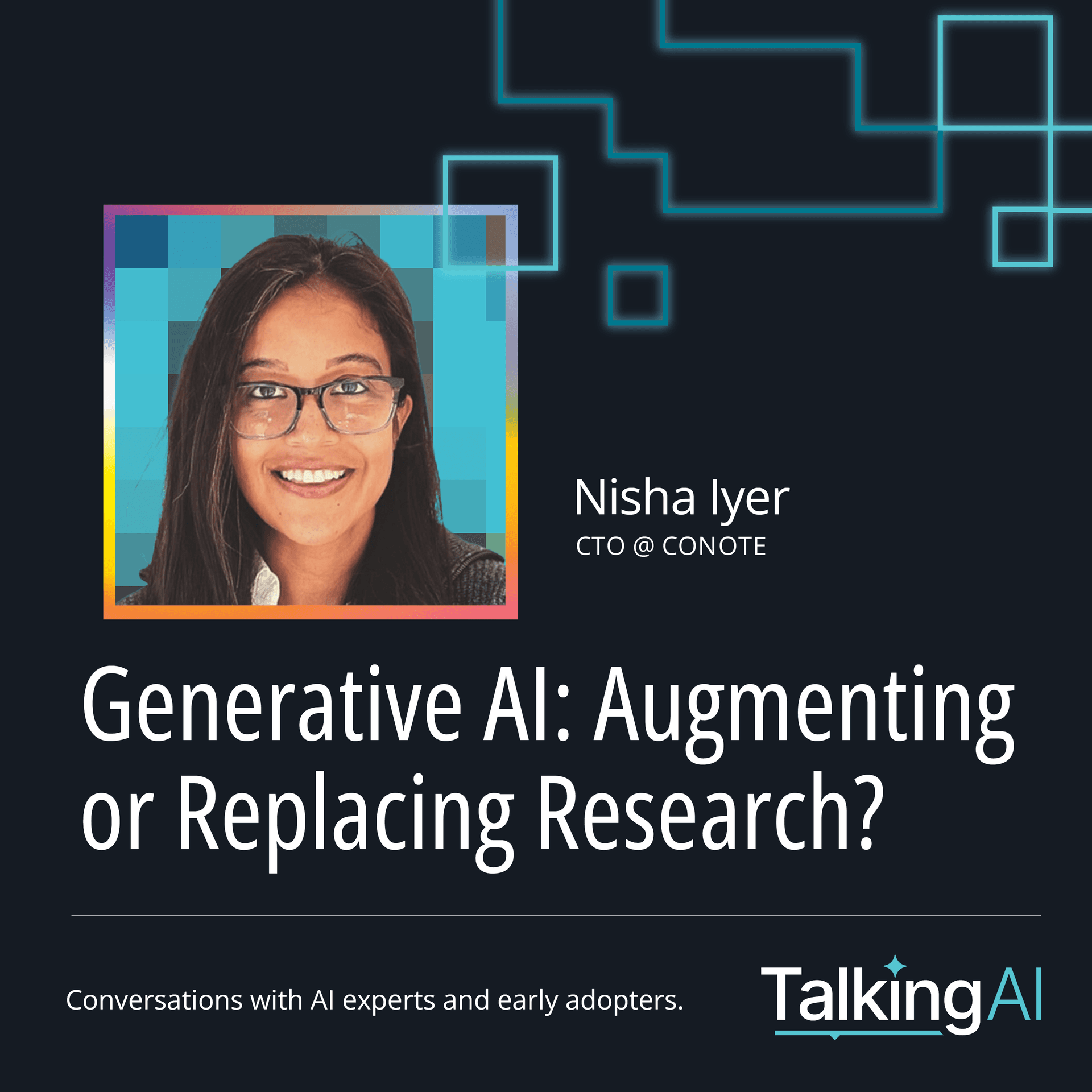
Episode Summary In this episode, Matt Paige interviews Nisha Iyer, CTO of CoNote, an AI-powered platform that enhances user research by transcribing, analyzing, and organizing user interviews. The discussion focuses on the impact of generative AI on user research, exploring how AI can augment research processes without completely replacing human involvement.
Key Topics Discussed
- Nisha's professional background and journey toward founding CoNote.
- Challenges in traditional user research that CoNote aims to solve.
- The skepticism surrounding generative AI in the field of user research.
- Predictions for the future of generative AI in managing user interviews.
- The importance of continuous research in the product development process.
- The integration of customer feedback in CoNote's product development strategy.
---
Key Moments
- Nisha's Background:
- Over 10 years in data science, with experience in product development and user research.
- Founding CoNote:
- Born out of personal experience with the inefficiencies of user research processes.
- Augmentation vs. Replacement:
- Nisha emphasizes that generative AI is designed to enhance the research process rather than replace human researchers.
- Skepticism in User Research:
- User researchers are often tentatively adopting AI tools due to fear of job displacement and distrust in AI's capabilities.
- Continuous Research:
- Nisha advocates for integrating continuous user research into the development cycle (CRCICD) to improve product-market fit.
- Customer Feedback:
- CoNote actively uses customer insights to inform product roadmap and features.
---
Key Concepts
- Challenges in User Research
- Time-consuming transcription and analysis processes.
- Risk of bias in interpreting user interviews.
- Difficulty in synthesizing large volumes of qualitative data.
- Generative AI's Role
- Provides rapid synthesis of user research findings.
- Facilitates the extraction of key themes and quotes from interviews.
- Allows researchers to focus on data interpretation rather than data collection.
- User Research Skepticism
- Many user researchers are hesitant to adopt AI tools due to:
- Fear of job loss.
- Lack of understanding of AI functionalities.
- Perception of AI as a "black box."
- CoNote's Approach
- Combines traditional machine learning with generative AI to enhance user research methodology.
- Aims for an intuitive user experience, emphasizing usability alongside powerful technology.
---
Future Predictions
- Short-term: Generative AI will continue to streamline the transcription and synthesis of user research, enhancing productivity and reducing workload.
- Long-term: Nisha predicts that while some automation in interviews may occur, human interaction will remain essential for qualitative insights. CoNote aims to extend its capabilities into various research domains such as marketing and academia.
---
Action Items for Listeners
- Explore CoNote for enhancing user research processes ([CoNote Website](https://www.conote.ai/)).
- Connect with Nisha on LinkedIn for insights into user research and AI ([Nisha Iyer LinkedIn](https://www.linkedin.com/in/nisha-ranjani-iyer/)).
- Consider the implications of generative AI in your own research and development processes.
---
Conclusion The episode emphasizes the transformative potential of generative AI in user research while addressing common concerns about its adoption. Nisha Iyer's insights highlight the importance of using technology as a tool for augmentation rather than replacement, paving the way for a more efficient and human-centered approach to product development.
Written by AI. May contain mistakes. Listen to the episode to check what was said.
Transcript
Automatic transcript. May contain errors.0:00Season three of the Built Right Podcast is right around the corner, but we've got one big change coming your way. The Built Right Podcast is now the Talking AI Podcast, and we've got a lot to talk about in AI. In the Talking AI Podcast, we'll be having in-depth conversations with both AI experts and early adopters of AI. That way you can understand how the technology works and how early adopters are beginning to implement and, more importantly, get value from AI. Our guests range from AI research scientists to founders of AI products to industry leaders putting AI to work in their business. While you're waiting for season three, go ahead and subscribe on your favorite podcast platform so you don't miss an episode.
0:41And make sure to leave us a comment about the AI topics that you want to hear about. So get ready to talk some AI in the new Talking AI Podcast, coming your way August 6th.
0:58Welcome to Built Right, a podcast by Hatchworks where we help you learn to build the right digital product the right way. In each episode, we'll deconstruct the layers of successful product development, break down popular trends, and offer real advice to help make sure your product is Built Right. We may not have all the answers, but we've built a lot of digital products across a lot of industries, and we've seen a thing or two. Let's get into it.
1:33Welcome, Built Right listeners. Today, we're chatting with Nisha Iyer, CTO of Conote. Conote makes qualitative research fast and easy with its AI-empowered platform, helping transcribe, analyze, and organize user interviews. It's a tool built for user researchers, which at Hatchworks, that's a big part of what we do. So we can definitely sympathize with that type of tool. But welcome to the show, Nisha. Thanks. Great to be here. Yeah, excited to have you on. And today we're going to get into how generative AI, and more broadly, just the democratization of AI, will fundamentally change user research and more broadly, user experience.
2:15But let's start off there. Nisha, why user research? Why this problem? What part of user research is broken or needs help? And how's CoNote looking to solve it? What gap do you see in the market right now? Yeah, great question. So just real quick intro. My background is data science. I've been in the industry for about a little over 10 years. And my last company, I was working at a startup. I've been there for five years and had built a tech team and had come to a point where we're doing product development. So with product development comes user research, right? Like to build a good product, you need to understand your users.
2:58That's how you get to product market fit. That is how you really build what people are asking for versus what you're building in your own head. So we did a lot of user research there. And I worked directly with a small group that did the product development. One person was a UX designer and then an engineer and a data scientist and myself. And we did a bunch of user interviews and went through the process of distilling them and really pulling out insights. And it was tedious. It took a long time. It took a lot more time than I had expected, you know, just from my technical background. And I was pretty overwhelmed with like the amount of information that we had to consume.
3:45Like, you know, you do the interviews first, record the interviews, transcribe them. And by the time you sit down to really distill what's what has been said, like the important themes, the important takeaways, You have to pretty much go through the interviews again and go through every transcription, you know, like the basic affinity mapping technique where you're taking post-its and grouping themes. And it just takes a long time. Like it took, you know, a week to two weeks because you don't have like that set aside time to just dedicate to the distilling of research. And so what I found myself doing with my little team was just taking shortcuts, like being like, okay, like I remember this, I remember that and being like, and then like internally thinking like this isn't the right way to do this.
4:31Like I'm 100 % biasing the, you know, I'm biasing my findings by thinking like hearing the things that I really wanted to hear, obviously, like that's just human nature. So what actually happened is that I had a project come up where there was like some kind of commitment to do 20 interviews in a period of two weeks and then distill the research. And I was like, this is insane. Like from my experience with research, I was like, this is a crazy requirement. And I and I thought like there must be some tools, like there must be some AI platform that does this. Like we, you know, we're at the age where this should be available.
5:12So I started Googling for it and I couldn't find anything. I was like, this is insane. So I called my friend at the time, my coworker, and now my co-founder, one of my two co-founders. And I was like, hey, dude, like we should build this. Like we can do it together. Called my third co-founder and we all talked about it and all agreed that it was a huge pain point of, you know, not being able to synthesize research in a speedy amount of time. And then also like just that, that unbiased synthesis, right? So that's how this came about. Honestly, it's just from personal pain points, which I think is a great way to build a product because you've actually experienced it.
5:54And you're like, I want to use this to solve my problems. Yeah. Quick break in the pod. If you're listening to this podcast, chances are you've been thinking about how to actually use AI inside your business. And that's exactly why we built the AI Opportunity Finder. It's a free tool that helps you uncover high impact, tailored AI use cases based on your business, your goals, your pain points, and your industry. No fluff, no generic use cases, just real ideas that fit your business and the ranked by ROI potential. It takes about three minutes to run, and it's like having your own personal AI strategist for free.
6:27If you want to try it for free. Check out the link in the show notes or go to hatchworks.com backslash AI dash opportunity dash finder. That's a great explanation. And you're bringing me back to my product days where we would do user research interviews and I would always schedule like an hour after the user interview to like debrief, go through it again. And it's like, you know, that's a two hour block there. And then to your point, you got to synthesize the whole thing. You forget stuff. You mentioned bias, but there's also recency bias where I'm going to remember the most recent interview more so than the other one.
7:03And then you have like for us, we would have these Miro boards where it's just huge with all these insights. And it's like you're trying to connect the dots. It's it can get messy. So like I can I can feel that pain. It's it's bringing back some some memories from those days. Yeah, exactly. A hundred percent. It's just like, how do we and then and so like just to continue on, it was just like, like this journey has been quite serendipitous. Honestly, I ran into my upstairs neighbor and she now also works for Kono and are with us. And she was a user researcher and I told her the idea. And she was like, oh my God, like this is going to make my job so much easier.
7:45Right. And I, and like, I like I'll stop there, but I just want to like touch on that as well, because it's not like, oh my God, it's going to take over my job. It was more like, this is going to make my job so much easier. Yeah. And I love the point too, like you're hitting on the pain points of the speed element, but there's also the quality piece for the bias. So there's some core like value points you're starting to hit on. But I was, I was digging through your LinkedIn and your, your CEO, James, and I'll mispronounce his last name. Frasier. Frasier. Okay. But he had this like interesting quote that was out there, a survey by user interviews and said, UX researchers were the most tentative of all roles to use AI with 44 % saying they've tried to use AI, but avoid it in their research.
8:34But like by comparison, CX professionals at 5%, data scientists, 9%, product managers, 21%. What do you think is the reason behind that? Why are you user researchers in particular, like less likely to adopt this technology that could potentially make things easier for them? I mean, honestly, I think it all boils down to like, fear of the unknown. If you look at like, if it 9%, right, data scientists are 9%. Like we, most data scientists understand exactly what's going on at the bottom level, right? Like it's we're, it's mathematical, there's no like magic, there's a lot of inference on based on similar words and, and words transformed into number numeric representations.
9:24And that's where like, it all stems from. So I think like, the number one thing is fear of the unknown. And, and then it just goes into like, I don't want this to take away my job, like, it's not do it. And then like, so then I feel like I would get on the defensive of saying, like, AI cannot do my job the way I'm like, better than me, it's not going to replace me. So I don't trust it. I think instead, like, where we could go with this is AI is augmenting my job. Like I can actually focus on the important pieces versus like the tedious nature of things that I could actually like bring to the forefront using a tool that does what I would be doing over a week or two weeks in a matter of minutes, right?
10:07And then I can spend the time taking those insights and making more inferences and pulling more information out of it, I can also speed my research cycles up. So I think that like that, that fear, like we've heard it, you know, we do our own user research with Conote. And I think it's just like, what's going on under there? Like it's a black box. And, and I think that like the way that I would talk to people who had that fear is that it's not a black box. It's just, it's like something that I can, I can help explain and walk through. I think that would just get boring though, because it's super technical, but it is all, you know, it is all related to similarities and semantic understanding.
10:52And AI is also not here to take your job. Like I will end with that. Yeah. And that's an interesting theme we've had across several episodes we've done lately is there is that fear of the unknown, that fear that it's going to take my job, that It's going to replace me. But this idea of a co-pilot, it's enhancing my skills. It's making me better is a theme we've continued to hear. I was chatting the other day with, and I'm trying to find the episode. It was Brennan at, I think maybe that's episode 15. We'll see where it is, what it launches, but it's hyper context. They're solving this tool for one-on-ones and performance reviews.
11:34And they had the same kind of idea with HR was like, you know, AI cannot solve this for me. There's no way. But what was interesting is like with the latest, you know, just craze over the past year, you know, chat GPT and all that kind of stuff. they were able to play around with it and get a sense of how things can work. And it kind of opened up their minds a bit. I don't know. Has some of that happened with user researchers as of late, where we've had this crazy hype cycle with generative AI, where people see some of the power with it? Because I think with user research, it's so qualitative.
12:06I think that's one of the big hiccups there as well. It's like, you know, this is qualitative stuff. It's not ones and zeros. But with generative AI, it adds that kind of semantic piece to it, to your point. Yeah. Yeah, no, I think that there is a growing acceptance and people want to use this. When they start seeing the way that generative AI can augment their research versus take over, I think people are more accepting. Like, I think we just actually spoke to someone recently that's getting on the platform at a large corporation, and they were a little skeptical at first. And then we introduced Conode as it gets you 85 % of the way, right?
12:51It's not doing all the research. It's just getting you to a point, jumping off point, where then you can take those findings and build your own insights. And that helped her feel better. She's like, oh, okay. So it's not like just giving me this output. It's more so like giving me stepping stones to get to that output. And I think when put like that, researchers seem to be more open to using the tool or using products like this, like any kind of generative AI products. You know, there are a couple out there in the market that seem to be getting some kind of traction. I can talk to those later.
13:28But like, I do think that like, it's like, and still in like the early adopter phase, right? People are still weary and we have to show people at Conote the reasons why they should be using it. And I think what we're doing for that is building a lot of user education, showing people how they can use the tool to augment their research and giving examples within Conote of how you can do that. Yeah, it's an interesting kind of product. And then getting into the marketing problem where they may be problem aware, but not really solution aware and trying to migrate them down that path. Let's get into like kind of short term evolution about AI can impact user research versus like longer term.
14:12And in the short term, I'd be curious, and this may be even be like functionality within Codenote or stuff on y 'all's roadmap. like what's the short-term view of how generative AI or AI in general is helping the user research process I mean is it simply just churning through this long interview and it's spitting out the insights like where do you see it today and then like what's like the crazy like you know utopian future of what it could be in the future so right now the power of conote lies within you know like we are actually moving pretty fast. We released our initial beta live July 18th, and we've already had a couple of releases since.
14:58The big, powerful generative AI piece right now, or so like, I just wanted to take a step back. Like we, I don't think Kono is 100 % generative AI. We have layered models. We do use traditional machine learning layered with a couple of like large language models. And I think to that extent, like there's already like power there. And that's why we call it an AI engine versus like just like Gen AI, right? And what we're doing, like the big powerful piece right now is that you can upload hours of research. So multiple interviews, and then you can synthesize. So not only can you synthesize, you can transcribe with the interviews and see the transcriptions, see the diarization by speaker, and then highlight key quotes.
15:42You can then synthesize your interviews. And then under 10 minutes, you will get the key themes and then the keywords within each theme. And those keywords directly relate to sentences within the transcripts. So let's say like I get four themes. I can click into those. I can then see where each speaker, like if I had five interviews, I can see where each of those speakers said that mentioned that theme. I can then click into detailed view where I can actually hear the speaker saying it so I can get sentiment. And I can also, you know, bookmark this and build a presentation that I can send out to a stakeholder that may be interested in like some of the key quotes that were said over, you know, like eight hours of interviews, which is usually would take, as you know, usually would take so much more time.
16:33So, yeah, I'll stop there. That is our current like big bang of our AI engine. And we definitely have some other plans ahead, but just wanted to stop for any questions. Yeah, it's an interesting point, too. You mentioned like generative AI is the hyped up word right now. But like machine learning and you as a data scientist knows like there's some of this stuff's been around for a very long time. This is not necessarily a new thing, right? And there's so much power just in like machine learning and a lot of the things there as well. And I'm curious too, you know, it seems like every day there's another Gen AI, you know, product coming out there.
17:20Like, how do you see differentiating when, you know, I feel like a lot of this, the tools with AI have been a bit democratized to where people have access to these large language models. You kind of mentioned that's not the only core point to your tool, but how do you build a moat when it's so much easier now to integrate some of this technology into a tool? How do you all think about that? I think we have to really think about the user, right? Like, sure, everyone can access these APIs and build and integrate them into their product. Are they actually thinking about the UI and the UX? Like, that is a key piece of co-note.
18:00Like you want to have, and as you know, like also being in product, like you want to have a really intuitive like journey when you get to an app, right? So you could integrate an API and build like all the tech and be amazing and stacked and everything. And if you're building a SaaS product and don't have like an intuitive front end, people are just going to stop there. Like they're not going to know how to use, get from point A to point B. And what Cono, so I have James Friscia as the CEO and co-founder, and then my third co-founder is Cameron Ridenor, and he's chief design officer. And so his background is UX, right?
18:39And so not only, like we live and breathe these problems, we get in touch with people that live and breathe these problems. We have people that also work with Cono that do. And I think that our moat is, A, that we're not just simply consuming APIs, right? We have other pieces of infrastructure around them on the AI side that actually enhance and empower us to be a little ahead of, not a little, a lot ahead of some of these gen AI companies that are just simply consuming and using prompts for some of these APIs. And then secondly, like just the fact that we have such a deep understanding of the user and are focusing on that when building our product, right?
19:25Like the experience, the interaction with the app. And if you're listening to this and are curious, like please go check out Kono.ai. It is live and free. And Matt, I'm not sure if you've checked it out, but when you're on the application, compared to many other competitors that we've checked out and tried out, there is a very simplistic flow to get to the pain point that we're solving for, which is really being able to speed up your research process. Yeah, I think part of the benefit there is you're very focused in on a particular type of user, which is user researchers, right? I think so many folks, and we see this with a lot of clients too, they're trying to serve too many different people.
20:11And then you get back to user experience. How can you build, you know, not simple, but just intuitive user experience when you're trying to serve different groups? Do you have even within user researchers a persona within that that you're targeting? Or is it user research is kind of the core? Like, is there a type of user research you're even more granularly focused in on? Maybe not a type of user research per se, but definitely a type of user researcher that is, you know, interested in synthesizing multiple interviews and has a research cycle they can't keep up with. or potentially, you know, like where I'm trying, where we're trying to drive people is the fact that research is more important than people give it.
20:57Like it takes so much time. The research cycles are longer than development cycles, right? Like I, like if I'm thinking about dev, I think of CICD and DevOps in CICD and just in general agile principles, a sprint is two weeks. There is in no way that like researchers think they can finish a research cycle in two weeks. However, with Kono, you could do a week of interviews, and then synthesize and be done and ready with new, with new findings for the next sprint. And I think that is a missing piece in the entire like end to end process. Like I have tirelessly worked with development teams and like lead engineering and data science teams.
21:37And the missing gap is that they don't get the user, they don't understand thoroughly like the user research part right like they it's like a game of telephone like 10 people have spoken to each other before the engineering team hears what they need to build and they can get so in like uh you know like just in deep in the rabbit hole of like hey this is how we're going to do it technically and not be thinking of like the actual user problem and that's where i really want to like you that's where kono comes in right kono gives you the ability to add continuous research to CICD. So like in my, in my mind, it should be CRCICD.
22:18Like that should be instilled in the development process. No, I love that. And you're speaking our language. When we talk about built right, we talk about building the right digital solution the right way and building the right one. It's a key element. It's user research. And I love the concept you're talking about where it has to be continuous. And this is what we preach as well. Like so, So much of the time, it's like, all right, let's go do our research. All right, discovery is done. Let's go build the thing. But it has to be built into the process. So I love that idea of it's, you know, you think of CICD, same type of thing.
22:52You need that feedback loop built in as you evolve the product. It seems like y 'all are kind of, you know, dogfooding it a bit by using the product yourself. I'm curious, how much of the roadmap are y 'all defining as you use the product versus feedback from customers? We try to definitely take more of the customer's feedback just because they're using it as their customers. But I do have to say, I listened to a podcast recently and I started to listen to it. And I was like, let me just put this through Kono and see what happens. And it just was able to distill the key points. so fast. And going back to like the roadmap ahead, you were asking about, in our next release, actually, October 13, there's a really cool feature coming out that's called action items.
23:44So now not only do you get themes like that have been synthesized during the process, but you actually get the items that to action on, right? So like, this is what your users have talked about. These are the actions to take. That came from us using it and from feedback, Like, I think like, I wouldn't say 50, 50, I'd want to say like more like 70 users, 30 us if we had to put a ratio to it. But I think we end up all seeing like, the great thing is we, I think we all end up like coming up with very similar pain points. And one of the main pain points we heard is like, this is great, but it doesn't give me items to like where I need to go next.
24:21So, so I ran the initial, like the first round of Kono interviews we did before user interviews we did before we had started building our product, right? We had just like a prototype. I ran those interviews through on dev through the action items feature, like with that to see what the action items were. And it actually gave me action items that were the features that we ended up building, which is crazy, right? Like it told us like users want audio recordings, Users want ability to like integrate with Zoom and Google Meets. Like, so I think that's, that's like, I kind of got off on a tangent, but that's what happens when I get excited.
25:08I think that's something that we've heard from users and from, we've also experienced that we're really excited about. And then, yeah, like, I think it's cool that we get to use it as we do our process as well, because it definitely makes us realize like what is like, you know, like sometimes you can just be drinking from the fire hose. Like you think of really cool ideas, but we use it and we're like, this is annoying. We need to change it. Like we spot the little things too. So yeah, it's a good mix. Yeah, that's interesting. And, you know, getting into the, let's get into like the future state, like, you know, way in the future, you know, where do you see the practice of user research going if things continue to evolve where AI is continuing to evolve?
25:52Is there a future where it's not even a real person doing the interview? And do I, at some point in the future, have an agent or a bot that's collabing with somebody else and performing this research? Do you ever see a future where it looks like that? Where does your mind go when it starts to wander of where things could be way in the future? I mean, I don't know about like, yeah, like great point. And I think people like wonder about that. But like, for me, I think there's like a degree to personal interaction. Like if you're a bot interviewing me right now, I feel like, sure, maybe like in some years there will be AI that's able to replicate each of us very well.
26:35But I do think like that human to human interaction is important in being able to, you know, like what 94 % of cues are like communication is nonverbal right like I think there's a lot to uh process that's outside of just like a conversation that I'm sure AI will be able to replicate but I don't know if I'm like yes like we want to make everything computer like like you know that like in the age of AI and just take away the human element I think more so like the way I I see Cono evolving in the future is being able to scale across, right? Like not like becoming so focused on like automating the entire user research process, but being able to scale to all types of research.
27:19So like to be able to reach product market fit and to really understand our target audience, we want to focus on user researchers right now. But to be able to like scale, I think where we go is just redefining all types of research, right? Like, how do we help in the political space? How do we help in academia? How do we go into like specific types of research? And I think that's where I see Kona moving. Like, that's where we're going in the future and not like, I don't think I don't see us adding a component where like, we're gonna build in AI bots that like, interview people or, and so like, once again, like, that's, that's why I feel like we're not taking away anything.
Read the full transcript
28:00It's more just like, let's augment the cycle so that people can be more productive and be up to speed with development teams. Just like I just read someone posted today about Copilot, like the code AI, right? And just telling engineers that Copilot is something people should lean into. They can automate so much of what they're currently doing. like some of the like tedious, like granular code writing that like you don't necessarily need to spend as much time on and can focus on the bigger picture. I see that exact parallel to to co-note with user research. Yeah, that's a great connection point there.
28:43We're using Copilot a lot at Hatchworks and it kind of just gets the mundane out of the way so you can think about the bigger problems. But I want to pause here like for all the listeners, when you're thinking about product strategy and product in general, the way Nisha and team are doing it is a perfect example. They're solving a specific use case for a particular user and user researchers, but you can also see where her mind's going in terms of like Tim's gentle, other areas where they can move into in the future. But you kind of build this, you know, this base with user researchers first, and that allows you the opportunity to expand further out, but you've got to do that first.
29:25So that's a great way to think about it. Don't try to boil the ocean, solve something specific first. But is there an area, you mentioned a couple, is there one that you think is like, oh, this is definitely where we're going next. From you mentioned like the political side, these different areas. Is there one that excites you outside of just traditional kind of, you know, product technology solution user research? Yeah, I don't think I can say that like there's one, like I think there's multiple, Right. Like this people have already been using Kona for marketing use cases. So I think that's probably like the next place to really go.
30:01Right. Like, hey, we want to distill all of these these interviews or these podcasts and find the key quotes. And this is going to help us be able to, like, make our marketing campaigns faster, just being able to pull these quotes out and having people saying them. So I think that's a place that we can really like either you be used right now or expand to immediately. I think political campaigns could be really cool because as we're coming up also into a big year, like I think just hearing a lot of like if people, you know, like if there's campaign interviews, being able to distill those and and once again, like play clips, depending on whoever we're working with.
30:40And then I think that academia is close to my heart and also a really great space to be able to use this. Like, let's say you're a master's student working full time, which I was. And you have like multiple lectures, right? Like that you have gone to and then are recorded. Imagine being able to use Kono to upload these lectures and then to just be able to find the most important themes and use this to study. Like, I think this basically is with some tweaks, of course, right? Once again, like you said, we have focused on user research for a reason. And I see this being expanded into a line of products potentially or Kona academia, Kona marketing, that kind of thing.
31:23But just imagine being able to take your notes and be able to have an easy way to search across hours and hours of lectures. That would have made my life so much easier, honestly, when I was doing my master's. Um, so I just think like, yeah, those are like some key areas that I'm excited to focus on. I don't know if like one will come before the other. I think we still have to like really nailed this initial, uh, product market fit and, uh, group down. Uh, but I think that there's like the exciting thing about Conote is I feel like there's so much room to grow and there's like, so there's so many things that I want to act on, um, which makes me feel excited about it.
32:05Nice. Well, I think that's a good stopping point, Nisha. Thanks for being on the Built Right podcast. And where can folks find you, find CoNote? What's the best place to go? You can email me at nishanisha at conote.ai. And you can also just check out CoNote. It's live. You get five free credits. Go test it out. Email me. Let me know what you think. So our website is conote.ai. And then from the website, you can log into the app. so it'll take you straight there and it's pretty easy. So yeah, we'd love to hear from you all. Awesome. Great having you on, Nisha. Thank you. Yeah, thanks, Matt.
32:49Thanks for listening to Built Right. If you enjoy the show, give us a follow or subscribe on your favorite podcast platform. And don't forget to leave us a review. For more info on Built Right, visit us at hatchworkbuiltright.com.
33:10The single biggest mistake we see companies make with AI is they don't properly train their teams. We see it all the time. Companies roll out AI tools and expect people to just figure it out. But using AI effectively requires a totally different mindset and skillset. And that's exactly why we built training for every level of your org, from AI training for teams and executives to training engineering teams on our generative-driven development methodology. Or if you've already identified your AI use cases and want to just prioritize where to start, we offer an AI roadmap and ROI workshop to help you build a clear plan.
33:42It's all about going from we should use AI to actually driving real value with it. Head over to hatchworks.com to learn more.
From the publisher
Generative AI is making an impact on every aspect of digital product building. But we wanted to delve deeper into how it’s affecting user research and interviews, so we invited Nisha Iyer, CTO of CoNote, onto the Built Right podcast to share industry insights and predictions.
Nisha shares the story of CoNote, an AI-empowered platform helping transcribe and organize user research. We hear her thoughts on GenAI skepticism and how CoNote builds on customer feedback to improve its efficiency. Plus, Nisha tells us her predictions for GenAI in user research and whether it could eventually manage user interviews entirely.
Key Moments:
- Nisha’s background in the industry
- The decision to found CoNote
- How CoNote augments user research processes, without taking over
- Building a moat in age of AI hype
- How generative AI is impacting user research in the short- and long-term
- Will AI take over the role of AI research?
- Why continuous research must be part of the development process
- How much of CoNote’s plans are based on customer feedback
- Why CoNote is a great example of product strategy
Key Links:
- Visit the CoNote website: https://www.conote.ai/
- Connect with Nisha on LinkedIn: https://www.linkedin.com/in/nisha-ranjani-iyer/
Mentioned in this episode:
Talking AI - Conversations with AI experts and early adopters
Welcome to the Talking AI podcast, where we dive deep into the world of artificial intelligence with host Matt Paige. Formerly known as the Built Right podcast, Talking AI brings you insightful conversations with AI experts, founders of AI products, and industry leaders who are leveraging AI in their businesses. Whether you're an AI expert or a beginner, our episodes will help you understand how AI technology works and how early adopters are deriving value from it. New episodes drop starting August 6th.
AI Opportunity Finder
Feeling overwhelmed by all the AI noise out there? The AI Opportunity Finder from HatchWorks cuts through the hype and gives you a clear starting point. In less than 5 minutes, you’ll get tailored, high-impact AI use cases specific to your business—scored by ROI so you know exactly where to start. Whether you're looking to cut costs, automate tasks, or grow faster, this free tool gives you a personalized roadmap built for action. 👉 Try it now at https://hatchworks.com/ai-opportunity-finder/