
In short
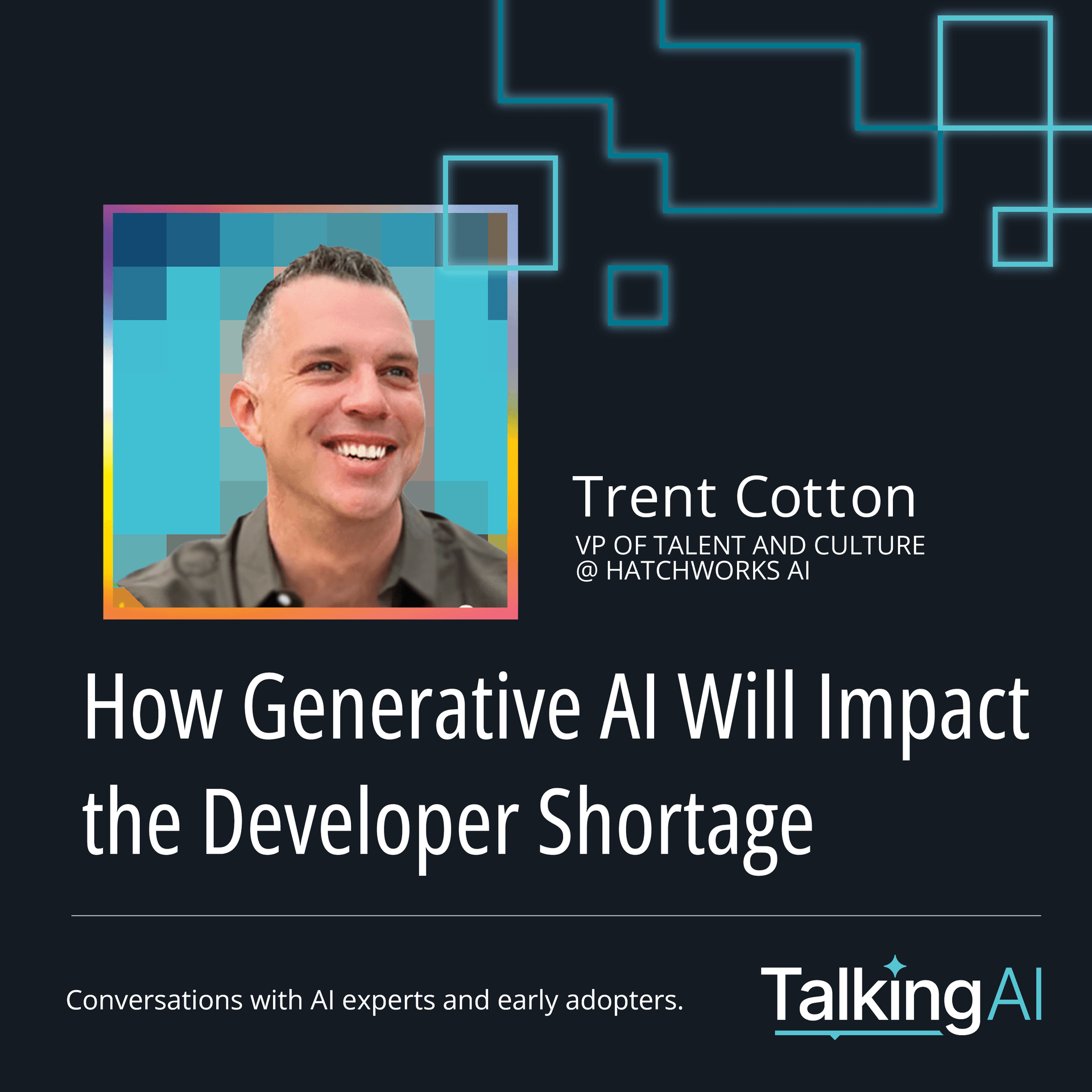
Podcast Summary: Talking AI Episode with Trent Cotton
Episode Overview In this episode of the Talking AI podcast, host Matt Paige engages with Trent Cotton, VP of Talent & Culture at Hatchworks, to discuss the growing talent shortage in the tech industry and how generative AI could potentially alleviate this issue. The conversation covers various factors contributing to the talent gap, insights into recruitment dysfunctions, and the intersection of AI and workforce development.
---
Key Themes and Discussions
The Current Talent Shortage
- Magnitude of the Problem:
- Korn Ferry's Prediction: By 2030, an estimated 85 million jobs could remain unfilled globally due to the talent shortage, with $8.5 trillion in potential revenue loss, including $162 billion in the U.S.
- Driving Factors:
- Early retirements of baby boomers during COVID.
- Insufficient skill levels among younger generations entering the workforce.
- Fast-paced technological evolution outpacing workforce training.
The Recruitment Landscape
- Recruitment Challenges:
- Overwhelming pressures on recruiters leading to ineffective prioritization.
- Misalignment between hiring managers and recruiters.
- Slow and broken feedback loops in the hiring process.
- Four Dysfunctions of Recruiting:
- Everything being treated as a priority (nothing is prioritized).
- Lack of rhythm or opportunity for assessment of recruitment strategies.
- Disconnected hiring manager-recruiter relationships.
- Broken feedback mechanisms delaying candidate evaluations.
Introducing AI into Recruitment
- Generative AI's Role:
- Potential to streamline recruiting processes and improve candidate engagement.
- Use of HR analytics to gauge employee sentiment and enhance retention.
- AI as a tool for augmenting human capabilities, rather than replacing them—akin to the concept of a "co-pilot".
Skills Gap and Workforce Development
- Reskilling and Upskilling:
- Importance of training existing employees to utilize AI effectively in their roles.
- Investment in educational initiatives for younger generations to foster interest in tech careers.
- AI Impact on Job Creation:
- Historical context: Major tech advancements have historically created new job categories.
- Concerns about potentially increased unskilled labor versus new opportunities created by AI advancements.
---
Key Takeaways
- Addressing the Talent Gap: Organizations must adopt flexible recruitment strategies and invest in employee training to keep pace with evolving technologies.
- AI as an Enabler: Rather than viewing AI as a threat to job security, it should be regarded as a means to enhance work efficiency and create new opportunities for innovation.
- Future Opportunities: Companies that prioritize reskilling and adapt to the changing landscape of work will be better positioned to attract and retain talent.
---
Noteworthy Quotes
- "Recruiting groups are limited by time, focus, and energy; everything being treated as a priority means nothing is prioritized." - Trent Cotton
- "AI can enhance our delivery or enhance our job skills, enabling us to work on more impactful projects." - Trent Cotton
- "Trust the journey." - Trent Cotton
---
Additional Resources
- Hatchworks: [Website for AI Opportunity Finder](https://hatchworks.com/ai-opportunity-finder/)
- Trent Cotton's LinkedIn: [Connect with Trent](https://www.linkedin.com/in/trentcotton)
- FutHRist: [FutHRist Website](https://futhrist.com/)
- Sprint Recruiting: [Sprint Recruiting Website](https://sprintrecruiting.com/)
- Related Reading: [Why AI Will Save the World](https://a16z.com/2023/06/06/ai-will-save-the-world/)
---
This structured summary aims to highlight the critical discussions from the podcast episode while providing actionable insights and resources for individuals interested in the intersection of AI and workforce dynamics.
Written by AI. May contain mistakes. Listen to the episode to check what was said.
Transcript
Automatic transcript. May contain errors.0:00Season three of the Built Right Podcast is right around the corner, but we've got one big change coming your way. The Built Right Podcast is now the Talking AI Podcast, and we've got a lot to talk about in AI. In the Talking AI Podcast, we'll be having in-depth conversations with both AI experts and early adopters of AI. That way you can understand how the technology works and how early adopters are beginning to implement and, more importantly, get value from AI. Our guests range from AI research scientists to founders of AI products to industry leaders putting AI to work in their business. While you're waiting for season three, go ahead and subscribe on your favorite podcast platform so you don't miss an episode.
0:41And make sure to leave us a comment about the AI topics that you want to hear about. So get ready to talk some AI in the new Talking AI Podcast, coming your way August 6th.
0:58Welcome to Built Right, a podcast by Hatchworks where we help you learn to build the right digital product the right way. In each episode, we'll deconstruct the layers of successful product development, break down popular trends, and offer real advice to help make sure your product is built right. We may not have all the answers, but we've built a lot of digital products across a lot of industries, and we've seen a thing or two. Let's get into it.
1:33All right, I'm excited to be joined today by Trent Cotton, Hatchworks VP of Talent and Culture. And he's the reason we're able to attract and retain the best talent in the industry across the Americas. He's got deep experience in talent management, organizational development, HR tech, data analytics. I got to take a breath here. HR process and has even developed his own unique process to recruiting called sprint recruiting, which frankly is just completely transformed how we recruit at Hatchworks. And oh, by the way, he's a published author. As you can see from the two book titles behind them, sprint recruiting, the first one in the futurists coming out later this fall, but welcome to the show, Trent.
2:15Thank you. Thank you. It's a little humbling. That's quite the introduction. I appreciate it. Yeah. Lots, lots of good stuff. And I'm sure we'll hit on some of the sprint recruiting stuff in the discussion later today, but the main topic, it's, it's a meaty one. It's a hot topic right now in the industry and it's the tech talent shortage and how AI is going to impact that. And how do, how do I know this is a hot topic? because our blogs right now on our website, those are getting the most traffic. It's talent shortage and it's how the impact of generative AI, those are the most trafficked right now.
2:50And PS, you can check those out on the Hatchworks website. And I'd say, make sure you stick around till the end. We're going to go into whether AI is actually going to help shrink this talent shortage or make it even larger. But Trent, to set the stage, help us just kind of set the stage of what is the current talent shortage gap? What does the future projections look like? And kind of what's, what's attributing to that? Help, help break that down for us to kind of set the stage for today. All right. So you got to ask the data nerd to come out because I love some of the statistics, although I don't like how much you're saying.
3:22I like the statistics. Yeah. All right. So Korn Ferry, which is a fairly large search firm, they have a fantastic analytic arm. It's one of the ones that I go to just to try and get a good feel of what's going on in the talent market. They estimate that by 2030, so not too far down the road, that 85 million jobs will go unfilled because of the shortage. So that's a huge number. Now, that's worldwide. You're looking at about$8.5 trillion in revenue loss. And just$162 billion of that is here in the United States. So, I mean, we're going against something that is borderline unprecedented, which is causing a lot of...
4:06I was going to say, just for context, that gap in revenue, right, is because there's initiatives companies want to do and things they want to get done, but they just don't have the talent to do it, right? Wow, that's insane. The competitive landscape now, everything is driven by tech. So if you're not staying ahead of the curve with the latest tech and making sure that something as simple as your website, your apps, your delivery systems, you know, think about Amazon, all of the different technology that's involved. That's what made them the behemoth that they are. They can't keep the roles filled quick enough to be able to stay ahead of the curve, which is a direct translation over into revenue.
4:42Maybe. Oh, that's interesting. It's really scary. Yeah. Yeah. And some of the driving things. So, I mean, that's a scary stat. And so let's kind of peel it back and, you know, what's driving this? And some of this has been hyper-intensified since COVID. So one of the first ones is the baby boomers. That was a huge generation of the workforce. A lot of them were forced to retire early in COVID. And they never reentered the workforce. They reentered at kind of a lower skill level. So that great in the gap that was already there. and then you have this up and coming generations that are not necessarily at that same skill level that's furthering the gap.
5:23But then you throw technology and the constant evolution of technology and you can't keep your workers skilled enough, fast enough to be able to evolve as quickly as AI is changing the game. I mean, just think about it. This time last year, were we talking about chat GPT? No. Quick break in the pod. If you're listening to this podcast, chances are you've been thinking about how to actually use AI inside your business. And that's exactly why we built the AI Opportunity Finder. It's a free tool that helps you uncover high impact, tailored AI use cases based on your business, your goals, your pain points, and your industry.
5:58No fluff, no generic use cases, just real ideas that fit your business and they're ranked by ROI potential. It takes about three minutes to run and it's like having your own personal AI strategist for free. If you wanna try it for free, check out the link in the show notes or go to hatchworks.com backslash ai-opportunity-finder. I know I wasn't. We weren't looking at the impact that generative AI is going to have. There was some talk about it in theory. Now the rubber's hit the road. And now companies are looking at, you know, just in the last six or seven months, all the evolution is going. So that's just a micro vision of what's going on in the economy and the direct impact of a gap that's already huge in the talent market, it's just going to exacerbate the issue.
6:48And then two, tech professionals. You know, the average person changes the job about three to four years, according to LinkedIn. And tech professionals change 20 % more. So it's, you know, the average anywhere between a year and a half to two years. So not only do you have the gap, not only do you have all of this changing technology, Then you got to figure out how do I keep these people once I get them on board. So it is for a lot of talent people or talent professionals, we're fighting a battle on six or seven different fronts. So for anyone that is listening that is a CEO, go and love when you're a talent person.
7:23They are exhausted. We get past the pandemic and the other stuff starts happening. So I usually know talent people because all of us have circles under our eyes for the last three years. no and you're deep in the industry too that's funny yeah go go give your love to some talent people they need it right now but it's interesting though it's it's not like one thing it's like five six different things all attributing to this talent shortage we have right now right it is it is quite the perfect storm um just because you can't you can't deal with just one issue. So let's go back four or five years.
8:02You were able to diagnose one particular area and go in there and fix it, do some triage, and then move on about your business. There's no way to do triage wherever you've got all of this stuff that is so interconnected and interdependent and constantly changing. So just when you think you can diagnose, it's very much like a virus. You know, you kind of treat the virus just as soon as you think that you have it nipped, the thing mutates and now you've got something different. That's the current state of the talent market. And then you add to that that most recruiting processes are utterly broken.
8:37It's just, so you can't get the talent. You have to worry about retaining the talent. And then it takes too damn long for the talent to get on board because of the broken process. So there's a lot of things that companies are trying to do to leverage AI to help fix some of that, at least from a process and engagement standpoint. Some of the analytics, you know, we use a lot of HRA analytics to really kind of get a sentiment analysis of what's going on with our team members. Because I think the difference for us versus a lot of companies that I've consulted or that I've worked with is everyone talks about, yeah, retention's a big thing.
9:17I have never worked for a company like Hatchworks. We're obsessed. Like, we almost take it personally. Whenever people leave, we want to dig into why did they leave? You know, how do we make sure that no one else in the organization feels that way? And I think that speaks a lot to why we have over 98 % retention in our organization. Yeah, that 98 % number is insane. And I do want to get to this topic around AI, but you hit on something that's interesting. You know, everybody kind of sees AI as this, you know, maybe this is the solution to solve all our problems. but you mentioned the process point of it.
9:52And I think it's worth noting just, you know, because I've been amazed at how much it's helped us, but the sprint recruiting, and not that we're going to go on a full tangent on the sprint recruiting and everything there, but just hit it at a high level because it's done so much for our organization. It's worth noting that, you know, there are basic fundamentals with process that are important to have in talent recruiting, anything in business, but this is especially true here. Yeah, so let's tackle the four dysfunctions of the recruiting. I said that the recruiting process is broken. I've been in recruiting in HR for 20 years.
10:26I've done through Hatchworks. I've also done some consulting for our clients on their recruiting process. There are four constants. The first dysfunction is that everything's a priority, which means nothing is a priority. Recruiting groups are limited by time, focus, and energy. and whenever you're constantly moving the needle or moving their cheese, they're not able to make the progress that they need. The second is that there is no rhythm or opportunity for recruiters or recruiting leaders to stop and go, hey, what's working and what's not? And find ways that you can scale what's working and identify the obstacles and work together with the partners to overcome them.
11:02And then clients and recruiters are, it's kind of like running a daycare sometimes as a talent leader because you have a hiring manager saying this person hit me and then you got the recruiter saying well this person looked at me and there's just this huge lack of alignment and then last one is the feedback loop is broken uh whenever i first started this i i went through agile training came out of it and i said okay there's got to be something that i can learn from agile and apply it to recruiting and the first one was looking at the feedback um the average amount of time that it would take for us to get feedback on candidates was two to three weeks.
11:39So there's your four dysfunctions. We balance that in sprint or agile recruiting with the four principles. The first one, we look at things in two weeks. So if you've got 400 jobs, the first part of that funnel is, okay, in the next two weeks, what's realistic? And what's the most important roles that the team needs to focus on and get? That can be to mitigate risk. That could be to drive revenue. That could be to hit certain milestones within the technology sprint. The next is that business defines the priority. So we go to them and say, okay, out of those 400, you say these 20 are the most important.
12:11You have 200 points. I want you to assign a point value to those 20, and we're going to work them in order. The next is that we have lip limits or work-in-progress limits. We limit the number of candidates in each stage of the process because that enhances the candidate experience. It makes sure that we do not lose great candidates. It also stops this FOMO that a lot of hiring managers have of, I want to interview 25 people. Look, dude, there's not only five people out there. We need to go and move on these top five. And the last one is that we have a 48-hour feedback mandate. We present a candidate.
12:45We want 48 hours. We want feedback, yes, no. And what this does is it provides almost like a drumbeat. It also provides us metrics. So I know, on average, on 10-day sprint, day two, day seven, day eight, and day ten, that's usually whenever our offers go out. I don't schedule meetings with my teams. I block any kind of meeting or anything that's going to disrupt them from focus on getting those offers out the door. We're also able to track how many candidates. We can almost precisely say, if you need a full stack developer, we can get it done in 32 days. Or if you just trust our judgment and you want us to hire it for them and we place them on the project, we can get it done in probably about one sprint or at least maybe 15 or 16 days.
13:30There's not a lot of companies out there that can do that. And we move with speed because now we're focused so intently on what is important to the company, not just working on everything. We've developed these pipelines of candidates that are just sitting and waiting for us to go and pluck them and put them on our project. So we've really been able to ship. I mean, kudos to our talent team. This time last year, we were not in this space. Now we're on the offense. We're ready to go. Yeah, I mean, you hit it. It changed the way we work. And I love the comment. There is a rhythm to it. It's like the whip limits.
14:01And, you know, my wife will tell you, rhythm's important and I'm six foot eight left handed and two left feet. I don't have it. So it's it's critically important. And the team has it. You can just and it gets them excited, too. So, you know, a little bit of a tangent, but it's it's worth hitting on because so many people overlook the process. Honestly. Yeah. Yeah. All right. So let's get into this topic of how AI is going to impact this talent shortage. And I think, you know, one thing to note, like AI has been around for a super long time. It's nothing new. And like, I'd encourage folks to check out our episode with Jason Slachter.
14:40He's got a lot of insight on the history of AI and everything there. But what's been interesting about this latest evolution, like you mentioned with chat GBTs, large language models, the generative aspect of it, it's almost made it, you know, it democratized it. They made it accessible to all in a lot of ways where you don't have to be, you know, in the code doing things to leverage it. But let's get into kind of your perspective of how is this going to impact the talent market? Whether it's, you know, does it shrink it? Does it grow it? Or how does it enable people to perform better at their jobs?
15:19There's a lot of angles we could take this, but we'd love kind of your take of, you know, this AI boom that's going on right now. Yeah, absolutely. So I think the greatest impact that it's going to have is some of the frontline workers. I think there's going to be a lot of intense look by organizations to say, okay, what can AI do that we don't necessarily need a human to do? There's going to be also, so that's kind of the first major impact there. So that's not going to create a skill gap. That's actually going to create a surplus of unskilled workers, which is, again, this is just part of that whole big trifecta that we're dealing with.
15:57But then if you move a little bit upstream, there are going to be jobs that are highly impacted, that are very manual in process, that AI or even some of the machine learning, some of all of the different technology impacts are going to look and make, how can we do this in a more streamlined fashion, more efficient with a focus on client engagement and client retention. I think that's going to be one of the very interesting things because whenever you have these manual processes, you don't have analytics on the back end. Companies now, especially since COVID, are so obsessed with what is the data telling us.
16:34I know in HR we are. What is the data telling us and how do we make sure that we stay ahead of the curve, that that's going to be one of the things that companies go, okay, we've got to invest in this. So there's going to be opportunities for a lot of workers to be able to learn some of these processes, maybe not from a technology standpoint, but how do they actually leverage AI as a partner versus it's an us versus them. And I think this is the part that's going to be really exciting for the right part of the workforce that sees this as an opportunity to level up their skills and they go into it with an open mindset.
17:10Um, I always use the example of, um, cause I get asked in HR a lot, you know, is, is HR going to be replaced by AI? And the answer is no, it's not. Will some of them? Yes. Um, I look at AI almost like Iron Man. So Rob Stark, fantastic guy, wonderful business guy, billionaire, sexy, charming. Oh, I mean, he's a badass all by himself. You put him along with his AI in Jasper and you put the suit on, now he's a superhero. And if you watch, he's taking in all this data that AI is able to process incredibly quickly, but he's still making the decision on whatever action he's going to do. So I think that the more that we as talent professionals and leaders in the organizations can look at our workforce and go, how do we take our Rob Starks, you know, that are not Rob Stark, that's Game of Thrones oh my gosh Tony Stark there we go Tony Stark yeah I was like we're mixing genres here yeah so now everybody knows I'm one of those kind of nerds and I like Game of Thrones and man but you take your who are your Tony Stark's and how can we make them better by pairing them up with something that's going to just enhance their delivery or enhance their job skills but then you have the whole thing with it so it's really interesting I was talking to a professional not too long ago, and they were frustrated because they were trying to get some roles filled for developers.
18:37And the managers were getting so ticked because they were doing like an assessment. And a couple of the people using ChatGPT to kind of help with some of the basic code, and then they were focused on like the more sexy stuff. And the manager was disqualifying them. And to me, that's the antithesis. That's what people should be using AIs. What's the mundane, non-value add, but critical and necessary parts of this coding or whatever it is? Let AI do that so that way they can work on some of the things that are more impactful. Yeah, that's the whole point around our built right method at Hatchworks is how do you enable it?
19:15I love that co-pilot mindset because that's what it is, right? It's not going to take over. It's going to make the folks leveraging it better. I think one interesting point, though, that I've heard from some, it's like, you know, you can't over rely on it to the extent of if you have a bad developer, you give them AI that could actually make a more tangled mess versus you have skilled developers leveraging it. I love that idea of it gets rid of the mundane. That's like the first go at this. But it's like the co-pilot example. I think Tesla has this where if you're in co-pilot mode, it forces you to touch the steering wheel every so often.
19:55So you don't just go completely mindless. And same thing with flying a plane. Same kind of analogy could be applied to technology. But I do think that this is going to force companies to, and we've been looking at this since COVID. How do you reskill, upskill, and redeploy your workforce? I think now with some of the intensity that's coming driven by artificial intelligence, that's really going to kind of come to the forefront. I know that organizationally we're talking about it. We give all of our employees a$2 ,000 a year training budget to use to get certifications or whatever they want to learn to enable them to be even more productive in an area of interest.
20:41And so, you know, we're looking at what are some AI courses? What are some AI certifications that we can offer to our employees to make sure that they're staying ahead of the game? So not just to benefit them, but also to benefit our clients. We want to be that trusted partner, not just someone that you come to and say, hey, I need three or four software developers in the DevOps. We want to be able to come in and add a level of knowledge and acumen that is unparalleled to anybody else in the market. Yeah, and I think, too, the other interesting point, and you hit on it. It's like so many folks are looking externally for this talent when you have this like workforce sitting there that that if you give some, you know, love and care to in terms of upskilling them, you can help evolve them.
21:29So that's that's a great point and a big piece that's missed a lot, I think, with a lot of organizations. Yeah, and there's actually some there's a lot of government funding that's going into boot camps. They're looking at some of these low to moderate income areas or even people that, you know, maybe you train to be a teacher. Like, all right, I'm tired of this. And you want to do an about face, but you don't want to necessarily go back to college. There's boot camps out there that will teach you some of the basics of coding, software development, AI, and some of this. So a lot of companies are actually being forced to shift the educational requirements and look more at non-traditional approaches.
22:06So it has had a very far-reaching and very deep impact on the talent strategy for most companies in the U.S. Yeah, that's a great point. So next thing I want to get into, what's your take here? Is AI, this new evolution with AI, is it going to close this talent gap or does it make it wider? maybe what's your take there or maybe there's alternate you know parallel universes or it could be the case on both sides i think we're more in a parallel yeah it's definitely in um in reference another movie kind of the metric is like which pill are we going to take here right it's it's a lot of what we've been talking about do we use this as an opportunity to re-skill some of those that may be replaced by ai or their jobs change as a result of implementing some type of ai practices.
23:00If we do, then I think that that's going to shorten the gap and be able to tap into a huge force. And it's actually going to help break some of the poverty cycles because a lot of these frontline workers, they just kind of stay in that mode. If we're able to go in and take them and give them a skill that's actually applicable in the new market, I think that's going to help us economically, but it's also going to help from a tally gap. If we do not, that gap is going to continue to exponentially just grow. And it's terrifying looking at, I mean, 85 million jobs by 2030. That's mind-blowing. I mean, that's more jobs than were added, and I can't even think of how many years that we're just going to lose in the blip of a decade or two decades.
23:54That's crazy. I want to get your take here. So there's Andreessen Horowitz, he wrote the seminal article of why software is eating the world. And he has this new one out, why AI will save the world. And just to call out a couple points, he has these different AI risk he goes through. And I encourage anybody to check this out. Super interesting read here. But point number three is, will AI take all our jobs? And his perspective is, you know, every new major technology has led to more jobs, higher wages throughout history, with each wave accompanied with a panic of, you know, this time is different.
24:33It's going to steal all their jobs and everything. And he gets into this point that, you know, that doesn't necessarily happen. And then he goes on to call out, you know, if we're allowed to develop and proliferate throughout the economy, this new kind of evolution with AI. it may actually cause the most dramatic and sustained economic boom of all time with corresponding like record job and wage growth um but it's this interesting point and the last thing i'll hit on let's let's chat there i'm curious to get your take but he talks about this lump of labor fallacy which is the notion that we have this fixed amount of labor to be done so it's like supply and demand side uh and either humans are going to do it or machines are going to do it but the fallacy comes into play he goes on in the article to state that when you have ai and things like that making it cheaper to do things it increases purchasing power of people people have new demands and wishes and all these things which creates all new types of businesses and verticals and industries and all these things and like one point he mentions from Milton Friedman, humans' wants and needs are endless.
25:49It's just kind of an interesting point. But what's your take there on Andreessen Horowitz's kind of perspective? I think it's a unique one. What's your perspective there? So I'm going to get to an answer. So I'm going to equate it to something like the economic downturn. So let's go back and look at 2008 through 2011, okay? banks failed, massive, massive recession, setback, people are out of jobs. Darkest of times, you would think. But look at what came out of that. Prior to 2008, 2010, did we know that we needed an Uber? Did we know that we could have a social network that, you know, people could go and actually create their online business and be an influencer and make money from that?
26:41So I agree with what he is saying, that this new technology will spawn an economy or facets of the economy that we don't know that we need yet because we haven't really, the need has not been created. So I do agree with that. From a talent perspective, it's going to be really interesting to see. That sounds really, really exciting of new economic avenues, new job opportunities, new job growth. but I'm a little concerned that we can't fill the damn jobs that we have now. How are we going to fill some of these new ones out there? Yeah. Does it make it worse? Right. Right. So there's like the personal side of me that gets really excited.
Read the full transcript
27:22I'm going, Oh, I wonder what's next. And then the talent part of me kicks in and goes, Oh crap. Here comes another level of complexity. But I do think that this is an opportunity for a lot of organizations. We do this to a degree of going in and trying to get ahead of the curve. So looking at how do we train up and get high schoolers, or just start high school, how do we get them involved in some of the tech jobs and the tech opportunities that are out there? Because a lot of, I know I did, I thought tech is fun, I like it as a consumer, but I don't necessarily want to sit there and code all day.
28:01Well, there's other things in the technology sector besides just sitting down and coding. But there may be a kid out there that that's how their brain works, and they love that kind of stuff, but they don't know that that's actually an avenue. So we have a philanthropic arm called Hatch Futures where we actually go in and we do that. So anyone in the United States who's familiar with junior achievement, it's very similar to junior achievement, but we do it through STEM. So we teach them the basics of an algorithm using a couple of pictures saying, hey, put this in order. Guess what? You just wrote logic.
28:33That's what an algorithm is. and it's just an opportunity for us to be able to get them excited. So I think more companies that go in and start doing that is going to help, not in the media, but it's going to help us in the next five to 10 years as those high schoolers come out and they're on the cutting edge of some of those technology programs. That's one avenue. The other avenue, it gets back to how are we going to reskill and redeploy our current workforce? And will we have the interest? Will we have the commitment to some of our current employees to make sure that they stay abreast of the new technology so when those new opportunities do come up, we're ready to meet them and we're ready to push them into it?
29:16Yeah, you triggered one thought in my head too that's interesting. We kind of hit on it earlier, this evolution of generative AI. It's democratizing AI in a lot of ways. But a lot of folks, especially younger kids coming up, they think of coding as like, let me see if I get the sides of the brain right. It's more like right brain, like analytical thinking, all that. And it's like, oh, I'm creative. That's not for me. But what it does is like the actual physical coding becomes maybe less important to those other avenues you can leverage from a creative standpoint that I think is a huge unlock, whether it's, you know, with a chat GPT or you have like mid journey and people are creating whole movies with AI, generative AI.
30:00And it's like this whole new world in a sense for like the creative folks out there that I think is going to be really interesting to see how that evolves over time. It is. And with AI, I think it was probably a couple of months ago that one of the big articles on LinkedIn was a company was paying over$300 ,000 for a chat GPT prompt engineer. Like, how do you structure the logic to get AI to do what you want to do? So that's not necessarily coding, but I mean, that is an avenue. You do have to understand the logic behind it. So I think that there are going to be opportunities that open up that are not the more traditional, as we think of today, technical routes.
30:45And how are we going to educate the youth currently? And how are we going to re-educate our workforce to be able to meet those demands? That, that's to me, that is probably public enemy number one. Yeah. Do you think this whole evolution has an impact on the proportion of folks that prefer, prefer like gig type work versus like, you know, gainfully employed by a single employee? Do you think that impacts that in any way, that kind of trend? it does if you look at um the it's called the workforce participation rate so it measures i think it's from 24 to don't hold me i think it's 62 or 48 sorry it's looking at what are the what percentage of the population is actually working yeah it is flight line it is in the 80s it was at 80%.
31:37You know, it dropped down to 70%. We have been hovering in and around 60 to 62 % over the last three or four years since COVID. Because what happened with COVID is that it wasn't just a recession where just the financial industry or the car industry was impacted. COVID was unilateral in its decimation of jobs. And so a lot of people move to the gig workforce because they don't want to have to depend on their livelihood coming from someone else. This is hyper intensive in the technology space. There are people that just enjoy working on a project and they want to do it for themselves. They're a freelancer.
32:16They don't want to necessarily clock in or have to go to meetings or anything else like that. They enjoy that freedom of just doing the work that they're passionate about and then clocking out and enjoying life. We're starting to see a lot more of that behavior wise, mindset wise. It's something that we look at internally. of, you know, we've got people that are highly engaged or really want to be on that employee side and all the training. And then we've got others that just, all they want to do is do their work and call it a day. So, you know, we've had to learn to be very flexible and agile to be able to accommodate both types of mindsets.
32:49So that way we can retain the top talent in the market. If a company goes in and says it is this way or no way, you're probably going to have more of a tally gap or a talent shortage than your competitor who's willing to say, you know what, if you just want to be a contractor, that's fantastic. Just get the work done, you know, and go and live your life the way that you want to. So it's another aspect that's a result that was intensified with COVID. There's 24 % of the mail market left from 2020 to COVID, and economists cannot figure out where they went. Now, ideally, I mean, interestingly enough, if you look at the timeline and you look at average number of hours of gameplay, it's almost proportional from when they left to the hours that...
33:39It's playing video games. Yeah, they're playing video games, but I think it's more because they're doing gig work and they can go and enjoy games and work whenever they want to. So there's some benefits on both sides. But companies have got to learn to be a little less dictatorial and a lot more flexible and agile if they want to survive. Yeah, don't cut off your nose to spite your face. Oh, yeah. So a couple rapid-fire questions for you. What AI technology is most exciting to you right now, whether it's a tool or anything in particular? For me, it is the impact on HR analytics. So sentiment analysis, forecasting, looking at – because for the longest time, you could look at what was going on internally, but then you would have to pull in data from external, and it was a very manual process.
34:27Now you've got these that can just go and scrape the information, say, here's your retention, male, female, age groups against what's going on in the industry quicker than it would take for me to actually go and find the information two or three years ago. So the impacts on HR analytics, on talent analytics is probably one of the things that I am just, I'm like over there like a kid at Christmas waiting to open up a gift. I'm ready. Oh, there's so many tools coming out. It's so cool to watch. Who are you watching in the HR, you know, talent or tech talent industry? Who are you following that you really find insightful or interesting?
35:04You know, it's, I have a love-hate relationship with applicant tracking systems. Most of them are built for HR processes, not actually built for finding and engaging and nurturing talent. Um, there has been one that I've looked at not too long ago, Luxo, who has got all the AI and machine learning power for sourcing across multiple platforms. It's got the nurturing and everything that, again, is driven by AI and nudges and all that from a candidate to relationship management. And then it's got all the cool little backend stuff with all the analytics. So to me, it's just interesting to kind of watch some of these thought leaders take these thoughts and actually become advisors for some of the HR tech companies and having an immediate and direct influence on it.
35:53So I think some of the big boys that have enjoyed all the limelight and the talent market, like a LinkedIn that has gotten so much money invested in it. And I don't really recognize a change over the last 10 years. You know, there's a, there's a lot of people that are coming for them. So I am, I'm here for the show. I'm kind of like that, that Michael Jackson, and just pop and pop going, okay, which one's going to win? That's right. All right, last one for you. What's one thing you wish you could go back to your former self before you started your career to give yourself some advice? Any one piece of advice you would give yourself?
36:26Trust the jury. There are so many. So I started out as a banker. I put myself through college as a banker. I got into HR because I hated working with HR professionals. and there are so many curves that I took that did not make sense at the time, but now whenever I look at it, it makes complete sense. You know, the banker, the analytic, the minoring in statistics, it comes in handy in HR now because I can look at data and see what is the story that's being told. So it's just kind of trust the journey. Yeah, trust the journey. I love that. All right, Trent, thanks for joining us. before we go where can people find you what's the best spot to go find Trent and all the great insight you have LinkedIn.com Trent Cotton you can follow me at Twitter at Trent Cotton all one word you can follow me on sprintrecruiting.com or futurist that's F-U-T-H-R-I-S-T dot com and of course you can follow all the blogs and posts that we do on Hatchworks yeah and find the sprint recruiting out on Amazon, I'm assuming, or I guess on your website directly.
37:35So you don't have to pay the fees to Amazon. Yeah, it's on both, but yeah, you can go and get it on Amazon and it's on Kindle and then futurist comes out in the fall. Yeah. Great. Trent, I appreciate you joining us. Thank you. I enjoyed it.
37:52Thanks for listening to built right. If you enjoy the show, give us a follow or subscribe on your favorite podcast platform, and don't forget to leave us a review. For more info on Built Right, visit us at HatchworksBiltright.com.
38:31every level of your org, from AI training for teams and executives to training engineering teams on our generative-driven development methodology. Or if you've already identified your AI use cases and want to just prioritize where to start, we offer an AI roadmap and ROI workshop to help you build a quick plan. It's all about going from we should use AI to actually driving real value with it. Head over to hatchworks.com to learn more.
From the publisher
Could generative AI help recruiters fill the gaps in the talent market?
The developer community is facing a shortage of skilled workers, and the needs of the tech industry are growing. To stay ahead of the curve and remain competitive, companies must hire the best of the best. But with a shortage of talent, recruiters face a tough challenge.
To share some perspectives on recruitment difficulties, Trent Cotton, our VP of Talent & Culture, joins this episode of the Built Right podcast. Trent explains why we’re facing such a talent shortage, what that means for businesses, and why broken HR processes are holding many companies back.
Trent explores the growing usage of generative AI in the HR space and how that could help to patch up some of the gaps in the talent market.
Key Moments:
- How the talent shortage directly impacts revenue
- The training challenges of evolving technology
- Why the talent shortage is down to multiple factors
- The four dysfunctions of recruiting
- Four principles of Sprint Recruiting
- How AI could streamline recruiting
- How AI will impact the skills gap
- The Horowitz perspective on AI
- Why we need to introduce children to tech earlier
- Why employers need to be flexible about work preferences
- The most exciting things to come in AI
Key Links:
- Connect with Trent on LinkedIn: https://www.linkedin.com/in/trentcotton
- FutHRist: https://futhrist.com/
- Sprint Recruiting: https://sprintrecruiting.com/
- Why AI Will Save the World: https://a16z.com/2023/06/06/ai-will-save-the-world/
Mentioned in this episode:
AI Opportunity Finder
Feeling overwhelmed by all the AI noise out there? The AI Opportunity Finder from HatchWorks cuts through the hype and gives you a clear starting point. In less than 5 minutes, you’ll get tailored, high-impact AI use cases specific to your business—scored by ROI so you know exactly where to start. Whether you're looking to cut costs, automate tasks, or grow faster, this free tool gives you a personalized roadmap built for action. 👉 Try it now at https://hatchworks.com/ai-opportunity-finder/
Talking AI - Conversations with AI experts and early adopters
Welcome to the Talking AI podcast, where we dive deep into the world of artificial intelligence with host Matt Paige. Formerly known as the Built Right podcast, Talking AI brings you insightful conversations with AI experts, founders of AI products, and industry leaders who are leveraging AI in their businesses. Whether you're an AI expert or a beginner, our episodes will help you understand how AI technology works and how early adopters are deriving value from it. New episodes drop starting August 6th.