
In short
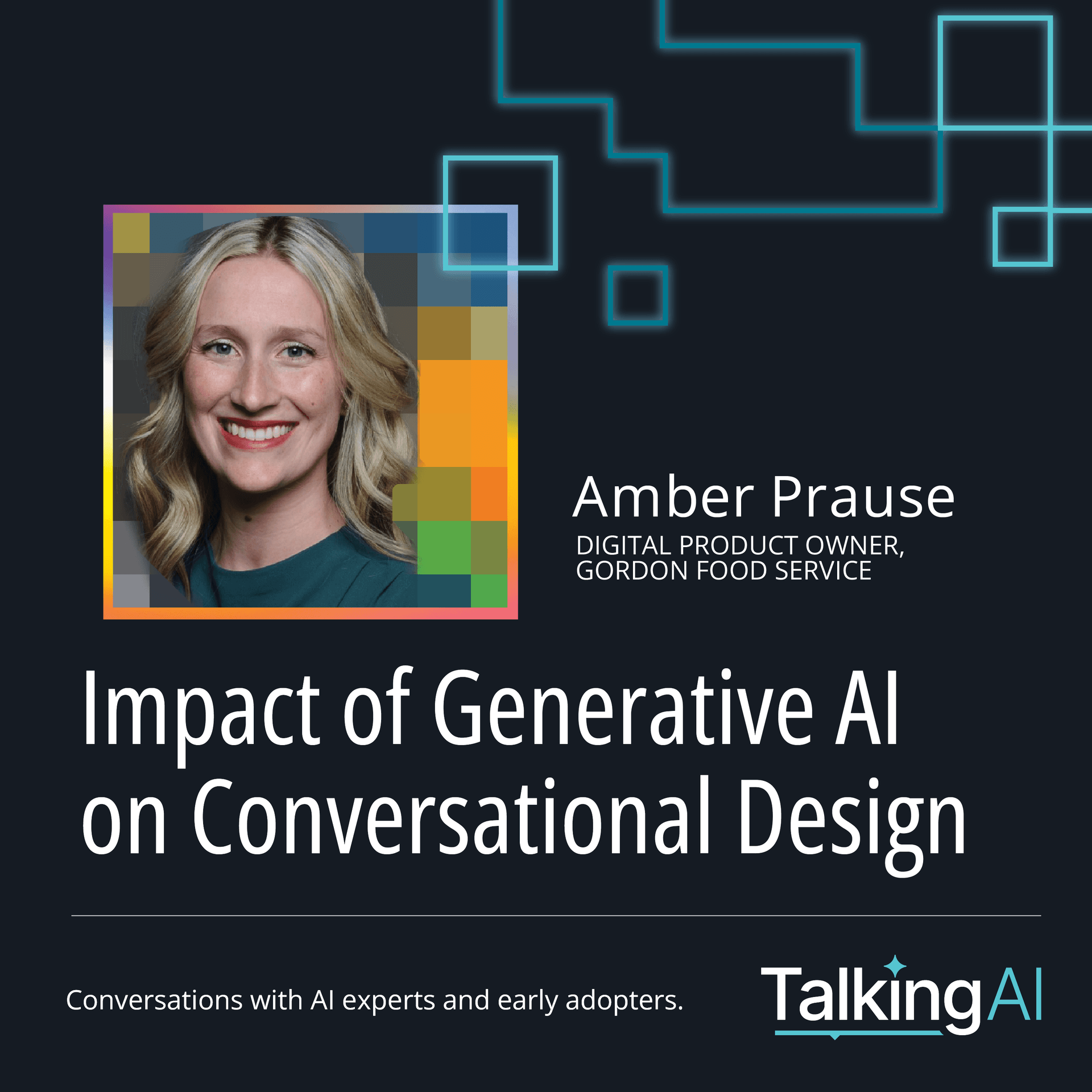
Talking AI Podcast Episode Notes: Impact of Generative AI on Conversational Design
Episode Overview
- Podcast Title: Talking AI
- Episode Title: Impact of Generative AI on Conversational Design
- Host: Matt Paige
- Guest: Amber Prause, Digital Product Owner at Gordon Food Service
- Release Date: August 6, 2023
Episode Description This episode delves into how generative AI (Gen AI) has transformed conversational design and interfaces. Amber Prause discusses the evolution of conversational interfaces, moving from deterministic design to non-deterministic models, and emphasizes the significance of user personas in chatbot design. The conversation also addresses the training of Natural Language Understanding (NLU) systems, the role of prompt engineering, challenges in business AI integration, and examples of AI failures.
Key Themes and Discussions
- Introduction to Conversational Design
- Definition: Conversational design involves training NLUs to understand and process human language naturally in chatbot interactions.
- Importance of UX: User Experience (UX) plays a critical role in ensuring chatbots provide seamless and intuitive interactions.
- Evolution of Conversational Design with Gen AI
- Deterministic to Non-Deterministic Models: Pre-Gen AI, conversation design required meticulous flow planning with defined responses; Gen AI allows for flexibility and adaptability in responses.
- Tools and Technologies: The use of tools such as Google’s Dialogflow for chatbot training and the integration of LLMs (Large Language Models) like ChatGPT.
- User Personas and Chatbot Design
- Understanding the target user is crucial in designing effective chatbots. Recognizing user needs and motivations informs the development of conversation flows.
- Shift in Approach: The conversation designer's role is evolving from defining every response to guiding LLMs by providing a set of rules or examples.
- Challenges in Implementing Gen AI in Business Workflows
- Risks for Large Companies: Potential risks tied to deploying Gen AI technologies, including mishaps and legal issues stemming from bot interactions.
- Testing and Implementation: The importance of testing Gen AI capabilities internally before deployment to customers, especially in large, complex organizations.
- Real-World Examples of Gen AI Usage
- AI Mishaps: Instances of chatbots behaving unexpectedly, leading to negative outcomes. Examples include:
- A chatbot that negotiated a car sale for an absurdly low price.
- Legal cases involving chatbots providing incorrect information, leading to customer disputes.
- Future of Conversational Design
- Role Evolution: The title "conversation designer" may evolve into "prompt engineer" or "automation designer" as the field matures.
- New Opportunities: As Gen AI capabilities expand, the role of conversational designers will become more strategic, requiring skills in integrating AI with branding and personalized user experience.
Key Takeaways
- The integration of generative AI into conversational design represents a significant turning point, enabling more adaptive and user-centric chatbots.
- Understanding user personas remains vital in chatbot design, regardless of the technology used.
- Businesses must carefully navigate the risks associated with deploying Gen AI, emphasizing thorough testing and risk assessment.
- The future of conversational design is likely to involve more complex integrations of AI, requiring new skill sets and approaches.
Useful Resources
- Gordon Food Service: [Link to Gordon Food Service](https://gfs.com/en-us/)
- Amber Prause LinkedIn Profile: [Connect with Amber](https://www.linkedin.com/in/amberprause/)
- AI Opportunity Finder: A free tool to discover tailored AI use cases for businesses: [AI Opportunity Finder](https://hatchworks.com/ai-opportunity-finder/)
Conclusion Amber Prause's insights in this episode illuminate the transformative effects of generative AI on conversational design, highlighting the complexities and evolving nature of this field. The careful integration of AI tools presents both opportunities and challenges that businesses must navigate to succeed in the changing landscape of user interaction.
Written by AI. May contain mistakes. Listen to the episode to check what was said.
Transcript
Automatic transcript. May contain errors.0:00Season three of the Built Right Podcast is right around the corner, but we've got one big change coming your way. The Built Right Podcast is now the Talking AI Podcast, and we've got a lot to talk about in AI. In the Talking AI Podcast, we'll be having in-depth conversations with both AI experts and early adopters of AI. That way you can understand how the technology works and how early adopters are beginning to implement and, more importantly, get value from AI. Our guests range from AI research scientists to founders of AI products to industry leaders putting AI to work in their business. While you're waiting for season three, go ahead and subscribe on your favorite podcast platform so you don't miss an episode.
0:41And make sure to leave us a comment about the AI topics that you want to hear about. So get ready to talk some AI in the new Talking AI Podcast, coming your way August 6th.
0:53Welcome to Built Right, a podcast by Hatchworks where we help you learn how to build the right digital product the right way. In this season, we're going all in on generative AI with guests ranging from international AI speakers, founders of Gen.AI products, experts in specific domains of Gen.AI, and leaders across industries. We're here to help you figure out how to take advantage of this new emerging technology so you can win in the market. So whether you're an AI techie or just AI curious, we got you covered. Let's get into it. Welcome, Built Right listeners. We have a great guest today, Amber Prowse, digital product owner and formerly full stack conversation designer at Gordon Food Services.
1:34and she manages 10 of their different chatbots across the organization. And today we're going to get into how the world of conversation design and conversational interfaces like chatbots have changed with the recent surge of J.I., introduction of tools like ChatGPT, and a million other large language models that are out there. And just for context, Gordon Food Services is the largest privately held food service distributor in North America, delivering the products to over 100 ,000 customers, including independent restaurants, long-term care facilities, hospitals, schools, colleges, regional and national chain restaurants.
2:13Amber, you can tell I went through the About Us page here, but you've probably eaten their food at some point in time. They even have grocery stores, and they've been around for 125 years, so a massive organization. Welcome to the show, Amber. Yeah, Matt. Thanks so much for having me. Yeah, I'm really excited for this. And, you know, foundationally conversational design is one of those domains that's really changing and getting impacted with everything going on. So you have this proliferation of Gen.AI tools like ChatGPT. And it's a very clear inflection point of before Gen.AI and after Gen.AI.
2:53And it's impacting, you know, every domain, every industry out there. But I think a good starting point for the listeners, like give us some context for what even is conversational design. Let's start there. Yeah, that's a good question and kind of hard to pinpoint because I feel like even before the shift into this Gen AI, the industry was still kind of getting their bearings on exactly what it means to be a conversation designer. but in my perspective and from my experience as a full-side conversation designer is we are training NLUs to understand human language basically and how we would speak in a normal conversation and we're in charge of when you're typing with a chatbot or anything like that it sounds as natural as possible even though it's not a human on the other side.
3:45And you mentioned NLUs What does that stand for? Yeah, so that's the natural language understanding. Understanding, okay. Oh, that's interesting. Yeah. It's kind of cool. So like, you know, we build software solutions at Hatchworks and the user experience is a big part of what we do in building software. And a lot of times people think traditionally of, okay, how I'm interacting with a software product, but user experience UX is a huge part of conversational design, I would guess as well, right? Yes. Yep. Absolutely. It kind of goes hand in hand there. Yeah. Designing the experience. So, all right.
4:23So we've hit this inflection point. ChatGPT came out and there was LLMs prior to that. It's not like some new amazing thing that just popped out of nowhere and people have been using those. But there was almost this, and correct me if I'm wrong, pre-ChatGPT, a lot of the conversational design was very deterministic in terms of, you know, You really had to design out every aspect of the flow, every edge case, because you had to define it. Whereas LLMs, now those have been introduced and they can kind of do their own thing in a non-deterministic way. So talk about how that has evolved. Like previously, everything that kind of went into designing a conversation flow.
5:11So like, were you actually going in and having to determine every edge case? Like, I'm imagining like this giant Miro board or whiteboard solution that has this, you know, intense workflow of all the different things that could happen. Yeah, you're not far off there. I actually am a fan of whiteboards. I would whiteboard a lot of things. But yeah, kind of free this Gen AI. there would be so we approached it as identifying like main components of why somebody might use this chatbot and it was always important to know obviously like where is your chatbot who's going to be using it right just knowing your user um and from that we were able to kind of bucket these reasons we think somebody would use this chatbot and build around that quick break in the pod if If you're listening to this podcast, chances are you've been thinking about how to actually use AI inside your business.
6:11And that's exactly why we built the AI Opportunity Finder. It's a free tool that helps you uncover high impact, tailored AI use cases based on your business, your goals, your pain points, and your industry. No fluff, no generic use cases, just real ideas that fit your business and the rank by ROI potential. It takes about three minutes to run and it's like having your own personal AI strategist for free. If you want to try it for free, check out the link in the show notes or go to hatchworks.com backslash AI-opportunity-finder. But always knowing that we're billing for 80 % of the questions, we know we're not going to be able to answer 100 % of it.
6:50So with that approach and also customer service logs, I come from customer service background. I actually was on the customer service team here at Gordon Food Service. So having that knowledge of why are our customers calling in, right? What can we automate for that? That's kind of like the standard starting point. And yeah, just finding those common themes. And then like you said, breaking down each of those themes into this working conversational flow that would get a user from point A to point B with the answer they needed. Very hand broken down and thought out. and then on the tech side of that um we're a google company so we use dialogue flow and you are in there getting training phrases so teaching the chat about like if somebody says something like this we're going to output this exact writing that i'm telling you to output yeah and that's that's like one of the main shifts we're seeing now or with an llm or gen ai we're kind of telling the large language model here's kind of like your rule set it could be different what outputs every time so yeah and we've been talking a lot about this at hatchworks so it's something similar on the software development side where our people are moving from the uh the doers in essence to like the orchestrators and what you just said there is really interesting.
8:21It's like that role of the conversation designer now is shifting from, okay, I'm going to literally define every response and there's like this enormous tree of stuff that's happening to, you're now kind of training the LLM in a sense on, okay, these are the type of questions that you want to feed in this response. That's really interesting. And you also mentioned some core principles too in terms of like, who's the chatbot for, the purpose of it, what are they trying to get out of it? That doesn't go away, does it? With the evolution of Gen AI, I feel like that's still always going to be present.
8:57You got to answer those questions up front. In my opinion, that's like one of the most important things to have. Like you have to know your why. We don't just want to like throw a chatbot anywhere and assume that's the answer to solve all the problems, right? So I would think, yes, we're still approaching it as there's a reason this chatbot is here. just how we get to that end result is looking a little different. Yeah, and we're going to get into some of those fun examples, maybe scary examples where some of this has gone wrong in the past. So we're going to get there in a minute. Okay, so you have around 10 or so chatbots right now.
9:40I think this is a really interesting area too, because like we hit on the top of the show, Gordon Food Services is an enormous company. And the larger the enterprise, the more potential risk of using new technology. So how are you all approaching this? I'm sure you have internal chatbots, you have customer-facing chatbots. They're doing different things. There's varying levels of risk where if something went wrong, it could be a bad outcome. But how are you all approaching starting to dip your toes into the potential regenerative AI and what it has to offer? Yeah, I would say from my perspective here, we are definitely not ignoring the fact that this is big.
10:26This is changing the way how people do their job. We are servicing people. And we've definitely been experimenting internally with some Gen AI capabilities. We are moving ahead with caution. I'm putting anything in front of the user, as you've been alluding to. We've seen a lot of cases where, yeah, it's great. Like maybe you were the first adopter of it, but that doesn't necessarily mean it was orchestrated well and it kind of had some detrimental endings. So I would say our approach is we're very in tune with what's going on with Gen AI. And we're kind of testing it out on our people internally before we kind of hold the plug and start putting it in front of our users.
11:15Yeah, so that's an interesting approach. I think it makes a lot of sense, too, especially when the main function of board and food service is food service, right, and the distribution of those things. So it's not like you're an AI company and a chatbot is your main product you're serving. But what I found interesting, though, you said you're testing this internally first. So is that in terms of like internal chatbots within employees or are those like certain types of customers? Like where are you all starting to test there first? Yeah, so I would say this is kind of twofold. So the first thing that you said, correct.
11:57We're spinning up some internal chatbots. We actually have one in the works right now that's going to be servicing our sales representatives and just making their workflow easier, kind of streamlining some things. But the other side of that is I feel like we've kind of been empowered to use Gen AI in our workflows. So going back to like as a conversation designer where I would be scraping customer service logs and looking for training phrases and every single way somebody might ask something. Now I just go, you know, to the chat GPs or the Bards or the Geminis or whatever they are now. and say, hey, I'm looking for training phrases for this, and it gives me that starting point.
12:45So kind of weeding that into our workflows would be the other way that we're dipping our toes in. Yeah, I hadn't even thought about that. That's interesting. It's like a meta type of thing where the conversational designer is using it to improve the conversation design. Go deeper into that. So what areas are you using it in that way? Is it helping to define the flows? And you mentioned like the analytics side of it and takes me back to the point you made earlier around the customer service logs. That's kind of your input on how things are going, where you improve. So go deeper on how you're using that internally in your work process.
13:28Yeah, so I would say kind of some key touch points before Gen AI, right, where manually like looking for all of those training phrases, like how we would train somebody to hit this specific intent. Another bucket of that would be actually writing out the flow, right? So I'm sketching on my whiteboard. I'm going to say this. User is going to say this. Chatbot is going to say this. Where now I prompt right in LLM like, hey, here's the use case. How might this conversation look? Now, I'm not saying like you just plug that in and there's your flow, right? But it's really driving that efficiency of, okay, I have a starting point now.
14:15Now I can really put my human touch on it and make it that conversational way. And then the other side that maybe people aren't thinking of is for building your user persona. A lot of that would be, there'd be a lot of time like researching and everything. But, you know, we have our marketing team. We know who our user is. But let's really build a story around that for a chatbot use case. So that's been another way that I'd use Gen AI differently as a conversation designer. where before it would be like really thinking through all of that, taking a bunch of time, but it's kind of like kickstarting me into really diving down into where I can make a difference.
14:55That's interesting. And have you noticed any weird behaviors from things you've been testing or playing around with it? Whether it's in the actual ones you're looking to put into production or just yeah i would say like training phrase wise it obviously doesn't know who your user and customer is so it's very it can be broad um nothing like too strange out of the ordinary i guess that sticks out but it just a good thing i guess right yeah it is showing though like you can't you you need somebody with this type of knowledge on your team like it's not a you plug get into the LLM and now it's good to go, right?
15:38There's so much nuance to your personal customer and you want to be personalized to that. So. And you mentioned training phrases, go deeper on that. Like, what does that actually look like when you're training the LLM? Are you just giving it like five different phrases that it associates with this type of conversation or response or how many does it take? Like, what does this look like in terms of the scale and how you're training the LLM? Yeah, good call. So before it was training in LLM, we would want to see like 15 to 20 what we call training phrases and really just like examples of how somebody would ask this question that would hit this intent, right?
16:24Now fast forward to when you are putting an LLM in front of your customer, it's more like that prompt engineering hat. So you're telling the LLM, this is what I need you to do. And then rather than training phrases, you're really just giving an example of what you want it to do. So, and you don't need 20 of those right now. We need like three and it's true. So that's almost a shift from before and after before it was kind of training on the key phrases. And now you're almost defining the the persona, the purpose of the tool, the process it is to follow. So that's kind of a change that's happened.
17:05Yep. Okay, then that's interesting. Like an LLM to answer one of your questions, like if you're using chat GP, chat GP or something, we're doing that on the back end. And we're saying, hey, this is like your use case. Like one of our main ones here at Gordon Food Service is track my truck. so i would say this is your role you're you're supposed to like you need to track a track for a customer right i want you to say it exactly like this or you know something it's really just like being able to in simple terms explain to this this large language model what you need it to output so it's more like you get to talk english right to it and it's putting um it's doing the outputting rather than you going in and like specifically saying this will be the exact output.
18:00Yeah, you don't have to dictate it. But you mentioned like tracking my truck, like the LLM can't just like magically figure that out. I'm assuming there's some component of integrating it with your systems. We're getting into this concept of like a RAG model architecture, which is just retrieval augmented generation where you upload some files and it uses that as its source to pull from. Is that dynamic starting to play into it? Yes. Like I said, we haven't really changed any way our users interacting with it and LLMs. But with these new chatbots, at least in the near future, maybe not the future future, but I'm seeing that there's probably going to be a mix of there's still going to be that need for intent-based, right?
18:49And know exactly what the output is going to be, plugging in your APIs, things like that. But also like maybe there's some use cases in there that can utilize Gen AI. So I think that's been the task as of late. There's been this new layer of thought process like, okay, here's what we want to solve. First question, can this or should this be solved with Gen AI? Yes or no? So then if yes, this way, if no, this way, right? Yeah. And for the listeners, like that's how you need to be thinking about it. And in one of our previous episodes with Jason Slachter, we kind of went through this same example, right?
19:31It's like, how do you identify winning Gen AI use cases? And at the starting point, it's like, well, is this even a good use case or purpose for Gen AI? I think a lot of people think of it as, oh, it's a search engine, but not really, right? Right. And that's the core part, too. It doesn't solve everything. There still is the need, to your point, of having it connected into your systems where it can get actual data. But it makes that process, I guess, a lot easier in terms of how it can look at the data, retrieve it, decipher what the customer is wanting from it. Right. So I think that's the that's the key thing that folks need to understand is how do you identify the right use case and when to use it?
20:15Because it's a tool at the end of the day. Do I need a hammer or do I need a wrench or do I need some other, you know, random backup? Right. You don't know. Yep. So let's get into some examples like I've seen several in the press as of late. Any that come to mind that you've seen, whether it's chat bot related specific or just Gen AI in general, where either it's a fail or you've seen somebody do something really compelling and interesting with Gen AI? That's a good question. Yeah, I think we kind of discussed offline a couple of the chat bots maybe that we've seen take a stab at having Gen AI answer some things.
21:00I can't obviously remember the exact companies, but there was a car one I think I heard of where they ended up like buying a car for a dollar because the LLM behind it was doing the actual. Like negotiating when it probably that's not that was meant for that one comes to mind. And then, of course, I think the airline one has been the big buzz lately. That's funny. I haven't heard the – I'm, like, literally Googling as we talk. I know. I can't remember. It just came up on Hacker News. This is interesting. I hadn't heard this one yet. So it looks like it was, like, a Chevy or something. Yeah. Frankster tricks a GM chat bot into agreeing to sell him a$76 ,000 Chevy Todd for a dollar.
21:56Oh, my God. I have not heard of this one. Yeah. That's interesting. But that's like the perfect example right there where like that's the scale of one. But if something like that proliferates, like that's huge. And we're already seeing, I think, some court cases. And you mentioned the airline one where, and this was actually back in, I think, 2022. So maybe very early days of ChatGPT and just using traditional LLMs in advance of that. But something around the person interfacing with the chatbot was looking for like a bereavement credit for somebody traveling for a funeral. And the chatbot said, you can get the credit after booking versus in advance.
22:40And that went against their policy and the person took him to court and basically said, well, no, you know, the chatbot is under your purview. And the airline was trying to make the case that they shouldn't be responsible for that because the chatbot is like its own entity. It's responsible for its own actions. And they lost, which makes sense, right? I said, well, this is within the purview of your company, right? You're responsible for it. So there's already. You have to have that on your website. Exactly. So there's already legal precedents happening where, you know, you've got to be very cautious.
23:20And these things can act autonomously, but they can go rogue as well. I was trying to find another one. I've also seen the ones where some of the chatbots are acting rude towards a customer. Oh, yeah. Or, you know, calling using some profane language, which, you know, that was not part of the intent and what it was trained off. Hopefully, yeah. You know where it's going to go. Right, exactly. Maybe you found something in a call log somewhere and pulled something from that. The other cool thing, like the cool part about that, though, is that really you could dive in to be so personalized for your user.
24:01Like we're thinking about this in a in a maybe positive way that you could use it. Like if your preference is, Matt, that the chatbot does kind of use this more not nice language or whatever. Right. And my preference is that it's just like straight to the point, personalized. Like you could have different chat experiences using the same chatbot. And I think that's cool. That's very cool. And that's where it comes into connecting with the interactions like me as a consumer has had with the brand. And we've all had that experience where you call in and you got to, you know, go through every answering of every question you feel like you've answered a million times versus the chat bot knowing who you are, your experience, what your preferences are, even stuff that the company didn't have to necessarily specifically develop in code in a way.
24:55It's just it's there and it's being leveraged by the LLM. I think that is the that's the utopian side of it versus the dystopian where it's got some jout. And another interesting, I just saw this yesterday. So Meta has Llama. That's like their open source model. You know, think of like ChatGPT with OpenAI. They came out with something called Llama Guard. So it's an LLM based input output safeguard for human AI conversation. So there's some interesting new stuff coming there where you could almost add this wrapper around your LLM that's acting as like a safeguard or a second check. So something doesn't go rogue and do something atypical of what you would want.
25:41There's a lot of interesting stuff. Have you all played with anything related to that yet? Not to my knowledge. Not in my area. We have, but yeah, that's interesting. And that also is a good reminder. It's hard because this space is changing so much, right? And you're always going to have the early adapters, but also kind of like sitting back and being able to soak it in and cut through the noise and figure out what's going to work right for you. And let Gen AI play that role of it's opening these doors, right? It's why it's advancing so quickly. now we have people thinking of guardrails for uh and such so yeah i'll have to look into that but i think that's a good point too though like tomorrow we'll wake up and there's going to be another new announcement of something uh new that maybe gen ai has advanced so it's always that that interplay between people trying to hack the system and then people trying to safeguard it and set that back and forth.
26:50But I'm interested too, like whenever we're talking about it, I think a lot of people think Gen.AI and they think chatbot, right? It's the logical use case and thing. But in our mind, it's like the chatbot is just like the tip of the tip of the snowflake that just landed on the iceberg. It goes so much deeper than that. And I almost feel like this profession of the conversational designer is going to evolve past just that? Because, you know, you think of, quote unquote, AI agents starting to be created and they're almost like a second coworker. I can totally see this evolving into something bigger where they're helping design these AI agents that are acting as employees or different functions within business workflows or different types of things.
27:45But any thoughts there? of how it goes past just like your chatbot on a website or something like that? Yeah, I have thoughts on also like the conversation design shifts even further. But to touch on that point, I think for the greater public, it's easy to attach the LLM to the chat because that's what made it visible to them, right? Or us, however you want to define that. um but yeah like i said we're experimenting internally where like llms are helping us do things that aren't necessarily helping our customers or like moving that along anyway but yeah it goes way deeper than that i guess is my my stance on that and then for the conversation design part we're already seeing a shift in it's not even really being called maybe conversation design anymore if you're working with um llms we're seeing prompt engineering yeah as as a name for it right because rather than maybe design out every step of the conversation you're giving this this llm like rules and then it creates it um so i've seen prompt engineering um brandon rain the ceo at voice flow which is like kind of a conversation design tool i've used a lot here um has suggested like maybe it's called automation design so i think that yeah we're seeing that shift in maybe even it's more it's what am i trying to say like structured out now like if you're a conversation designer that means maybe you work with intent based bots and then if you're an automation designer that that means like you have the skill set for uh training llms and and that sort of thing so yeah it's interesting i've not heard of voice flows just looking at them but it reminds me of it's like this new emerging industry uh which i've seen other products called pi orchestration we had uh alexander on the podcast i think probably previous to this episode, but SmithOS, what they're building, they do AI orchestration, which is that same kind of concept.
30:09It's like you're, it's going down deeper into like the workflow level, the AI agent level, and it's becoming more than just your chat bot or your user interface. And the other thing that's interesting too, Benedict Evans has a great kind of view on Gen AI and where it's going. and what he equated it to was chat gbt is like excel from back in the day because when you had excel it was everything and it was nothing at the same time you could do pretty much anything you wanted to but it was such a blank canvas that you saw you know thousands millions however many sas products that generated off of that and really they were like excel functions that were built into solutions.
30:55And he made the point, well, with ChatGPT, is this a product or a tool, or is this a platform in a sense similar to Excel where you could do any number of things with ChatGPT, but is every prompt now going to become its own product and things? I think we're going to see a big evolution of solutions that are available that come out. Yeah, that's a great comparison. I didn't even think about it like that. So I got a couple of rapid fire questions for you. Okay. Unprompted. I didn't ask you about these ahead of time. But what would your AI solution product are you using most right now? Funny enough, I think it's ChatGPT.
31:39That's the first one that is the first one that I came across. And I'm a creature of habit, right? I've been trying to bring it out and use more. But, yeah, ChatGPT. Yeah. And just to pause on the rapid fire. The same thing, I always default to ChatGPT, but when this records, this will be old news. Or when this appears, it'll be old news. But like Claude just came out and they're saying, oh, it's way better than ChatGPT now. But what's even more interesting for me is when I go to Google something, I'm now conscious of, should I Google this or should I go interact with ChatGPT? Which is really interesting because for the longest time, it was just my subconscious, right?
Read the full transcript
32:21I would just automatically go Google it. But now it's came out of my subconscious to making a decision. Do I go here or there? I think that's where new habits are formed. And that's where if I'm, you know, Google and Google obviously has some great solutions they're building. But it's a change from traditional search and how we interact. I was about that and I resonated with it too because I find myself like would like a normal Google search get me actually the answer I want? Or if I asked chat GPT this, A, would I get it like way faster than searching through a bunch of articles on it? And B, would it be more what I was looking for?
33:06So yeah, I feel that. And then there's the reliability factor. Is it factual? Would you get a bad check sometimes? How up-to-date is this LLM? Yeah, the$1 Chevy dollar, right? Which is your, not enough, the most used tool, but what tool are you most excited about or you think is most interesting? Could be a brand new one or one you haven't played around with as much. Is there a tool out there that is really interesting to you? I mentioned, this is kind of more in the world of conversation design, but I mentioned VoiceFlow earlier. and they really seem to be on the cutting edge of like combining the world of conversation design and these LLMs, Gen AI, what that all means.
33:51So I've been following what they're doing and they have some cool stuff in the realm of my world. I'm trying to think like personal life wise. I don't know. What about you? uh okay so flipping it on me that's good uh so perplexity i've used it here and there but i've started to look at it more and it's kind of like you know it's it's like a chat gpt but it actually pulls real sourced articles i think that's really interesting uh similar with voice like the ai orchestration stuff is really cool on the personal side i love like mid-journey i was going to be yeah yeah mid-journey's a need one it's really cool i think sora is going to be really interesting whenever that they decide to launch that because it's that's the crazy thing to me it's like every week something new launches that just you know has the potential to change everything right yeah i think like back to like conversational design too like take take something like a Sora, if I can generate a video that looks realistic, that's awesome.
35:03But if I can't go back and really like edit, fine tune, use similar characters, it's going to be tough to adopt for bigger use cases. I think the same thing with the conversational design. It's like that ability to like fine tune and edit it for your needs will be important through any of these tools that we're that we're using. Yep. A hundred percent. Well, cool. I think that's all the questions I got for you. But yeah, I really appreciate you being on the podcast, Amber, really interesting insight, just a domain that's changing a lot right now. Let me ask you this though, before we wrap, what do you think is the future of the conversational designer?
35:45You think it goes the way of the dinosaurs or does it evolve like what happens to it yeah i hope not no i yeah i don't see it going away as long as we as conversation designers are constantly keeping up to date right on these new skills and i don't think it's going to be maybe called conversation design anymore or look the same as it does now but people with these skill sets are going to still be important and one part i didn't i kind of touched on earlier but didn't go into too much depth is that um you still have to find a way for your chat bot to like stick out right and be like brand recognized and everything like that and just plugging in an llm and having it answer the questions it doesn't it doesn't give it that persona it's not your brand and i think that's where the conversation design is going to be super important forward.
36:43Yeah. So it almost takes it up a more strategic level in a sense. That's cool. Well, great. Awesome. Having you on the Bill Wright podcast, where can people find you, Amber, if they want to connect with you or check out what things you're sharing out there? Yeah. LinkedIn would be the best spot. I post there than Facebook. So probably LinkedIn. Well, great. Well, I appreciate you being on the podcast, Amber. Thanks so much for having me. It was fun.
37:17Thanks for listening to Built Right. If you enjoy the show, give us a follow or subscribe on your favorite podcast platform. And don't forget to leave us a review. For more info on Built Right, visit us at HatchworkBuiltRight.com. The single biggest mistake we see companies make with AI is they don't properly train their teams. We see it all the time. Companies roll out AI tools and expect people to just figure it out. But using AI effectively requires a totally different mindset and skillset. And that's exactly why we built training for every level of your org, from AI training for teams and executives to training engineering teams on our generative-driven development methodology.
37:57Or if you've already identified your AI use cases and want to just prioritize where to start, we offer an AI roadmap and ROI workshop to help you build a clear plan. It's all about going from we should use AI to actually driving real value with it. Head over to hatchworks.com to learn more.
From the publisher
How has the world of conversational design and conversational interfaces changed with the recent surge of Gen AI?
Taking a deep dive into this topic is Amber Prause, Digital Product Owner at Gordon Food Service, North America's largest privately held food distributor. She joins this episode of Built Right to talk about the evolution of conversational interfaces, the shift from deterministic design to non-deterministic models, and the importance of understanding user personas in designing chatbots.
Amber shares insights on training NLUs, the role of prompt engineering, and the challenges of leveraging AI in business workflows. We explore real-life examples of AI mishaps and the future of conversation design in the age of gen AI.
Listen to our podcast for insights from leading figures in this evolving field. Subscribe, share your favorite clips, and join the conversation today!
Key moments:
- Introducing Amber and Gordon Food Service
- Amber provides insight into what conversational design is
- What part does UX play in conversational design?
- The potential risks of utilizing gen AI for large companies
- Examples of gen AI being used to do compelling and interesting things
- Big shifts in conversation design
- What AI solutions Amber is using right now
- The tool Amber is most excited about
Key links:
Mentioned in this episode:
Talking AI - Conversations with AI experts and early adopters
Welcome to the Talking AI podcast, where we dive deep into the world of artificial intelligence with host Matt Paige. Formerly known as the Built Right podcast, Talking AI brings you insightful conversations with AI experts, founders of AI products, and industry leaders who are leveraging AI in their businesses. Whether you're an AI expert or a beginner, our episodes will help you understand how AI technology works and how early adopters are deriving value from it. New episodes drop starting August 6th.
AI Opportunity Finder
Feeling overwhelmed by all the AI noise out there? The AI Opportunity Finder from HatchWorks cuts through the hype and gives you a clear starting point. In less than 5 minutes, you’ll get tailored, high-impact AI use cases specific to your business—scored by ROI so you know exactly where to start. Whether you're looking to cut costs, automate tasks, or grow faster, this free tool gives you a personalized roadmap built for action. 👉 Try it now at https://hatchworks.com/ai-opportunity-finder/