
In short
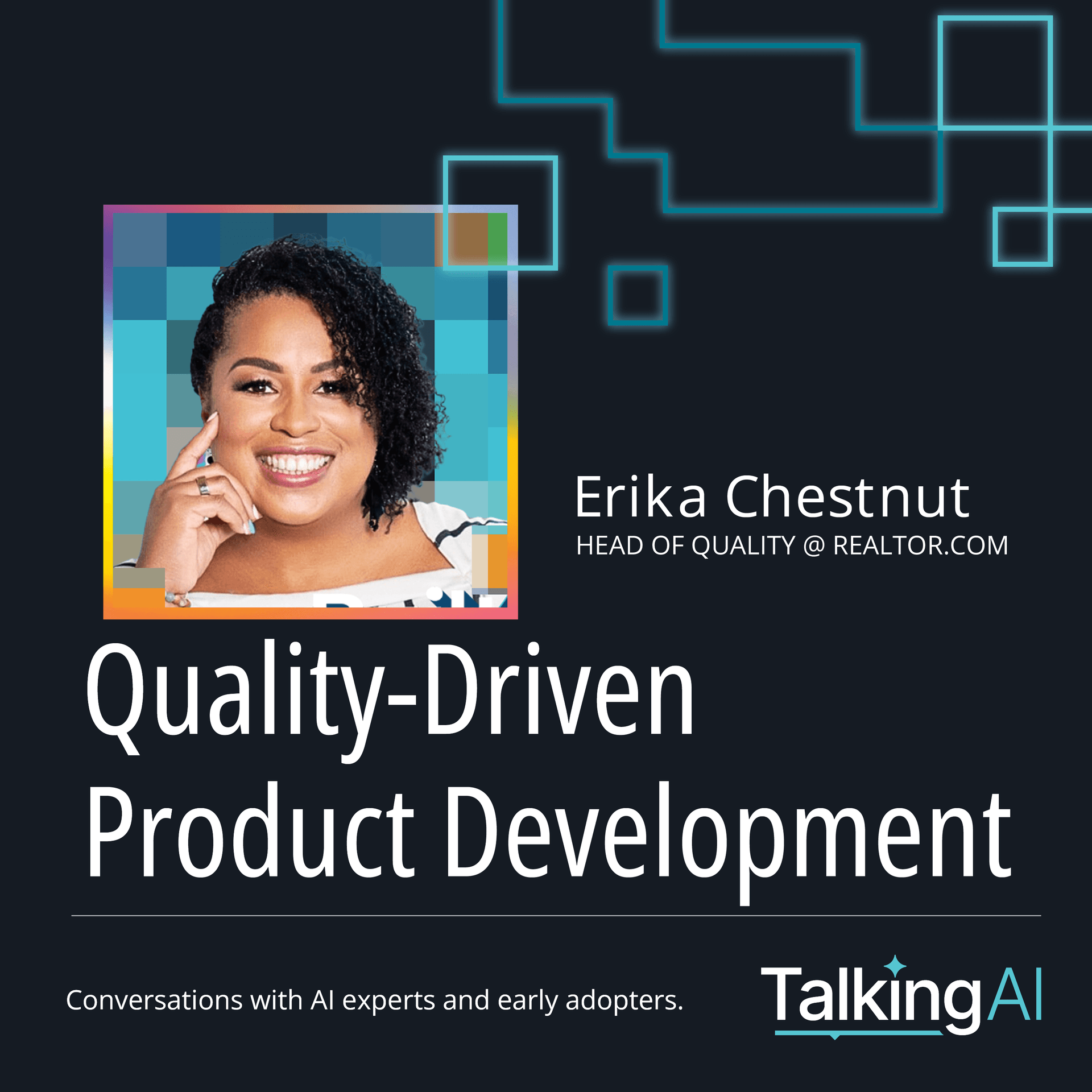
Podcast Episode Summary: Quality-Driven Product Development with Realtor.com’s Erika Chestnut
Episode Overview In this episode of Talking AI, host Matt Paige engages with Erika Chestnut, the Head of Quality at Realtor.com, to discuss the critical yet often overlooked topic of quality in software development. Erika, with over 15 years of experience in leading quality teams, shares insights on creating a strong foundation for quality through process and culture, balancing quality with innovation, and the impact of generative AI on the quality assurance discipline.
Key Themes and Discussions
Importance of Quality in Software Development
- Quality Misconceptions: Organizations often focus on testing as the sole component of quality. Erika emphasizes that quality is not just about testing but starts much earlier in the development process.
- Shift Left Testing: This concept involves integrating quality checks and validations earlier in the development cycle rather than waiting until the testing phase. It highlights the need for awareness of all factors impacting product quality.
Process and Culture as Foundations of Quality
- Process Consistency: Erika points out that good processes create consistency, which leads to quality outcomes. Organizations need to evaluate their processes, communication flows, and documentation practices.
- Cultural Impact: The culture within an organization greatly influences quality. Teams must understand how their work fits into the larger business structure and flow to improve quality.
Balancing Quality and Innovation
- Struggle for Balance: Companies often prioritize rapid innovation at the expense of quality, leading to issues like architectural problems and increased defect rates.
- Long-Term Implications: Focusing solely on short-term innovation can create a backlog of quality issues, affecting customer satisfaction and trust.
Indicators of Quality
- Leading vs. Lagging Indicators: Erika discusses the importance of establishing metrics for quality, such as defect density and mean time between failures. These indicators help teams identify potential problems before they escalate.
- Defect Density Metrics: Monitoring the volume of defects can indicate the health of releases and signal when teams need to slow down and reassess their processes.
Recognizing Value in Quality
- Connecting Quality to Business Outcomes: Erika suggests that quality teams need to tell compelling stories that connect their work to the business's core values, such as customer satisfaction and revenue impact.
- Engaging Teams Early: Including quality team members in early discussions about user stories and requirements can lead to better outcomes and enhanced understanding across departments.
The Impact of Generative AI
- AI as a Tool for Quality Improvement: Generative AI has the potential to enhance quality assurance by automating routine testing tasks and generating test cases based on user behavior.
- Future of Quality Assurance: Erika envisions a future where AI can analyze business systems, predict potential problems, and suggest areas for innovation, fundamentally changing the role of quality professionals.
Key Takeaways
- Engagement: Quality professionals should be engaged early in the development process to provide insights and prevent issues.
- Cultural Change: Organizations must foster a culture that values quality and encourages open communication about process improvements.
- Embrace AI: Rather than fearing AI, quality teams should adopt it as a tool to enhance their work and focus on more strategic, cognitive tasks.
Quick Insights
- Advice to Younger Self: Own your expertise and don’t be afraid to champion what you know; it’s valuable.
- Community Engagement: Erika emphasizes the importance of supporting women in tech and building a community to address the unique challenges they face.
Resources
- Erika on LinkedIn: [Erika Chestnut](https://www.linkedin.com/in/erikachestnut/)
- Erika’s Website: [erikachestnut.com](https://www.erikachestnut.com/)
- HatchWorks: [hatchworks.com](https://hatchworks.com/)
- AI Opportunity Finder: A tool to uncover tailored AI use cases for businesses [AI Opportunity Finder](https://hatchworks.com/ai-opportunity-finder/)
Conclusion This episode underscores the essential role of quality in product development and the need for organizations to adopt a holistic approach to quality assurance that incorporates process, culture, and innovative technologies like AI. By fostering a mindset that values quality throughout the development lifecycle, businesses can improve their product outcomes and better serve their customers.
Written by AI. May contain mistakes. Listen to the episode to check what was said.
Transcript
Automatic transcript. May contain errors.0:00Season three of the Built Right Podcast is right around the corner, but we've got one big change coming your way. The Built Right Podcast is now the Talking AI Podcast, and we've got a lot to talk about in AI. In the Talking AI Podcast, we'll be having in-depth conversations with both AI experts and early adopters of AI. That way you can understand how the technology works and how early adopters are beginning to implement and, more importantly, get value from AI. Our guests range from AI research scientists to founders of AI products to industry leaders putting AI to work in their business. While you're waiting for season three, go ahead and subscribe on your favorite podcast platform so you don't miss an episode.
0:41And make sure to leave us a comment about the AI topics that you want to hear about. So get ready to talk some AI in the new Talking AI Podcast, coming your way August 6th.
0:58Welcome to Built Right, a podcast by Hatchworks where we help you learn to build the right digital product the right way. In each episode, we'll deconstruct the layers of successful product development, break down popular trends, and offer real advice to help make sure your product is built right? We may not have all the answers, but we've built a lot of digital products across a lot of industries, and we've seen a thing or two. Let's get into it.
1:33Today, we're chatting with Erica Chestnut, a true champion of quality. She's been building and leading quality teams for around 15 years now at places like Cabbage, Turner Broadcasting, Calendly, Realtor.com, to name a few. And that's an awesome list there, by the way. Erica, before that, she's led development teams. She was even a developer herself. So I know you're going to fit right in with our Bill Wright community here, but welcome to the show, Erica. Thanks. Thanks for having me. Yeah. Excited to get into this topic. This is one we haven't gotten into yet on the Built Right Podcast. Today we're getting into the often overlooked and sometimes undervalued topic of quality in software development.
2:17And the topic of why good processing culture are really at the foundation of good quality. And PS for everybody listening, stick around. We're going to get Erica's take on her perspective of generative AI and how it's impacting the discipline of quality. I know everybody's talking about it. So we want to get Erica's take on that as well. But to set up the problem, Erica, you talk about organizations who want to improve their quality are often focused on the wrong thing. So what is this wrong thing and what can they do about it? Yeah. You know, quality is always, not always, that's a poor statement.
2:56Oftentimes, when people think about quality, they think about the end state and therefore they think about the thing that happened right before the end state, which is oftentimes testing. And so when they say our quality is not good, they say our testing is not good, or we are not investing in the right type of testing, i.e. manual versus automation, or we don't have enough coverage. We don't have enough code coverage. We don't have enough functional or non-functional testing. But the reality is actually that it starts much further up the stream. And you started to hear about this when the industry was like shift left with testing.
3:36But then just like most buzzwords, right? Innovation, innovative, right? It's not unpacked. And so now it's like shift left testing. Okay, well, what does that genuinely mean? And what is the impact of that? Right? And real quick, shift left testing, that's kind of meaning moving quality further up the value stream towards more of the beginning of the process. Is that right? Just for listeners? Yes. Yes, but it's not moving quality up. It's moving the, well, I mean, it is moving quality up, but it's really about moving the validation, the checks, the awareness, right? What is impacting our product quality?
4:21And so one thing that I always love to say is that process creates quality. Process results in quality, good process, because process creates consistency and continuity, which results in quality. So when you say moving quality left or further up the chain, people are still thinking testing. Oh, we're testing the requirements. Well, are you checking your process? Are you checking your communication flow? Are you checking your documentation? Does everybody have what they need? Are you checking to make sure that the quality team is not starting the new sprint at a deficit because the engineers didn't start stopping before they started finishing, right?
5:05Like you've got to shift the idea of what impacts quality, what creates poor quality, right? And it's not just testing. Yeah, and you make a good point because quality is at the end for all intents and purposes. That's kind of the last thing. Let's check everything, make sure it's good to go. And a lot of times they can be the scapegoat when something goes wrong or doesn't get delivered. And I love how you hit on this concept of process. But to clarify, like a lot of people think like process, they think like tools, but it's not about the tools. Like tools are kind of often, you know, over, you know, put on a pedestal in terms of, oh, they'll fix everything.
5:46But it's not, it's not about the tools. It's the underlying pieces in the process. And I love how you talk about the culture element that comes into play as well. Yeah, there's definitely tools and it's testing that's at the end. It's the testing. It's quality is the entire thing. So actually, I have to retract my statement. It's not that it's not about moving quality. It is. It's quality doesn't need to be moved. Quality is everywhere, right? Yeah. Opportunities to lead with quality are everywhere. So it's not about moving it left or right or up or down. It's about acknowledging that there are opportunities to improve quality in everything.
6:29Is it improve quality in our process? Is it improve quality in the tools that we use and how we leverage them? Are they the right tools? Are they answering the right question? Are they implemented in a way that it's cohesive, the not cohesive, that it integrates into our system in a meaningful and impactful way? All of that is quality. All of that produces quality at the end state. And they all come together like they're it's not just testing. It all comes together to produce quality. Quick break in the pod. If you're listening to this podcast, chances are you've been thinking about how to actually use AI inside your business.
7:09And that's exactly why we built the AI Opportunity Finder. It's a free tool that helps you uncover high impact, tailored AI use cases based on your business, your goals, your pain points, and your industry. No fluff, no generic use cases, just real ideas that fit your business and the ranked by ROI potential. It takes about three minutes to run and it's like having your own personal AI strategist for free. If you wanna try it for free, check out the link in the show notes or go to hatchworks.com backslash AI-opportunity-finder. So to make this more real, I am curious because you've been in a lot of interesting companies from small to large and you do some like side consulting stuff in the past.
7:52But what examples do you see? Like what are those common pitfalls that companies have, whether it be process related or just in quality in general? Is there anything that's like, I see this every time or this is like a big thing that typically happens a lot? You know, one thing that I see that's always, it's a, it's, I think a pain point for, not a pain point. It's, yeah, it's a pain point for me is that, or a pet peeve, that's actually a better word. There you go, pet peeve. It's a pet peeve of mine, and I see it all the time. The structure of the business is not clear. And it's fundamental quality opportunity that is missed.
8:34When it's the structure of the business is not clear to the teams or the business flow, like the whole, like, what is it? what are the boxes that make up the business and how does it flow left to right? What are the, you know, what are the little exits along the way and what happened is not fully unpacked for the team. And then when we go through like hiring companies are going through like this massive hiring, these windows, and then we're throwing people in and we're saying, hey, listen, go to your team they'll help you the team has blinders on the team has blinders on and they're like this is our little world but we're not providing this big big big picture view for for people to understand at the top level like this is our this is our business this is our structure this is how we talk about ourselves internally and this is very clearly how it moves down into the organization from a structure and from a business flow, like the actual product.
9:49And so I find that those are missed opportunities oftentimes. And they don't recognize, leadership doesn't recognize that it's impacting quality. You know, I'll go into teams and I'm talking to teams and they're like, I don't know about this. I don't know how this integrates with this other system. I don't know. I had one manager saying, my area, my enterprise area doesn't integrate with this other area, this main area of our product. It does. It did. And they didn't know it. right so like we put on these blinders and you're like hey i've got my area and i'm good it's like what are you thinking about how your area integrates with these other areas and what the impact is and do you understand and are you mindful of that so that's the thing i think it's missed that's interesting especially i guess when you get into larger scaled organizations but it gets back to like you know we talk about a lot about at hatchworks connecting to the outcome and understanding the outcome and knowing that it all layers of the organization.
10:58It's so important because you have to understand, you know, what is the business outcome trying to be achieved? But I love your point around the connection between multiple teams, right? And having that quality understanding between the different organizations. Let's hit on this topic. So quality and innovation, you know, in my mind, I feel like they can sometimes be at odds. Quality is very much like, you know, process driven, like, you know, rigid's not the right term, but you do want like foundational process and how things are structured. And then on the innovation side, a lot of times, whether it's like business model innovation or, you know, anything like that, you're thinking of breaking process and norms.
11:43How do these two play together and how do you create balance between quality and innovation? Yeah, most companies struggle with that as well. That balance of quality to innovation, because obviously the business is running after innovation. That's the they want to stay ahead in the market. They want to be first to make that next big change. They want to be the unicorn in the space to do that. Sometimes you're running fast and you are focused on like, what's the new whiz bang feature that you have? You know, but that can be that can be a struggle. It can it can it can be at the expense of quality.
12:25And if we're not looking at it, if we don't pay attention, we're like, listen, just just innovate. Get these get these new products out. Get this out. and you might have the teams, you might have the quality team saying, there's a problem with our quality. There's a problem with our architecture and we're building these new features on top of it. And so these new features are nice and shiny, but we're putting them on top of something that doesn't smell so great. And eventually the new shiny thing will wilt and it will also smell, right? Because we're not considering that we never fixed the actual problem.
13:03We never cleaned up the smelly stuff, right? And that's part of quality, but it's not just bugs. It's what might create delivery problems. What might create inefficiency? What doesn't allow us to roll back quickly if we have problems? How long does a problem linger out there? How many open issues do we have? just even just needing acceptance criteria, the turn of how frequently, you know, how long it takes to get something delivered. And then we're making, we're taking shortcuts because the requirements weren't 100 % clear. And so we had to go talk to product a lot. And then we went back and forth and we made changes.
13:47And then all of a sudden, something that we developed two weeks ago that was actually pretty well-baked has now been hacked at the very end and were released out there. And then there's an edge case that we didn't know about, but it's like extreme edge case, right? So it's that innovation. Like when you think, are we innovating too quickly over quality? What is the impact of our innovational quality? Did we release these new features that we, you know, this new functionality, there's new innovation. and do we see a high level of defects? Did our defect density increase? Did our CFAC scores go down because our customers are like, yo, this is broken.
14:26You told me about this new hotness and now I'm coming here and it's just broken. Like, well, that sucks. I don't want to use your product anymore. I don't want to tell somebody else about your product. Right? We have to balance that. But it's oftentimes a struggle. It's almost like quality in a lot of ways is the enabler for innovation. If you don't have that foundation set, It makes innovation that much more difficult, right, to actually do that. And I love the, I got a visual in my head. I have a, you know, a one-year-old baby. So when you mentioned the doesn't smell so great, that's bringing up some bad memories from last night.
15:02Things were thrown away. I don't want to get into it. But the, you hit on some other things though, like, you know, in our business and we've done kind of a foundational shift as of late, really focusing on what are our leading indicators versus our lagging indicators? Like, what are some good leading indicators in quality? And you mentioned, I think, like some time to resolution and things like that. What are you looking at, whether, you know, lagging or leading, that are indicative of either, you know, things are going good or maybe I need to like hone in in a certain area? Yeah, like that defect density, right?
15:40What does our release health look like? And do we see a lot of releases that are going out and we're seeing our health dip? Are we seeing a lot of releases returned, a lot of rollbacks, reverts, incidents? What's our mean time between failures in production? These are all alarms. These are red flags that we can look at and say, maybe we're innovating too quickly. Maybe we need to slow down. what's causing this. Maybe we need to look like, were our requirements not fully baked? Were our acceptance criteria not clear? Where was the failure? Did, you know, did we push in something really late that increased effects?
16:22Did we not, is it, what type of failure is happening? Is it a back-end failure? Is it a load capacity issue? These are all things that like, when we begin to unpack that and we say, hold on, we're seeing an increase here. Let's look at it and understand what the problem is so that we can target it, fix it, and then go fast again. Right. But often times they don't. That's such a foundational. Yeah. Yeah. That's a foundational piece is knowing what those metrics are. So you kind of have your, you know, dashboard for lack of a better term of your indicators. And then when something's off, you kind of know where to dig into.
17:00And I heard you mentioned the defect density. Is that just kind of like volume of defects or is it hitting on something more specific? Yeah, it's volume of defects. So let's say that, you know, we we've identified 200 defects in production. And please don't start me mathing because mathing is hard. We've identified 200 production notes. It's Friday for us. We're not getting into math. It's Friday and it's been a Friday. Yes. Not in a Margaritaville kind of way, although maybe it needs to be very soon. Yeah, that's that's next. Yeah. Yeah. But like the number of defects and then let's say that we, you know, we have kind of a trend.
17:41We see that we have, you know, maybe some spikes here and there. But we start to recognize that those spikes are happening every time we release to production. That means we're recognizing that we are introducing in every release a spike of issues that then we're having to work back down. How do we improve that spike? Like, is there a correlation? And then what is causing that? What are we missing? Do we not have enough automation regression? Are these regression issues? Do we not understand our system well enough that we understand the impact of the changes that we're making on downstream areas of the system?
18:24What is creating that spike, which is costly? Because especially if it's like a critical area of the system, generates an incident, you've got no less than 10 people jumping into that conversation. You've got the eye of the CTO, the eye of the CMO. So you've got executive leaders and you've got senior leadership. I mean, this gets really expensive and they're just looking at it and waiting. Right. And I mean, they're jumping in, but, you know, they're engaging in the conversation. And then you've got the management, you know, the middle management layer. And then you've got the ICs that are implementing potentially the change.
19:02You've just got a lot of people in that. It's costly. and so it's like hey we're seeing we release and we spike and then we spend on top of the innovation time to get those spikes back down or we're leaving them out there and the customers begin to deal with death by a thousand cuts because i don't know when it wasn't big issue but there are a thousand of them that everywhere because it's like next right you're like yeah like walking into a death by a thousand bugs yeah i went to school down in in uh south georgia georgia southern so i'm used to the the natch you can probably yep sympathize being in lana georgia native can i get around you yes yes that's a good point though you talk about it's like how do you help the business recognize the value in the impact of processing quality yeah um it's almost like it's before it's too late, I think is the key thing.
20:01It's like, how do you help them recognize that value? What is, where have you found success or what are some good things to hone in on to help connect it to business value before it is too late? And then you got all the C-suite breathing down your neck, kind of like you mentioned as a scenario nobody wants. Right. It's telling that, it's identifying the story of quality within your organization. So hearing from, I love to like, when I come into an organization I really want to hear. I host what I call my what the bug meetings and I'm meeting with different people and I'm asking them some similar questions, depending on where they are kind of level wise.
20:40Some are a little bit more detailed questions, some are more strategic, but they're still kind of in the same vein. And then I'm looking for those categories. I'm looking for the sentiment in the conversation. I'm looking for the themes to surface to help understand where are all the problems? Because the thing about telling a story is you want it to be compelling. You want it to be interesting. We've all picked up a book before and gotten, you know, maybe a chapter or two in or watched a new series and got into like the second half, halfway through the second episode. It was like, this just isn't my jam, right?
21:17The story of quality is no different. You have to tell a compelling story. You have to explain it in a way that attaches and connects to the business heart, to what leadership is interested in, to the value of the business, which is the customer, which is our revenue, right? You've got to connect it into that conversation. And that takes time. That requires a lot of like moving parts and pieces. But when you understand the sentiments, when you get that feedback, you're at least able to say, ooh, you're worried about availability. or who you're worried about, you know, SEO tracking or, you know, you want to understand our customer sentiment.
22:01OK, well, how can I get that and surface that information? How can I make that visible through the lens of quality and say, hey, listen, we're tracking this and we want to hold the teams accountable to it and start to drive that conversation So you're taking the heart of what the business is interested in and you're moving it through the lens of quality and pushing it back to the teams to say, this is something that we need to look at. How are you helping to improve this? You're like a quality marketer. And I promise that's one of the reasons you've been so successful in your career is being able to connect that story.
22:39That's so cool. I love that. It is not an easy thing to do, right? No. I'm still telling you. But it's interesting. It's not. It's interesting. But people don't always think, you know, the thing and the interesting thing, though, is the frustrating thing is that it's not like explaining that I have to go through that. I can't like it's not common. It's not a common expectation. And so, yeah, I'm like wandering around sometimes. What data do you have? What like what is the data? And people are like, but why? Like getting this data is hard. And I was like, I know. And I don't really have a why for you yet.
23:12I'm actually just trying to see what you're tracking. what do you think quality is and what do you measure? Because now I want to pull it together into a single cohesive conversation and be like, now when we look at this across the board, hey, we have a problem right here. Should we focus in on that? Yeah, that's how you connect the dots, right? And one thing you mentioned earlier, you talk about acceptance criteria. And I'm curious your perspective on this. When should quality members on the team, whether it's a QA engineer or, you know, whatever role it may be, when should they be engaged in understanding the user stories, requirements, or whatever it may be?
23:55At the very beginning with everybody else. Here's the thing. With quality, quality team members have the benefit of constantly exercising the entire system. if somebody knows the ins and outs of your house and you have a problem or you want to make an addition to your house wouldn't you call them first yeah exactly who's constantly you know i'm thinking we just had a problem with our ac and we call somebody that this the it was the same guy that came out and fixed the ac problem we had last time i'm not going to talk about the shadiness that that feels like but we clearly said he was like yeah he's talking to my husband and he's saying because i wasn't out there but he was talking to my husband and he was like yeah this is what we talked about last time here's this that and so forth and so on like he knew the problem which made getting to the resolution or understanding that like just that knowledge push in made it so much quicker to get to the resolution and therefore cost us less money because he's out here last time, right?
25:06Yep. That's QA. QA is constantly exercising your system from the customer perspective, which is who we care about. Yeah. QA is connected to the heart of the customer inside the business. It's the health of it, right? And I want everybody to like pause for a second, just so you don't miss this point. if you're a scrum master product person or whatever it is, bring your QA folks into these ceremonies early on. Because to your point, they can save you a lot of times. They're going to be thinking about something from a different angle that you may not thinking about one. And they're going to be given additional context when they actually are doing the testing, which is going to make their job a lot easier.
25:50So anybody that's not doing that, bring your QA friends into those conversations earlier on. And I will, I will point out like one thing that I often have had to do when I'm going into new orgs, when I have a new team, I have to coach inside of my team because the QA folks can be wallflowers at times. Some of them can be wallflowers. And so they will come into a conversation and are like, yep, I'm listening. I'm actively listening. It sounds odd, but okay. They know what they're talking about. And so I'm just going to wait for to come to my desk and I have the context. But the QA organization, it's one of the things that I love talking to the QA community about.
26:33It's like we are more than just testing and that single step in the delivery lifecycle. We provide that value. We need to speak up. We need to provide the, here's a gotcha. Have you considered this? Have you turned the box in this way? And when team members, when we're brought into this conversation, ask for that. Pull on them. Get the, you know, request that feedback. Like, hey, what do you think? Like, I'm, these, this kind of, these are the boxes. I love to talk about things in the form of boxes. So like, this is the box of the flow. These are the boxes of the flow currently. We want to shove one right there.
27:11What do you think about that? You know, like, what's going to happen? How does that help or harm the journey that you experience and go through and think about from a customer perspective. Is that good? Is that bad? Ask those very specific questions specifically to the QA team to draw them out and get that insight. And that's a facilitator tip there. If you're a Scrum Master product person, one thing that we do in a lot of workshops is we'll always ask around the group, hey, Lisa, do you have any clarifying questions or anything like that? Bob, do you, and you go around the full room and it's funny, a lot of times you'll have people say no, but, and then they'll go into what's on their mind.
27:57So that's a good tactic to kind of get those, like you mentioned wallflowers to speak up because they, they do have an opinion and it's a valuable one a lot of the times. All right. So the hot topic right now, everybody's talking about it. Everybody and their mom, generative AI, you know, we're playing around with, uh, GitHub copilot and some other tools at Hatchworks, but I'm curious, what is your perspective, thoughts, theory, whatever it may be, a prediction on how generative AI will impact the quality assurance discipline positively, negatively, how it evolves? What's your hot take? It's significant.
Read the full transcript
28:40It's significant. The thing to remember with all of the technologies, these are tools in our toolbox. You know, I've heard the conversations, people in and out of QAOs, you know, the end of testers, the end of all of these things. But AI has been building in the quality space for years now, for years. You know, chat GBT, I love some chat GBT, right? Like just being able to ask questions, it is another way to turn the box. It's another way to leverage a tool to help us better communicate, to help us quickly write scripts. But just in general, this, this generation of AI, like the conversation around it, automated routine testing.
29:31It's like, it's just generate, generative AI can create new test cases that mimic the variety of user behavior and edge cases. Let it do it. Right. Yeah, we're still humans still need to be in the conversation because we still need to analyze that we need to and I can handle those routine tasks. But we are analyzing it as humans. But it changes our role. And that's the thing like, it doesn't go away, it changes our role so that we can, it could be more cognitive, we can, we can literally sit with something and think about it, as opposed to this is mundane, this is redundant. You know, what people have said years ago, you're just banging on testing is just banging on a keyboard, which it's not.
30:20It has never been. It is not. But it gets us even further away from that idea because now we're like, let the machine take the inputs and generate something and then let us tweak it to be more informed, more intuitive, more human. Let us use the machine to do predictive analysis, analyzing historical data to predict potential problem areas. Let it enhance performance testing or increasing QA accuracy. Unbiased testing. This is a good one. Go further into that. So the story, right, when the Apple Watch came out, eventually became, one of the stories was like, women are the biggest users of it. I don't have data points.
31:07It's been so many years. Women are the biggest users of this, but it does not have period monitoring on it. But yet women are the biggest users. It was a miss, right? Because women were not included in that product team. They were not included in the usability testing. This was a miss, a big miss. And when it was added, women were like, you know, hallelujah. saying, right? But we have these bias, you know, especially it's like you talk about like people, you know, in the DEI space. And when you think about accessibility, I've had bias. There's, we all have them. I don't know what it feels like or what to consider directly when it comes to screen reading, not being able to read the screen.
32:05I don't know, like, what is better? What is a better experience? But that could be programmed into AI, right? And there's, like, having unbiased testing supported with AI. And then being able to, like, be a lead, taking that information from, like, leaders in the space who understand it and plug those in as models that that AI can use, right? Like there's so, so, so much opportunity to make it, to leverage this tool to create more efficiency, to create more impact, to be more valuable in the organization. But we've got to, we can't be scared of it. We can't be scared. We need to look at it and be like, listen, you are mine and I am going to, like, I know that you're a hammer and there is a nail.
32:57I am not going to use you. you know to do these other things but i'm going to use you nail everything in because i know how you work yeah no this is great i love this you kind of have the eternal optimist uh mindset versus the pessimistic you know it's going to take everybody's job i love that because it's it's an enablement view of it gets me out of like the mundane like stuff i don't want to be doing and it up levels us as humans it's that that's why i love how it's positioned as you know we people talk about it as a co-pilot you know we're still in charge um but it but it's helping enhance what we're doing so yeah really exciting stuff you know i i love where this is um going i love that you're testing it and playing around with the tool versus like waiting because i think that's where so many people miss is once it becomes mainstream then it's like too too late and you're like trying to play catch up mode right yeah i mean transparently listen i when it first came out um i was playing around with it and i was like okay here's a requirement write a test case um or tell me tell me what the acceptance criteria for this requirement is and it two seconds rattled some stuff off and i was like those are decent all right tell me the question now they'll use it to tell me what the test cases are for this and it two seconds later rattled off some pretty decent test cases you know and and i say that decent test cases with it not being informed especially before it was had access to the internet but it really not being informed and just going off of like well if we're talking about this thing right if you've told me this is the requirement and giving it enough information to be informed enough so it doesn't just say well you're gonna have to log into the system so do that right but instead like well if you're you know if you're doing this functionality here are some things that you'd want to to connect and then really deep diving in and saying well what are some non-functional versus functional like what is security um what type of performance testing how would i test these apis what type of data should i use uh where should i what are some considerations and just continuing the conversation that was fun but it was scary at first because i was like oh yeah snapple sleek yeah it's it's Like you said, it's like, wow, this is decent.
35:17But connecting back to a point you made earlier where you had the example of somebody kind of being blinders on focus into just their organization. They didn't think about how they were impacting others. Like this could be a use case right here where generative AI and the tools we're using do have that purview across the entire organization to kind of say, hey, are you considering this? Yeah. You know, that may be outside of your discipline. And so like, that's an interesting kind of use case for this as it starts to evolve. I think it's really exciting where it may go. I want us to get into the point where we're able to feed it, you know, privately feed it information and say, okay, now that you understand this ecosystem, now that you understand our structure, our business flow, our business model, right?
36:09Now that you understand that, what should we innovate on? What are the concerns with our product? Like now you've analyzed our tests and how our tests are performing. Should we innovate or should we fix tech debt? And what's the impact? What's the financial impact? Like AI can start to answer all of those questions just as a few keystrokes. Like that is so, so exciting. um being able to like unpack and i'm not saying like to get to that point is significant i get that right like what is the data that we feed it how do we feed it that data how do we protect privacy and security and all that stuff i get that yeah but man jetson's opportunity there like yeah i always think back to like the beginning of you know cell phones where they were to where they are today it's like nobody could have imagined where we are today where like where the internet's gone i think it's going to be the same thing with generative ai in a lot of ways so it's going to be fun to watch i mean that all right so iphone right like that's what that's what generative ai is it's like that point and then all products now all phones follow that same view every phone is that you know smartphone view based off of what apple did nobody has a razor flip phone i mean some do still have but you know there i remember the verizon little like brick thing that split up and stuff like that that was a cool thing not more right like everybody sidekick yep that's what yeah generative ai that's where we're at right now and it's i cannot wait that's awesome all right so let's do a couple quick rapid fire questions to wrap it up first thing that comes to mind so uh what company is doing qa right like which is there somebody in the community that you're like oh they're they're really good at that's not that's not a fair question it's subjective right like everybody's doing something right i'm gonna can i can i plead the fifth everybody's doing something right everything has opportunity um you know i worked at calumny i'm gonna say calumny's doing it right yeah shout out calumny the local atlanta Yeah, yeah, yeah.
38:27You know, teams are looking to improve. There's a lot of great things that Realtor is doing. There's still opportunity. There's opportunity at Calendly. There was opportunity at Cabbage, right? It's just about the focus. So, yeah, I'm going to cramp lead the fifth. Cool. No, those are good answers. What about individuals? Is there anybody in the QA community that you follow or, you know, think is influential? Angie Jones. is amazing uh lisa crispin and janet gregory are the agile queens like just nice i mean that they have the bible um three of them actually on agile testing and processes um come kind of top of mind for me for sure like those like it's send send their linkedin's to we'll put them in the show notes for for some folks who may be interested to start following them and what's one thing that you wish you could go back to like your former self and give some advice uh to your former self if you could go back it's usually not about it's not about quality it didn't have it didn't have to be it'd be anything um own what you know don't worry about what you know own what you know because what you know is impactful it's important and it's valuable and when you spend time worrying about what you don't you don't celebrate and champion and communicate to others what you are excellent at and therefore you don't continue to hone it it's okay to know that you have what the gaps are if you want to work towards filling them but some gaps like i don't i don't want to learn how to surf and that's okay yeah i'm not a surfer and i don't want to learn how to surf I like to swim and I want to learn how to become a better swimmer still in water.
40:24Right. So it's like, hey, what are you what are you excellent at? And what are your what are your passions like? So own what you know and lean into that. And don't worry about don't worry about what I love that. And one thing you mentioned earlier, and just to wrap it up, like one thing I love about your experience, what you do is your, you know, involvement in kind of women in tech and the diversity inclusion space. Anything to speak about there? I see you're kind of involved with the women in tech and career coaching there. Anything that you are either excited about within this space or, you know, how you're helping folks in this area?
41:02Yeah, I, you know, as a woman in tech myself, I've spent the better part of my career being the only woman in the room, especially as a leader, being the only woman in the room, also being the only Black person in the room. And that can be difficult. It has been difficult. And I've had to learn how to manage my own imposter monster. I've had to learn how to manage my voice and showing up the way that is right for me and not worrying so much about what others, how others think I should show up. I had somebody tell me I should be more docile and quiet because certain gender should be docile and quiet, that I should modulate my tone.
41:53And so I'm passionate about coaching women, especially because I spent a lot of my career not being confident about who I was and how I showed up and second guessing and not speaking up when I should have spoke up or or not owning what I knew. you know um and so i'm i'm i'm excited about that and i love to talk to women about that and in the space and and help them and the community element's so important too i think right having that community of folks that are going through you know the same thing you can trade stories and i got two young daughters at home so i appreciate you kind of pioneering the way for for women in tech as as they come up.
42:42You're an awesome, awesome role model there. But where, just to wrap it up, where can people find you, whether it be LinkedIn or kind of what you're doing? Anything you want to plug here? Yeah, I'm Erica Chestnut on LinkedIn. Please, please, please feel free to reach out. I love to talk about quality. I'm a bit of a dork about it. And obviously I love to talk about women in tech in general. But you can also reach out to me at ericachestnut.com. That's where you'll learn a little bit about my leadership consulting and my women in tech coaching and my quality leadership consulting and coaching, all things I love to do.
43:19I'm really passionate about coaching and supporting people, either women in tech or in the coaching or excuse me, in the quality sphere. Feel free to reach out. I'm around. Awesome. Thanks, Erica. I appreciate the conversation. Thanks for joining Built Right. Thanks.
43:37Thanks for listening to Built Right. If you enjoy the show, give us a follow or subscribe on your favorite podcast platform. And don't forget to leave us a review. For more info on Built Right, visit us at HatchworksBiltRight.com.
43:57The single biggest mistake we see companies make with AI is they don't properly train their teams. We see it all the time. Companies roll out AI tools and expect people to just figure it out. But using AI effectively requires a totally different mindset and skillset. And that's exactly why we built training for every level of your org, from AI training for teams and executives to training engineering teams on our generative-driven development methodology. Or if you've already identified your AI use cases and want to just prioritize where to start, we offer an AI roadmap and ROI workshop to help you build a quick plan.
44:30It's all about going from we should use AI to actually driving real value with it. Head over to hatchworks.com to learn more.
From the publisher
In this episode of the Built Right podcast, we look at the often overlooked and undervalued topic of quality in software development and how good process and culture are what creates the foundation for it.
Joining us is women-in-tech career coach, Erika Chestnut, who is Head of Quality at Realtor.com. Erika has been building and leading quality teams for around 15 years. She has a wealth of knowledge to share about the foundations of good quality, why organizations that want to improve quality are often focused on the wrong thing, how you create a balance between quality and innovation and the good leading indicators in quality.
Key moments:
- What organizations can do to improve quality
- The struggle to find balance between quality and innovation
- Some of the best leading indicators in quality
- How to help your business recognize the value and impact of process and quality
- Erika’s thoughts on generative AI and its impact
- An example of a company that is doing QA right
- The one piece of advice Erika would give her younger self
Key links:
- Erika on LinkedIn: https://www.linkedin.com/in/erikachestnut/
- Erika’s website: https://www.erikachestnut.com/
- HatchWorks: https://hatchworks.com
- The Built Right podcast: https://hatchworks.com/built-right-a-podcast-about-building-the-right-digital-product/
Mentioned in this episode:
Talking AI - Conversations with AI experts and early adopters
Welcome to the Talking AI podcast, where we dive deep into the world of artificial intelligence with host Matt Paige. Formerly known as the Built Right podcast, Talking AI brings you insightful conversations with AI experts, founders of AI products, and industry leaders who are leveraging AI in their businesses. Whether you're an AI expert or a beginner, our episodes will help you understand how AI technology works and how early adopters are deriving value from it. New episodes drop starting August 6th.
AI Opportunity Finder
Feeling overwhelmed by all the AI noise out there? The AI Opportunity Finder from HatchWorks cuts through the hype and gives you a clear starting point. In less than 5 minutes, you’ll get tailored, high-impact AI use cases specific to your business—scored by ROI so you know exactly where to start. Whether you're looking to cut costs, automate tasks, or grow faster, this free tool gives you a personalized roadmap built for action. 👉 Try it now at https://hatchworks.com/ai-opportunity-finder/