
In short
Podcast Summary: The AI Startup Journey: Lessons Learned from Wysper.ai's Founder
Podcast Details
- Title: Talking AI
- Host: Matt Paige
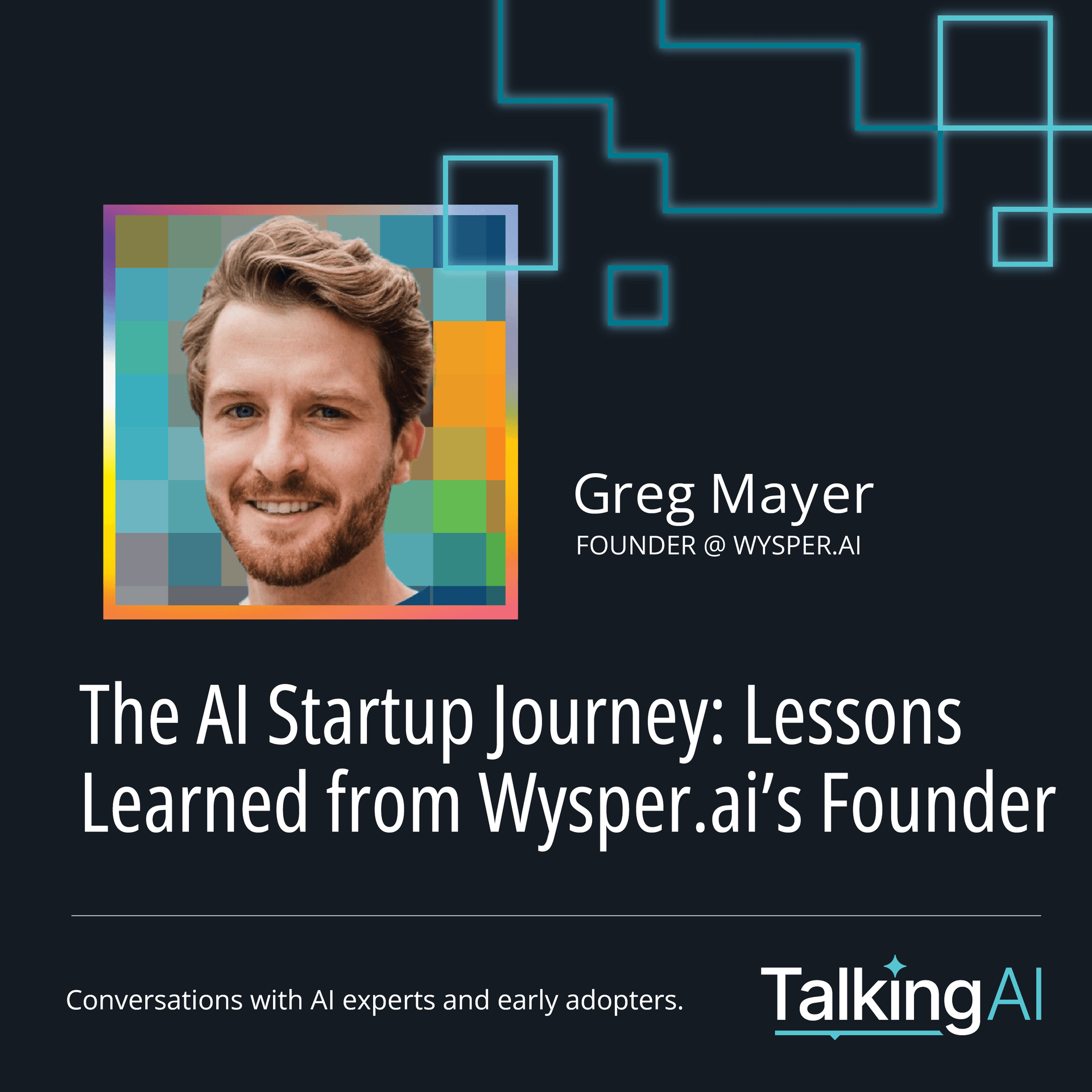
- Guest: Gregory Mayer, Founder of Wysper.ai
- Episode Release Date: August 6th
- Formerly Known As: Built Right Podcast
Episode Overview In this episode, host Matt Paige speaks with Gregory Mayer, founder of Wysper.ai, about the intersection of AI and entrepreneurship. The discussion revolves around how AI is transforming the product development landscape and what this means for the SaaS (Software as a Service) market.
Key Themes and Concepts
- Diminishing Barriers to Entry
- Overview:
- The ease of product development is increasing due to advancements in AI.
- Tools and platforms are making it simpler for individuals to create and market their solutions.
- Insights from Gregory:
- Acknowledged the significant decrease in friction associated with building new tech solutions.
- Reference to "Mossberg's law," highlighting the historical context of technology becoming more accessible.
- From Idea to Market
- Gregory’s Journey:
- Transitioned from working at Jasper and Gong to starting Wysper.ai, a tool that automates content creation.
- Managed to develop the MVP (Minimum Viable Product) in about two months with limited initial funding.
- Emphasized the speed at which businesses can now launch products leveraging available technologies.
- Shifts in SaaS Business Models
- Changing Landscape:
- The traditional SaaS business model may need to adapt due to the influx of lower-cost, niche solutions emerging from smaller players.
- Larger enterprises will likely remain stable, but SMB (Small to Medium Business) sectors may see disruption.
- The potential for new business models, including "once-off" purchases as proposed by 37signals, could reshape expectations for software payments.
- The Role of Adaptability
- Essential Skills for Entrepreneurs:
- Gregory emphasizes the importance of adaptability in today’s fast-evolving tech landscape.
- The ability to pivot and embrace change is critical for survival and success.
- Building Customer Relationships
- Customer-Centric Approach:
- The importance of establishing strong relationships with customers, ensuring transparency and trust.
- Highlighted that customer feedback should guide product development and marketing strategies.
- Innovations and Future Trends
- Generative AI and Its Impacts:
- Discussed the democratization of AI and how it allows a broader range of individuals to create unique solutions.
- The potential emergence of AI-generated content and how it could disrupt traditional media and entertainment sectors.
- Investment and Capital Needs
- Funding Considerations:
- While capital is still important, founders may not need as much as before due to lower development costs.
- Founders should weigh their goals and be strategic about fundraising versus bootstrapping.
Key Takeaways
- Emerging Opportunities:
- The current tech landscape presents unprecedented opportunities for new entrepreneurs.
- Emphasizing creativity and curiosity will be essential traits moving forward.
- Navigating Distribution:
- Distribution is becoming a crucial aspect of success, with strong followings necessary to stand out in a crowded market.
- Future of AI Tools:
- There are predictions that AI wrappers will evolve, with new solutions emerging that leverage existing technologies in innovative ways.
Conclusion The conversation with Gregory Mayer illustrates the transformative potential of AI in entrepreneurship and product development. Aspiring founders are encouraged to embrace the changing landscape, be adaptable, and prioritize building meaningful customer relationships.
Additional Links
- [Wysper.ai](https://www.wysper.ai/)
- [Gregory Mayer on LinkedIn](https://www.linkedin.com/in/gregoryjmayer/)
---
This episode serves as a valuable resource for anyone interested in understanding the current trends in AI and entrepreneurship, as well as the evolving nature of the SaaS market in a rapidly changing technological environment.
Written by AI. May contain mistakes. Listen to the episode to check what was said.
Transcript
Automatic transcript. May contain errors.0:00Season three of the Built Right Podcast is right around the corner, but we've got one big change coming your way. The Built Right Podcast is now the Talking AI Podcast, and we've got a lot to talk about in AI. In the Talking AI Podcast, we'll be having in-depth conversations with both AI experts and early adopters of AI. That way you can understand how the technology works and how early adopters are beginning to implement and, more importantly, get value from AI. Our guests range from AI research scientists to founders of AI products to industry leaders putting AI to work in their business. While you're waiting for season three, go ahead and subscribe on your favorite podcast platform so you don't miss an episode.
0:41And make sure to leave us a comment about the AI topics that you want to hear about. So get ready to talk some AI in the new Talking AI Podcast, coming your way August 6th.
0:53Welcome to Built Right, a podcast by Hatchworks where we help you learn how to build the right digital product the right way. In this season, we're going all in on generative AI with guests ranging from international AI speakers, founders of Gen.AI products, experts in specific domains of Gen.AI, and leaders across industries. We're here to help you figure out how to take advantage of this new emerging technology so you can win in the market. So whether you're an AI techie or just AI curious, we got you covered. Let's get into it. Welcome, Bill Ray listeners. We have a special one for you today with guest Greg Mayer, founder of Whisper AI and previously product marketing at Jasper and Gong.
1:33And for those that don't know what Whisper is, it's an AI tool that turns your podcast into content engines with one click using AI. So this tool immediately caught my attention because that's what we're doing right now. We're podcasting. But it's actually an amazing example of the topic we're focusing on today. And that's how Gen.ai is reducing the barriers to entry at an insane pace for anyone really with an internet connection to build insanely useful products faster than ever before. But welcome to the show, Greg. Yeah. Thanks, Matt. You nailed it there. And I'm excited to see what kind of content we can repurpose out of this episode.
2:11That'll be fun. Yeah. So that's a really good idea. We're going to use Whisper.ai on this episode and we'll give it a test run right uh but i want to start though with your journey i like kind of context setting with the the uh guest journey what was that tipping point for you you know going from jasper everything going on in gen ai they kind of pushed you to say i want to build my own thing there's there's something happening here that i want to go and build my own thing yeah there was a lot of factors and forces at play in my own life. And I think I always wanted to, ever since I was a kid, I wanted to run my own business and then moving into startups.
2:52That was a step in the direction of starting my own business. And that was like a theme of like trying to get closer and closer to that point. And I got to this point where it was a combination of feeling like there was this window of opportunity open to build AI tools that, you know, were pretty revolutionary and solving pretty complex use cases, being able to build them relatively quickly and inexpensively, like you don't need to raise a ton of money to go out and build an MVP and get traction. And I found that to be the case and it was pretty incredible to see people buying it and getting psyched about it right away.
3:26And I also, it was a unique aspect of time in my life where I felt like I had very little responsibility, like no mortgage, no kids, don't have a dog and was like - It's the time to do it. Yeah, if I don't do it now, it's just going to get harder from here. So I'd rather get my, you know, get in the game now, basically. Yeah. It's crazy. I was actually just recording an episode with Heather Murray, who's an awesome AI evangelist, trainer, international speaker. And we were talking about how quickly things are moving. You know, it, on one side, we were talking about, you've never been closer to a starting line than you've ever been before with a major, like you know kind of one spice in a lifetime transformation but in the same way people are measuring how far ahead you are in a matter of months when like companies are looking at other companies so the pace of change is just insane and props to you for for jumping on it right now yeah uh but you mentioned like this this diminishing friction you know going on right now in the ability to create a tool uh and we were chatting about this earlier this diminishing friction between humans and technology that's going on like go deeper into that for for the audience here some really neat things we were chatting about there yeah i think there's this there's this i call it mossberg's law there's this guy walt mossberg he's a famous tech writer and he wrote about the diminishing friction between humans and technology from like a com a computer the size of a house to down to like now where if smartphones and like where's that gonna go and i think there's a similar law of this diminishing friction between humans and creating technology and developing so like the um like coding language is getting easier no code tools coming out custom gpts like we're taking steps towards it getting easier and easier to build things and uh it feels like when you're building a custom gpt they're fairly basic at the moment but it's like a glimpse into the future of what software development might look like for people like you and me.
5:28There's obviously always going to be developers that push the frontiers of technology. But that kind of like middle use case can be solved, I think, for folks like you and I. The friction will be way, way, way, way less than it even is today. And you hear Sam Altman talking about GPT-5 and AGI being like sooner than we expect, which scares me and excites me, I think, equally. But, you know, what are the ramifications of that on software development? I think that's one of the areas where we'll feel it first, to be honest. Quick break in the pod. If you're listening to this podcast, chances are you've been thinking about how to actually use AI inside your business.
6:08And that's exactly why we built the AI Opportunity Finder. It's a free tool that helps you uncover high impact, tailored AI use cases based on your business, your goals, your pain points, and your industry. No fluff, no generic use cases, just real ideas that fit your business and they're ranked by ROI potential. It takes about three minutes to run and it's like having your own personal AI strategist for free. If you want to try it for free, check out the link in the show notes or go to hatchworks.com backslash AI dash opportunity dash finder.
6:41Yeah, it's insane to think about. It's like, how do you define AGI and the way he's talking about it? you know i'm excited to jump into it i think it's going to be crazy to see where it actually goes to but getting back to building whisper like for you what what was the time from idea to having an mvp out leveraging you know all this new tech that's out there all these new kind of concepts around generative ai yeah it was about a month um i was toying around with the idea i wasn't sure if I was going to like fully pursue it. Um, and I basically went out and started building like an MVP myself in, in, I tried doing things like replet bounties.
7:27I tried like finding people to work with, um, all this stuff. And then eventually I found a, a co-founder was introduced to a technical co-founder and was like, Hey, uh, are you interested? He was entrepreneurial. And basically within two weeks we had a working prototype mvp that was like pretty close to what we have today um and then i did kind of like a product management product marketing sprint for two weeks and within them we had like a business that people could sign up and pay for and we did kind of like a beta launch for the following month and then we were live so it was like two months and then everything was you know to the races that's awesome and i think like at hatchworks we're leaning into this with our generative driven development approach.
8:09But that time from idea to actual working solutions is just going to continue to reduce and the number of people you need to do it as well. And the beauty of it is like your super smart people, your engineers, they can focus on what's truly important versus more of the kind of mundane and boring, repetitive things. So they're actually focusing on building value first. I think that's going to be insane to see that scale as we start to evolve with this new technology. Yeah, definitely. So back to the lower barriers of entry. So we've kind of gone through your use case. We talked a little bit about custom GPTs.
8:53And the way I equate that, it's like we're just at the beginning. It's like with the internet, you couldn't use your phone and the internet at the same time. Yeah, mobile phones, you had to text with a number pad and snake was the coolest thing on there. I think we're going to like laugh at how basic custom GPTs are and just the different modalities, even past the idea of a custom GPT with building solutions. But the opposite side of that is the barrier is so low. So now anybody can really come out and create a solution. So what does that do to the market, to the landscape? you're going to have a lot of smaller players coming in you still have the major big players as well what's your take there i think like smaller sass will be disrupted very quickly um i think enterprise sass will still have its place because enterprises move incredibly slowly they want like a certain level of support they want security certain things that like the indie SaaS or smaller time SaaS can't really, you know, fix right away.
9:58But I think these like niche solutions where it solves a very specific pain point for a low price, I think that will start to like eat away at like the SMB side of an enterprise SaaS business. And I think that, yeah, over time it will, it's hard to imagine that SaaS as a business model will look the same in five to ten years right like i think this way that we've been doing things just won't can won't be sustainable anymore um and trying to understand what that means and like where the puck is going i think like internal tools for enterprises building those types of things or you know having a team that just builds all of your tools and supports them um in one shop like these types of new business models i think will be more prevalent all right so let's let's go deeper here because you just kind of opened pandora's box a little bit like yeah uh in terms of questioning the sas model right there that's pretty much the standard nowadays is the recurring revenue insane valuations based on that because you have the the predictability of reoccurring revenue yeah but i saw the other day you have uh 37 signals the the creators of base camp they're coming out with this new concept called once.com.
11:15I think it's once.com, but check that out for any of our listeners out there. I'm Googling it as we, as we have once.com, check it out. So their whole idea is the SAS model is broken and you should only have to pay for software once. So you look at that and the underlying piece there is it's so much easier to build these solutions. solutions like that could completely disrupt how we think about technology solutions and the business model around them to your point right uh what's your take though like you mentioned that the business model may be disrupted do you think it's something like how 37 signals is thinking about it or do you think there's a whole other type of business model that may emerge over time yeah i think that's one aspect of it i think depending on the tool that's fine but a lot of enterprise s you want customer support you want regular updates you want patches when books and things like software that's going to happen and so if you can solve for that with ai agents or something like that that like basically like cycles through the software and time patches bugs answers support tickets educates the customer does onboarding better than a human can all of those things and i think that's feasible but today if it's like if i had slack and then it stopped working or if i wanted to add a new feature to it but i could only buy it once and no one to talk to would be not the best experience as a user i think the other side is like there's like probably three categories there's like that there's building your own internal tools if you have the dev resources and like companies that provide the tools for companies to build their own internal tools i think will well over the next you know decade and then the third is like the outsourced software like agency that builds what you want and manages it and does like a full in-house like ownership of your entire tech stack something like that like outsourcing your tech stack i think is something that i've been thinking a lot about as a potential business model but i don't know it's it's really hard to say right yeah we can go deeper on that that's a lot of what hatchworks does if you ever want to chat offline.
13:25But so the interesting piece though, and you're hitting on it here is there's always been this concept of build versus buy, right? So it's a decision point of, okay, well, do I build my internal solution or do I go buy off the shelf SaaS? And there's pros and cons to each. If you're building it, you got a lot more ability to tailor it to your needs. But then to your point, you got to manage the thing. And if it breaks, it's on you to fix it. If you buy, you got off the shelf. You get support. There's value to it, but with everything going on, I believe there's going to be a change in that build first buy framework.
14:02The way people, companies think about it is going to change. I hadn't even thought about the point you mentioned, the concept of agents. Can you employ agents in a sense that are doing a lot of the things that you previously got through the benefit of sass and also to your point you could build the thing a lot easier quicker and tailor it to your needs so i think the whole build versus buy equation just completely changes in a lot of ways but i think there's something interesting about all this like they've talked about this since like the beginning of software right a lot of these trends have existed and a lot of people have talked about and um it's kind of like predicting a recession like eventually you could you could predict 10 recessions eventually you'll be right um it's kind of like a lot of these trends probably will manifest in the in the market it's just like when they'll start to really take place one trend that i'm really excited about that people have talked about a lot is the like importance of distribution in technology and that's one of the barriers to entry it's like well right now you can build a c plus product and if you have a million followers you're going to destroy someone who builds an A plus product, right?
15:13That distribution is so important. And what I'm really excited about is maybe the leveling of the playing field of distribution and getting to a point where it's a bell curve, right? Like it started off distribution wasn't that important. Now it's the most important and hopefully things like marketplaces or just the fact that you and I could go build the tool if we don't want to pay for it means that we'll go back to kind of like the best products will rise. Those are the only ones we'll be willing to buy. And that's the only distribution matter. That's I'm excited about that because it makes it feel more fair and like the best product should win.
15:45Right. Yeah. You hit on it. The distribution element is key. It's your whole kind of go to market motion. Yeah. You think about that. And if you have that built-in base of people that follow you or your company, a whole lot easier to sell something. Because to your point earlier, reduced barrier to entry, you're going to have a lot more companies coming in to the market. So how do you see companies standing out? You mentioned the distribution angle. If you have a distribution, that's going to help you get above the noise. But any other thoughts on how do you stand out in this new market with just a flood of AI tools and everything going on right now?
16:29uh that's a good question i i think it always comes back to like the value accruing in the customer relationship right like that is the moat it'll it'll ultimately comes back to moats right like how do you create an moat right now we just like i just saw a post about someone in six months they made like 1.8 million dollars in revenue building a ai dating app that just like flirts with you and they're selling it for like really 10x profit right so um there's no moat to that there's about a thousand of those, but somehow they had the distribution to have people know about it and sign up. And, um, I think it's just an example where, yeah, over, over time, you'll just have to continue to build like a strong customer relationship and provide value for them to feel like they trust you, uh, that you make it really easy for them.
17:19All of those types of there's transparency, um, all incentives, you're moving faster than other folks like it's it's that like why should i bet on you as my racehorse type feeling that you can have in sass which is often how i think people make their buying decisions in a in a sense so uh yeah i think that that's still where we're value or will accrue yeah you mentioned the the that example of the ai dating flirting it's like it's almost like that movie her with is it joaquin phoenix yeah but that's not just so far out of the the yeah the dystopian world of maybe it's not human interactions where humans are looking for uh those deeper personal relationships maybe it is with uh ai agents and you look at tesla building these new uh robots that can actually pull clothes and do things it's starting to intermix and really kind confuse the digital and the physical worlds in a way uh but any thoughts there like go into that topic the physical and the digital you know once you start having these you know type of robots and things like that that can actually they were folding clothes i saw a demo the other day right so what starts to happen then when it's not just you know the pane and glass in your computer it can actually start to come into the physical world it's a good question um i think one thing that immediately stands out is that i am bullish on real life experiences in that sense like unity that is somewhere between that connects like-minded people on the internet because that's a powerful tool for that but then brings them together in person in ways that you just can't really replicate um but i think it goes back to that diminishing friction between technology and humans, right?
19:10Like there's, uh, who does what, who owns what, um, they're like some of these, like truly confusing societal questions will become more prevalent, right? Yeah. It's going to be interesting to see how it evolves. The point you mentioned though, what's, what's actually going to be differentiated and different is going to be the real, right? Real human connections, real experiences to where, yeah, exactly. That's, that's going to be the interesting thing real art right that's going to be uh something that's differentiated in a sense so that'll be i i have a feeling we'll have a pendulum that swings one way very far this way and then you'll have pockets that kind of grow over time but the uh going back to the idea of lowering barriers of entry yeah let's get into the idea of raising money when you're building something, venture capital, you just potentially don't need as much of it.
20:11How does that change the concept of what you need to build something? Any thoughts on how that impacts the market and different things like that? I think the key word that you said is as much. I still think that capital is an incredibly valuable resource and helps you do a lot of things. As a bootstrap founder, it definitely wouldn't suck to have a pile of cash, right? To help like to do less of the work and hire folks and grow and throw some money, more money at paid growth and things like that. Although I think that's just kind of a bandaid and you need to build an organic content machine. I think that's also a trend that will increase, but that's somewhat beside the point.
20:54But so ultimately, Like it's, it's still like not a question of whether you need it at all. In most instances, it's like, you know, whether how much you need, but it comes back to your goals. Like it always has, right? Like if you want to build a billion dollar business, it will be very difficult to do that in a short period of time without raising some capital. But if you want to build a business that previously you would have required raising capital, that's a million dollar ARR to$10 million ARR business. I think you could do that with a few smart people and just bootstrapping and reinvesting all of your money.
21:26But, you know, you have to be very intentional about that. And it's not necessarily the easier path, but it's easier in some ways and more difficult in some ways. There are trade-offs for both. But this idea of raising like infinite amounts of money, I think the teams that don't do that will at least get the best outsized returns for everyone. Right. Yeah. And the ones that have already raised the money, the expectation for what they're delivering in terms of revenue and valuation is at a higher level too. An interesting component just in the math behind how things are going right now. I think one thing for me was that it was very intentional that I had no desire to do that, at least my first time around in business, where I was here to learn and have fun and explore on my own time and follow my own curiosity, etc.
22:23I could say it in a million ways. But I think the second you take someone's money, you now have a new boss and you need to send those quarterly updates on your metrics. And that pressure is good, right? I think that pressure is important, but it's just not necessary. It's not 100 % binary. You have to do that or you won't succeed. So it's something you need to make a decision for yourself. Yeah, and the beauty with you bootstrapping the people's money you're taking right now are your customers. So that's really who you're focused on serving. And I think that's, you know, do or die. Yeah, exactly.
22:56And that's, that's the, that's the, the, the folks that you really need to, uh, impress, but you mentioned one term that you're curious, like the way I always talk about it right now with this change is curiosity, creativity. Those are going to be the two most important skills you need. The hard skills of knowing how to code, how to write still important, but it's, it's those that are curious and creative are the ones that are going to be able to really take advantage of this new shift in technology are there any other like qualities that you think are going to be important as this whole trend evolves like what are you saying i think the number one rule it's not even a trait or quality the rule is adaptability like you will not survive if you're not adaptable right now if you panic and you know feel like your your dream is over after a single open ai demo day or a developer conference or whatever, like you're not going to make it.
23:53You have to expect that no matter what role you are, but I think it's just like a heightened sensitivity to it if you want to be an entrepreneur in this space. You just have to be ready to adapt, pivot, change, do whatever you need to do to survive and kind of ride the tide because I don't think it's going to really kill anyone. It's just like, how can you use every change to your advantage is how you have to think about it. Not like, how is this change going to kill me? it's yeah you have to just flip it you have to reverse it yeah and you mentioned there this this scenario of open ai having their dev day releasing something new and it comes into this concept which some may call it a dirty word like the the concept of ai wrappers like for the audience like what is an ai wrapper type of product and like how do you see that evolving like you mentioned the the adaptability component as well you know because we don't know what they're going to release and they're insanely capable like if they wanted to they could launch something that kills a whole slew of products that have been built around these foundational lln models totally totally and i am not naive to that point like i'm the first person to say like hey if you want to take the time to try to reverse engineer my product in chad gpt like more power to you like I love that, but I don't think that 99 % of people who have a full-time job to do something, they don't want to do that.
25:15They just want to have a niche solution that does everything for them up until the desired endpoint, right? And I think that that won't change. I think that AI rapper derogatory term I think is kind of funny because it's like what technology isn't just a rapper built on AWS or something. But yeah, I think the term just to explain it to listeners that haven't heard that is It's just the idea that it's just kind of a UI built on top of a few API calls to ChatGPT. And there's no real difference between you going into that tool versus into ChatGPT. But I think that that's a little bit of an oversimplification of what's happening most times.
25:55But I do think that it's built on the core technology of what ChatGPT can do. Or any of these AI, there's plenty of APIs that you can tap into to solve use cases. So that's what I'm focused on doing. Yeah. And I take it a step further back to like, let's look at, uh, when Excel came out, right? You could do endless things with Excel, but it's this blank slate. And let's say chat GPT is very similar. It's the single pane where I could do a million things. Like yesterday, for example, we were leading a training with our, our team at Hatchworks and we were using chat GPT as a data scientist that it was doing as an example, like some k-means clustering uh which is advanced stuff i used to work with data scientists it would take them weeks to do it it was doing it in a matter of seconds in an airbnb just sample data set yeah uh but the the insane thing is though like you go back in time to excel right look at every sas product out there for most part you know it's it's something that started as something you were doing in Excel and they made the experience easier.
27:04Because a lot of people don't want to build something that, and it's harder to maintain when it's in Excel. It doesn't have the necessary guardrails and control on it. I think we may see something similar with ChatGPT, like each, you know, cool use case you can do in ChatGPT. We're going to start seeing people build products around these and, you know, look back to the the age of Excel and SaaS, there's a lot of very valuable companies that manifest out of that. Yeah. I think there's a discovery issue with ChatGPT. It's like, there's just too much that you can do. I think the GPT store could solve some of that, right?
27:40You go into the GPT store and search data science and you'll find the best tools for that. And go back to the Excel example. I think that's a great example because I worked in finance for a little while and you realize that like the American financial system is just an Excel wrapper. Like everything basically builds on top of Excel, like everything. So I always think that that's kind of a funny example. It's a good call out. Yeah. And I think you used to be at Citibank, if I'm not mistaken. I'm sure you've seen experiences where whole processes are still maintained on Excel. So it's amazing what goes on.
28:18And that's not a knock on Citibank. that's just, I think, several across all companies. Yeah. Well, cool. So, all right. So I want to get into a couple rapid fire questions with you. So what Gen.A.I. technology tool, whatever it may be, most excites you outside of your own product, Whisper? It could be something that's very niche, kind of unknown, or it could be something that's just part of your daily life. Yeah. I think the thing that I'm most excited about is more looking forwards. I'm a big sci-fi reader. I'm always reading, always have a sci-fi book going. And I think the future state that I'm most excited about is to be able to take any story that I'm passionate about and plug it into Mid Journey or any other AI model and say, take this script and turn it into a movie.
29:07Or take this book and turn it into a short film and I can go create my own entertainment. Because you hear about all these things all the time and then you go to watch something and it's just another Marvel movie. You're like, where's the good content? And I have all these creative ideas. I want to manifest that into the world. And that is super exciting to me. Not something I can use now, but, you know. Yeah, but you hit on a cool topic. I have seen people, this is one of those on my to-do list. I played a lot with Mid Journey, but less with the, you know, Pika Labs and Priya. And there's some Runway, some other ones that kind of start to do the video element.
29:42have you played around with any of those yet starting to actually like animate some of the the things you create in mid-journey yeah yeah i've like played around with it but it's you're purely out of my own intellectual curiosity like nothing i'd ever publish out in the world and i also think there's there are cool use cases for that that are possible now it's like if you're reading you're reading a book maybe it's just for yourself and you want to animate it and have visuals for it or maybe it's like your kid is reading a book and you like they have to read some uh you know book for school that they're really bored about and it's not interesting to them go into dolly and create really cool imagery around the book and help them visualize and tell a story that way and like that stuff's possible today um so i think those are really cool use cases and that i'm excited about yeah i've done two things with my daughter uh so one is kind of a storybook builder doing exactly what you said just using the dolly three yeah like it with chat gpt another one is kind of like a choose your own adventure uh custom gpt where you you come in and it's like you know you've seen the movies and the books where you have a scenario that happens and then the reader is posed with a question all right do i go this path or that path you go this path turn to this page what said it's creating the imagery for the scenario and it's building the story based on that so kind of cool um examples there but i i agree with you i think we're gonna to see, maybe it's this year, I don't know.
31:08There's going to be somebody that comes out with a truly AI generated, uh, movie, short movie film. Uh, but what's great is there's so many amazing creatives out there, so many great stories to be told, but they just don't have access or the budget to do these things. And now they do, right. The democratization of AI is happening in a lot of ways. Yeah. So who's your favorite person to follow right now in the AI world? Is there somebody that stands out that you follow a lot with everything going on? I'd have to think about that. I follow too many people on Twitter. It's like what Spotify has done to my music taste.
31:45I'm like, I like a million artists, but I just know from the sound, it's like ruined me as a patron. Yeah. I'd have to think about that one. I'll come back to you. Yeah. Okay. We'll have to drop some in the comments of folks to follow. And then let me ask you this. What's one thing you would go back to your former self and give your advice before you get started? Maybe before your journey starting Whisper, what's one bit of advice based on what you know now? There's so many little things that would just make me far more efficient. I think like optimize everything you do to be able to move faster, going back to that adaptability.
32:21Like I built my website Webflow. That slowed me down because I didn't know much about Webflow and it was a little unnecessary. Like I would have just used Framer or one of those tools and things that I could just iterate really fast and change easier. And I think getting more feedback after each step, like I think I could break down like the approach that I would take now is like identify the problem, create a workflow, like product, I'm in stock, get feedback, do positioning, get feedback, go to market strategy, get feedback, build the MVP, get feedback, like at every stage and kind of create like a little council for yourself of folks that are willing to give you that feedback.
32:59I think you just move so much faster and like the light bulbs go off and you're like, why didn't I talk to this person two weeks ago? Like that just, I've been spinning my wheels, you know? So that's a big one for me. And I'm doing more than that. That's the best advice you can give anybody. Get this feedback loops built in. Iterate on them very quickly. Yeah. Right? Because to your point, if you build in a silo, you're not going to know until you put a ton of work into it. You're potentially setting yourself up for a lot of rework as well. Yeah. Yeah. So Greg, I appreciate having you on the podcast.
33:31Where can people find you? find Whisper AI? How do they find those things? Yeah. So we're just whisper.ai, which is pretty easy to find, but we are spelled slightly differently with a Y instead of an H. And then just LinkedIn. That's really where I'm spending most of my time. Also spend some time on Twitter, but just Gregory Mayer on LinkedIn. Feel free to connect and happy to talk about this stuff anytime. So yeah, thanks for having me. Awesome. Appreciate it. That's whisper.ai, W-I-S-P-E-R.ai. Check it out. Really cool tool. Thanks, Greg. Thanks, Matt.
Read the full transcript
34:13Thanks for listening to Built Right. If you enjoyed the show, give us a follow or subscribe on your favorite podcast platform. And don't forget to leave us a review. For more info on Built Right, visit us at hatchworkbuiltright.com. The single biggest mistake we see companies make with AI is they don't properly train their teams. We see it all the time. Companies roll out AI tools and expect people to just figure it out, but using AI effectively requires a totally different mindset and skillset. And that's exactly why we built training for every level of your org, from AI training for teams and executives to training engineering teams on our generative-driven development methodology.
34:54Or if you've already identified your AI use cases and want to just prioritize where to start, we offer an AI roadmap and ROI workshop to help you build a quick plan. It's all about going from, we should use AI to actually driving real value with it. Head over to hatchworks.com to learn more.
From the publisher
The barrier to entry in product development is growing smaller every day as new tech like AI makes it easier than ever to build your own products. But what does this mean for the SaaS market? Will the business model that SaaS companies have followed need to evolve?
On the Built Right podcast, we welcomed Gregory Mayer, the Founder of Wysper.ai, a solution that automates content creation by turning podcasts and webinars into written content for marketing purposes. Gregory’s story is an inspiring one for anyone who’s ever wanted to build their own tech solution, as someone who went from idea to market in the space of just a couple of months.
Learn how AI is changing content creation and entrepreneurship. Listen to our podcast for insights from leading figures in this evolving field. Subscribe, share your favorite clips, and join the conversation today!
Key moments:
- Why Greg decided to build his own AI tool
- The diminishing friction of creating new tools for the market
- How Wysper went from idea to market in just a couple of months
- What the low barrier to entry in product development means for the market
- How the SaaS business model could change
- How companies can stand out in the evolving market
- The most important skills needed when building a product today
Key links:
Mentioned in this episode:
Talking AI - Conversations with AI experts and early adopters
Welcome to the Talking AI podcast, where we dive deep into the world of artificial intelligence with host Matt Paige. Formerly known as the Built Right podcast, Talking AI brings you insightful conversations with AI experts, founders of AI products, and industry leaders who are leveraging AI in their businesses. Whether you're an AI expert or a beginner, our episodes will help you understand how AI technology works and how early adopters are deriving value from it. New episodes drop starting August 6th.
AI Opportunity Finder
Feeling overwhelmed by all the AI noise out there? The AI Opportunity Finder from HatchWorks cuts through the hype and gives you a clear starting point. In less than 5 minutes, you’ll get tailored, high-impact AI use cases specific to your business—scored by ROI so you know exactly where to start. Whether you're looking to cut costs, automate tasks, or grow faster, this free tool gives you a personalized roadmap built for action. 👉 Try it now at https://hatchworks.com/ai-opportunity-finder/