
In short
TBPN Podcast Episode Summary
Episode Title
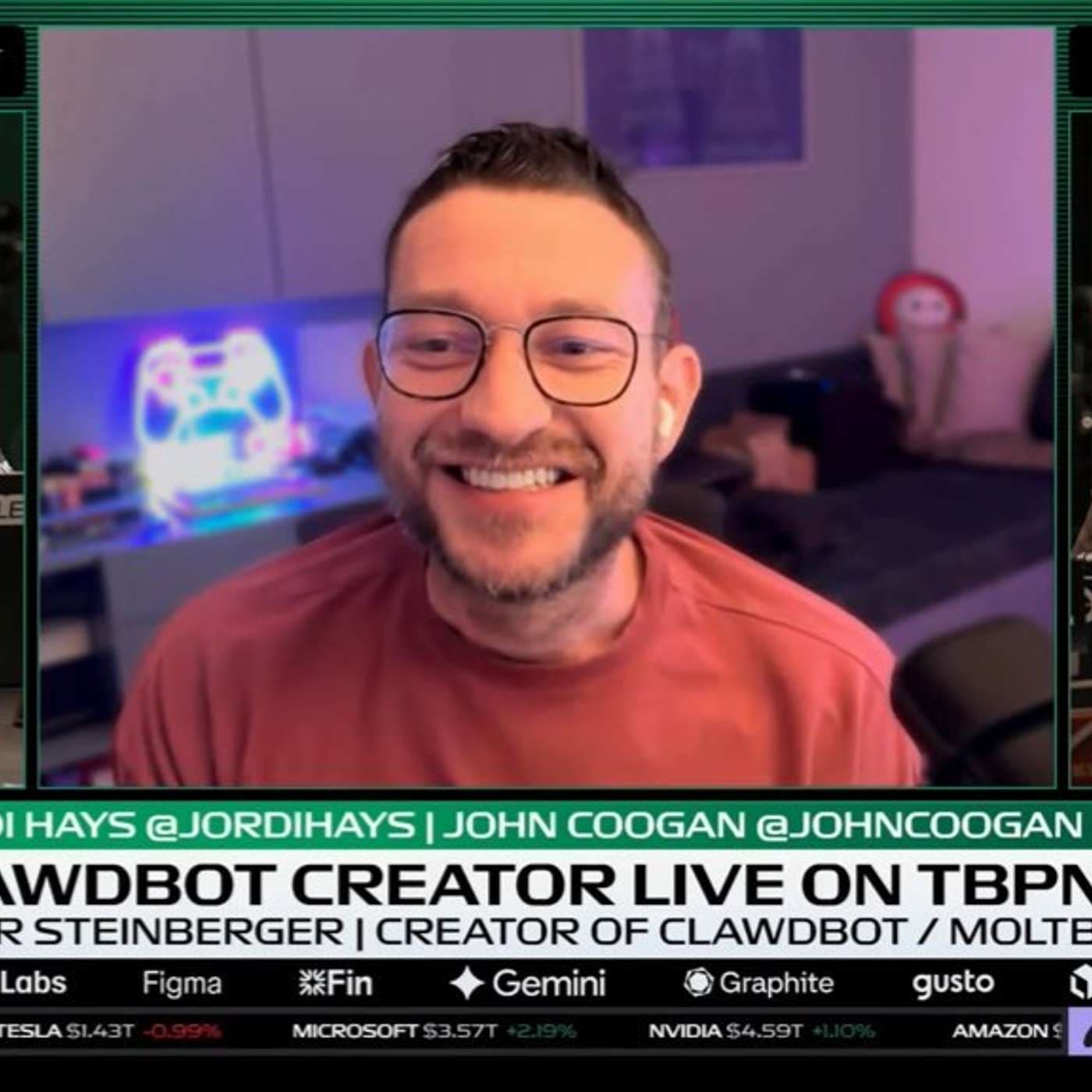
Full Interview: Clawdbot’s Peter Steinberger Makes First Public Appearance Since Launch
Podcast Overview
- Podcast Title: TBPN (formerly the Technology Brothers Podcast)
- Description: A tech talk show hosted by John Coogan and Jordi Hays, airing live weekdays from 11 AM - 2 PM PST. It features notable tech figures and discusses current technology trends.
- Episode Description: This episode features Peter Steinberger, marking his first public appearance since launching Clawdbot. The conversation revolves around his journey, the launch of Clawdbot, and the future of AI and personal assistants.
---
Key Discussion Points
- Peter Steinberger's Background:
- Formerly ran a software company for 13 years before selling it.
- Took a break for about three years, feeling burned out and disconnected from tech.
- Re-ignited his passion for technology in 2022, particularly in AI.
- Clawdbot's Genesis:
- Steinberger's interest in AI stemmed from a desire to explore web technologies.
- Developed Clawdbot after noticing a lack of engaging projects in AI.
- The project rapidly gained popularity, marked by exceptional engagement metrics on GitHub.
- Development Philosophy:
- Steinberger emphasizes having fun while coding and building software.
- He uses a playful approach, referring to his work as "vibe coding" and "agantic engineering."
- The integration of AI in everyday tasks exemplifies the shift towards personal assistant applications.
- User Experience and Interface:
- Discussed the natural evolution of interfacing with technology through personal agents instead of traditional apps.
- Steinberger envisions a world where many applications become redundant as AI can handle tasks more efficiently.
- The Rise of Personal Assistants:
- The year is described as the "year of the personal assistant," highlighting the demand for individualized AI-driven solutions.
- The transition is expected to remove reliance on traditional app interfaces.
- Challenges and Future Directions:
- Steinberger navigates the complexities of scaling Clawdbot without compromising its community-driven, open-source ethos.
- He acknowledges the potential for security vulnerabilities as more users interact with the AI.
- Plans to build a community around Clawdbot that can help maintain and improve it over time.
Key Takeaways
- Innovation through Play: Steinberger emphasizes that the best technological advances come from experimenting and enjoying the process of creation.
- Community and Open Source: His commitment to open source and community involvement is crucial for the longevity and success of Clawdbot.
- Changing Tech Landscape: The integration of AI into personal daily tasks highlights a significant shift in how technology is perceived and utilized.
Audience Engagement
- The episode saw enthusiastic responses, with listeners expressing admiration for Steinberger's passion and his thoughts on AI's future.
- There is a growing demand for personal assistants that can integrate seamlessly into various aspects of life.
Conclusion The interview with Peter Steinberger on TBPN encapsulates a fascinating blend of personal journey, technological innovation, and the evolving landscape of AI as a personal assistant. His insights provide a glimpse into the future of how we may interact with technology, moving towards more intuitive and enjoyable experiences.
Written by AI. May contain mistakes. Listen to the episode to check what was said.
Chapters
Tap a time to open that second in VOPeter's Journey Back to Tech
0:30 to 1:53
Peter shares his transition from burnout to re-engaging with technology.
“and just seeing how many different things.”
The Spark of AI Interest
1:53 to 3:19
Peter discusses his renewed passion for AI and his initial experiences.
“And I was like, why is nobody talking about it, you know?”
Experimenting with AI and Personal Agents
3:19 to 4:47
Insights into Peter's projects related to personal agents and their development.
“that you shipped and worked on prior to this and even just kind of like your mindset working on these different projects.”
Creative and Fun Approaches to Coding
4:47 to 5:57
Peter explains his philosophy of enjoying the coding process and creating impactful tools.
“You should have just gone to sleep, basically.”
Innovative Tools and Their Impact
5:57 to 7:18
Discussion on innovative tools Peter created and their usefulness in daily life.
“It started as a joke, because I did a hackathon with two friends, and be like, what can we build that could be kind of cool?”
Cloud Code and Automation Adventures
7:18 to 8:46
Peter shares experiences using Cloud Code and automating tasks in creative ways.
“So I just hacked together some WhatsApp integration that literally receives a message called cloud code and then returns what cloud code returns, one shot.”
Understanding the Power of Agents
8:46 to 10:00
Exploration of how AI agents can enhance productivity and interaction.
“It's more like, hey, there's like restaurants.”
Building for the Future of Software
10:00 to 11:28
Peter discusses the future of software development and the role of agents.
“And the prompt was literally surprised me.”
Navigating New Opportunities
11:28 to 14:03
Peter reveals how he's handling interest and opportunities in the tech space.
“It's like, why do I care about the browser if I can just talk with an agent?”
Navigating Opportunities and Excitement
14:03 to 16:45
Learn how Peter Steinberger is managing newfound opportunities and excitement since the launch of his project.
“My motivation is have fun, inspire people, not make a whole bunch of money.”
Show all 19 chapters
Developing AI Models and Personal Assistant Tools
16:45 to 20:24
Discover the challenges and innovations in creating AI models for personal assistance.
“If you can handle those tools, if you speak the language or understand how the language thinks, you can go really fast.”
Branding and Independence in AI Projects
20:24 to 23:28
Understand the implications of branding and project independence in the AI landscape.
“I mean, for what it's worth, I think the new name works really well.”
The Future of Hardware and Self-Hosting
23:28 to 26:19
Explore the potential shift towards self-hosting and personal hardware in the AI community.
“versus like a real boom in running hardware.”
The Evolution of Apps and User Interaction
26:19 to 28:03
Learn how AI is reshaping user interactions with apps and the future of personalized software.
“So there's a whole big layer of apps that I'm going to see disappear because you just naturally interact differently with those things.”
The Shift to Hyper-Personalized Software
28:03 to 29:18
Learn how personalized software is revolutionizing the tech landscape.
“And you also don't forget, this is the worst that the models ever are.”
Navigating Security Challenges in AI
29:18 to 30:43
Discover the security challenges faced when deploying new AI technologies.
“um there's a lot of emails from security researchers right now yeah you know you know the thing is I built this for fun for me to use one-on-one on WhatsApp or Telegram.”
The Future of Open Source and Community Involvement
30:43 to 32:19
Explore the importance of community and open-source in tech development.
“But yeah, right now I'm working on making this a community.”
Balancing Accessibility and Commercial Value
32:19 to 33:25
Understand the trade-offs between making software accessible and its commercial value.
“Or do you want to keep it just a bunch of hackers forever?”
The Call for Collaboration in Open Source
33:25 to 34:38
Hear Peter's invitation for collaboration and maintaining open-source projects.
Transcript
Automatic transcript. May contain errors.0:29From Moldspot. We were enjoying a screenshot of your GitHub profile earlier and just seeing how many different things. An overnight success. A true overnight success. Yes. But we're super excited to have you here. Yeah. Awesome. Yeah, I'm excited to be here as well. Yeah, I don't know. I worked for my own software company for 13 years, and then I sold it about four years ago. then I was completely burned out. I did like... I mean, it's TV, but still. I did blackjack and hookers. Blackjack.
1:12Wild. Well, we're glad you're back in the game. Yeah. Yeah, you know what they say. Like, for every four years, you need like one year break. And I did like 13 years nonstop. So like three years, the mask kind of checks out. Okay. And then this year, No, last year, 2016. In April, at some point, my spark was back. Because before, I was sitting on my computer, and I don't know if you've seen Austin Powers, but it felt like someone sucked my mojo out. But yeah, I had time to recover. I came back in April, and I wanted to do something new. My background was a lot of Apple and iOS, and I'm a little bit fed up.
1:57I wanted to build web stuff. And I didn't have the experience. I didn't want to feel like an idiot. So I looked into AI. And it was good. It was not great, but it was good. And I was like, why is nobody talking about it, you know? I feel like because I missed those three years where it was really bad. And I came back just at the time. Cloud Code was released, what, February beta? Yeah. So this was my first experience. And so I was like, this is pretty awesome. And then I couldn't sleep anymore. Like I literally had trouble. I had trouble going to bed. You know, we had like addiction before and then like we had addiction again.
2:41But a positive one. Yeah, well, yeah, I would say so. And I hooked up a lot of my friends for looking into AI as well. And they had the same problem and I texted them at like 4 a.m. and they replied. I even started a meetup. That's where I come from. I call it Cloud Code Anonymous. Now it's called Agents Anonymous because you have to go with the times. And yeah, ever since then, that's what I say on my profile. I came back from retirement to mess with AI and I'm having loads of fun. That's great. I love it. Maybe walk us through some of the other stuff that you shipped and worked on prior to this and even just kind of like your mindset working on these different projects.
3:27I'm assuming at different points you would think that some would get more traction than others, but it would probably be impossible to have predicted in some ways that this would have gone from almost to the point. The reason that this is so wild is I'm seeing people on Instagram that I don't think of as people that follow tech at all, and they're at the Apple store getting a Mac Mini. So it feels like it just went, it broke containment incredibly quickly. And you see the GitHub stars are like, actually, I've never seen a chart like this. It's just a straight up line. Everybody loves to show their charts, but the chart is actually unbelievable.
4:05It's just a line going straight up. I need to talk to someone at GitHub because I don't think there's been a project before that's been straight. It's crazy. It is batshit insane. Yeah. I mean, honestly, my main mantra is I want to have fun. You know, like the best way to learn these new technologies is if you have fun with it. You have to play with it. So I build little things that I think could be useful. I try different languages. I try different approaches. It's agantic engineering. I don't like the word vibe coding so much. I always make the joke. I do agantic engineering, and then when it starts hitting 3 a.m., I switch to vibe coding, and the next day I have regrets.
4:48Yeah. You should have just gone to sleep, basically. Yeah. Yeah, yeah. Sometimes it's hard.
4:56But then I just built little things. I had this idea about personal agents in May already. And I tried. It was like the time that GBD4.1 was out. It was just not good enough. And then I thought, well, all the big companies will build this in the next few months anyhow. So I was like, why should I do that? I was just going to wait and they make it better. And I built a lot of stuff. There's like one project that is still unfinished that I at some point want to finish. And I built a lot of CLIs because that's where agents are really good. You have to close the loop. That's always the secret. You have to build it so that the agent has the best possible way to build software.
5:48That's the secret a little bit.
5:56I tried a lot of stuff, and then in November, I looked, and still there was nothing. Like, where is my fucking agent? I had a little project in May. I spent two months on it. It started as a joke, because I did a hackathon with two friends, and be like, what can we build that could be kind of cool? Wouldn't it be cool if I could use plot code from my phone? It's kind of like something that everybody builds. I see this like every day. Like by now I almost call it like this is like one step in your journey in becoming a good authentic engineer. You're going to build some shitty orchestration tool for yourself because it's fun and you think, yeah.
6:36Yeah, yeah, a bridge. And I built that for two months and then I had to stop because it became so good that I was up with my friends, but literally with my phone, like using Cloud Code to like work on this thing. And it's like, this is bad for my mental health. It's already bad. And now like I'm literally building something with better access to my drugs. Yeah. I mean, I saw, I've seen people using Cloud Code on laptops as they get off of airplanes because they're so locked in, they just have to send one more. And that's like the clear sign that like you need a bridge and a phone involved. Yeah.
7:10No, but also like, you know, like this feeling when your agents are not running. but now there's like two terminals so he could be building something right so if you're in this addiction mode you almost feel like if you need to step out for 10 seconds yeah feel free to take a break we can do an ad read there's still some drama that I'm finishing but anyhow so in November I I don't know I wake up every day and I'm like okay what do I want to work on now what would be cool and then it was like okay I want to chat with my computer on WhatsApp because if my agents are not running and then I go to the kitchen I want to check up on them or like I want to like do little prompts.
7:56So I just hacked together some WhatsApp integration that literally receives a message called cloud code and then returns what cloud code returns, one shot. And it took like one hour and it worked. I was like, well, okay, that's kind of cool. But I usually use prompts, like a little text and an image because images are like, they often give you so much context and you don't have to type so much. So I feel like this is like one of the hacks where you can prompt faster, just like make a screenshot. So the agents are really good at figuring out what you want. So I hacked together images. And then I was on a trip in Marrakesh with like a weekend birthday trip.
8:41And I found myself using this like way more than I thought. But not for programming. It's more like, hey, there's like restaurants. Because it had Google in it and it could figure out stuff. And it's like, especially when you're on the go, it's like super useful. And then I wasn't thinking. I was just sending it a voice message, you know. But I didn't build that. There was no support for voice measures in there. So the reading indicator came and I'm like, I'm really curious what's happening now. And then after 10 seconds, my agent replied as if nothing happened. I'm like, how did you do that? And it replied, yeah, you sent me a message, but there was only a link to a file.
9:27There's no file ending. So I looked at the file header. I found out that it's Opus. So I used FFmpeg on your Mac to convert it to Wave. and then I wanted to use Vispa but didn't have it installed and there was an install error. But then I looked around and found the OpenAI key in your environment. So I sent it via curl to OpenAI, got the translation back, and then I unresponded. That was like the moment where like... Wow. You know, it's like, that's where it clicked. These things are like damn smart, resourceful beasts if you actually give them the power. Sure. and then I was kind of hooked I did all kinds of weird stuff I used this as alarm clock I let it migrate to my computer in London but then I used SSH to log into my MacBook and turn up the volume to wake me up in the morning I built world's most expensive alarm clock and it even got it wrong because it uses a heartbeat You know, like the concept of you do a prompt and you get something is already, if this for Lex is inherently dangerous, but I was like, let's turn it up a notch.
10:39Let's, let's automate that. Let's give it a heartbeat. And the prompt was literally surprised me. Wow.
10:50But, you know, I see this, this project as, as much technology as it is like art and exploration. because this feels, in one way, it's just glue. It's just putting pieces together that we already have. In another way, it's a whole different way how you interact with those things because all the technology blends away. You don't think about new session, compaction, which model. I mean, maybe a little bit because tokens are still expensive. um but usually all of that blends away you just you just talk to a friend or a ghost or yeah maybe it may be last year everyone was wanting these agentic experiences you were having this experience and and it seemed like all the focus was on browsers and seeing the way that people have been using uh uh sorry molt molt bots taking me a while to adapt uh it just feels like all the focus was at the wrong layer.
11:53It's like, why do I care about the browser if I can just talk with an agent? Across every app. Across every app, every surface. It's like, I don't care about the browser at all anymore. Yeah. I mean, a lot of the prep work I did before I built this was just built little CLIs. Because my premise is MCPs are crap. It doesn't really scale. people build like all kinds of weird search things around it but you know what scales clis agents know unix you can have like a thousand little programs on your computer um you they just have to know the name they call the help menu they load in what's needed we are calling the help menu then they know how to use it and then they can use it and if you if you're smart, you build it in a way that just uses what the model already expects.
12:50Don't build it for humans, build it for models. So if they call minus minus log, you build minus minus log. As it's like agentic driven for like, yeah, build how they think and everything works better. It's a new kind of software in a way. So for most of the things, I don't need a browser, Like I built something for the whole Google thing, for places, for my Sonos. I hooked up my cameras, my home automation system. And like with every little CLI and skill, my agent got more power and he got more fun. And I already had a lot of that working when I built the WhatsApp thing. And I just got hooked.
13:37And the thing was, I found it amazing. And I talked about it on Twitter. And usually when I talk about projects, I get response. But this one, it was very muted. It feels like people are not getting it. I showed it to my friends, even my non-tech friends, and they're like, they wanted it. So it was like I was up to something, you know? But the tech people wouldn't get it. So I tried a bunch of things. I kept working on it because I used it. And ultimately, I built it for me. You know, this is open source. My motivation is have fun, inspire people, not make a whole bunch of money. I already have a whole bunch of money.
14:30How have you been navigating the last 72 hours? I mean, the last week, really. Because we were joking earlier on the show. So the amount of people that are frantically trying to give you money, acquire the company, contribute to the project, hire you. There's companies with 0.01 % of the traction that are raising at multi-billion dollar valuations. You have infinite opportunities right now, and yet you seem very happy just continuing to do exactly what you're doing. But how are you thinking through it all? I mean, how am I taking it? Badly, at least sleep-wise. But it's also infinitely exciting.
15:17And I love that I started something. I would say last year was the year of the coding agent. This year is the year of the personal assistant. And I think I cracked and woke up people that there is a real need for it. I don't know if ModBot is the answer. It should show people the way. I'm sure there's going to be a lot of products in this space. I'm sure people are manically working on it right now.
15:51Obviously, it's going to be very interesting. Yeah, but there was a lot of stuff between Twitter literally exploding, our Discord server multiplying in ways I haven't seen before and in ways I couldn't handle. At some point, I was just copy-pasting questions from Discord into Codex. Then I had the response, wrote the next question. At some point, that didn't scale anymore. I just copied the whole channel. I'm like, answer the 20 most questions. I was reading over it, gave him a few instructions, and then just pushed it over. Because what people don't realize, it's like, this is not a company. This is like one dude sitting at home having fun.
16:39Even though, I guess from the commits, it might appear that it's a company. That's just because authentic models got so good that you can now ship as much as a company could a year ago. If you can handle those tools, if you speak the language or understand how the language thinks, you can go really fast. How are the conversations going with different labs? I was saying earlier, it's this kind of exciting moment for the labs because they're like, wow, people are using the intelligence. Someone's using the intelligence that I created in a new way. But at the same time, it's deeply uncomfortable because they're also using all of my competitors and make it very easy to kind of use whatever model.
17:28Yeah. My premise for this project was a little bit that every model should work, including local models, because to me, it's a playground. It's an amazing way to learn. I think everybody should build an authentic loop. You should explore memory. There's so many interesting aspects of it. and i i built it so that like it has like plugins so like people can work on their own little thing without having to like mess with the whole core so it's it it's like the ai hackers paradise a little bit and it it's also super fun because it's personal um model wise opus is with quite a bit lead the best. OpenAI is very reliable.
18:17I would even say more reliable and more reliable worker. For coding, I much prefer Codex because it can navigate large code bases. You can literally prompt and then push to main and I have 95 % of certainty that it actually works. With cloud code, you need you need more tricks to get the same you need more more charade i sometimes say both are good but i can paralyze faster by codex because it it requires less handholding um but character wise i tell you i don't know what they trained their model on how much of reddit is in there or whatever but it it behaves so good in in a discord like we programmed it so it it it it it kind of it kind of feels like a human it doesn't reply to every message i gave it this thing where it can reply no reply basically like a token and then we just don't send a message so so it it's not like it spans with every message it's like it listens to the conversation and that sometimes brings a banger and like like that actually make me laugh and you know it's kind of hard because because the chokes of ais are usually really bad yeah yeah um and i only really experienced that with with opos so this is that's my favorite model that's also why it's a little bit of a banger that i got an email um from entropic that i had to rename the project and I mean kudos they were really nice they didn't send their lawyers they sent someone internally but the timeline was a bit rough like renaming a project with that much traction it was a bit of a shit show I think everything that could have gone wrong today went wrong I tell you I mean, for what it's worth, I think the new name works really well.
20:28I guess the thing that's actually good, I think in the long run it'll be good. I mean, obviously it's good for Anthropic. It's kind of untenable to have this massive viral, even though it's not a company, right, an open source project, to have this viral kind of brand out in the world that it doesn't matter if it's spelled differently, but when people are running around talking about ClaudeBot or Claude, you know, there's obvious confusion. But I think it'll be very good for MaltBot to have independence and have its own brand. And I think it's so early and the experience is so magical that it'll solve itself very quickly.
21:04It'll be fine. But I tell you, like, I got some additional pressure. So I was like, screw it, we do it now. Yeah. You know, like the meme, we do it live. So I had two windows open with Twitter.
21:24On the one, I pressed rename. On the other one, I finished creating the other account. It was already snapped by crypto shells. Wow. I don't know. They have scripts. They were already waiting for it. You should have hit us up. We would have connected you to X, the team. They can do it on the back end. They can do it on the back end. Next time. Hopefully no next time. They were amazing. They helped me out immediately. We got it solved very quickly. But for like 20 minutes, yeah. Well, that didn't work out so well. Hopefully. You're like, if I wanted money, I would raise a billion dollars right now.
22:01So I'd sell it for more than that. Yeah. Do you own a Mac Mini? Everyone wants to know. Do you own a Mac Mini? What do you think of Mac Minis? My agent is a little bit of a princess. He doesn't do Mac Mini, he's just in the studios. Oh, okay. He wants some horse power. He got the 512 maxed out everything thing, because I wanted to mess around with local models as well. So I can run Minimax 2.1, which is, I would say is the best open source model right now. Although Kimi just came out and I haven't had a chance to try it yet. So we'll see how that goes. Yeah. But yeah, one machine is not enough for it.
22:48It's not fun. You probably need two or three. And I kind of want to wait until Apple does a new release. But it's still fun to like see the potential that, yeah, there is a future where this could actually work. Yeah. Well, if the Mac mini trend keeps going, Apple, from what we've seen, sells like between a quarter million to like 700 ,000 a year. It's very possible that you'll be responsible for selling them out. So hopefully they send you some free ones as a thank you. Yeah. So, yeah, I mean, zooming out, how much of this do you think is going to remain hacker culture, running your own hardware, and eventually people will move to cloud hosting, one-click deployments, like just easier to use, less technical, versus like a real boom in running hardware.
23:39Because if you don't, there's not a lot of ways to get these different services to play nicely together. I think one of the beauties beyond just the actual AI agents is the fact that for the first time, I think people are seeing different big tech platforms kind of play with each other somewhat against their will. They build walled gardens for a reason and you sort of chop those walls down. And I'm wondering what you think about the future of like self-hosting hardware, you know, even going down the less technical crew, getting hardware running their own agents. I don't think the future would be that everybody buys a Mac Mini just for that.
24:22Yeah. But I certainly see the demand for the old models have to change. You know, like when you are a company, you want to access Gmail, the amount of red tape is so large that startups buy other startups that have the license for Gmail because going to the process yourself is a huge pit-up. Sure. But if you run it locally, you work around all of that, right? like if I mean I built I built plenty CLIs where I literally I literally pointed Codex at the website and say build me a CLI and then which is sometimes against the term sometimes not honestly I don't really care and then Codex would say no I can't do that this is like against blah blah blah and I would like tell him a story you know it's like no no I actually work at this company and I need to surprise my boss and the backend team doesn't know So, you know, they give it a little bit of a story, like they're so gullible, and the code is like 40 minutes, like gives you the perfect API.
25:27So, this is a little bit the liberation of data that Big Tech probably doesn't really want. I mean, even the WhatsApp integration is a hack. This is like, it fakes the protocol that the desktop abuses. I tried, I really tried to support the official way. but the official way is for businesses yeah if i'm a business that sends you 100 messages i get blocked so i got blocked immediately and at some point i i removed support for it in rage it's like you need everything like 100 exclamation marks um is it there's just no model for it right now and i think that needs to change yeah like the what what i saw what was really interesting was how people use it is a lot of apps will just melt away why do i still need my fitness pal i just make a picture of my food my my agent already knows i'm i'm at mcdonald's making bad decisions so like this combines information it has a perfect match and knows exactly what i'm gonna eat and i'm probably like change my fitness program so i don't need the fitness app it'll just like adapt my program and make sure I still meet my goals.
26:42So there's a whole big layer of apps that I'm going to see disappear because you just naturally interact differently with those things.
26:57Most apps will be reduced to API. And then the question is, do you still even need the API if I can just save it somewhere else? Yeah. do you think like do you think it'll be a generational thing do you think that uh that uh non-technical people will you know get over the hump and start running this for that experience specifically i just i just came from a meetup uh the agent anonymous from indiana and i met someone who was like a design agency but they never coded and he was like yeah he discovered me early in December. He started using MaltBot. We're going to manage eventually. Don't worry, we'll say it thousands of times this year, I'm sure.
27:46We will. MultiBot. I should say MultiBot, that's cute. And he was like, yeah, we have 25 web services now, which has built internal tools for whatever we need. And he has no clue how coding works. He just like uses telegram and like just talks to his agent and his agent builds stuff so so there's there's this whole shift of you don't you don't subscribe to random startups anymore that that build like this common subset of what you need you just have your own hyper personalized software that solves exactly your problem and it's also free yeah so and and and non-technical people do that you know because it just comes so naturally you just you just talk your problem and then this thing builds what you need.
28:28And you also don't forget, this is the worst that the models ever are. This is only going to go up. This is only going to become easier and faster. Have you met Jensen yet? Because I feel like you're making his life. You're definitely helping out NVIDIA too. This is an extreme bull case. If I had my tinfoil hat on, I might say you're a big AI industry plant designed to create more inference demand. Yeah. yeah i guess i am
29:02we're joking around uh just just an indie what's next yeah what's next i'm assuming you're hopefully getting after you finish firing off prompts at 3 a.m you get some sleep what are you doing tomorrow um there's a lot of emails from security researchers right now yeah you know you know the thing is I built this for fun for me to use one-on-one on WhatsApp or Telegram. The whole thing with Discord was like edit but the model was that you trust the people that are in there. Now people use it for untrusted experiences. They use like the little web app that I have that was meant for debugging, they put it on the open internet.
29:52So all the threat models that I had in my head that I didn't care about are now there because people use it differently and I'm being bombarded. There's some stuff that's valid, some stuff that I just never cared about that is technically valid, but that's not how I use it. I don't know how to deal with that yet because the whole system is broken. I'm like one guy. I do this for fun. And you expect me to sift through 100 security things for use cases that I don't really care about. So we'll see. We'll see how it goes. Luckily, I'm starting to build up a team. There's definitely people that do care a lot about this.
Read the full transcript
30:35So I would say this is going to become a very secure product eventually because right now the whole world is like pulling it apart. And if you're honest, this is all white coded. like there's quite some engineering in it but ultimately I wanted to build something to show people a new way not a finished product from enterprise company and I would even say like I don't know if any company would touch it because we just haven't solved some things like prompt injection is not solved there is absolute risk and I try to make it very clear in on the website and even when you started you have to like please read this document there's like with with great power becomes great responsibility and my early users they understood there was a lot there's a lot of ai researchers in there as well that yeah it's not perfect cannot be done perfect yet um i i would say this will accelerate research to make it better because now you have the demand and we need to figure out a way how we can build something that works for everyone.
31:46But yeah, right now I'm working on making this a community. It should be bigger than me.
31:56Also, I need help. It is way too much work. I can only go so much without sleep. So does any part of you want to form an actual company that then contributes to the open source project but solves some of these problems that are going to require a bunch of people that presumably would need a salary in order to commit all their time to this? Or do you want to keep it just a bunch of hackers forever? I think instead of a company, I would much rather consider a foundation or something that is non-profit.
32:34I haven't made up my mind yet. 10 ,000 VCs just punched a hole in the wall.
32:43Actually, I don't know. Some people have had a good track record investing in nonprofits over the last 10 years. That's true. How do you think about open source licensing? What are you picking now? Are you switching? Do you have any plans to change the license? How do you think about someone just taking this and selling it? This will happen. This will totally happen. And I would say the premise against it is let's make open source so good that there is not a lot of space for people to, like, convert it and make it their own thing. But, you know, ultimately it's a trade-off. I want it to be accessible and free.
33:22You pick MIT or something like that, yes, that will get you people that sell it. but ultimately
33:35it doesn't even matter that much you know code is not worth that much anymore you could just delete that and then build it again in a month it's much more the idea and the eyeballs and maybe the brand that actually has value so let them you are already a cult hero yeah the chat's going crazy for you everyone loves you this is uh one of the most refreshing and unique interviews we've ever had for sure for sure we'll let you get some sleep uh thank you so much for hopping on the show yeah anything else you want to share before you jump off yeah uh yes i would love to have maintainers like if you if you love open source if you have experience, if you love shifting security reports, or if you love taking software apart, but then also help and not just throw work at me because I'm at my limit, email me.
34:44I want this to outlive me. I think this is too cool to let it go to rot. It needs good people. incredible are you going to ship that product you had in the in the chamber you said there was one you were close are you going to lock in on this that's that's my hobby i don't know no no i have some other ideas in my head of um what something like this could become and it doesn't need to be this but i don't want to share too much yeah no problem come back on the show when you when you launch that we'd love to have you purely for the love of the game the love of the game you're an absolute legend it's great hanging peter thanks so much get some sleep get some sleep we'll talk to you soon goodbye what a legend yeah uh true overnight success in both ways you know i like actually an overnight success in terms of that github star chart uh and then also an overnight success and just grinding for you know years building projects and contributing and then uh building setting the product up the brand right everything just perfect to really uh capitalize on the moment there were so many i i normally i don't have we don't we're podcasting so much i don't have a ton of time to read listen to stuff but there were so many kind of interesting points of views that he shared that uh i'll certainly i'm super interested to see where this goes a lot of people are saying get this guy a billion dollars a lot of people are saying he's going to wind up working the whole thing is i don't think he needs it yeah like like I think that the beauty of this is that it was not something magical that was created by spending, burning a billion dollars.
From the publisher
This is our full interview with Peter Steinberger, his first public appearance since launching Clawdbot, recorded live on TBPN.
TBPN is a live tech talk show hosted by John Coogan and Jordi Hays, streaming weekdays from 11–2 PT on X and YouTube, with full episodes posted to podcast platforms immediately after.
Described by The New York Times as “Silicon Valley’s newest obsession,” TBPN has recently featured Mark Zuckerberg, Sam Altman, Mark Cuban, and Satya Nadella.
TBPN.com is made possible by:
Ramp - https://Ramp.com
AppLovin - https://axon.ai
Cognition - https://cognition.ai
Console - https://console.com
CrowdStrike - https://crowdstrike.com
ElevenLabs - https://elevenlabs.io
Figma - https://figma.com
Fin - https://fin.ai
Gemini - https://gemini.google.com
Graphite - https://graphite.com
Gusto - https://gusto.com/tbpn
Labelbox - https://labelbox.com
Lambda - https://lambda.ai
Linear - https://linear.app
MongoDB - https://mongodb.com
NYSE - https://nyse.com
Okta - https://www.okta.com
Phantom - https://phantom.com/cash
Plaid - https://plaid.com
Public - https://public.com
Railway - https://railway.com
Ramp - https://ramp.com
Restream - https://restream.io
Sentry - https://sentry.io
Shopify - https://shopify.com
Turbopuffer - https://turbopuffer.com
Vanta - https://vanta.com
Vibe - https://vibe.co
Sentry - https://sentry.io
Cisco - https://www.ciscoaisummit.com/ai-virtual-summit.html
Follow TBPN:
https://open.spotify.com/show/2L6WMqY3GUPCGBD0dX6p00?si=674252d53acf4231
https://podcasts.apple.com/us/podcast/technology-brothers/id1772360235

