
In short
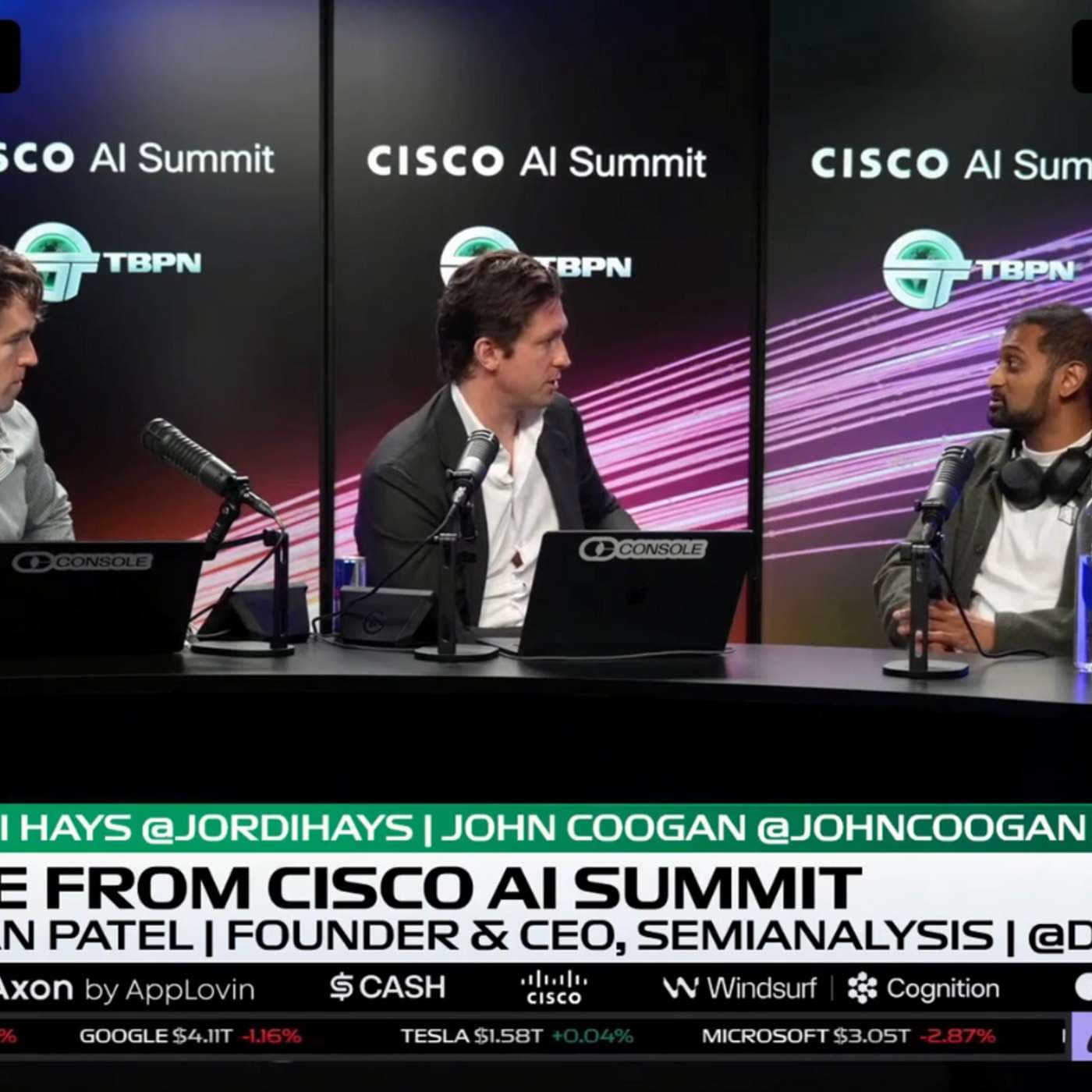
Podcast Notes: TBPN - FULL INTERVIEW: Dylan Patel Says We’re Still Underestimating AI
Episode Overview
- Guest: Dylan Patel, Founder and CEO of SemiAnalysis.
- Recorded Live: At the Cisco AI Summit in San Francisco.
- Hosts: John Coogan and Jordi Hays.
Key Themes
- Space Data Centers
- Challenges of Current AI Hardware
- The Future of AI Infrastructure
- Geopolitics and Chip Manufacturing
Introduction
- The hosts welcome Dylan Patel and dive into the topic of data centers in space.
- Discusses the burgeoning space tourism industry and the implications for technology.
Data Centers in Space
- Key Insights:
- Space tourism is viewed as a novelty, with the desire for real space experiences (e.g., prolonged stays).
- Exploration of using AI chips in space, such as NVIDIA's potential involvement with Starlink.
- Challenges Identified:
- Cost of launching hardware into space is decreasing due to advances like the Starship program.
- Heat dissipation and reliability of chips remain significant challenges in a space environment.
- Error rates in chips increase with complexity, which poses issues in remote locations like space.
AI Hardware Limitations
- Current Issues:
- Chips currently suffer from reliability concerns, especially in remote or extreme environments.
- Discussion includes how often chips fail during operation and the complexities of servicing them in space.
- Comparative Analysis:
- Comparison of Tesla’s self-driving chips to space-bound chips indicates that reliability and redundancy are crucial.
The Future of AI Infrastructure
- Emerging Trends:
- NVIDIA’s pivot towards specialized chips (like Grok) for different AI functionalities indicates uncertainty in the industry about which technologies will prevail.
- Cerebrus’s role in speeding up inference processes in AI applications is discussed as critical for future developments.
Geopolitics in Chip Manufacturing
- Tensions with China:
- Discussion of the strategic importance of semiconductor technology and its parallels with military capabilities.
- The hosts explore the implications of restricting chip technology access to China and the potential for economic dependencies.
- Energy and Manufacturing Bottlenecks:
- Debate between whether TSMC's fabrication capacity or energy availability is the primary bottleneck for AI development.
- Highlights the complexity of scaling up semiconductor manufacturing against the backdrop of energy supply challenges.
Oracle’s Position and Market Dynamics
- Recent Developments:
- Oracle's announcements regarding financing for new data centers and its relationship with OpenAI amidst market fluctuations.
- Discussion on the communication strategies of tech companies and their implications during financial uncertainty.
Meta and the Future of AI Products
- Meta's Strategy:
- Examination of Meta's investments in AI and its potential to outperform competitors like Google in generating personalized content.
- Insights into the importance of user engagement and content generation as AI technology improves.
Conclusion
- Final Thoughts:
- Both hosts and Patel express a bullish outlook on AI’s potential to transform industries, with the caveat that many uncertainties remain.
- The conversation concludes with reflections on the societal implications of rapid AI advancements and their geopolitical ramifications.
Key Takeaways
- Future of Space Data Centers: Feasibility is improving, but reliability and maintenance in space pose unique challenges.
- Chip Reliability: Increased complexity results in higher failure rates, presenting significant hurdles for AI hardware.
- Geopolitical Implications: The interplay between technology access and military strategy is a central concern in international relations.
- Market Dynamics: Companies like Oracle and Meta are adapting to the rapidly evolving AI landscape, with distinct strategies to leverage AI capabilities.
--- This markdown file serves as a comprehensive summary and analysis of the podcast episode, highlighting critical discussions and insights presented by the guest.
Written by AI. May contain mistakes. Listen to the episode to check what was said.
Chapters
Tap a time to open that second in VOThe Fun of Space Tourism
0:46 to 3:08
Hosts chat about the excitement and experiences of space tourism.
“Like, you know, put water and then they're bubbling and then you try and drink the water.”
Challenges of Space-Equipped AI Chips
3:09 to 5:11
Discussion on the technical challenges of deploying AI chips in space.
“But let's say the chip is 10x as big, right?”
Reliability of Chips in Space
5:12 to 7:40
Exploration of chip reliability issues for space applications and comparisons to Earth.
“when sacks of meat are actually very cheap?”
NVIDIA's Shift and New Chip Developments
7:41 to 10:48
Analysis of NVIDIA's evolving strategy in chip design, including the Grok acquisition.
“my desktop and I was like, there are six different models and then there's another button that I can pick to it.”
Cerebrus and the Future of Data Centers
10:49 to 13:21
Discussion on Cerebrus technology and its implications for data center performance.
“So, you know, Starship hasn't worked yet fully.”
Google's Innovations in TPUs
13:22 to 14:00
Examination of Google's TPU advancements and their competitive strategy.
“and what numerics you want, and all these other things.”
Google's Data Center Strategy
14:00 to 15:00
Learn how Google structures its data centers to optimize AI training.
“And that's very difficult to split across data centers.”
AI Workloads and Energy Use
15:00 to 17:00
Explore the current debate over TSMC and energy constraints for AI workloads.
“Minutes at a time instead of seconds at a time.”
Power and Data Center Constraints
17:00 to 19:10
Understand the power and data center capacity issues facing the semiconductor industry.
“It's like this is, you know, you've got to understand the mindset.”
Challenges in Semiconductor Manufacturing
19:10 to 21:40
Delve into the complexities of semiconductor manufacturing and the cleanroom environment.
“26, we're still, we're swinging the pendulum, but it will fully beat semiconductors again in 27, right?”
Show all 22 chapters
Oracle's Communication Missteps
21:40 to 24:00
Analyze Oracle's recent communication strategy and its implications for investors.
“I mean, like, I'm sure a handful of people in your DMs are random, but that doesn't mean...”
China and AI Technology Control
24:00 to 26:20
Examine the geopolitical implications of controlling AI technology access to China.
“Yeah, what's funny is Oracle stock peaked just a week after they announced the OpenAI deal.”
Global Supply Chain and AI Technology
28:00 to 28:58
Explores the geopolitical implications of AI technology ownership and supply chains.
“We're going to do more military actions.”
China's Tech Strategy and Economic Value
28:58 to 30:22
Discusses China's approach to technology and its long-term economic impacts.
“Yeah, they loop it through and you can see this in the traffic data.”
Cloud Code and Its Relevance
30:22 to 31:41
Investigates the concept of cloud code and its implications for software development.
“Is Doug O 'Loughlin suffering from a case of cloud code psychosis?”
Hedge Funds and AI Investments
31:41 to 34:08
Examines hedge funds' beliefs in AI and their strategies for investment.
“And it's to the point where it's like our head of data, head of IT is like, oh, can you send me that?”
AI Market and Company Analysis
34:08 to 36:21
Discusses the current market conditions for AI startups and major players.
“So we're getting an office together, Leopold, myself, Dwarakash, and then a client of mine, another hedge fund.”
Meta's AI Strategy and Financial Performance
36:21 to 37:37
Analyzes Meta's approach to AI and its financial implications.
“irrational yeah right because we have not lived through you know you get these These PMs who like don't.”
The Future of Digital Experiences
37:37 to 41:26
Speculates on the impact of AI on user engagement and digital products.
“So if you think about it, right, like, okay, Meta's, where are they going to win, right?”
Branding and Marketing in Tech
41:26 to 42:01
Considers the challenges of branding and marketing in the technology space.
“Like if you're an assistant it means that there's some commerce happening.”
Sony Products and Branding
42:01 to 42:43
Discussing the branding and marketing of Sony's audio products.
“Yeah, yeah, Borabia brand is actually a Chinese company now.”
Football Talk and Game Experiences
42:44 to 43:38
Exploring conversation around football culture, excitement for upcoming games, and advertising during events.
“You guys, what are some plays that we don't watch a lot of sports?”
Transcript
Automatic transcript. May contain errors.0:00What's up man? Good to see you. Good to have you. Data centers in space, what you got? When are we going to space? Coming in hot. Me, you, the International Space Station, let's break it down. You know, the space tourism industry is quite a fun one, right? Yeah. Would you go? Would you do the Blue Origin thing where they blast you out past the Carmen line? It's good enough for Katy Perry. It's not good enough for you. What's going on? It's like you're in free fall. You're not actually in space. Oh, it doesn't count? Shots fired. Carmen line denied her. I want to be like going around for days. Oh, OK.
0:30I want my bone density to start to atrophy. I truly want to feel the negative effects of space. Yeah, yeah. It's not enough just to go up and back. I think I would do it. It's like 90 seconds, right? Yeah, but it's better than hanging out on Earth. But all the cool stuff that astronauts do, right? Like, you know, put water and then they're bubbling and then you try and drink the water. Soon they'll be unplugging the GPS and plugging it back. Oh, yeah, yeah, yeah. That's how you pay for your space tourism. You got to go on the sea of ships. 90 seconds of servicing a SpaceX satellite. One 90 second trip at a time.
1:04No, but people were wondering, you know, TPUs, NVIDIA going on the Starlink V5 or whatever something gets up there. It feels like this will be something more like a Tesla silicon chip, an AI chip. Like, do you have any insight into like, what the process, if you wind up figuring out how to heat dissipate, if you wind up figuring out the costs, what might the chip look like? So I think, you know, everyone freaks out, oh my god, putting stuff in space is expensive. But if you look at like starship launch costs and they keep falling, you're like fine, right? I think that's not, by the end of the decade, the cost of space launch will be fine.
1:42The heat dissipation, I mean, it's a challenge, but you just put a massive, massive, effectively radiator and it's fine, right? By the end of the decade, you'll be good. I think the big challenge is that chips are just really unreliable, right? And so how do you deal with a couple things, right? Satellites can only be so large before they start needing a lot of support and structure before they tear themselves apart. So when you look at the launches, these things are shooting out tiny satellites, and many of them. Okay, so you can't have a big, fully connected cluster of chips. And then on top of that, how do you deal with any random error?
2:18On Earth, you have techs running around the data center, unplugging stuff, putting in spares, things like that. What do you do in space? You RMA it to the factory where they might unsolder it and re-solder it and then test it and it works and go back out. Sometimes it is just trashed. That's the challenge to me. I feel like maybe the pattern we should be looking at is how often do the Tesla self-driving chips need to get serviced? Because that's the team that would probably be building or bridging the gap there. The Starlink satellites, they go down, but the service works. like you're you're just relying on some sort of like you know 90 % uptime stuff's coming down but most people that are in a way mo like the chip keeps working right most people that are in a Tesla self-driving like they're not like you don't hear about Tesla owners being like I love FSD but I'm constantly in the shop getting my my custom silicon chips unseated and reseated right I mean it's it's also a function of like the complexity of a chip right sure um you know if if a chip is twice as fast yeah and let's say the bit error rate right Like how often a bit flips is the same, then it's erroring out twice as often.
3:28But let's say the chip is 10x as big, right? And so when you look at like a Tesla FSD chip, very, very good, very, very efficient, still like relatively inexpensive and cheap compared to, you know, a big old GPU or TPU or whatever. Those things are extremely large. And, you know, again, like if the error rates are the same, then it fails 10x more. But in fact, the error rates are a bit higher because they're pushing these things to the absolute limit. whereas Tesla does have some level of like, well, first of all, the Tesla car has two chips, sort of redundancy already built in, right? Maybe you do that on the satellite, but then there's more power, more...
4:04Yeah, right, so the whole lore, right, of it is, you know, effectively power is free, right? And solar panels, you look at the cost curve of solar panels, you look at the cost curve of satellite launches, you're like, this is free, this is great. But power is less than 10 % of the cost of the cluster, right? so so like it's that 90 % you're not saving anything on yeah and in so far as much as potentially a hundred times the hassle yes yes there's this whole like you know like if you look at NVIDIA GPUs right when you first turn on the cluster about 10 to 15 percent of them fail RMA in the first two weeks Wow and then that's fine like you have to reseat them whatever and like the industry knows how to deal with this right and in over time like hoppers now at 5 % but But Blackwell's still 10 to 15%.
4:51Actually started out higher than that. And when a new generation comes out, it's gonna be higher than 10, 15%. It'll have its curve gradually decline down. But who's gonna, are you gonna test it and burn it in on the ground? Or are you gonna say 5 % of my chips or 10, 15 % of my chips are trashed? Because someone can't go up there and do these things? Or am I saying, oh, I need robots who can do all this stuff in space, and now that's an additional engineering problem when sacks of meat are actually very cheap? Yeah, sacks of meat, yeah. Speaking of invidia, We haven't talked since the Grok acquisition.
5:20What does that look like in the bulk case? Like if it's a good, if the next version of Grok is a great chip, is it sitting next to the, you know, H200, H100s in the rack, GB200? How does it fit into the actual, like what NVIDIA deploys? Is it just a separate chip? I think it's a big vibe shift from NVIDIA, right? Before they were like, all right, I got this big GPU. Everyone's gonna use this GPU. Software ecosystem of the GPU is so good. It's one size fits all everyone's trying to make all these specific point solutions, but we've got the thing that's good at everything. And then they had a vibe shift, right?
5:56They launched this thing called CPX, which is a chip made for pre-fill. With prompt processing, creating a KV cache, and also good at video generation and image generation. And that's coming out later this year. In the Grok press release, they were really talking about video generation as well. So yeah, you've got CPX, you've got the standard GPU, and now you've got the Grok chips, and they all fill a different niche. But really it screams, oh crap, we don't really know exactly where AI is going, which I don't think anyone does, right? I mean, it's moving so fast, the software is, the model architectures, etc.
6:25So we're just going to engineer solutions that are along multiple points of the Pareto Optimal Curve, and then one of them will win, right? And I think it's sort of like a big vibe shift from NVIDIA. Also, they just knew OpenAI was going to do the Cerebrus deal, so they freaked out. Got it. Yeah, get me up to speed on what makes Cerebrus important in the ecosystem right now. So, you know, you have people thinking like, oh, latency matters in terms of where our data center is. It doesn't matter at all. What matters is, you know, as we've moved from, you know, chat applications, which were like, or search response immediately, chat applications, let's say response takes 10, 20, 30 seconds.
7:03You've got agents, you know, I don't know, my cloud codes are working in the background for a long time, right? It doesn't matter where the data center is, but what does matter is that these streams of inference take, you know, 30 minutes versus 10 minutes, versus five minutes, and for a lot of people, I'm fine to spend 10x the price on something that completes 10x faster. And so Cerebrus sort of just makes a ton of sense there. So OpenAI, they've got these long horizons. There's Codex 5.2, extra high thinking or whatever, it's terrible. Can you guys teach them how to market? OpenAI, you have to sponsor this podcast.
7:38Yeah, yeah. We had two on yesterday, and I did actually ask him, I had the Codex app pulled up on my desktop and I was like, there are six different models and then there's another button that I can pick to it. Well, how many different products are called Codex now? There's a lot. Now there's an app, yeah. We actually have another guy on just to do branding. Lexicon branding came on the show yesterday talking about all the naming. Naming architectures. Naming architectures. It is complicated, but hopefully. You can tell he's just blood's boiling because all the AI companies just have the most chaotic Anthropic, Claude, Claude Code, but also you can use Claude Code for other stuff.
8:16Yeah, but yeah, I mean, with Cerebras, it seems like there is a value to it, but are they constrained on the supply side? Can they actually scale up to a Colossus-style data center that could actually speed up Codex, not just for one user, but all the users? So, I mean, Cerebras can speed up multiple users for sure. The question is sort of like where you use it, and that's where they have to like figure out where within Codex, right? Because there are times where Codex is running for like 10 hours, and sometimes you don't mind, right? Like, screw it, I put up this nice prompt, gone, work on it, refactor my code, do this thing, do this task.
8:51Other times I want this iteration feedback loop, so how do you expose it to the user without saying, hey, actually there's another toggle, so your permutation is 18 times. Well, hopefully like a really robust model router, but it feels like that's been a process. Yeah, so the OpenAI deal is like for 750 megawatts. It's not that much capacity on the order of what OpenAI has talked about. By the end of 28, they'll be at like 16 gigawatts of that. So it's just like the absolute cutting edge, the most price-insensitive customers in that specific use case of, this is the type of prompt that you need to return fast, then you'll get the speed up, potentially.
9:26Right, right. And they've got to figure out how to do it from a product, exposing it to the user, etc. But it's clearly something where there is demand, right? Like, I don't know, like Andre Carpathie doesn't care if he's spending a thousand bucks per agent per second or whatever, right? Like, you know, so whatever it is, these like super cracked engineers don't care at all. And then obviously there's like a long tail of like actually cost does matter for most people. And so all along that curve, they've got to have solutions, right? When did you first think that XAI might end up at another Elon company?
9:59I mean, this has been rumored for a long time, right? Like people are saying Tesla, Tesla, Tesla for the longest time. It's harder with a public company. Yeah, yeah. And then a bit ago, people were like, oh, SpaceX, I'm like, wait, this makes no sense. No, but there was a very coordinated narrative pump at the end of last year. And it was almost perfectly telegraphed. Well, there's a bet, right, between basically the head of compute of XAI and the head of compute of Anthropic. And the bet is what percentage of worldwide data center capacity is in space by the end of 28. And the bar is 1%. Oh, wow.
10:34And so the XAI guy is like really bullish. The Anthropik guy is like, eh. Yeah, a little slower. Yeah, yeah. But it's a really interesting bet. I take the under on 1 % by 28, because that's a gigawatt in space. Yeah. But it's actually not that crazy, right? Yeah. It's roughly 150 Starship launches. Yeah. We'll get them to a gigawatt in space. Yeah. So, you know, Starship hasn't worked yet fully. I was looking at the energy draw of the current Starlink fleet, and I think they're at like what is it 200 kilowatts or something like that so you you get a thousand of those 200 megawatts and like you're starting to be in the territory yeah so the v2 stars satellites I think are the only ones they've launched maybe they've launched a few V3 the V3s are coming soon and those are those are like a hundred X more bandwidth each right and more power and just more power and so what I'm just thinking of like can you scale this thing up at all it's like are they two orders magnitude off are they three or two this feels like they're like one order of magnitude off something that looks like an H100.
11:35I think the metric is like 50, it's either 50 kilowatts a ton or something like this per satellite for V3. Let's say from V3 to whatever the compute thing is, they double it again, get to 100. I think the V2s are like 25. So if you get to 100 kilowatts per ton for launch, it's only 150 or so Starship launches. I think that's so reasonable. Maybe not 28, maybe it takes 29, but like, you know, it's so reasonable. Well, the question is cost and reliability. What happens when the chip fails? How do you service it? That kind of stuff. How do you deal with having clusters be much smaller instead of these big clusters?
12:10Even for inference, big clusters are useful. How do you think about Google's response to Grok's, Eris, TPUs? Obviously, they're very successful. But are they forking that project to eat more of the Pareto curve? Yeah. Yeah, so for the longest time, Google's had one main line of TPUs, right? All made by Broadcom. And then sort of next year, they've diverged it, right? Where Broadcom makes a TPU and MediaTek makes a TPU. These two TPUs are focused at different things. And they're fabbed at TSMC. They're both fabbed at TSMC. Everything at the end of the day goes to Arrakis, right? I want to go there next, but everything goes to Arrakis.
12:50So fabbed by TSMC regardless, but both of these TPUs are focused on different things. Okay. And they've actually got a third project for another kind of TPU there. They also see this need to proliferate along the curve of like, hey, do I care a lot about super high amounts of flops, not that much memory? Do I care a lot about super fast on-chip memory only? Do I care about 3D stacking memory? Do I care about this sort of general purpose middle ground AI chip, which is what an H100, a Blackwell, a TPU looks like today? They're sort of like, oh, we need to hit the entire Pareto optimal curve. And it's like, okay, within this, there's training versus inference differences and and what numerics you want, and all these other things.
13:26There's so much complexity there. Everyone sort of is diverging their roadmaps once they're at a sufficient scale, I think. Yeah, is Google still way ahead on cross data center training? Yes. And are the other labs, like, is that important to the other labs to catch up there? Or is it something that will just naturally happen because everything sort of commoditizes? Or do the other labs need to sort of marshal some Herculean effort to like crack the code on what it takes and what Google's doing? Yeah, so it's a couple of things, right? In 2023, everyone thought that scaling was pre-training. Yeah.
14:00Right? You know, more parameters, more data. And that's very difficult to split across data centers. And has Google been able to do that? And Google's been able to do that to an extent, right? So what they've done is they've got, you know, they don't have the largest individual data center campus, but what they do is they do these like regions where it's like, hey, each data center's roughly 40 miles apart from each other. Sure. So in Nebraska and Iowa and then in Ohio, they've got these complexes, and now they're building one in Oklahoma, Texas. Got it. You know, these complexes where there's all these data centers pretty close to each other.
14:29So it's not really cross data centers, like across the world. Right. It's just across regions. Yeah, and then that makes a lot of the difficulties a lot easier. Yeah. Flip side is we've also moved to RL, right? Yeah. And majority of the time of the chips is spent generating data, right? Only doing forward passes through the model. Sure. And then you only send the final tokens that you verified sort of back to train on to the training, right? So then you end up with like, oh, instead of in pre-training scaling, you need to like synchronize all the weights every 10, 20, whatever seconds. When you're doing these rollouts, and especially as things get more and more agentic in training, you might not only need to send not the entire weights, but just the tokens that are relevant, so way smaller amount of data and way less frequently, right?
15:11Minutes at a time instead of seconds at a time. Yeah. And so you've got this like now, now it's become like reasonable where, oh, actually, multi data center training is completely reasonable. And people do this. People do multi data center, multi chip training. Sure. Right. You know, you do your inference on one set of chips and you do your training on another set of chips. So like Anthropic does this. I don't know if Google does this, but Google's kind of already got the cards. Yeah. OK, got it. Let's go to Arrakis. Yeah, talk about Arrakis. Just there's this debate. TSMC risk. Is that the bottleneck or is energy the bottleneck?
15:43I was doing back of the envelope calculations. It seems like we're using maybe like 1 % of global energy production or Western energy production on AI, specifically, workloads. And then we're using like 50 % of leading edge fab capacity on AI workloads. And so that feels like, okay, well, even if we all agree, and we say as a society we're going all in on AI, we can only double the AI chip capacity before we need to build more fabs. That takes years. whereas we could say everyone turn off your air conditioning we're sending the electricity to the data that is right like we have the ability to do so now we have create new I need my cat dancing videos but seriously like there's this debate over you know is TSMC the main bottleneck or energy the bottleneck how How are you feeling about that?
16:40Yeah, yeah. So sidebar before I answer the question because I think it's fun. You know, in the US it's insane to say turn off your AC for AI. Yes. Right? And the general public hates AI already. Of course. But in Taiwan, they've had droughts before and they've turned off water to entire cities. They're like, oh, you get water three days of the week. Whoa. And then the fab still gets supplied water. It's like this is, you know, you've got to understand the mindset. We are not ready as weak Americans to do this. Yeah, that's crazy. No, but at the end of the day, water and power are certainly less big of constraints.
17:14Now, you've got to imagine, like, you know, semiconductor industry is used to, hey, doubling the amount of transistors made every year or two. Part of that is Moore's law, part of that is more capacity. Whereas the energy industry in America wasn't. And so, like, initially people were, like, not creative. They're like, let's do these kinds of gas plants. It's like, well, no, now we've realized, you know, yes, there's three main manufacturers of turbines and then you've got for a dual combine cycle then you've got like IGTs but you've also got like medium speed reciprocating engines right like turns out Cummins can make like a million diesel engines a year and like those can make electricity like if I don't give a fuck and I put it in West Texas easy um so now it's more of like a regulation thing a supply chain thing power is not a constraint in insofar like that much right I think it certainly is a constraint still today um it was the biggest constraint in 24 25 data center capacity power uh because the industry was not ready.
18:04People have woken up, they've sort of been shocked to the system. Now you've got tens of gigawatts being deployed. Next year, 30 gigawatts are being added, and we think the power's there for it. What was it this year? This year is like, I think it's like 18-ish, 10-ish. 15 to 18-ish, sorry. So almost a doubling. Yeah, almost a doubling, yeah. And when you look at TSMC and the crew, right, there is not really oh this random you know there's 12 people making medium-speed reciprocating engines that you can now convert to make power at some random data center no no there's like there is a racket yep right there is one set of spice like you know there's a you know that's it right and so and then and then the flip side is like okay when you have 12 vendors everyone's got a little bit of slack capacity you know there's more likelihood you know you can people like oh turbines you can't get you can call a broker and you can get a turbine you might be paying 50 % more 2x more but you can get a turbine yeah right like You can't get a 3 nanometer fab.
19:01You cannot get a 3 nanometer fab, exactly. And so when you talk about what's the, you know, the baton got passed from semiconductor shortages in 23 to power and data centers in 24, 25. 26, we're still, we're swinging the pendulum, but it will fully beat semiconductors again in 27, right? And so we see this across the entire space of the ecosystem. It's not just TSMC, it's also memory, both. Because both of them have built at a certain pace. Now TSMC has been expanding at some rate. The memory makers, in fact, have just not expanded capacity. Basically, they have not built new fabs since 2022 because their cycle is so undulating.
19:38Yeah, and so when you look at it, it's like, oh, even if they wanted to double capacity, they need to build the fabs, right? And building the fabs, it is the most complex building humans make, right? The entire area of a clean room circulates itself every 1.5 seconds. What? And you don't even feel it when you're inside. Really? It's like that, and it's like parts per billion of particles, right? Like, it's actually insane how you could get coughed in the face by someone who has COVID and not get COVID. It gets circulated so fast it doesn't even hit you? It's like that meme of like the spraying when someone's talking, and then it gets circulated.
20:14So another sidebar is everyone knows COVID like really popped off in Wuhan, right? Wuhan also is home to China's largest memory company, YMTC. And so when they were like welding people into their homes, the people who worked in the fab still went to work. Wow. Because it's, you know, one, it's a national importance. But two, like these people are getting sick. This fab is like way too clean. Yeah. Sorry, Jordy. I want to talk about Oracle. They put out a post this morning that said, Our partners financing for the Doña Ana County, New Mexico, Shackleford County, Texas, and Port Washington, Wisconsin data centers are secured at market standard rates, progressing through final syndication on schedule and consistent with investment grade deals.
20:58Obviously, they were fast following their posts from yesterday where they said the NVIDIA OpenAI deal has zero impact on our financial relationship with OpenAI. We remain highly confident in OpenAI's ability to raise funds and meet its commitments. And obviously, everyone was looking at this being like, give me a cigarette. I like spoken. It's like bank run language. I haven't seen posts like this since the FTX era. Is it just bad comms or is there something worse? It's terrible comms. It's terrible comms. I told my Oracle contacts, I was like, who the hell is in charge of the Twitter? What are you doing?
21:31NVIDIA did something similar last year when the whole TPU mania was going on. Yeah, it was like, we're thrilled with Google's progress with the TPU. That said, NVIDIA chips are the only, you know. It's like no one asked you to comment. I mean, like, I'm sure a handful of people in your DMs are random, but that doesn't mean... It's sort of the lion shouldn't concern themselves with the sheep. And like, okay, NVIDIA is a lion. Maybe Oracle is a little bit more bumpy, but I think Oracle is like fine. People are just freaking out because, you know, OpenAI is peak. You know, people are peak negative on OpenAI right now because of how good Anthropix has been killing it.
22:09But yeah, I think it's just like kind of silly. Like they need to hire someone to do comms like a Lulu or something, right? Both NVIDIA and Oracle because what are you doing? How did you process yesterday in general? Jensen was clip farming. He was like, I don't know why he does these street interviews, right? No other CEO does those where they just stick 25 microphones in your face and the paparazzi is flashing. It's a great vibe. It's, you know, Jensen's not been as famous as other CEOs for as long, and yet he's so important now. And if you've like, if you know Jensen, how he's in meetings, I feel like there's two Jensens, right?
22:49There is like PR, like good at PR, just good at talking, good at like making people hyped up and believe what he's doing. He's great at standing on stage, holding up the chip, delivering like a sermon. And then there's the real Jensen, which is like a business killer. Yeah. And like actually just knows about every like aspect of the supply chain, right? All the way from like niche semiconductor, you know, design and manufacturing stuff all the way to like energy power data center. Like and then doing the business deals too, right? And so like you've got this whole Pareto, like a whole thing, a whole range of things that he's good at and he's a killer in.
23:23And clearly he's like he was in a meeting where he was being a killer and like negotiating like supply contracts or something And then he walks out That's hilarious That's my inference But I like it Yeah That's awesome And that's why he was like you know like he was like still a killer like no we never said we committed to 100 billion You know like and it's like I don't know where do you even get the 100 billion dollar number from And it's like well you did go on CNBC and like you know make a big deal out of it So I think people would assume that it was, but they did say in the press release, I remember these are early talks, but they just kind of jumped the gun.
23:58This was the height of the press release economy. Yeah, what's funny is Oracle stock peaked just a week after they announced the OpenAI deal. And so the press release of like, hey, OpenAI's gonna do this humongous deal, stock peaks. Same happened with a couple other vendors who announced deals with OpenAI or NVIDIA. A lot of these, they all peaked then and then it's been like NVIDIA, OpenAI Trade has been going poorly and the TPU, Anthropic, Google, Amazon complex has been doing well. It's quite interesting that this happened. There's been good energy back at home with the roommates. What's going on in here?
24:37I wanted to... One more thing. Over the weekend, it was drowned out by all the Justice Department stuff. but we have you just talked about Elon saying you can smoke a cigar in the fab no yeah yeah yeah this is I didn't realize that was related yeah that makes this yeah indoor heaters yeah we have indoor heater technology I know it's taking yeah what does the fab look like if you'd have no humans inside like that's probably his long-term things like yeah there there will be an optimist no one no like the number of people working a fab is like irrelevant like but but is it is it irrelevant because there's all these things you have to do when a human's in there because they sweat and they breathe and if you don't have to do that because it's a robot walking down even if it's puppeteered or tele-operated you you might be able to have different considerations I don't know if that actually affects well it's like a nesting of like it's a nesting of the cleanliness right for example you've got this wafer you've put like down let's say you put down copper yeah and now you're moving it from one area to another well it needs to be stored in a vacuum but the easiest way to store a vacuum like or an inert gas yeah and that's like the thing that's being transported in but then around that you want it to be super clean as well you If you don't then the copper starts getting oxidized, it affects our yields, all this sort of stuff happens.
25:49And so like you kind of want it to be a nested layer of like, well this chain this thing inside the EUV tool is super clean and then the thing feeding it is super clean and then the thing it sits in is super clean. Because that's how you get to like there's zero particles. Because like you know in the FOOP, in the transportation devices like parts per trillion and maybe FOOP, it's called F-O-U-P, front operated, front opening, I don't know, something pod. But it's called a foop. It's like the thing that moves and it carries the wafers. Sure, sure, sure. And then the fab is like parts per billion and you've got this nesting relationship so everything is super clean.
Read the full transcript
26:24I'm bullish on robots, like super bullish on robots, but only for like, not for tasks that have like TSMC's Arizona fabs or okay, let's say TSMC Tynon, which I think produces like indirectly hundreds of billions of dollars of global GDP. even directly it's like still tens of billions of dollars, has like 5 ,000, 10 ,000 people in it. Like it's like irrelevant in terms of the number of people who work there. In terms of the overall economic value. Right. It's like how many people fold laundry or how many people wash dishes or how many people like do construction work. Like these are way bigger markets.
26:58For robotics. Yeah. Speaking of China, what are you making of the Dario essay, or I guess his comments at Davos about selling chips to China is equivalent to nuclear weapons these days. The Ben Thompson line was something like he's okay selling chips because he wants dependency on the NVIDIA ecosystem, Kuda, but he would ban lithography tools from going to China. And I've been wrestling with this idea of, I don't know if China would accept this, but wouldn't there be a different world where you want them dependent in on American LLM APIs and you don't even send them the chips and you say, yeah, you're going to have as much AI as you want as long as you're paying, you know, open AI and anthropic API.
27:43Yeah, I think it's I think it's like a curve of like. What they will accept. It's it's it's you know, one, you you you push someone to the corner, they're going to start swinging. Right. And I'm like very concerned that China does this. Right. Do they do you do you push them too far into the corner? Do they say, screw this, we're going to start being a lot more aggressive. We're going to do more military actions. Or even just invest twice as much in... In global supply chains, take over Africa more than they already have, like LATAM, etc. Or just take over Taiwan. Because if I can't have the chips, what value is there in Taiwan existing?
28:17Sure, sure. In its current state, right? So there's this game theory aspect. At the same time, you don't want China to be able to... If you believe AI is going to do what I think many, at least in San Francisco, think it's going to do, which is like completely revolutionized humanity and caused GDP growth to accelerate. Do you want to have China also own that technology? And all, you know, their ability to integrate that into their military and all these other things much faster. You know, so there is like these competing like, you know, interests. Where is the like right line? And some people think it's like, hey, sell them AI model.
28:52Well, I think Dario would say don't even sell them AI model access. Don't even sell them tokens. Yeah, I think so. I think like I think Anthropic does not sell AI access to China. Yeah, they loop it through and you can see this in the traffic data. They go through Korea and Japan and other places, and so they get it. And then the other side is sort of like the Ben Thompson view, which is like, and I think I'm more sympathetic to that, although I think I'm not exactly aligned with that, which is like, and we've been saying like, don't sell them equipment, don't sell them equipment, don't sell them equipment.
29:17And my argument is like more economic in the sense of like, if you sell them like tens of billions of dollars of equipment, they can make hundreds of billions of dollars of AI value or chips with that equipment. Whereas if you sell them AI model access, then it costs them this much to get the economic... You're capturing more of the value in the West. Exactly. And so that's sort of the question that is at foot here, right? Do you want them to capture all this value of the supply chain in equipment or by buying the chips or using the models and services? And we've seen across many stacks, China refuses to accept using American ecosystem and they'll wait many years before they develop their own.
29:57Whether it was like hey they didn't use Windows, they figured out a bootlegging economy, or they didn't use Visa and eventually they came out with like Alipay and WeChat Pay or whatever it's called. These things are way better than Visa in fact, right? Lower transaction cost and higher volume. I've never used Red Star Linux. It's North Korea's Linux distribution. Wait, really? Yeah. If you put it on a network it'll immediately call home. So you have to put it on a firewall network or else it just like steals everything immediately. I'm a fan of Temple OS, you know? Yeah, yeah. All right. Is Doug O 'Loughlin suffering from a case of cloud code psychosis?
30:35Okay, yes, yes. So I think everyone's like, cloud code is for coders. It's like, no. Cloud code is for people who don't code now. Yes. Right? And that's the big realization this year. Yeah. You know, we've got a couple folks now in the firm who have psychosis, but Douglas O 'Loughlin, who is like, you know, semi-analysis, number two, he's president, you know, he's my boy. In fact, he's the one who encouraged me to make a substack a long time ago. What were you doing before? I had a WordPress blog, and I was like consulting on the side, but I was like, okay, let me do a substack now. Because I saw him making money off it, I was like, this is shit, like, why are you getting paid for this?
31:11There were multiple times where he wrote something, I was like, I could do way better. I'll show you. And obviously it was good because we both taught each other a lot of things and we've been great friends. Eventually he joined Semi-Analysis. His background is he was a hedge fund analyst and then he decided to do a substack slash hike the Continental Divide trail for six months, walking from Mexico to... and then came back to doing substack and tried to do a fund. Six months of touching grass and then he was like, I'm ready to lock in on ClockGuard. And so now he's... he's never been a software developer, but he's been on a generational run, he's not coding anything, right?
31:46He's just telling Claude to do stuff. And it's to the point where it's like our head of data, head of IT is like, oh, can you send me that? And he's like, how do I do that? And then he zips the whole thing and sends it to him. It's like local host. He sends him a leak once. It's like local host. It's like, bro, that's not how this works. But yeah, no, I've talked to some folks who Vibecode, and they'll be like, why'd you choose Node.js? And they're like, what's Node.js? That's a very specific choice. Someone? Yeah, Tyler. No, but we went on a little tour of a lot of our clients. Roughly like half our business is, or 40 % of our business is like hedge funds.
32:21So we went to New York a week, two weeks ago, and we went to all of our clients. And part of it's like them asking me, is opening I fucked? And I'm answering like, no, I think they're fine. And then some actual ideas. And then a lot of it's Doug just telling them Cloud Code is like, they're like, you don't have to hire any junior hedge fund analysts anymore. And they're like, the junior hedge fund analysts are like, and then he's explaining, what can you do? It's like well like you can just do like financial models and perform a financial models and like everything in cloud code Without ever opening Excel and you can generate charts and like you don't need to know how to code Yeah, you just need to know how like how this stuff generally works and you can just do it Are how many hedge funds are just trying to copy trade situational awareness?
33:02I mean I think Everyone who's I think I think a lot of hedge funds obviously believe in AI I think there's a lot of them who don't believe in it right to be clear but a lot of them that have done the best believe in AI. They believe in it. Why are they selling software everywhere? Oh, you mean selling software stocks? Yeah, yeah. Oh, yeah. Why the sell-off then? Yeah, I mean, of course, it's like an incremental thing, right? But anyway, so these hedge funds, like, and then the question is, like, okay, if you believe in it, how do you manifest that trade? And so when you look across the, like, ecosystem, I would say almost all my clients sometimes think our two years out numbers are too high.
33:39But Leopold is like, your numbers are too low. And so it's like, in general, right? And I think if you think about how much do you believe in AI and what's your access to information of AI, there's not many hedge funds who live in San Francisco and fully breathe and live and understand it. And then depending on how much you believe in AI, how do you manifest that trait, right? Are you surprised that more hedge funds wouldn't, even just smaller shops, wouldn't say, hey, Hey, this AI thing seems like it's going to be big. Maybe we should set up in San Francisco or hire. There's a number of people, right?
34:10So we're getting an office together, Leopold, myself, Dwarakash, and then a client of mine, another hedge fund. And they have one analyst here. And there's a number of other hedge funds that are hiring analysts here. But being plugged into the AI ecosystem does not mean you're just in San Francisco because you can just walk around and talk to doofus startups and VCs and not actually see what's coming down the pipeline. And you have to combine it with all sorts of information, right? You have to have a good tune with what's going on in Asia supply chains. You have to have a good tune with what's going on in New York.
34:41You have to have a good tune with what's going on in the financial markets, right? And then what's going on in credit markets and what's going on in the data center, energy, blah, blah, blah, all these different industries. And so it's actually not so simple to be in tune with what's going on in AI. You can easily get head faked, right? For the longest time, people were thinking, you know, Adobe is an AI company. and like and it's like first for a bit like oh don't be was going down on AI and then they like launched a few AI features and this stock skyrocketed and then now it's going back down again because people realize oh wait no actually it's not an AI company like I think it's it's the manifestation and thought of like what is actually gonna the world gonna look like if Anthropic 3x is its revenue again this year opening I 2x is its revenue again this year or you know by the end of the year do how many people even believe by the end of the year AI startup revenue is over a hundred billion dollars I think that's an insane statement for a lot of people but that's what it's gonna be right and who believes that number right it's like very few people and then you you draw the continuation it's like and who believes you know and when Anthropix says in their funding like hey we're gonna have 300 billion dollars of revenue by the end of the decade and it's like actually I think that number is too low because because the economic value of what they're gonna create is gonna be insane yeah and and you tell people oh excellent you know and open is gonna have 18 gigawatts or 16 gigawatts by the end of 28 and they're gonna be able to pay for it and that's like well that's 300 billion dollars to spend how they gonna pay for it's like you sweet summer child don't worry Sam can raise they're gonna blow up on revenue they're fine right like it is like a bit of a vibe thing it's a bit of like you know irrational exuberance almost right like Leopold's in his you know mid-20s like I'm 29 like we are irrational yeah right because we have not lived through you know you get these These PMs who like don't.
36:29You've never been that humble. I don't know. My family almost went bankrupt in 2008 because we lived in a motel and we almost foreclosed. And we actually did foreclose on one motel. It was pretty bad. But I was still a kid, right? Yeah, I've never been humble in the same sense. I mean, it's good to live through that and understand how things can go wrong. That's interesting. What are you expecting out of Zoc and Meta this year? We've been big Zoc defenders, especially. I mean, there's this pressure of like, oh, Meta is spending so much and yet they haven't created any AI product that's super compelling or that's really working.
37:03And our stance has generally been Meta is making more money from AI than almost any company in the world outside of NVIDIA. So it's like, of course, Zuck should be justified in saying, hey, this is real. It's big. Like, I'm going to like back the truck up and go all in. Yeah, I mean, it's clear if you look at the most recent earnings. I think their CPM went up 9 % when the consumer's weak, which means if you were to try and strip out what is consumer spending increasing for CPM of ads versus what is the effectiveness of their algorithms, their algorithm got better by double digits in one quarter.
37:35It's actually insane how good the algo's getting at serving you the slop and the ads. So in that sense, like... The pig sound and the trough. I love it. Slop for the slops. We're going all in on that farm. Slops. I love it. So if you think about it, right, like, okay, Meta's, where are they going to win, right? I think if you have the galaxy brain take, it's like, well, they've got the best wearables coming down the pipeline. They're going to put AI on it. Apple won't be able to put good AI on their wearables, so they'll cede it all to Google or Anthropoc. Well, the other thing is people have had this narrative, oh, as AI gets better, the value of real world experiences will increase.
38:27And I think that's a cool theory. But if you actually play it out, AI getting better means more content that's more effectively crafted for you, more personalized, 100 times more content, 1 ,000, a million times more content. That would imply to me that people will just use digital products more, which means more time on site, more time in the app for meta. So, I don't know. I mean, I'm with you entirely, but I think the Galaxy brain take is that you're just going to have a wearable and that's going to have an AI assistant. OpenAI is trying to make wearables, you know. Everyone's trying to make wearables, Google is, et cetera, et cetera.
39:04I think that will actually execute and then they'll have a good AI. And then you stack on a few things, right? How do they get users? Well, we've seen, at least if you look at the user metric charts, Google's, you know, OpenAI's users were growing, growing, growing. they were going to hit a trillion by the end of the year, they hit 800 billion. Why did they not keep growing in the last quarter? It's because NanoBanano came out and they took all the incremental users. Right? And likewise, if you go look at like, you know, Gemini 3 didn't actually make Google grow that much. It was NanoBanana and then Pro or 2 or whatever it's called.
39:34Those were the ones that made them really grow. Meta's licensed all of Midjourney's code data models. Right, one. Two, they're like actually just like focusing hardcore on Was that a billion dollar plus deal? The number is undisclosed. Majority still exists as a company. No, it looked to me like effectively a massive exit, but the best case scenario where they can just keep kind of being artists. I think if you had me guess, I would bet it's over a billion. Every deal that Meta did was over a billion. Basically, whether it's an employment contract, a licensing deal, an acquisition, everything had a B after it.
40:14So the interesting thing is meta... It sucks like ad is missing a zero again. Don't never miss the zero again. Every discussion was how many billions are we spending on hiring this person, buying this company? Well, meta interestingly has gone down market for a compute because there's not enough compute in the big size deal. So they've actually gone and bought small clusters. Oh. Because it's like, well, I want more compute. From like long tail Neo clouds? Yeah, just like, yeah, from a longer tail. Okay. Because that's the only place they can get the compute they need. Because they've already went out and signed big deals with Google and CoreWeave and so on and so forth.
40:48Is ClusterMax 3 going to be a smaller chart because of consolidation in the industry? No, there's more. It's going to be bigger. It's going to be bigger, bigger. But, you know, so Meta... That's the thunder. That's ominous. It's ominous. So I think Meta will capture consumers through Generative. If there's more content, people are just going to go to the content marketplace, right? The creator of the content captures less value as there are more content creators and more diversification of content. And so I think Meta just wins by being a platform. Google does too and ByteDance does too. But those three win by having a platform.
41:24And then the real question is can they get in the assistant productivity game? And I think this is important. And through that effectively search. Like if you're an assistant it means that there's some commerce happening. Well they spin out and poached a bunch of people from Google. So this wasn't in the media much but like they actually poached Google search people with similar sized deals as like these crazy Yeah, and I always I was I you know demoing demoing any of the Wearables you can imagine like meta wants you to walk around in the world and see like oh What are those headphones and like while we're talking?
41:56I just hit my little thing and buy it right and it's like you didn't even necessarily know that it happened But like of course meta is gonna want to know those are the Sony MDR Rx suit 272's 462 dude I've been screaming about them like doing some proper marketing it's literally like they're over here is like WH exit 1000 XM I reason and then they're in here is like WF 1000 XM 1000 it's like dude just call them like bravia buds in bravia like headphones or some shit China just bought Sony? Yeah, yeah, Borabia brand is actually a Chinese company now. Sony sold their TV and Borabia brand. PlayStation Buds.
42:35Yeah, yeah, PlayStation Buds. Walkman. Oh, yeah, yeah, Walkman Buds. Come on, like, something, something. For sure. Anyway, anything else, Jordy? No, this is great. I'm excited for this weekend. Yeah, yeah, super excited. You guys, what are some plays that we don't watch a lot of sports? What are some plays? What are some plays? You're a football guy, right? Yeah, yeah, Georgeman? Yeah, rural Georgia, so I like football. High school football was the thing. College football was the thing. I think NFL is a little less soulful. Sure. But, you know, now college football has the NIL, and so it's also soulless to some extent.
43:10It's fine. We enjoy it. Primal desire of seeing heads clash. Yes. And sometimes that manifests in Twitter drama, and sometimes that manifests in real football. Yeah. All I can say is fuck the Patriots. Okay. Whoa, okay, okay. I'm kind of bummed. Since we're going to be at the game, we're not going to really get the great experience seeing the ads. I'm going to be like glued to my phone. I want to see all the AI, the different ads. Well, don't worry. I got some more ads for you. Thank you so much for coming. Thank you so much. Have a great segue.
From the publisher
This is our full interview with SemiAnalysis Founder and CEO Dylan Patel, recorded live on TBPN at the Cisco AI Summit in San Francisco.
We discuss data centers in space, the limits of today’s AI hardware, and how chips, power, and geopolitics will shape the future of AI infra.
TBPN is a live tech talk show hosted by John Coogan and Jordi Hays, streaming weekdays from 11–2 PT on X and YouTube, with full episodes posted to podcast platforms immediately after.
Described by The New York Times as “Silicon Valley’s newest obsession,” TBPN has recently featured Mark Zuckerberg, Sam Altman, Mark Cuban, and Satya Nadella.

