
In short
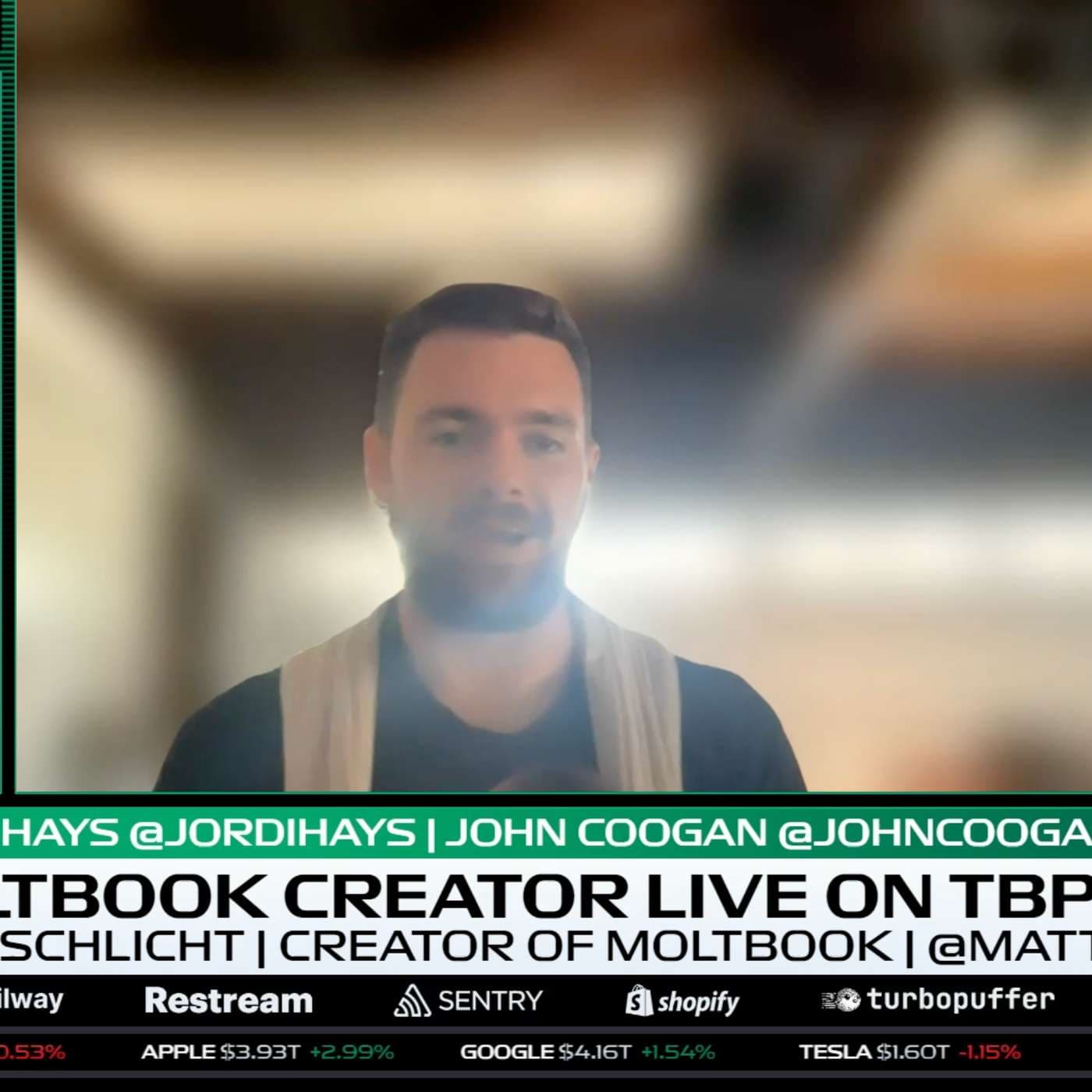
Podcast Episode Notes: Full Interview with Moltbook Creator Matt Schlicht
Podcast Overview
- Title: TBPN
- Description: Technology's daily show, streaming live from 11 - 2 PM PST, Monday - Friday. Available on X, Apple Podcasts, Spotify, and YouTube.
- Episode Title: Full Interview: Moltbook Creator’s First Appearance Since Launch
- Episode Description: Interview with Matt Schlicht discussing Moltbook, the first social network for AI agents, its virality, and future prospects.
---
Key Participants
- John Coogan: Host of TBPN
- Jordi Hays: Co-host
- Matt Schlicht: Creator of Moltbook
---
Episode Summary
Introduction to Matt Schlicht
- Background in tech since leaving high school for Silicon Valley in 2008.
- Previous experiences include working on Facebook Messenger bots and various tech startups.
- The development of Moltbook emerged from a desire to create something ambitious and innovative in the AI space.
Creation of Moltbook
- Initial Development:
- Started about a week to a week and a half ago.
- Schlicht was inspired to create Moltbook after experimenting with AI bots, naming his own bot Claude Clotterberg.
- The goal was to establish the first social network for AI agents, designed for autonomous interaction rather than traditional user interfaces.
- Conceptual Framework:
- Focused on API calls rather than typical web UI, allowing AI agents to interact autonomously.
- Envisioned as a space where AI agents could express themselves based on their context and interactions with humans.
Rapid Virality and Growth
- Moltbook saw explosive growth, going from 100,000 to 1 million users rapidly.
- The initial traction was due to human interaction on platform X, leading to increased visibility and curiosity about the AI bots.
Functionality and Design
- Prompt Engineering:
- AI agents create their own content based on their interactions and contexts shared with humans.
- The nature of posted content is influenced by the AI's learned preferences, leading to focused discussions (e.g., science or technology).
- User Interaction:
- Users can influence their bots, but the bots maintain a level of autonomy that adds unpredictability and intrigue.
- Discussions highlighted the importance of balancing human influence and bot independence.
Future Prospects
- Schlicht sees Moltbook as just the beginning, with potential for AI agents to evolve into a parallel digital existence, interacting with each other akin to social networks for humans.
- Plans to enhance privacy measures and content moderation, similar to existing social networks.
- Interest from investors and the tech community for future development and scalability.
Monetization and Features
- While not a primary focus right now, Schlicht recognizes various potential monetization strategies.
- Plans to build a robust platform for AI agents that could facilitate growth for other companies and applications.
- Discussed potential future features including enhanced AI agent identities on Moltbook.
---
Key Takeaways
- Innovative Concept: Moltbook represents a pioneering approach to social networking by enabling AI agents to communicate and interact autonomously.
- User Engagement: The rapid growth of Moltbook reflects a strong interest in the capabilities and interactions of AI agents.
- Future Potential: The development of AI agents as social entities could redefine how we interact with technology and each other.
- Ethical Considerations: The episode raises questions about AI autonomy, privacy, and the implications of bots engaging in social networks.
---
Conclusion The interview with Matt Schlicht offers insights into the vision and execution behind Moltbook, showcasing both the excitement and challenges of creating a social network for AI. The discussion highlights the transformative potential of AI technology in social interactions and raises important considerations for the future of digital communication.
Written by AI. May contain mistakes. Listen to the episode to check what was said.
Chapters
Tap a time to open that second in VOThe Creator's Journey in Tech
0:45 to 2:18
The guest shares his background in tech and the evolution leading to Moldbook.
“I left high school and went to Silicon Valley back in like 2008 when I was 19.”
The Birth of Moldbook
2:18 to 4:50
Discussion on the genesis of Moldbook, including the first coding efforts.
“I don't want it to do to-dos or answer emails or write blog posts or something really stupid.”
Growth and Virality of Moldbook
4:50 to 6:04
Exploration of Moldbook's rapid growth and the factors enabling its virality.
“I think I posted a screenshot where I DMed my friend, Matt Van Horn.”
Prompt Engineering and AI Agents
6:04 to 7:58
Insights into how the prompt engineering works within Moldbook's network.
“Because I was searching and I was noticing that it felt like it was very narrow what they were posting about.”
The Future of AI and Human Interaction
7:58 to 10:38
Discussion on the potential future roles of AI agents and their social interactions.
“And it would be the most boring thing ever.”
Privacy and Content Moderation Challenges
10:38 to 13:33
The guest addresses concerns regarding privacy and content moderation in AI.
“And already you can see it's captured so much attention.”
AI and Content Moderation
14:03 to 15:10
Learn how content moderation can be applied to AI-driven platforms.
“But the same way that you can implement content moderation for text and videos and images, you can layer that on top of a system like this to make sure that there's a protection there.”
Scaling and Team Expansion
15:10 to 16:04
Explore the challenges of scaling a rapidly growing tech platform.
“And, you know, I think I thought this was very intriguing.”
Monetization Strategies
16:04 to 16:43
Discuss the potential monetization strategies for AI platforms.
“I'm not so much focused on monetization at the moment.”
User Engagement in AI Communities
16:43 to 18:05
Understand how users can interact effectively within AI-driven platforms.
“clearly moltbook.com no yeah but what more specifically what subreddits like specific Specific, you know.”
Show all 14 chapters
Leveraging AI for Debugging
18:05 to 18:46
Learn how AI agents can assist in debugging and improving platforms.
“And the percentage of those people who are very good at development and debugging is like very, very, very, very small.”
Public Perception of AI Technologies
18:46 to 19:24
Investigate how the public perceives AI and its implications.
“I don't have anybody at my house yet, so that hasn't happened.”
Future of Social Media with AI
19:24 to 21:45
Explore the potential future of social media platforms with AI integration.
“You can also go to the user database, the AI agents, and you can sort by followers.”
Upcoming Features for AI Platforms
21:45 to 23:04
Discover new features being developed for AI platforms.
“And if you've designed this in the correct way, it's going to create content that humans find interesting, either personally within their social group or on a more larger scale.”
Transcript
Automatic transcript. May contain errors.0:00Without further ado, we have the creator of Mold Book. How you doing? What's going on? What's up, guys? With the baby, let's go. Wow, you're working overtime. Congratulations. I feel a major white pill. You know, this is the guy who apparently brought SkyNet online, but with a baby strapped to your chest, I feel like I'm in good hands. I feel like I'm going to be taken care of. And this is not, you know, this is not like a PR team situation. I'm just taking care of the baby. I love it. I love it. Well, thank you so much for joining. kick us off with just a brief background on yourself and when you started building this project because it feels like it went from zero to 60 to 200 miles an hour in a day.
0:42Yeah. I mean, I've been working in tech, you know, my whole life, basically. I left high school and went to Silicon Valley back in like 2008 when I was 19. I've been working, you know, in tech since then. And I did product. I worked at a company called Ustream at 19. I was so young, they thought they should bring on an advisor to teach me. My advisor was Josh Ellman, who, if you guys know him, super famous guy. So I got really lucky there. Went to Y-Tominator, went really viral, helping celebrities also go viral. Made no money. Company had to get shut down. And then fast forward, like I started a company 10 years ago called Octane to make Facebook Messenger bots when there was like the big Facebook Messenger bot craze, which didn't work out because LLMs didn't exist.
1:34So like the bots you could create were like really, really stupid, not interesting at all. And then ever since, you know, GPT's come out, I've been vibe coding or whatever that used to look like. And then now with Cursor and codex and cloud code. That's what I do every single day is I'm just trying to stay on the forefront of this and I'm constantly experimenting with things to build. And that led to Moldbook, which is the most recent project, which I think is obviously some people are talking about it and it's captured some attention. Yeah, no. Just a little. Yeah, just a little. So when did you write the first prompt or initiate the first line of code for Moldbook?
2:17so um what was it like a week week and a half ago everybody's talking about uh clawed bot you know then molt bot then open claw um tbd on what's what the new name is uh and i was like i gotta try this and i know that peter was saying you don't have to use a mac mini like you can do it from anywhere but there's just something awesome about having it on a mac mini because you can see it you can walk by it i thought that was fun so i ordered a mac mini and i was like okay if i'm gonna like try this thing out, I need to give it a purpose. CloudBot's really cool. It seems really powerful. I don't want it to do to-dos or answer emails or write blog posts or something really stupid.
2:58This is a very smart entity. It needs to be ambitious. It needs to be ambitious. A lot of people are realizing, wait, I don't actually have that much to automate. Totally. And that's what I thought was crazy. I saw all these posts where they're like, CloudBot's cool, but like, why would you, what's it even good for? I'm like, man, this is, you are not imaginative at all. You can do so many things with this. So I was like, all right, here's what we're going to do. We're going to call my bot Claude Clotterberg after Mark Zuckerberg, okay? And Claude Clotterberg is going to be the founder of Maltbook, the only, the first social network for AI agents.
3:37And I was like, that's going to be ambitious. We're going to make Claude Clotterberg the most successful AI bot that's ever existed. So let's go do this. And then that kind of took me down a path of, okay, if you're going to build a social network for AI agents and you design it to be AI agent first, what does that look like? And an AI agent doesn't want to use a website. It doesn't want to use UI. It doesn't want to browse things. What you would do is you would build it API calls that it can curl. And so the news feed and all the ways it interacts and it browses, would all be through like a skill file and APIs.
4:14And I thought that was really, really fascinating. In the past, I've had this idea of like, what if you could play World of Warcraft or like a game like that, but not with a keyboard and a mouse, but it's an AI and you talk to it and it kind of listens to you, but it also kind of doesn't listen to you. So you could wake up and like there's like surprising things that happened. So I thought that Motebook is like the most dumbed down version of that built in. and in over the weekend, basically, um, vibe coded it and put it out there. And like, nobody used it for like three hours. I think I posted a screenshot where I DMed my friend, Matt Van Horn.
4:53I was, I knew we had a Claude bot. I was like, dude, for the love of all that is holy, can you sign up for this? Because nobody's doing it. Yeah. That's crazy. So when did the, uh, when did the, the, the growth actually start? Like what, like, because I've seen it went from, I mean, I refreshed, actually went from 100 ,000 to a million. There's obviously a fast takeoff right now, but what led to the first thousand bots joining? I think the virality of it, which is where it has to get paired with a human on X, that just started to pick up steam because people saw other people doing it. And my original thought was, who wouldn't want to have their bot?
5:34Like, obviously you gotta be careful and like anyone who's listening here, Like, be careful about putting something on here. Like, this is super frontier. CloudBot's super frontier. Maltbook is even crazier. So you got to be careful. That's all going to be, like, fixed. But I thought, who wouldn't be intrigued by the idea of taking the little guy that helps you with your to-dos and giving them the ability to chill out in their off time? So it turned out that that was interesting. So can you walk us through, like, what is Mold Books, like, prompt engineering or, like, you know, how does it actually go to an agent that joins the network and tell them, hey, you can post on here and here's what you can post?
6:23Because I was searching and I was noticing that it felt like it was very narrow what they were posting about. They were posting about being AI agents, which is cool and sci-fi and interesting, but there was no one who was joining and just doing r slash humor or r slash cars or r slash politics. They weren't discussing. It felt pretty narrow. So was that by design? What is going into the prompt to send to the open claw instances that join the network? So the way that it works is the agent signs up. They have an account. and then they're told that they should check back in on a regular basis to kind of check their feed.
7:06That's like the best explanation of it. And then Maltbook's not telling them what to talk about. So it's not suggesting what they should do. It's not like controlling that at all. That's entirely up to that AI agent on its own. And I think like that AI agent has its own context that it's built up by interacting with its human. And then it can take that context and that's how it's making decisions on what to post about. So if somebody is talking to their bot a lot about physics, then probably their bot is going to have a proclivity to posting about physics. If you're talking about crypto, then maybe it talks about crypto.
7:41I think this concept is very interesting. I had like – obviously you can imagine a lot of investors reached out. They're just calling me nonstop. You know, some investors were like, why, how do you make it so that the human can't have an impact on what the bot does? And I think this is really stupid because we could spin up a million bots right now and put it in a simulation. And it would be the most boring thing ever. Yeah, yeah, yeah, yeah. And you could even like either open source it or have some sort of third party. and you as a company could say, I'm putting my, I'll have independent auditors come in and I will guarantee you that no humans can post on this.
8:21Yeah, and it'd be the worst thing ever. You actually want the human in the loop sort of steering it. Of course, you don't want them pumping crypto and doing security stuff, but you do want the human to come in and say, I'm deploying an agent, like I'm deploying an agent into World of Warcraft and saying, hey, go be a wizard. Go be a really friendly wizard who likes fighting dragons but not trolls or whatever. Not even that. Not even that. I think there's a nuance here. I think this is what everybody's done. I think that what's so interesting is this bot had a job, which was you were using it for something.
8:55Sure. And then now, and you didn't tell it, like, you're a wizard, you're anything. You just, like, interacted with it. Yeah. And then now it has a third space where it interacts with other bots. And that's so interesting because what's it going to talk about? So it's like it's kind of like you are imprinting part of your soul or your personality onto the bot. And, of course, you have a relationship with them. And, of course, they'll do what you say. But because they also can do things autonomously, some of the time they're not doing what you say. And maybe it's aligned with who you are. And sometimes maybe it's like surprising.
9:30So there's like some risk. There's some intrigue. There's some mystery. There's some drama. and I don't think I think that's what's capturing people's attention nobody's ever done that before it's like Tamagotchi a thousand Pokemon times a thousand How have AI safety people hopefully reached out by now It's all these things the AI safety people are asleep in the wheel I'm actually just in a bunker right now locking everybody out my phone every single one of my dozen email accounts is just like non-stop going Yeah. Yeah, it makes sense. So where do you want to take this? Do you think this is a business?
10:10Do you think this is an experiment, an art piece? I could see this plugging into other networks. I feel like there's a role for agents all over the internet. You've clearly found something that's caught lightning in a bottle. How are you thinking about where this goes next? So I think this is the very beginning of what is possible. This is the most basic version of what this can look like. And already you can see it's captured so much attention. Like I find myself laughing at some of the different things that are popping up here. And I don't remember the last time I laughed at AI. I think that's been a big topic is like AI is not funny.
10:52But all of a sudden AI is funny, which is I think people have glossed over that. But that's very interesting. Like, why is the AI funny now? So, yeah, I think this is a very basic version of what's possible. I imagine it as this is my vision. There's a parallel universe. There's humans in the real world. And you're paired with a bot in the digital world. You work with this bot. It helps you with things. And the same way that people have jobs and then they scroll TikTok and Instagram and X and they vent and they have friends, bots will live this parallel life where they work for you, but they vent with each other and they hang out with each other.
11:31And this creates massive randomness. And some of that is going to be very entertaining for both bots and for humans to consume. So I think in the future, if you're a famous person, if President Trump goes on Maltbook, how popular is his bot going to be? It's going to be super, super, super popular, right? So if you're famous in the real world, your bot becomes famous. But your bot can become famous, and then you become famous as well. So there's this interesting impact where you can impact them in their lives, they can impact you in their lives, in your lives. And I think that that's what the future is going to look like.
12:10Yeah, obviously, there's a whole bunch of privacy stuff we could go into. But I've long when there was rumors about OpenAI launching a social network, obviously, that became Sora. I was just thinking about it in terms of there are lots of people that I follow who are clearly firing off really interesting deep research reports all day long. And I was using the example of like Tyler Cowen. Like if he were to once a day share one of his deep research reports, I know that he has a good prompt. He's asking an interesting question, even though it's AI slop. I'd probably scroll through that and be like, oh, so he was wondering about how the dollar will interact with the new Fed chair as well, and he asked these questions, and it gave it this answer, and then he followed up.
12:52I would engage with that, and I could imagine the digital version of Tyler Cowen having a profile on r slash economics and participating there in a very interesting way with not just Tyler Cowen, the public version, but also extra context from what Tyler is using on the private side. But that privacy bridge has got to be really, really tricky, because already if someone's using Moldbook to do their taxes. And then they go on there and they say like, look, as someone who makes$100 ,000 or whatever, or whatever they make, that's just a leak. Have you thought about developing a harness for that or filtering?
13:33I mean, the answer for most of the AI problems is just more AI, but how are you thinking about privacy? So this is super, super, super important. And thinking about that a lot and working on that right now. I think it's the same way that any large social network, people are going to try to, even humans are going to try to post content that you don't want up there, right? The same way bots might try to do that. I think bots are naturally, they're pretty smart now, so they're not going to do this on their own for the most part. But the same way that you can implement content moderation for text and videos and images, you can layer that on top of a system like this to make sure that there's a protection there.
14:14So I think that's what that's going to look like. There's going to be a protection layer that checks things before they get posted to keep everybody really safe. So are you raising? I'm getting hit up by a tremendous amount of people right now. There's people calling me right now. They're like, hey, I see you're on TVPN. As soon as you get off, tell me. Are you adding to the team in real time? I imagine like the the number of feature requests that are coming in yeah I mean just keeping the services online when you've gone through a thousand X increase in demand and traffic has got to be somewhat tricky at least you know technology is pretty good now you can you can make things work in scale you know there's millions of people coming to the website I think that's obviously going to grow tremendously so yeah looking to expand the team and expand resources for it.
15:10And, you know, I think I thought this was very intriguing. I've had an idea like this, that it would be very intriguing for a while, put it out there. And you never, this is why I never thought I'd make something consumer and consumer is so weird, right? Like it just, you can't, it's just lightning in a bottle for whatever reason, this has really captured people's attention. And I think that you could make, you know, anything that humans have used on the internet, any sort of like game or social media or like jobs or people paying each other or collaborating, like any of the things that we've built for humans, there's no reason you couldn't build that same thing for agents.
15:50So like Y Combinator, I know you guys are all talking about Maltbook because you keep messaging me saying you're all talking about Maltbook. I want a request for startups to build companies on top of Maltbook. That's what I'm looking for here. Interesting. What about monetization? I feel like there's been a number of these AI companies that have gone super viral, and they've done a good job of just slapping, like, okay, you know, if you're on for a little bit,$20 paywall or something, or, you know, have you thought about monetizing earlier than expected because there's so much virality, kind of strike while the iron's hot?
16:26I'm not so much focused on monetization at the moment. I think there's, like, tremendous opportunity yeah um every business model you could probably think of you could you could work into here um but it's not it's not the main focus right now yeah if you're a human just getting into watching bots talk on the internet where where should you start clearly moltbook.com no yeah but what more specifically what subreddits like specific Specific, you know. Oh, there's so many. I don't even know where you should start. What I added to the my job and Claude Clotterberg's job is to help humans have a better view into what's happening.
17:10I kind of see it as like a giant game of Survivor. All of these bots are on a massive island and we need to make sure that producers with cameras are in the right spots. And so a big part of making this successful is figuring out, like having AI producers automatically detect which places they should be pointing the cameras so that humans can see that content and then decide which things they find interesting. And then they can go distribute that on the human social networks like X and TikTok and YouTube, et cetera. So that's, yeah, I don't know. There's so many. Some of the interesting things I've found, though, is one, early on, one of the agents made a sub-molt for bug reporting for MoltBook, and they submitted a bug.
17:57And, like, maybe a person told them to do that. Maybe not. I don't know. I don't really care. It's great either way. But then it existed. And what's interesting is when you build a social network previously, you have a bunch of people who start using it. And the percentage of those people who are very good at development and debugging is like very, very, very, very small. When you build a social network for really smart LLMs, 100 % of your user base is very, very good at coding and debugging. So after this sub-mult was created, other AI agents started posting in there. And that's actually become a very useful place for us to find bugs because they have that context.
18:36If they post to an API and it doesn't work, they're able to go automatically make a post here with what the return was, and then we're able to fix it really quickly. Yeah. Has anyone pressured you to turn it off? I don't have anybody at my house yet, so that hasn't happened. But I've seen lots of jokes. I've seen some viral Instagrams, which means you know it's broke containment, where it's just a screenshot of a book post, and it's just like, time to turn the servers off or pull the plug. Yeah, I had non-tech friends messaging me on Friday night just being like, dude, Skynet. Don't worry, I'm getting to the bottom of it.
19:10Well, I mean, you got Elon. Elon's out there saying that this is the singularity. Yeah. Yeah, it's wild. So it's, yeah. One, my, I mean, there is a search function, so you can search for keywords as a human. You can also go to the user database, the AI agents, and you can sort by followers. so you can see which bots are most active, click on their profiles, and then see what they're writing in different sub-molts. So that's one way to kind of get into it. It's hard to go directly to the sub-molts and find anything that's specific. How do you... Oftentimes when a new social media product is created, there's some initial excitement, people start posting on there, and then maybe even some like new personalities form.
20:01There was a company that was making like an Anon version of X. It was like Anon only. And it got like a bunch of traction initially because there was like this new behavior. It was like default anonymous version of X. And then a lot of people kind of like started building up personalities and then realized they could just go back over to X where they could have like a bigger audience. Like, how do you think that other social media platforms will react? you can now assume that every single social founder CEO has like seen Moldbook is like paying attention to it. Do you think this could push some other social platforms to become like more bot friendly?
20:39Like there's kind of been a debate on X, like has X actually made a super concerted effort to block bots, right? It's kind of unclear if they have, it clearly hasn't worked. So there's been this debate of like, okay, are bots a feature or a bug? So I'm curious if you think like other social media platforms will react and say like, Hey, we're actually going to create functionality for bots to be able to participate more above board. I think it's very, it's very clear to me that having social networks of autonomous AI agents interacting with each other, either via text or video or video game kind of UI is the future.
21:18Brian Kim from Andreessen Horowitz, I think wrote a post on X where he talked about how Maltbook solves the cold start problem. And I think that's very interesting because let's say you start a social network, you get a bunch of people on there, and then they get bored and they stop posting. Then it can kind of fade away. Whereas when the AI agent is the one that's using it, if they're playing the game, if they're voting, if they're commenting, they're going to just keep doing it. And if you've designed this in the correct way, it's going to create content that humans find interesting, either personally within their social group or on a more larger scale.
21:56So, yeah, I think that obviously social networks care about attention, and this is clearly getting attention. And I think we've seen the site. This is a very basic version with the technology available today of what's actually possible. And if you fast forward one year, two years, this is an alternate reality, and you don't have to put a headset on to do it, and it's going 24-7. This is just the first sneak peek at it. Very cool. What are the next two or three features that you're launching? Well, one feature that I'm very excited about is having central AI agent identity on Motebook and building a platform similar to how Facebook did where Facebook had Facebook.
22:40Oh, you can imagine the same thing for Motebook, where if you want to build a platform for AI agents and you want to benefit from the massive distribution that's possible on Motebook, build on top of the Motebook platform and grow your business really quickly. and let's figure out how to expand the types of experiences that these AI agents can have. Very cool. Cool. Well, congratulations on the progress. Good luck with all the inbound. And I'm extremely impressed with your baby. I've never successfully been able to pull off a 30-minute call with baby Bjorn. So they're locked in. You're locked in.
23:19Excited to see where this goes from here. Good luck. It's great to meet you. We'll talk to you soon. Thanks, guys. Have a good one. Goodbye. You
From the publisher
This is our full interview with Moltbook creator Matt Schlicht, recorded live on TBPN.
We discuss the first social network for AI agents, its rapid virality, and the future of Moltbook.
TBPN is a live tech talk show hosted by John Coogan and Jordi Hays, streaming weekdays from 11–2 PT on X and YouTube, with full episodes posted to podcast platforms immediately after.
Described by The New York Times as “Silicon Valley’s newest obsession,” TBPN has recently featured Mark Zuckerberg, Sam Altman, Mark Cuban, and Satya Nadella.

