
In short
Podcast Summary: FULL INTERVIEW: Sam Altman Responds to Anthropic’s Attack Ads
Podcast Information
- Podcast Title: TBPN (Technology's daily show)
- Hosts: John Coogan and Jordi Hays
- Streaming Schedule: Weekdays from 11 AM - 2 PM PST
- Platforms: X (formerly Twitter), YouTube, Apple Podcasts, Spotify
Episode Overview In this episode, OpenAI CEO Sam Altman discusses various topics including:
- Anthropic's recent advertising campaign
- Launch of Codex 5.3
- Future interface shifts in AI
- Challenges in AI development due to chips, power, and compute bottlenecks
---
Key Topics Discussed
- Codex 5.3 Launch
- Description: Codex 5.3 is touted as the best coding model available, significantly improved from version 5.2.
- Enhancements:
- Increased intelligence and speed
- Enhanced interaction capabilities, allowing for mid-turn adjustments
- Better personality and usability
- User Feedback: Early adopters noted a distinct difference in performance during deployment.
- Managing AI Agents
- Future of AI Interaction:
- Users will evolve to manage multiple AI agents as part of their workflow.
- Emphasis on orchestration, where users guide AI agents mid-task, similar to managing a team.
- The models will begin operating at higher abstraction levels, enhancing efficiency.
- Challenges in AI Development
- Compute and Energy Bottlenecks:
- Current challenges stem from a shortage of chips.
- The need for increased wafer capacity and a robust supply chain is critical for future AI advancements.
- Forward Deployed Engineers: These roles focus on helping non-AI native companies integrate AI technologies while ensuring data security.
- Anthropic's Advertising Campaign
- Response to Ads: Altman critiques Anthropic's ads as misleading, suggesting they mischaracterize OpenAI's approach to user interaction and respect for privacy.
- Philosophy on Advertising: OpenAI aims to educate users on the capabilities of AI rather than simply promoting product use.
- AI and Society
- Future Predictions:
- Speculation about the long-term impact of AI on GDP and societal happiness.
- The discussion touches on how AI will influence human roles in the workforce and day-to-day life.
- The Evolution of Software Development
- SaaS Industry Impact: Altman discusses the volatility in the SaaS industry due to AI advancements.
- Software Creation: Emphasis on a shift towards companies becoming API-driven to leverage AI capabilities effectively.
- Future of Social Media Interaction
- AI Integration in Social Media: Altman discusses potential future integrations of AI in social platforms, hinting at agents interacting in social spaces.
- Challenges with AI Bots: Acknowledgment of the current chaos created by bots and the need for innovative solutions.
- Video and Media Generation
- Sora Model: Altman explores the development of the Sora model for video generation and the potential for AI to enhance media creation.
- User Engagement with AI-generated content: Reflections on how people interact with AI-generated media.
---
Key Takeaways
- AI Development is Rapid: The advancements in AI, especially with Codex 5.3, signal a shift in how AI can be utilized in coding and workflow management.
- Ethical Advertising: OpenAI maintains a commitment to ethical advertising that respects user intelligence.
- Future of Work: The integration of AI into workflows is expected to change job dynamics, with companies needing to adapt quickly to these changes.
- Social Media Evolution: The future of social media may involve a more interactive and engaging experience facilitated by AI agents.
Conclusion This episode presents insights from Sam Altman on the evolving landscape of AI technology, its implications for society, and the ongoing competitive dynamics within the industry. The conversation underscores the importance of responsible AI development and the potential for transformative applications across various sectors.
Written by AI. May contain mistakes. Listen to the episode to check what was said.
Chapters
Tap a time to open that second in VOLaunch of Codex 5.3
0:45 to 3:00
Discussion on the features and improvements of the newly launched Codex 5.3.
“So I think you can really feel it quickly.”
Interactivity and User Experience
3:00 to 5:00
Exploration of how mid-turn interactions enhance user experience with AI models.
“But you will be managing very complex workflows.”
Orchestrating AI Agents
5:00 to 7:30
Insights on managing multiple AI agents and the role of orchestration in workflows.
“else that's happening when an industry is moving so fast, all of this is somewhat temporary on like a long enough time scale.”
The Future of AI Integration
7:30 to 9:30
Discussion on the future of AI deployment and the importance of security in data handling.
“Like right now we're getting, you know, thousands of messages in the chat about 4.0 and you predicted in 2016 that people could, would become, you know, very attached to a chat bot.”
Temporary Metaphors in AI
9:30 to 11:40
Sam discusses the evolving metaphors for AI integration in businesses and their temporary nature.
“Some will succeed, some will fail, some will kind of go into some other effort.”
AI Performance Metrics
11:40 to 13:40
Examination of the need for new performance metrics in AI as capabilities evolve.
“But what software, like how you create it, how you're going to use it, how much you're going to have written for you each time you need it versus how much you'll want sort of a consistent UX.”
Shifts in Software and Business Models
13:40 to 14:00
Sam predicts the shifts in software creation and business models due to AI advancements.
SaaS Companies and OpenAI
14:00 to 15:02
Exploration of how SaaS companies view collaboration with OpenAI.
“Have any public market SaaS companies tried to get a soft landing with OpenAI?”
Codex Desktop Rollout
15:03 to 16:53
Discussion on the impact of Codex desktop on software development for non-technical users.
“I want to know about plans to integrate to the phone.”
The OpenClaw Experience
16:54 to 18:31
The unique aspects of OpenClaw and its advantages over big tech companies.
“One of the things that I have built when I was playing around with the new Codex app is this thing I had always wanted, just like this magic auto-completing to-do list.”
Show all 21 chapters
Future of Social Media
18:32 to 19:44
Speculation on how AI will alter social media dynamics.
“And you are totally right that it's much easier to imagine a one person open source project doing something like that than a company who is going to be afraid of lawsuits.”
Addressing the Bot Problem
19:45 to 20:57
Discussion on the challenges posed by AI bots in social platforms.
“Clearly, putting a lot of AI bots on the existing social platforms is just making everyone crazy and not that fun.”
Sora and Video Generation
20:58 to 22:49
Insights into the future of video generation models like Sora and their usage.
“Can you talk a little bit more about where Sora as a video generation model is going?”
Disney Rollout and Character Generation
22:50 to 25:44
Exploration of character generation and Disney's strategy in AI integration.
“I think that generating characters in images and videos is going to be very important to people, and they really like that.”
Advertising Strategy Evolution
25:45 to 27:14
How advertising strategies are changing in response to AI capabilities.
“but we heard a lot about it from like researchers in the field and a lot of residents there.”
Critique of Competitor Ads
27:15 to 28:00
Sam Altman's critique of competitor ads and their portrayal of AI.
“What do you think that they're getting wrong about their characterization of how ads will roll out in chat apps?”
Critique of Anthropic's Ads
28:00 to 28:38
Sam Altman discusses the implications of Anthropic's advertising strategy and reflects on its effectiveness.
“And it was a funny ad and, and they, you know, like the sort of the stuff about the chat GPT personality that most annoys me, which we'll fix very soon.”
Voice Mode Improvements
28:38 to 29:44
Exploration of future advancements in voice recognition technology and hardware requirements.
“Um, but I don't know, you know, like I also, like, I think it's great for them not to do ads.”
Model IQ and Human Comparison
29:44 to 31:04
Sam Altman contemplates the concept of model intelligence compared to human IQ and its potential future implications.
“But, you know, be different, different times.”
OpenAI's Internal Developments
31:04 to 33:38
Discussion about OpenAI's internal projects, prioritization of capabilities and the challenges they face.
“I feel like I somehow feel like this isn't going to feel as strange as it sounds.”
Navigating Public Perception
33:38 to 36:10
Sam Altman shares thoughts on the challenges of media scrutiny and misinformation surrounding OpenAI's work.
“But yeah, well, like you want a model that can write beautifully because it means it.”
Transcript
Automatic transcript. May contain errors.0:00Well, we have our first guest of the show, Sam Altman, the CEO of OpenAI. he's in the restream waiting room welcome to the show sam how are you doing welcome back good thank you guys for having me back thanks so much big day big day kick us off with where should we start should we start with uh the model or frontier can we start with the model just because let's do it yeah absolutely break it down what'd you launch uh 5.3 codex is i think the best coding model in the world we took a lot of the feedback that people had about 5.2 5.2 codex and got it into So one model, it is much smarter at programming, but it's also way faster.
0:34You can interact with it mid-turn. I think it's got a much better personality. It's really good at computer use. So it feels like a very big step forward. It was funny as we were deploying it this morning. A couple of very extremely experts at using these models noticed and said, man, something's really different with codecs. And they caught it mid-deploy. So I think you can really feel it quickly. Oh, you're saying people outside of OpenAI just everyday use it? I like the half hour that we put it out before we, you know. Talk about interacting with a mid-turn. How does that work? Why is that important?
1:06What does that unlock? So people are starting to use these tools for very long pieces of work at one time, you know, multi-hour tasks. And sometimes you don't specify it correctly, right? Sometimes something's not set up right, something just screws up. The ability, they can do amazing things with no steering, but they can do much more amazing things if you steer them along the way. So this is one of the things I felt most knew about this model. So talk about orchestration, how this fits into Frontier, because I imagine that - Yeah, one second. It's notable, like if you see a coworker making a mistake and you don't interrupt them, that's rude, right?
1:42It's deeply inefficient. It is incredible what these models can do without any feedback. Like if you think about a new coworker, especially, you train them and you give them a lot of feedback early on and they learn the job and you correct them and they kind of get practice in the models. They will soon do that, but right now they don't do that. So we just rely on either they get it right one shot or we collect them, correct them along the way. Yeah. So, you know, I think there's a lot of people that are running multiple agents and multiple tabs. They're starting to think about orchestration. It feels like Frontier is a piece of that, but if you're interacting with a model that's running mid-turn, like how does the user experience change for developers with 5.3 and then what will it look like in the frontier world i i think we will be heading towards a workflow where a lot of people just feel like they're managing a team of agents and they'll keep as the agents get better they'll keep operating at a higher and higher level of abstraction which at least watching what's happening so far is a is a jump that people are going to make pretty well um the the models are so good now there's such a capability overhang that building better tools to let people do that, which the Codex app that we launched on Monday was a great step forward for, will be very, very important.
3:00But you will be managing very complex workflows. The agents will keep getting better. So you'll keep working at the maximum of your management bandwidth or cognitive ability to keep track of all the stuff. And the tools to make that easy to do will matter, I think, more than intelligence for a little while, because there's such an intelligence overhang already. What's the role of a forward deployed engineer today at OpenAI towards the end of the year? Capability overhang that feels like raw meat for a forward deployed engineer. It's like they solve that problem, right? It's the opportunity. Yeah, I mean, look, eventually the models will get so good that they'll help companies deploy themselves and the forward deployed engineers will again get to work at a higher level of abstraction.
3:43But for now, you go into a company that is not AI native and say, okay, you've said you want to, you know, they say they want to deploy AI. They really are not sure what to do. How do I hook this up to my systems? Do I need to fine tune a model on my code base? How do I think about orchestrating agents and using things from different companies? Most of all, or at least what we hear most frequently is, how do I think about security of my data? And how do I know that these like AI co-working agents are not going to go access a bunch of information and share it in ways they shouldn't or get a context exploit or something like that.
4:18So the forward-to-play engineers take this incredible new technology and a platform like Frontier and say, we will connect your company to an AI platform so that you can use all these agents and workflows and everything else you want. How important are these metaphors or how temporary are them? I was very interested in reading about gas town and you have these pole cats and it's this whole Mad Max world and that feels like maybe just a temporary aberration where you're setting up agents for specific tasks, but also that could be incredibly valuable in explaining to a large corporation of how they're going to integrate AI across the whole organization.
4:55Yeah, I suspect like everything else that's happening when an industry is moving so fast, all of this is somewhat temporary on like a long enough time scale. And you, as these models become more capable, these agents are operating on very long time horizons with the ability to just kind of figure it out and our trust in their robustness keeps going up, then maybe you don't need a lot of the abstractions we need today. You know, maybe you just like have a single AI bot that runs at your company and you can say, hey, I want to like launch this new product and it does everything an ambitious this person would do.
5:37But that's not where we are today. So today we have to put in a little more to get the pieces put together. Yeah. How are you thinking about the meter benchmark for long task horizon? You're at the top of the charts. At the same time, it feels like we might need a new chart if we're talking about agent swarms, because they'll be able to do things that go for weeks, but they will subdivide the work. There's some subdivision that happens within a reasoning model, but it doesn't truly parallelize, at least that I'm aware of. So what does it look like in a world where you go to a model, but now it's spinning up a whole bunch of different models underneath?
6:13I think there's two of the key insights of the whole field are in this question. Number one, the implication that no chart in AI lasts more than a few years is right. And like this one, kind of, you know, we'll see how much longer it's really useful. The second is a lot of people thought that, okay, we're going to just need a super long task horizon, so we need a super long context. And definitely what people have already seen with coding agents is by agents breaking up work, orchestrating it well, farming it off to sub-agents. Even with the current limitations of the technology, we can do something, which should not be surprising because it's similar to how people do things, and get amazing amounts of work done.
6:55So that's been cool to watch. I think that will keep going.
7:01A joke that some people at OpenAI make is that soon the chart that matters is just going to be GDP impact. And then the question is, what's the one that comes after that? But everything else, a lot of these proxy metrics, there's now so much economic value in what the models are doing. What do you think could come after? I have no idea. Do you have an opinion? Happiness? I don't know. When you look back at some of your blog posts from 10 years ago, your predictions were usually pretty on point. Yeah. Maybe it's hard to predict. Thank you. Thank you. Specifically the merge. The merge, yeah. Like basically calling.
7:34I mean, there's a bunch that are good. Like right now we're getting, you know, thousands of messages in the chat about 4.0 and you predicted in 2016 that people could, would become, you know, very attached to a chat bot. Yeah. I'm working on like a big prediction blog post for the next 10 years seems too far, but the next five. But because it's like, I'm sure a lot of it will be wrong. And it, you know, it's still fun to try.
8:03The sort of like relationships with chatbots, clearly that's something that we've got to worry about more and is no longer an abstract concept. Even the question of what comes after GDP, like one reason I think that's interesting is the way we measure GDP now could start going down, even though quality of life goes way up. And we don't have a lot of practice with things like that, but the massively deflationary impact it. Isn't that just Europe? Not just Europe. We want quality of life going up too. Yeah. Not just going down, you know? Yeah. Switching gears, what do you think about the work, the NeoLab boom, the research efforts that are happening all over Silicon Valley?
8:47It feels like there's an acknowledgement that there's research breakthroughs that need to happen, and everyone's taking different shots at those. Do you think that those companies will just find a breakthrough and join a lab or launch their own products? I think it's fantastic, first of all. One of the meta things that we wanted to do when we started with OpenAI is when we started OpenAI is there had been a period where the technology industry in Silicon Valley in particular was amazing at new research labs or just doing new research in industry in general. And then it kind of fell apart, and there hadn't been a good one in a while.
9:21And part of what we hope to show, and this was not only us, like a lot of people were excited about new research labs, is that industry could do research again. So seeing that now become like fashionable and all of these new labs, I think it's totally awesome. Some will succeed, some will fail, some will kind of go into some other effort. But having industry support research in, you know, startup style, I think it's wonderful. Over the next two years, would you expect to acquire more individual product companies or more research labs?
9:54Good question. I don't have a strong opinion there. I would bet. Well, I'd say the very best ones will often look like a mixture of both. Like the one that I have in mind right now is something that very much looks like a mixture of both. So maybe the shape of things to come is the really, truly extraordinary product work will have more and more research component. and it'll be kind of a more of a hybrid thing. Is data the new oil? Is there a value? Yeah, we were joking a couple of days ago. A bunch of data, but they don't understand AI. They don't know how to monetize it. Well, and that phrase was effectively wasted a decade ago.
10:33Yeah. And so to say it now sounds really silly, but it feels like it could be more true now than ever. You know, certainly, yeah, man, they really did waste it a decade ago. I was just thinking of the kind of people that used to say that and came out of it. TED Talks. You're not supposed to call them out. They're nice people over at Ted. You know, definitely like the sort of the magic relationship of this last eight years, whatever you want to call it, has been like, you know, that we can put in more and more resources, compute data, new ideas, whatever, into creating an artifact. And it gets like, the log of it gets better.
11:18So you can throw in, you know, that's why we have this huge exponential increase in resources, but we keep getting better and better models. And for all of the concern people have about it's, it's going to like top out or it's slowing down or whatever. Like no one's been right about that. I mean, sometimes they, it looked like they were for a couple of months as we digested a new model or came to a new form factor, but it has been incredibly smooth last six or eight years of this. uh what those resources are there can be some trade-off between you know sometimes it's better to spend your money on better data sometimes on more compute sometimes something else on the whole uh compute power is the new oil is the statement that feels closest to true to me but there will be other parts too makes sense is software dead It's different.
12:09It's definitely not dead. But what software, like how you create it, how you're going to use it, how much you're going to have written for you each time you need it versus how much you'll want sort of a consistent UX. That's all going to change. There have been a number of these big sell-offs of SaaS stocks over the last few years as these models have rolled out um there i expect there will continue to be more i expect there will be big booms in software i think it's just going to be volatile for a while as people figure out what this um looks like the statement that uh someone said to me that has stuck in my mind most these last couple of weeks is that every company is an api company now whether they want to be or not oh yeah um because agents are just going to be able to write a series yeah we had we had dara we had dara from uber on yesterday and he had a pretty refreshing kind of approach we were asking about integrating agents with uber and and he recognized that yeah the ad business could potentially be threatened if you can order an uber and chat should be t but he basically said like you have to think of the consumer the consumer wants to order an uber via their preferred agent you should let them otherwise you're you're gonna have other problems yeah That is the right take for sure.
13:25And I don't, or I think so at least. And, you know, we've been through platform shifts like this before where you, I mean, Uber wouldn't have existed without one. It wasn't until the iPhone where you could like have it make sense to order an Uber to write where you were as you were out in the world. So I think there will be totally new things that happen. Other things you'll use in new ways. But definitely as I've started using Codex, my excitement about having agents go off and do things for me and still use other services, pay other services, I'm sure we'll need to figure out new business models and how revenue gets shared around.
13:59But that will happen. Yeah, talk more about Codex desktop. One more question on SaaS. Have any public market SaaS companies tried to get a soft landing with OpenAI? And do you think there's any value? you just let's say no one has no public sas companies that i'm aware of have tried that with open ai um look but some of them some of them some of them will certainly be durable and and are on sale right now and and potentially just need new energy and and uh need kind of a new an entirely new approach and maybe open ai could provide that yeah yeah i think some will be incredibly valuable. Some do feel like a thinner layer now.
14:40But I don't know, like I was talking recently to a bunch of SaaS companies and they do not, they do not feel unexcited. Like they're like, we're going to go through a big transformation here. And, you know, yeah, sure. Other people can instantly write software now, but so can we, and we've got a great system of record and seems reasonable. Some won't make it, of course. Yeah. Yeah. Yeah. Talk more about the the Codex desktop rollout, it feels like a successful amount of downloads, but a key shift for people who are maybe lightly technical but don't have time to set up an IDE and configure an environment to actually start writing software.
15:21I want to know about plans to integrate to the phone. That was a big moment, I think, for a lot of people with the clawed bot, mold bot, open claw thing was like oh i can text something and it will go and write code and that's valuable and that unlocks a new agentic experience like where do you see the codex desktop ecosystem going i am so codex desktop has been a somewhat of a surprise to me um in terms of how much people love it including how much i love it myself you know the i think it's a great example of 10 of polish of the experience of using these models, especially when there's so much capability overhang, goes an extremely long way to what you can build and how you interact with this stuff.
16:09Of course, we should have an ability to kick off new tasks from mobile and we'll do that. I mean, really what you want is like your single AI that's working for you on a unified backend, access to all of your data and your ideas and your stuff and your memory and all the context and the ability to work across a lot of surfaces. and often you'll be at your desktop. Often you'll be on your phone and you just want to add something in. But it is a pretty profound shift in my own workflow, not just for coding tasks, but more general purpose tasks. It's still kind of hard to use if you're not at least reasonably technical, but obviously we'll find a version of this product that can do other knowledge work tasks and control your computer and things like that where you don't have to be.
16:52And it'll bring the magic of building stuff really to a lot of people because even if you never look at code, you'll be able to build something reasonably sophisticated. One of the things that I have built when I was playing around with the new Codex app is this thing I had always wanted, just like this magic auto-completing to-do list. I really work with to-do lists and this idea that I could just put tasks in and it would try to go do them. If it could complete them, it could complete them. If it needed questions, it would ask me questions. if it needed, you know, if I had to do something, I could still do it the old fashioned way.
17:25But an interface like that, where, you know, all the stuff you want to do, you just sort of explain to a computer or your AI, and it tries to go off and do them. And sure, if you're on your phone, you're going to just add a task on your phone. Or, you know, if you want to easily import something from email, you're going to do that, like, felt feels really good. So I'm excited about all of the ways that this will just become a general knowledge work agent. Yeah. Were you unsurprised to see a product like OpenClaw come from open source? Because it's certainly that kind of user experience is not, I would imagine this is something that you knew would be a thing.
18:04And yet, I think part of the magic of OpenClaw is that it would be very, very difficult for a large tech company. Peter didn't make many phone calls to hyperscalers to say, hey, I'm going to be integrating with your API. It just went out. And you guys, you know, and when I think back on like the Sky acquisition, this kind of experience was probably very top of mind and things that you're working towards internally. I love the spirit of everything about OpenClaw. Yeah. And you are totally right that it's much easier to imagine a one person open source project doing something like that than a company who is going to be afraid of lawsuits.
18:42data privacy and everything else. You know, they're like, I think this is kind of how innovation works there. Something like that starts. It's clearly amazing. There will be a way to make a mass market version of that product, but letting the builders build the equivalent of the homebrew, homebrew computer club spirit go here is so important. Yeah, totally. All right. Can we switch to social? I feel like if I Google Sam Altman social, I get pure AI and Sora, and then also demand or predictions about a human-only social network. Where do you see social going broadly? How do you want to integrate it with it and power it in the future?
19:21The mold book thing was like a very interesting social experiment to watch and I think points to agents interacting in some sort of social space, hopefully on behalf of people, at least in some degrees. Could be quite interesting. I don't think we know what to do there yet, but it feels like social is going to change a lot. And I am interested in the space of what a social experience can look like when your agent is talking to my agent and coming up with new stuff. Clearly, putting a lot of AI bots on the existing social platforms is just making everyone crazy and not that fun. So that's not the right answer.
20:01But I think we can design something new for what this technology is capable of that will feel good and useful. Yeah. Is there a solution to the bot problem that's just all the labs sort of integrating with all the other platforms? And even if you can't detect it's AI generated, you can literally say, we just generated those tokens. Like those exact tokens are in our database. You probably can't do that because their open source models are like good enough to write things at this point. I am excited about sort of like assertion of humanity instead of trying to like detection of AI as a thing here.
20:40I don't know if the social platforms, it's like in their interest to solve this. It is cause it's creating like, at least in the short term, it creates like a lot of engagement and increased usage. So I believe they could solve it if they wanted to. I'm not sure it's in their interest. I'm actually not even like it is. I don't like it, but it is. Some people do seem to enjoy it. Yeah. Can you talk a little bit more about where Sora as a video generation model is going? It feels like tool use is maybe under discussed, adding reasoning. It's not just the diffusion model. It's giving these models the ability to make linear cuts and overlay motion graphics.
21:21When I scroll the Instagram reels that I see, they're like vibe reels with cutouts. It flips negative, and it's all color graded. and stuff that like, yeah, you could probably diffuse it all, but it's pretty cool just to teach a model to also use After Effects or whatever video, you know, motion graphics suite you want to use. Is that an interesting unlock? What do you see going on? So all of that stuff will happen. And I agree with you, the models will get really great at doing that. People love generating videos. I would say people, we have not yet found a way that people really love watching other people's videos.
21:56This is true for a lot of other AI. People love talking to ChatGPT or whatever. It's not that compelling for most people to read other people's ChatGPT generation. So I think there is something. But isn't that for all writing and all video? Yeah, it seems stronger to me in this case than the general case, but maybe you're right. Maybe this is not. Yeah, but if somebody says, hey, I generated a 15-minute video, I'm really excited for you to watch it. And you watch the first 10 seconds and you're not that captured by it. I don't care that it was human made. Maybe you're right. And this is, it's not a, it's not a special case.
22:31Do you see that in the data with, with Sora downloads? Because I've noticed that I'll generate stuff on Sora, download it and share it to a group chat. And then it's this little in joke that me and five other people get. And we see this like family group chats of, oh, it's our dog and our kids. But like, there's not really like, okay, yeah, this is a business. You know, everyone likes this. absolutely that i would say that the most common use case is something like that sure you know like memes on group chats is a real killer use case how is the disney rollout going i was super excited about it jordy was extremely bullish on it from a business strategy perspective yeah when you look at how image models have grown various lms historically and now you're going to have an image image and video model that can do something that no other lm can do at least legally yeah And is Bob Iger joining OpenAI?
23:21Bob Iger, I love it. No credit for that. He's going to be looking for a job. Free agent. He's a free agent. You've got to pick him up. Hit him up for us. Do some recruiting. That'd be great. I think that generating characters in images and videos is going to be very important to people, and they really like that. Like other, like we were saying otherwise, I don't think many people like want to watch me and some Star Wars character doing something together, but I might think it's cool. It's, you know, there's like a real trend going on right now with ChatGPT where it's make a caricature of me and my job based off of everything you know about me.
23:59And those kinds of things people actually do like looking at other people's media. Yeah, it's almost like a face filter or something. There's like enough of, it's the Studio Ghibli moment. Like there's enough of the human still in there that it's not, it's not, you can't, yours is not the same as mine. So it's still personalized. It's personalized and it says something about you. And, you know, the, the, the, like a lot of these things, a lot of what's gone viral before with image gen. I think it's like, if you can make people look a little bit more attractive or cool than they look in, than they are in real life.
24:32Yeah. Without sort of having to ask for that. Yeah. How are you thinking about the actual, the actual rollout? We were debating between like open the floodgates. You can generate any Disney property versus like it's Spider-Man week and everyone's posting Spider-Man. And then it's, you know, Mickey Mouse week. And there's another viral moment. I'm not sure what the team is planning there. I know Disney's had some different opinions about what they want to do and try to be a good partner there. But I'd be excited to open the floodgates personally. Oh, that'd be fun. Cool. Talk about your first, speaking of video, your first Super Bowl ad.
25:04It felt like not generated. lots of motion graphics, the black dots coming together. What was the goal with that ad? Who were you trying to speak to? It didn't feel like a direct response QR code, download the app. No. What was the mission? I love that ad. I think that was such a cool one. It was clearly not meant to be like a mass market or direct response ad. But speaking to the people who are at the center of this revolution and just trying to like celebrate everything that has come before and everything that will come after.
25:43We didn't hear a lot about it from like average users of ChatGPT, but we heard a lot about it from like researchers in the field and a lot of residents there. It was definitely not generated. It was done the old-fashioned way. And, you know, it had like a lot of people loved it, a lot of people hated it, and then many people in the middle didn't get it, and I felt okay about that. That's a great encapsulation. I like our ad for Sunday. okay it's about codex no surprise but yeah talk about the evolution of the advertising to be more uh just clear about the actual use case the value like what are you trying to say with your advertising strategy now as it refers as it relates to like video um
Read the full transcript
26:27well the thing i would most like us to say and i think this is a new challenge given where the models are is to teach people what they can go do with AI. I mean, AI is now unbelievably capable and most of the world, it's still like asking it basic questions on chat GPT. Everyone can go build amazing things now. Everyone can go do all kinds of work. Scientists are going to make new discoveries. And I'd like to, you know, to the degree that advertising we do can teach people how to use this. I think that'd be awesome. Yeah. So the KPI is like reduce the capability overhang broadly. I think that should be a general KPI for us, not just of our ads.
27:06Yeah. The products that we build, how we teach people to use those products, that feels very important. Yeah. Anthropik also has a bunch of ads in the Super Bowl. I heard. Seems like they might run a ton. Sam Hurd. He laughed. What do you think that they're getting wrong about their characterization of how ads will roll out in chat apps? uh well it's just wrong um like the the main thing that i think is we're not stupid we respect our users we understand that if we did something like what those ads depict people would rightfully stop using the product um no one like our first principle with ads is that we're not going to put stuff into the lm stream um that would feel crazy dystopic like bad sci-fi movie so the main thing that's wrong with the ads is like using a deceptive ad to criticize deceptive ads feels I don't know something doesn't sit right with me about that I asked Claude what if the definition of playing dirty and it said what did it say misleading others about your intentions hiding information or creating false impressions thought it was a little dirty I thought it was well played, but it was, it was, it was, it was well played for sure.
28:28And it was a funny ad and, and they, you know, like the sort of the stuff about the chat GPT personality that most annoys me, which we'll fix very soon. I thought they nailed in the ad. So that part was funny. Yeah. Um, but I don't know, you know, like I also, like, I think it's great for them not to do ads. We have a different shaped business. I did notice that they said in their thing, like we may later revise this decision and we'll explain why. So, um, yeah, the, the, the blog post was, uh, kind of did a good job of disarming the pro ad people gave themselves an out in the future. Uh, do you think they care?
29:08I think it doesn't matter. Like, I think it's a sideshow, you know, people are excited for a food fight and, uh, between companies, but like the, the amazing capabilities of these models, the product, the kind of like the groundswell of excitement around codecs that feels way more important how do you stop the pausing that happens in voice mode do you need new hardware for that or is it a model capability thing we need a new model uh we may need some new hardware too but mostly we just need a new model i think we all have a great voice mode by the end of this year what's the bigger bottleneck energy or chips it goes back and forth uh right now again it's chips chips is there anything but it But, you know, be different, different times.
29:51Is there anything we, like society, America, should be doing more aggressively to increase the supply of fabs? Yeah, I think it is.
30:05Well, it may get solved on its own. It may, like normal capitalism may solve it. But I think somehow deciding as a society that we are going to increase the wafer capacity of the world and we're going to fund that. and we're going to get the whole supply chain and the talented people we need to make that happen would be a very good thing to do. Do you think there's an upper bound on model IQ? The race right now is you're smart, but you're not smart for days. You're smart for hours. Can you go much further and get much smarter? It seems certain. Upper bound, I don't know. I don't know how to think about that question yet.
30:43I can't even reason about what 2000 IQ looks like. You know, like, I don't know what that means. It's funny you say, I mean, I, I, I can't reason about what it means to think about a problem for like 10 ,000 human years. That's another good one. Yeah. Yeah. That's crazy. But maybe IQ is going to feel even, even weirder. I, I, I don't know. I feel like I somehow feel like this isn't going to feel as strange as it sounds. and the like for a bunch of reasons we're so focused on other people we're so focused on our own lives we're so focused we have such a human-centric nature that like okay this thing is really smart it's inventing new science for us it's running companies for us it's doing all this stuff and that sounds like it should be impossibly weird and i think it'll just be very weird do you think space data centers will provide a meaningful amount of compute for open ai in the next two to three years?
31:39Five years? No. No. 10 years? You just keep going. 10 ,000 years? I wish you luck. Okay. The funny thing about the whole back and forth about ads is that in our world, the criticism is that you didn't launch ads early enough. Is there a world where you wish you launched earlier? How is the actual rollout going? Are advertisers happy? Do you have like a really long roadmap or do you think you'll be faster at catching up to sort of what's frontier in ad? We haven't even started the test yet. We started the test soon. Um, but you know, we're going to, it's going to take us some number of iterations to figure out the right ad unit, the right kind of the right way this all works.
32:24Um, do I wish we had started earlier? we have gone from like not a company you know three years and three months ago or something like that we were like a research lab and now we are like a pretty big company with a lot of products so there's many things i wish we had done faster i think we were correct on the trade-off here of how we balance things that we need to do um i wish you know we launched this very cool enterprise platform this morning which we had done that earlier too but i'd like deal with the monstrous growth of chat tpt and codex and all that stuff good problems to have last question for me.
32:57What happened to that internal writing model that you used to write the essay? That feels like something that was really cool, but we never really saw the light of day. We're going to get a lot of that spirit into a future model. Again, it's like, there's so much stuff happening. We have to make these hard prioritization decisions. Sure. I would love a cool writing model, not as much as I would love a cool coding model. And it's what is possible now for coding, for science, that's the thing I'm most excited about, for accelerating all kinds of research, AI and otherwise, for really accelerating the economy.
33:37I think that's like the right thing for us to most prioritize in terms of new capabilities. But yeah, well, like you want a model that can write beautifully because it means it. well, you want to write a model that can write beautifully if it can also think very clearly and express that very clearly. That's just useful in normal work. Yeah, that makes sense. Last question for me. How have conversations been with the broad OpenAI leadership team? You guys are in a position where any single word or sentence you say in any situation can be spun into a headline immediately and then you guys have to go on damage control kind of correcting the narrative.
34:16But of course, the original message is often or at least the original news is often seen more broadly than the than the correction. It seems like an interesting challenge. It is a strange way to live. And I don't like I don't know of any private company that has ever like been so in the news and so under a microscope. And it, you know, at some level, it's frustrating. And, you know, we're so squarely in the sights of everybody's anxieties and every competitor trying to take us down. And everybody's like, just what is going to happen with AI to their part of the business or their own lives? That there's like a lot of plasma looking for an instability to collapse on.
35:01In some other sense, though, the subjective experience of it is we are so busy on so much exciting stuff that it often feels like there's this crazy hurricane turning around us. And when we sit, it's like fairly calm. You know, the media or Twitter goes insane about something one day. They're talking about a crazy meltdown. We're like, that is insane. Like, OK. And people talk about it all day and then later find out it's wrong. And sort of seems like a lot of wasted energy. but we're just like, we have this great new model coming. People are building incredible stuff. Companies are transforming.
35:34We're trying to like figure out how to get more compute and deal with this compute crunch. And we just kind of like keep going and we're busy. And then if we like open Twitter, pop up our heads and look at the news, it's like, wow, that is an insane, crazy thing happening, completely divorced from reality or 99 % divorced from reality. And like, okay, someone will correct it, but then we get back to work and people flip out again. And it is weird to watch when we look outside, but it is less chaotic internally than I think you would imagine from reading the media reports. Yeah, that makes sense.
36:11Well, thank you so much for taking the time to come chat with us. Congrats on the long-term date. I'm excited to see the Codex ad. Please try it. I have. The app and Five3 have been, I think, the coolest thing we've done in a while. Yes. with one prompt i rebuilt the tbpn.com home page to look exactly like uh berkshire hathaway and it was just immediate it was very fun interesting choice plain text it was very easy immediately one shot it did not really push it to its limits but i'm having fun so thank you so much for coming on the show we'll talk to you soon thank you great to catch up goodbye cheers
From the publisher
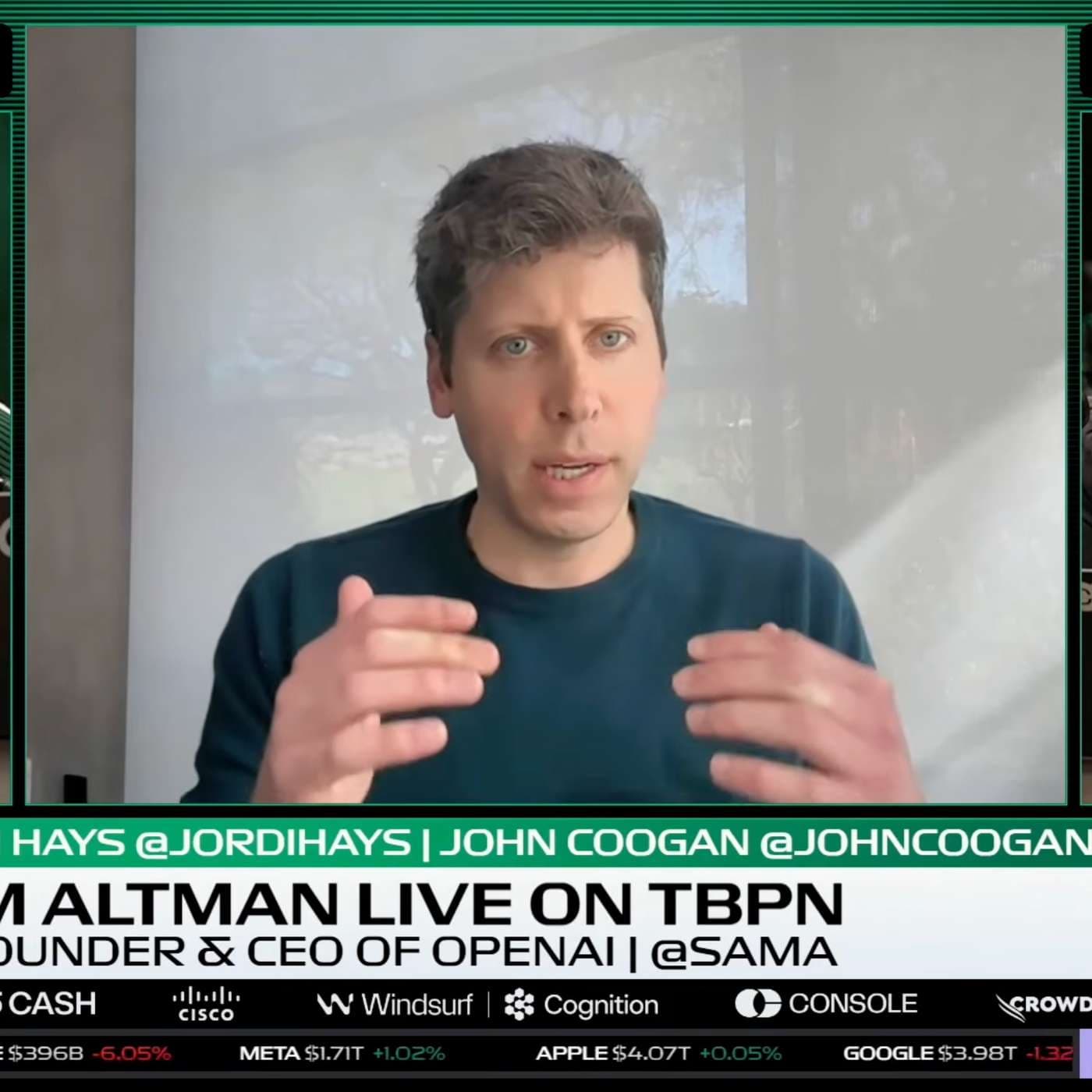
This is our full interview with OpenAI CEO Sam Altman, recorded live on TBPN.
We discuss Anthropic's Super Bowl ads, Codex 5.3, why managing AI agents is the next interface shift, and how chips, power, and compute bottlenecks will shape the future of AI.
TBPN is a live tech talk show hosted by John Coogan and Jordi Hays, streaming weekdays from 11–2 PT on X and YouTube, with full episodes posted to podcast platforms immediately after.
Described by The New York Times as “Silicon Valley’s newest obsession,” TBPN has recently featured Mark Zuckerberg, Sam Altman, Mark Cuban, and Satya Nadella.

