Ask ChatGPT
 The Angel Next Door
17 Sep 2026 · 28m · 10 chapters
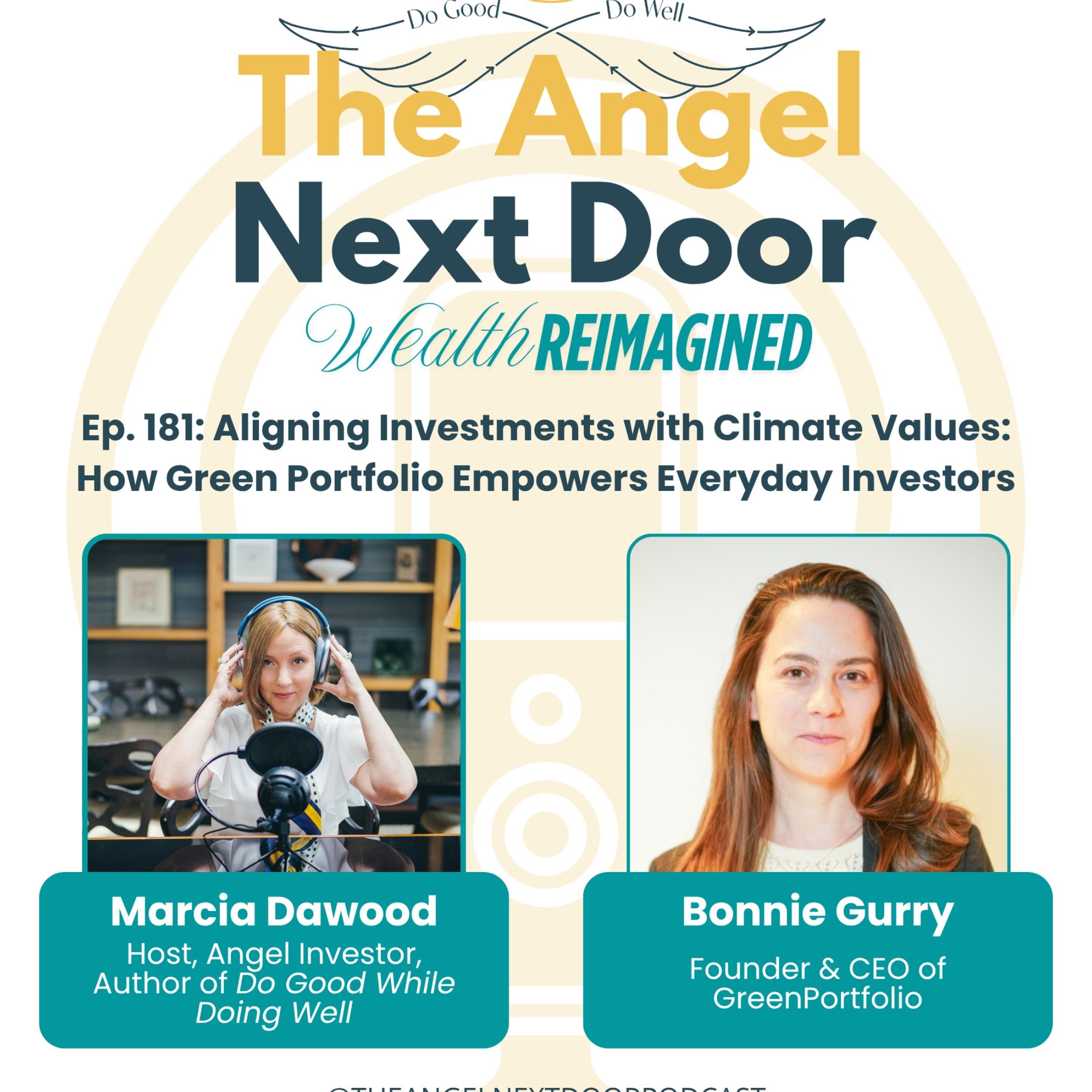
Green Portfolio helps everyday investors align their investments with climate values by showing how holdings may fund high-emissions industries and by matching them with climate-focused financial advisors.
Bonnie Gurry, founder of Green Portfolio; started as a mechanical engineer building micro-devices in clean rooms, later moved into finance (MBA; worked at a financial software company; worked at a venture capital firm).
Retail investors may unknowingly invest in climate-damaging assets through default funds (e.g., target-date 401k funds). Aligning investments can be far more impactful than lifestyle changes (she cites “21 times more effective”). Banking choices are a “scope three” driver because banks lend deposited money to activities like oil and gas.
JP Morgan Chase/Citi/Wells Fargo financing oil and gas exploration vs climate-pledge/local banks funding photovoltaic projects and EV loans. Green Portfolio is an SEC-registered digital advisory with a free holdings climate-rating tool and free algorithmic matching to up to three advisors (no cold calls). Mentions great wealth transfer to women/next-gen investors.
Written by AI. May contain mistakes.
Learn how investments may not align with personal values.
“I don't know if there are a lot of people that understand that when they're investing in mutual funds or things in the stock market, that they could be investing in some things that maybe don't align with their values.”
Explore Bonnie's background and her transition to climate-focused finance.
“Well, Bonnie, welcome to the Angel Next Door podcast.”
Understand how aligning investments with values can impact climate change.
“So first, tell us, like, how did you get, how did you start to figure that out?”
Learn about scope three emissions and their relevance to banking.
“And it's not talked about because the average person doesn't have much assets, right?”
Discover Green Portfolio's services and how they aid in sustainable investing.
“There are other things that are of great value to you, whether it's community-based investments or supporting women in particular locations.”
Discover the challenges in finding specialized financial advisors who align with individual values.
“And this is looking at, this is not just climate.”
Learn about the significant wealth transfer to women and younger generations and their distinct financial needs.
“basis, this great wealth transfer happening first horizontally.”
Explore how women's approach to financial management differs and the importance of empowering their decisions.
“Trust me, the people running sustainable funds are not there for altruism.”
Examine the concept of risk in investing and the value of information in making informed financial decisions.
“Speaking of general terms or things that people just think is true.”
Learn how to align your investments with your values and the importance of defining personal success.
“You are off learning how to be a surgeon or many other difficult jobs that are incredibly, doesn't mean you're stupid.”

Get the gist, explore an idea or ask about something said.
 Claude
On The Angel Next Door, what are the key points of this episode?
Searching your listeningAutomatic transcript. May contain errors.
0:00I don't know if there are a lot of people that understand that when they're investing in mutual funds or things in the stock market, that they could be investing in some things that maybe don't align with their values.
0:17Welcome to the Angel Next Door podcast, your gateway to the dynamic world of angel investing. I'm your host, Marsha Dawood, and together we will demystify what it means to invest in early stage companies, who's behind it, and how anyone can be a part of it. If you've ever wondered how you can affect the change you want to see in the world, then tune in to learn more. In this episode, I'm talking to Bonnie Gurry, founder of Green Portfolio, who shares her unique journey from mechanical engineer to climate-focused fintech entrepreneur. We discuss how your money might be fueling the climate crisis without you even realizing it.
0:52We also talk about why aligning your investments with your values is now more accessible than ever, and how you can make a bigger impact through your portfolio than you can through any single lifestyle change. Bonnie also reveals eye-opening facts about the true power of banking decisions, the rise of sustainable financial advising, and what the coming Great Wealth Transfer means for women and next-generation investors. Enjoy the show.
1:24Bonnie Gurry: Well, Bonnie, welcome to the Angel Next Door podcast. Thank you so much for having me. I appreciate it. It's great to be here and have this conversation. Yeah, I'm excited to hear all about green portfolio. So before we get started, tell us a little bit about your background and how you came to think, you know what, I really think there needs to be something like green portfolio in the world. Sure, I'm happy to. I started my adult life actually as a mechanical engineer. I have an undergrad and graduate degree in mechanical engineering, spent much of my time in clean rooms actually building micro devices and things of this nature until I realized what I wanted to work on was solving this climate crisis.
2:04Bonnie Gurry: And a lot of the, especially 20 odd years ago, a lot of the advances that needed to be made were in the world of engineering and manufacturing and things of this nature. So that's really where I started putting my efforts was how could I, as a mechanical engineer at that time, start to build the kinds of products and services we needed to solve the climate crisis. And just over time, being in New York City, you end up in finance bit by bit. And over my career, even though I started out as an R &D engineer, I found myself working more and more on the business side, the business case of bringing a new technology to market or working on a project that would eventually earn a return.
2:47Bonnie Gurry: Ended up getting my MBA and just over time. Also, I worked at a financial software company. I got to see more and more of this, the intersection of climate and finance, which are deeply intertwined. And was just really frustrated. I was doing all of this and realizing that my investments, my money was sitting in accounts and investments that were fueling the climate crisis. Right. And that really didn't sit well with me. It was pretty frustrating that as a retail investor, it was hard to unwind myself from investments that did not match my values. And that's where I really started to dig into the different opportunities within the climate, finance, and fintech space.
3:29Bonnie Gurry: At the time, I actually was working at a small venture capital firm and was seeing some really interesting services come across my plate, but never saw the one I wanted, which was like, help me figure out how to align my investments, my children's inheritance with what matters to me. And that's really where a green portfolio came from, was just trying to help people find climate aligned financial products and services that they can access, right? That you don't need to be extremely wealthy. So for many years, like if you, I don't know, had a family office or were an endowment or the state pension fund, they were doing these activities where they were saying, this is not aligned with our thesis.
4:12Bonnie Gurry: This is not how we want to invest in the future. And many students, right, were pushing endowments to digest from fossil fuels. And it was difficult for an individual to do that. And over time, we've really seen that the ability to decarbonize your investments is now accessible to pretty much everyone. You no longer need to be ultra wealthy in order to align your investments with your values. So it really was like the germ of an idea was just we should make this easier, automate the ability to see what you're investing in and then also automate the ability to find a financial advisor who aligns with your values.
4:54Yeah, that makes a lot of sense. So let's talk a little bit more. I don't know how, I don't know if there are a lot of people that understand that they're, when they're investing in mutual funds or things in the stock market, that they are, could be investing in some things that maybe don't align with their values. So first, tell us, like, how did you get, how did you start to figure that out? And how would somebody go about seeing if they were invested in things they didn't realize?
5:23Bonnie Gurry: Yeah, so I've always been very interested in investing, managing my own money, digging into how financial products are structured. And I really just started looking into what my kind of default 401k investment was, like the target date fund that my company had defaulted me into unless I changed it, right? Was pretty unhappy with what I saw. So these target date funds are pretty opaque and they may hold other funds inside. They're like a nested doll of investments and it can case a little bit of work sometimes to unwind them. And then once I looked at what it was investing in, I was pretty unhappy.
6:04Bonnie Gurry: Further unhappy because there really weren't too many other options in my 401k plan, right? So your employer is a fiduciary or they sometimes have an external fiduciary who decides what the employees can actually invest in. And so you're kind of stuck if you stay in the 401k plan. Of course, once you move on from a job, you have so much more freedom. But that's really where it started was trying to understand that. When just doing research, You can read the prospectus. If you can read, you can learn about what you're investing in, right? It's just really slow. And so that was where the first, I just built for myself a tool that could pull in an automated fashion, my investments, what I was holding at all these different accounts, unwind what everything was invested in, and then look at the climate impact.
6:52Like how much of my investments were in oil and gas?
6:56Bonnie Gurry: How much were in really just high emitting industries in general? Like all of these things. So marrying financial data with climate data. And the reason this is important is because if you are a person of means, which I'm going to define as over, let's say,$200 ,000 in investable assets, your investments are likely, unless you've gone to some trouble, your largest source of emissions. So they're off this part of, if you're familiar with scope one, two, three emissions that a company may have, people have those too, right? So scope one might be very direct emissions you're creating as part of your life.
7:36Bonnie Gurry: Scope two is like when you're paying other people to do stuff for you, the emissions that's creating. And then scope three are these more indirect emissions. So for a bank, for instance, almost all of a bank's emissions will be scope three emissions that are related to their investment activities. And you're talking about emissions that are going into the environment. Exactly. Exactly. So we have this whole accounting system that has developed over many years trying to understand, can we keep track of where emissions are coming from? And can we, by measuring, be able to change how we do business, right?
8:10Bonnie Gurry: But the only way we're ever going to solve the climate crisis is we can really bring down our emissions. And so I was pretty surprised to learn the more I dug into it that if you are a person with investable assets, aligning your investments with climate goals can be 21 times more effective than pretty much all the lifestyle activities combined. So eating less meat, flying less, all these little things that are very annoying, right? But instead, we focus on those instead of really tackling these systemic issues. And so that's really what I want to be able to empower people to do, is to start to really make a difference in this matter by using their money.
8:52It's just most people don't think about it.
8:55Bonnie Gurry: And it's not talked about because the average person doesn't have much assets, right? But our service, we try to help everyone, but we're really trying to talk to the mass affluent and say, it's your turn now. You can do this. We'll help you get there. It is achievable. And you just set it once or review it quarterly and move on with life. It's not something you have to keep doing over and over again. So give us some examples of things that were maybe really high, like scope three. And then you were able to find some other things that weren't as bad. So I think banking is a great example. I think it's really tangible for people to understand how this, where you bank contributes to your, is your scope three category 15 emissions?
9:40Bonnie Gurry: And why is this? So when your check from your job ends up in your bank account via direct deposit or whatever, most people think the money just kind of sits there and waits until you show up again and ask for it. But that is not true, right? The bank takes that money and will make many loans off maybe, let's say that makes seven loans off of your deposit. So indirectly, let's say you are also making loans essentially, right? And so if you are banking at one of the very large banks in the world, JP Morgan Chase, Citi, Wells Fargo, they are all out there taking your money and loaning it to a variety of activities, including, let's say, oil and gas exploration directly.
10:27Bonnie Gurry: So there's organizations that go and they look at every oil and gas project that's ongoing right now and they figure out, they backtrack, who loaned the money to go and put a drill in a particular place, right? Someone has to finance that activity. And it is largely from many of these banks, which we're all very familiar with. On the other hand, if you choose a bank that either is more local or just has a climate focus or at least a climate, like a climate pledge about what they will and will not invest in, your money directly will go to funding photovoltaic projects or EV loans for cars or other kinds of community nearby activities that are not oil and gas exploration in the tar sands of Canada, right?
11:14Bonnie Gurry: So there is a real direct connection between that. And we're starting to see that people are affecting this change at banks. In fact, I think last year, banks officially made less money from oil and gas investments than they did from other activities that were more climate aligned. So it's a step in the right direction. However, it's still, it's such a simple way you can take to start to understand the impact of your money. And that applies not just for climate. There are other things that are of great value to you, whether it's community-based investments or supporting women in particular locations.
11:55Bonnie Gurry: It's worth taking time to understand what works for you and your family and what's important. And finding ways that your money can directly or indirectly support those efforts. That's so interesting. So then how does Green Portfolio work? Yeah, so Green Portfolio, we are an SEC registered digital advisory service, and we have two services that are completely free for our clients to use. The first, we have a platform where you can use an interface to pull in all of your holdings, your investment holdings. And we have our own proprietary climate rating, and we've rated many things, not every everything, but most publicly traded things, financial products that are available to you.
12:39Bonnie Gurry: And we can give you an overall compliance score. Where are your investments? One of the worst offenders. Which ones are having the highest impact? Just so you can start to understand what your money is up to. And then after, so we built that service. We've had that up for a bit. But we quickly realized people wanted more help. And all had very particular requests for how they wanted that help. Some people were like, no, I only want to invest in the U.S. I want to do X, Y, Z. I want private investments. Others said, I just want an ESG portfolio and I want to move on with life. And so we realized what we really needed to do was to connect our clients with financial advisors who have these specializations.
13:20Bonnie Gurry: So there are absolutely financial advisors out there who have spent many years building a practice of centering climate or sustainability and everything they do. So they will help you reach your long-term financial goals, but they will also make sure that they align with your values and help actually invest in the world we would all hope to live in someday. So our second service is we can algorithmically match you with up to three advisors. And then you decide if you want to set up a meeting, we don't give them your phone number. We don't give them your email, no cold call. You have a link to their calendar.
13:55Bonnie Gurry: So if you want to set up a meeting and see what it's all about, see what they could help you with. And this is looking at, this is not just climate. They really look at your whole holistic picture of what your family needs over the next 10, 50, 100 years, right? And how they can build impact into the overall investment strategy and plan. Wow. So are these financial advisors, are they hard to find? Are there a lot of them or not so much? So the financial advisors on our network, at least, are super niche. They're very hard to find. They often are one or two people at a larger firm. So you still get the whole support structure of being at a larger firm.
14:37But it's a bit of an antiquated industry that is still a lot of referrals are word of mouth.
14:43Bonnie Gurry: They don't really do digital advertising super well, in my opinion. It also underwent a massive change during COVID. Before COVID, the vast majority of meetings between an advisor and a client were in person. And during COVID, people got really comfortable with just hopping on a call with a financial advisor. And when I started learning that, I realized it was such a huge opportunity. We can match you with the best advisor for you no matter where you live. If you are in rural Kentucky, I can match you with a great advisor in Northern California who you never would have come across, right? And there's no reason you can't work with that person if they're properly registered, etc., which we handle on our platform.
15:27Bonnie Gurry: And especially as we've seen, we're really building this for next-gen wealth. Gen X and millennials really want sustainable options in their portfolios. Every survey, it's like 95, 98 % of them say that they want this. But it can be very, if you just walk into your local bank where you've been banking and you say, I want a sustainable wealth advisor, they literally will just assign you to whoever's next on the whoever's mail. Because they have their own internal way that they handle referrals that may not align with what you want necessarily, right? They'll try, but it's highly unlikely that they will refer you to an office in Northern California if you are many states away.
16:09Bonnie Gurry: It's not going to happen. And we think that there's no reason you can't find a good advisor who is super experienced and also just going to open your worldview at the same time as taking stress off of you. Because they're handling and making sure that everything's being taken care of. So, yeah, we're really cognizant of the needs and interests of all of these people that are going to be inheriting enormous wealth in the next 10, 15 years, in particular women. So we're already starting to see that. We're really expecting, and this is not Green Perfolis, this is on a U.S. basis, this great wealth transfer happening first horizontally.
16:54Bonnie Gurry: So to generally widows, but mostly women, will be inheriting quite a bit of wealth before it then goes vertically to Gen X and then millennials on turbocharge. So to me, this is such a huge opportunity because these are two generations saying, I would like to do this categorically differently than how my parents or grandparents managed money. And I want to find the right person who can help me to manage this wealth in a responsible way that matches my values and also is not squandering this wealth and opportunity that you've been so lucky to have acquired. So we're really there to just be an assistant in this process.
17:37Interesting. So whenever we talk about impact, a lot of cases people say, well, if I'm going to invest for impact, then I won't get the returns. Yeah.
17:48Bonnie Gurry: And we hear that too. And then I ask, well, where did you get that statistic from? What are you citing? And it's just an idea people have. And actually, if you dig into the data, Martin Stanley and others have done pretty good longitudinal studies of investing in sustainable funds versus traditional. And on the average, sustainable funds have actually outperformed traditional funds. And this is on the average, right? This is not necessarily looking at one fund versus another. This is looking at thousands of funds at once. And so the data actually disproves that to some degree, which inherently should make sense.
18:25Bonnie Gurry: Like when I ask people, what would you prefer to invest in an unsustainable company? Does that Does that make sense to you when a company that is not setting themselves up for long-term growth and success, which is built into the word sustainable, right? To me, having this kind of stricter practice of understanding long-term goals and sustainability built into a company's strategy is so important. And that's why I think they outperform. But that's just my hunch. But I do think it's important to always push on those assumptions because people assume it's an altruistic endeavor and it is not. Trust me, the people running sustainable funds are not there for altruism.
19:09Bonnie Gurry: They, too, want to get you superior returns. And we've seen that, which is great. That's great. Okay, so back to talking about the wealth, great wealth transfer, women. And what are you seeing as far as the difference between what women want related to wealth management and what men want? And also, you did talk a little bit about the generational differences as well. Yeah, so I really can only speak to the vast majority of our users are Gen X and millennial. It's just my hunch, but most baby boomers aren't looking to do an online financial advising relationship, perhaps. It's just not the norm for their generation, which is fine.
19:49Bonnie Gurry: But for us, we're really focused on these clients who are at their peak earning potential. They're inheriting money. They have a lot of accounts everywhere. That's also something very different from baby boomers who were at jobs much longer in their careers. So we see people show up to us with a list of 20, 30 accounts, right? That's between a couple. It's not so unusual. And then you add on to that, many of them are now starting to manage their parents' wealth as well. and also at the same time setting up accounts to help their children go to college or just in general over the course of their life.
20:27Bonnie Gurry: So it's a lot to handle, which is also fairly different. The new, this whole sandwich generation is a real thing. And that's another place of financial advisors so helpful of managing how all of these different needs. And so what we're also really seeing, so within this cohort of millennial and Gen X clients, is we do see a difference in the behavior between both single women who are often divorced, but not always, married couples and single men. So in general, our service has been doing really well with married men and divorced or single women who I think feel more empowered potentially to make a decision about working with a financial advisor, which that's great.
21:14Bonnie Gurry: But at the same time, I really, we've been trying to understand like how can we help especially in relationships where the husband has been managing the money how can we help the because we'll get clients come through where it's like the woman is in charge of figuring this out and then at the end the husband decides to go do something else right and we don't want to miss that opportunity we also want to be able to empower both individuals to be full advocates for how their money and their wealth is being managed. So it's something we've been really chewing on lately is how can we approach, because it's hard because our clients often couples, right?
21:55Bonnie Gurry: And we have to work with both of them. So how can we help both couples work together to both people in a couple work together to be able to have the information they need to make that next step? Because we see especially divorced women. I'm always so impressed by them. And they come through our platform and they go so fast and to a certain degree. They do great depth of research, make a decision, and then they move on. And I always find that so impressive that they make a really good, well-informed decision quickly. And I think that's the way to do it. Right. So we do see some real changes in behavior on our platform based on where people are in their lives.
22:35That's so interesting that I think women, especially, If they can feel comfortable and get the information that they need in order to make a decision. We talk about women are risk averse. Speaking of general terms or things that people just think is true. And I don't really think that's true. I actually would call us risk astute. We want to get the information before we make a decision so we feel like we make an informed decision. But I think not lollygagging about the decision either. Don't say, well, when I have more time, I'll do it because time is what is on our side when it comes to investing.
23:15And if we keep putting it off or waiting or thinking, well, I'll just keep my money here for now and I'll eventually do something with it. That time period could turn into months or even years that it's sitting in investments or even in cash not doing anything. I 100 % agree.
23:34Bonnie Gurry: And I think and I really do think for many investors, women or men, the idea that they're risk averse, I think it's risk reduces when you have more information. That's right. And I think that's really where it's coming from is people are nervous about making a decision because they don't have enough information or they feel like they don't have enough information to make an informed decision. and when you look at studies for why financial advisors can be such a good investment right financial advisors are not free they charge you a monthly fee based on how much generally based on how much of your assets they are managing and yeah working with an advisor over the long term you will have two to four percent more money at the end of the day right even after you've paid for fees.
24:24Bonnie Gurry: And that's because they take out, they reduce the waiting time, the thinking time, the emotional decision-making, right? Because they have systematized managing money. And it's strange because in a way we all have become, or we all are, whether we want to or not, money managers, right? You are the manager of your own money. And sometimes I'm like, well, would you have chosen yourself to be the money manager? Or would you choose, do you feel like you have the skill set to do that. And so many people are like, no, not really, because no one ever really taught me how to do that, which is completely fair.
24:58Bonnie Gurry: You are off learning how to be a surgeon or many other difficult jobs that are incredibly, doesn't mean you're stupid. You're obviously very smart, but why do we assume people know how to manage money if they have not gotten that skill set? So I really feel like people shouldn't beat themselves up. You just can't do everything and you can't do everything well. You have to choose which things you're good at doing and focus on those, in my opinion, and outsource the rest to some degree. Yeah, that's some great advice. So where would people find Green Portfolio and how can they interact with you?
25:34Bonnie Gurry: Sure, yeah, we're at greenportfolio.com. Our service is free to use. We are compensated by advisors if you end up working with one of them, just for full disclosure. And we're just there to try to help people who care about climate find the kinds of financial services to help them reduce their impact. Always happy to chat. You can also find me. I'm pretty active on LinkedIn and always happy to talk about how we can use our wealth to really build the world we all want to live in. We only have one. And we only have one life. And we really, I think, is worth... This is one thing that whenever I talk to people, about money, whether it's angel investing or regular investing or whatever, is first take some time and focus on what matters to you.
26:23Bonnie Gurry: What would be success for you in the end when you're very old? And is it just money? Is it impact? What really is the end result you would hope for? Because until you've done that exercise, I think it can make it hard to find the motivation to really start this kind of whole investing journey, whether it is just learning or whether it is working with an advisor or even just understanding where your money is. So that's really where I think it's worth. Even if it's just 10 minutes once a year, like, what is our goal? Where do you want to be so that you can build towards that? Yeah, that's really, that's some definitely sound advice.
27:00Well, Bonnie, thank you so much for coming on the podcast today and telling us all about Green Portfolio. I love what you're doing. And I think this is definitely something that people should take a look at and see how they can align their money with their values. So thanks for being here.
27:15Bonnie Gurry: Absolutely. Thank you for having me. Thanks for listening. To connect with me, visit my website at MarshaDalwood.com. And please subscribe, follow, and leave a review. It helps the podcast get seen by more people. And remember, you can also find the Angel Next Door podcast on YouTube too. And if you're looking to learn more about investing in the changes you want to see in the world. Sign up for Ann and Bill Payne's ACA Angel University classes. Go to the angelcapitalassociation.org, all one word, to find out the schedule. And classes are now available on demand. Many classes are offered, everything from angel investing basics, which include fundamentals, risk, due diligence, term sheets, valuations, returns, and portfolio strategy, and even a class on group formation.
27:58There's even a deeper dive where you can get advanced classes, including capitalization tables, startup boards, and exit strategies. If you're not already a member of the Angel Capital Association, you can become one for a low price that will give you unparalleled access to discounts, free webinars, with a huge archive of content, networking opportunities, and much more. We'd love to have you join us.
Have you ever wondered how entrepreneurial drive can transform not just industries, but entire systems like finance and climate action? This episode of The Angel Next Door Podcast prompts listeners to consider the power of innovation in addressing some of society’s most pressing challenges, especially when those challenges are as broad-reaching as the climate crisis and personal wealth management.
The guest for this episode is Bonnie Gurry, a mechanical engineer-turned-entrepreneur with a background in R&D, finance, and venture capital. Bonnie shares her journey from cleanroom engineering to the world of climate fintech, detailing how her personal frustration around aligning investments with her climate values led her to found Green Portfolio—a digital advisory service focused on helping individuals effortlessly decarbonize their investments and find like-minded financial advisors.
Throughout the conversation, Bonnie demystifies what it means for regular investors to align their money with their values, highlighting how bank choices and investment accounts can significantly impact the environment—often much more than daily lifestyle changes. The episode covers practical steps, like using Green Portfolio’s tools to evaluate climate impact and matches with specialized sustainable financial advisors, and explores broader trends, such as the upcoming generational wealth transfer and the distinct needs and mindsets of women and next-gen investors. This is a must-listen for anyone interested in actionable ways to make their wealth a vehicle for positive change, as well as those curious about the intersection of entrepreneurship, finance, and impact.
To get the latest from Bonnie Gurry, you can follow her below!
https://www.linkedin.com/in/bonniegurry/
Sign up for Marcia's newsletter to receive tips and the latest on Angel Investing!
Website: www.marciadawood.com
Learn more about the documentary Show Her the Money: www.showherthemoneymovie.com
And don't forget to follow us wherever you are!
Apple Podcasts: https://pod.link/1586445642.apple
Spotify: https://pod.link/1586445642.spotify
LinkedIn: https://www.linkedin.com/company/angel-next-door-podcast/
Instagram: https://www.instagram.com/theangelnextdoorpodcast/