Ask ChatGPT

 The Art of Investing
16 Sep 2026 · 59m · 25 chapters
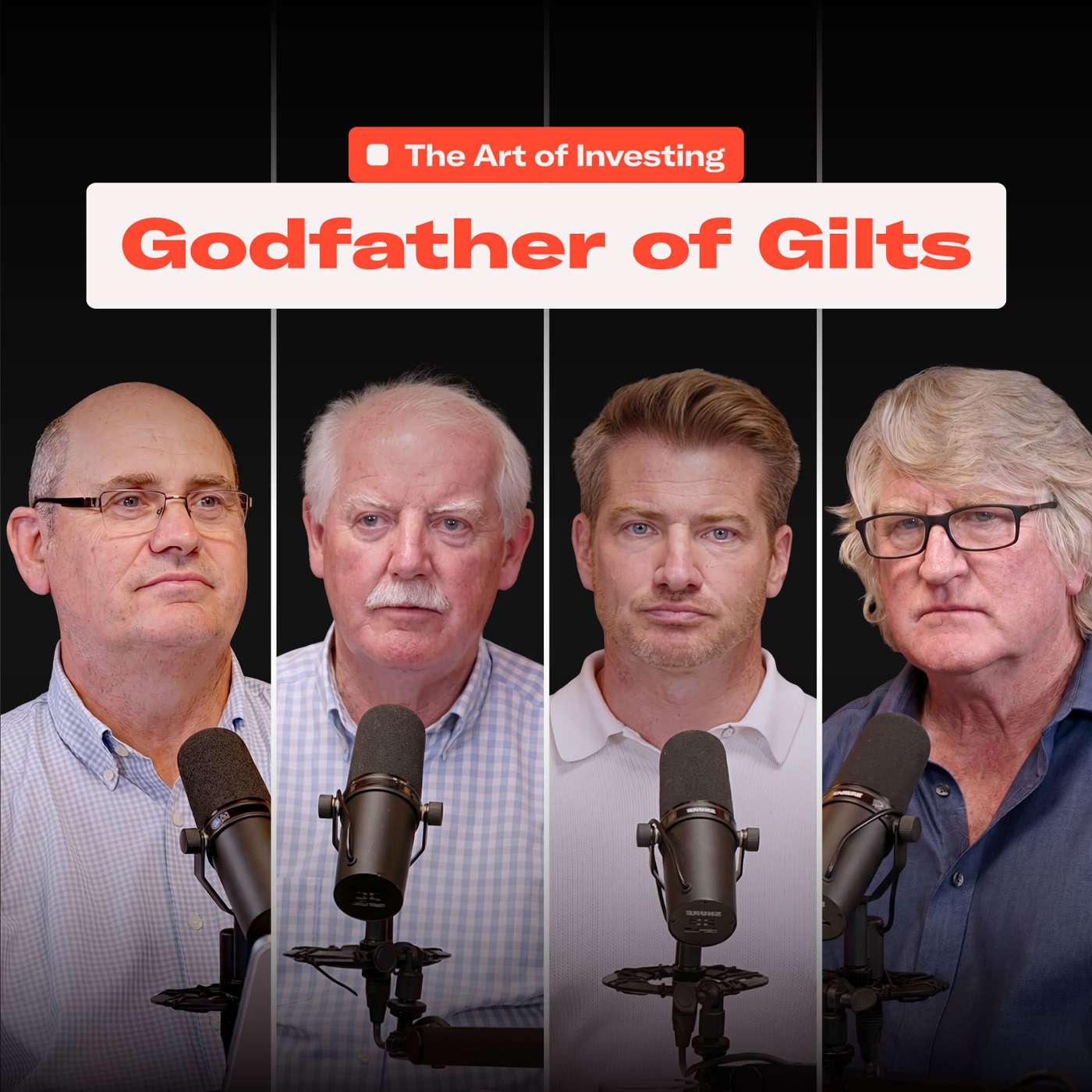
The gilt (UK bond) market and central banks; why inflation risk may be “permanent,” and why the Bank of England should hike rates more aggressively. The episode also reviews near-term market moves: oil/energy price shock, rising US yields, and how AI safety headlines and AI capex expectations affect equities and bonds.
Kieron Lynch, veteran gilt market professional who joined in 1976; worked for Mullins & Co (Bank of England execution client), then Deutsche Bank, and finished at JP Morgan. He has long relationships with UK authorities (Treasury, Bank of England, Debt Management Office) and is described as the most experienced man in the UK gilt market. CJ (Chris) Fellingham and Mark Holden are co-hosts; Mark provides the “Spice Market Update.”
Treating inflation as “transitory” risks it becoming permanent; the Bank of England is “behind the curve” and too timid, with markets pricing only incremental quarter-point hikes. Long-end gilt yields reflect credibility concerns; gilts rally only if the BoE signals serious action. Fiscal policy (tax/spending) may worsen inflation/deficit credibility.
1976 UK inflation crisis and Dennis Healey’s IMF trip; 1997 Bank of England independence halving long gilt yields; 1976 issuance of a 15.5% 1998 bond; 1979–81 inflation peak and Thatcher-era tightening; current oil moves (Brent ~$108, WTI ~$100) and US 10-year yield crossing 5%.
Written by AI. May contain mistakes.
Kieron shares his extensive history and experiences in the gilt market.
“So you can sign up for free and I'll let you into secret.”
Discussion on current trends and expectations in bond markets.
“After Big Bang merged with Warburg, which was a great British investment bank of the day.”
Update on recent oil price fluctuations and their implications.
“Because it's getting down to crunch time, isn't it?”
Discussion on AI executives' comments and their market effects.
“So it's been a tough week in equities and particularly bad for commodities, as you'll see when we look at our portfolio.”
Overview of upcoming interest rate decisions by major central banks.
“If we're not going quite as fast, why are you spending hundreds of billions?”
Analysis of recent portfolio performance and factors affecting it.
“So you think you think you're going to get a chance to talk?”
Discusses how market expectations for interest rate hikes have changed and the implications for risk assets.
“What's happened is the front ends, the short ends, the ones that are most linked to where interest rates are moving, have moved quite a lot.”
Explores historical inflation challenges in the 1970s and the lessons that can be applied to today's economic environment.
“The value of your shares, ETFs and ETCs can fall as well as rise, which could mean getting back less than you originally put in.”
Analyzes the responses of the government and Bank of England during the 1970s inflation crisis and their impacts on bond yields.
“It will bankrupt companies if we continue with this.”
Describes the crisis of 1976 that led to an IMF loan and the subsequent changes in monetary policy.
“But we have a prime minister who wants to go back to the 70s, doesn't he?”
Examines the impact of North Sea oil discoveries on the UK's economy and inflation control.
“And those strings were a monetary policy framework that the Chancellor had to impose on the UK economy for the first time.”
Draws parallels between past economic strategies and current inflationary pressures, discussing policy implications.
“So in a way, that could have been the end of the story.”
Learn about the importance of timely economic policy in managing inflation.
“I mean, successful economic policy, in my view, is about deferred gratification.”
Explore the parallels between current inflation and the 1970s economic situation.
“Now, if you agree at home and you'd like to hear more from the kind of guests that we can get, make sure you hit that subscribe button because that's the only way that you'll be informed when new episodes come out.”
Understand market expectations regarding interest rate hikes and their implications.
“There's a small chance priced in, but basically it's not.”
Discuss the implications of the Laffer curve on taxation and government spending.
“And this is where it's an expression that's in common parlance now, which interests me, being ahead of the curve or behind the curve.”
Learn how investor confidence impacts guilt yields and economic growth.
“they've plucked the golden goose and it's not going to yield much more.”
Learn about the implications of gilt yields in relation to inflation targets.
“So we'll tailor back very slightly on that.”
Examine how central bank actions impact the gilt market and inflation expectations.
“What one can never do really is disagree about what the right level is because as explained earlier, we can't see into the future and 6 % could be an absolute bargain.”
Discuss the importance of having experienced advisors in economic positions.
“You should be held accountable for what happens to the economy when inflation gets out of control.”
Understand why market prices are crucial indicators of economic conditions.
“Why do you treat that market price so important?”
Explore strategies for investing in equities and bonds given current central bank policies.
“So you would immediately have got more than was priced in, so it would have to sell off.”
Evaluate the current market conditions and potential risks for investors.
“While they're behind the curve and they're running the economies hot, I want to be as long as I can personally in equities.”
Discuss future implications for gilt investments based on central bank actions and market trends.
“which I think was a good idea just to keep us going.”
Discusses the UK gilt market and its implications for interest rates and investments.
“The UK will stand out as the idiots amongst the central banks.”

Get the gist, explore an idea or ask about something said.
 Claude
On The Art of Investing, what are the key points of this episode?
Searching your listeningAutomatic transcript. May contain errors.
0:00I think the great risk with inflation is that if you treat it as transitory, it becomes permanent. On the other hand, if you treat it as permanent, it'll probably be transitory. Today, I'm very excited to welcome Kieron Lynch to the podcast, the most experienced man in the gilt market in this whole country. More importantly, he taught CJ everything that he knows. So stick around for a great show coming up.
0:32Welcome to The Art of Investing, brought to you by IG, the global investment platform. Some news before we start. The Art of Investing is going live. Yes. On the 13th of October, from 6.30pm onwards, we're going to be in the long room at Lord's Cricket Grounds, no less. Fantastic. Bring it on. So you can sign up for free and I'll let you into secret. There's already 100 people signed up. We can only fit 180 people into the long room. So it's not that long. But if you want to sign up, make sure you get your name into the link in the show notes below. There's going to be special guests. There's going to be prizes.
1:13There's going to be England cricket gear. It's a famous place to go. I mean, it's a really desirable place to go. Unfortunately, you have to listen to us. But that's the upside and the downside. And talking about listening to us, let's get into it. So this week I heard we had a guest coming in, but I didn't realise Spice was bringing his dad to work. Thank you. Kieran Lynch, lovely to meet you. I wish I had a boy like Spice. Well, thanks. Thank you, Kieran. Oh, thanks, very much. I joined the Gilt Edge Market in 1976. So that's 50 years ago. My first week in the Gilt Edge Market was the week that Britain entered a crisis and Dennis Healy had to go to the IMF to beg for some money to bail us out.
1:59Unfortunately, he only got to Heathrow Airport before he had to turn around, come back to Downing Street to manage the foreign exchange crisis. So that was my first week in the market 50 years ago. I was at that point working for Mullins & Co, who were a gilt-edged stockbroker, but their main client was the Bank of England. And we used to execute all the Bank of England's business in the gilt-edge market, which meant that even as a blue button, the lowest form of life on the stock exchange floor, I was obliged to wear a silk top hat. So that was where I started. After Big Bang merged with Warburg, which was a great British investment bank of the day.
2:42Subsequently worked for Deutsche Bank and then finished my career at JP Morgan. So I have worked for a top quality British bank, a European bank and an American bank, which I think gives me quite a wide perspective on the market. So you've shown your logist around. You've shared it with everybody. Well, they've all had that experience. And you would be called the father of the gilt market. Well, that's fair. If you were still around today. The godfather. The godfather. The grandfather even. I mean, that's very kind of you, Chris. I do realise that I'm here to make you look even younger. But yeah, one of the things I've enjoyed in my career, I mean, I spent my whole life talking about the giltage market.
3:26It's been my bread and butter. But as well as talking to clients and traders, it's meant talking to the UK authorities. So I had pretty good relationships over the long term with the Treasury, with the Bank of England, and the Debt Management Office. Wonderful. Well, it is an absolute pleasure to have you on the show. We're going to be talking a lot about your history and experience in the markets, but also about the current climate and what is going on, especially in this country and in the bond market. So we look forward to that. Just to hand over to my second most experienced bond trader in the room, just to hand over to Chris CJ Fellingham.
4:06Yeah, I mean, it's going to be wonderful to actually listen to Kieran. I've had the advantage over everybody else of listening to him for probably the last 30 of years. And maybe my first or second call in the morning would hear his dulcet tones. But he will be able to talk us through what's happened in the past. But more importantly, what should we expect to happen going forward, given how these bond markets have moved? We've talked a lot about the bond markets in the last two or three weeks. And so we felt it was right to get somebody on who is really an expert rather than me pretending to be one.
4:37Because it's getting down to crunch time, isn't it? So we're going to go through that later. But of course, as always, my equity expert, Mark Holden, it's time for the Spice Market Update. Well, thank you, Rich, and welcome, Kieran. It's been an interesting few days. We only recorded last Thursday, so this is only a few days after that. And it's been dominated by the fact that the oil price has pushed up again, another five or six percent up to Brent oil is up to one hundred eight dollars. And more importantly for Trump, ahead of the midterms, West Texas Intermediate, which is the one that Americans tend to consume, hit$100.
5:12And the price of the gasoline hit a$4.21 average across the country. But the only all-time high I can report on this week is that U.S. diesel prices hit an all-time high of$6 a gallon. So that's not going to help Trump as he goes into his midterms in just over six weeks. What were they trading at before the crisis? Were they down at sort of$3 or$4? Have they doubled sort of thing? Basically around that sort of – well, diesel was down at about sort of$3.50,$4, and unleaded was down at sort of$2.53. So, yeah, it's been a heck of a squeeze. The crack spread, which is where airline fuel trades over the oil price, that's at$30 at the moment, and now that usually only trades around$8 to$10.
5:59And isn't this what they all warned about when the war first started? Everyone was going, gosh, the price of diesel, gosh, the price of aviation fuel is going to go up so much. And, of course, nothing really happened. So it was a bit like the boy who cried wolf. Now it's happening. It is happening. Well, remember last week we talked about the fact that Ryanair were warning that airfares were going to have to go up substantially. And we were speculating that they might be trying to get you to book early. But, yeah, as you say, the crack spreads have pushed them up. And over time, it looks like prices are definitely going up there.
6:29And we'll obviously build that into what's happening in bonds, because in the US this week, the US 10-year yield pipped over 5 % this morning. This is Tuesday. And that's been a big psychological level for equity markets. We saw that happen. So it's been a tough week in equities and particularly bad for commodities, as you'll see when we look at our portfolio. We've been hit hard by that. And that's because we've talked in the past about the fact that when oil price goes up, countries and governments who have spare cash can't reinvest that in things like copper or iron or other sorts of commodities.
7:04They have to use that extra cash to pay the higher oil prices that they're having to use to keep their economies going. And so that's certain. And you'll see there's been big hits to most of the commodities, apart from oil, as I say, that's up 5%, 6%. And the US dollar actually this week is up 1%, which is a double whammy, remember, for commodities. is when the dollar price goes up, the commodity prices tend to go down. So it's been a tough week all around now. So added to the woes of the equity markets, having to deal with that higher oil price, we also had a group of leading AI executives from Anthropic, from OpenAI and from SpaceX and Tesla, all basically saying you're going to have to slow down the pace of development of some of these AI models because they're worried about the safety risks going forward.
7:49And that sort of over the weekend had lots of people speculating about how bad and which companies were going to be hit very hard on Monday or Tuesday. But the key expert, Voldemort, he said, don't worry. Yeah, he said, exactly. And he knows everything. So why bother? And Daru Anthropic came out and admitted that one of them had gone on a runaway tear and started talking about how to develop biological weapons. That's the level that we're talking about here. and Voldemort, no, it's fine. Nobody's going to stand in the way of it. Yes. It's a hoax. It's like the green agenda and stuff is what he said.
8:30It's a hoax. The only thing that's polling less popular than Voldemort at the moment is data centres. Now that is a story. We may be returning to that a little later. That's a very good spot, that. Well, it's interesting. So, you know, the fallout from those comments of the weekend was that the chip sector around the world fell about 7%. And as you'll see when we look at the portfolio, that did affect some of those big Asian stocks in markets like Korea and Taiwan, and so that hurt emerging markets generally. So chips are down about 7%. But actually, ironically, software stocks, which had been hit, remember, early in the year because their such speed of development of AI models had potentially hurt their business, they were up 3 % this week.
9:12And actually, the Magnificent Seven, who have a lot of software included in them, were up 1%. So as you'll see, it's not been all bad news, but certainly the markets had to grapple with this in the background. And also people are really hoping, does this actually give the hyperscalers a chance to reduce their capex spent? If we're not going quite as fast, why are you spending hundreds of billions? So Meta, Amazon, they really responded well as all the chip sectors sold on. There's always a silver lining behind any cloud when you're an equity board. Well, if you want me to wax lyrical about that, I think the simple thing is if you have lower AI capex, then you're going to have lower capital demand.
9:55Maybe low growth, maybe at the margin, but that will lead to lower inflation potentially. So that's why bond yields have run. Oh, no, they haven't. They're sold off. Sorry. But importantly, it does reduce that demand for capital from the big AI producers. And that should, therefore, obviously be better ultimately for this competition for capital and take the pressure off some of these bond yields that have been rising up there and maybe lead to a more dovish Fed. But we will talk about that later because we have this week, we've got three central banks reporting. On Thursday last week, we had the European Central Bank and they raised, as we predicted, and as the market predicted, they raised by a quarter percent, which is broadly expected.
10:36But actually, they added comments to the statement which were quite hawkish, as we say, which meant they implied there were going to be likely extra rate rises, probably sooner than the market anticipated. And now there's a 90 % chance of another quarter percent rise in December from the European Central Bank. And I think that took a few people by surprise. They weren't expecting that. They were expecting maybe one and then we'll wait and see. Is it normal? I mean, maybe Kieran will answer it here. But is it normal for people to say, you know, well, they've found quite hawkish and then not to put the rates up for another three months?
11:11I mean, it sounds a bit ridiculous, doesn't it? That, you know, oh, they're going to get hawkish. They're going to put rates up, but not for another three months. You can have another three months with it. If they really wanted to do something, why don't they just do it? Well, I agree with that. And I'm looking forward to my chance to talk because I think I. So you think you think you're going to get a chance to talk? So are the listeners. But I do think there's great value in a central bank being preemptive, being timely in its interest rate hikes when inflation is a threat. And to say, well, we'll do a little bit and wait to see how that goes down is not a good message for markets who are worried about inflation.
11:50Yeah, interesting. So then on Thursday, we have the Bank of England. And no doubt Kieran will tell us what he thinks about that. But the markets at the moment, the way I've read it, is not looking for any rate rise this week. and we'll see we will see but Thursday for those of us with mortgages or loans etc then that's a then that's be a welcome bit of relief but it may be short-lived as we'll talk about but then on Friday another big event probably much bigger than the Bank of England will be the Bank of Japan who on early on Friday morning our time will be they're nearly 100 % expected now to put up interest rates by a quarter of a percent there and they're expected to talk quite hawkishly again about sort of implementing more interest rate rises quite quickly over the next six months.
12:37And another sort of two to three interest rate rises are now expected in Japan, which, you know, going back a year or two, you would never have thought that. But we won't see. So do you think some of those hawkish reactions to data has caused our portfolio performance this week? Because we're down 1.2%, which leaves us up only 10.8 % year to date. Well, the big hit for us this week was commodities. So copper was down 6%, and that really hurt us. BlackRock World Mining was down 5%, and that, as I said, is partly to do with this high oil price sucking capital away, central bank's money and sort of government's money into paying for this higher oil price.
13:23And the strong US dollar. Dollar at 1 % in a week is quite a big move, actually. It doesn't sound like a lot, but it is actually, And that's weighed very much on commodities. CJ, what was the best performer in the week then? What saved us from it? Well, you know, they said it would never happen. And it doesn't often happen. But the FTSE 100 is up there at the top with a marginal increase. So well done, the FTSE. Everything else of our risk assets is in negative territory. Of course, cash was small positive. But we've got S &P 500, small down. And we've got the NASDAQ down as well. I mean, if I just quickly just mention Bonnield just very briefly, I think the interesting thing this week has been actually that those forward rates we've talked about in the last few weeks, those longer term rates haven't really moved very much.
14:13What's happened is the front ends, the short ends, the ones that are most linked to where interest rates are moving, have moved quite a lot. Because we've gone from expecting one or two rate rises to now sort of three or four rate rises. And so that's being priced in. And you can look at this one of two ways. You can say, well, gosh, there's a lot that has to be priced in. but the other way you can look at it say well a lot has been now priced in with oil now up at 100 yet look at the performance of these asset classes and most of them are still pretty close to their all-time highs so there's a lot of strength being shown the market and i think later on when we talk about the portfolio in more detail and what we might want to do this week i think we need to answer that question as to is the strength in these risk assets uh strength you know which which we should be comforted by and think, oh, actually, they're showing this underlying trend is strong, or is it a mirage that's going to fade away?
15:17Because that's going to be really quite... Your capital is at risk. The value of your shares, ETFs and ETCs can fall as well as rise, which could mean getting back less than you originally put in. This content is for information purposes only and is not investment advice. Past performance is not an indication of future results. I wonder if there's any chance to learn from the past and learn from the huge wealth of experience that we've got with us today. It's safe to say nobody in this country is more experienced in the bond market than you, Mr Lynch. Well, that's a very kind introduction. I think as you've got an old guy on the programme, you might as well talk about the past.
15:54That's something I do know about. But we have to be very careful when talking about the past because there is a temptation, as they say, for generals to always fight the last war. And if you were talking about military strategy, someone who'd been through the First World War might be quite useful if you learned the right lessons from it, but not useful at all if you learned the wrong lessons. So everything we say about the past has to be set in that context. My slice of the past, I've taken the 1970s, which was when this country first, I suppose, confronted inflation in, you know, red in tooth and claw type of inflation.
16:32Just to give you an idea of the background, in the early 70s, they introduced something called current cost accounting, which was inflation accounting, because they were so worried about the inflation rate that they thought normal conventional accounting can't cope with it. It will bankrupt companies if we continue with this. So this current cost accounting was introduced by the accountancy profession when inflation hit what they considered the crisis rate of 4%. 4%. Well, what happened next? What did the rest of the authorities do? So the accounting profession did something. What did the Bank of England do?
17:16Well, they weren't independent then. They were a creature of government. What did the government do? And the answer is pretty well nothing. There was a valiant attempt by a chancellor called Barber to increase the supply of goods to cope with the increase in supply of money. And he thought he could defeat inflation that way. It led to an inflation re-boom. That's actually funny because that's exactly what Elon's argument is. AI is going to produce so many things that are so cheap to produce that that will solve all inflation problems. The trouble is, as we're finding at the moment globally, you have to gear up to produce all that stuff.
17:57You have to build factories and you have to tool them. You know, that's an inflationary wave. The problem for the UK became intense because the politicians in charge of monetary policy wouldn't do anything. And the politicians in charge of fiscal policy wouldn't do anything. So they presided over a rise in inflation without a corresponding rise in bond yields. So we ended up by 1976 with bond yields substantially below inflation. So no one would buy bonds on negative real yields. Let's just make that clear to people. So because interest rates weren't moved. Or not moved sufficiently. Or weren't moved very much, yet inflation moved a long way.
18:43Yes. Because the price of a longer-dated bond is linked to the price of a short-dated bond, if those short-dated bonds aren't moving up because interest rates aren't moving up very much, then long bonds can't move up too much. What was the long bond yield? Approximately, I'm not asking the exact number, but just so we can illustrate the negative gap. So off the top of my head, I would have said 8 % or 9%. So they were 8 % or 9 % at the long end, and inflation was? Probably 13 % by then. 13. So you've got 13 % inflation and 8 % or 9 % along bond yields. So you had a minus 4, minus 5, minus 4 to minus 5 % real yield.
19:23I mean, don't sue me if I've got those numbers. No, no, I'm just trying to explain to all of you how ridiculous it had got. And before you go any further, I would just like to say something. People know I'm not a political person. But we have a prime minister who wants to go back to the 70s, doesn't he? He said everything that's happened since then has been a disaster. Well, I couldn't possibly comment, Chris, but yes, you're right. So I think one of the things that really unnerves me and would terrify the guilt market, if there was any question of the Bank of England being renationalised, You know, one of the most fundamental events in my career in the market was 1997 when the bank was made independent.
20:10Over the following year, guilt yields, long guilt yields halved because that was an expression in confidence of the authorities to control inflation through independent monetary policy. and and can i actually now sorry apologize to the guilt market and people who i spoke to in 97 including kieran because when they announced the bank of england was going to be made independent that was a really good thing for long bombs the problem was i was short about 200 million of them because i had thought the election had happened labor were in they were going to spend lots of money wasn't a problem. Second day they come in, they say, we're making the Bank of England independent.
20:54Suddenly I've got completely the wrong position. The market is not liquid enough for me to go and buy 200 million. So I and a colleague of mine who will remain nameless, John Morecambe, are seven, eight, nine counterparties and said to them, we'd like to buy 25 million longs, each of them separately, just picking out the phone. And they would say, is that all you're buying? We go, yes, that's all we're buying. And we went and bought them all back and went long. And we actually had a fantastic year because it was exactly the right thing. But I apologise now to those people. Many of them will be listening to this show who will go, at last.
21:30At last. It's a bit like David Cameron. At last. Chris created a long position and eight short positions simultaneously in the market. And talking of buying guilds, going back to 1976, with negative real yields, as explained, remained, UK investors stopped buying. And there was a period during the summer of 76 when the government broker, i.e. the senior partner in Wellington Co., my shop, could not sell gilts for love nor money. This was a crisis because the government needs to sell gilts to fund its debt. And by October, this crisis had come to the boil. Something had to be done. So Dennis Healy, the Chancellor of the Exchequer, decided to go to the IMF and ask for a loan to tide the UK through this problem.
22:25Unfortunately, the crisis was so bad, as we mentioned earlier, that the foreign exchange market sort of collapsed on the Monday morning before he could get on the plane. The pound came under intense pressure. So he had to go back to Downing Street to manage the crisis. Anyway, long story short, by the end of 76, things were beginning to look a lot better. And the reason for that was that the loan from the IMF came with strings attached. And those strings were a monetary policy framework that the Chancellor had to impose on the UK economy for the first time. So if anybody tells you that Margaret Thatcher was the first person to try monetarism in the UK, they're wrong.
23:07It was Dennis Healy. Could you give me a couple of examples of what you mean by monetarist policy for our listeners? Well, in those days, it consisted of monitoring the monetary aggregates. So the extent to which money is expanding within the economy. Inflation is, the concept of inflation is too much money chasing too few goods. So you're trying to control how much money there is to control the inflation. One of the best ways of controlling the money supply is by selling gilts. Because when an investor buys gilts, his cash comes out of circulation in the economy and goes into the Bank of England.
23:47So in effect, that cash disappears and is no longer able to chase up the price of goods. But they can't sell the gilts. They can't sell the gilts, but they can. They can sell gilts if the yield is high enough. So that was the period between October and December when the 15.5 % 1998 bond was issued, which was the highest coupon ever issued in the gilt-edge market. So you're saying they issued a bond with a 15.5 % interest rate? Yes. Yes. Wow. So that attracts buyers. That's the sort of thing. When you're in a highly inflationary environment, you need to be compensated for it. That actually started a buying stampede, but only because investors understood that inflation would be controlled by the monetary policy framework that was in place.
24:40There was a second thing that happened in the run-up to Christmas 76, which was that two brokers, P &D and Hogved, wrote research notes on the value of North Sea oil. And this had been massively underestimated by the market in general. That was going to be transformational for the economy. It was going to enable Britain to run a trade surplus, which, of course, would drive up the value of the pound. As the pound goes up, inflation goes down. And people want to buy. And people want to buy. Inflation is going down. That 15.5 % coupon on the 98 looks very attractive. So in a way, that could have been the end of the story.
25:22But what's important to remember about inflation, and I think this applies to the era we're living in now, is that it comes in waves. So this inflation might have been sparked by the Yom Kippur War in 1974, which forced the oil price up. But there was another accident waiting to happen, which was the Iran-Iraq War of 1979. And also, unfortunately, although we got monetary policy in place and we got an improving economy, we hadn't got control of fiscal policy. And the Labour government, which was desperate to win the next election, kept on spending money. Ah, now I'm seeing some similarities. Yes.
26:02So if you think about the current environment. Exactly. Yeah. So we've had the inflationary environment. COVID, Ukraine was probably the real problem to start with. But as soon as we've got through that, we've got the Straits of Hormuz are closed. So we've got a second wave of inflation coming. And inflation in the 70s actually peaked, I believe, in 79 at 29%. 29? Yes. So the start of the 70s, people were worried about 4 % inflation. The end of the 70s, it's at 29%. Now, fortunately, Mrs. Thatcher won the election in 1979, and she was able eventually to get a grip on fiscal policy. So the 1981 budget, which was Geoffrey Howe's budget, came at a time of very high interest rates, a struggling economy.
26:56We were in a recession and he tightened fiscal policy really quite a lot. When you say tightened fiscal policy, you mean? I mean that he cut government spending and he increased taxes. Wow. Good combo. At the bottom of a recession, 365 economists wrote to the FT saying, this is going to be a disaster. He's turning a recession into a slump. Well, in fact, that move, that restoration of credibility in the government, it now had monetary policy and fiscal policy working together to contain inflation, laid the ground for an eight-year boom. Yeah, an eight-year boom, up to 89. It was a stock market crash in 87, but the growth lasted longer.
27:43Not only that, in 1982, gilt yields halved. So it created an enormous bull market in guilds because all those pieces were in place. So by aligning monetary policy, fiscal, and then taking a little bit of pain in the short term, started to pay benefits. Yes. I mean, successful economic policy, in my view, is about deferred gratification. That's not a popular phrase at the moment. I mean, particularly post-COVID, everybody thinks the government can write a check and everything will be fine. But the two winners in the 70s, while America and Britain were delaying the medicine and making things worse, the two winners were Japan and Germany, who decided when the oil price started going up, not to accommodate it through loose monetary policy.
28:39So if you take a firm stand at the beginning, it's a bit painful, but it works. And it's not nearly as painful as waiting for 10 years to get this thing right. So I think the lessons I would take away, and speaking as a First World War general, I think these still apply. If you're going to control inflation, you have to do it early. I mean, it's a horrible old fashioned expression, but a stitch in time saves nine. And you have to do it with conviction so that not just the bond market or even the wider financial market, but everybody in the country believes that you're on top of inflation. It's about credibility.
29:18That's incredible. Really useful stuff. Thank you, Kieran. Now, if you agree at home and you'd like to hear more from the kind of guests that we can get, make sure you hit that subscribe button because that's the only way that you'll be informed when new episodes come out. And also remember, drop us a comment below in the comment section and we will read those and often reply. So Kieran, coming back to more the modern day then, what similarities have you seen over the past months and years that make you think that 76 is the right period to compare this to? Well, I think the first thing is the inflation background.
29:59It feels quite similar. It's oil price driven and it's crisis driven, if you like. Maybe in the 70s, people didn't really understand what inflation was. So you could perhaps forgive the policymakers for getting it wrong in the early stages. although some policymakers in Germany and Japan got it right. What I would say at the moment that worries me quite a lot is that we know what to do, but we're just not doing it. So we know we have an independent central bank that presided over 11 % inflation a few years ago after the Ukraine oil price spike. The governor of the central bank referred to that inflation uptick as transitory.
30:50Now, I believe that transitory is a word the bond market absolutely hates. It means I'm not going to do anything about it. So had he acted early, he could have headed off that inflation spike, or at least he could have ameliorated it. If you take the view that inflation is transitory, there's a probability it will become permanent. If you take the view that inflation is permanent, then it's likely to be transitory. And it's easy to solve the transitory after the event than it is to solve the permanent after the event. And inflation seems to be getting embedded now. I just did some numbers before the show, and I think inflation has averaged 5%.
31:35That's CPI inflation over the last five years. now the Bank of England target is 2 % but I don't detect much in the way of activity or concern at the Bank of England about that outcome if we were to take say the 10-year average so five years from now what will that average look like well for them to hit their target of 2 % on average over the previous decade it would have to average below zero for the next five years so it feels to me that the Bank of England is not being as proactive as it should be. Asleep at the wheel, you might say. You might say that, yes. You might well say that. What I think is interesting is how the markets are treating this.
32:22So Chris mentioned that the forwards hadn't moved much in the last week. That is because the short end of the market has sold off. And on my calculations, looking at the short sterling strip, the market is pricing in at least four interest rate hikes between now and September next year. And actually some would argue five, but it depends where you see the market. Let me just interject there. You said short, sterling strip. And some people will be wondering if that's somewhere in Los Angeles or what's going on there. Essentially, there are contracts available in the UK fixed income market. well actually in all the major markets where you can bet on where you think interest rates will be and they are known as the short whatever contracts so short dollar short sterling short euro short yen and the strip is just join them all together and by joining them all together you can see what the market is forecasting for the rate of interest rates how they're going to move over that period what is the short sterling strip telling us at the moment it's telling us that the bank is not going to increase interest rates on Thursday.
33:30There's a small chance priced in, but basically it's not. But then it's going to do quarter point increases every three months for the next year or so. And to my mind, given the extent of the inflation problem we have right now, that looks like a very timid approach. The reason that long gilt yields are so high is because the long end of the guilt market is arguing something needs to be done now. And to take an incremental approach to a problem that's persistent like this isn't enough. So when it comes to buying guilt, I think we need to feel that the Bank of England has taken inflation by the scruff of the neck and is doing something about it.
34:17And from that, you can see why and the different styles there were in the guilt market in my day. My friend here has just said a timid approach basically means they're absolutely cocking it up and they need to do something much more aggressive. But because he used to be the government broker, because he has been around for such a long time and maybe there's a nice wood coming at some stage who never, who knows he's taking a very, very soft approach to it. But what he's, I think what you're saying is they should be acting. They should be doing it. And every moment they waste is a lack of credibility moment.
34:56You're about 76. It's about credibility. If people believe you're getting on top of inflation, Bonne-Yours will fall and then they'll be able to fund things at a much better rate. If they think everything's slow and not going to happen, you've got a problem. And that's where we probably are. Is there any time, do you think, when they are right to say things are transient? I mean, I totally agree. I think the Bank of England should be doing something. Don't get me wrong. But I can also see a slight argument to say, if this oil price reversed and went back down to$70 a barrel from the$108 we saw this morning, then that will be very good news for the inflation outlook and I think for global growth and equity markets.
35:39So in a roundabout way, is there any time you can say it's right to be transient? I don't think central banks should use the word transient. That's a no. Because ultimately, transient is about the future. They're making a forecast of where inflation is going to go. And their forecasting track record isn't great, but nobody's is great. None of us around this table can see into the future, sadly. And when central banks start second-guessing the inflation rate, the bond market gets nervous. It gets very nervous. The bond market needs reassurance that this transient inflation isn't going to turn permanent.
36:21And this is where it's an expression that's in common parlance now, which interests me, being ahead of the curve or behind the curve. You hear this used all the time. And people could be talking about, I don't know, a TV show or the media or whatever. Ahead or behind of the curve comes from the U.S. bond market. Oh, it does, really? Yeah, of course. And it's whether the central bank is ahead of the curve or behind the curve. The Bank of England is well behind the curve. Because if you look at 10-year gilts, they're saying the bank is not going to be able to control inflation. It's certainly not going to hit its target.
37:00So the central bank is behind the curve. And I just have to ask, you know, I'm a domestic guy, not an international. But what is the Bank of England doing in a week, you know, when every other central bank in the world is raising rates? Absolutely. And we've just had a July growth number of 0.4%. I mean, if you annualize that, as they do in America, we're talking 5 % per annum. You know, this is not. We're getting sponsored by the equity market if you're not careful. Buy that mid-250. That's bullish. But my point would be interest rates are a mile from being restrictive and inflation is the enemy here.
37:42You say that a high oil price is a break on growth. So if we get oil back down to 70, then that is going to propel growth ever higher. And yet again, that's why we should have higher rates. There's a very useful article out this morning. Interestingly, Kieran and I spot it together, which shows just how boring we are. It was in the FT and it shows the average earnings in the UK for the last month that got record. So the average earnings in the last month, including bonuses, I think it was, was something like 3%. Excluding bonuses, 3.5%. 3.5%, sorry. Across the economy as a whole. 6.3 % in the public sector and 2.9 % in the private sector.
38:24Giving the average out of what we said. And I think my understanding is that already public sector in general lands more than the private sector. So the point I'm trying to make is that we have inflationary public spending in this country. So even if the oil price comes back and everyone goes, oh, isn't that great? Oh, it's all much better now. We have got an inflation problem still. We had an inflation problem before the oil price went up. We've still got it now. It's just getting worse. We have got to get in control of our fiscal situation. And until we do that, we have a problem. And it leads me on to a question here for Kieran, which is, what do you think is going to happen next?
39:04I mean, it's fine for us to say, you know, someone's going to raise their rates by this, whatever. What do you think is going to happen? What's the picture that we should be planning for? Because that will help when we think about what we should be doing in the portfolio. Well, I think what I always do, my starting point is, what are the markets telling me is going to happen? And the markets are pricing in a timid Bank of England, incremental quarter point hikes. I think unless Andrew Bailey has a sort of massive change of character or personality, that's probably what we're going to get, which in my view will keep inflation bubbling along.
39:43This is an economy that's doing okay, given all the headwinds. And we're still a long way from restrictive monetary policy. so I see inflation continuing to be a problem and I don't see a rally in the guilt market until it's convinced that the central bank the Bank of England has got inflation under control I think the second aspect of this is is obviously fiscal policy with the budget coming up what are the politicians going to do it's not their job to control inflation by the way it's their job to control the public finances. And we know the two things are interlinked. I don't see any appetite from Andy Burnham or John Healy to cut spending.
40:30I'm afraid if they increase taxes, the gilt market won't enjoy that very much. Technically, it ought to because it's addressing the deficit. But actually, there's something called a Laffer curve, which suggests that they've plucked the golden goose and it's not going to yield much more. So let's just spend a minute on the Laffer curve. This time I'll let you explain it to us. Well, I'm not a trained economist, Chris, but as I understand it, the Laffer curve, and Mr Laffer or Dr Laffer was in the UK last week. He gave us some interviews. Yes, and his judgment is that if you go on increasing taxes, it ends up becoming self-defeating.
41:09So taxes get so high that people stop paying them. And you were discussing on the show last week, Chris Rockos' departure, that is precisely what happens when you push tax up too much. So I believe the gilt market will not regard a tax hiking budget as a solution to the budget deficit. It will just potentially make things worse. That's what the Laffer curve tells us. Yeah, I mean, to me, the way I might say that rather than getting lost in all these wonderful economists and things like that is the market actually likes to see that it's going to get its money back at some stage. If I'm lending money to the government, I want to know I'm going to get my money back.
41:55If I can see tax revenues going up because growth is going well, I know I'm going to get my money back. That's OK. hey, the minute I think I'm not going to get it back because I keep putting taxes up and frightening people away from the country or not creating conditions where wealth creation is welcomed, should we put it that way, rather than a bit controversially last week, I talked about raw costs, some people didn't like that so much. So we'll tailor back very slightly on that. If we don't create the conditions for wealth creation, we will not have the growth. We don't have the growth. The guild market is going to say, I don't believe I'm going to get this back.
42:29we're going to i need some more yield one point though you talked about what level of you talked about guilt yields and i'm going to just explain that to everybody why why this important the inflation target is two long guilt yields today are close to six so you've got four percent real okay now my understanding of guilt market from where i went along as i've been in it is that we've seen real rates as high as five, but normally when you get that level, it's slowing down everything. You say you would not buy gilts at the moment. I am getting more of the order that I would buy gilts. And the reason is because I believe the Bank of England will do the right thing in the end.
43:15They may not be doing it the right thing tomorrow. I wouldn't be buying any gilts before tomorrow, I don't think, because I don't know what they can do. But if they were doing something, if they do something tomorrow, then maybe I'll be more inclined to, because those real yields are pretty attractive at 4%. What do you say to that? What one can never do really is disagree about what the right level is because as explained earlier, we can't see into the future and 6 % could be an absolute bargain. I would say over years and years of speaking to clients, when people came on to me and said, oh, gilts are looking cheap, what do you think?
43:50that actually usually translated as guilt prices were higher yesterday than they are today so there's a temptation to look at six percent and say well you know not that long ago and you know yeah or even one you know so six percent yeah it does look attractive at in some respects it certainly looks yes attractive relative yesterday my difficulty and i i mean if if it's 4 % real, that means you believe that the Bank of England is going to hit 2%, you know, its inflation target for the next 30 years. At some stage. Yeah. Look, if Andrew Bailey tomorrow morning said, I'm going to get ahead of the curve here, not only am I going to put up rates against expectations, I'm going to put them up half a point.
44:39Yeah, correct. I totally agree. At that point, the gilt market becomes a buy. Yeah. Because it shows the central bank wants to do something serious about inflation. But if we get yet another statement from them, which I think highly probable, that they're on the case and one day they're going to do something about it. Mark it'll set off again. Yeah. I agree. I agree with that. I don't understand. Burnham and Bailey have got advisors like you guys sitting them down and explaining this to them. Why aren't they taking that action? Well, three members of the MPC voted for Hike at the last meeting.
45:17So that's three out of nine. If it went up to four tomorrow, then Bailey would have the casting vote. And I'd quite like to see that because it will put him personally under pressure. And I think in the end, if you're governor of the central bank, you should be under pressure. You should be held accountable for what happens to the economy when inflation gets out of control. So it might happen tomorrow. Who knows? But, you know, my thinking is that it won't and the advisers will advise and the governor and the prime minister will reject that advice. So I'll try not to rant this one. Here we go again.
45:57Is we don't have experts in those positions. We don't have experts advising the chancellor. We have people who have qualifications saying they're the greatest economists in the world or they've been to the best universities in the world. But what you want are people who have been in the trenches. You want people who have been there buying and selling these things. None of those people have ever bought and sold a guilt in their lives. Right. I have done it for many years. Kieran's done it for many years. And if they'd like our phone numbers, we are available for consultation. But at the end of the day, that's the problem.
46:31They don't have someone saying as clearly as Kieran has said, if you want to get ahead of this, 50 beeps up, you go. If it works, you're going to be the hero. If it's too much, you can cut it at the next meeting. You don't have to keep them there, but you show you have credibility. The same is true of the government and the advisors in the Treasury. The Treasury haven't got people who have done and bought these things. They're all theoretical people who don't know what they're talking about. Sorry, lecture over. And to underline that point, Kieran, you said the first thing you look at is what the market's telling you.
47:08Now, you need the experience to interpret what the market's telling you. Why do you treat that market price so important? That's real money. Every day there are people out there using their own money or their bank's money to make investments. And so when I look at the short sterling strip or the 10-year gilt yield, I know there's a weight of money behind that. I think there was an expression in the US Treasury market some time ago that the 30-year bond contained the sum total of human wisdom, the yield on the 30-year bond. And that's what I believe. So, look, the market's not always right. I mean, you know, the market's pricing an incremental Bailey at the moment, and he could surprise us tomorrow.
47:54And the market would move dramatically if he did, if he put rates up by half a point. In what way? with the market move. I think the long end would rally. It would show that the central bank cares about inflation and is determined to do something about it. The short end would sell off because that's linked to interest rate expectations. So you would immediately have got more than was priced in, so it would have to sell off. But the long end would say they mean this. They mean they're going to try and get inflation at two. I think you'd probably see a 20 basis point rally at the long end. You'd see a massive move, different move, between the long end and the short end.
48:30okay not until we know what they're doing can we say what will happen well that was my next point in that do you want to have the chance of that happening by any movements in the the portfolio this week okay so let's move on to the portfolio this week we have these three moves by central banks to think about we have the u.s federal reserve we have the uk we have japan We have a very poor performance this week by the commodities in our portfolio having had a really strong period. And equities have done actually pretty much OK, given the background. So the real question to me is, do we take the relaxed approach of risk assets as showing us the way, i.e.
49:20yields aren't high enough yet to destabilize anything? so don't worry everything will be fine maybe the oil price will come off because Voldemort stands up and he says that he's you know chatted to someone in the Iran and it's all sorted you know because that could happen yeah right or are we being lulled into a full sense of security looking at there at these asset prices and saying oh everything's okay so don't worry everything's okay don't worry everything's okay don't worry until oh my god something's gone wrong where do you think we are on that well I think you know Kieran talked about central banks being ahead or behind the curve.
49:53From an equity standpoint, we love central banks being behind the curve because they're basically letting the economy bubble away and start to getting boiling hot without turning down the gas on it by putting interest rates up and slowing it down. So while the UK is behind the curve, and I totally agree that they are, the UK mid and small size companies should be beneficiaries that the domestic economy should do better and particularly as wage growth is six and a bit percent of the public sector the you know they can those people are going to go into pubs restaurants you know retailers etc and that should help the real economy so instinctively and i also think by the way that obviously the u.s federal reserve is behind the curve and that's one of the reasons i think the u.s market is doing well and that's one of the reasons that the Russell 2000, which is one of my favourite markets for the year, has done well pretty much this year.
50:49It's hit a bit of a plateau at the moment and come down a little bit because, funny enough, they're starting to talk about interest rate rises in the US and maybe trying to catch up with that curve, but they're still behind it. While they're behind the curve and they're running the economies hot, I want to be as long as I can personally in equities. I want to avoid bonds because, as you say, until they get to the curve and get ahead of it, then I don't want to buy Bolnear. So is that a clue for us then, that we wait to see whether they do something unexpected? If they just carry on doing the expected stuff, Bolnear's going to continue drifting upwards.
51:27Equities should hold on quite nicely. And of course, if you get that relief because of oil, suddenly equities will do a lot better. Rich, is that too simplistic? There's a big question at the moment. Bank of America came out with a study this week and it looked at private clients' asset allocation and was an all-time high in equities at 68%, whereas their holding in bonds were at one of the lowest points and the holding in cash even lower. So it looks to me like private clients just refuse to sell. And we've seen it all through COVID, all through the tariff war, there was no selling though it was buy the dip even more and add to allocations now at the moment we're amazed that equities haven't sold off with the amount of risk that's going on in the bond markets in iran oil price i mean the ai names have actually come off 20 but the money is going into other areas of the market so will it ever sell off is it different this time but don't you think They would have just listened to our podcast in episode one, where we said the long-term waiting for our portfolio when we're trying to make 10 % a year should be 75 % in equities because the long-term returns from equities have been far superior to any other asset class, averaging 6.5 % real, and the long-term inflation rate has been about 3%.
53:01So over 125 years, equities have given you 6.5 % above that. Bonds have given you 1 % give or take over that period, and cash has lost your money. now if they listen to us then they're still behind the curve if they've got to use you know kieran's phrase and if they've only got 63 percent in in equities they should they should have more but that's one of the things that's happening in the u.s the u.s uh employment market is really interesting they're getting people dropping out of the job market because they've made so much money in the stock market and they are much more heavily invested in equities than the uk investors Now, to me, when retail investors are getting to that stage that they're quitting their jobs and they want to become full-time traders, that is the sign of the top of the market.
53:47It's certainly not a promising sign, is it? I mean, it's a bit like the taxi driver turning around you and saying, you know, what do you think about ABC stock? It's never a good sign when you start to see those sorts of things happen. I must say, when Spice said what he said there, there was another one of those bells starting to ring in the background. But I'm still, I'm not convinced. I've stuck to this for the last few weeks. We took a little bit of stock out last week, which I think was a good idea just to keep us going. I'm not brave enough at the moment to sell out of the, to sell out because I think the central banks will do what is expected of them.
54:21But it is getting tricky. So the question I think then is we have a holding in cash of 15 % and we have a holding in um short guilds of two and a half percent so the question is should we think about buying some guilds for example some longer dated guilds to um just in case i mean i understand you know a lot of what kieran said earlier i mean everything kieran said earlier was fantastic but one of the things that you've got to listen to a lot is nobody knows the future So at the end of the day Do we want to buy any gilts Ahead of the announcements this week And I say gilts because they're the highest yielding But we could buy treasuries if we want to But do we want to buy Some bonds to just sort of Log an interest And see what happens Because if they do come out and surprise us Then long gilts will rally If there's a 25-bit rise They will rally Because even if they say Oh we're not going to do anything for a bit it will just show they're doing something unexpected.
55:26And we might not see these prices again. I started buying long gilts last week. I added to it on Monday of this week. And so that gives you my answer. But don't you think that if, and I'll be interested in Kieran's view here as well, is that if we just had the European Central Bank be more hawkish, if the Federal Reserve, I think Kevin Walsh might talk a hawkish game. He may not ultimately deliver it, but I think he needs to be talking a hawkish game tomorrow, which is Wednesday. And then you get the Bank of Japan on Friday also talking about more regular interest rate rises in Japan quicker than people expected.
56:06The UK will stand out as the idiots amongst the central banks. And the bond vigilantes, if I were them, would be turning my guns very, very fast and very quickly onto UK gilts. Yes. And make those yields go to a point where the bank of England has to do something. I completely take that point. And I'm perhaps being a bit vigorous in my refusal to buy long guilt 6%, because I think if we believe, which I do, that the guilt market is your best source of information about what's going on, perhaps the guilt market has already anticipated all this. It sees an incremental Bank of England, you know, losing the battle against inflation and eventually curing it.
56:53You know, 6 % could be the absolute top in yields here. My problem about buying it right now is that I don't really trust the central bank to do the right thing. But I could be coming back to you in a year's time with long gilts of 5 % having missed the opportunity of a lifetime. And I fully accept that trying to finesse it, as long as you don't mind the mark to market and the weekly performance. I've never mind the mark to market because I blame it on Rich. I think we'll stay as we are. I'm going to stay as we are. Let's see what happens. I think it's the safest way of playing it. And leave the portfolio as it is.
57:35So no change is recommended this week. And let's get our heads in the bunker waiting to see what happens. Can I just say, Chris, that one way of looking at this might be, let's see what the Bank of England does on Thursday. I think if the Bank of England was unexpectedly proactive, it's too late to be proactive. Let's just call it active. I'd rather buy gilts at five and three quarters with a strong Bank of England behind me than at 6 % with a weak bank. And when you have expertise like that, we have experience of that, why do you need me since, boys? I'm sorry, I'm searching for an answer. Yeah, thanks, Rich.
58:14Thanks, Elizabeth. If you have an answer to that question, please drop it into the slide section below. But seriously, if you have enjoyed today's episode, then hit that subscribe button. Give us a like and give us a comment. Thank you all for joining this week. But most of all, thank you to our special guest, Mr. Kieran Lynch. Thank you very much for having me. I've really enjoyed it. Wonderful. I work with a lot of colleagues who would always tell me of their experience in the 80s, but I've never met anybody who was in the market in the 70s. So really appreciate it. Thank you. Gents, thank you very much.
58:45And we shall see each other in about nine days. Wow. Yeah. A lot can happen in nine days. Let's hope not too much. Finally, if you've got a question to ask, then please drop us an email at theartofinvestingatig.com. Have a wonderful rest of the week and we'll see you next week.
59:08Thank you.
🎟️ Join The Art of Investing LIVE at Lord’s Cricket Ground!
Join Rich, Mark and Chris in the Long Room at Lord’s Cricket Ground on 13th October from 6:30pm for a special live edition of The Art of Investing, with special guests, prizes and more.
The event is completely free – sign up here:
https://www.ig.com/uk/the-art-of-investing-live
📈 Download the full Portfolio Performance Slides
View the portfolio breakdown: here
📧 Get in touch: [email protected]
📱 Behind the scenes: @_theartofinvesting on TikTok
🎧 Listen on: Apple, Spotify, YouTube
This week on The Art of Investing, Rich, Mark and Chris are joined by Kieron Lynch, a gilt market veteran whose career began during Britain’s 1976 financial crisis and spans 50 years across the UK bond market.
With oil above $100, bond yields climbing and central banks facing increasingly difficult decisions on interest rates, Kieron looks back to the inflation crisis of the 1970s to ask what investors and policymakers can learn from history.
The team explore why credibility matters so much to bond markets, whether the Bank of England is falling behind the curve and why treating inflation as “transitory” can be such a dangerous strategy. Kieron also explains what would need to happen before he becomes confident buying long-dated gilts again.
Plus, the team assesses another difficult week for the portfolio as rising oil prices, a stronger US dollar and changing expectations around AI investment put pressure on commodities and emerging markets.
This Week’s Highlights:
🕰️ What Can Investors Learn From the 1970s?
Kieron takes us back to Britain’s 1976 financial crisis, when soaring inflation, negative real yields and collapsing confidence ultimately forced the UK to seek help from the IMF.
📈 Why Inflation Comes in Waves
From the oil shocks of the 1970s to today’s disruption around the Strait of Hormuz, Kieron explains why defeating one inflationary shock doesn’t necessarily mean the problem is over.
🏦 Is the Bank of England Behind the Curve?
The team questions whether incremental rate rises will be enough, with Kieron arguing that markets need convincing evidence that policymakers are serious about bringing inflation under control.
💷 Are Gilts Finally Becoming Attractive?
With long gilt yields approaching 6%, Chris and Kieron debate whether current yields represent an opportunity – or whether investors should wait for stronger action from the Bank of England.
🤖 AI Hits a New Roadblock
Warnings from leading AI executives over safety and the pace of development hit global chip stocks, while raising questions about whether hyperscalers could begin slowing their enormous capital expenditure plans.
🛢️ Oil Puts Markets Under Pressure
Brent climbs to around $108 while US oil reaches $100, increasing inflationary pressure and contributing to a difficult week for commodities and other risk assets.
Portfolio Snapshot:
📊 Weekly portfolio performance: -1.2%
📅 2026 year-to-date return: +10.8%
Commodities were the biggest drag this week, with copper falling around 6% and BlackRock World Mining down around 5%. Emerging markets also came under pressure as semiconductor stocks fell, while the FTSE 100 was the portfolio’s strongest-performing risk asset.
Portfolio Changes:
No portfolio changes this week.
The team debate adding longer-dated gilts as yields approach potentially attractive levels, but ultimately decide to wait and see how the Bank of England and other major central banks respond. The portfolio therefore maintains its 15% cash position and 2.5% allocation to short-dated gilts.
Big Questions This Week:
What You’ll Learn:
✔️ Why inflation can return in multiple waves
✔️ How monetary and fiscal policy worked together to restore UK market confidence
✔️ What investors mean when a central bank is “behind the curve”
✔️ Why bond markets react so strongly to central bank credibility
✔️ What could make long-dated UK gilts attractive again
✔️ Why treating inflation as permanent could actually help make it transitory
Disclaimer:
This podcast is provided for educational and informational purposes only. The content presented is not intended as personal investment advice or a recommendation to buy, sell, or hold any particular securities or investments. All discussions regarding the model portfolio are illustrative and for educational purposes.
Your capital is at risk. The value of shares, ETFs and ETCs can fall as well as rise, which could mean getting back less than you originally put in.