 The Bid - An Investing Podcast from BlackRock
30 Oct 2026 · 23m

 Add vo to ChatGPT or Claude to ask about everything you hear
vo listened to this episode to put together the overview and transcript, so there may be the odd mistake.
Retirement systems are being “rewired” globally as people live longer and responsibility shifts from governments/employers to individuals. The episode argues retirement success depends on three linked steps: how people save, how savings are invested, and how investments are converted into reliable retirement income across a lifetime.
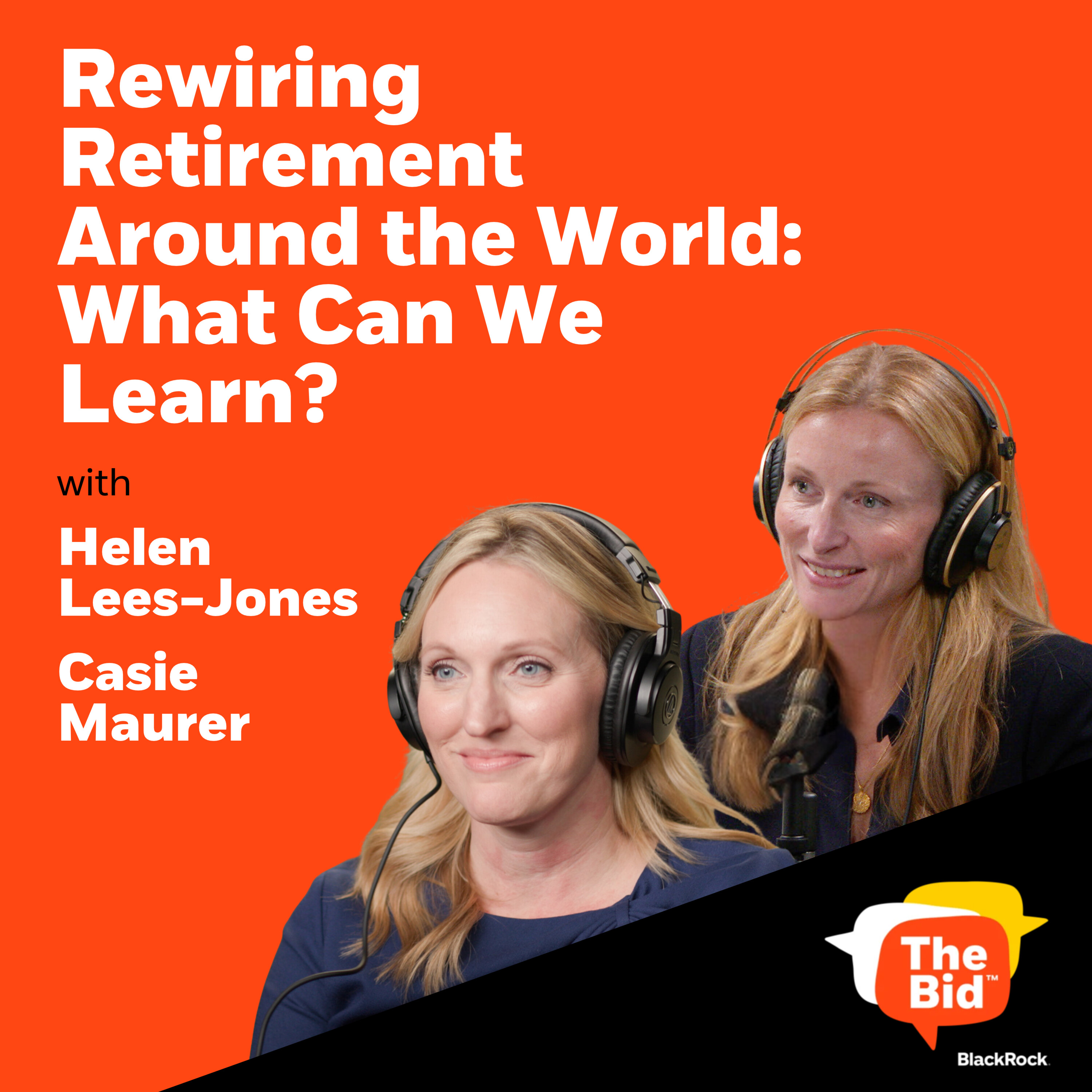
Casey Maurer, head of U.S. Defined Contribution at BlackRock; previously describes parents with traditional defined-benefit pensions (teacher, military pilot). Helen Lees-Jones, EMEA head of Global Consultant Relations and Institutional Strategy at BlackRock; based in London, works with UK/Germany and broader Europe.
No two countries’ retirement systems look the same; reforms take decades; employer defaults and auto-enrollment reduce decision friction; capital-market access and staying invested matter.
UK vs Germany (UK ~ $3T pension assets vs Germany ~ $300B; UK auto-enrollment since 2012; Germany moving toward capital-market-based products). U.S. 401(k) blueprint (Pension Protection Act; target-date defaults) and income “gap” (7/10 feel prepared; savings may cover only 50–60% needed). Australia focusing on retirement income via superannuation pools; Mexico boosting saving and using target-date structures.
0:00Seven out of 10 American workers feel prepared for retirement. But what we actually see is that their own savings may translate into just 50 to 60 percent of what they actually need.
0:15Oscar Pulido: People around the world are living longer. That's one of society's great achievements. But it's also changing the economics of retirement. People may need their savings to last for decades, While in many countries, more of the responsibility for funding those years is shifting from governments and employers to individuals. At the same time, there is no single global model for retirement. And different countries are tackling different pieces of the challenge. One thing I think you can guarantee on retirement is that no two systems or two countries look the same. There's three ways to help drive particular outcomes for retirement.
0:54how people save, how much you're saving. Two is how you translate those savings into actual investments. And then three, taking those investments and turning that into the reliable stream of income.
1:07Oscar Pulido: So what can we learn from how different countries are responding? Which ideas can travel across borders and which can't? And as retirement is rewired, do we need to think differently about retirement itself? Not as a series of separate problems, but across the whole portfolio and the whole lifetime. Welcome to The Bid, where we break down what's happening in the markets and explore the forces changing the economy and finance. I'm Oscar Pulido. Joining me today are Casey Maurer, head of U.S. Defined Contribution for BlackRock, and Helen Lees-Jones, EMEA head of Global Consultant Relations and Institutional Strategy.
1:46Oscar Pulido: Together, we'll look at the forces rewiring retirement around the world, how different systems are adapting, and what those changes could mean for the future of retirement.
2:01Oscar Pulido: Helen and Casey, thank you for joining us on The Bid. Thank you so much for having me here, Oscar. Great to be here. Well, Helen, we're here in London. I'm visiting this week. I know this is where you're usually based. And the topic today is retirement, which is something that everybody around the world is thinking about and trying to prepare for. But it's important to take a step back and acknowledge that the way in which people prepare might vary across different regions. It might look different. I guess the first question I have for you, though, is why are we talking about retirement so much today?
2:33Oscar Pulido: What's changing that is bringing this topic forward in more conversations? Well, that's a great question. And when you think about it around the world, what we're seeing right now is that the retirement systems are being fundamentally rewired. Why is that? Look at the world. It's completely different. the economic demographic and institutional assumptions on which the old retirement systems were built no longer hold. So when you think about it, the model was that in the 20th century, you'd work maybe for 35, 40 years, maybe for the same employer. You'd retire perhaps for 10, maybe 15 years with good health.
3:03And then you receive income from the state, your employer, or both. Now, what we're seeing is that people are living much longer. And what we're seeing is that as those populations age and traditional defined benefit pension systems are disappearing, governments are really facing a different set of pressures, fiscal pressures and individuals who now are increasingly accountable for their own retirement. What we're seeing right now is really a structural shift in the ecosystem. We're seeing a transfer of retirement responsibility, risk and capital from governments and employers all the way over to individuals.
3:36And that's really seeing a shift in the market that we're here to talk about today.
3:40Oscar Pulido: And one of the things that you mentioned as to why we're talking about this is that individuals are living longer lives. This is good news, but it comes with then a responsibility to help them think about how to save and invest and also then spend in retirement. You talked about greater responsibility on that individual in terms of managing those investments in retirement. And Casey, if I could come to you then for a second, what does it mean when we're talking about individuals having to take more of that responsibility? How is that changing what retirement systems are having to do on behalf of these investors?
4:15First, Oscar, I think it forces us to rethink what success actually looks like in retirement systems. As responsibility shifts more to individuals, we're asking people to make pretty complex financial decisions at different points throughout their life. And when we think about the phase in particular, for example, where someone is approaching retirement. Often this is where their own financial picture looks the most complex. And kind of overnight, we're asking people to be part actuary, part investor, part financial planner. And that is a tall order. One of those questions as well is how long do my savings need to last for me?
4:57So not only is that a tough financial question to answer, it's also deeply personal. When I think about what resonates with me with retirement, and one of the reasons I'm so passionate about this work is when I was growing up, my parents knew that they would have the traditional defined benefit pensions. One was a teacher, one was a military pilot, and what that gave them, and really us as a family, was a sense of security about that time in their lives. And I think the reality of this is it's less common nowadays. As responsibilities just to individuals, I don't think this means that we just leave individuals to their own.
5:37I think there's a real role to play for our policymakers, for the financial services industry, for employers to really help reduce the complexity that individuals may face. Some of those questions that we talked about and really help solve for outcomes. If we think about retirement as the freedom to do what comes next, then I think what success looks like is not the size of someone's retirement account, but actually it's help in providing that certainty, that security to do just that, to be able to allow them to do what's next.
6:11Oscar Pulido: And Helen, Casey sits in the US and maybe she's thinking about retirement through a little bit more of a US lens. You're based here in the UK. you work a lot with savers and investors across the broader European continent. What does retirement look like in parts of the world like the UK and Germany? Are there differences in those approaches? And is there anything that is going on in those countries that we can learn and maybe apply in other parts of the world? One thing I think you can guarantee on retirement is that no two systems or two countries look the same. And really, when you look at the UK, it's in a fundamentally different place to Germany.
6:44The UK system is really a market-based retirement system. It's got a range of different pension savings options, whereas Germany is really a principally state-led pay-as-you-go system. Maybe if we just bring that to life through some numbers, the OECD puts the UK pension provider asset industry at almost$3 trillion. Compare that to Germany, and that's almost$300 billion, because our population sizes are pretty equivalent. The UK, there's 70 million people. In Germany, there's around 85 million people. But the pensions industry is not even a tenth of the size of the UK. And so that really shows you how much of the pension provision is being provided by the state, rather than by the kind of commercial pension savings industry.
7:26But I think other really important piece to note is that they're in fundamentally different starting points. We could look at the UK and say, wow, what a great success story. There's $3 trillion of retirement assets. The UK has never really had a state funded pensions industry. It's really moved into the hands of the employer and the commercial sector since almost the 1950s. The UK system has really advanced over many decades. And really what we're now seeing in the UK is that system that has been in the hands of companies to provide for their employees through defined benefit systems. It's now moving in defined contribution.
8:00They're almost in the kind of third age of pension provision from state to fully corporate funded to now corporate provided in terms of platform and defined contribution, but really the responsibilities falling to the individual. And when you look at what's happened in the UK, regulation has really kind of triggered a lot of that innovation. You go back to 2012 with the introduction of auto-enrollment, where employers really had to provide a mandatory pension savings system for their employees. It's massively increased the amount of employees, the amount of savers into retirement systems to almost 90 % of eligible workers, which I think is a huge success of a regulatory change here in the UK.
8:39Because Germany has had such great success in providing for pensioners in retirement through a state-funded system, the impetus to change hasn't really been there. But when we go back to the beginning of our conversation talking about those changing economic and demographic shifts, that kind of shift towards needing to rethink the system, I think, is increasing across many parts of Europe and around the world. But what we are seeing from Germany is that there is a shift perhaps towards a little bit of the individual retirement responsibility. There's going to be some reforms coming in at the end of this year where we'll see the creation of a capital market based retirement product, which will really put the responsibility for investing into the hands of individuals even more so than it was before.
9:18So when you think, what are we learning from these two markets? I think there are really three things to take away. It's not a slow game, right? Retirement reform takes decades. This plays out over a really long time frame. I think the second thing to really note is that employer participation is real critical unlock to helping individuals save for their retirement. It's much easier to help investors save if it's a default in your corporate pension plan than having to convince millions of savers to go ahead and buy a financial investment product. And then maybe the third story, and that's really related to the size of the UK system, is that gaining access to capital markets and staying invested in capital markets over the long horizon is really the critical part of having larger asset pools that can provide for people in their retirement.
10:02Oscar Pulido: Yeah, just on those last points, it sounds like the more you make it convenient for people to save for retirement, the more you provide them access to capital markets, that's beneficial to them. But there is that theme of the individual having to take responsibility. Perhaps the days of somebody is going to do it for you are starting to go away and you have to do it more yourself. And Casey, perhaps to then come back to you where in the U.S., there's been a tremendous amount of success over the years with 401ks, where individuals are saving and investing for themselves. They've done a great job of helping people accumulate savings.
10:36Oscar Pulido: But what does that next phase of the 401k look like as people are aging and moving into retirement? And as you say, they want the freedom to do what's next. I think it builds on actually some of what we just talked about. But the history of the 401k gives us a great blueprint when we think about what could come next. One clear lesson is that plan design really matters. And I think this is a timely conversation because in August, we just passed the 20-year mark since the Pension Protection Act in the U.S. And what this did is helped accelerate some really important innovations in the marketplace.
11:14So things like automatic enrollment, investment defaults like target date funds, And so I think it's important to pause for a minute there and actually say this is a success story. There are some really successful innovations when we think about retirement systems. And oftentimes when we're having this conversation about retirement, we focus on the challenges and that is really important. But I think the opportunity now is to just build on that success, as you said, build on that accumulation system and really think about how we can help people achieve particular outcomes. This is important because there's still a gap.
11:50Our own research from Read On Retirement Survey that we do every year tells us that seven out of 10 American workers feel prepared for retirement. And that's pretty good. But when we layer on our own research, what we actually see is that their own savings may translate into just 50 to 60 % of what they actually need. You know, that's a shortfall of about half. And that doesn't mean the 401k has fallen short, let's be clear. It just means the evolution is not over. And so I think we need to do two things. One is help people make those savings work harder for them. What's exciting is there's a lot of innovation and creativity and value that the industry is bringing to help people achieve this.
12:37And then the second is turning those hardworking savings and investments into a reliable stream of income. And so I have a lot of optimism about this because we're not starting from scratch and we don't need to reinvent the 401k. We just need to finish the job.
12:54Oscar Pulido: And one of the things that you mentioned in the U.S. is this need to address retirement income and help people also have a paycheck in retirement. There's another market in the world, very far from the U.S., but similarly tackling this retirement income challenge, which is Australia. I'd love to hear a little bit more about what you see there. And then maybe to contrast that with a region of the world like Latin America, where there it's more about expanding access to markets. What are some of the observations in these different regions? And what does it tell us about the evolution of the retirement system around the world?
13:26Yeah, Oscar, I think one of the most important lessons, and Helen touched on this earlier, is there's not a single model that works everywhere. Different systems are tackling different parts of the retirement challenge. And what we just talked about in the U.S., for example, is the innovations we've seen have made it much easier for many working Americans, but we're still working through how to translate those savings into income. And then Australia, as you mentioned, is interesting because what we can see is that they are further along in tackling income. They've built up huge retirement pools of assets through superannuation funds, and they're turning to their focus to how they can then translate that to help support people through retirement, balancing things like longevity and flexibility throughout.
14:15Mexico, I think, is another interesting example. And what fascinates me is they're tackling two sides of the equation. So one, increasing the amount that people save, and then two, the actual investments that are powering those savings and using things like target date structures to help do that. I think stepping back, what this is telling us is that there's three ways just to simplify it to help drive particular outcomes for retirement. One is help people save, how much you're saving. Two is how you translate those savings into actual investments and what's powering that. And then three, taking those investments and turning that into the reliable stream of income.
15:00And all three matter. The reality is no single market has the answer that works for all. And one of the reasons I find the retirement story globally so interesting is that, like I said, different systems are solving for different parts of it. But I do believe that good ideas travel, countries can learn from each other, and at the same time, no market is exactly the same. And finally, given that, we know it's very local at the same time. It's a very universal human experience. And so I think the combination of learning across markets, remembering what we're actually trying to solve for at the human level, while coupling that with local implementation is really, really critical.
15:42Oscar Pulido: The good news is that there seems to be evolution going on around the world, and that looks different in different regions. And like you said, a very local type of solution, depending on the population, the region that we're talking about, whether it's more addressing retirement income or just expanding access to capital markets. And so, Helen, it's clear there are different ways to solve for this puzzle. As these retirement systems evolve, though, how does the industry need to adapt with them? And what does it mean to think about retirement more holistically across the whole portfolio and the whole lifetime?
16:15That is a great question, Oscar. And I just love those examples that Casey brought to life around the innovation we're seeing in Australia and in Mexico and the US. And I think that diversity is just a huge opportunity. And every time you see a market change, there's an opportunity for innovation. And personally, I find that really exciting. And yes, I think pensions can be exciting. And I think we're here on a mission to try and build excitement around the pensions opportunity for individuals. Because joking aside, I think one of the challenges and opportunities for the industry is that we've got to demystify a lot of the perceived complexity and anxiety around saving for retirement.
16:49And when you look at the ecosystem as it stands today, it's really been built for the same needs. It's just been advising corporates and governments to build pension plans rather than individuals. So when you look at that ecosystem and you mentioned the whole portfolio, whole of life opportunity set, you could take that real institutional knowledge and convert it into something that makes sense for the individual. So think about that in real terms. What does that mean? It means financial planning, not only in your retirement, but to and through retirement. It also means looking at things like new and creative investment products.
17:21So rather than having to build complex asset liability matching models and thinking about how to really ensure corporates can provide for pensioners in their retirement, it's really about designing investment solutions that do that for you. So think about investment products that provide income or investment products that help draw down or spend your capital responsibly through a period of time in your retirement. And then I think there are a whole host of other things that are happening around the individual and around the industry, which probably are a little bit more behavioral in nature. And auto-enrollment, I think, is a good example of that, where you're really seeing prompts and reducing the friction of decision-making coming into play.
17:59So automatically putting employees into pension savings systems, automatically increasing your contributions to your pension as your earnings increase. I think those types of ecosystems and those types of evolutions in the market are going to be some of the most important things that we'll see evolving over the next, you know, kind of decades and centuries to come, I'm sure. When I take a step back and really think about what's happening, we're really seeing a blurring of the boundaries between institutional and individual investment ecosystems. And I think in the past, you would have seen them as two very separate spaces.
18:33But that blurring, I think, is really meaning that saving for your retirement is no longer a singularly defined moment. It's almost moving from saving for retirement to just saving for a range of different life outcomes. And I think increasingly that's going to be, as Casey mentioned, a really interconnected set of choices that individuals are going to need to make over a whole lifetime. And what does that mean for the ecosystem around it? For the financial services industry, it really means that we've got to be thinking through how to help individuals make the best decisions at every step of that journey along the way.
19:04Oscar Pulido: And I think part of the blurring of those lines is historically we've talked about defined benefit plans and defined contribution plans. And we've used some of that terminology here in this discussion. And I think part of what's happening is that some of those benefits of the pension, the defined benefit plan, professional management, retirement income, access to broader opportunities. I think some of that is coming to the defined contribution space as well, Casey, if I understand correctly, where the individual still has ownership, but is getting some of those benefits. Is that type of personal pension part of the next evolution of retirement?
19:38I absolutely think so. When we think about the defined benefit plan and what traditional pensions do so well, it is exactly what you just said. It's pooling the risk. It's the professional investment management with a broad toolkit. It's that, in many cases, paycheck for life. And then the DC plans bring different strengths. They have the ownership and portability and flexibility. And that's really important. And so to me, the idea of the personal pension is bringing some of those best features of the defined benefit plan into the modern retirement system and the defined contribution space. And so this connects back to an idea I was talking about earlier, this sense of security that my parents had.
20:23And so while this may look different for many now and in the future, we shouldn't give up on trying to provide that same confidence. And so I think that's what makes this idea so compelling. It's not about creating systems of the past, but actually taking features of the defined benefit, things like guaranteed income, things like private markets where it makes sense to help power those investments and actually bringing them into the defined contribution space to preserving those things that we all enjoy in that space, the flexibility, ownership like we talked about. With this, I think it's important, and Helen touched on this a little bit as well, we have to remember that with that increased sophistication or complexity, that all has to stay under the hood, right?
21:09We as an industry have to absorb that complexity and can and are for the individual. I think that's really key as well.
21:17Oscar Pulido: And that's a great point. I think sometimes we talk about it a lot on the bid, which is financial markets can be complex and we're trying to demystify a lot of these topics. And retirement can be complex if you want it to be complex, but the industry is really trying to simplify and create more convenience for the end investor. Anytime we've done an episode on retirement, listeners will know that I sometimes reference my own parents who are retired. And when I think about what is it that gives me comfort is they have peace of mind. They took good steps in an era before the system had evolved as much as it's evolving now.
21:52Oscar Pulido: And so it sounds like from listening to both of you that around the world, there's a lot of evolution going on in retirement systems and is setting up a good foundation for more people to have the sort of peace of mind that my parents seem to have right now. Helen and Casey, thank you so much for sharing this global perspective on retirement. I'm sure we're going to be talking about this topic for many, many years to come. And thank you for doing it here on The Bid. Thanks, Oscar. It's been a real pleasure to be here. Thanks, Oscar. It's been fun. Thanks for listening to this episode of The Bid.
22:21Oscar Pulido: Next up, Alex Brazier and Kerry King join me to discuss what's behind the recent strength in equity markets, how investors are thinking about AI and market concentration, and where opportunities may be emerging across global equities as we look toward year-end. Don't forget to subscribe to The Bid wherever you get your podcasts. This content is for informational purposes only and is not an offer or a solicitation. Reliance upon information in this material is at the sole discretion of the listener. Reference to the names of each company mentioned is merely for explaining the investment strategy and should not be construed as investment advice or recommendation.
22:53The views expressed by third-party speakers are their own and do not necessarily reflect the views or positions of BlackRock, nor should they be interpreted as an endorsement by BlackRock. In the UK and non-European economic area countries, this is authorised and regulated by the Financial Conduct Authority. In the European Economic Area, this is authorised and regulated by the Netherlands Authority for the Financial Markets. For full disclosures, visit blackrock.com forward slash corporate forward slash compliance forward slash bid dash disclosures.
23:24Thank you.
Retirement planning is being transformed around the world. As people live longer, traditional pension systems evolve and governments face growing financial pressures, individuals are taking on greater responsibility for their retirement savings and income. But with no single global model for retirement, what can different countries learn from one another?
In this episode of The Bid, host Oscar Pulido is joined by Casie Maurer, Head of US Defined Contribution at BlackRock, and Helen Lees-Jones, EMEA Head of Global Consultant Relations and Institutional Strategy at BlackRock. Together, they explore how retirement systems are changing across the US, UK, Germany, Australia and Mexico, and how policymakers, employers and the financial services industry are responding to the challenges of an aging population.
From the evolution of 401(k) plans and automatic enrollment to the growing importance of retirement income, the conversation examines how different markets are approaching retirement planning. Casie and Helen discuss the shift from traditional defined benefit pensions toward individual retirement responsibility, the role of capital markets in supporting long-term savings, and why the next phase of retirement innovation may be less about accumulating assets and more about providing financial security throughout retirement.
Key moments from this episode:
00:00 Introduction
02:37 Why Retirement Systems Are Changing
04:15 Individual Investors Take the Wheel
06:34 UK vs Germany Models
09:18 Lessons From Reform
10:46 Next Phase of 401k plans
13:26 Australia and Mexico Comparisons
16:03 Holistic Lifetime Planning
19:32 Personal Pension Future
21:17 Closing Thoughts
🔗 Watch and Subscribe to The Bid on YouTube: https://1blk.co/48iHOs4
🔗 Follow Us on LinkedIn: https://1blk.co/3v09q6Q
🔗 Follow Us on Twitter (or X): https://1blk.co/3NuiIOW
🔗 Learn More About BlackRock: https://1blk.co/41uwhDS
Sources: 2026 BlackRock’s Read on Retirement survey; OECD Pensions Report 2025; “Investing In The UK Economy”, House of Commons Report 2025; “Department for Workplace Pensions”, UK Department for Work and Pensions Report 2025; UK Census 2021; United Nations population data
retirement planning, retirement income, pension systems, retirement savings, 401(k) plans, global retirement trends, capital markets, personal pensions
This content is for informational purposes only and is not an offer or a solicitation. Reliance upon information in this material is at the sole discretion of the listener. Reference to any company or investment strategy mentioned is for illustrative purposes only and not investment advice. In the UK and non-European Economic Area countries, this is authorized and regulated by the Financial Conduct Authority. In the European Economic Area, this is authorized and regulated by the Netherlands Authority for the Financial Markets. For full disclosures, visit blackrock.com/corporate/compliance/bid-disclosures.
See Privacy Policy at https://art19.com/privacy and California Privacy Notice at https://art19.com/privacy#do-not-sell-my-info.
Scan the code with your iPhone camera
Listen in the app.