
 The Bid - An Investing Podcast from BlackRock
20 Nov 2026 · 19m

 Add vo to ChatGPT or Claude to ask about everything you hear
vo listened to this episode to put together the overview and transcript, so there may be the odd mistake.
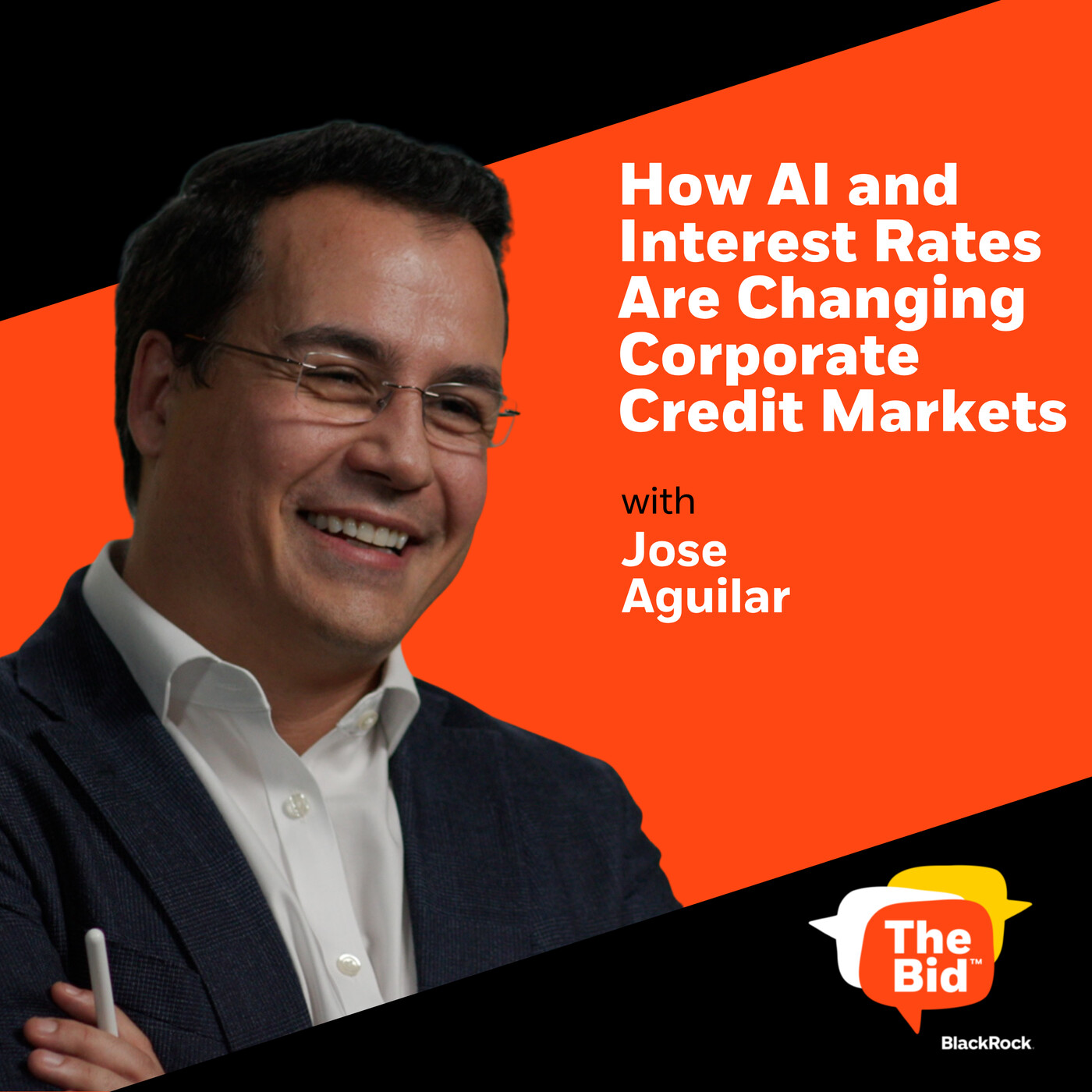
How AI-driven capex and higher interest rates are reshaping corporate credit risk, especially for companies with heavy leverage and software business models vulnerable to disruption.
Jose Aguilar, BlackRock head of European credit; Tony Kim, head of global technology team within BlackRock Fundamental Equities (quoted from a Silicon Valley technology tour); Jean Bavon (quoted).
AI infrastructure buildout (data centers, chips, power) increases competition for capital, raising borrowing costs even for non-AI firms. Credit investors underwrite “bear cases,” focusing on whether companies can pay coupons and principal, not just bond yields. AI’s impact is uneven: mission-critical, data-rich software may gain, while smaller, less defensible software acquired during low-rate, high-multiple periods faces refinancing and revenue risks.
“SaaSpocalypse” concerns; hypothetical refinancing at higher rates; smaller/private software acquired with high leverage; potential need to renegotiate amendments if rates stay high.
0:04Oscar Pulido: Artificial intelligence has been one of the biggest investment stories of the past several years. And behind the billions of dollars being invested are companies making decisions about how to finance their businesses. Some are borrowing to expand, while others are figuring out whether their existing businesses can survive the disruption that AI might bring. So what happens when the same technology, creating enormous opportunities for some companies, begins to threaten others? And how can investors understand which businesses might be able to repay their debts and which could find themselves in trouble?
0:38Oscar Pulido: Welcome to The Bit, where we break down what's happening in the markets and explore the forces changing the economy and finance. I'm Oscar Pulido. Today, we're looking at the corporate credit markets, where companies borrow money and investors lend it to them. and we're going to explore how artificial intelligence, higher interest rates, and changing business models are creating new questions about risk. We'll hear from Jose Aguilar, BlackRock's head of European credit, along with insights from some of our conversations throughout the year. To understand why the AI story isn't just about identifying the next big winner, it's also about recognizing which businesses could be left behind.
1:23Oscar Pulido: To understand why this matters for credit markets, we first need to look at the extraordinary amount of money being invested in AI. When we think about artificial intelligence, we might picture a chatbot answering questions or software helping us work more efficiently. But making that technology possible requires something much more physical. Enormous data centers, advanced semiconductors, electricity, and the infrastructure to connect it all.
1:56Oscar Pulido: When I joined Tony Kim, head of the global technology team within BlackRock Fundamental Equities, on his annual technology tour in Silicon Valley, he described just how different that infrastructure is becoming. We need to build an entirely new internet. The internet pre-AI was built on a very basic foundation of chips, very little power, small data centers, CPUs, a little bit of memory. Today's data centers and tomorrow's data centers are an order of magnitude more compute, order of magnitude more energy, order of magnitude bigger. That build-out is creating opportunities across the economy. But it also raises an important question.
2:45Oscar Pulido: Where does the money to finance all this investment come from?
2:53Oscar Pulido: Some of the world's largest technology companies can fund significant portions of their spending from the cash their businesses generate. Others may need to borrow money. And as the demand for capital grows, the cost of borrowing becomes an increasingly important part of the story. Alex Brazier, BlackRock's global head of investment and portfolio solutions, explained how the scale of AI investment could affect borrowing costs across the broader economy. So$7 trillion over five years of CapEx to build the infrastructure. That is creating intense competition for capital.
3:35And so every borrower, governments, companies, all having to pay more for their slice of the available pool of capital.
3:44Oscar Pulido: So even companies that have little direct involvement in AI could find themselves paying more to borrow money. And that brings us to corporate credit, where understanding a company's ability to manage its debt becomes particularly important. Let's talk about corporate credit. At its simplest, when a company issues a bond, it's borrowing money from investors. In exchange, the company typically agrees to make regular interest payments and repay the amount borrowed when the bond matures. For investors, corporate bonds can provide a source of income. For companies, they're a way to raise money, to invest, expand their operations, or refinance existing debt.
4:31Oscar Pulido: But there's a fundamental difference between lending money to a company and buying its stock. As a shareholder, you're hoping the value of the business will grow over time. As a bondholder, you're primarily concerned with whether the company can meet its obligations and repay what it owes. And that means understanding not just how a company is performing today, but what could go wrong in the future.
4:59Oscar Pulido: I recently sat down with Jose Aguilar, BlackRock's head of European credit, to discuss how investors assess those risks. That's why it's important to have a process, to have a team, to have access to information and to the companies to really understand that risk and underwrite the actual bear case scenario. What we try to do is always think about what can go wrong in credit and think the real risk that that company have in terms of paying us that coupon and that principal at the end of the period. In other words, it's not enough to look at the interest rate a company is offering investors. You also need to understand the business behind that bond.
5:46Oscar Pulido: Consider two hypothetical companies that borrowed money a few years ago when interest rates were close to zero.
5:57Oscar Pulido: One has a strong balance sheet, reliable revenues, and relatively little debt. The other has borrowed heavily and depends on continued growth to meet its financial obligations. Now imagine both companies need to refinance their borrowing at today's higher interest rates. For the first company, the additional cost might be manageable. But for the second, those higher interest payments could put significant pressure on its finances. And that's important. Because a company doesn't necessarily have to be losing money or operating in a declining industry to encounter financial difficulties. Sometimes the problem is simply that the debt it took on has become too expensive.
6:42Oscar Pulido: Jose explained that this was something credit markets had already experienced following the sharp rise in interest rates in 2022. It wasn't a problem with the best model of the company. It wasn't a problem with the sector. It was a problem with the capital structure. And in most of those situations, sponsors or equity holders contributed to adding a little bit of equity, and bondholders or loanholders agreed to extend the maturities. What Jose is describing is a situation where lenders and business owners work together to give a company more time to repay its debts, sometimes with shareholders contributing additional money.
7:27Oscar Pulido: The distinction is important. A company can have a viable business, but still face financial pressure because of the way it has financed itself. And while some businesses have been able to manage those pressures, others could find themselves facing difficult decisions if interest rates remain elevated. We have gone through that already. Clearly, some of those amendments and some of those capital structures, we're still hoping for a lower interest rate environment. So if we see a higher or consistently higher level of interest rates, we may see some of those will have to go back to the negotiation table.
8:07Oscar Pulido: But higher borrowing costs are only part of the equation. Because the other question investors have to consider is whether the business itself will continue to generate enough money to repay its debts. And that's where artificial intelligence introduces an entirely different kind of risk. We've spent a lot of time on the bid discussing the potential benefits of artificial intelligence, how it could improve productivity, accelerate scientific discoveries, and create entirely new businesses. But technological innovation doesn't benefit every company equally. Think about the Internet. It created enormous opportunities for businesses that could adapt.
8:50Oscar Pulido: But it also disrupted established industries and companies whose products and services became less valuable. AI could create a similar divide. And one of the industries where investors have already been asking difficult questions is software.
9:08Oscar Pulido: During our technology tour, Tony Kim explained that while AI has created enormous demand for the infrastructure needed to build and run these systems, It's also raised questions about the future of existing software businesses. At the top layer, the third main category, there's a few areas here. But that is really what I would call the applications and services. And when you look at that layer, there's more questions being asked. You've seen the SaaSpocalypse concerns around all these various service industries also being disrupted. That's been a difficult area of the stack in the last three years.
9:45In fact, when you look at these three layers, there has been trillions of dollars of value that have shifted from the top layer down to the model and the compute layer.
9:59Oscar Pulido: That concern comes down to a fairly straightforward question. If AI can perform tasks that previously required specialized software, what happens to the companies selling that software?
10:15Oscar Pulido: Of course, not every software business faces the same risk. Some provide services that are deeply embedded in their customers' operations. They may have access to proprietary data, longstanding relationships, and products that would be difficult or expensive to replace. Others may offer more specialized services that could become easier to replicate using AI. And that difference matters enormously when you're deciding whether to lend money to a business. Jose told me that credit investors are already distinguishing between these different types of companies. Six months later or eight months later, what we are seeing is that the market, again, has done the work, has understand how that risk plays out.
10:56And it's starting to differentiate those large software companies that have some real advantage in terms of being mission critical, in terms of having a very large set of clients and distributions, in terms of having access or proprietary data that is very hard to move to a different platform.
11:17Oscar Pulido: That's an important distinction. For an established software company with millions of customers and services that businesses depend on every day, AI might actually create opportunities to improve its products and become more efficient. But a smaller company offering a more easily replaceable service could face a very different future. And this is where the conversation about AI becomes particularly relevant to corporate credit. Because the risk isn't simply that a company's stock price might fall, is that its underlying business could become less valuable, its future revenues could weaken, and its ability to repay debt could come under pressure.
11:54Oscar Pulido: That becomes especially concerning when a company has borrowed heavily. Jose highlighted how some smaller software businesses were acquired when interest rates were much lower and valuations were considerably higher. The main risk that we're seeing, and that's part of our job here in credit markets, is to look more at the smaller players, small software companies. A lot of them own privately, right? Not listed. And a lot of them were acquired at a period where interest rates were very low, but also leveraged very highly because the multiples of those businesses traded very highly as well. Let's unpack why that's important.
12:36Oscar Pulido: Imagine a software company that was purchased a few years ago for a high valuation. The buyer financed part of that acquisition by borrowing money, expecting the company's revenues and value to continue growing. But now AI is changing the competitive landscape. Perhaps customers are finding alternative products. Perhaps the company's growth expectations are weakening. And perhaps investors no longer believe the business is worth what it was when the debt was first taken on. The company still owes that money, but if its value has fallen, borrowing again to repay its existing lenders could become much harder.
13:11Oscar Pulido: And that combination of a changing business model and significant debt could create real problems. Here's how Jose described the challenge. That's where we are seeing a bit more pressure. These companies have less mission critical. They tend to be more regional or more sector specific. And they are a bit less defensible. Now, that doesn't mean we're facing a widespread wave of defaults across the software industry. Jose was careful to distinguish the more vulnerable parts of the market from the broader universe of companies borrowing money. But it does demonstrate why investors need to look beyond the headline story of AI-driven growth.
13:50Oscar Pulido: The same technology that could make one business more profitable might weaken another. And for a heavily indebted company, that disruption could have serious consequences. It's also a reminder that credit risk isn't static. A company that looked like a reliable borrower five years ago might face very different challenges today.
14:14Oscar Pulido: Even if it hasn't fundamentally changed the way it operates. Sometimes it's the world around the company that's changing.
14:25Oscar Pulido: So what should investors take away from all of this? First, the extraordinary amount of money being invested in AI is creating opportunities across the economy. But that investment is also increasing demand for capital and physical resources, with potentially important consequences for interest rates and borrowing costs. Second, the impact of AI won't be evenly distributed. Some companies could become more productive and competitive. others may find that their existing products and services are becoming less valuable. And third, those differences matter when it comes to corporate debt. When investors buy a company's bonds, they're not simply making a judgment about whether an industry will grow.
15:11Oscar Pulido: They're also assessing whether that particular business can generate enough money to meet its financial obligations. And as the economy changes, understanding those differences could become increasingly important. Earlier this year, Jean Bavon made a point that I think captures the uncertainty surrounding this transition particularly well. I think the disruption and the disruptee, like the losers, will become clear before we get clarity on the winners. In other words, we might recognize which businesses are being disrupted before we know which companies will ultimately emerge as the biggest beneficiaries of AI.
15:49Oscar Pulido: And for credit investors, identifying those potential vulnerabilities is a particularly important part of the job. Because while stock investors may look for companies with the greatest potential to grow, bond investors also need to understand what could prevent a company from paying back its debt. That brings us back to the question we started with. Two companies might offer investors similar income on their bonds, but that doesn't mean they're equally likely to repay what they owe. Understanding their financial strength, their borrowing costs, and how their businesses might be affected by AI could help explain why the risks are different.
16:26Oscar Pulido: And in an economy undergoing significant technological change, those differences may become increasingly important. For much of the past few years, the AI investment story has been dominated by the race to develop new technology and build the infrastructures to support it. But as AI moves deeper into the economy, the story is becoming more complicated. It's no longer just about which companies are investing the most or which technologies might transform our lives. It's also about which businesses can adapt, which might struggle, and how those changes affect their ability to borrow and repay money.
17:07Oscar Pulido: And that is why corporate credit deserves a place in the conversation. because sometimes the most important investment risks aren't the ones making the headlines. They're the ones developing beneath the surface as companies navigate changing technologies, higher borrowing costs, and an increasingly uncertain future.
17:31Oscar Pulido: Thanks to Jose Aguilar, Jean Bovan, and Tony Kim for sharing their insights. And if you'd like to explore more of the AI investment story, you can find links to our earlier conversations in the show notes. Thanks for listening to this episode of The Bid. If you've enjoyed this conversation, check out my discussion with Jeff Rosenberg titled AI and Bond Markets, How AI is Reshaping Fixed Income Investing. The link is in the show notes and don't forget to subscribe to The Bid wherever you get your podcasts. This content is for informational purposes only and is not an offer or a solicitation. Reliance upon information in this material is at the sole discretion of the listener.
18:07Reference to the names of each company mentioned is merely for explaining the investment strategy and should not be construed as investment advice or recommendation. The views expressed by third-party speakers are their own and do not necessarily reflect the views or positions of BlackRock, nor should they be interpreted as an endorsement by BlackRock. In the UK and non-European economic area countries, this is authorised and regulated by the Financial Conduct Authority. In the European economic area, this is authorised and regulated by the Netherlands Authority for the Financial Markets. For full disclosures, visit blackrock.com forward slash corporate forward slash compliance forward slash bid dash disclosures.
18:39them.
Corporate credit markets are facing new questions as artificial intelligence reshapes the economy and companies navigate higher borrowing costs. Billions of dollars are being invested in AI infrastructure, from data centers and semiconductors to energy and computing power. But while this investment creates opportunities for some businesses, AI disruption could threaten others, raising important questions about their ability to repay debt.
In this episode of The Bid, host Oscar Pulido explores how AI investing, interest rates and changing business models are affecting corporate bonds and credit risk. Featuring insights from José Aguilar, BlackRock's Head of European Credit, alongside Tony Kim, Head of the Global Technology Team within BlackRock Fundamental Equities, Alex Brazier, BlackRock's Global Head of Investment and Portfolio Solutions, and Jean Boivin, the episode examines why understanding the financial strength of individual companies matters in an evolving market.
The episode also explores how AI disruption is creating differences within the software industry. Established companies with mission-critical services, proprietary data and strong customer relationships may be better positioned to adapt, while smaller, highly leveraged businesses could face greater challenges. For corporate bond investors, understanding those differences means looking beyond headline yields to assess how resilient a company's revenues, business model and balance sheet may be.
Key moments in this episode:
0:00 Introduction
01:24 The AI Infrastructure Boom
02:38 Competition for Capital
04:01 Corporate Credit Basics
05:47 Refinancing in Higher Rates
06:42 Capital Structure Stress
08:08 AI Disruption Hits Software
09:59 Winners and Losers in SaaS
11:54 Leveraged Small Software
14:26 Key Takeaways for Investors
15:25 Spotting Losers Before Winners
16:27 Why Credit Belongs in AI
17:32 Wrap Up and Disclosures
Related episodes mentioned in this episode:
🎧 AI's Latest Frontiers ft. Tony Kim: https://open.spotify.com/episode/7IhSnj8Q4YJ4Tz3AWmss8H?si=c43645af10ce474b
🎧 2026 Midyear Outlook: https://open.spotify.com/episode/10uV0fHA20TJ5WdXIfgcNP?si=e65e2112606a431c
🎧 Global Equity Markets: Can The Stock Market Rally Beyond AI?: https://open.spotify.com/episode/0hiYU6IUgONCnhWIMcQ7ag?si=bfc3e3ccfb74461b
🎧 AI & Bond Markets: How Artificial Intelligence Is Reshaping Fixed Income Investing: https://open.spotify.com/episode/3qrd92Wk0WmlCGFCn4erPY?si=fe082e3401684de9
🔗 Watch and Subscribe to The Bid on YouTube: https://1blk.co/48iHOs4
🔗 Follow Us on LinkedIn: https://1blk.co/3v09q6Q
🔗 Follow Us on Twitter (or X): https://1blk.co/3NuiIOW
corporate credit markets, AI investing, corporate bonds, interest rates, credit risk, AI infrastructure, corporate debt, software industry
This content is for informational purposes only and is not an offer or a solicitation. Reliance upon information in this material is at the sole discretion of the listener. Reference to any company or investment strategy mentioned is for illustrative purposes only and not investment advice. In the UK and non-European Economic Area countries, this is authorized and regulated by the Financial Conduct Authority. In the European Economic Area, this is authorized and regulated by the Netherlands Authority for the Financial Markets. For full disclosures, visit blackrock.com/corporate/compliance/bid-disclosures.
See Privacy Policy at https://art19.com/privacy and California Privacy Notice at https://art19.com/privacy#do-not-sell-my-info.
Scan the code with your iPhone camera
Listen in the app.