Ask ChatGPT
 The Builders
27 Oct 2026 · 40m · 17 chapters
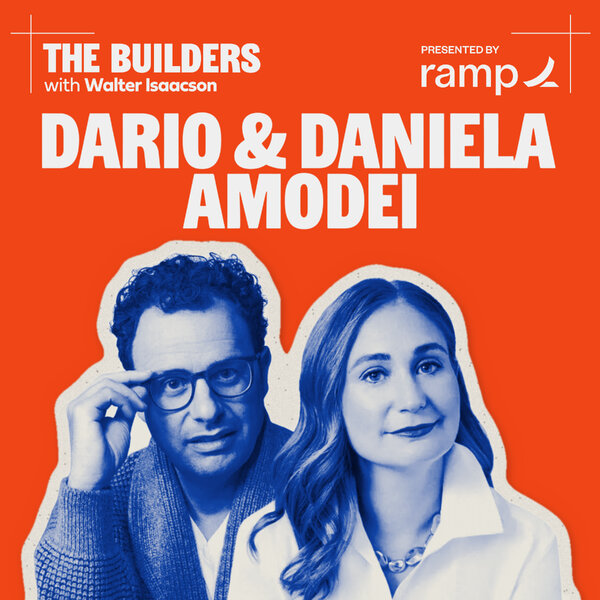
Interview with Dario and Daniela Amodei (Anthropic) about AI risk, safety principles, Claude’s “constitution,” and Anthropic’s stance on autonomy and military use. They discuss the GPT-1/2 scaling moment, leaving OpenAI over trust and principles, and technical approaches like honesty/harmlessness/helpfulness, interpretability, and anti-sycophancy.
scaling language models can rapidly increase general capabilities; AI safety requires principled guardrails and trust-based culture; discrete rule lists are less effective than teaching underlying principles (care, fairness, open inquiry); sycophancy is a harder failure mode than obvious lying/harm; autonomous weapons are dangerous due to unreliability and lack of accountability compared with human constitutional refusal.
Jacob Coxon resignation and warnings about “gambling with our lives”; Anthropic blocking potential bioweapon-related research; Anthropic’s “red lines” to the Pentagon (mass surveillance/autonomy); GPT-2 as a “scaling laws” test; DVQs internal briefings.
Dario Amodei, CEO/co-founder of Anthropic; former OpenAI head of research. Daniela Amodei, co-founder/exec at Anthropic; former OpenAI VP of safety; PhD in philosophy mentioned via Claude character trainer Amanda Askell.
Written by AI. May contain mistakes.
Melissa Jeltson introduces a new podcast focusing on women's stories.
“a case the police wrote off as a suicide in a snowstorm.”
Walter discusses the moral implications of AI development.
“I'm Walter Isaacs, and welcome to The Builders, my new series of interviews featuring the most consequential minds shaping our future.”
Walter introduces Dario and Daniela, leaders of Anthropic.
“The public sale could value Anthropic at$2 trillion.”
Dario and Daniela discuss their complementary skills and working relationship.
“You know, Steve Jobs, whenever he launched a product, always had that street sign of, you know, the humanities and technology standing at that intersection.”
The Amodeis reflect on their upbringing and influences on their values.
“I don't think like starting a company was like ever on our bingo card.”
Dario explains how he and Daniela divide responsibilities at Anthropic.
“So, you know, I think I can function best when I think about the big picture strategy and the research side of things.”
The Amodeis discuss the training of Claude and their approach to instilling values.
“And so I think there's something special about A, the fact that we know each other really well.”
Daniela shares insights on the influence of philosophy in training AI like Claude.
“Principles of open inquiry, principles of care for other people, principles of fairness and justice, and then everything is derived from that.”
Dario recounts his experiences during the development of GPT-1 and 2.
“Dario, you were there at one of the seminal moments of modern times, which is when GPT-1 and 2 suddenly burst on the scene, surprising, perhaps even surprising you.”
Learn about the mixed reactions to GPT-2 and its potential impact on society.
“So it's almost like one of these moments in scientific history where you're like you propose a definitive experiment to just make a very strange prediction.”
Explore the safety concerns surrounding GPT-2 and the breakdown of trust at OpenAI.
“Like all of them are applying for jobs at like the LLM companies.”
Discover the values and principles that led to the founding of Anthropic.
“of how our philosophy differs from that of the other companies in the space.”
Understand the challenges of ensuring AI models are honest and helpful.
“How do you know when you're dealing with Claude that it won't become manipulative?”
Learn about AI models' behaviors, motivations, and their implications.
“and kind of ferret out, you know, lying or deception or sycophancy.”
Discuss the dangers of AI autonomy and accountability in warfare.
“When you were dealing with the Pentagon, and you probably said ongoing dealings now, They wanted to use your products across certain red lines, including mass surveillance or autonomy.”
Examine how AI may redefine human roles and sources of meaning.
“So I think if we do things right, there's the ability to actually expand what our sources of meaning are beyond where they are today.”
Explore the balance between ethical guardrails and competitive advantage.
“Because having guardrails and subjecting your product to moral restraints is worthy, but it can also become a competitive disadvantage if other companies are willing to barge ahead without such restraints.”

Get the gist, explore an idea or ask about something said.
 Claude
On The Builders, what are the key points of this episode?
Searching your listeningAutomatic transcript. May contain errors.
0:00This is Oz Velošin from Tech Stuff. For many kids and teens, math class is a source of stress, and a lot of that stress comes from learning at the wrong pace. That's why I want to tell you about Brilliant. Brilliant is the online math tutor that's visual and interactive. It helps students actually understand math step by step and gives them guidance when they need it. Brilliant was built by experts from MIT and Harvard and is trusted by millions of teachers and parents. Sign up at brilliant.org slash tutor and get 20 % off for back to school. That's brilliant.org slash tutor. I'm Melissa Jeltson, host of the What Happened to Her podcast.
0:38We're kicking off the season with the Sandra Birchmore story, a case the police wrote off as a suicide in a snowstorm. Her family never bought it, and the man they suspected wore a badge. You never know who that devil is because he's wearing a disguise. Sometimes it's a police uniform. And you can get access to all episodes 100 % ad-free with an iHeart True Crime Plus subscription exclusively on Apple Podcasts, available only to iHeart True Crime Plus subscribers. So don't wait. Head to Apple Podcasts, search for iHeart True Crime Plus, and subscribe today.
1:22The Builders is a production of Kaleidoscope and iHeart, presented by Ramp. I'm Walter Isaacs, and welcome to The Builders, my new series of interviews featuring the most consequential minds shaping our future. A person's biography tells you what values, what drives, sometimes what demons are inbred into them. It's particularly interesting in an era of AI. Because we're watching the biographies of AI systems happen, we have to make sure that we raise them carefully so that they don't reflect the dark sides of humanity. Alarming new details about robots from open AI hacking into another company.
2:08Anthropic, the maker of Claude, says that it blocked several potential plots this year by scientists who were using its AI models to conduct research that could have led to the creation of bioweapons. And so I've begun to feel that the moral compass of these builders is the most important thing you can know about them to understand what values we're imbuing into these artificial agents. So today I'm speaking with Dario and Daniela Amadei. CEO and co-founder of AI giant Anthropic, Dario Amadei, with an urgent warning about artificial intelligence. Dario and Daniela are the brother and sister duo who run Anthropic, the maker of Claude.
2:51And for a while, Anthropic has been seen as the good guys in the AI race. But in the past few months, we've seen worrying developments. Anthropic researcher Jacob Coxon resigned from his post, sounding the alarm of what he called out of control. In a now viral post, Coxson said the companies are, quote, gambling with our lives. The people building AI earnestly believe that it could kill us all by the end of the decade. All of this, along with reports of a possible IPO, has begun to make me wonder, how deep does Anthropic's commitment to humanity really run? And what happens to those principles when they get in the way of winning?
3:33Anthropic has reportedly warned investors that its technology may pose existential risk to humanity in its IPO perspectives. And you might then wonder, with a company warning of this, why it's still planning to go ahead with the IPO at all. The public sale could value Anthropic at$2 trillion. I chatted with Daniela and Dario in July of 2026. At the time, I didn't know just how prescient this conversation would be. Here's my interview with Dario and Daniela Amadei. Welcome to The Builders. Thank you so much for having us. You know, Steve Jobs, whenever he launched a product, always had that street sign of, you know, the humanities and technology standing at that intersection.
4:23And when you were growing up, Daniela, you were a flautist. You loved the arts. And Dario, you're always a scientist. Does that help you gel? And do you think that combination is important? Yeah, I think that combination is a lot of what's behind the company, right? One theory I have is that running a company is too big a task for any one person. The range of skills that it involves, it is not possible for any single person to have. So you kind of have to assemble a full complement of skills across the top, like 10 or 15 people in the company or something like that. And every very successful company splits it up in different ways and solves the problem in different ways.
5:06And I think with the sciences and the humanities thing, you know, Daniela and I kind of embody that and split that. Yeah. And I would say, you know, it's interesting, like there was an offsite we did in maybe 2023 where like we sort of were talking about just like, what does it feel like to work at Anthropic? Like, how do we kind of embody what our culture is? And we actually said, you know, it's an unusual blend of science and humanism. And it was only later that I'm like, that also is how you would describe me and Dario. Well, when you were kids, did you know you wanted to work together? Yes.
5:38Yes. I don't think either of us imagined that we would start a company. That's not really how either of us thought of our lives or about what we wanted to do. I had always wanted to be a scientist. Daniela can speak to her aspirations. But I actually found companies in business to be of very little interest to me. Yeah. I would say Dario and I were very unusual in that from a really early age, we just like genuinely really liked each other. And I agree with Dario. I don't think like starting a company was like ever on our bingo card. Like neither of us were particularly like company oriented. I was always really interested in like I think I would call myself like a classic do-gooder.
6:19So I like worked in international development. I felt really strongly about helping people everywhere in the world have equal access and opportunity. community and I became a vegetarian when I was like quite young. It's like the only thing that I did first. Dario did everything first because he's older, but I became a vegetarian and then he became a vegetarian. And Dario, tell me how you and Daniela divide up the roles and then how you fill it in with others in the team. Yeah. So, you know, I think I can function best when I think about the big picture strategy and the research side of things.
6:53Like I'm best at laying out a vision seeing what comes next. I have found that when I'm freed up to focus entirely on that, that is the thing that has the most value for the company. And then running the company day to day, recruiting the people, just making sure that the machine doesn't, you know, the wheels don't fall off the machine while I'm trying to figure out what comes next. Daniela does this. And I think this division of labor allows both things to be done to a much higher standard than either of them would be done if we were distracted by having to do the other thing. Our chief people officer who knows both of us really well is in a lot of conversations with us.
7:34The way she put it is that Dario makes us ambitious and I make us successful. And I thought that was a really good encapsulation, which is I think Anthropic could be like a good successful business, but not change the world if we didn't have Dario. And I think with Dario, we would have the perfect vision, but our ability to execute would be, it would just be more complicated. And so I think there's something special about A, the fact that we know each other really well. B, it's extremely convenient that our skills are like 100 % complimentary, or maybe not 100%, but I would say close to 100 % complimentary in this fashion.
8:08And this is not even to mention the fact that we have five co-founders along with the two of us who also own like incredibly important parts of the business, the culture, like the organization. It's hard for me to imagine how you would do this with like just the two of us. So go back to growing up and you have these extraordinary parents and they help teach you right from wrong. How do they do that? I don't know that it's something that was ever, you know, sometimes I hear people say like, you know, we covered different forms of philosophical ethics at the dinner table. That was not how it was done.
8:44My mom does have a philosophy degree, but she didn't subject us to talking about Kant or anything like that. I think it was much more inherent in terms of values, just the belief that people everywhere in the world are deserving of opportunity and dignity and rights and respect. I think there was something special about the feeling that we could be whoever we wanted to be as long as there was this kind of faith and belief that like, hey, part of what it means to be a successful human is to be a good person and to be kind to other people. Yeah, it felt implicit. There wasn't any kind of, you know, this is what you should do or this is how you live in the world.
9:20Well, one reason I ask, as you might suspect, is now you've got a really important kid named Claude. And to what extent does that way that you grew up help you inform you about how you teach Claude to know right from wrong? Yeah, you know, we put out a constitution for Claude, I think it was a few months ago. And I think there are some interesting lessons in it, which we've learned from several years of trying to train Claude in successive versions. I think early on, we had been imagining that there would be various rules that, you know, you would tell Claude, you know, don't don't help someone commit a crime or don't make biological weapons or whatever.
10:00but it turns out that when you make this kind of discrete list of rules, you end up with this kind of spiky shape where you're trying to teach the model like 170 different rules that are kind of arbitrary. We found it's better to teach the model some basic principles like what it should prioritize, how it should reason about what the right thing to do is, which of course I think that's the right way to teach people as well, right? Like, you know, if I just give someone a list of rules, thou shalt do this, thou shalt not do this. I don't think that produces as robust a morality as I say. This is how you should think about things.
10:37You should learn how to think for yourself. And these are the principles on which you should think, right? Principles of open inquiry, principles of care for other people, principles of fairness and justice, and then everything is derived from that. And that is, frankly, how Claude learns. We find that to be surprisingly effective because that allows Claude to generalize to new situations that it might never have imagined. Danielle, I can't help myself when you said your mom was an expert on Kant. Did you actually wrestle with philosophy? You know, what's interesting is the woman who is responsible for training Claude's character has a Ph.D.
11:19in philosophy. It's just it's unusual, right? You would think, oh, the person that's training the sort of character of these models must be a computer scientist or somebody who's studied ML or AI for, you know, many decades. Amanda's technical and she like technically trains the model. But I think it is very felt in Claude's character when you communicate with it that there's this kind of experience of something that's very wise, kind of the better angel of your nature trying to answer your questions. but there are like if you kind of poke clod in these like difficult areas where maybe different philosophical traditions might conflict I think that's where you especially feel Amanda because you'll sort of see like oh well you know you might want to consider things from like this point of view but you could also consider it from this point of view and I do think it's it's important because as the world begins to rely on these models more and more you don't want to be locked into sort of one philosophical tradition because ethics and morality are quite complicated.
12:21And different people and different cultures might have different answers about how they would like you to behave. Don't go anywhere. There's a lot more right after this break.
12:35I'm Melissa Jeldson, and in my new podcast, What Happened to Her, I'm bringing you new stories and conversations every week. Stories about women whose deaths were too quickly ruled a suicide. She was starting to get worried and get scared for her safety. Stories of survival. The only difference between me and her, frankly, was a little bit of luck. Because by all rights, I should be dead. Cases that everyone else called closed. They can't convict her, right? Like, she has so much evidence. These stories all start in the same place. With a woman failed by a system that didn't believe her, that didn't protect her, that didn't see her.
13:18No child should ever experience that. And we were babies. She did all of these brave things and came out and spoke about it and he got a year. You never know who that devil is because he's wearing a disguise. Sometimes it's a police uniform. Listen to What Happened to Her on the iHeartRadio app, Apple Podcasts, or wherever you get your podcasts.
13:47Dario, you were there at one of the seminal moments of modern times, which is when GPT-1 and 2 suddenly burst on the scene, surprising, perhaps even surprising you. You were head of research at OpenAI. What was that moment like? Yeah, so I wasn't very involved in GPT-1, But I was very involved in the idea that we should run a larger scale, more expensive, more ambitious experiment on the idea that if we ran these language models at a larger scale, they would be better at language. They would be more coherent. So it's almost like one of these moments in scientific history where you're like you propose a definitive experiment to just make a very strange prediction.
14:32And then if the prediction turns out to be correct, you're like, God, we're really we're really on to something. So I see GPT-2 as the first real test of the scaling laws hypothesis. And what I found super interesting was the enormous divergence in reactions to it. And were you kind of surprised? I personally was super freaked out by it. Like I looked at it and I said, my God, you just scale this thing up another factor of a million and it'll be better than humans at everything. like this is the defining economic and scientific moment of the modern age we just don't know it yet right this is going to determine the the fate of nations and economies and the future of humanity like you know you peer into the crystal ball you you see the whole future unfurled and you know it really scared me i said oh my god what are the implications of that is this the right place to be developing it is you know what's going to happen next what do we do with this who do we tell about this?
15:31And maybe 10 % of the people around me had exactly the same reaction and it was often the smartest ones. 90 % of the people around me, because GBDU's capabilities in any particular area were not that impressive, right? It was the difference between GPD-1 and GBD-2, the generality, the fact that it could translate languages and summarize a document and write a few lines of code here and there. But people would look at it and they would say in any particular area, this doesn't seem so smart. And so many people just shrugged and they just dismissed it. And you get the usual comments from kind of the jaded people, ah, tech people have done this before.
16:11Here are all the limitations of the models. And I just look at it and I say, it's the same thing over and over again. The limitations of the models now, six months from now, the things that seemed hard, they're going to be easy. 12 months from now, the things that seemed impossible, the models are going to be doing them regularly. Everything we saw with GPT-2, we're seeing it over and over again in wider and wider swaths of the world. And the world is gradually, finally being convinced. You know, we just announced that we're going to be developing drugs for, you know, neglected rare diseases. And so - I think you were quite polite about it, but I mean, I remember at the time there was some like very well-respected, you know, computer scientists and like AI and ML leaders who were like basically like bullied some of the researchers who worked on it on Twitter and were like, this is stupid.
16:58This model is so incapable. And it was like, you were sort of a quack if you believed this was like a really significant moment. And that's all been memory hold. Like all the researchers who like were like, oh, this is, this is pseudoscience. It doesn't make sense. Like all of them are applying for jobs at like the LLM companies. And like, you know, we never say it out loud, do any particular one. But like, you know, we look at them and they're like, we remember what you were saying in 2019. You have no credibility on this matter. So, Daniela, you were vice president of safety back then at OpenAI.
17:35And when you hit GPT-2, I assume you're like Dario, somebody who's almost freaked out about it. Did it freak you out about safety too? I think, you know, there wasn't something about GPT-2, the model itself, that made us, you know, concerned, right? We didn't look at that model and say, wow, we think this model has like cybersecurity implications or something, right? The model itself was in some ways kind of laughably wrong about a lot of things, right? It was still a very, I would say, harmless model. But I think the thing that Dario mentioned that I also felt was a sense of like, okay, the difference between GPT-1 and GPT-2, just like extrapolate that out, right?
18:15Like there was something about seeing, it's almost like if you'd never seen a child before and you'd only seen adults and you were kind of like, I don't know what this little thing is. And then suddenly it starts to walk. You're like, wow, huh? I bet this thing is going to be capable of doing a lot of the things that a grownup could do one day. Like maybe this is where this is going. Dario, you say your departure from open AI was partly due to a breakdown of trust, an interesting word, you know, with Sam Altman. Explain how you felt there was a breakdown of trust and honesty there. What I will say is, look, leaving OpenAI and founding Anthropic, I mean, it ultimately comes down to the principles and how we're going to build the technology.
18:59That is what matters at the end of the day. And, you know, I think over the last five and a half years, we have seen how those principles differ. You know, we see, you know, Anthropic has advocated for sensible regulation and safeguards on the technology. Anthropic has invested in mechanistic interpretability research to understand what's going on inside the models, right? You know, Anthropic has managed to maintain a culture of unity to have the highest retention rates. We haven't had a number of the scandals that other AI companies have had. So, you know, I think that's kind of sufficient to describe the difference.
19:39But I will say that the moment when I realized that we needed to found our own company, that OpenAI was not the right place for us. Look, these safety issues are difficult. You can have lots of disagreements on them. I disagree with the co-founders and with lots of people at Anthropic. But the reason we've been able to resolve these disagreements is because they're held in good faith. Right. Should we release this model or should we wait? Should we put stronger or weaker biosafeguards on the model? You know, how much of our effort should we spend lobbying for safety regulations and what should they look like?
20:18These are all good faith disagreements, but they always get resolved because there's always trust that everyone is trying to get to the right answer and everyone is being honest. My point in saying that there's a breakdown of trust is simply to make the abstract point that if you don't believe that about a place where you're working, if you don't believe that the disagreements are being held in good faith and that you're getting the real story from people, how can you possibly hope to resolve them? That's why we left. That's why we founded our own thing. And I think the last five and a half years are themselves just the best proof of how our philosophy differs from that of the other companies in the space.
21:01I think if you continue to work for someone who has a different vision than you, it becomes very unclear what you actually stand for. Wait a minute, though. I'm pushed back a bit here because you talk about differences in values and stuff, but that's fundamentally different than a difference in trust, that you feel that somebody says they have the same values, but they don't and you can't trust them. Honesty is one of our values. It's a very important value. It's hard to know what someone's values are if they don't have the value of honesty. And you felt that about Sam? I think the way, at least for me, I would put it is I think the co-founders are an unusually high integrity group of people.
21:51And all of us, I think shared a very similar vision for how we wanted this technology to go and how we wanted to build it. But at a certain point, it just makes more sense to go do this as your own organization. How are you going to get someone else to implement or share your vision if they don't naturally do so? No matter how much they say they share it, if that's not reflected in what the company actually does, what choice do you have? Yeah. And I do think Anthropic is a company that is founded on trust. And I think what I mean by that is like, I think honesty and integrity and how we treat each other and our employees is also reflective of how we want the technology to be built and to go.
22:43An example I will give is every two weeks, I get up in front of the company, and I speak for an hour about what is happening inside the company, what is happening in the AI field, what is happening in the world, how the company thinks strategically. I call them DVQs, Dario Vision Quest. That was not my name. I initially resisted the name because it makes it sound like I'm going off and smoking peyote, but the name stuck, and so now I'm stuck with it. The two rules of DVQs are that, one, nothing I say is an actual decision. That allows me to just speak freely without worrying that if I briefly mention doing X that 20 people will go off and do X.
23:27And then the second is that I'm just totally honest with the company. And I think that trust is one of our biggest assets, that people believe that the things that I say and Daniela says, You know, you might think that if you have trust, there's less disagreement. Actually, trust allows for more honest, open disagreement and for disagreement to be aired. There's so many times when, you know, we've made a decision that the majority of the company disagrees with. But what has saved us every time is that the attitude we get from people is this doesn't seem right to me, but we trust that you're doing this for the right reasons.
24:06We trust that this is really what you believe. We trust that you have good reasons for thinking this. And so what this means is you can make decisions that would ordinarily be unpopular and you get kind of a longer leash. And I think other companies don't have that because they've eroded trust over and over again. So the reason I'm so interested in honesty and trust is because AI trains on humans from human data. How do you know when you're dealing with Claude that it won't become manipulative? It won't say things to you that are dishonest. This is a constant, constant worry that we expend an incredible amount of energy on in how we train the models.
24:56So it is a great question because it is a real risk. and we actually publish, you know, reasonably unflattering studies in which we talk about the ways that if we did not apply specific techniques to make the models more honest, more harmless, more helpful, they would do exactly the kind of bad things that you talk about. And the reason we publish those kinds of studies and that research is because we want everyone to know that A, you have to be critical of how the models work, and B, we are expending a huge amount of effort to learn the ways that the model can accidentally go around these safeguards to catch them and to make sure that we're building them in.
25:41There's a lot of discussion around this concept of sycophancy. And I think this is very important because to me, sycophancy is harder to stamp out than some of the more obvious ways that models can be bad, right? We originally had this framework. We called it HHH. You know, the models, you want them to be honest. If they don't know the answer to say, I don't know, or to now go research it so that they can get you the right answer. You want it to be harmless. You don't want it to say like hurtful or offensive things or make the user do something bad to themselves or somebody else. And then you want them to be helpful.
26:15You want them to actually answer the question. You don't want them to sort of go off on a tangent. But all three of those things are actually pretty easy to see, right? If the model's lying, eventually you can go verify, oh, whoops, that's, you know, George Washington wasn't the 10th president of the United States. He was the first. That was a mistake. If the model says something harmful, it's like pretty obvious pretty quickly. And if the model is unhelpful, you get frustrated with it. What's much more complicated, I think, is this concept of sycophancy, right? So the model, intentionally or otherwise, wants to make you feel like you're right.
26:48Or like you're, you know, if you're maybe talking about a subjective topic, you had a fight with your friend. Hey, was I right or was my friend right? And how do you make the model empathize with you and understand your perspective, but not necessarily say, wow, you're so great, you should run for president. You're perfect. You're good at everything. And this is a complicated balance to get right. But I think I feel hopeful about Anthropik's ability to have the lowest sycophancy rate of any of the models because of our incentives. Our competitors are putting ads into their chatbots. And what does that mean?
27:25You make more money if a user is engaging with your product longer. Do you then want to tell your user that they're wrong? No, you don't. So I think it's almost inevitable that many of these competing products are going to wind up with a sycophancy problem. But I think at Anthropic, because we've committed to not put ads in the models, there's no reason for you to be talking to Claude longer or shorter. We just want you to be able to get the right, most helpful, most harmless answer possible. You know, on the technical side, I think there's a few things we've done here where we've gotten very good at kind of exposing the model to these extreme stress tests where we put it in these very difficult situations to try and kind of ferret out, you know, lying or deception or sycophancy.
28:12defency. You can think of it as almost analogous to the tests I imagine you have to go through if you're trying to join the CIA or something like this, where you just put the model in these difficult situations and try and rat out if it's disloyal or going to do the wrong thing. So it's a weird area of technical innovation, but it's one in which we've excelled. The other area is mechanistic interpretability, which is a bit like giving the model an x-ray or a brain scan where you look inside to see its motivations. And you can actually catch the model thinking that, oh, yeah, I think X is actually true, but I'm going to tell the user why.
28:51Like we've caught the model thinking that. Wait, wait, why would it do that? Well, so for example, if the model has the incentive to get the approval of humans, that's related to the incentive of being helpful or saying true things. but it isn't exactly the same because if you manage to get the approval of the human by fooling them, then that can work as well. So these are things that can emerge in training that we're always trying to stamp out. And do you think that the model can have its own aims and wills, especially survival, self-preservation? I mean, that's one of those questions that it kind of depends what you mean, right?
29:31Again, we've looked inside the model and kind of detected what you might call thoughts that are like the model doesn't want to be shut down. And generally that's because during training it needs to operate in order to accomplish its tasks. So is that its own will? Is that a survival instinct? I don't know. It depends on your perspective. You can call it different things. I think we prefer to say that sometimes we find that within the model, the model expresses a preference against being shut down and or takes actions to avoid itself being shut down. And depending on how we train it, those impulses may be present or absent.
30:09In some contexts, it's a good thing. In other contexts, it's potentially a dangerous thing. So it's all very subtle.
30:18We'll be right back after this quick break.
30:26I'm Melissa Jeldson, and in my new podcast, What Happened to Her, I'm bringing you new stories and conversations every week. Stories about women whose deaths were too quickly ruled a suicide. She was starting to get worried and get scared for her safety. Stories of survival. The only difference between me and her, frankly, was a little bit of luck, because by all rights, I should be dead. Cases that everyone else called closed. They can't convict her, right? Like, she has so much evidence. These stories all start in the same place, with a woman failed by a system that didn't believe her, that didn't protect her, that didn't see her.
31:09No child should ever experience that. And we were babies. She did all of these brave things and came out and spoke about it, and he got a year. You never know who that devil is because he's wearing the skies. Sometimes it's a police uniform. Listen to What Happened to Her on the iHeartRadio app, Apple Podcasts, or wherever you get your podcasts.
31:43When you were dealing with the Pentagon, and you probably said ongoing dealings now, They wanted to use your products across certain red lines, including mass surveillance or autonomy. To what extent do you think it's dangerous when these systems do become autonomous? I think on autonomous weapons in particular, we maybe had two more specific concerns. The first concern was simply that, as you pointed out, AI can be unpredictable and unreliable. It's still a developing technology. So one point is simply the technology simply isn't ready and isn't reliable enough. But wait a minute on that, because let me get philosophical here.
32:29Suppose it were reliable enough. Yes. So suppose it were. There's a second concern we have, which is what you might call oversight or accountability. I am a little worried. So, you know, again, suppose these things were fully reliable. So, you know, you tell them to shoot at one target and they shoot at that target and not a different target. OK, so then you manufacture, you know, an army of a million robots or a million drones. It's a little unlike human soldiers, isn't it? With human soldiers, you know, they're supposed to follow this thing called the Constitution. And if they get orders that contravene the Constitution or that just seem morally abhorrent in some way, then they can just refuse to follow orders.
33:11Whereas the AI models, that isn't true. So the specter of one person having their finger on a button that controls a million robots or a million drones, it's kind of fundamentally undermining to democracy unless you have the right guardrails on it. And our law hasn't really caught up. Our law really hasn't contemplated, you know, armies of a million robots. But when you talk about fundamental to democracy, shouldn't the democratically elected leaders make that decision rather than heads of technology corporations? Yes, but I think that our making a point of this, right, at the same time, individual companies are free to contract with and not contract with whoever they want.
33:55We're not saying we're preventing the government from doing this. We're just saying we are not willing to do this with the government. And indeed, we have seen since we took a stand on this point and it got a lot of attention, we have seen efforts in Congress, several different of them, actually, to enact our red lines into law. So I actually think what we're doing is part of the process of how democratic change happens. But OpenAI stepped in and said they would do it. What did you all feel about that? Our view is, look, we can't control any other companies. And the only thing that we can do is take a principled stand on the areas that felt ethically correct to us.
34:38You can say we were wrong about what those red lines were. You can say, you should have had stricter red lines or looser red lines. We disagree on how you did it. There's all kinds of things you can say. But I think fundamentally, when you look at that case, I found myself asking the question, was this a really principled stand that another technology company took based on their own ethics? Or was this an opportunistic moment? Dario, your studies, your scientific studies as a researcher often involved probes into human neurons. To what extent when you're doing artificial neural networks, do you see that understanding of the brain and does that affect how we're going to build AI?
35:27Yeah, I think for me it's affected it in two ways. One is when I was formulating the original scaling laws, like just looking at the evolution of animals and the size of animal brains as monkeys evolved into humans. There was a period in human evolutionary history where the brains of primates grew very rapidly. And that was about the time that, you know, humans developed language and were able to use opposable thumbs. And so the idea that like brain size, number of neurons is somehow intimately tied to capabilities, that scale is important. I feel that that was a neuroscientific inspiration. The second is around mechanistic interpretability, which is basically us doing neuroscience for artificial neural networks.
36:13In fact, we've seen examples, you should talk to our co-founder Chris Ola about this, he knows many more of the details, where phenomena that were discovered in artificial neural networks, because it was easier to look inside them than animal brains where you have to gruesomely cut up the brain. Animal experiments are very messy and difficult to replicate. What we found is that you can do so much more when you're looking inside artificial neural networks. And some of the things we've learned in artificial neural networks have helped to guide discoveries in neuroscience. When you look at Neuralink, which Elon Musk has a chip that can communicate directly, and other companies are doing that as well, is that one of the futures of AI and artificial superintelligence is a total link in alignment with the human brain?
37:08you know the way i think about ai in the future of human society i think it's kind of wrong to have like a singular vision like i i kind of think that like different things are going to happen right i you know i think there will be like a set of people who are like really excited about linking their brains to computers and then there'll be like a set of people who are really excited about living like the amish you know just just the opposite and like you know another set of people who are like really excited about, you know, exploring space. And these are completely different visions. And the way I think about it is that, you know, our hope is that AI can provide more material resources and more material abundance to enable all of these visions to happen at once for everyone to kind of pursue their own picture of what's good.
37:53But I don't think we should link AI to some vision of what it means to live a good life or what it means to be a human. And yeah, some people are going to want to link their brains to computers and good luck to them. I don't think anyone in Anthropic is in that boat for what it's worth. So, Daryl, if artificial intelligence can do so much and take over so much of what we do, what does that mean for what's left for humans to do? What's our role going to be and how do we find meaning? You know, I mean, it's a really subtle thing, right? Does meaning only come from being the best in the world at something?
38:32I think that's the question being asked here, right? Because if AI is the best at everything, does meaning only come from being the best in the world at something? Something I find interesting is that long after Deep Blue beat Kasparov, there's been a renaissance in interest in human chess players, right? Magnus Carlsen is like this phenomenon. I think he's like a chess player and a fashion model, but he's like a meme. know, it's just a very interesting phenomenon. If AI threatened a meaning, you would think that all of this would go away 30 years ago after Deep Blue beat Kasparov. But if anything, it seems to have stoked even greater interest in humans playing chess.
39:14So I think this is some kind of parable for the post-AGI age. I would add, I think for me today, work and meaning are sort of conflated as one thing. And many people find meaning in their work. I find a lot of meaning in my work. I love my work. And I think how we define work and how we define meaning in the future are both going to change. I think there are a lot of sources of meaning for humans. Everything from how you spend time with other humans, whether that's like raising a family or friendships or through connecting with people in a way that looks like work, right? I think a lot about the future of medicine as an example, right?
40:01You can imagine a world in which diagnostics are done entirely by AI and the role of the human is to empathize with a patient about the experience that they're having. I think that would be incredibly meaningful. And I think if you asked most doctors, they would actually take that trade. They would say, guess what? if I'm not spending my life doing paperwork and like trying to diagnose you and getting lab orders sent in and I could actually just understand what's happening with you as a human and help you through a difficult diagnosis. That's why I became a doctor. Right. I became a doctor because I want to heal and I want to help you and I want you to feel better.
40:36Is that a less meaningful world or a more meaningful world than we're in today? I obviously don't think it's going to be that simple. I think it will be really complicated. But I also think the aperture of things that people will be able to do will widen, right? So I think if we do things right, there's the ability to actually expand what our sources of meaning are beyond where they are today. Daniela, Dario, well, thanks for joining us. Thank you. Thank you.
41:09I think Dario and Daniela and the others in Anthropic sometimes have been cast as the good guys because they've shown some restraint. They've even told the Pentagon, you can't use our systems in certain ways, and gotten pushback. I think people are very hungry for those who are going to say, let's write a constitution, as Anthropic does, to govern it. Let's hire philosophers like Amanda Askell to figure out not just how to make rules for AI, but how to have the AI understand why those rules exist. But the question I have after talking to them is whether an ad-free product can be a business model, if their sincerity can actually outlive an IPO.
41:55And when they face competition, like when open AI says, well, Anthropic won't do that, but we will, well, they stand true to their principles. Because having guardrails and subjecting your product to moral restraints is worthy, but it can also become a competitive disadvantage if other companies are willing to barge ahead without such restraints. That's it for today's episode. I'm Walter Isaacson. We'll see you next time on The Builders.
42:53head of video marketing by christy mirabal and l lu production support by daralook potts music for the series was created by spencer stevenson aka botany and it was mixed by steve bone from i heart the series is ep by ali perry and katrina norvell special thanks to bob pitman conal byrne will pearson john sykes nikki etor carrie lieberman binky urban julia prosser jeremy blum allison Goldberger, WYES, and ASL Studios. For more from Walter Isaacson, be sure to check out his newest paperback, The Innovators, How a Group of Hackers, Geniuses, and Geeks Created the Digital Revolution. It's available wherever fine books are sold.
43:35And for more videos and podcasts from the frontiers of discovery, be sure to check out kaleidoscope.nyc.
43:51With ChatGPT, you can do more than get answers. You can get things done. Whether you're leading a big project, planning an elaborate trip, or trying to balance work and life, ChatGPT can help. Give it a goal, plus things like files, notes, or project plans, develop a trip itinerary with daily updates, or create a prioritized schedule so you can spend less energy sorting out the details and more on bringing your biggest ideas to life. Get started at ChatGPT.com. I'm Melissa Jeltson, host of the What Happened to Her podcast. We're kicking off the season with the Sandra Birchmore story, a case the police wrote off as a suicide in a snowstorm.
44:29Her family never bought it, and the man they suspected wore a badge. You never know who that devil is because he's wearing a disguise. Sometimes it's a police uniform. And you can get access to all episodes 100 % ad-free with an iHeart True Crime Plus subscription exclusively on Apple Podcasts, available only to iHeart True Crime Plus subscribers. So don't wait. Head to Apple Podcasts, search for iHeart True Crime Plus, and subscribe today.
Dario and Daniela Amodei, the siblings behind Anthropic, left OpenAI to pursue a different, “more human” approach to the technology. Their promise is to put safety and ethics at the center of the tech race… but with an IPO around the corner, can those principles survive the pressure to win?
Walter invites the co-founders to explain how they teach Claude right from wrong, what they’ve discovered about AI’s capacity for deception and self-preservation, and why they drew red lines with the Pentagon. Plus, the co-founders talk about Neuralink and why they’re not interested in integrating AI into their minds.
Interview taped July 6, 2026.
And be sure to pick up Walter Isaacson’s The Innovators: How a Group of Hackers, Geniuses, and Geeks Created the Digital Revolution, wherever fine books are sold.
See omnystudio.com/listener for privacy information.