
In short
Podcast Notes: The Business Acquisition Podcast with Bruce Whipple
Episode Title
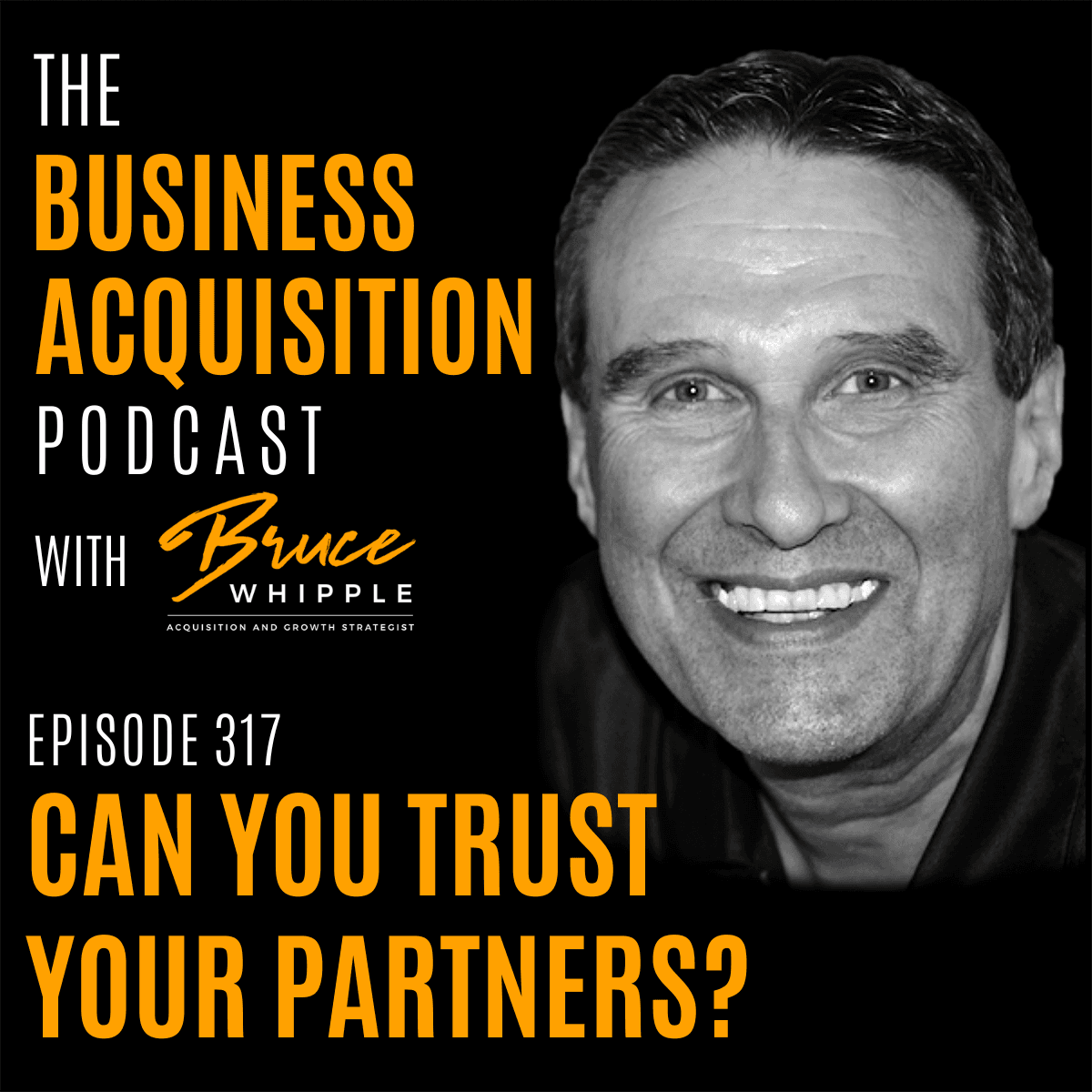
317 - Can You Trust Your Partners?
Episode Overview In this episode, Bruce Whipple discusses the crucial topic of trust in business partnerships, particularly focusing on how to evaluate trust among partners, board members, and acquisition prospects. He emphasizes the importance of trust beyond performance metrics and offers strategies for assessing trustworthiness in potential business relationships.
---
Key Themes
- The Importance of Trust
- Trust is a critical element in business partnerships and is often overlooked in favor of performance metrics.
- Evaluating trust can be challenging since it lacks quantifiable metrics compared to performance.
- Personal Experiences with Trust
- Bruce shares his long-term relationship with his mentor as an example of trust built over 31 years through shared experiences and challenges.
- He highlights that trust develops over time, especially through shared experiences in "battles" or challenging circumstances.
---
Strategies for Evaluating Trust
- Behavioral Interviewing
- Ask Questions About Trust: Inquire how potential partners evaluate trust in relationships, both personal and professional.
- Integrity and Tough Decisions: Request examples of difficult choices where integrity was tested and how they made their decisions.
- Observations of Past Behavior
- Review the potential partner's history, including:
- Instances of past partnerships and their outcomes.
- Personal relationships (e.g., divorce rates) as indicators of trustworthiness.
- Establishing Clear Expectations
- Discuss the importance of clarity in ethical and moral expectations.
- Set the groundwork for what constitutes having each other's back.
---
Case Study
Real-Life Application
- Bruce recounts a situation with a mentee who neglected to ask critical questions about potential risks associated with a new board member, leading to problems down the line.
- He stresses the necessity of asking hard questions upfront to avoid future complications.
---
Additional Insights
- Trust is a two-way street; both parties need to engage in building and maintaining trust.
- Bruce mentions a forthcoming course on seller finance designed to aid in financial decisions during acquisitions, highlighting the importance of financial trust in partnerships.
---
Key Takeaways
- Build Trust Gradually: Trust is built over time through shared experiences and transparency.
- Ask Hard Questions: Proactively seeking answers about integrity and past experiences can help identify trustworthy partners.
- Protect Your Reputation: Emphasize the importance of reputation in business to encourage transparency in discussions.
- Be Prepared for Tough Decisions: Understand that sometimes, trust must be earned and maintained through actions and decisions.
---
Conclusion Building trustworthy partnerships is essential for success in business acquisitions. By evaluating trust through behavioral interviewing, observing past behaviors, and establishing clear expectations, individuals can foster stronger, more reliable partnerships.
Written by AI. May contain mistakes. Listen to the episode to check what was said.
Transcript
Automatic transcript. May contain errors.0:00Can you trust your partners? and by partners I mean board of director, members, your acquisition prospects, you're going to be in business with those people. It's a really important subject and one we don't talk a lot about. We talk about performance metrics, but we don't talk about trust and how you evaluate trust. Last week I did a video which was titled Performance vs. Trust. trust, I'd encourage you to go back and watch that if you haven't watched it already. But today I want to talk about in this podcast how you can evaluate trust, or at least do a better job of attempting to evaluate trust.
0:44It's a tricky one. Performance, yes, you could ask about how many acquisitions and what their history was, that sort of thing. But when it comes to trust, that's a different deal. We don't have a whole lot of metrics for that. We're not going to ask someone how many times did they trust someone and what were the results and how many times were they trusted, unlike performance metrics like how many acquisitions you can do. And a lot of mentees worry about, well, how can I keep my board from cutting off my head? And I commented in the video last week that I've currently, at least to this point, have never had that concern.
1:23And I don't think you need to have that concern. One, if you lead from the front and you're working this hard, they have on your board or your business partners, most of the time, a lot of other things, and why are they going to take what you're doing? Can it happen? Yes. Will it likely happen if you're working this the right ways? Probably not. So let's talk about how you might be able to evaluate trust. My mentor and I have known each other and been in business for 31 years, 32 years this coming February. And if you were to ask him, does he trust Bruce Whipple, I am without a doubt sure that he would say, yes, I do.
2:10And the same is true. If you were to ask me if I trust him, the answer is, yes, I do. So how did that trust come about? It came about over time. It came about being in battles together and seeing that you actually could trust someone. Well, you don't have that luxury of 32 years when you are picking your board or your acquisition partners. So how can you get a better handle on it? And I'm not telling you you can totally evaluate it, but you can get a better handle on it. And you can do some things like behavioral interviewing. One of the things you might think about is that saying to a potential board member or prospect, you know, I think that trust is really important in a relationship, whether that's personal or business.
2:59And so how did you evaluate trust when you were interviewing people? You probably never have been asked that question. What the answer to that would be would be interesting. ask them to give you examples of when they had tough choices to make that involve their integrity or their trust and tell me about one of those and how you made the decision to do what you did. They could certainly come up with that. We do some things when we get married for instance, we say, till death do us part. There's a whole lot of people that don't do till death do us part. So I'm not sure what that one would tell you about.
3:45But those kind of questions, asking them to how they did something, how they were faced with tough decisions, they certainly can help. When I first got a corporate job, the manager I had said to me, the way I'm evaluated is my people. So my job is to make you look successful. That will, in turn, make me look successful. So we both have an interest in doing that. And what he said to me was, if you screw up, I'm going to take the hit the first time. If the same thing happens again, then I'm not going to protect you the second time. You'll have a chance to learn your lesson the first time but not the second.
4:32And I saw that he actually did that. And so what did that do? That gave me some feeling that I could trust him, that he said and did what he said he was going to do, which is somewhat unusual. And so those things I learned about people as I worked with them. You can certainly look at their past, look at the behaviors in their past, look at how many times they've been divorced, how many times they've had breakups with businesses. Those things, while not 100 % will tell you something. But think about trust when you're talking to somebody. There's mentees that say to me, well, I'll ask them if they're going to have my back.
5:13And I always say to that, if you ask me that question, I would say, I have no idea if I'm going to have your back. If what you did was legal, ethical, moral, we both understood it was the right thing to do, yes, I will have your back. If you cheated, did something unethical, illegal, I will absolutely not have your back. So understand those rules up front. But we all have things in our past where we broke our word, we didn't follow up on something. and so you can get an example of those. Maybe you could ask someone, how do you instill trust in your children? How do you have trust with your wife?
5:58Remember, these are tricky questions. One of the things you might want to do is to say that one of the reasons that I ask these questions, and you could do this up front, is it's really important for me to protect the reputation of the people that are in this business. So I do ask some hard questions because those are better asked now than later on to find that out. I recently had a situation with a mentee who was in the middle of a deal and the lawyer for the other side, well, you know, we're concerned because your lawyer had this situation, this situation, this situation. There were three situations.
6:42Now, I asked the mentee, did you ask the question, is there anything in your past that would cause us a problem, whether it's finance or anything else? And the answer was no. But there were three things that at least required an explanation. If not, they were disqualifying. So that's a good example. And I said to her, you have a tough choice to make. you have to decide why he didn't tell you those and what you're going to do as a result of it are you going to keep this guy on your board are you going to let him go i already know what i would do but i don't know what she's going to do so i hope those things help one of the things recently that i've done and i was asked this a lot would i create a course on seller finance because a lot of people are worried about how to get finance and where to get finance.
7:40So I finally said yes to that. I'm in the process of putting that out. It'll be six weeks. It'll start November 12th. I don't know when you're listening to this podcast, but November 12th, 2024. And it'll go for six weeks. It'll be recorded so you can have lifetime access to that. If you want to see what that entails, go over to BruceWhipple.com. look up under the boot camps and courses the seller finance if you want to go there directly just go.brucewhipple.com forward slash seller finance there is an early bird special which is time sensitive so you can save some money if you look at that now and then decide that this is something you want to do but think about trust think about the partners you have ask the hard questions and then make the hard decisions based on this.
8:33But trust is a two-way street, so remember that as well.
From the publisher
How do you avoid getting your "head chopped off" and build a team with people you can trust.
That is what this week's podcast is about.
Here is the link to the seller finance boot camp I mentioned.