
In short
The Business Acquisition Podcast with Bruce Whipple
Episode Title
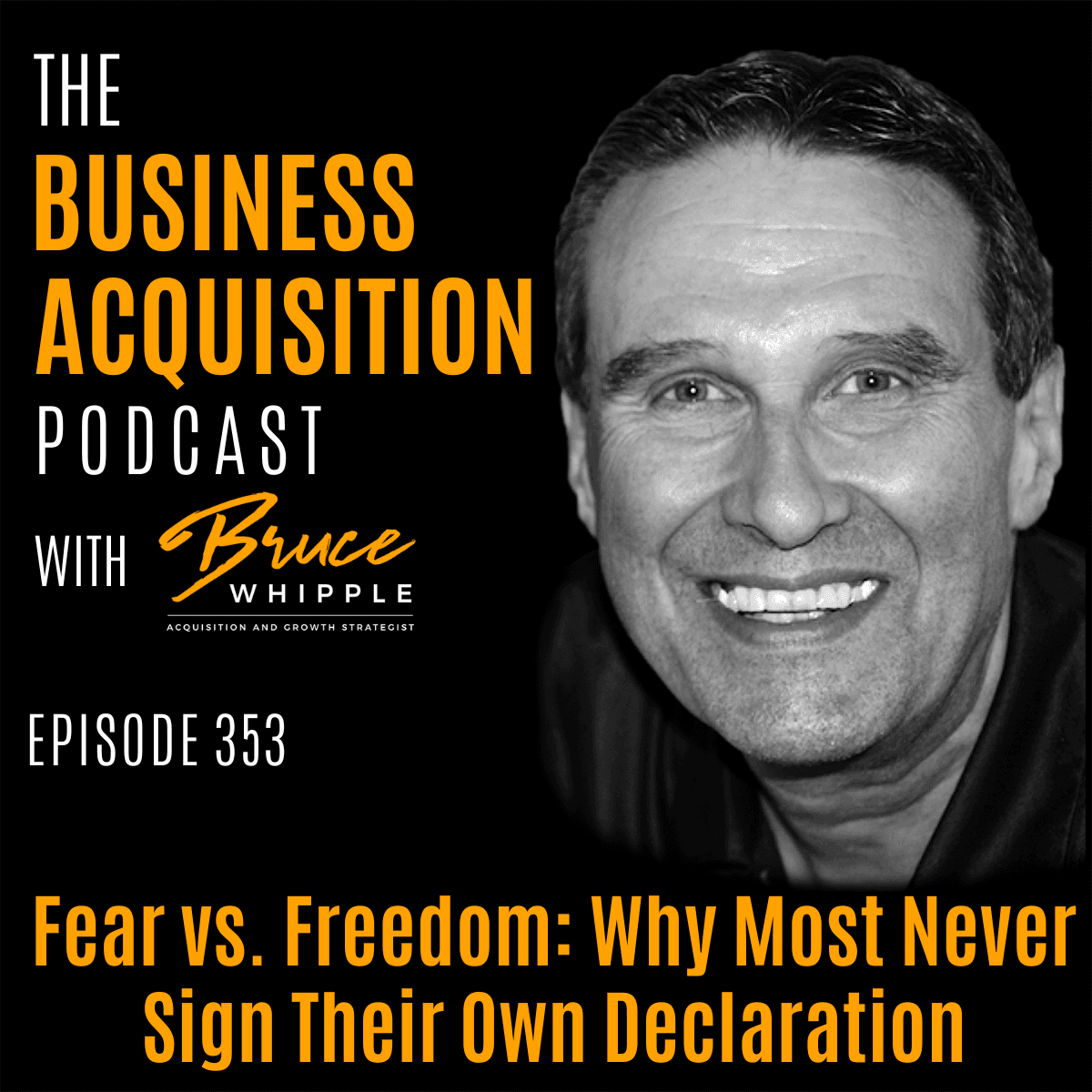
353 - Fear vs. Freedom: Why Most Never Sign Their Own Declaration
Episode Overview In this episode, Bruce Whipple reflects on the significance of Independence Day in the United States, drawing parallels between the courage of the signers of the Declaration of Independence and the fear that often holds people back in their business acquisition journeys. The discussion encompasses themes of freedom, sacrifice, and personal history, urging listeners to contemplate the price of success and the value of liberty.
Key Themes and Concepts
- Independence Day Reflection
- The episode coincides with the July 4th weekend, a time for acknowledging the sacrifices made for freedom.
- Whipple emphasizes the importance of reflecting on historical sacrifices during this celebration.
- Courage vs. Fear
- Whipple identifies fear as the primary barrier preventing individuals from pursuing their business acquisition goals.
- Drawing a comparison to the signers of the Declaration, he highlights how overcoming fear is essential for achieving freedom and success.
- Historical Context of the Declaration of Independence
- Whipple discusses the sacrifices of the 56 signers, who risked their lives, fortunes, and reputations.
- Notable points from the history:
- Many signers lost homes, family members, and faced severe consequences for their actions.
- The signers were educated men of means who understood the risks of treason, yet chose liberty over security.
- Personal Connection to History
- Whipple shares his familial ties to the Declaration through his ancestor, William Whipple, a signer.
- He also recounts his grandparents’ immigration story, emphasizing their renunciation of allegiance to England in pursuit of a better life in America.
- Motivation for Business Acquisition
- The episode serves as a motivational piece, encouraging listeners to recognize the sacrifices that allow them to pursue business ownership in a free society.
- Whipple urges listeners to reflect on the personal cost of their ambitions and to remain committed to their goals.
Key Takeaways
- Fear as a Barrier: Recognizing that fear is a significant obstacle in one's journey and understanding how to overcome it is crucial for success.
- Historical Sacrifice: Reflection on the sacrifices made by historical figures can provide inspiration and context for contemporary struggles.
- Personal Legacy: Understanding one's personal history can enhance motivation and commitment to achieving goals.
- Pursuit of Freedom: The pursuit of business acquisition is framed as a path of freedom that requires courage and sacrifice.
Closing Thoughts Bruce Whipple concludes with a call to embrace the opportunities available in America, reminding listeners that while the journey may involve challenges, the freedoms fought for by previous generations empower individuals to pursue their dreams. The episode reinforces the idea that true freedom is never free and encourages a mindset of courage and commitment in the face of fear.
Additional Resources
- For those interested in learning more about business acquisition, Whipple invites listeners to explore the Acquisition Advantage Boot Camp 2025 edition available at [brucewhipple.com](https://brucewhipple.com).
Final Reflection As listeners celebrate Independence Day and reflect on the sacrifices of those who came before them, Bruce Whipple's message serves as a reminder that the journey toward business success mirrors the courageous acts of those who fought for freedom.
Written by AI. May contain mistakes. Listen to the episode to check what was said.
Transcript
Automatic transcript. May contain errors.0:00As I'm recording this this weekend, it is the July 4th weekend, our Independence Day in the United States. And one of the things that I wanted to think about and pass on to you is just how lucky a lot of us are to have been born or grew up or live in the United States. And towards that end, in doing this mentoring, the number one thing that I see that holds people back is fear. And so it might be helpful to think about how this country was formed in the United States and the cost of that freedom for those that broke off from Britain. And so there's an article that I saw, which was a year or so old now, so the date's off just a tad, but the point is the same.
0:57and it was entitled, What Signatories of the Declaration of Independence Sacrifice? And it reads as follows. The 4th of July will soon be upon us. It actually is past as I read this. Hopefully a time for a sunny day with picnics or barbecues in the backyard or a day at the beach followed by fireworks at night. It's typical in the United States. But it is not just meant to be another day off from work, another day for summary activities and fireworks. It should also be a day of reflection in remembrance of what happened in Philadelphia 247 years ago to make this country free and of the men who swore an oath on that day.
1:40In a time when swearing an oath was considered a morally sacred obligation and what happened to those men. As a point of interest, there was a William Whipple who signed the Declaration of Independence, so I've always been interested in that process. Okay, to continue on. The oath they signed in 1776 was a summing up of their resolve. Those words are the last words of the last sentence of the Declaration of Independence. We mutually pledge to each other our lives, our fortunes, and our sacred honor. These men were lawyers, jurists, merchants, farmers, shop owners, and owners of large plantations.
2:27Men of means, well educated. They signed the declaration knowing full well what they were putting at risk. They were British subjects at the time. They knew that the penalty for treason was death by hanging. They were not wild-eyed rabble-rousers, but mostly soft-spoken men of means and education. They had security, but valued liberty even more. Each one surely had more to lose from the revolution than he had to gain by it. But they stood tall and unwaveringly signed, pledging their lives, fortunes, and sacred honors to each other and everyone else in the colonies back then, and to every American that followed in the 247 years since then.
3:18These were the fates of those signers So what price did they pay? What were they willing to give up for the independence that they wanted in forming the United States? Nine did pay the ultimate price and died from wounds or hardships during the war Five were captured by the British, charged with treason, and were tortured before they died If you want to read something, I'm not going to go through it here but read what the cost of high treason was, that crime, and you're going to be horrified, I think. Twelve signers had their homes ransacked and burned. Two lost their sons serving in the Revolutionary Army.
4:02Another man had two sons captured. Several lost wives, sons, and entire families. One lost his 13 children. All were, at one time or another, the victims of manhunts and driven from their homes. Another, 17, lost everything they ever owned, along with all their money. They were left penniless and impoverished. Yet not one of them defected or went back on his pledged word. Of note is the New Jersey signer, Abraham Clark, the man who had sons serving in the Revolutionary Army, and both had been captured. His sons were sent to an infamous British prison boat known as the Hell Ship, Jersey, sitting in New York Harbor, where 11 ,000 Americans would die.
4:56Clark's sons received extra brutal treatment because of their father's signing of the Declaration. One was thrown into solitary and given no food. With the war almost over and won, no one could have blamed their father, Abraham Clark, if he had accepted the British offer of sparing his son's lives. But they would only do this if Clark would recant his oath and come out in favor of the king and parliament. Certainly with other despair and tormented anguish in his heart and soul, the answer he gave them was no. These 56 men proved by their every deed that they made no idle boast when they composed that magnificent pledge.
5:39They ultimately gave us, you and me, a free and independent United States of America whose liberties should never be taken for granted. Freedom is never free. This is why we have fought to fight for it. We must pay attention to those who we allow to govern us. We must periodically reawaken the purity of those who govern with new fresh blood, fresh ideas, and above all, the best intentions for this country to continue under each person's individual freedoms. This is why we honor these men and all those who stood against tyranny. Why we should proudly fly our flag and always stand during the national anthem in honor, respect, and memory of those 56.
6:24The words of the last sentence of the Declaration of Independence, a document that forever changed this country, has gone on and continues to go on to change the world in which we live. They were bold and courageous. We pledge our lives, our fortunes, and our sacred honors. That was a quote. Happy Fourth, and this was written by Michael Carbone. So that's worth thinking about. think about the process you're going through in acquiring a business and building a business and the sacrifices that you'll make they will not be as serious as being hunted down tortured and hung for treason so i hope that it gives you some courage to think about what you're doing realize the price that you are paying for the success you think you want, and realize that the reason that you're able to do that in the United States of America is because of these 56 men and what they pledged almost 250 years ago.
7:36In addition to William Whipple being a signer of the Declaration of Independence, one of the, I guess, benefits of the home we restored here in Maine, It was a family home back to the 1860s, was we found the documents that came along over time. And one of those was from my mother's parents, my grandparents. And it was when my grandfather and grandmother left England and came to the United States. And I just find this really interesting. So I'm going to read it to you. It's pretty short. I. William Parker. That was his name. I'm age 35, occupation butler. Describes his personal description, et cetera, et cetera.
8:24Talks about where he was born in England. But I immigrated to the United States from Southampton, England, on the vessel Beringerie. My last foreign residence was Epping, England. I am married, and my wife is Annie. She was born in England and now resides at Scotland. It is my bona fide intention to renounce forever all allegiance and fidelity to any foreign prince, potentate, state, or sovereignty, and particularly to George V, King of Great Britain and Ireland, of whom I am now a subject. I arrived at the port of New York in the state of New York on or about the second 1923 day of November. I am not an anarchist.
9:17I am not a polygamist, it's interesting, nor a believer in the practice of polygamy. And it is my intention in good faith to become a citizen of the United States and to permanently reside therein. So help me God. And then he signed it, William Parker. So there's a little bit of history with me, obviously, in the Declaration of Independence. And also, I wouldn't be sitting here doing this podcast if it weren't for my mother's parents who renounced their allegiance to the crown and came to the United States. So think about the sacrifices again that those before us have made to give us the benefits where we live.
9:59Is America perfect? No, but it's a whole lot better than most other places that you could have been born or live in, if that's your case now. So on this date, on this weekend where we celebrate our independence, I think it's important to remember that. And I hope that gives you fuel and motivation to pursue what your dream is with respect to acquiring businesses, owning businesses, and to do that in a place where the laws allow you to do that and be successful if you pay the price to be that. So hope that helps. Hope that's motivational. And for me, it was good to remember just the history before my personal history with that process.
From the publisher
This weekend is the celebration of our Independence Day in America.
It is a perfect time to reflect on the courage of those 56 men who gave us the freedom we enjoy in the Unted States.
As is often said, "Freedom isn't Free," and the same applies to your business acquisition journey and the price you are willing to pay for what you think you want.
This week's podcast explores courage, sacrifice, and shares some personal history.
If you're wondering about the steps in the business acquisition journey, grab the Acquisition Advantage Boot Camp 2025 edition at brucewhipple.com.
To Your Success,
Bruce Whipple
brucewhipple.com